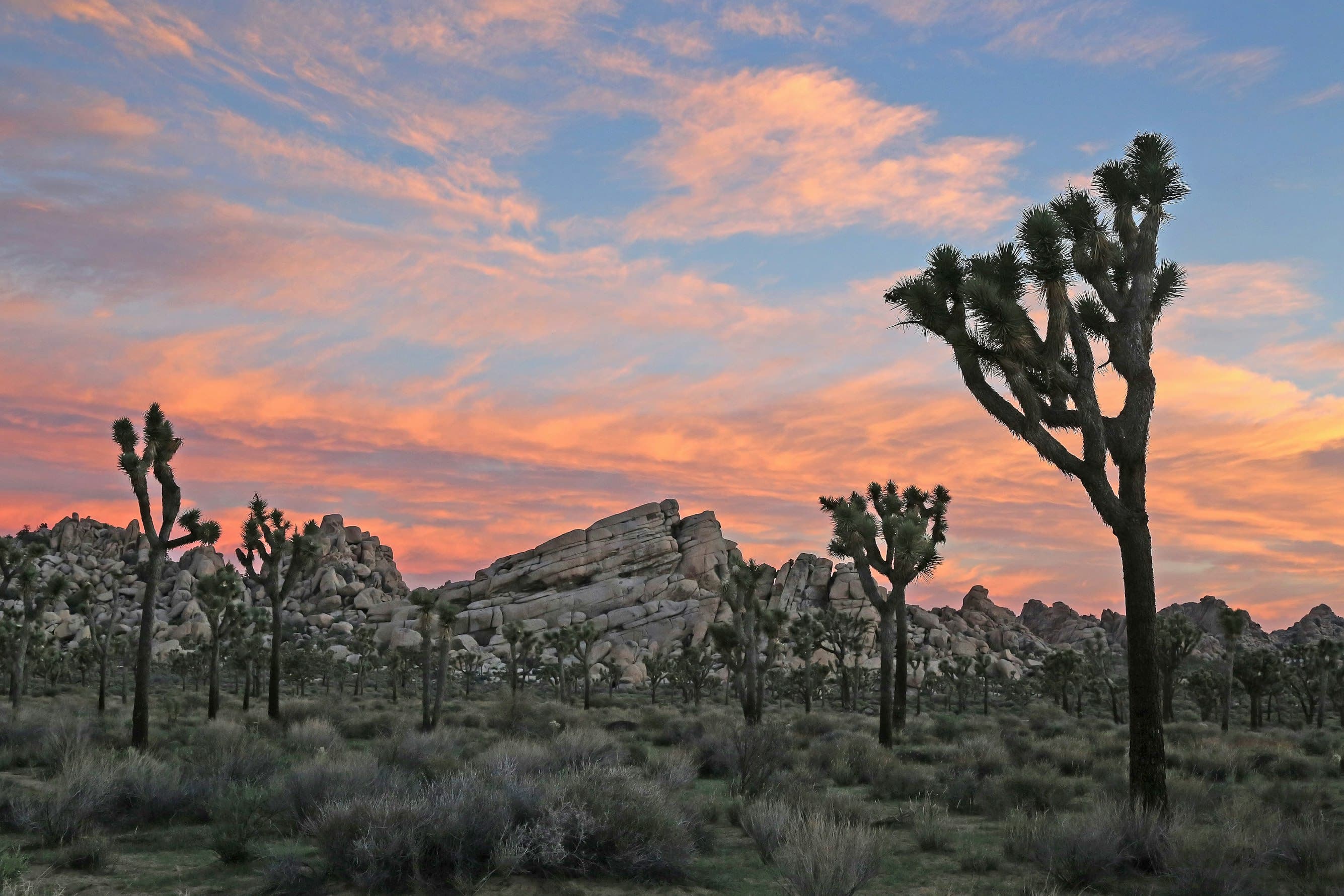
Joshua Tree National Park, California
A surreal desert landscape where ancient rock and twisted trees draw seekers to the edge of the ordinary world
Joshua Tree, California, United States
At A Glance
- Coordinates
- 33.8817, -115.9006
- Suggested Duration
- Day visitors can experience key sites in 4-6 hours. Overnight camping deepens the experience significantly—the night sky and dawn light are essential dimensions often missed by day-trippers. Multi-day retreat (3-7 days) is recommended for those seeking transformative encounter.
- Access
- The park is approximately 2.5 hours east of Los Angeles, 45 minutes north of Palm Springs. Three entrance stations: West (from Joshua Tree town), North (from Twentynine Palms), South (from Interstate 10). Entrance fee required or National Parks Pass accepted. Camping reservations essential during spring and fall; book well in advance.
Pilgrim Tips
- The park is approximately 2.5 hours east of Los Angeles, 45 minutes north of Palm Springs. Three entrance stations: West (from Joshua Tree town), North (from Twentynine Palms), South (from Interstate 10). Entrance fee required or National Parks Pass accepted. Camping reservations essential during spring and fall; book well in advance.
- Practical desert attire: layers for temperature swings, sun protection (hat, sunscreen), sturdy footwear. No special spiritual attire expected or required.
- Photography is encouraged and the landscape rewards it. Be mindful of others seeking solitude. Drone use is prohibited in the national park.
- The desert is a demanding environment. Heat exhaustion and dehydration are serious risks, especially in summer. Carry far more water than you think you need. Tell someone your plans. The emotional and perceptual effects of the landscape can be intense—those processing significant grief or carrying mental health challenges should build in support rather than assuming the desert will heal everything automatically.
Overview
Rising from the meeting place of two deserts, Joshua Tree's otherworldly landscape of giant granite boulders and twisted trees has drawn seekers for millennia. Indigenous peoples recognized this land as sacred—the Oasis of Mara being the Serrano's first home on Earth. Today, the park's surreal beauty and vast silence continue to attract those seeking creative breakthrough, spiritual connection, or simply the perspective that comes from standing amid geological time.
Something strange happens in Joshua Tree. The landscape refuses to behave like ordinary terrain. Granite boulders stack impossibly, their shapes suggesting melted wax or the work of giants. Joshua trees—not trees at all but giant yuccas—twist toward the sky with limbs that seem to gesture rather than grow. Two deserts meet here: the higher Mojave and the lower Colorado, each with its own ecology, combining into something neither possesses alone.
For at least five thousand years, indigenous peoples have recognized this land's power. The Serrano, Cahuilla, Chemehuevi, and Mojave lived in or traveled through these lands, finding sustenance, spiritual connection, and home. According to traditional Serrano songs, the Oasis of Mara is the first place their people lived on Earth—not merely a settlement but an origin point. The Joshua tree itself is sacred in indigenous ceremony, its ability to thrive in harsh conditions a living teaching about endurance.
In the 1940s, the spiritualist Ding Le Mei identified this area as containing nineteen energy vortices, establishing his Institute of Mentalphysics on the land that would become adjacent to the national park. Artists, musicians, and seekers followed—drawn by the landscape's surreal quality and its reported capacity to unlock creative and spiritual experience.
Today, nearly three million visitors enter the park annually. Many come for hiking and rock climbing; many come for photography; many come for the stargazing that the park's dark skies permit. But whether they consciously seek it or not, most encounter something beyond recreation—the vast silence, the geological time made visible in every formation, the sense of standing at the edge of the ordinary world where something older and stranger waits.
Context And Lineage
Joshua Tree's sacred significance draws from at least five thousand years of indigenous presence, the recognition of its power by spiritual practitioners since the 1940s, and its ongoing role as a destination for artists and seekers drawn to its transformative landscape.
The Serrano people tell in their traditional songs that the Oasis of Mara is the first place they lived on Earth. This is not metaphor but cosmology—the land as origin point of existence itself. The Joshua tree appears in indigenous ceremony as a sacred being, its thousand-year lifespan and ability to thrive in harsh conditions teaching perseverance. When the spiritualist Ding Le Mei surveyed this land in the 1940s, he identified nineteen energy vortices where earth energy concentrated, establishing his Institute of Mentalphysics to take advantage of these power points. Whether indigenous and New Age understandings describe the same phenomenon through different vocabulary remains an open question.
The lineage of recognition runs from indigenous peoples who lived with and from this land, through the preservation efforts that created the national park, to the spiritual practitioners who established retreat centers, to the artists and seekers who continue to find inspiration in the surreal landscape. The Twenty-Nine Palms Band of Mission Indians maintains the indigenous connection today, their reservation adjacent to the park, their ceremonies continuing though not open to visitors.
The Serrano, Cahuilla, Chemehuevi, and Mojave peoples
Indigenous inhabitants who recognized the land's sacred character for thousands of years
Ding Le Mei (Edwin Dingle)
Spiritualist who identified the area's energy vortices and founded the Institute of Mentalphysics in the 1940s
Minerva Hoyt
Conservationist whose advocacy led to the 1936 National Monument designation
Gram Parsons
Musician whose legendary connection to Joshua Tree brought the area to countercultural attention
Why This Place Is Sacred
Joshua Tree's thin place quality emerges from the convergence of surreal landscape, indigenous sacred tradition, vast desert silence, and the particular energy that has drawn artists and seekers for over a century.
The desert has always been a place of vision. The Hebrew prophets, the Christian desert fathers, the Zen masters who spoke of 'the sound of one hand clapping'—all recognized that certain landscapes strip away the noise of ordinary existence, leaving space for what lies beneath. Joshua Tree participates in this desert tradition while adding its own distinctive elements.
The landscape itself operates on perception. The granite boulders, formed over 200 million years as underground magma cooled and then was exposed through erosion, take shapes that seem to suggest faces, creatures, impossible architectures. The Joshua trees—which can live a thousand years—twist and gesture like frozen dancers. The eye finds patterns; the mind finds meaning; the boundary between objective seeing and imaginative projection blurs.
Indigenous peoples encountered this landscape without the overlay of national park designation or spiritual tourism. For the Serrano, the land was not metaphorically but literally their origin place. Their traditional songs locate the beginning of their people at the Oasis of Mara. The Joshua tree was not a quirky plant but a sacred being, used in ceremony, honored for its teaching about survival in difficult conditions.
The New Age understanding of Joshua Tree as a vortex site adds another layer. Whether one credits the energy readings or not, the consistency of reported experience—creative breakthrough, spiritual insight, perceptual shift—suggests something operates here that resists purely material explanation. The quartz content of the rocks, the convergence of two desert ecosystems, the vast electromagnetic quiet of land far from urban infrastructure—some combination of factors creates conditions visitors consistently describe as transformative.
What makes Joshua Tree thin is perhaps nothing more or less than its refusal to be ordinary. The landscape is too strange; the silence is too vast; the night sky is too full of stars. The ordinary defenses of consciousness—distraction, interpretation, the constant hum of civilization—fall away, and something else becomes possible.
For indigenous peoples, this was homeland, sacred ground, and origin place. The Oasis of Mara provided water and resources; the surrounding landscape provided hunting, gathering, and ceremonial space. Each tribe had its relationship to specific locations within the territory.
The 1936 designation as National Monument and 1994 elevation to National Park simultaneously preserved the landscape and marked its appropriation from indigenous control. The Institute of Mentalphysics established a retreat center in the 1940s that continues today. The surrounding towns of Joshua Tree and Twentynine Palms have become centers for artists, seekers, and wellness practitioners. The park now receives nearly three million annual visitors while the indigenous connection continues through the Twenty-Nine Palms Band of Mission Indians.
Traditions And Practice
Joshua Tree supports a range of contemplative practices from structured retreat programming at surrounding centers to self-guided meditation in the vast desert silence. The landscape itself becomes the practice for many visitors.
Indigenous peoples practiced ceremonies whose details are not for public disclosure but which recognized the land's sacred character. Traditional harvesting—mesquite beans, deer grass for basketry, palm fronds at the oases—integrated practical and ceremonial relationship to the land. The Joshua tree featured in ceremony as a sacred plant teacher.
Contemporary practices range from structured retreats at centers like the Institute of Mentalphysics (sound baths, breathwork, meditation, yoga) to informal practices in the park itself (silent hiking, rock meditation, stargazing as contemplation). The Integratron in nearby Landers offers sound bath experiences in a unique acoustic environment. Many visitors simply sit with boulders—the massive granite forms offering a kind of containment and presence that supports inner stillness.
Begin with arrival practice: after entering the park, find a quiet pullout and step outside your vehicle. Stand in silence for five minutes, letting the desert soundscape replace whatever you carried from outside. Then choose a trail that matches your physical capacity and walk it slowly, pausing frequently. When you find a boulder that calls to you, sit against it. Let the rock's mass support you. Stay as long as you can. For deeper immersion, camp overnight and wake before dawn—watch the sun rise over the boulder fields as the stars fade. Let the landscape be the practice; no technique is required beyond presence and attention.
Indigenous (Serrano, Cahuilla, Chemehuevi, Mojave)
ActiveThis is sacred homeland, origin place for the Serrano, territory of multiple tribal nations. The Joshua tree is a sacred being. The land's spiritual character was recognized millennia before any other tradition arrived.
Traditional ceremonies (not public), cultural preservation, connection maintained by Twenty-Nine Palms Band of Mission Indians
New Age Spirituality
ActiveThe area is recognized as containing energy vortices since the 1940s. The Institute of Mentalphysics established a retreat center on documented vortex sites. The landscape's surreal quality is understood as evidence of its special energetic status.
Meditation, breathwork, sound baths, yoga retreats, vortex exploration, stargazing as spiritual practice
Experience And Perspectives
Joshua Tree offers experiences ranging from challenging hikes among surreal rock formations to silent contemplation in vast desert space. Many visitors report creative and spiritual breakthrough, enhanced by the landscape's otherworldly quality and the profound silence that surrounds it.
The experience of Joshua Tree varies with intention, but certain elements remain constant: the silence is profound; the landscape is strange; time operates differently in the desert.
Many visitors enter from the west, passing through the town of Joshua Tree before reaching the park entrance. The transition is gradual—suburban development gives way to desert scrub, then to the first Joshua trees, then to the enormous granite boulders that define the park's heart. Hidden Valley, an enclosed space surrounded by rock formations, offers a contained first encounter. The Barker Dam Trail leads to a reservoir built by early ranchers, now a wildlife oasis. Skull Rock presents an unmistakable face—two dark eye sockets gazing from weathered stone.
As visitors venture deeper, the landscape grows more extreme. The Wonderland of Rocks offers miles of boulder scrambling through formations that seem designed by a surrealist imagination. Ryan Mountain provides a strenuous climb to a 360-degree viewpoint—at the summit, nothing intervenes between you and the visible curve of the Earth. The Cholla Cactus Garden, at lower elevation where the Colorado Desert begins, presents a field of teddy-bear cholla that glow golden in late afternoon light.
But perhaps the most essential Joshua Tree experience requires no hiking at all. Find a boulder to sit against. Let the silence settle. Notice how sound behaves differently here—how a bird call carries impossible distances, how your own breathing becomes audible. Watch shadows move across rock faces as the sun traverses the sky. In this stillness, many visitors report that thoughts slow, then quiet, then give way to something else: not exactly emptiness, but spaciousness—the kind of inner landscape that mirrors the outer.
Night transforms the park entirely. Dark sky designation means the Milky Way is visible in its full brilliance. The granite boulders, bone-white in moonlight, take on new shapes. Coyote howls carry across miles. Many who arrive for a day trip find themselves booking overnight camping—the night sky alone seems to demand more time than daylight permits.
Approach Joshua Tree with time. The park rewards slow attention rather than hurried sightseeing. Arrive at dawn or stay until dusk for optimal light and temperature. Bring silence with you—leave devices off, conversation minimal, and allow the desert's quiet to become the dominant presence. If seeking transformative experience, consider overnight camping or multi-day retreat. The depth of encounter correlates with duration of immersion.
Joshua Tree can be understood through indigenous, geological, ecological, and New Age lenses, each illuminating different dimensions of the landscape's power without claiming exhaustive explanation.
Archaeological evidence confirms at least 5,000 years of indigenous presence. The geological history is well-documented: oldest rocks are 1.4-1.7 billion years old; the distinctive granite boulders formed as underground magma that cooled, then was exposed through erosion over 200+ million years. The Joshua tree (Yucca brevifolia) is a monocot, not actually a tree, which can live over 1,000 years. The species is threatened by climate change and may disappear from the park within the century.
For the Serrano, Cahuilla, Chemehuevi, and Mojave peoples, this land was and remains sacred. The Oasis of Mara is the Serrano origin place. The Joshua tree is a sacred being used in ceremony. The national park designation simultaneously preserves and represents appropriation of indigenous land. The Twenty-Nine Palms Band of Mission Indians maintains cultural connection today.
New Age practitioners understand Joshua Tree as containing multiple energy vortices, with the quartz-rich geology amplifying earth energy. The Institute of Mentalphysics identified nineteen vortex sites in the 1940s. Contemporary retreat centers offer programming designed to access this energy through breathwork, sound healing, and meditation. The consistency of reported experiences—creative breakthrough, spiritual insight, perceptual shift—supports claims of special energetic properties.
Why this particular landscape produces such consistent reports of transformative experience remains unexplained. The relationship between the geological quartz content and reported energy phenomena is not scientifically established. The full significance of the area to pre-contact indigenous peoples is not fully recoverable. What makes the Joshua tree sacred beyond its practical uses is known to indigenous practitioners but not generally shared.
Visit Planning
Spring and fall offer ideal visiting conditions. Summer is dangerously hot. The park is roughly 2.5 hours from Los Angeles. Camping reservations are essential during peak seasons. Dark sky conditions make overnight stays particularly valuable.
The park is approximately 2.5 hours east of Los Angeles, 45 minutes north of Palm Springs. Three entrance stations: West (from Joshua Tree town), North (from Twentynine Palms), South (from Interstate 10). Entrance fee required or National Parks Pass accepted. Camping reservations essential during spring and fall; book well in advance.
Campgrounds within the park (reservations essential in peak season). Hotels and vacation rentals in Joshua Tree town, Twentynine Palms, and Yucca Valley. Retreat centers offer structured programming with accommodation. Palm Springs resorts are 45 minutes away for those seeking comfort between park visits.
Joshua Tree is both national park and sacred land. Leave no trace applies strictly. The Joshua trees themselves are protected and should not be touched. Respect for the land's indigenous significance should inform visitor comportment.
Visiting Joshua Tree carries responsibility. The land is sacred to indigenous peoples who maintain connection despite the intervening layers of national park designation. The park's ecosystems are fragile, recovering from decades of abuse and currently threatened by climate change. The Joshua tree itself is a protected species, increasingly endangered.
Leave no trace is not merely park policy but ethical imperative. Pack out everything you carry in. Do not disturb rocks, plants, or any natural feature. The cairns visitors build seem harmless but damage soil crusts and confuse other hikers. The Joshua trees should never be climbed, touched, or damaged in any way—each tree may be centuries old, and the species faces potential extinction within the century.
The silence that makes the desert sacred is easily broken. In campgrounds, respect quiet hours. On trails, let conversation fade as you venture deeper. Some visitors bring musical instruments or portable speakers—consider whether your desire for background sound is worth interrupting others' encounter with stillness.
Indigenous ceremony continues in this landscape, though not in the national park proper and not open to visitors. If you encounter ceremony, do not approach, photograph, or observe. The proper response is respectful distance and continued walking.
Practical desert attire: layers for temperature swings, sun protection (hat, sunscreen), sturdy footwear. No special spiritual attire expected or required.
Photography is encouraged and the landscape rewards it. Be mindful of others seeking solitude. Drone use is prohibited in the national park.
Leave no trace means leaving nothing behind. If you wish to make offerings, silent prayer or intention is appropriate. Physical offerings disturb the ecosystem.
{"Do not touch, climb, or damage Joshua trees","Pack out all waste","Stay on designated trails in sensitive areas","No drones in the national park","No collecting rocks, plants, or artifacts","Respect quiet hours in campgrounds","Do not build cairns or other structures"}
Sacred Cluster
Nearby sacred places create the location cluster described in the growth plan. This block is intentionally crawlable and links into the wider regional graph.