Unstan Chambered Cairn
A Neolithic tomb on the water's edge that gave its name to an entire tradition of pottery
Stenness, Orkney Islands, United Kingdom
At A Glance
- Coordinates
- 58.9867, -3.2494
- Suggested Duration
- 20-40 minutes for the cairn itself. Allow additional time to absorb the landscape setting and sit by the loch. Half a day or more if combining with the Stenness-Brodgar Neolithic sites.
Pilgrim Tips
- Outdoor clothing suitable for Orkney weather. Waterproofs and knee protection recommended for the crawl through the entrance passage. The passage floor can be muddy or damp.
- Permitted. A torch or camera flash will be needed inside the chamber. The chamber photographs well, and the contrast between the dark passage and the stalled interior is striking.
- The entrance passage is very low and narrow. It is not suitable for those with claustrophobia or significant mobility limitations. The crawl is approximately six and a half metres. The passage floor can be damp.
Overview
Unstan Chambered Cairn stands on a promontory reaching into the Loch of Stenness, where Neolithic communities placed their dead between land and water for over a thousand years. Built between 3400 and 2800 BC, the cairn's five-stalled chamber held communal burials and the remains of dozens of decorated pottery bowls, now known worldwide as Unstan Ware. To enter the tomb through its original low passage is to cross a threshold that has endured for five millennia.
On a tongue of land extending into the Loch of Stenness, a grass-covered mound holds one of Orkney's most significant Neolithic secrets. Unstan Chambered Cairn is five thousand years old. It is not the largest tomb on these islands, nor the most famous, but it occupies a singular place in the archaeological record as the site that defined an entire tradition of pottery and a particular way of honouring the dead.
The cairn is entered through a passage on its eastern side, six and a half metres long and barely wide enough for a human body. To reach the chamber, you must crawl. This is not a modern inconvenience but an original feature, a deliberate narrowing that transforms entry into an act of physical commitment. Inside, the chamber opens to over two metres in height. Five stalls, divided by pairs of upright stone slabs projecting from the walls, line the rectangular space. A small side cell opens from the central stall, an architectural surprise that makes Unstan unique among Orcadian tombs.
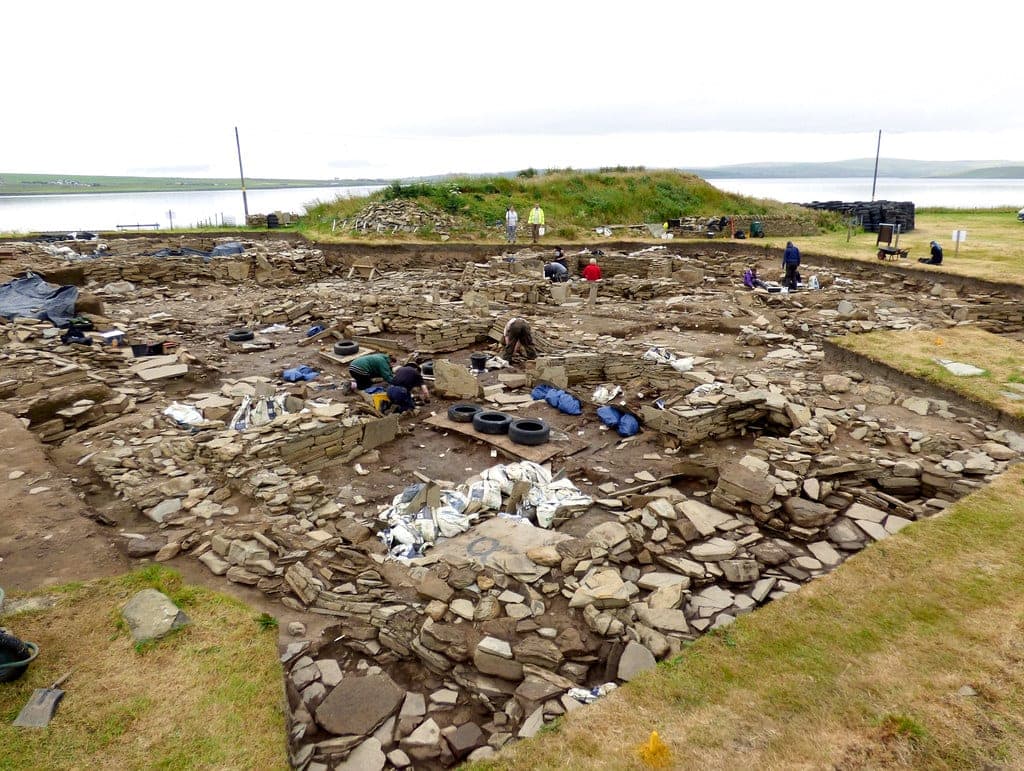
When Robert Stewart Clouston excavated the cairn in July 1884, he found human bones piled in every stall, two crouched skeletons in the side cell, and the broken remains of between twenty and thirty-five decorated bowls scattered across the compartments. Sherds from individual vessels had been separated across different stalls, a pattern that puzzled Clouston and continues to provoke archaeological discussion. Those bowls, shallow and carinated with bands of incised decoration around their rims, became the type specimens for what is now called Unstan Ware, a defining marker of Early Neolithic culture across Orkney and northern Scotland.
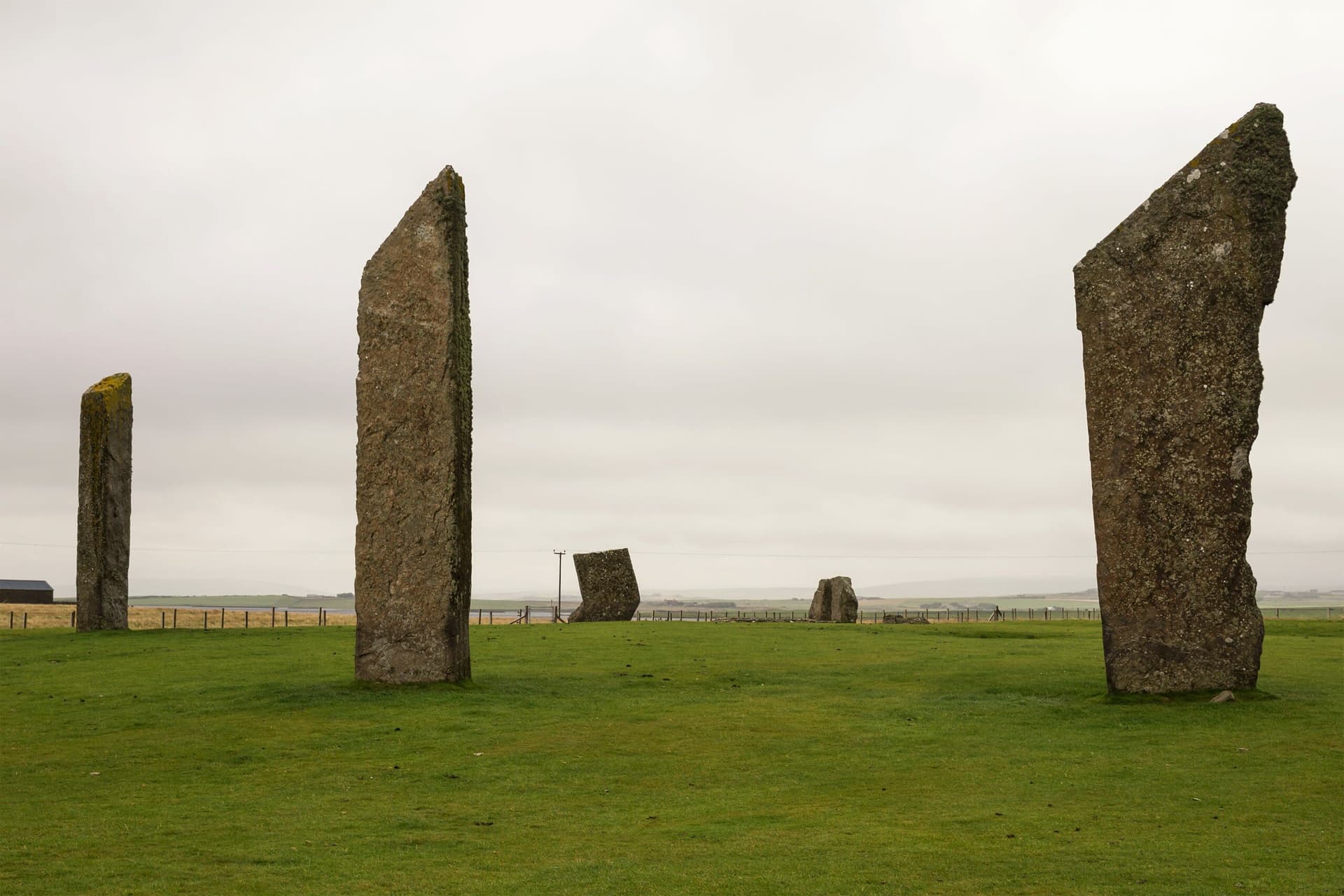
The cairn sits within the broader ceremonial landscape centred on the Brodgar-Stenness isthmus. Though not formally part of the Heart of Neolithic Orkney World Heritage Site, it belongs to the same world. Maeshowe, the Stones of Stenness, the Ring of Brodgar, and the Ness of Brodgar all lie within a few miles. Unstan was part of a society that understood its landscape as a place where the living and the dead shared space, where the water and the stone and the sky formed a single geography of meaning.
Context And Lineage
Unstan Chambered Cairn is a Neolithic communal burial tomb on Orkney's West Mainland, built between 3400 and 2800 BC. Its hybrid architecture combines features of two distinct Orcadian tomb traditions. The pottery found within its chamber in 1884 became the type collection for Unstan Ware, a defining marker of Early Neolithic culture across Orkney and northern Scotland.
The communities who built Unstan chose a promontory extending into the Loch of Stenness, placing their dead at the meeting point of land and water. They constructed a rectangular chamber six and a half metres long, dividing it into five stalls with pairs of upright stone slabs, and covered it with a circular barrow thirteen metres across. A long, narrow entrance passage on the eastern side controlled access to the interior.
What made their tomb unusual was the inclusion of a small side cell opening from the central stall. In the broader Orcadian context, stalled chambers belong to the Orkney-Cromarty tradition while side cells are characteristic of the later Maeshowe type. Unstan combined both, creating a hybrid form that challenges neat architectural categories. Whether this reflects a transitional moment between building traditions, a deliberate cultural synthesis, or simply local innovation remains debated.
The community used this tomb over an extended period. Bones accumulated in the stalls. Decorated pottery bowls were brought into the chamber and broken, their fragments distributed across compartments in patterns that may encode a ritual logic we can no longer read. The dead were not abandoned here but tended, visited, and accompanied by the material culture of the living.
No continuous tradition survives from the Neolithic communities who built and used the cairn. The site's significance is now understood through archaeological investigation and heritage management. The pottery tradition it gave its name to, Unstan Ware, is a cornerstone of Neolithic ceramic studies in northern Scotland. The transition from Unstan Ware to Grooved Ware pottery is a subject of active archaeological research, with recent excavations at the Ness of Brodgar and elsewhere demonstrating that the two styles overlapped for a considerable period.
Robert Stewart Clouston
Excavator
Stuart Piggott
Archaeologist
Why This Place Is Sacred
Unstan's power lies in the physical act of crossing its threshold. The low passage demands that you lower yourself to enter, an involuntary gesture of humility before the accumulated dead of a Neolithic community. Inside, the chamber holds the shape of ceremonies that were repeated here for centuries.
The passage at Unstan is not a corridor. It is a compression. Six and a half metres long, between forty and sixty centimetres wide, it forces the body low and close to the stone. This narrowing is not accidental. The builders chose this proportion, understanding that the space between the world of the living and the world of the dead required a particular kind of crossing.
What awaits inside is expansion. The chamber rises to over two metres, and the paired stone slabs dividing the five stalls create a rhythm of space and enclosure that still reads as intentional architecture. The side cell, opening from the central stall, adds an element of architectural surprise that has no parallel among the stalled cairns of Orkney. Its two crouched skeletons may represent the most recent dead, placed in a liminal space between the passage and the communal bones that filled the main stalls.
The pottery deepens the sense of thinness. Dozens of bowls were brought here, filled perhaps with offerings of food or drink, and broken. Their sherds were scattered across compartments in a pattern that defies simple explanation. A piece of one vessel found in the fourth compartment fitted precisely to the rest of that vessel in the second compartment. Whatever ceremony distributed these fragments across the chamber was deliberate and meaningful, even if its meaning has not survived the intervening millennia.
The loch surrounds the promontory on three sides. Water and stone and sky meet here in a way that the Neolithic builders must have recognised. The dead were not buried underground in the modern sense but placed within a stone chamber at the edge of a body of water, between elements, between worlds. This is the quality that endures at Unstan: the sense that you are standing in a place where boundaries dissolve.
Constructed between approximately 3400 and 2800 BC as a communal burial chamber for Neolithic communities on Orkney's West Mainland. The hybrid architecture combining a stalled chamber with a side cell suggests a community drawing from two distinct tomb-building traditions.
Excavated in July 1884 by Robert Stewart Clouston. The original roof structure is unknown and has been replaced by a modern concrete dome for protection. The site has been in the care of Historic Environment Scotland as Scheduled Monument SM90232. The pottery found here was defined as Unstan Ware by Stuart Piggott in 1954, transforming the site's significance from a local burial cairn to the type site for an entire ceramic tradition.
Traditions And Practice
No active ritual practices take place at Unstan. The site invites contemplative entry, slow attention to the architecture of the chamber, and awareness of the Neolithic landscape in which it sits. The act of crawling through the passage provides an involuntary form of ritual in itself.
Neolithic communities practiced communal burial within the stalled chamber over an extended period. Bodies may have been placed initially in the side cell before their bones were moved to the main stalls. Decorated Unstan Ware pottery bowls were brought into the chamber, likely containing offerings of food or drink, and deliberately broken. The scattering of sherds from individual vessels across multiple compartments suggests a specific ceremonial practice whose meaning has not survived. Leaf-shaped arrowheads and flint tools were also deposited alongside the dead.
Visitors enter the chamber through the original passage, experiencing the same compression and release that the builders intended. Some visitors sit quietly in the chamber. The site is included in tours of Orkney's Neolithic monuments. There is no organised ceremony or regular gathering.
Approach slowly. Walk around the cairn before entering. Notice the loch, the sky, the relationship between land and water. Bring a torch for the passage. Crawl through without rushing. Let your body register the transition from openness to enclosure. Stand in the chamber and look at the stalls, the side cell, the stonework. Consider the pottery that was broken here, the bones that were arranged here, the community that returned to this place across centuries. When you emerge, sit by the loch and let the experience settle.
Neolithic Communal Mortuary Practice
HistoricalUnstan served as a communal burial chamber for an extended period, accumulating the remains of multiple individuals across its five stalls. The practice of communal burial in a stalled cairn reflects a society that maintained ongoing relationships with its ancestral dead, returning to the chamber to deposit new remains and conduct ceremonies involving decorated pottery.
Communal deposition of human remains in stalled compartments; placement of crouched burials in the side cell; ritual breakage and scattering of Unstan Ware pottery bowls; deposition of leaf-shaped arrowheads and flint tools; sustained use of the tomb across centuries.
Unstan Ware Ceramic Tradition
HistoricalThe pottery found at Unstan defines the type collection for a distinctive Early Neolithic ceramic style characterised by shallow, carinated bowls with incised decorative bands. This tradition represents a local Orcadian development of the broader Carinated Bowl tradition that originated in northern France and arrived in Britain with the first farming communities around 4000 BC.
Production of finely made, decorated pottery vessels for ceremonial or special-purpose use; ritual deposition and breakage of vessels within chambered cairns.
Experience And Perspectives
Arrive by the narrow road that feels like a farm track. Leave the car at the small parking area and walk a short, level path to the cairn. The Loch of Stenness opens around you. Crouch to enter the passage. Let your eyes adjust. Stand in the chamber where Neolithic hands placed the dead and broke the bowls.
The road to Unstan diverges from the A965 between Stromness and Stenness and narrows until it resembles a farm driveway, which it partly is. Continue past the farmhouse to a small parking area that holds perhaps half a dozen cars. The path beyond is short and level, though it can be muddy after rain.
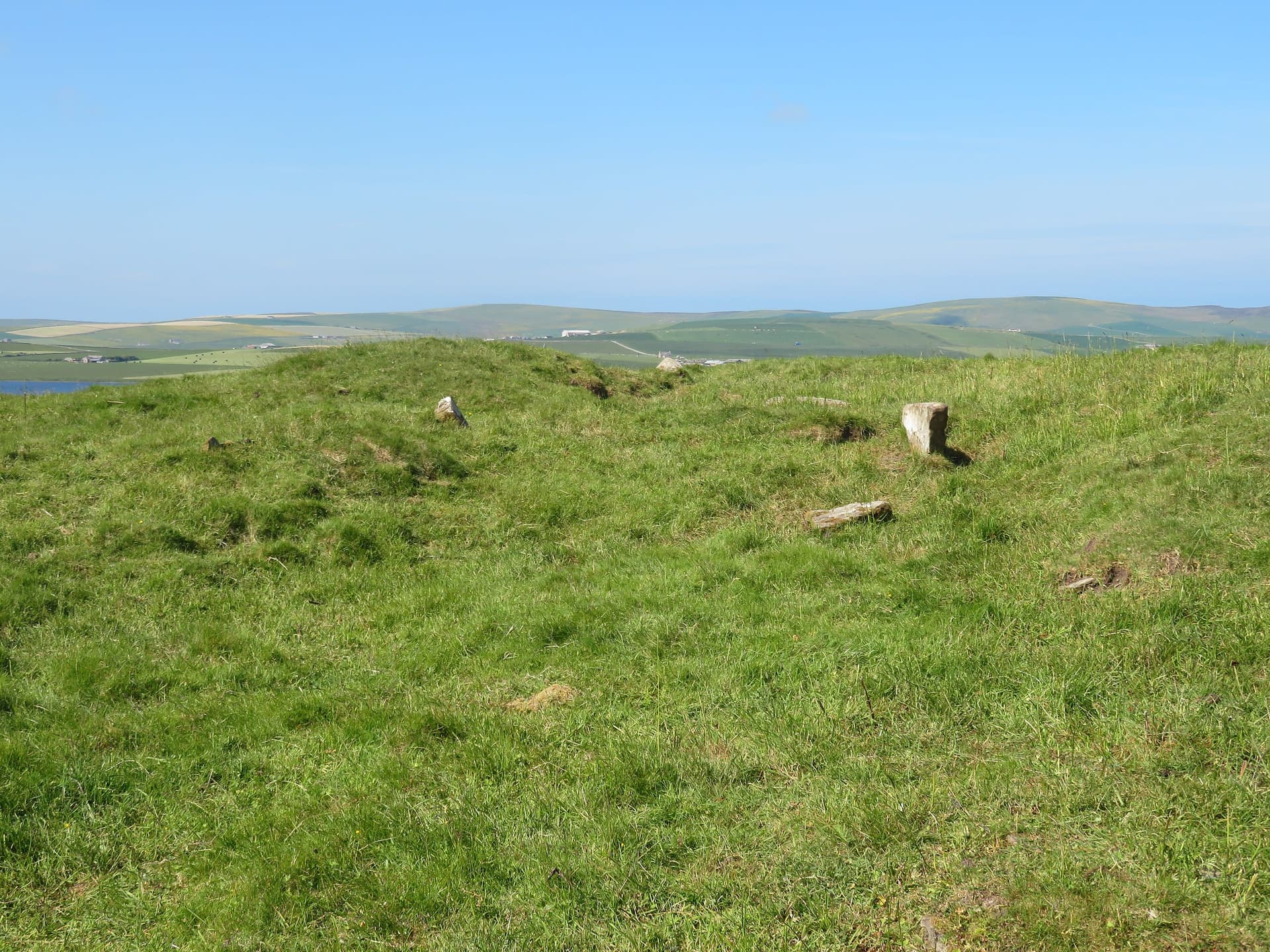
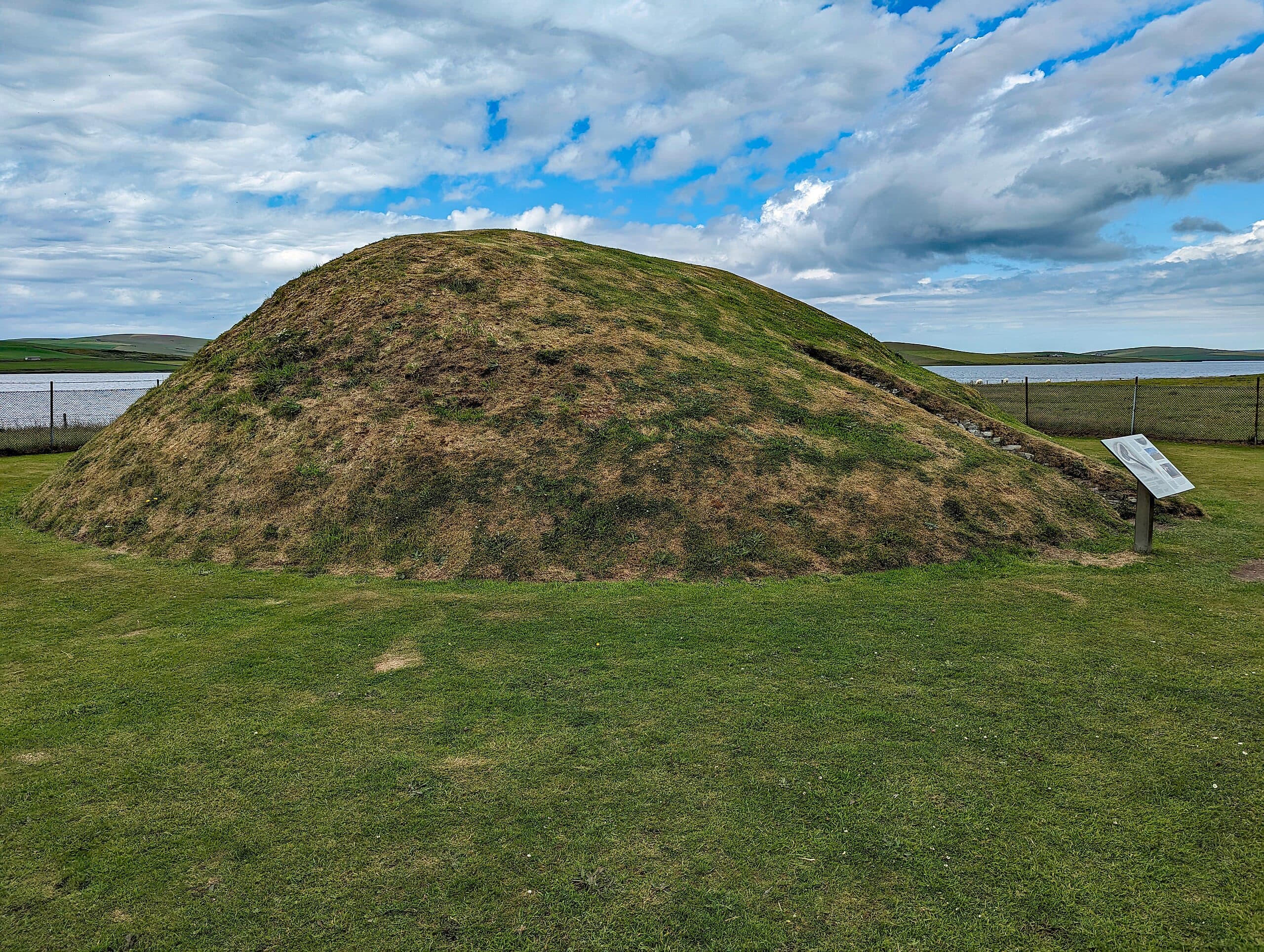
The cairn appears as a low grassy mound on the promontory, its concrete dome visible from a distance. The loch stretches away on three sides. Before entering, walk around the perimeter. Notice the setting. This is not high ground or hidden ground but land that reaches into water, a place chosen for its relationship to the elements.
The entrance is on the eastern side. It is low. Bring a torch if you have one. The passage is six and a half metres long, and you will crawl its length. The stone walls press close. This is the narrowest moment, and it is the point. The builders meant for this crossing to be felt in the body.
Inside, the chamber opens and the ceiling rises. The five stalls, divided by their upright stone slabs, create a measured sequence of spaces along the length of the chamber. The side cell, opening from the central stall, invites separate attention. Stand in the chamber and consider that the bones of an entire community were arranged in these compartments. Pottery bowls were carried down the same passage you crawled through, filled with whatever the living believed the dead required, and broken.
Emerge into daylight. The contrast between the enclosed chamber and the open sky is immediate and instructive. Look toward the northeast, where on a clear day the Stones of Stenness and the landscape of the World Heritage Site are visible across the water. Unstan belongs to that world, even if it stands apart from it.
The cairn is located on a promontory extending into the Loch of Stenness, approximately 2 miles (3 km) northeast of Stromness. Access is from a narrow road off the A965. Grid reference HY 2829 1172. Sat nav postcode KW16 3JX.
Unstan Chambered Cairn can be understood as an archaeological type site, as a hybrid architectural experiment, as evidence of Neolithic beliefs about death and community, or as a place where the physical act of entry creates an encounter with deep time.
Archaeologists identify Unstan as a critical site for understanding Neolithic Orkney. Its hybrid architecture, combining the stalled chamber of the Orkney-Cromarty tradition with a Maeshowe-type side cell, complicates the conventional binary classification of Orcadian tombs. The pottery assemblage, defined as Unstan Ware by Stuart Piggott in 1954, provides the type collection for the dominant Early Neolithic ceramic style across Orkney and northern Scotland. The Unstan Ware tradition is now understood as a local development of the broader Carinated Bowl tradition that arrived in Britain from northern France around 4000 BC. Recent research, including excavations at the Ness of Brodgar, has shown that the transition from Unstan Ware to Grooved Ware was gradual and overlapping rather than abrupt.
No oral tradition specific to Unstan survives. The Orcadian landscape carries broader Norse and Scots traditions about mounds and cairns, but none has been recorded as attaching specifically to this site. The name variants Onstan and Onston may derive from Old Norse personal names, suggesting the cairn was a recognised landscape feature throughout the Norse period.
Some visitors and writers interested in sacred geography note the cairn's liminal position between land and water as potentially significant beyond practical considerations. The eastern-facing entrance, the compression of the passage, and the expansion of the chamber have been interpreted as a symbolic death-and-rebirth journey. These readings, while not supported by direct evidence, reflect a genuine quality of the architectural experience.
The precise meaning of the pottery-scattering ceremony remains unexplained. The reason for the architectural hybridisation of stalled and side-cell forms is debated. Whether the two crouched skeletons in the side cell represent the final burials or a different category of the dead is uncertain. The original roofing arrangement is unknown. The relationship between Unstan and the later ceremonial monuments at Stenness and Brodgar, built centuries after the cairn, is a matter of inference.
Visit Planning
Freely accessible at all times, year-round. Located on a promontory by the Loch of Stenness, approximately 2 miles northeast of Stromness. No admission charge. Small parking area. Combine with visits to the Heart of Neolithic Orkney World Heritage sites nearby.
Accommodation in Stromness (2 miles) or Kirkwall (10 miles). Stromness has hotels, guest houses, and self-catering options. For visitor enquiries, telephone Skara Brae at 01856 841 815.
Treat the cairn with respect as a burial monument and scheduled ancient monument. Enter the passage carefully to avoid damaging stonework. Leave no trace.
Unstan is a burial place. For centuries, the bones of a community were arranged within its stalls and bowls were broken beside them. The modern visitor enters a space that was built to hold the dead and to facilitate whatever ceremonies attended their passage. While the bones and pottery were removed during excavation, the architecture that housed them remains. Treat it accordingly. Move carefully within the chamber. Do not touch or lean against the upright slabs dividing the stalls. The Scottish Outdoor Access Code applies.
Outdoor clothing suitable for Orkney weather. Waterproofs and knee protection recommended for the crawl through the entrance passage. The passage floor can be muddy or damp.
Permitted. A torch or camera flash will be needed inside the chamber. The chamber photographs well, and the contrast between the dark passage and the stalled interior is striking.
Do not leave offerings, coins, or objects at the site. This is a scheduled monument and any disturbance is prohibited.
Scheduled Ancient Monument SM90232. Any disturbance, excavation, or use of metal detectors is prohibited without permission from Historic Environment Scotland.
Sacred Cluster
Nearby sacred places create the location cluster described in the growth plan. This block is intentionally crawlable and links into the wider regional graph.