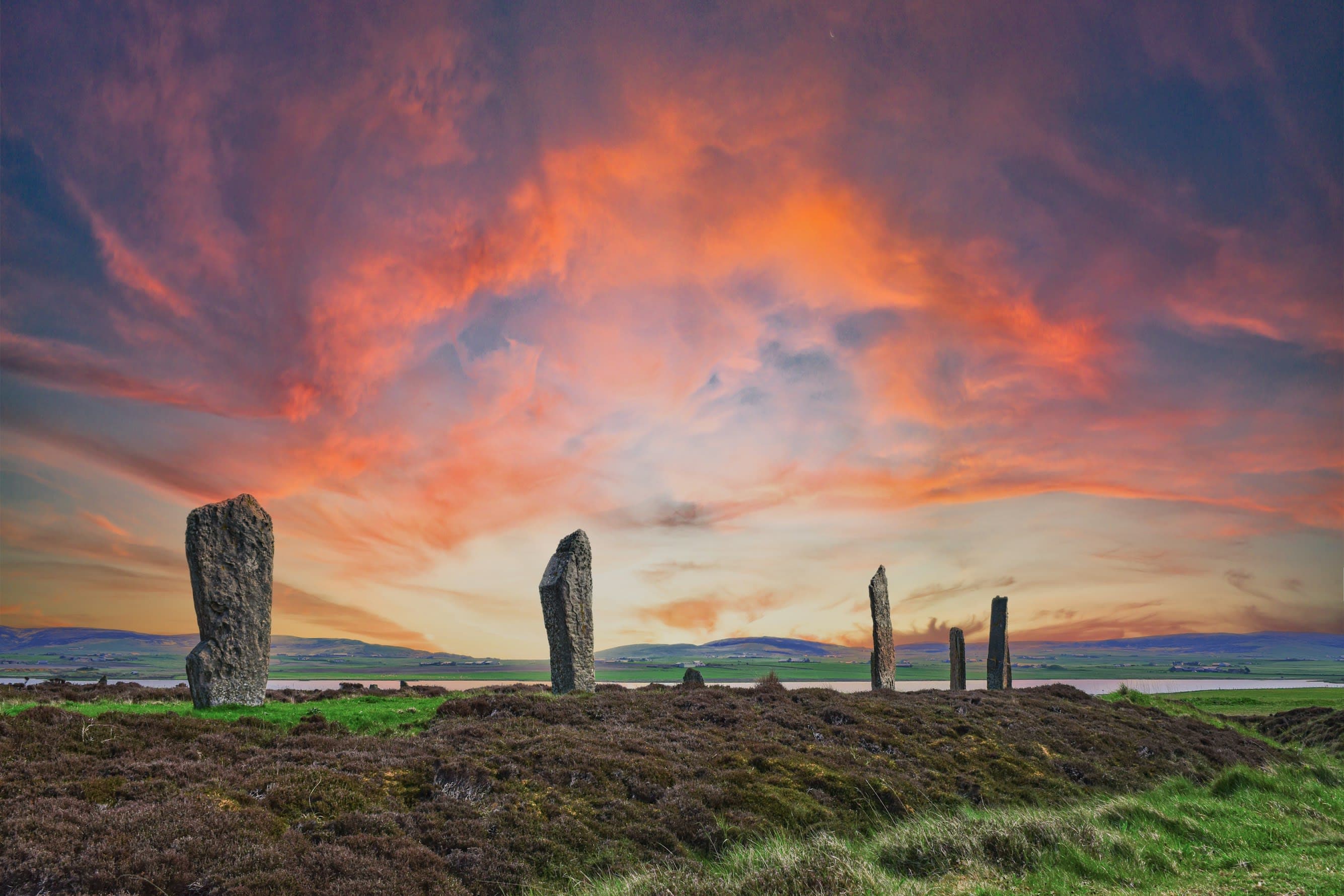
Ring of Brodgar
Where Neolithic builders raised stones from seven quarries to create a circle that has drawn seekers for five millennia
Stromness, Orkney, United Kingdom
At A Glance
- Coordinates
- 59.0020, -3.2287
- Suggested Duration
- Allow 1-1.5 hours for the Ring of Brodgar itself. A full day permits exploration of the Heart of Neolithic Orkney sites: Maeshowe (timed entry, book ahead), Stones of Stenness, Skara Brae, and if open, the Ness of Brodgar excavations. Multiple days allow for deeper engagement and return visits at different times of day.
- Access
- The Ring of Brodgar lies 6 miles northeast of Stromness on the B9055, with free parking at the site. Orkney is reached by ferry from Scrabster (90 minutes from Thurso) or Aberdeen (6 hours overnight), or by air to Kirkwall from Edinburgh, Glasgow, Aberdeen, or Inverness. A car is recommended for exploring the island, though tours from Kirkwall visit major sites. No public toilets at the Ring; nearest facilities at Maeshowe Visitor Centre.
Pilgrim Tips
- The Ring of Brodgar lies 6 miles northeast of Stromness on the B9055, with free parking at the site. Orkney is reached by ferry from Scrabster (90 minutes from Thurso) or Aberdeen (6 hours overnight), or by air to Kirkwall from Edinburgh, Glasgow, Aberdeen, or Inverness. A car is recommended for exploring the island, though tours from Kirkwall visit major sites. No public toilets at the Ring; nearest facilities at Maeshowe Visitor Centre.
- Practical, layered clothing suited to the Orcadian climate. Wind is nearly constant and can be fierce; a windproof outer layer is essential. Waterproof jacket and trousers advisable regardless of forecast. Sturdy, comfortable shoes for the walk from car park to circle. No spiritual dress requirements exist.
- Personal photography is welcomed and encouraged—the Ring of Brodgar has inspired image-makers for over a century. Commercial photography or filming requires permission from Historic Environment Scotland. Drone operators should check current regulations. Be considerate of others engaged in contemplation; photograph stones and landscape rather than intruding on fellow visitors' experiences.
- The Ring of Brodgar receives significant visitor traffic, particularly when cruise ships dock at Kirkwall. Those seeking solitude and depth of experience should time visits for early morning or late evening. The Orcadian climate can shift rapidly; exposure is a real concern for those engaged in extended contemplative practice. Dress appropriately and inform someone of your plans if visiting during transitional light conditions.
Overview
On a windswept isthmus between two lochs in Orkney, thirty-six ancient stones stand in an almost perfect circle, remnants of sixty that once marked one of Britain's most sacred ceremonial landscapes. The Ring of Brodgar has witnessed nearly five thousand years of human devotion—from Neolithic builders who transported massive stones across the islands to Norse settlers who prayed to Odin here to modern pilgrims seeking connection with the deep past.
The stones rise from the Orcadian earth like sentinels from another age, their weathered surfaces recording millennia of wind, rain, and human reverence. The Ring of Brodgar stands on a narrow neck of land between the Lochs of Stenness and Harray, a liminal space that prehistoric peoples chose as the site for one of Britain's grandest ceremonial monuments. Constructed between 2500 and 2000 BCE, the Ring once comprised sixty stones set within a deep circular ditch—a feat of engineering that required an estimated 80,000 hours of labor.
What draws visitors today is something beyond the monument's archaeological significance. The stones came from at least seven different quarries scattered across Orkney, suggesting that different communities contributed their own megaliths to the circle. This was not merely construction but communion—separate peoples coming together to create something larger than any single group could achieve. Archaeologists now believe the process itself held sacred meaning; the act of quarrying, transporting, and raising a stone may have been as spiritually significant as the completed monument.
Orcadian folklore remembers the stones as dancing giants, frozen by the rising sun mid-celebration. Norse settlers who arrived fifteen hundred years after the last stone was raised still recognized the site's power, naming it the Temple of the Sun and conducting their own ceremonies here. Standing within the circle as the Orkney wind carries the scent of sea and moorland, visitors enter a conversation that spans five millennia—joining a lineage of seekers who have found something essential in this remote northern place.
Context And Lineage
The Ring of Brodgar emerged from a Neolithic culture that created an interconnected ceremonial landscape across Orkney between approximately 3000 and 2000 BCE. The site gained renewed sacred significance under Norse occupation and continues to serve as a pilgrimage destination for modern spiritual practitioners.
Orcadian folklore preserves the memory of the Ring through the tale of the dancing giants. According to this legend, the stones were once giants who gathered in a great circle to dance and celebrate. So absorbed were they in their revels that they failed to notice the night passing, and when the sun rose over the horizon, its light transformed them instantly to stone—the fiddler who played for them turned to stone as well, standing outside the circle where he is remembered in a single outlying megalith. This tale belongs to a widespread pattern of transformation legends attached to standing stones throughout Britain, yet carries its own Orcadian character in the image of giants frozen mid-dance beneath the northern sky.
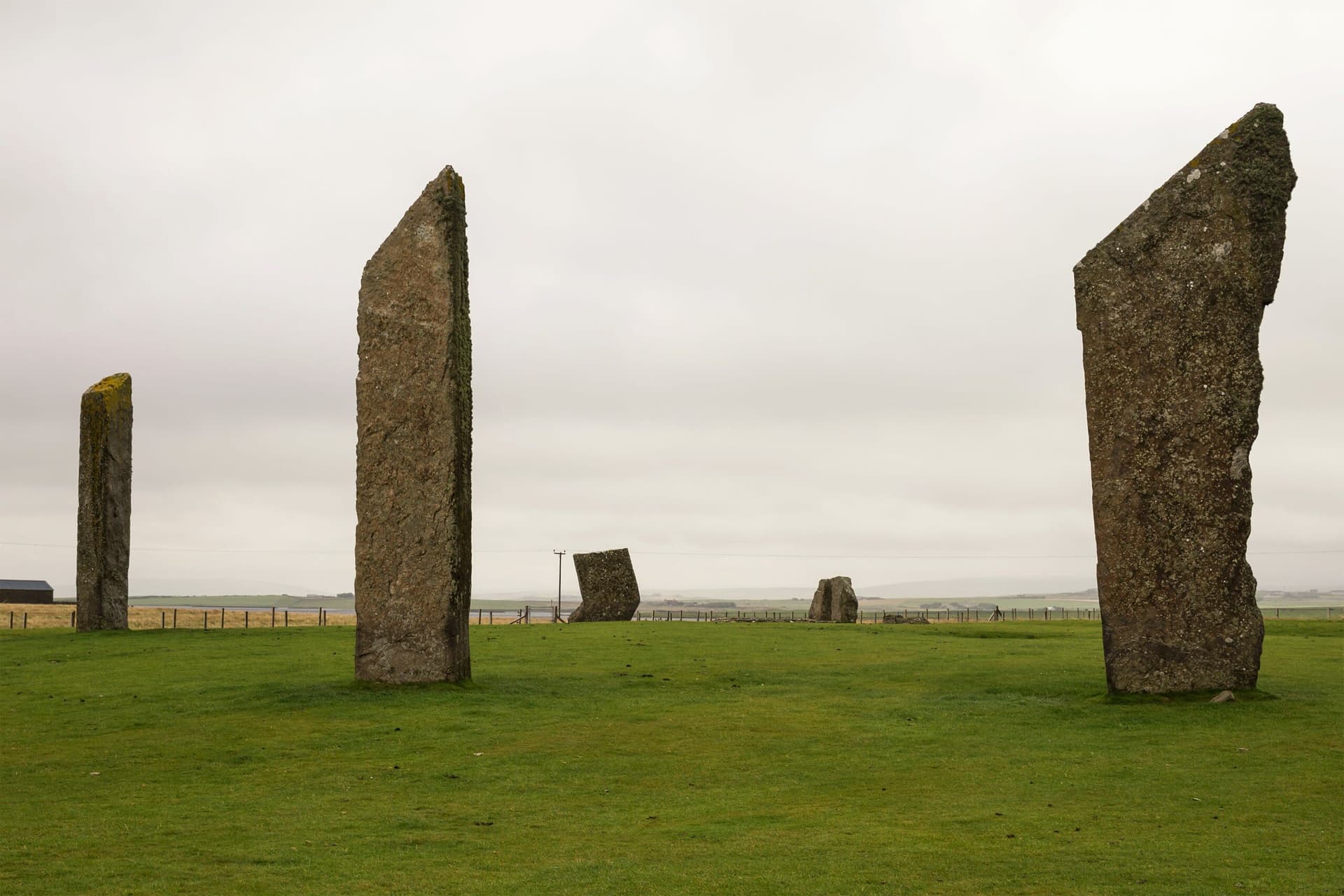
The Ring of Brodgar emerged from the same cultural impulse that produced Stonehenge and Avebury—the late Neolithic drive to create monumental gathering places of stone. Yet Orkney's monuments predate these southern sites and may have influenced them; the Stones of Stenness are among the oldest stone circles in Britain. The Norse period added a layer of meaning that persisted in Orcadian folk practice until the early 19th century. Modern recognition as part of the Heart of Neolithic Orkney UNESCO World Heritage Site has established the Ring within a global network of protected sacred landscapes.
The Neolithic Builders
Communities from across Orkney who collaborated to construct the Ring, each potentially contributing stones from their own quarries
Norse Settlers
Ninth-century arrivals who integrated the ancient monument into their religious practices, naming it the Temple of the Sun
Captain Frederick Thomas
Royal Navy officer who conducted the first formal survey of the Ring and surrounding antiquities in 1849
Why This Place Is Sacred
The Ring of Brodgar embodies the quality of thin places through its position on a liminal isthmus, its construction as a collaborative sacred project across Orcadian communities, and its continuous recognition as spiritually significant across nearly five thousand years of human history.
Thin places are those locations where the membrane between ordinary existence and something deeper grows permeable, where the presence of the sacred becomes tangible. The Ring of Brodgar possesses this quality through multiple converging factors.
Geographically, the site occupies a natural threshold—a narrow isthmus between two bodies of water, neither fully land nor surrounded by sea. Such boundary spaces have attracted sacred attention across cultures, representing the liminal zones where transformation becomes possible. The Neolithic builders who chose this location understood something about the power of in-between places.
The Ring's construction deepens its sacred quality. Stones were quarried from at least seven locations across Orkney, each source potentially representing a different community or tribal group. The circle thus embodies unity from diversity—separate peoples contributing to a shared sacred project. Recent archaeological thinking suggests the meaning resided not only in the completed monument but in the process of creation itself. Each stone carried the effort, intention, and prayers of those who cut, transported, and raised it.
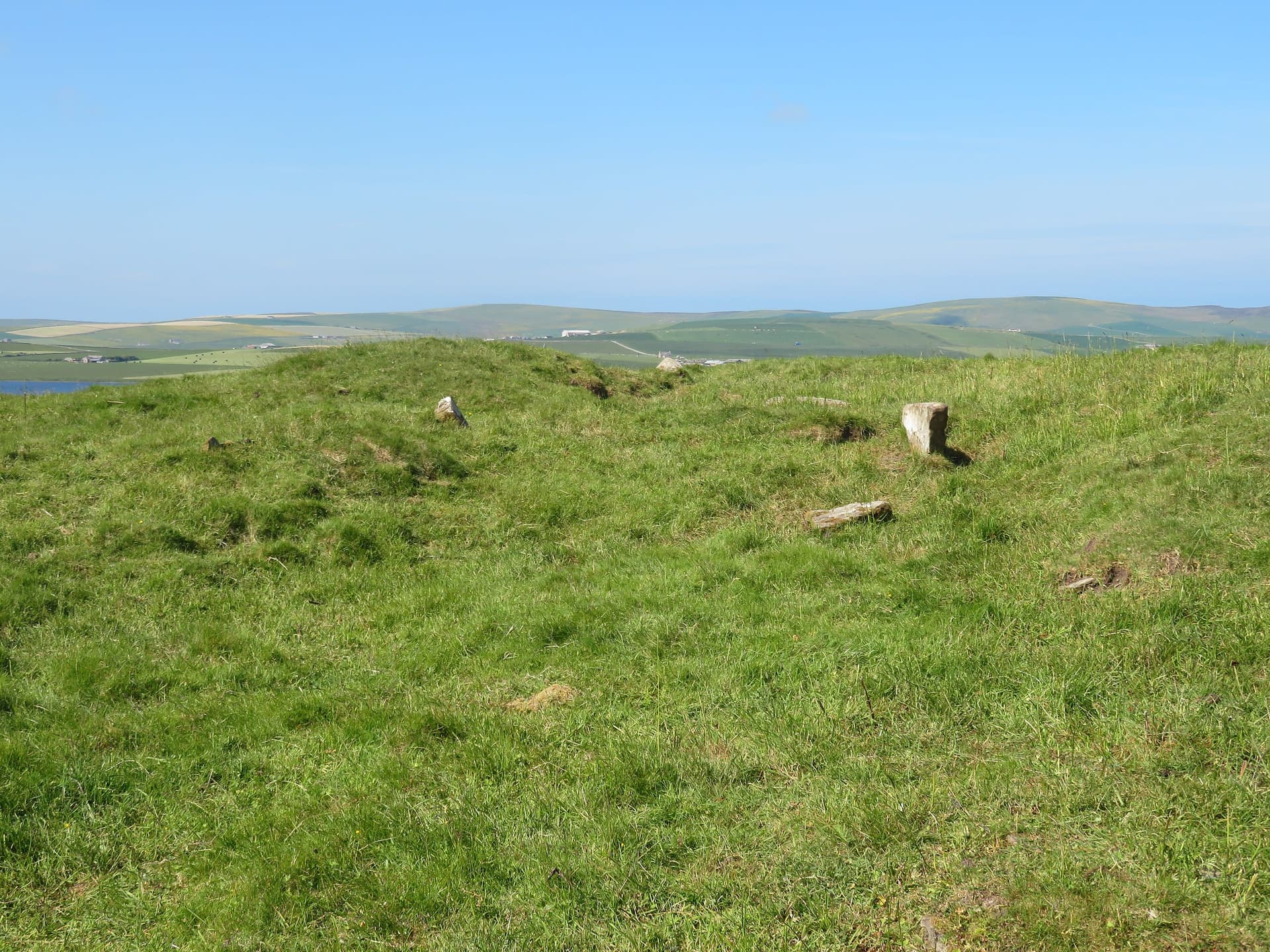
Perhaps most striking is the continuity of sacred recognition. The surrounding landscape contains burial mounds spanning a thousand years of Neolithic use, demonstrating that generation after generation considered this place worthy of their dead. When Norse settlers arrived in the 9th century CE, they did not dismiss the ancient monument but integrated it into their own religious framework. Modern druids and pagans continue the pattern, recognizing the Ring as a site where connection to ancestral wisdom remains accessible.
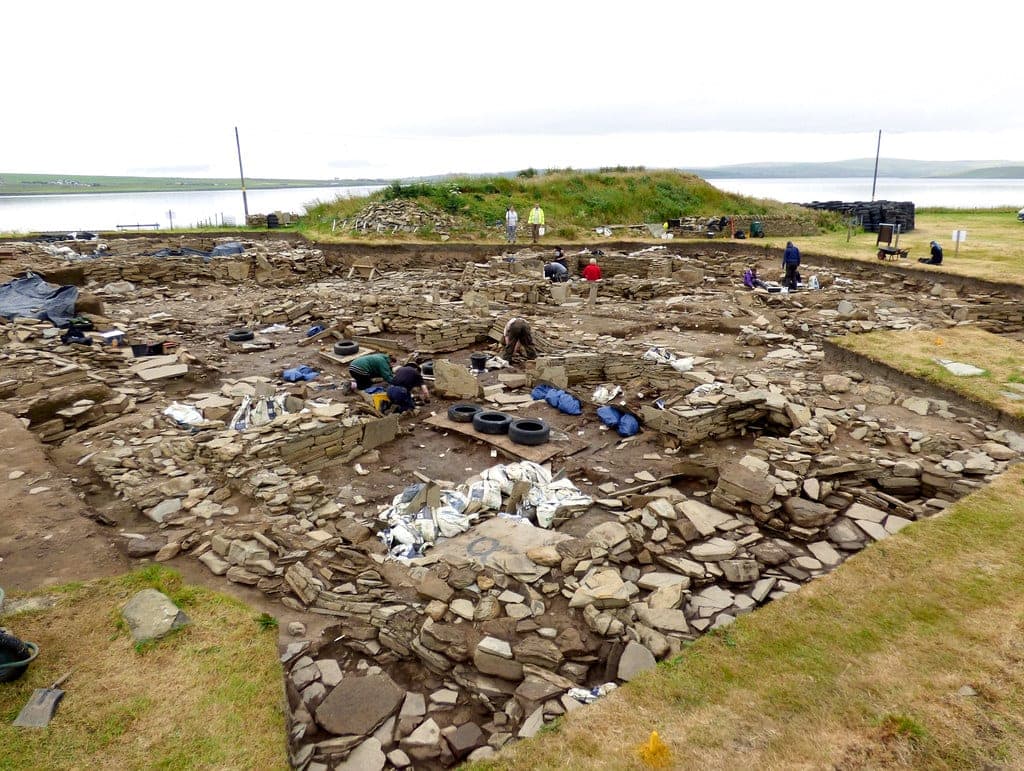
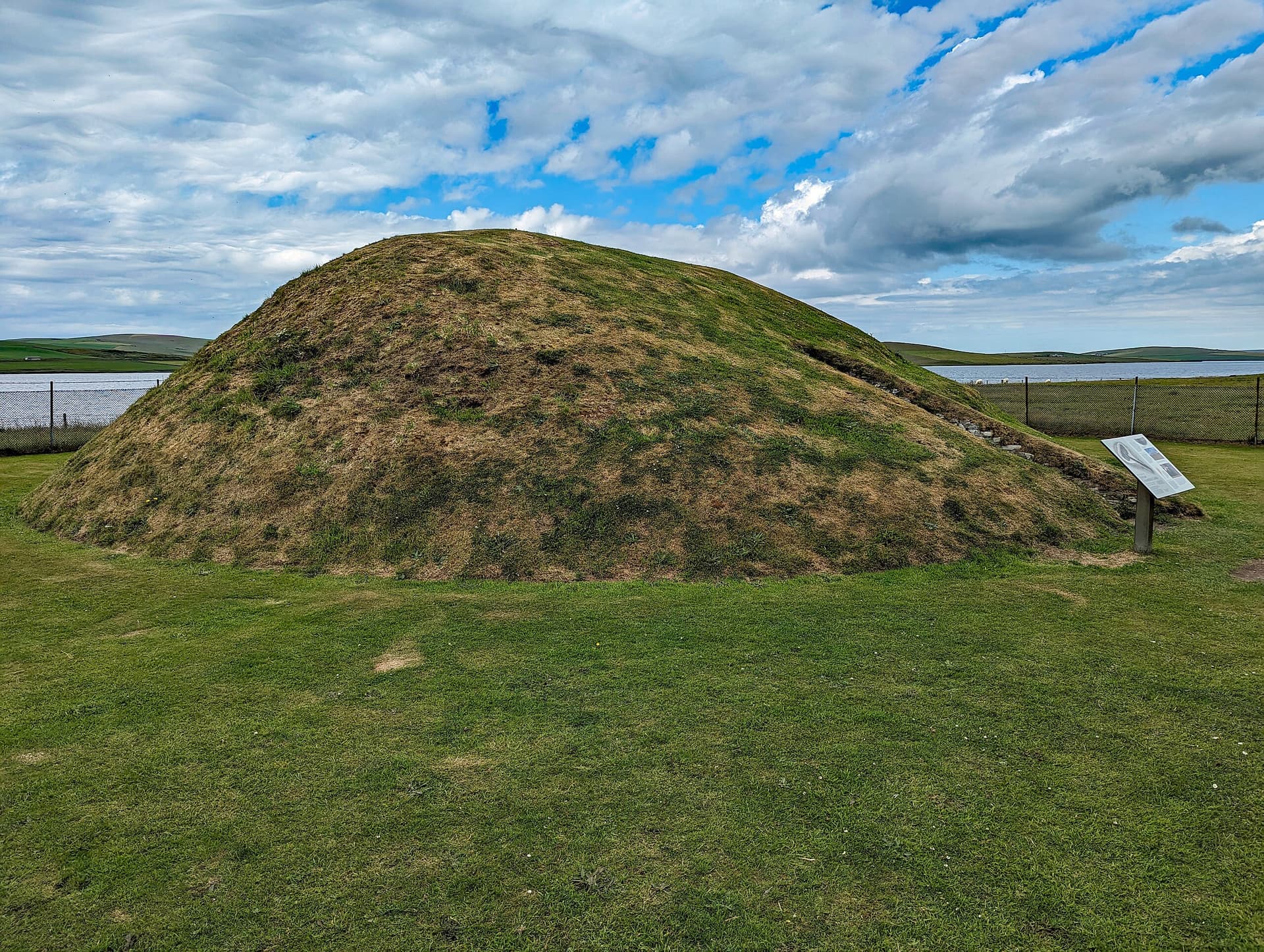
The Ring of Brodgar functioned as a ceremonial center within a vast sacred landscape that included the Stones of Stenness, Maeshowe chambered cairn, and the recently discovered Ness of Brodgar complex. The specific nature of Neolithic ceremonies remains unknown, but the presence of surrounding burial mounds suggests connections to ancestor veneration and possibly seasonal celebrations.
Norse settlers in the 9th century CE adopted the monument as the Temple of the Sun, using it alongside the Stones of Stenness (Temple of the Moon) for betrothal ceremonies and oaths made to Odin. The destruction of the Odin Stone in 1814 ended these folk practices. Modern recognition as one of Scotland's premier sacred sites has established the Ring as a pilgrimage destination for contemporary pagans and spiritual seekers.
Traditions And Practice
The Ring of Brodgar supports both historical reconstructionist practices drawing on Norse and Neolithic themes and contemporary druidic and pagan ceremonies, particularly at solstices and equinoxes. The site's 24-hour accessibility facilitates dawn and dusk observances.
The specific ceremonies of the Neolithic builders remain unknown, though the surrounding burial mounds suggest practices related to ancestor veneration. Norse-era customs are better documented: young couples would pray to Odin at both the Ring of Brodgar (Temple of the Sun) and the Stones of Stenness (Temple of the Moon), then seal their betrothal by clasping hands through the hole in the Odin Stone. This practice continued among Orcadians until the stone's destruction in 1814, when a farmer seeking to discourage visitors broke it apart—an act that reportedly caused such local outrage that the man required protection from his neighbors.
Modern druids and pagans gather at the Ring for solstice and equinox ceremonies, continuing the ancient pattern of marking astronomical transitions at this site. Individual practitioners visit for meditation, prayer, and personal ritual throughout the year. The site's position within a larger sacred landscape encourages pilgrimage circuits that include Maeshowe, the Stones of Stenness, and Skara Brae.
Visitors seeking meaningful engagement might begin by walking the circumference of the circle clockwise, acknowledging each standing stone. Enter the circle through one of the natural entrances and find a position near the center where the full sweep of stones becomes visible. Sit in stillness, allowing the wind and the weight of ages to work upon your awareness. Some find value in silent dedication to the unknown builders whose labor created this space. Those visiting at solstice or equinox join a practice that may extend to the monument's Neolithic origins.
Neolithic Ceremonial
HistoricalThe Ring of Brodgar functioned as a major ceremonial site for approximately a thousand years during the late Neolithic period. The collaborative construction, drawing stones from communities across Orkney, suggests the monument served to unite diverse groups in shared sacred purpose.
Unknown in detail. The presence of burial mounds suggests connections to ancestor veneration. The nearby Ness of Brodgar complex contained buildings too impressive to be domestic, implying elaborate ceremonies. Possible astronomical observations related to seasonal transitions.
Norse Religious Practice
HistoricalNorse settlers arriving in the 9th century CE recognized the ancient monument's power and integrated it into their religious framework as the Temple of the Sun, paired with the Temple of the Moon at Stenness.
Betrothal ceremonies in which couples prayed to Odin at both temples before sealing their vows at the Odin Stone. This practice persisted in Orcadian folk tradition until the stone's destruction in 1814.
Modern Druidry and Paganism
ActiveThe Ring of Brodgar serves as one of Scotland's premier pilgrimage sites for contemporary druids, pagans, and those following Celtic spiritual paths.
Solstice and equinox ceremonies, meditation and contemplation, pilgrimage circuits connecting multiple Orcadian sites, personal ritual and prayer.
Experience And Perspectives
Visitors to the Ring of Brodgar commonly report a profound sense of connection to deep time, accompanied by the humbling recognition of human continuity across millennia. The dramatic Orcadian landscape—with its vast skies, constant winds, and interplay of land and water—intensifies the experience of stepping outside ordinary temporal awareness.
The experience of approaching the Ring of Brodgar unfolds gradually. From the car park, a path leads across open moorland toward the circle, the stones resolving from distant silhouettes into individual presences. Each megalith carries its own character—some straight and sentinel-like, others leaning with age, several marked with lichen patterns accumulated over centuries.
Within the circle, many visitors report a shift in awareness. The scale of the monument becomes apparent—103 meters in diameter, originally enclosed by a ditch carved three meters deep into solid rock. The labor required staggers modern imagination. Standing where people stood five thousand years ago, performing ceremonies whose meaning has been lost, visitors often describe a collapse of temporal distance. The builders become present, not as abstractions but as fellow humans who shaped stone with intention and reverence.
The Orcadian environment amplifies these sensations. Wind is nearly constant, carrying the salt of the surrounding sea and the peat-smoke scent of the moorland. Skies in Orkney change rapidly, cycling through sun, cloud, and rain in the space of an hour. Light at high latitudes possesses a quality found nowhere in southern Britain—clear, angled, capable of transforming the stones from grey to gold. Those who visit at dawn or dusk, when the tourist buses have departed, find the silence itself becomes eloquent.
Approach the Ring of Brodgar as you would any place where something beyond the ordinary has been repeatedly recognized. Allow more time than you think you need—rushing diminishes what the site offers. Walk the circumference slowly before entering the circle. Choose a stone that draws your attention and spend time with it. If possible, visit twice: once during daylight hours and once when the light is transitional. Bring layers against the Orkney wind, but leave expectations behind. The monument has outlasted every interpretation imposed upon it; let it speak in its own terms.
Understanding the Ring of Brodgar requires holding multiple interpretive frameworks simultaneously. Archaeological evidence provides dates and construction details but cannot recover the beliefs that motivated such monumental effort. Folklore preserves imaginative engagement across centuries. Contemporary spiritual practitioners bring their own frameworks of meaning. The monument contains and exceeds all these approaches.
Archaeological investigation, though limited at the Ring itself, has established the broad outlines of the site's history. Construction occurred between approximately 2500 and 2000 BCE, making it among the last great Neolithic monuments in Britain. The circle originally contained sixty stones, of which thirty-six remain standing. A rock-cut ditch, three meters deep in places, surrounds the circle. Excavation at a nearby quarry site revealed that specific stone sources were deliberately selected—perhaps locations imbued with their own sacred significance. Current archaeological thinking emphasizes the process of monument-building as itself ritually meaningful; the goal may have been not a finished structure but the communal act of creation.
Orcadian folklore has long remembered the Ring as the dwelling of giants turned to stone by sunrise. This transformation legend, common to standing stones throughout Britain and Ireland, carries particular resonance at Brodgar, where the stones' varied heights and angles do suggest frozen dancers. Norse-era traditions, better documented, named the Ring the Temple of the Sun and used it for betrothal ceremonies involving prayers to Odin. These practices persisted among Orcadians until the destruction of the Odin Stone in 1814.
Modern druids and pagans recognize the Ring of Brodgar as a site where earth energies concentrate and ancestral connection remains accessible. Some practitioners work with the site in terms of energy lines or ley networks; others focus on the builders' intentions and seek communion across time. The Ring serves as a pilgrimage destination for Scottish pagans and those following Celtic spiritual paths, part of a circuit of sacred sites that includes Callanish, Clava Cairns, and numerous other ancient monuments.
Significant mysteries remain. The precise dating and construction sequence of the Ring awaits excavation that may never occur. The specific beliefs and ceremonies of the Neolithic builders left no written record and can only be inferred from architecture and artifacts. The meaning of sourcing stones from seven different quarries—whether representing different communities, different sacred qualities, or something else entirely—remains debated. The full extent of the Ness of Brodgar complex, adjacent to the Ring and still being excavated, continues to reshape understanding of the ceremonial landscape. Why this particular isthmus, of all possible locations, drew such sustained sacred attention across millennia remains an open question.
Visit Planning
The Ring of Brodgar is freely accessible around the clock throughout the year, best visited in spring or autumn for fewer crowds and dramatic skies. Early morning or late evening times offer the most contemplative atmosphere, though summer's midnight sun provides unique opportunities.
The Ring of Brodgar lies 6 miles northeast of Stromness on the B9055, with free parking at the site. Orkney is reached by ferry from Scrabster (90 minutes from Thurso) or Aberdeen (6 hours overnight), or by air to Kirkwall from Edinburgh, Glasgow, Aberdeen, or Inverness. A car is recommended for exploring the island, though tours from Kirkwall visit major sites. No public toilets at the Ring; nearest facilities at Maeshowe Visitor Centre.
Stromness and Kirkwall offer the main accommodation options in Orkney, ranging from hotels to bed-and-breakfasts. Several options exist nearer the Ring for those wishing to maximize time at the site. Camping is available at various sites around Mainland Orkney.
The Ring of Brodgar requires the reverent attention appropriate to any sacred site that has served humanity for millennia. Follow designated paths, respect the stones by not touching them, maintain silence to honor both the site and fellow visitors, and leave no trace of your presence.
Approaching the Ring of Brodgar, visitors enter a space that has been treated as sacred for nearly five thousand years. This recognition should inform behavior. Follow the one-way walking system established by Historic Environment Scotland—this seemingly mundane regulation protects the grass paths that could otherwise erode under visitor pressure. Stay on designated routes rather than wandering freely among the stones.
The stones themselves require care. Though they have weathered millennia, they are not indestructible, and the oils from human hands contribute to surface degradation over time. Do not touch, lean against, or climb upon the megaliths. Graffiti, once common (Viking runes and Victorian inscriptions mark some stones), is now a criminal offense.
Respect for other visitors means maintaining relative silence within the circle. Many come seeking contemplative space; conversations, phone calls, or loud behavior diminish their experience. If traveling with a group, consider spreading out rather than moving as a cluster. Be mindful when photographing—ask permission before including other visitors in your images.
Leave no trace of your visit. The impulse to leave offerings—flowers, crystals, coins—though spiritually motivated, creates maintenance burdens and can introduce materials foreign to the ecosystem. Your presence and attention constitute sufficient offering.
Practical, layered clothing suited to the Orcadian climate. Wind is nearly constant and can be fierce; a windproof outer layer is essential. Waterproof jacket and trousers advisable regardless of forecast. Sturdy, comfortable shoes for the walk from car park to circle. No spiritual dress requirements exist.
Personal photography is welcomed and encouraged—the Ring of Brodgar has inspired image-makers for over a century. Commercial photography or filming requires permission from Historic Environment Scotland. Drone operators should check current regulations. Be considerate of others engaged in contemplation; photograph stones and landscape rather than intruding on fellow visitors' experiences.
Leave nothing behind. The site is maintained as an archaeological monument, and objects left as offerings must be removed by staff. Direct your devotion through attention and intention rather than material gifts. If you wish to mark your visit ceremonially, a moment of silent dedication before departing honors both the site and those who will come after.
{"Follow the designated one-way walking system","Stay on established paths; do not walk on the grass within the circle","Do not touch, lean against, or climb the stones","Carving, marking, or defacing the stones is a criminal offense","No camping, fires, or overnight stays","Keep voices low and phones silent within the circle","Dogs must be kept on leads","No commercial activity without permission"}
Sacred Cluster
Nearby sacred places create the location cluster described in the growth plan. This block is intentionally crawlable and links into the wider regional graph.