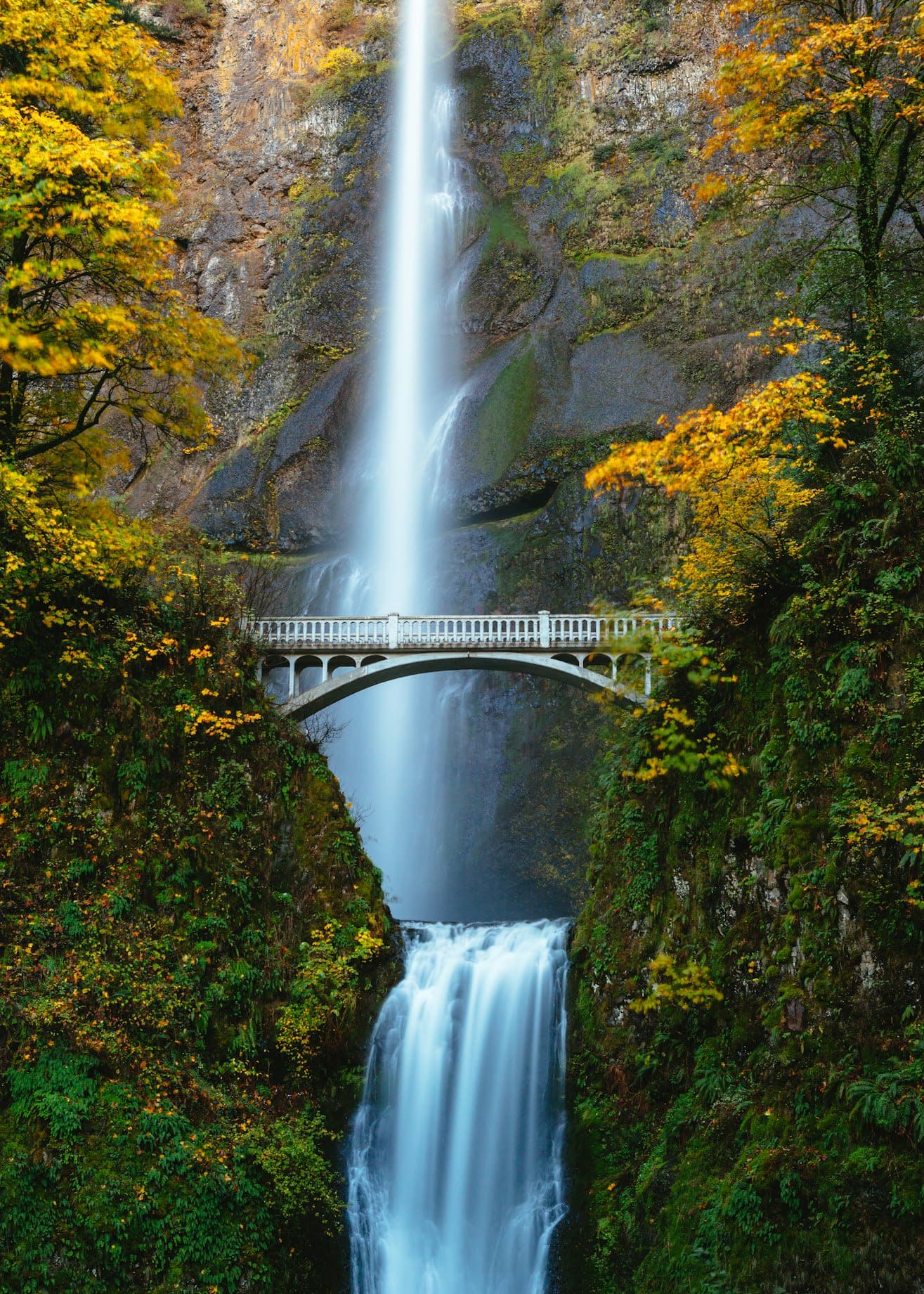
Multnomah Falls, Oregon
Where a maiden's sacrifice became an eternal waterfall in the Columbia River Gorge
Corbett, Oregon, United States
At A Glance
- Coordinates
- 45.5762, -122.1158
- Suggested Duration
- 1-2 hours to walk to the bridge, spend time in the mist, and possibly hike partway up the trail
Pilgrim Tips
- Outdoor attire appropriate for hiking. Waterproof layer recommended due to mist, especially if spending time on the bridge. Sturdy footwear for the upper trail. Layers for changing weather conditions in the Gorge.
- Permitted and extremely popular. The Benson Footbridge is the iconic photo location. Be courteous to others waiting for photos. Consider what you lose when you experience the falls only through a screen.
- This is a popular destination; solitude is difficult to find, especially in summer. The upper trail requires appropriate footwear and physical capability. Weather can change quickly in the Gorge. In winter, ice forms on the trail and may cause closures. Respect the landscape and stay on designated paths.
Overview
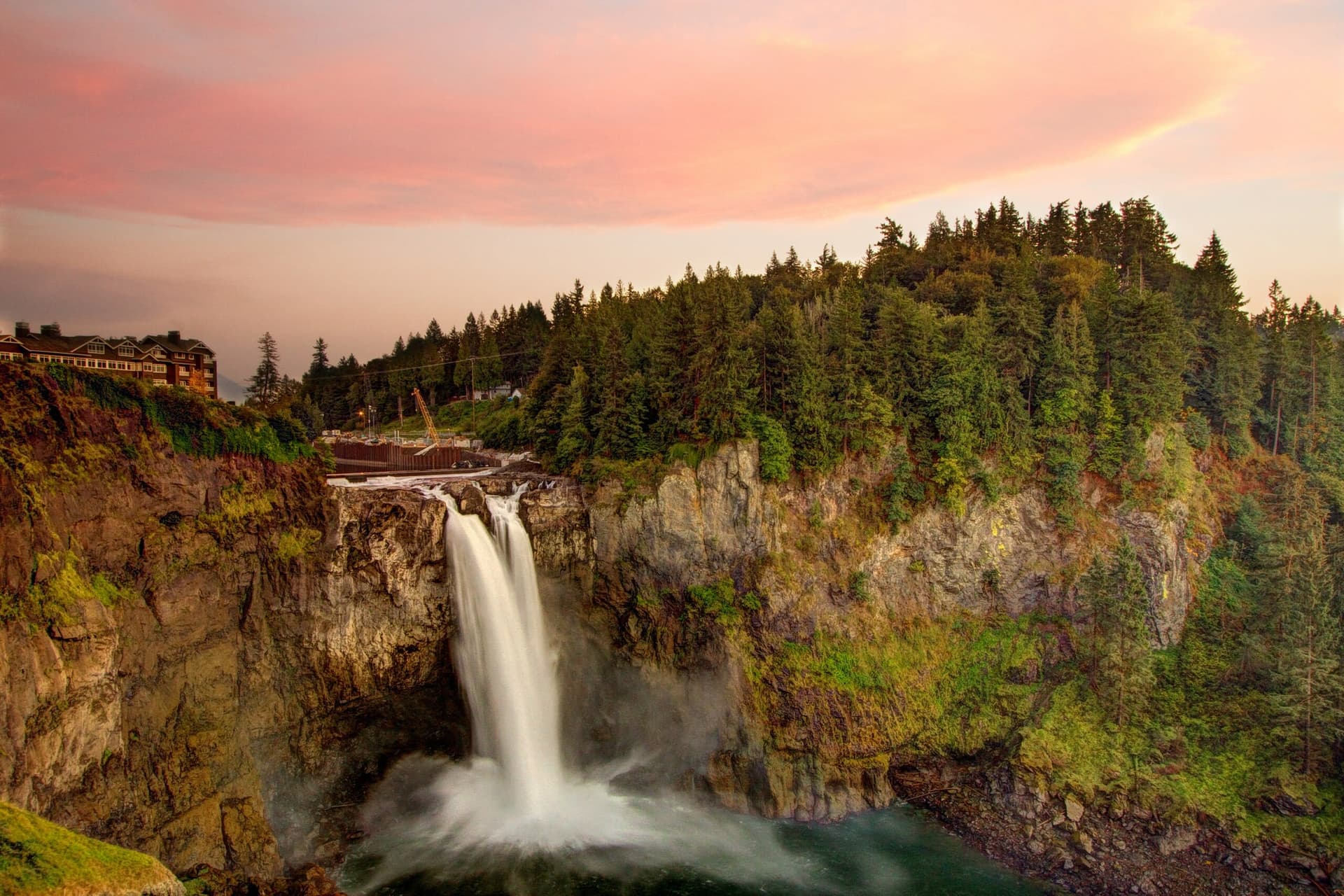
Multnomah Falls plunges 620 feet down basalt cliffs in the Columbia River Gorge, the most visited natural site in the Pacific Northwest. For thousands of years, the Chinookan peoples knew this place as sacred ground where the boundary between human and spirit worlds grew thin. According to their teaching, the waterfall was created when the Great Spirit honored a young woman who leapt from the cliff to save her people from plague. Her courage became the falling water; her spirit, the mist that rises to cleanse all who visit.
The water falls six hundred and twenty feet. This is a fact you can measure. But what draws over two million visitors each year cannot be captured in feet and gallons. The Chinookan peoples who have lived in the Columbia River Gorge for millennia understand this place as the physical embodiment of a young woman's ultimate sacrifice. The story is specific: a deadly sickness spread through the Multnomah village. The medicine man declared that all would die unless an innocent maiden, daughter of a chief, willingly gave her life by leaping from a high cliff. The chief refused to allow it. But when the young woman's new husband fell ill, she knew what she must do. She traveled to the highest cliff above the river, asked the Great Spirit for a sign of acceptance, and when the moon rose over the trees, she closed her eyes and stepped into empty air.
The next morning, everyone who had expected to die awoke healed. Where the maiden fell, the Great Spirit created a waterfall so her courage would be remembered forever. The mist that rises from the base carries her continuing gift: cleansing and healing for all who enter it.
This is not a legend consigned to the past. Standing at the base of Multnomah Falls today, watching water cascade in two massive drops over basalt that formed in ancient lava flows, you can choose how to encounter this place. The geology is extraordinary on its own terms. But the story offers something else: an invitation to consider what we might give for those we love, and what endures after we are gone. Some say the maiden returns each winter, dressed in white, to watch over the place of her sacrifice. Those who look carefully claim to see her form in the upper falls.
Context And Lineage
The Chinookan peoples have revered this place for millennia. The current legend may represent one telling of a story that has existed in various forms across generations.
Long ago, a deadly sickness spread through the Multnomah village. People fell ill by the dozens; nothing the healers tried could stop the plague. The medicine man sought guidance from the spirits and returned with terrible news: all would die unless a pure and innocent maiden, daughter of a chief, willingly sacrificed her life by leaping from a high cliff.
The chief had such a daughter, young and beloved. He refused. He would rather die himself than ask this of his child. The days passed, and the sickness took more lives.
Then the chief's daughter met a young man, a warrior, and they fell in love. They married in the traditional way. But almost immediately after the wedding, the young husband fell ill with the sickness. The woman watched him grow weaker and knew what she must do.
She left her dying husband and walked to the highest cliff overlooking the great river. Standing at the edge, she spoke to the Great Spirit: if her sacrifice would be accepted, let the moon rise over the trees as a sign. She waited. The moon rose.
She closed her eyes and stepped forward into nothing.
The next morning, every person in the village who had expected to die awoke healed. The young husband opened his eyes and called for his wife, but she was gone. The villagers found her at the base of the cliff.
The Great Spirit created a waterfall where she had fallen, so her courage and love would be remembered forever. The mist that rises from the water carries her healing spirit to all who come here. And some say that in winter, when the water freezes on the rocks and snow covers the cliffs, the maiden returns dressed in white to watch over the place of her sacrifice.
This telling comes primarily from the Multnomah people, a Chinookan tribe. The Wasco people maintain a similar version. Scholars note variations across sources; the legend has been transmitted orally for generations, and each telling adds or emphasizes different elements. What remains consistent is the core: a maiden's self-sacrifice saved her people, and the waterfall is her memorial.
The sacred significance of Multnomah Falls emerges from the cosmology of the Columbia River Gorge peoples, including the Multnomah, Wasco, Klickitat, Chinook, and others. These traditions understood certain landscape features as sites where the spirit world intersected with the human world. The waterfall's origin legend belongs to a broader pattern of Pacific Northwest narratives in which natural features memorialize important events and beings. While active ceremonial practice is not documented at the falls today, the legend continues to be told and forms part of the region's cultural heritage.
The Maiden
Simon Benson
Why This Place Is Sacred
The waterfall stands where a young woman became spirit. The mist that rises is not mere vapor but the continuation of her gift, carrying healing to all who enter it.
What makes a place thin? The Celtic concept describes locations where the distance between the human world and something beyond it narrows to almost nothing. Multnomah Falls possesses multiple qualities that traditions worldwide associate with such sites.
First, there is the threshold. The 620-foot drop creates an unmistakable boundary between worlds. Water falls from the upper realm to the lower; mist rises from the lower to the upper. You stand in the meeting place, neither fully above nor below. The Benson Footbridge, constructed in 1914, positions visitors precisely at this crossing point, 105 feet above the pool where mist and spray create a perpetual veil.
Second, there is transformation. In the Chinookan understanding, this is where a human became spirit. The maiden's body fell, but her essence rose in the water that has not stopped flowing since. Every drop is a continuation of that original act of love. The boundary between living and departed grows thin at sites of sacrifice.
Third, there is year-round flow. Unlike many waterfalls that diminish to trickles in dry months, Multnomah Falls maintains volume through all seasons. Fed by underground springs from Larch Mountain, the waterfall seems to exist outside ordinary time, always present, always falling. This permanence suggests something beyond the merely natural.
Fourth, the basalt cliffs themselves create a cathedral-like atmosphere. The black rock formations, product of ancient lava flows, rise in vertical walls that dwarf human scale. Sound behaves strangely here: the roar of falling water fills the space yet somehow produces a quality of listening rather than noise.
Visitors who know nothing of the legend still report experiences consistent with thin-place phenomenology: unexpected emotion, a sense of presence, feeling cleansed or renewed after standing in the mist. Whether this reflects psychological response to overwhelming natural beauty, the accumulated weight of millennia of human reverence, or something that cannot be measured, the pattern is consistent enough to take seriously.
Gathering place and site of spiritual power for Chinookan peoples. Location where offerings were made to honor spirits and seek guidance and protection. Possible site of wedding ceremonies based on the legend's context.
For thousands of years, the falls served as sacred ground for the Multnomah, Wasco, Klickitat, Chinook, and other peoples of the Columbia River Gorge. The coming of European settlers transformed the site's public use but did not erase its significance. Simon Benson, a timber baron and philanthropist, developed the current visitor infrastructure in the early twentieth century, constructing the iconic footbridge in 1914 and the lodge in 1925. The falls became Oregon's most popular natural attraction, drawing visitors who may not know the legend but consistently report experiences of awe, peace, and renewal. In 1986, the site was incorporated into the Columbia River Gorge National Scenic Area. Today, the legend continues to be told and the maiden's sacrifice is honored, though active Indigenous ceremonies are not documented.
Traditions And Practice
Traditional ceremonial practices at the falls are not well-documented in public sources. Today, the site functions primarily as a nature destination, though visitors often treat it with reverence.
According to historical sources, the falls were a sacred gathering place where the Chinookan peoples conducted rituals and offerings to honor spirits and seek guidance and protection. The context of the origin legend suggests that wedding ceremonies may have taken place here. Healing practices likely involved the waterfall's mist, which carries spiritual significance in the tradition. Specific details of pre-contact ceremonies are not publicly documented.
No formal indigenous ceremonies are documented as currently taking place at Multnomah Falls. The site functions primarily as a tourist destination managed by the U.S. Forest Service. However, the legend continues to be shared through official interpretive materials and popular retellings. Many visitors, whether or not they know the story, treat the falls with a reverence that transcends ordinary tourism. Some report coming for healing or renewal, consciously or unconsciously enacting the tradition that the mist carries cleansing power.
Walk the paved path from the parking area to the lower viewing platform and let the scale of the falls establish itself. Continue to the Benson Footbridge and stand in the mist. Allow it to touch your face, your hands, your clothes. Consider what the tradition teaches: this is not mere water but the continuation of a young woman's gift. If you feel moved, hike the trail to the upper overlook. At the top, you stand where the maiden stood before her leap. Look out over the gorge and consider what you would give for those you love. On the descent, let the legend accompany you. Notice if you feel different than when you arrived.
Multnomah/Chinookan
HistoricalThe Multnomah people, a Chinookan tribe native to the Columbia River Gorge, are the traditional keepers of the waterfall's origin legend. The falls were a sacred gathering place and a site of spiritual power where rituals and offerings were conducted to honor spirits and seek guidance and protection. The waterfall itself was created by the Great Spirit in response to a young maiden's self-sacrifice to save her people from plague.
Offerings at the falls to honor spirits. Healing rituals using the sacred mist. Prayers for health, well-being, guidance, and protection. Based on the legend's context, possibly wedding ceremonies. Active ceremonial practice at the falls is not documented today.
Wasco
HistoricalThe Wasco people, also of the Columbia River region, maintain their own version of the Multnomah Falls legend. Their telling emphasizes the healing nature of the mist and the ongoing presence of the maiden's spirit watching over her people.
Healing through connection with the falls' mist. Spiritual acknowledgment of the maiden's sacrifice. Contemporary ceremonial practice at the falls is not documented.
Experience And Perspectives
The falls reveal themselves in stages. First the sound reaches you, then the mist on your face, then the full vertical drop comes into view. The Benson Footbridge positions you in the space between worlds.
You arrive at Multnomah Falls along the Historic Columbia River Highway, a road designed in the early twentieth century to reveal the Gorge's beauty in carefully composed views. Or you come from Interstate 84, the modern route that trades scenic drama for speed. Either way, the waterfall announces itself before you see it: first as sound, a white noise that fills the canyon; then as humidity, a coolness and dampness in the air; finally as visual revelation when the 620-foot cascade appears through the trees.
The lower viewing area is often crowded. This is the most visited natural site in the Pacific Northwest, drawing over two million people annually. Yet something about the falls absorbs the crowds. The scale is humbling. The sound creates a cocoon of white noise that separates you from the conversations around you. Even surrounded by tourists, many visitors report feeling strangely alone, or alone with the water.
The paved path climbs to the Benson Footbridge, a stone arch spanning the pool between the upper and lower falls. Here, 105 feet above the base, you stand in the midst of the spray. The mist soaks your clothes, beads on your skin, enters your lungs. If you accept the traditional understanding, this is not mere water vapor but the maiden's continuing gift of healing and cleansing. Whether you believe this literally, the phenomenology is real: people feel different after standing in the mist.
From the bridge, the upper falls tower another 500 feet above you. In the spray and shifting light, shapes seem to form and dissolve. Some visitors report seeing a female form in the water. The tradition holds that the maiden returns each winter, dressed in white, to watch over her sacrifice. Even in summer, the play of light and water on the upper falls creates the impression of presence.
For those seeking deeper encounter, the trail continues 1.2 miles to an overlook above the upper falls. The path switchbacks through forest, climbing 700 feet. At the top, you stand where the maiden stood before she stepped into air. The view extends across the Columbia River Gorge to Washington's cliffs. Hawks circle on thermal currents. The world drops away beneath your feet.
The falls are located at 53000 Historic Columbia River Highway, Corbett, Oregon. From Portland, take I-84 east to Exit 31, approximately 30 miles. The lower viewing area and Benson Footbridge are accessible via a short paved path. The overlook above the upper falls requires a 2.4-mile round-trip hike with 700 feet of elevation gain. The Multnomah Falls Lodge provides food service and restrooms. Timed entry permits are required from late May through early September, 9am to 6pm.
Multnomah Falls exists simultaneously as geological feature, Indigenous sacred site, and contemporary tourist destination. Each lens reveals something different; none captures the whole.
The waterfall is a geological feature formed by water cascading over Columbia River Basalt Group formations, basalt layers deposited between 17 and 6 million years ago. The Missoula Floods, catastrophic glacial outburst floods occurring between 15,000 and 13,000 years ago, carved the Columbia River Gorge and exposed the cliff faces over which Multnomah Falls flows. The water itself comes from underground springs fed by snowmelt and rainfall on Larch Mountain, which is why the falls maintain flow year-round.
The Multnomah people were a Chinookan tribe historically occupying the Portland Basin and lower Columbia River area. Their name, which the county and falls now bear, may derive from a Chinookan word meaning 'downriver.' The legend of the maiden's sacrifice has been documented in various forms and is recognized as an important piece of Pacific Northwest Indigenous oral tradition. Scholars note variations between sources and acknowledge that the story has evolved through oral transmission and later written recording.
For the Chinookan peoples, the falls were not merely significant but powerful. This was a site where the boundary between human and spirit worlds grew thin, where prayers would be heard and guidance received. The origin legend teaches that the waterfall is not a natural accident but a deliberate creation by the Great Spirit to honor a young woman's courage and continue her gift of healing. The mist is not water vapor but spirit, the maiden's love made tangible. The falls exist as memorial, medicine, and ongoing presence.
This understanding does not require proof in the Western sense. The legend is not a hypothesis to be tested but a teaching to be received. Whether a maiden actually fell from a cliff is less important than what the story teaches: that sacrifice for community has meaning, that love transcends death, that certain places carry power because of what happened there.
Some visitors report seeing a female form in the upper falls, particularly in winter when ice and snow transform the landscape. Whether these are genuine encounters with the maiden's spirit, psychological projections onto a suggestive visual field, or something else entirely remains uncertain. The waterfall is not widely identified as an 'energy vortex' or similar New Age designation, but individual seekers have reported unusual experiences including heightened emotion, vivid dreams in nearby camps, and sense of presence. These reports are anecdotal and not systematically studied.
The specific ceremonial practices conducted at the falls before European contact are not well-documented in public sources. How the legend has evolved through oral transmission remains uncertain; early written recordings may have altered or simplified the traditional telling. Contemporary perspectives from descendant communities of the Chinookan peoples are not prominently represented in available sources. The geological and hydrological factors that maintain year-round flow are understood in general terms but not fully characterized.
Visit Planning
Located 30 miles east of Portland along the Historic Columbia River Highway. Open year-round. Timed permits required in peak season. Allow 30 minutes to 2 hours depending on how far you hike.
Multnomah Falls Lodge has restaurant and snack bar (no lodging). Hotels and lodging in Corbett, Troutdale, Hood River, and Portland. Camping available in the Columbia River Gorge National Scenic Area.
This is public land managed as a natural recreation site. No formal religious protocols apply, but the story invites respect beyond ordinary tourism.
Multnomah Falls is managed by the U.S. Forest Service as part of the Columbia River Gorge National Scenic Area. Unlike sites with active worship, there are no religious protocols visitors must observe. Yet the legend that accompanies this place offers an invitation to treat it as more than a photo opportunity.
The waterfall exists because a young woman gave her life for her community. The mist that touches your face is, in the traditional understanding, her continuing gift. These are not facts that can be verified by scientific measurement, but they have shaped how Indigenous peoples have related to this place for millennia. Visitors who take the story seriously often find that their experience of the falls deepens.
Practically speaking, respect the landscape. Stay on designated trails; the basalt cliffs and surrounding forest are ecologically sensitive. Do not throw objects over the falls. Do not remove rocks, plants, or other materials. The falls receive over two million visitors annually; each person's impact accumulates.
The crowds present their own etiquette challenge. The Benson Footbridge is a popular photo location; be mindful of others waiting for their turn. On the upper trail, yield to those descending on the narrow switchbacks. In the viewing areas, move through efficiently if others are waiting.
If you encounter anyone who appears to be treating the site as sacred space, whether through meditation, prayer, or quiet contemplation, give them room. Not everyone is here for the same reasons.
Outdoor attire appropriate for hiking. Waterproof layer recommended due to mist, especially if spending time on the bridge. Sturdy footwear for the upper trail. Layers for changing weather conditions in the Gorge.
Permitted and extremely popular. The Benson Footbridge is the iconic photo location. Be courteous to others waiting for photos. Consider what you lose when you experience the falls only through a screen.
Not a traditional practice for visitors. Leave no trace. Do not throw coins or other objects into the water.
Stay on designated trails. Timed entry permits required late May through early September, 9am-6pm. Dogs must be leashed. Drones prohibited. Upper trail may close in winter due to ice.
Sacred Cluster
Nearby sacred places create the location cluster described in the growth plan. This block is intentionally crawlable and links into the wider regional graph.