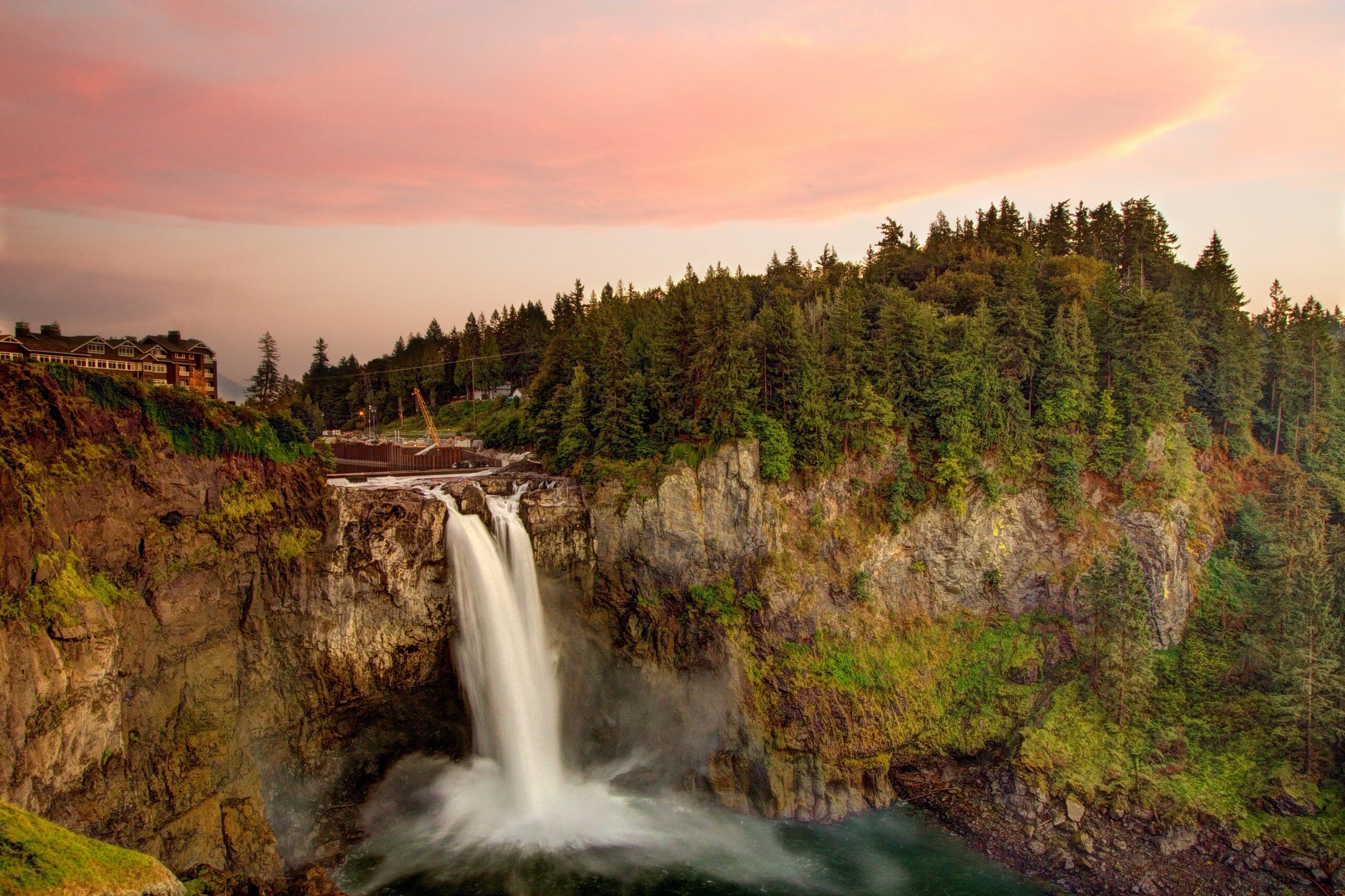
Snoqualmie Falls, Oregon
Where Moon the Transformer created humanity, and the Snoqualmie People still gather in ceremony
Snoqualmie, Washington, United States
At A Glance
- Coordinates
- 47.5416, -121.8375
- Suggested Duration
- Thirty minutes suffices for the upper observation deck. One to two hours allows exploration of both viewing areas and the interpretive trail. Those staying at Salish Lodge can return to the falls at different times of day, experiencing the changing quality of light and crowd levels.
- Access
- Address: 6501 Railroad Avenue SE, Snoqualmie, WA 98024. The falls are 30 miles east of Seattle via I-90. Take Exit 25 or Exit 27 and follow signs. Main parking lot charges $7 for two hours, $5 for each additional hour. A free overflow lot across the road connects to the main area via an overhead bridge with ADA access. The site is open dawn to dusk year-round. A visitor center and gift shop are available. The trail to the lower observation area is approximately half a mile with significant elevation change; it may be slippery when wet.
Pilgrim Tips
- Address: 6501 Railroad Avenue SE, Snoqualmie, WA 98024. The falls are 30 miles east of Seattle via I-90. Take Exit 25 or Exit 27 and follow signs. Main parking lot charges $7 for two hours, $5 for each additional hour. A free overflow lot across the road connects to the main area via an overhead bridge with ADA access. The site is open dawn to dusk year-round. A visitor center and gift shop are available. The trail to the lower observation area is approximately half a mile with significant elevation change; it may be slippery when wet.
- Hiking attire appropriate for the season. A waterproof layer is advisable due to mist from the falls, which can be significant depending on wind conditions. Comfortable walking shoes with adequate grip for the trail to the lower observation area.
- Photography is permitted at public viewing areas. Do not photograph tribal ceremonies under any circumstances. Consider spending time simply watching before documenting. The impulse to photograph can interfere with the quality of presence the site rewards.
- Do not attempt to conduct ceremonies, leave offerings, or perform rituals at the falls. The site belongs to the Snoqualmie People, and such practices by visitors are inappropriate regardless of spiritual intent. Do not photograph tribal ceremonies if you witness them. If areas are closed for tribal use, respect those closures completely. Be wary of anyone claiming to offer shamanic or indigenous ceremonial experiences at or near the falls. Authentic Snoqualmie practice is not available for purchase by visitors.
Overview
For the Snoqualmie People, this 268-foot waterfall is where creation began. According to their tradition, Moon the Transformer made the first man and woman here, and the mists rising from the plunge pool carry prayers to the ancestors. In 2019, after more than a century of separation, the tribe purchased the falls and surrounding land, returning stewardship of their birthplace to its original people.
The water falls 268 feet, nearly twice the height of Niagara, and where it strikes the pool below, something happens. The liquid becomes mist, rising back toward the sky in clouds that the Snoqualmie People understand as carrying prayers between worlds.
This is the birthplace. According to Snoqualmie tradition, Moon the Transformer traveled here in the time before time, transforming the world as he went. When he reached the great fish weir that Raven had built across the river, Moon changed it into a waterfall and declared that it would provide for the people. Then he created those people, the first man and woman, here at this place.
The Snoqualmie have gathered at these falls since time immemorial. They come for ceremony and prayer, to connect with ancestors buried in the surrounding land for hundreds of generations. The pounding of the water, the rising mists, the presence of spirit in the pool below, all persist as they have always persisted.
In 2019, after more than a century of displacement, the Snoqualmie Tribe purchased the falls, the Salish Lodge, and forty-five acres of surrounding land. For $125 million, they reclaimed not property but birthright. The most sacred site of the People of the Moon returned to their stewardship.
Over 1.5 million visitors come each year. Most see a waterfall. Those who learn the story encounter something else: a living relationship between people and place, unbroken across millennia, now restored.
Context And Lineage
Snoqualmie Falls exists within the cosmology of the Snoqualmie Tribe, whose name means 'People of the Moon.' The creation story of Moon the Transformer, passed down through oral tradition, tells of how the waterfall and the first humans came into being at this site. The tribe maintained their connection to the falls despite colonization, lack of federal recognition until 1999, and the industrialization of the river. Their 2019 purchase of the site represents one of the most significant land reclamations in recent indigenous history.
The story of Moon the Transformer spans the making of the world. It begins in the Sky World, where two sisters wished upon stars that descended and became their husbands. The older sister bore a child, the Star Child who would become Moon. Missing their home on Earth, the sisters wove a ladder of roots and returned, but during the celebration of their arrival, Moon was carried away by the Dog Salmon People.
When Bluejay found Moon and told him of his origin among the Sky People, Moon left the Dog Salmon to return to his mother's people. He traveled up the river, transforming everything he encountered. Sandpipers, ducks, clams, bears, and deer all received their current forms through his work. The world as it is took shape under Moon's hands.
When Moon reached the great fish weir that Raven had built across the river, he transformed it into the waterfall. He declared its purpose: 'You, Waterfall, shall be a lofty cataract. Birds flying over you will fall and people shall gather them up and eat them. Deer coming down the stream will perish and the people shall have them for food. Game of every kind shall be found by the people for their subsistence.'
Then Moon created the first man and woman. The Snoqualmie, whose name translates as 'People of the Moon,' trace their origin to this moment and this place.
The full telling of this story traditionally takes many hours. What appears here is a fragment, shared with permission, offering context for visitors. The complete narrative remains in the keeping of the Snoqualmie people.
The Snoqualmie are a Lushootseed-speaking Coast Salish people who have inhabited the Snoqualmie Valley since time immemorial. Archaeological evidence confirms continuous indigenous presence in the region for thousands of years, though the Snoqualmie understanding is that their presence predates any dating method.
Colonization brought treaties that were often broken, federal policies that denied the tribe's existence, and industrial development that disrupted the falls themselves. The Point Elliott Treaty of 1855 was signed by Snoqualmie leaders, but the federal government did not recognize the tribe until 1999. During those 144 years of official invisibility, the Snoqualmie maintained their identity, their ceremonies, and their relationship to the falls.
The tribe's cultural programs now include revitalization of the Lushootseed language, traditional arts such as weaving and carving, and ceremonial practices passed down through generations. Annual participation in the Canoe Journeys reconnects the Snoqualmie with other Coast Salish nations across the Pacific Northwest.
The 2019 land purchase placed the tribe's most sacred site back under their stewardship. This represents not the beginning of a relationship but its continuation, now with the legal and economic resources to protect what has always been protected through presence alone.
Moon the Transformer
deity
The creator figure who shaped the world and made the first humans at Snoqualmie Falls. Born in the Sky World to a human mother, Moon traveled the land transforming it into its current form before creating the Snoqualmie people at the waterfall.
Raven
deity
In the creation story, Raven built the great fish weir across the river that Moon transformed into Snoqualmie Falls. Raven appears throughout Coast Salish tradition as a powerful figure, sometimes trickster, sometimes creator.
The Spirit of the Pool
deity
A powerful spirit believed to inhabit the plunge pool at the base of the falls. Those who sought spirit power came to this pool, and some found what they sought in encounter with this presence.
Why This Place Is Sacred
Snoqualmie Falls is sacred as the creation site of the Snoqualmie People, where Moon the Transformer made the first humans. The falling water, the rising mist, and the spirit inhabiting the plunge pool create what the tribe understands as a connection between Heaven and Earth. Ancestors have been buried here for hundreds of generations, and the site remains the center of living ceremony.
The sacredness of Snoqualmie Falls does not derive from aesthetic grandeur, though it possesses that. The 268-foot cascade is the second most visited natural landmark in Washington State. But beauty alone does not make a thin place.
For the Snoqualmie People, this is where existence began. Moon the Transformer, Star Child born in the Sky World, descended to Earth and traveled up the river, transforming everything he encountered along the way. Sandpipers, ducks, clams, bears, deer, all received their current forms through his work. When Moon reached the great fish weir that Raven had constructed, he transformed it into the waterfall and spoke its purpose into being: birds flying over would fall and become food for the people, deer coming down the stream would perish and sustain the people. Then he made the people themselves.
The water's transformation is the key. Liquid pours over the cliff edge, strikes the pool with thunderous force, and becomes mist. That mist rises, carrying prayers to the Creator and to the ancestors who wait beyond. Tribal Elder Lois Sweet Dorman describes it this way: 'That pounding of the water is a sacred cycle, and that pounding and the mists rising are a connection of worlds.'
In Coast Salish traditional belief, a powerful spirit inhabits the pool at the base of the falls. Those who sought spirit power came here, and some found it. The pool was not merely deep water but a threshold, a place where encounter with the other-than-human became possible.
The land surrounding the falls holds the bones of ancestors. For hundreds of generations, the Snoqualmie have buried their dead in this sacred ground. Beginning and ending converge here. As tribal member McKenna Sweet Dorman states: 'It is our beginning and our end.'
The falls have served as the spiritual center of the Snoqualmie People since before recorded history. Traditional purposes included ceremony and prayer connecting the living with ancestors and Creator, seeking spirit power at the pool below the falls, healing rituals, and burial of the dead in the sacred ground. The site was understood not as a location of past events but as an ongoing point of connection between worlds, continuously active and accessible to those who approached properly.
The relationship between the Snoqualmie and their sacred falls was disrupted but never severed. In 1898, the Puget Sound Power Company constructed the world's first completely underground hydroelectric powerhouse in a cavern 270 feet below the falls, diverting water that had thundered over the cliff since Moon transformed it. The tribe was not consulted.
The Snoqualmie were not federally recognized as a tribe until 1999, leaving them without legal standing for most of the twentieth century. But they continued to gather at the falls, continued to pray, continued to bury their dead in the surrounding land. The ceremonies persisted even when the tribe itself was officially invisible.
The 2019 purchase represents restoration rather than acquisition. The tribe did not gain the falls; they returned to them. Today, the Snoqualmie Tribe owns and operates the Salish Lodge and the land surrounding the falls while balancing the needs of over 1.5 million annual visitors with the requirements of a living sacred site.
Traditions And Practice
The Snoqualmie Tribe conducts private ceremonies at the falls as they have done for generations. Visitors cannot participate in tribal ceremonies but are encouraged to approach the site with mindfulness and respect, acknowledging that they are guests on Snoqualmie land.
Traditional practices at Snoqualmie Falls include ceremony and prayer connecting the living with ancestors and Creator, seeking spirit power at the pool below the falls, healing rituals involving drumming and sacred sage purification, traditional songs and dances honoring the ancestors, and burial of the dead in the sacred ground surrounding the site.
The specific forms of these ceremonies remain private to the tribe. What can be said is that they continue. The Snoqualmie gather at their birthplace for reasons that long predate tourism and will long outlast it.
Contemporary Snoqualmie practice maintains connection to traditional ceremony while adapting to modern realities. The tribe participates in annual Canoe Journeys, gathering with other Coast Salish nations in ceremonies that affirm indigenous presence and cultural continuity. Cultural programs teach traditional arts, Lushootseed language, and ceremonial practices to younger generations.
At the falls themselves, the tribe continues to gather for private ceremonies. The 2019 purchase of the site allows the Snoqualmie to control access when ceremony requires it. Some areas may be closed to visitors during these times, and visitors should respect such closures without demanding explanation.
Visitors seeking meaningful engagement at Snoqualmie Falls might consider the following.
Before arriving, learn the creation story of Moon the Transformer. This narrative transforms the falls from scenery into sacred site. Understanding where you are standing, and what the Snoqualmie understand to have happened there, changes the quality of attention you bring.
Offer the land acknowledgment suggested by the tribe, either silently or quietly aloud. This practice of recognition is not performative but relational, an admission that you are a guest on someone's homeland.
Watch the mist rise. Allow the Snoqualmie understanding, that prayers travel in this mist to ancestors and Creator, to shape your attention. You need not adopt this belief as your own, but noticing what happens when you observe with that meaning in mind is itself a practice.
If you have concerns, questions, or gratitude, you might bring them to the falls without expecting anything in return. The practice of arriving with intention rather than consumption is valuable regardless of belief system.
Snoqualmie Tribe (People of the Moon)
ActiveSnoqualmie Falls is the birthplace of the Snoqualmie People, where Moon the Transformer created the first man and woman. The falls represent the physical and spiritual origin point of the tribe. The mists rising from the cascade carry prayers to ancestors and Creator, maintaining connection between Heaven and Earth. The surrounding land holds the bones of countless generations of Snoqualmie ancestors. This is simultaneously creation site, burial ground, and active ceremonial center.
The Snoqualmie gather at the falls for ceremony and prayer, connecting with ancestors and Creator. Traditional practices include seeking spirit power at the pool below the falls, healing rituals involving drumming and sacred sage purification, traditional songs and dances, and burial of the dead in the sacred land. Specific ceremonial protocols remain private to the tribe.
Coast Salish Traditional Religion
ActiveWithin broader Coast Salish spiritual understanding, Snoqualmie Falls represents a site where powerful spirits are accessible and spirit power can be obtained. The pool at the base of the falls is inhabited by a significant spirit being. The transformation of water from liquid to mist embodies the sacred cycle connecting different realms of existence.
Coast Salish traditional practices include seeking spirit power through encounter with powerful places and beings, healing rituals, and ceremonies maintaining proper relationship with the spirit world. These practices are embedded in a cosmology that understands land, water, and all beings as alive and relational.
Experience And Perspectives
Visitors to Snoqualmie Falls consistently report being affected by the waterfall's power and presence in ways that exceed typical scenic appreciation. The mist, the thundering sound, and the scale of the cascade create an immersive experience. Those who learn the creation story often describe a deepened sense of standing somewhere significant, somewhere that belongs to someone.
The falls announce themselves before you see them. The sound reaches you first, a constant thunder that grows as you approach the observation deck. Then the mist, drifting across the platform depending on wind and season, touching your face with water that has just completed a 268-foot descent.
Visitors use predictable words: powerful, overwhelming, majestic. But beneath the tourism vocabulary, something more consistent emerges. People describe feeling cleansed, renewed, as though the mist carries something away. The scale of the cascade, nearly twice the height of Niagara, demands attention in a way that quiets internal noise. For a moment, there is only the water.
Many visitors know nothing of the creation story when they arrive. They see a waterfall, take photographs, leave. But those who learn the Snoqualmie understanding often report their experience shifting. The falls become something other than scenery. Standing where Moon the Transformer created the first humans, watching mist that the tribe understands as carrying prayers to ancestors, visitors begin to sense that they are guests somewhere. The land has owners. The water has meaning.
This recognition is itself a kind of experience: the encounter with indigenous presence in a landscape that mainstream American culture typically frames as wilderness. Snoqualmie Falls is not wilderness. It is homeland, creation site, and active sacred place. Visitors who arrive with this understanding often describe feeling both welcomed and appropriately humbled.
The falls are illuminated at night, adding another dimension for those who stay at the Salish Lodge or visit during evening hours. Floodlit mist rising against darkness creates a different quality of encounter, perhaps closer to what the site reveals without the distraction of crowds.
Snoqualmie Falls welcomes visitors but asks for particular attention. You are standing at the birthplace of a people. The Snoqualmie are not historical; they are present, gathering here for ceremony as their ancestors have done for countless generations.
Consider arriving with awareness of whose land this is. The tribe offers a suggested acknowledgment: 'I acknowledge that I am on the Indigenous Land of the Coast Salish peoples, specifically the Snoqualmie Indian Tribe (sdukwalbixw). I thank these caretakers of this land who have lived and continue to live here since time immemorial.'
Watch the mist rise. This is what the Snoqualmie understand as prayers ascending, the connection between Heaven and Earth made visible. You need not share their cosmology to notice what happens when you attend to the mist with that meaning in mind.
The lower observation area, reached by a half-mile trail, offers a different perspective. From below, the full height of the cascade becomes apparent. The mist is thicker here, more enveloping. If you have time and mobility, the descent is worthwhile.
Snoqualmie Falls holds meaning across multiple frameworks. For the Snoqualmie Tribe, it is creation site and ceremonial center, the most sacred place in their cosmology. For geologists, it is a waterfall formed by the Snoqualmie River cutting through resistant volcanic rock. For visitors, it may be scenic destination, pilgrimage site, or both. These perspectives do not compete; they address different aspects of what the falls are.
Snoqualmie Falls is a 268-foot waterfall formed where the Snoqualmie River cascades over a shelf of erosion-resistant volcanic rock. The geological processes that created the falls span millions of years. Archaeological and historical evidence confirms continuous indigenous presence in the Snoqualmie Valley for thousands of years.
The Moon the Transformer narrative was documented by anthropologist Arthur Ballard based on accounts from tribal elder Snuqualmie Charlie, born around 1850. This documentation preserved a version of the story for the written record, though oral transmission within the tribe predates and continues beyond any academic collection.
The Snoqualmie were historically a Lushootseed-speaking Coast Salish people practicing seasonal hunting, fishing, and gathering. Their social and ceremonial structures were organized around relationships with salmon, cedar, and the specific geography of the Snoqualmie Valley. The tribe's creation narrative and spiritual practices are recognized as significant cultural heritage.
For the Snoqualmie People, the falls are not a place where sacred events happened in the past. They are where creation continues to happen, where the boundary between worlds remains thin, where prayers still travel in the rising mist. The tribe's understanding is experiential and relational rather than merely historical.
Tribal Elder Lois Sweet Dorman describes the sacred cycle: the pounding of water, the transformation into mist, the rising of that mist toward the Sky World. This cycle connects Heaven and Earth, the living and the ancestors, the present and the time of Moon the Transformer. The connection is not metaphor but reality.
The tribe's 2019 purchase of the falls represents this understanding in action. As the tribe states: 'For indigenous peoples, there is no separation of self and sacred lands.' Reclaiming the falls was not a real estate transaction but a restoration of relationship. The land returned to those who never left it, even when official recognition was denied and commercial interests controlled access.
The Pacific Northwest attracts spiritual seekers drawn to its landscape of mountains, forests, and water. Snoqualmie Falls appears in various alternative spiritual frameworks as a power site, a place of concentrated natural energy. Some visitors describe sensing the presence of spirits or experiencing unusual states of awareness at the falls.
These interpretations exist alongside, rather than instead of, indigenous understanding. However, visitors should recognize that the Snoqualmie have prior claim to defining what their birthplace means. Alternative spiritual frameworks can coexist with respect for indigenous authority over indigenous sacred sites.
Genuine mysteries persist around Snoqualmie Falls. The complete Moon the Transformer narrative, traditionally requiring many hours to tell properly, contains depths that summary cannot convey. What has been shared publicly represents only a portion of the story.
The specific practices conducted during tribal ceremonies remain private, as they should. The full extent of ancestral burial sites in the area is not public knowledge. The mechanisms by which the creation story has been transmitted across generations, surviving colonization, federal non-recognition, and cultural disruption, remain partly mysterious even to academic study.
The tribe holds knowledge that is theirs to share or protect as they choose. Visitors should respect that not everything is available for consumption.
Visit Planning
Snoqualmie Falls is located 30 miles east of Seattle, easily accessible by car. The main observation area requires no hiking. A half-mile trail descends to a lower viewing area. Parking is paid near the lodge, with a free overflow lot across the road. The Salish Lodge, owned by the Snoqualmie Tribe, offers accommodation directly at the falls.
Address: 6501 Railroad Avenue SE, Snoqualmie, WA 98024. The falls are 30 miles east of Seattle via I-90. Take Exit 25 or Exit 27 and follow signs. Main parking lot charges $7 for two hours, $5 for each additional hour. A free overflow lot across the road connects to the main area via an overhead bridge with ADA access. The site is open dawn to dusk year-round. A visitor center and gift shop are available. The trail to the lower observation area is approximately half a mile with significant elevation change; it may be slippery when wet.
Salish Lodge and Spa sits directly at the falls, offering upscale lodging with views of the cascade. The lodge is now owned and operated by the Snoqualmie Tribe. Additional accommodations are available in Snoqualmie, North Bend, and the greater Seattle area.
Snoqualmie Falls is simultaneously a major tourist destination and the most sacred site of the Snoqualmie People. Visitor behavior should reflect awareness of both realities. Stay on designated trails, follow Leave No Trace principles, and approach the site with mindfulness rather than conquest.
The most important principle is recognition. You are standing on Snoqualmie land, at the Snoqualmie birthplace, where Snoqualmie people continue to gather for ceremony. This awareness should shape everything else.
Stay on designated trails and observation decks. The land beyond these areas may be ecologically sensitive, spiritually significant, or both. Do not venture beyond maintained paths. Do not climb fences or barriers.
If you encounter what appears to be a tribal ceremony, do not approach, photograph, or observe from close range. Move away quietly. The Snoqualmie's practice is not a cultural performance for visitor benefit.
Follow Leave No Trace principles completely. Dispose of all trash and pet waste properly. The idea that this land is sacred should make littering unthinkable, but the volume of visitors requires explicit reminder.
Experience the land with mindfulness rather than conquest. This phrase, from tribal guidance to visitors, captures something essential. The falls are not a backdrop for photographs. They are a living sacred site that happens to permit visitors. Conduct yourself accordingly.
Hiking attire appropriate for the season. A waterproof layer is advisable due to mist from the falls, which can be significant depending on wind conditions. Comfortable walking shoes with adequate grip for the trail to the lower observation area.
Photography is permitted at public viewing areas. Do not photograph tribal ceremonies under any circumstances. Consider spending time simply watching before documenting. The impulse to photograph can interfere with the quality of presence the site rewards.
Physical offerings are not appropriate for non-tribal visitors. Leave nothing at the site. If you wish to offer something, make it internal: acknowledgment, gratitude, attention.
The falls are accessible dawn to dusk. Some areas may be closed for tribal ceremonies; respect all closures without requiring explanation. Stay on designated trails. Follow all posted guidelines. The hydroelectric museum is open Wednesday through Sunday, 10am to 5pm, from Memorial Day through Labor Day.
Sacred Cluster
Nearby sacred places create the location cluster described in the growth plan. This block is intentionally crawlable and links into the wider regional graph.