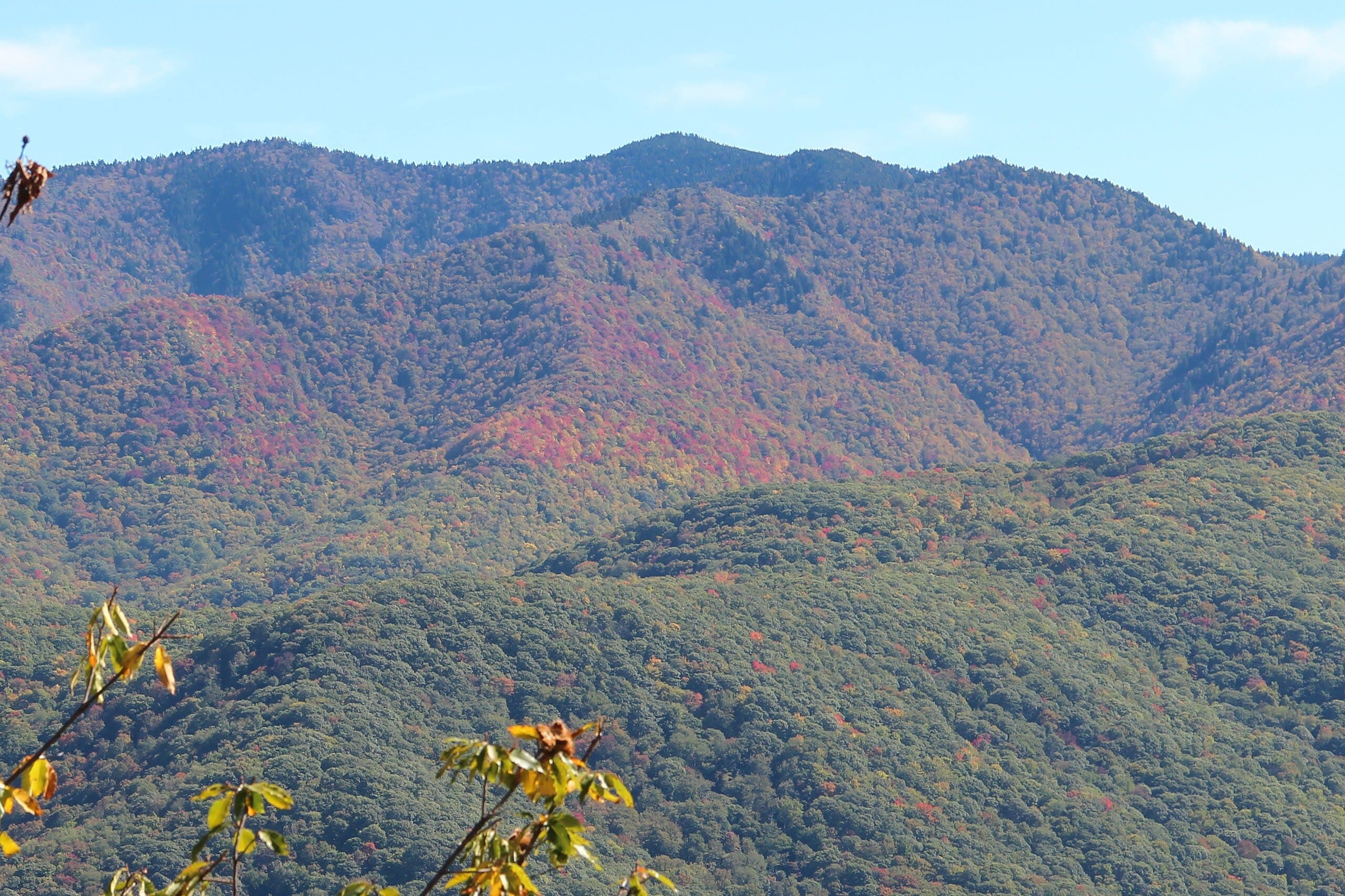
Mt. Richland-Balsam, North Carolina
Where the Great Slant-eyed Giant once dwelt, and spruce-fir mists still thin the veil
Near Waynesville, North Carolina, United States
At A Glance
- Coordinates
- 35.3672, -82.9904
- Suggested Duration
- The loop trail takes 45 minutes to 1.5 hours at a leisurely pace. Those seeking deeper engagement should allow additional time for sitting in silence and contemplation. A meaningful visit might take half a day, though most parkway travelers spend less than an hour.
- Access
- The site is located at Blue Ridge Parkway Milepost 431, at the Haywood-Jackson Overlook. Free parking is available at the overlook. The trailhead is at the north end of the parking lot. From Asheville, the drive takes approximately one hour (36 miles via the parkway). From Cherokee, the drive takes approximately 45 minutes (30 miles). The parkway speed limit is 45 mph and the road is winding, so allow extra time.
Pilgrim Tips
- The site is located at Blue Ridge Parkway Milepost 431, at the Haywood-Jackson Overlook. Free parking is available at the overlook. The trailhead is at the north end of the parking lot. From Asheville, the drive takes approximately one hour (36 miles via the parkway). From Cherokee, the drive takes approximately 45 minutes (30 miles). The parkway speed limit is 45 mph and the road is winding, so allow extra time.
- Dress for mountain conditions. Temperatures at 6,000 feet run significantly cooler than the valleys below, often by 15-20 degrees Fahrenheit. Layers are essential, as conditions can change quickly. Sturdy footwear with good traction is recommended, as the trail can be muddy and root-crossed.
- Photography is permitted throughout the site. The spruce-fir forest and mountain views offer compelling subjects, especially in fog. However, consider spending time simply seeing before reaching for the camera. The experience of Richland Balsam emerges more fully when you are present rather than constantly framing shots.
- The spruce-fir ecosystem is fragile. Stay on marked trails to avoid damaging the thin soil and sensitive vegetation. Do not remove anything from the forest, including natural materials that might seem insignificant. The site is managed by the National Park Service as part of the Blue Ridge Parkway. Physical offerings, altars, or ceremonial objects left behind will be removed as litter. If ceremony is important to your visit, practice it internally or arrange appropriate observances through Cherokee cultural resources. Weather at this elevation can change rapidly. Fog, rain, and cold temperatures can arrive with little warning, even in summer. Come prepared with layers and rain gear. The ethereal quality of a foggy summit can quickly become uncomfortable without proper clothing.
Overview
At 6,053 feet, Richland Balsam rises as the highest point on the Blue Ridge Parkway and the mythological dwelling place of Judaculla, the most powerful figure in Cherokee cosmology. The ancient spruce-fir forest that crowns this summit feels transported from Canada, creating an otherworldly atmosphere where visitors consistently report a sense of entering a different realm entirely.
The Cherokee knew this mountain as the home of Tsul'kalu, the Great Slant-eyed Giant who could control wind, rain, thunder, and lightning. Judaculla, as Europeans later rendered his name, was so powerful that when Sequoyah translated the Bible into Cherokee, he chose this name for Goliath.
The mountain still carries something of that presence. Rising at the highest point on the Blue Ridge Parkway, Richland Balsam exists in a world apart from the surrounding Appalachians. The spruce-fir forest that cloaks its summit belongs, ecologically, several hundred miles north. Step onto the trail and the temperature drops, the fragrance of Fraser fir fills the air, and your footsteps fall silent on a thick carpet of needles.
This is thin place territory. Not because a sign declares it sacred, but because the land itself insists on being noticed. The mists that frequently shroud the summit create a liminal atmosphere where visibility contracts to a few dozen feet and the boundary between forest and sky dissolves. The Cherokee understood something about why a being of power would dwell here. Contemporary visitors, arriving without knowledge of Judaculla, consistently describe the same quality: something watching, something vast, something that rewards stillness with a subtle but unmistakable sense of presence.
Context And Lineage
Richland Balsam holds significance as the dwelling place of Judaculla (Tsul'kalu), the most powerful figure in Cherokee mythology. This slant-eyed giant controlled weather, judged hunters, and inhabited a sacred landscape that included Devil's Courthouse and Judaculla Rock. The Cherokee presence in this region dates back approximately 12,000 years, and the mythology was documented in the 1880s by Smithsonian ethnographer James Mooney.
In Cherokee understanding, Judaculla was no mere legend. He was a giant with slanted eyes who lived on the southwestern slope of Richland Balsam Mountain, at the head of the Tuckaseegee River. His power was immense. He could control wind, rain, thunder, and lightning. He could drink whole streams in a single gulp and stomp from mountain to mountain as though they were anthills.
Judaculla governed the mountains as a kind of supernatural guardian. His usual dwelling was at Devil's Courthouse, the rocky outcrop visible from the parkway about nine miles away, but his territory extended throughout this high country. Hunters who entered without proper courage and virtue would find themselves punished. Judaculla would leap down upon the disrespectful, appearing from nowhere to administer justice.
So great was Judaculla's reputation that when Sequoyah created the Cherokee syllabary and translated the Bible, he chose Tsul'kalu as the Cherokee word for Goliath. The connection was apt: both were giants of legendary power, though Judaculla possessed a cosmic authority the biblical figure lacked.
The mythology describes a being who still exists, somewhere between human and divine. His handprint, pressed into a soapstone boulder, became Judaculla Rock, now a protected site bearing over 1,500 ancient symbols. One of the longest lines on that rock points directly toward Richland Balsam, though whether this alignment was intentional or coincidental remains unclear.
Cherokee presence in the southern Appalachians dates back approximately 12,000 years, following the retreat of the last Ice Age. The mythology of Judaculla and the sacred landscape of Richland Balsam, Devil's Courthouse, and Judaculla Rock reflects a relationship with this territory developed over millennia.
The forced removal of most Cherokee in 1838, the Trail of Tears, disrupted but did not sever this connection. The Eastern Band of Cherokee Indians remained in the mountains, maintaining cultural continuity in their ancestral homeland. Today, the Qualla Boundary, about thirty miles from Richland Balsam, serves as the center of Eastern Cherokee life.
The construction of the Blue Ridge Parkway in the mid-twentieth century brought new visitors to these mountains, most unaware of their Cherokee significance. In recent decades, growing interest in indigenous heritage has begun to reconnect visitors with the deeper history of places like Richland Balsam. The mythology of Judaculla, once at risk of being forgotten, has found new audiences among both Cherokee youth and non-Native seekers drawn to the sacred landscapes of the Appalachians.
Judaculla
deity
The Great Slant-eyed Giant, the most powerful figure in Cherokee mythology. He controlled the elements, governed the mountains, and punished hunters lacking virtue. His dwelling was on Richland Balsam Mountain, with Devil's Courthouse as his judgment seat.
James Mooney
historical
Smithsonian ethnographer who documented Cherokee mythology in the 1880s, including the Judaculla legends. His work preserved knowledge that might otherwise have been lost during the disruption of Cherokee society.
Why This Place Is Sacred
Richland Balsam's sacred quality emerges from multiple converging factors: its role in Cherokee cosmology as Judaculla's dwelling place, its extreme elevation creating an ecological anomaly, its position within a sacred triangle with Devil's Courthouse and Judaculla Rock, and the liminal atmosphere created by persistent fog and the haunting character of its dying and regenerating fir forest.
The Cherokee did not choose this mountain arbitrarily for their greatest mythological figure. They placed Judaculla here because the land demanded it.
Richland Balsam sits at an elevation where the southern Appalachians become something else entirely. The spruce-fir forest that covers its summit is a relic of the last Ice Age, an ecological island more related to the boreal forests of Maine and Canada than to the deciduous woods visible from the parkway miles below. When you climb from the parking area into this forest, you cross a threshold. The air cools. The light changes. The silence deepens into something that feels less like absence than attention.
In Cherokee cosmology, Judaculla lived on the southwestern slope of this mountain, at the head of the Tuckaseegee River. From here, he could see all, reach all, and judge all. The mountain forms one point of what some recognize as a sacred triangle: Richland Balsam where Judaculla dwelt, Devil's Courthouse where he held court, and Judaculla Rock where he left his handprint in stone. Whether this geometry was intentional or emerged from the landscape's own logic remains unknown.
The forest itself contributes to the site's numinous quality. The Fraser firs that define this ecosystem are dying, attacked by the balsam woolly adelgid that arrived in the late 1970s. Dead silver trunks stand among living green ones, creating a landscape that speaks of impermanence and renewal. The mist that frequently shrouds the summit adds to this quality of between-ness. Many visitors describe feeling they have stepped outside ordinary time, into a space where the usual rules of the world soften.
For the Cherokee, Richland Balsam was part of an animate landscape inhabited by powerful beings. Judaculla was not merely a legend but a real presence who governed proper behavior in the mountains. Hunters who entered his territory with disrespect would find themselves punished. The mountain's extreme elevation and unusual ecology likely reinforced this understanding, marking it as a place where ordinary human concerns met something larger.
The site was not a temple or ceremonial center in the built sense but rather a landscape feature whose sacredness was inherent. To approach it was to enter the domain of a being who demanded courage and virtue. The entire region, from Richland Balsam through Devil's Courthouse to Judaculla Rock, constituted a sacred geography mapped onto Cherokee cosmology.
Cherokee presence in this region dates back thousands of years. The mythology that placed Judaculla here was documented by James Mooney, a Smithsonian ethnographer who worked with Cherokee knowledge keepers in the 1880s. By then, the Cherokee had already been forcibly removed from much of their ancestral territory, though the Eastern Band remained in the mountains of North Carolina.
The Blue Ridge Parkway, constructed beginning in 1935, transformed the mountain's accessibility. What had been remote wilderness became driveable. The highest point on the parkway became a destination in its own right. Today, the National Park Service maintains the Richland Balsam Overlook and trail, interpreting the site primarily through an ecological lens.
The Cherokee sacred geography has not disappeared. The Eastern Band of Cherokee Indians maintains cultural connection to this ancestral territory, and contemporary spiritual seekers have rediscovered the site's quality of presence. The name Judaculla has returned to public awareness through the nearby Judaculla Rock, whose 1,500 petroglyphs draw increasing attention to Cherokee sacred landscape.
Traditions And Practice
No formal religious ceremonies currently take place at Richland Balsam, though the site holds continuing cultural significance for the Cherokee and draws contemporary spiritual seekers. Visitors seeking meaningful engagement can practice mindful hiking, silent contemplation, and respectful acknowledgment of the site's indigenous heritage.
Traditional Cherokee practices in Judaculla's territory centered on proper behavior rather than formal ceremony. Hunters entering the mountains were expected to demonstrate courage and virtue. Protocols for respectful conduct in the presence of powerful beings governed how people moved through this landscape. Specific rituals that may have occurred at the mountain itself are not well documented.
The broader Cherokee relationship with the land involved recognition that mountains, waters, and forests were not resources to be exploited but beings to be respected. This worldview shaped how the Cherokee interacted with places like Richland Balsam, approaching them as encounters with power rather than visits to scenery.
The Eastern Band of Cherokee Indians maintains cultural and ceremonial practices in the region, though specific contemporary ceremonies at Richland Balsam are not publicly documented. Cherokee cultural revitalization efforts have increased attention to sacred landscape, and the younger generation is reconnecting with the mythology and geography their ancestors knew.
Contemporary spiritual seekers from various backgrounds visit Richland Balsam with pilgrimage intentions. The site appears on some sacred site registries, drawing those interested in earth energies, vortexes, and thin places. These visitors often report experiences consistent with the Cherokee understanding of the site as a place of power, though they may use different language to describe what they encounter.
If you come to Richland Balsam seeking more than exercise or scenery, consider these approaches:
Begin at the overlook by taking in the broader landscape. The view extends across the Great Balsam Mountains and, on clear days, reaches distant peaks. Notice where you are in the world before entering the forest.
Walk the trail slowly. Let the transition from parking lot to spruce-fir forest register as the threshold it is. When the canopy closes overhead and the temperature drops, pause. Acknowledge that you are entering a place the Cherokee recognized as the dwelling of their most powerful being.
Find a place to sit in silence. Twenty minutes of stillness allows the forest to settle around you and reveals what hurrying obscures. Notice the quality of attention that emerges when you stop trying to get somewhere.
Before leaving, offer silent acknowledgment to the place. You need not believe in Judaculla to recognize that you have been a guest in someone's home. Gratitude costs nothing and aligns your visit with the respect this site has received for millennia.
Cherokee Traditional Religion
HistoricalRichland Balsam was understood as the dwelling place of Judaculla (Tsul'kalu), the Great Slant-eyed Giant and the most powerful figure in Cherokee mythology. Judaculla controlled wind, rain, thunder, and lightning, and governed proper behavior in the mountains. The site formed part of a sacred landscape including Devil's Courthouse, where Judaculla held court, and Judaculla Rock, where he left his handprint.
Traditional practices centered on respectful behavior in Judaculla's territory rather than formal ceremony at specific locations. Hunters were expected to demonstrate courage and virtue when entering the mountains. The Cherokee relationship with places like Richland Balsam involved recognition of the land as inhabited by powerful beings deserving respect.
Contemporary Nature Spirituality
ActiveModern spiritual seekers recognize Richland Balsam as a place of power and energy, a thin place where the ordinary world opens to something larger. The site has been included on various sacred site registries, drawing visitors who practice earth-centered spirituality, New Age traditions, or personal contemplative paths.
Contemporary practices at the site include contemplative hiking, meditation, mindful presence in the spruce-fir forest, and acknowledgment of Cherokee heritage. Visitors often describe becoming still and attentive as the key to experiencing what the site offers. Some frame their visits within the context of pilgrimage to the Judaculla sacred triangle.
Experience And Perspectives
Visitors to Richland Balsam consistently report entering a different world: the temperature drops, the forest closes in, and an unusual stillness settles over the trail. The sensory experience of the spruce-fir forest, with its Christmas-like fragrance and silent needle-carpeted floor, creates conditions that many describe as meditative or dreamlike.
The experience begins before you leave the parking lot. The air at 6,000 feet carries a coolness that surprises visitors on summer days, and the fragrance of Fraser fir announces that you have arrived somewhere different. The trees visible from the overlook already hint at what lies ahead: a forest of spires rather than the spreading canopy typical of Appalachian woods.
The trail enters the forest and the world contracts. Visibility narrows. The understory is sparse, all fern and moss and the bones of fallen trees. Your footsteps fall silent on the thick carpet of fir needles. Many visitors remark that walking here feels like moving through a church, though one built by something other than human hands.
The fog that frequently settles over the summit transforms the experience into something closer to dream than hike. The trail ahead disappears into whiteness. The trees emerge as silhouettes and fade again. Sound behaves strangely in these conditions, sometimes amplifying distant birdcalls, sometimes swallowing them entirely. Those who encounter the site in fog often describe it as the moment Richland Balsam revealed its true character.
The dying firs add a dimension of melancholy and impermanence. Silver skeletons stand among the living green, their bark stripped by weather, their branches vanished. The balsam woolly adelgid has been killing Fraser firs since the late 1970s, but the forest is not simply dying. Seedlings push up through the needle carpet. The cycle continues. Many visitors find themselves contemplating mortality here, not in a morbid way but as simple fact: everything changes, and that includes the forest itself.
Those who sit still for extended periods report something subtler. A sense of being watched, though not in a threatening way. A feeling that the forest is paying attention. Some describe this as the presence of Judaculla, whether or not they arrived knowing the mythology. Others use more general language: energy, spirit, awareness. The consistency of these reports across cultural backgrounds suggests something genuine about the site, even if it resists easy explanation.
Richland Balsam rewards those who approach it as more than a leg-stretcher on a scenic drive. The parking area can fill with visitors who walk a few hundred feet, snap photos of the view, and leave. The deeper experience requires going further, staying longer, and arriving with genuine attention rather than a checklist.
Consider coming early, when the parking lot is empty and the mist still clings to the trees. The loop trail takes less than an hour at walking pace, but the site asks for more than walking. Find a spot away from the trail, where a fallen log or mossy rock offers a seat. Sit for twenty minutes. Let the forest settle around you. Whatever drew Judaculla to this place may become apparent, not as spectacle but as subtle recognition.
Those who know the mythology might carry it lightly. The Cherokee did not worship Judaculla so much as respect him. He was a power to be reckoned with, not a god to be appeased. Approaching the mountain with that quality of respectful attention, aware that you are entering someone's home, aligns with the traditional understanding even if you hold no particular beliefs.
Richland Balsam can be understood through multiple lenses, each offering genuine insight. Cherokee traditional knowledge places the mountain within a sacred cosmology. Scholarly approaches document the mythology and ecology. Contemporary spiritual seekers experience qualities that align with traditional understanding even without sharing its framework. Holding these perspectives together, without forcing resolution, honors the complexity of what this place is.
Ethnographic research by James Mooney at the Smithsonian in the 1880s documented the Judaculla mythology, including the identification of Richland Balsam as the giant's dwelling place. Mooney's work, conducted with Cherokee knowledge keepers at a time of significant cultural disruption, remains the primary scholarly source for these traditions.
The connection between Richland Balsam, Devil's Courthouse, and Judaculla Rock is recognized in regional archaeology and folklore studies. However, no academic studies have focused specifically on the sacred status of Richland Balsam itself. The site is better documented ecologically, as an important example of southern Appalachian spruce-fir forest, than spiritually.
Scholarship on Cherokee sacred geography is relatively limited, though growing interest in indigenous religious traditions has brought new attention to how the Cherokee understood and mapped their landscape. The Judaculla complex, connecting mountain dwelling, judgment seat, and petroglyph rock, offers one of the clearest examples of Cherokee sacred landscape available for study.
For the Cherokee, Richland Balsam was part of an animate landscape inhabited by powerful beings. Judaculla was not metaphor or legend but a real presence who governed the mountains and their inhabitants. The Eastern Band of Cherokee Indians maintains cultural connection to this ancestral territory, though specific contemporary practices at the mountain are not publicly documented.
Traditional knowledge presents the Judaculla sites not as separate locations but as interconnected parts of a single sacred geography. The mountain, the courthouse, the rock, and the waters that flow from them form a coherent whole within Cherokee cosmology. Understanding any one element requires recognizing its relationship to the others.
This perspective does not conflict with ecological or historical accounts but adds dimensions they cannot capture. For those who hold this view, Richland Balsam's power is not archaeological relic but present reality.
Some contemporary spiritual practitioners recognize a sacred triangle formed by Richland Balsam, Devil's Courthouse, and Judaculla Rock, suggesting possible intentional alignment. The site appears on various sacred site registries and lists of earth energy locations, though the specific metaphysical frameworks applied vary widely.
Visitors familiar with ley line theory, earth chakras, or similar concepts sometimes interpret Richland Balsam through these lenses. The reported experiences at the site, consistent with Cherokee understanding of it as a place of power, find different vocabulary in these alternative frameworks.
These interpretations lack archaeological or scholarly support. However, they often emerge from genuine experiences visitors have at the site. The language of energy and power spots may be attempts to describe something real that resists conventional explanation.
Genuine mysteries remain regarding Richland Balsam's sacred significance. The precise relationship between the three Judaculla sites, whether intentionally aligned or simply features of a larger sacred landscape, is not definitively established. The meaning of the longest line on Judaculla Rock, which points toward Richland Balsam, invites speculation but no clear answer.
Whether specific Cherokee ceremonies occurred at this exact summit, or whether the sacredness was inherent to the entire mountain rather than particular locations, is not documented. The oral traditions that might have preserved such knowledge were disrupted by forced removal and the general devastation of Cherokee society in the nineteenth century.
The source of the experiences visitors report, consistently enough to take seriously but not easily explained by conventional means, remains open to interpretation. Whether Judaculla still dwells here, whether the land itself carries some quality that humans sense, or whether the experiences reflect psychology and suggestion, no one can say with certainty.
Visit Planning
Richland Balsam is accessible via the Blue Ridge Parkway at Milepost 431. The site is free to visit and includes a parking area and self-guided loop trail. The parkway may close in winter. Allow 45 minutes to 1.5 hours for the trail, or longer for contemplative visits.
The site is located at Blue Ridge Parkway Milepost 431, at the Haywood-Jackson Overlook. Free parking is available at the overlook. The trailhead is at the north end of the parking lot. From Asheville, the drive takes approximately one hour (36 miles via the parkway). From Cherokee, the drive takes approximately 45 minutes (30 miles). The parkway speed limit is 45 mph and the road is winding, so allow extra time.
No facilities exist at the Richland Balsam Overlook. The nearest towns with lodging are Waynesville (20 miles), Cherokee (30 miles), and Asheville (36 miles). The parkway itself includes several campgrounds, though none immediately adjacent to Richland Balsam. For those wishing to experience the site at dawn, staying overnight in the region is recommended.
Richland Balsam requires respectful behavior appropriate to both a fragile ecosystem and a site of continuing indigenous significance. Stay on trails, take nothing, leave nothing, and maintain an atmosphere of quiet attention. The site is publicly accessible but asks something of those who enter.
The most important principle at Richland Balsam is recognition that you are a guest. This is Cherokee ancestral territory. The mountain holds significance for people whose relationship with this land predates any European presence by thousands of years. Acknowledging this context shapes how a thoughtful visitor behaves.
The ecosystem here is equally deserving of respect. The spruce-fir forest is a relict community, surviving at this latitude only because of the extreme elevation. The Fraser firs are under stress from the balsam woolly adelgid. The soil is thin and easily damaged. Walking off-trail does measurable harm to a system that cannot easily recover.
Maintain quiet on the trail and at viewpoints. The stillness that makes Richland Balsam powerful depends on visitors honoring it. Loud conversation, music, and performative behavior for social media diminish the experience for others and disrupt the contemplative quality that draws seekers here.
If you encounter other visitors who have found a quiet spot for meditation or contemplation, give them space. The trail offers multiple opportunities for stillness; there is no need to crowd anyone seeking solitude.
Dress for mountain conditions. Temperatures at 6,000 feet run significantly cooler than the valleys below, often by 15-20 degrees Fahrenheit. Layers are essential, as conditions can change quickly. Sturdy footwear with good traction is recommended, as the trail can be muddy and root-crossed.
Photography is permitted throughout the site. The spruce-fir forest and mountain views offer compelling subjects, especially in fog. However, consider spending time simply seeing before reaching for the camera. The experience of Richland Balsam emerges more fully when you are present rather than constantly framing shots.
Physical offerings are not appropriate here. National Park Service regulations prohibit leaving objects behind, and the Cherokee tradition does not involve offerings at this particular site in the way some other traditions do. If you wish to offer something, make it internal: attention, gratitude, a moment of silence.
Standard Blue Ridge Parkway and National Park Service regulations apply. No camping, fires, or removal of natural materials. No pets on the trail. The parkway may close in winter due to ice and snow, making the site inaccessible during some months.
Sacred Cluster
Nearby sacred places create the location cluster described in the growth plan. This block is intentionally crawlable and links into the wider regional graph.