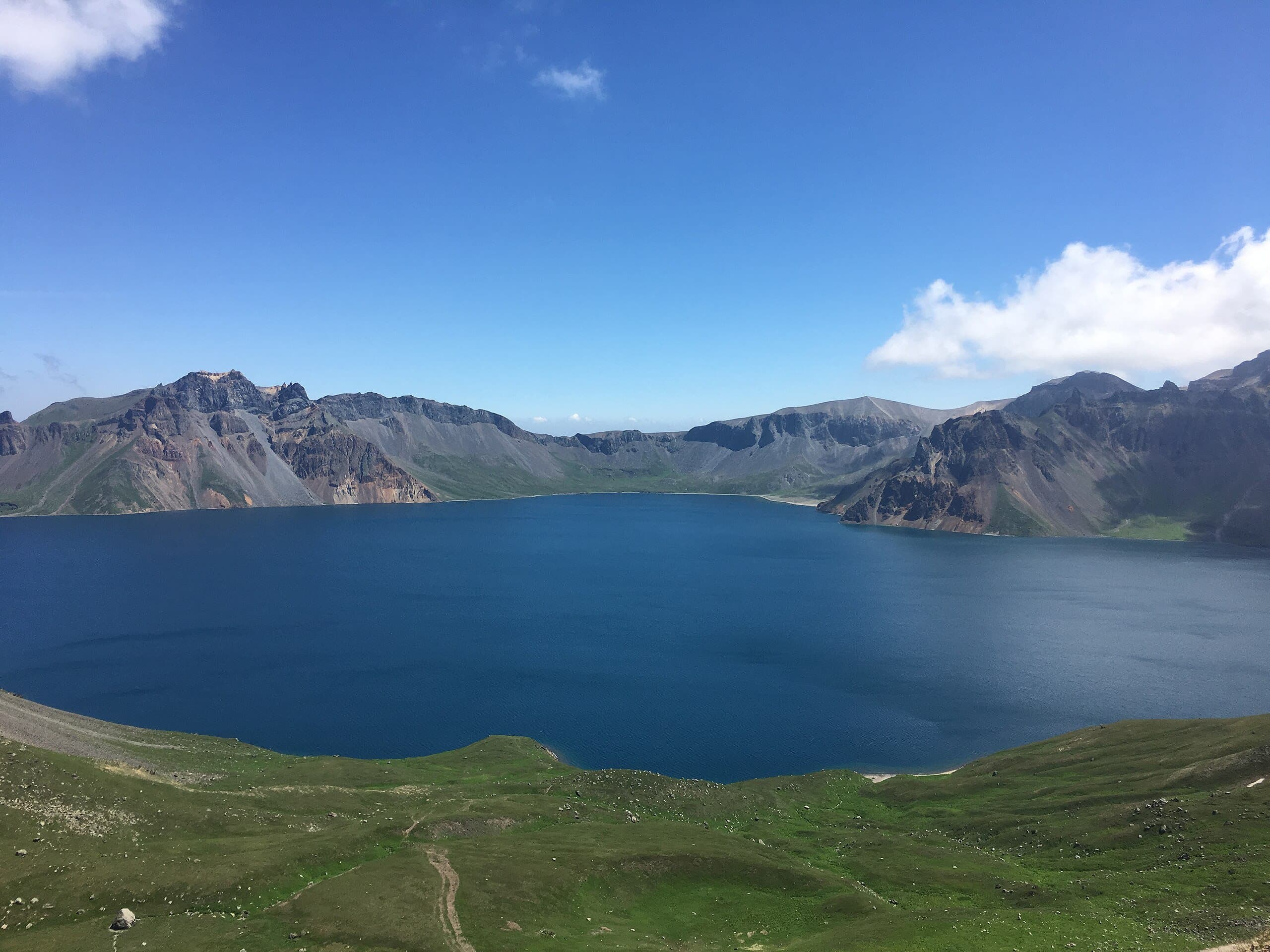
Haven Lake and Changbai (Paektu) Mountain
Where heaven touched earth and a nation was born from the union of god and bear
Changbai, Jilin, China
At A Glance
- Coordinates
- 42.0069, 128.0556
- Suggested Duration
- 2-3 days to visit from multiple slopes (North and West) and allow for weather contingencies
Pilgrim Tips
- Warm, layered clothing essential year-round. Temperatures at the summit can be 15-20 degrees Celsius colder than base. Bring fleece, windbreaker, boots, gloves, and scarf. Winter visitors need full cold-weather gear. No religious dress code, but respectful practical attire appropriate.
- Landscape photography freely permitted. Be sensitive when photographing Korean visitors in emotional states. Ask permission before photographing religious practitioners or ceremonies. The lake is often obscured by clouds, so patience is required.
- High altitude requires respect. The summit stands at 2,744 meters, the lake at 2,189 meters. Weather changes rapidly. Temperatures at the summit can be 15-20 degrees Celsius colder than the base, with strong winds. Warm clothing essential even in summer. The 1,400-step climb on the West Slope is demanding. Independent wandering is not permitted due to border sensitivity and tourism management. Be sensitive to Korean visitors who may be in emotional states.
Overview
Mount Paektu rises 2,744 meters from the borderlands between China and North Korea, the highest peak in Northeast Asia, crowned by Heaven Lake hidden within its ancient caldera. For Koreans, this is where the founder Dangun was born, where Hwanung descended with three thousand followers to establish the City of God. For the Manchu people, this is where their imperial ancestor was miraculously conceived when a heavenly maiden ate fruit dropped by a magpie. Two peoples, two founding myths, one volcanic mountain. The lake is visible only one hundred days a year. When the clouds part, pilgrims weep.
There is a mountain that two nations call their spiritual homeland. Mount Paektu stands at the border between China and North Korea, its crater holding Heaven Lake at 2,189 meters, one of the deepest and most inaccessible crater lakes on Earth. The Chinese call it Changbai, the Perpetually White Mountain. Koreans call it Paektu or Baekdu, and for them it is not merely a mountain but the birthplace of their civilization. According to Korean mythology, the god Hwanung descended here from heaven with three thousand followers, established Sinsi, the City of God, and fathered Dangun upon Ungnyeo, a bear who had transformed into a woman through endurance and sacrifice. Dangun founded the first Korean kingdom in 2333 BCE, ruled for over a thousand years, then became a spirit dwelling in contemplation at Heaven Lake. This is origin-story geography: the mountain is to Korea what Mount Sinai is to Judaism, what Mecca is to Islam. It appears in both North and South Korean national anthems. Korean shamans believe ki, the vital energy, flows from Paektu through invisible veins to every mountain on the peninsula. For the Manchu people and their ancestors, the Jurchens, the mountain holds equal significance. Their founding myth tells of three heavenly maidens bathing in a lake near Changbai when a magpie dropped red fruit near the youngest. She ate it, conceived miraculously, and gave birth to Bukuri Yongson, ancestor of the line that would produce the Qing emperors. The Jin dynasty conferred divine titles on the mountain. The Qing court designated it forbidden territory for two centuries. What makes this mountain so powerful to both peoples? Perhaps the physical presence: that isolated peak rising above the Manchurian plateau, four faces oriented to the compass, the ethereal lake hidden within. Perhaps the 946 Millennium Eruption, one of the largest volcanic events in recorded history, which created the current caldera and scattered ash as far as Greenland. Perhaps the accumulated devotion of millions over millennia has created what it describes. The lake is visible only about one hundred days a year. Most visitors climb the 1,400 steps to the crater rim and see only clouds. When the clouds part, something happens. Korean visitors have been observed bursting into emotional song. During the 2018 inter-Korean summit, President Moon Jae-in filled a bottle with Heaven Lake water to carry back to South Korea. Pilgrims come seeking origin, identity, connection to the source.
Context And Lineage
Origin point of Korean civilization in mythology, sacred homeland of Manchu imperial dynasty, site of one of history's largest volcanic eruptions.
Korean mythology tells that Hwanin, Lord of Heaven, had a son Hwanung who yearned to live among mountains and valleys. Hwanin permitted Hwanung and three thousand followers to descend to Taebaeksan, Mount Paektu, where Hwanung founded Sinsi, the City of God. He taught humans agriculture, medicine, and the arts. A tiger and bear prayed to become human. Hwanung gave them twenty cloves of garlic and mugwort, commanding them to remain in a cave out of sunlight for one hundred days. The tiger failed the trial, but the bear persevered and was transformed into Ungnyeo, a beautiful woman. She prayed for a child, and Hwanung took her as his wife. Their son was Dangun, who founded Gojoseon, the first Korean kingdom, in 2333 BCE. After ruling more than a thousand years, Dangun became a mountain god and dwells in contemplation at Heaven Lake. The Manchu origin story tells of three heavenly maidens bathing near the Changbai Mountains. A magpie dropped red fruit near the youngest, Fekulen. She ate it, became pregnant, and bore Bukuri Yongson, who would become ancestor of the Aisin Gioro clan and the Qing imperial line. This divine conception established the celestial mandate of Manchu rule. The geological origin is equally dramatic. In 946 CE, the mountain erupted in what volcanologists call the Millennium Eruption, one of the largest volcanic events of the past five thousand years. The eruption ejected between 13 and 47 cubic kilometers of magma, sent ash as far as Greenland, and created the current caldera containing Heaven Lake.
Mount Paektu represents the convergence of Korean and Manchu sacred geography. For Koreans, the mountain is the patriarch from which all mountains descend through spiritual veins (maek). For Manchus, it was the most sacred site in their shamanist religion, receiving imperial veneration from both the Jin dynasty (1115-1234) and the Qing dynasty (1644-1912). The Jin conferred divine titles: 'King Who Makes the Nation Prosperous and Answers with Miracles' (1172) and 'Emperor Who Cleared the Sky with Tremendous Sagehood' (1193). The Qing emperors performed state rites influenced by ancient Feng Shan ceremonies and sealed the mountain from common access for over two centuries.
Dangun Wanggeom
Hwanung
Ungnyeo
Bukuri Yongson
Milarepa
Why This Place Is Sacred
Two founding myths, two peoples, one mountain. The convergence suggests something present beyond cultural projection.
What makes a mountain sacred to multiple peoples? Mount Paektu holds parallel origin stories for Koreans and Manchus, each finding in this same peak the birthplace of their founding ancestor and the source of their spiritual heritage. These are not the same myth adapted differently; they are distinct narratives that independently converge on identical geography. For Korean shamans, Paektu is not metaphorically significant but literally the source of ki energy flowing through invisible veins to every mountain on the peninsula. The first mudang was Dangun himself, born on this mountain. The shamanic tradition traces directly to this place. For Manchu shamans, the mountain was the most sacred site in their entire religious cosmos, the dwelling place of ancestral spirits and the origin point of imperial mandate. The physical mountain seems designed to evoke such responses. It rises in geometric solitude, the highest point for hundreds of kilometers in any direction. The crater lake is hidden until you reach the rim, appearing suddenly as reward for the ascent. The lake water is an impossible blue. Clouds wrap the summit most days, revealing the lake as gift rather than guarantee. And behind all this lies the volcanic power that created it: the 946 Millennium Eruption, classified VEI 6, one of the largest volcanic events of the last five thousand years. Between 13 and 47 cubic kilometers of magma ejected. Ash found in Greenland ice cores. The current landscape is the aftermath of cataclysm. This may be the deeper source of the thinness: the mountain embodies primal geological force. What sits in that caldera is evidence of powers that dwarf human civilization. The lake formed in the wound left by explosion. Standing at the rim, looking down at that still water, you stand at the edge of something that was once violent beyond imagination. Two peoples found their origins in this place. Perhaps because origin stories need landscapes of appropriate power. Perhaps because something present here predates and exceeds both narratives. The mountain holds both myths without contradiction, as if both were attempts to describe something that transcends either.
Birthplace of Dangun, founder of Korea. Source of ki energy for Korean mountains. Sacred homeland of Manchu imperial ancestry. Site of divine conception in both traditions.
Sacred significance extends into prehistory. The Wuji people venerated the mountain in the fifth century. The Jin dynasty conferred divine titles in the twelfth century. Qing emperors performed state rites and sealed the area from common access. Korean shamanism maintained unbroken tradition of Paektu as the spiritual source. Modern Korean nationalism, in both North and South, has intensified the mountain's significance as symbol of national identity. North Korea has added revolutionary mythology, claiming it as the birthplace of Kim Jong-il. South Korean mudang have resumed pilgrimages via China since the 1990s.
Traditions And Practice
Pilgrimage to the crater and Heaven Lake. Korean shamans seek connection to ki energy source. Manchu shamans historically conducted elaborate sacrificial rites lasting days.
Manchu shamanism centered on sacrificial rites at sites throughout the Changbai region. Large rituals in spring and autumn lasted three to eight days, involving offerings of fish, sheep, oxen, horses, ducks, chickens, and especially pigs. The ancestral ritual included dawn sacrifice (chaoji), sunset sacrifice (xiji), and midnight light-extinguishing sacrifice (beidingji). Shamans wore distinctive regalia: smocks and pointed caps with colored paper strips, carrying mirrors and bronze bells, dancing to drumbeats. Offerings were made to holy trees and holy sticks. Korean shamanism (Musok) regards Paektu as the source of ki energy for every mountain on the peninsula. Mountains are places where deities dwell and spiritual power flows. The Qing imperial court conducted state rites in 1682, 1698, 1733, 1754, and 1805, with emperors paying homage to the ancestral homeland.
South Korean mudang have traveled to China since the 1990s for pilgrimage to the mountain. Manchu shamanism has revived since the 1980s, with some ten clans resuming outdoor rituals involving animal offerings to clan deities in Jilin and Heilongjiang provinces. Korean visitors often sing traditional or patriotic songs upon seeing Heaven Lake. Some collect water from the lake, following the example of President Moon Jae-in during the 2018 summit. Tens of thousands of North Koreans make annual pilgrimage, though their experience includes revolutionary mythology alongside traditional significance.
Approach the summit with awareness of what the mountain means to Koreans and Manchus. If clouds obscure the lake, accept this as the mountain's nature rather than personal misfortune. The lake is visible only about one hundred days per year. If the lake reveals itself, allow time for contemplation rather than only photography. Visit the hot springs and waterfall. Walk through the virgin forest at lower elevations. Consider multiple visits from different slopes. If weather permits, watching sunrise or sunset from the rim deepens the experience.
Korean Shamanism (Musok)
ActiveMount Paektu is the most sacred mountain for Korean shamans (mudang). It is believed to channel ki (spiritual energy) to every other mountain on the Korean peninsula through maek (spiritual veins). Dangun, born here, was the first mudang and remains the mythological source of shamanic practice.
South Korean mudang have traveled to China since the 1990s for pilgrimage. Shamans perform rituals at mountain shrines to access ki energy and communicate with spirits. Mountains are deemed places where deities dwell and spiritual power flows.
Manchu Shamanism
ActiveMount Changbai was the most sacred mountain in Manchu shamanist religion. The Jin dynasty worshipped it as god and protector of the kingdom. The Qing imperial family regarded it as their traditional homeland and the birthplace of their legendary ancestor.
Traditional rites included elaborate sacrifices in spring and autumn lasting three to eight days. Dawn, sunset, and midnight rituals with offerings to clan deities. Shamans wore distinctive regalia and danced to drumbeats. Revival since the 1980s in Jilin and Heilongjiang provinces with some clans resuming outdoor rituals.
Korean National Heritage
ActiveMount Paektu is sacred to all Koreans as the mythological birthplace of their civilization. Dangun established the first Korean kingdom here in 2333 BCE. The mountain appears in both North and South Korean national anthems. It is one of Korea's three spirited mountains.
Korean visitors treat the mountain as sacred homeland. The experience of seeing Heaven Lake can be overwhelmingly emotional. Some visitors collect water. National Foundation Day (October 3) celebrates Dangun's founding. South Korean pilgrimages to the Chinese side have occurred since the 1990s.
North Korean Revolutionary Pilgrimage
ActiveIn North Korea, Mount Paektu is the holy ground of revolution and the claimed birthplace of Kim Jong-il (1942). The revolutionary mythology is layered upon traditional Korean sacred significance.
Tens of thousands of North Koreans make annual pilgrimage. Visitors are trained to revere the mountain as the soul of Korea's revolution. Many pilgrims stand quietly, some in tears. Guides explain revolutionary significance alongside traditional meaning.
Experience And Perspectives
Ascending through alpine forest to the crater rim, where clouds may part to reveal Heaven Lake: blue water held in volcanic stone, origin of three rivers and two civilizations.
You arrive at Changbaishan after long travel from Yanji or the high-speed rail station, entering one of China's most protected wilderness areas. The mountain reveals itself gradually through alpine forest and tundra. Most visitors approach via the North or West slopes, each requiring shuttle buses through the scenic area. The ascent proper begins at high elevation, already thin air. The West Slope demands climbing 1,400 steps, a physical challenge at altitude. The North Slope shuttle brings you closer but still requires walking. Temperature drops sharply as you climb. Even in summer, the summit can be fifteen to twenty degrees colder than the base, with bitter winds. The provided coat rental exists for good reason. Then you reach the rim, and if fortune favors you, the clouds have parted. Heaven Lake appears below: 9.82 square kilometers of water held in volcanic stone, average depth 213 meters, maximum 384. The blue is profound, unearthly. Sixteen peaks surround the caldera. The Changbai Waterfall, 68 meters high, marks where the lake drains toward the Songhua River. The Tumen and Yalu rivers also originate here. You stand at the source of watersheds that define Northeast Asia. For Korean visitors, the experience can be overwhelming. South Korean teenagers have been observed spontaneously singing, overcome with connection to a homeland divided by politics but united in mythology. This is where Dangun was born, where the bear became woman, where heaven descended. For many, seeing the lake satisfies something deeper than curiosity. For Manchu visitors, the experience connects to ancestral heritage: the sacred site of their founding mythology, the mountain their emperors venerated with state rites. For all visitors, the physical power of the place asserts itself. The volcanic landscape, the hot springs reaching 82 degrees Celsius, the altitude, the weather that can change in minutes: this is not gentle terrain. The mountain demands something from those who approach it. On clear days, the view extends to the North Korean side of the border, a reminder of the mountain's position at the intersection of nations and ideologies. But from the rim, looking down at the lake, politics recedes. What remains is water, stone, sky, and whatever it is that draws people to the places where their civilizations began.
The Chinese side offers three entrance routes: North Slope (closest shuttle to lake, most popular), West Slope (1,400-step climb, best summit panorama), and South Slope (least visited). Base towns are Erdaobaihe (North) and Songjianghe (West). The North and West entrances are separated by 100 kilometers. Yanji is the regional hub, two hours by car. The North Korean side is accessible only through specialized DPRK tours.
Mount Paektu stands where Korean and Manchu sacred geographies converge, holding two founding myths simultaneously, a volcano that shaped regional identity as profoundly as it shaped the landscape.
Scholars recognize Mount Paektu/Changbai as one of Asia's most significant sacred sites, holding parallel importance in Korean and Manchu traditions. The Dangun myth, first recorded in the thirteenth-century Samguk yusa, may symbolize the arrival of Bronze Age culture and the integration of shamanistic animal totems from nomadic Central Asian tribes. The mountain's multi-ethnic significance reflects the complex history of Northeast Asia where Korean, Tungusic (Jurchen/Manchu), and Chinese peoples interacted and competed. Modern scholarship notes the politically sensitive nature of heritage claims, with both Koreas and China emphasizing their connections to the mountain. The 946 Millennium Eruption is studied as one of the most significant volcanic events in recorded history.
For Korean shamans, Mount Paektu is literally the source of spiritual power for all Korean mountains, channeling ki through invisible veins (maek) across the peninsula. The mountain is where Dangun, the first shaman and king, was born and later achieved immortality. Each prominent mountain in Korea has a sovereign mountain spirit, but Paektu is the patriarch from which all mountains descend. For Manchu practitioners, the mountain was the sacred homeland where ancestors received divine mandate through miraculous birth. These are not metaphorical beliefs but descriptions of actual spiritual geography.
The volcanic nature of the site, with its hot springs and history of massive eruptions, suggests powerful telluric forces. Some contemporary spiritual practitioners view the mountain as a major Earth energy point. Reports of a 'Heaven Lake monster,' a large creature reportedly seen in the lake, have Loch Ness-style folklore associated with them. The mountain's current volcanic state is being studied by international teams concerned about potential future eruptions.
The full prehistoric significance of the mountain before written records. Whether shamanic traditions predate both Korean and Manchu cultures at this site. The original location of the Manchu origin myth (some scholars suggest the Amur region rather than Changbai). The volcanic system's current state and eruption potential. The identity of reported lake creatures. How and when the mountain became sacred to multiple peoples simultaneously.
Visit Planning
Accessible from the Chinese side via Yanji or direct rail/air. Requires organized scenic area transport. Weather determines whether Heaven Lake is visible. The lake appears only about one hundred days per year.
Hotels and guesthouses in Erdaobaihe (North Slope) and Songjianghe (West Slope). Yanji offers more options as regional hub with Korean-Chinese cultural atmosphere. Booking essential during peak seasons. Basic to mid-range options dominate.
Respect the deep significance this mountain holds for Korean and Manchu peoples. Be sensitive to emotional pilgrims. Dress for extreme conditions.
For many Korean visitors, reaching Heaven Lake is not tourism but pilgrimage, connection to ancestral origin and national identity. The experience can be profoundly emotional. Be respectful of pilgrims who may weep, pray, or sing. Do not interrupt or intrude on these moments. Photography of the landscape is freely permitted, but ask permission before photographing religious practitioners or people in emotional states. The border area between China and North Korea has political sensitivities. Follow all guidance from tour operators and scenic area staff. Independent wandering is not permitted. If you encounter any shamanic ceremonies or ritual practices, observe from a respectful distance unless invited to participate. The mountain commands respect not through prohibition but through presence. No formal dress code exists, but practical warm clothing is essential. Even summer visitors should bring fleece, windbreaker, gloves, and scarf. Temperatures at the summit can reach freezing with bitter winds. Good walking shoes are required for the step climb. Coat rental is available for underprepared visitors.
Warm, layered clothing essential year-round. Temperatures at the summit can be 15-20 degrees Celsius colder than base. Bring fleece, windbreaker, boots, gloves, and scarf. Winter visitors need full cold-weather gear. No religious dress code, but respectful practical attire appropriate.
Landscape photography freely permitted. Be sensitive when photographing Korean visitors in emotional states. Ask permission before photographing religious practitioners or ceremonies. The lake is often obscured by clouds, so patience is required.
No specific offering traditions for general visitors. Those practicing within Korean or Manchu shamanic traditions may have specific practices. Collecting water from the lake has symbolic significance for Korean pilgrims.
Must use organized transport and pay entrance and transportation fees. Independent wandering not permitted due to border sensitivity. Respect other visitors' experiences. Do not disrupt ceremonies or emotional moments.
Sacred Cluster
Nearby sacred places create the location cluster described in the growth plan. This block is intentionally crawlable and links into the wider regional graph.