Bulguksa Temple
Where the Silla built the Buddha Land on earth and two pagodas freeze a moment from the Lotus Sutra
Gyeongju-si, North Gyeongsang, South Korea
At A Glance
- Coordinates
- 35.7901, 129.3321
- Suggested Duration
- Minimum 2-3 hours for the temple complex. Add 1-2 hours for Seokguram Grotto (separate location, 4 km by road). Full day recommended to include both sites at unhurried pace. Templestay programs require overnight commitment.
Pilgrim Tips
- Modest dress appropriate for a religious site. Shoulders and knees should be covered. Remove hats when entering halls. Shoes removed at all building entrances.
- Generally permitted in outdoor areas. Flash photography typically prohibited inside halls. Do not photograph monks or devotees at worship without permission. Tripods may require special permission. Check for posted restrictions at each location.
- Morning services begin very early (around 4 AM) and are primarily for practitioners. Visitors are welcome to observe from appropriate distance but should not disrupt. Templestay requires advance registration and commitment to the program's schedule. Some halls may be closed during ceremonies. The monks' quarters are not open to casual visitors.
Overview
Bulguksa Temple rises on the slopes of Mount Tohamsan as a physical theology—Korean Buddhism made visible in stone. Twin pagodas stand in the courtyard: one ornate representing existence's complexity, one simple representing enlightenment's clarity. To stand between them is to enter a scene from the Lotus Sutra, present at the moment when past and present Buddhas verified each other's truth.
The name says everything: Bulguksa, Temple of the Buddha Land. Built in the eighth century when the Silla kingdom was at its height, this is not merely a temple but an attempt to manifest the Pure Land on earth—to create through architecture what practitioners seek through devotion. The Buddha realm is not here imagined but constructed.
Two pagodas anchor the central courtyard in visual dialogue. Dabotap rises in ornate complexity, its lotus motifs and lion guardians embodying the intricate reality of existence. Seokgatap stands opposite in austere simplicity, its clean lines expressing the clarity toward which Buddhist practice aims. These are not merely decorative structures but frozen scripture: they embody a scene from the Lotus Sutra when Prabhutaratna, a Buddha from the distant past, emerged to verify Sakyamuni's teachings, and the two sat side by side. To stand between these pagodas is to enter that scene, present at the verification of truth across time.
Stone bridges rise from the lower courtyard to the Buddha realm above. The transition is not metaphorical but architectural—pilgrims physically ascend from the mundane to the sacred. Three halls house three Buddha realms: the historical Sakyamuni, the celestial Amitabha of the Western Paradise, the cosmic Vairocana of enlightenment. As a head temple of the Jogye Order, Bulguksa maintains living practice within this architecture of aspiration. Morning chanting begins before dawn; monks walk circuits the pilgrims walked thirteen centuries ago.
Context And Lineage
Built in 751 CE during the height of the Silla kingdom, Bulguksa embodies the Buddhist civilization that made Gyeongju one of Asia's great capitals.
The Samguk Yusa (Memorabilia of the Three Kingdoms) records that Prime Minister Kim Daeseong began construction in 751 CE. According to tradition, Kim built Bulguksa to honor his parents in his present life, and Seokguram Grotto to honor his parents from a previous incarnation. This dual foundation expresses the Buddhist understanding that our relationships and debts extend across multiple lifetimes. Kim died before completion; the Silla royal court finished both structures, giving the temple its name Bulguksa—Temple of the Buddha Land—in 774 CE.
Bulguksa represents the flowering of Korean Buddhism under the Silla kingdom, which unified the Korean peninsula in the seventh century. The temple combined influences from Chinese Buddhism with distinctively Korean artistic expression—the stone pagodas are a Korean innovation. As a head temple (bonsa) of the Jogye Order, Bulguksa today maintains the mainstream of Korean Seon (Zen) Buddhism. The Jogye Order traces its lineage through the great Korean masters, blending meditation practice with doctrinal study.
Kim Daeseong
Founder
Prabhutaratna (Dabo)
Buddha represented by Dabotap pagoda
Sakyamuni
The historical Buddha, represented by Seokgatap pagoda
Why This Place Is Sacred
Bulguksa is sacred as a physical manifestation of Buddhist cosmology—three Buddha realms built in stone—and as the site where twin pagodas freeze a scene from the Lotus Sutra.
The temple's sacredness emerges from its theological ambition: to build the Buddha Land on earth. While many temples serve as places to practice toward enlightenment, Bulguksa attempts to manifest what enlightenment reveals—the Pure Land itself. The architecture functions as a kind of preview, offering visitors not just a place to meditate but a space already transformed.
This ambition expresses itself most clearly in the three halls, each dedicated to a different Buddha and his realm. The main Daeungjeon enshrines Sakyamuni, the historical Buddha who taught in this world. Geungnakjeon houses Amitabha, Buddha of the Western Paradise where practitioners aspire to be reborn. Birojeon contains Vairocana, the cosmic Buddha representing enlightenment itself. Moving among these halls, pilgrims move through Buddhist cosmology.
The twin pagodas create the temple's deepest thin place. The Lotus Sutra recounts how, while Sakyamuni was teaching at Vulture Peak, a great tower emerged from the earth. Within sat Prabhutaratna, a Buddha who had achieved enlightenment in the distant past and vowed to appear whenever the Lotus Sutra was taught. He came to verify: what Sakyamuni teaches is true. The two Buddhas sat together, past confirming present. Dabotap represents Prabhutaratna; Seokgatap represents Sakyamuni. Standing between them, pilgrims stand within the Lotus Sutra itself.
The stone bridges complete the sacred architecture. Rising from the mundane courtyard to the Buddha realm above, they make the spiritual journey physical. To climb is to enact the passage from ignorance to understanding, from the suffering world to the Pure Land. The bridges are called Cheongungyo (Blue Cloud) and Baegungyo (White Cloud)—clouds being the traditional vehicles of heavenly passage.
Kim Daeseong founded the temple for his parents across lifetimes: Bulguksa for his present-life parents, nearby Seokguram for parents from a previous existence. This foundation story itself embodies Buddhist understanding: that our connections and debts extend across multiple lives, that gratitude transcends single incarnations.
The temple was commissioned by Prime Minister Kim Daeseong in 751 CE to honor his parents in this life (complementing Seokguram Grotto, built to honor parents from a previous life). The Silla royal court completed construction after Kim's death in 774 CE, naming it Bulguksa—Temple of the Buddha Land. The architecture was designed to physically manifest Buddhist cosmology: the journey from mundane to sacred, the three Buddha realms, the Lotus Sutra scene of mutual verification.
The original Silla structures were destroyed during the Imjin War (Japanese invasion, 1592-1593). Reconstruction began in 1604, with approximately forty renovations through 1805. Modern restoration has continued since 1920. While the wooden buildings have been rebuilt multiple times, the stone structures—the twin pagodas, the bridges—survive from the eighth century. The temple now serves as a head temple of the Jogye Order, maintaining continuous practice through all transformations. UNESCO inscription in 1995 recognized its outstanding universal value.
Traditions And Practice
Active Buddhist temple with daily services, seasonal ceremonies, and Templestay programs allowing visitors to experience monastic life.
Morning and evening chanting services (yebul). Prostrations before Buddha images—the traditional sequence of 108 prostrations for removing mental obstacles. Circumambulation of pagodas. Buddha's Birthday celebrations with elaborate lotus lantern processions. Memorial services (jesa) for ancestors. The Silla kingdom invested enormous resources in the temple's ceremonies, viewing Bulguksa as spiritually protecting the state.
Daily services continue in the traditional pattern. The Templestay program 'The Fragrance of a Thousand Years' opens monastic practice to visitors: early morning chanting at 4 AM, seated meditation (zuochan), 108 prostrations, tea ceremony with monks, temple food eaten in meditative silence (barugongyang). Buddha's Birthday (usually in May) brings elaborate lantern displays and community celebration. The temple serves both as pilgrimage destination and as functioning monastery within the Jogye Order.
If time permits, consider the Templestay program for the deepest engagement—even a single night offers encounter with the rhythms that have shaped this space for thirteen centuries. Otherwise, time your visit for early morning to observe the beginning of the temple's day. Take a moment between the twin pagodas to contemplate their dialogue: complexity and simplicity, existence and enlightenment, Prabhutaratna and Sakyamuni. Observe how light moves across the stones through the day.
Korean Buddhism (Jogye Order)
ActiveBulguksa serves as a head temple (bonsa) of the Jogye Order, the largest Buddhist denomination in Korea representing mainstream Korean Seon (Zen) Buddhism. The temple's name—'Temple of the Buddha Land'—expresses the aspiration to manifest the Pure Land on earth. The architecture embodies Korean Buddhist cosmology: the terrestrial realm of Sakyamuni, the celestial realm of Amitabha, and the dharma realm of Vairocana, each with its dedicated hall. The twin pagodas freeze in stone a scene from the Lotus Sutra—the moment when the past Buddha Prabhutaratna appeared to verify Sakyamuni's teaching.
Daily chanting services (yebul) morning and evening. The Templestay program 'The Fragrance of a Thousand Years' offers visitors experience of monastic life: 4 AM chanting, meditation, 108 prostrations, tea ceremony, temple food (barugongyang). Buddha's Birthday celebrations with lotus lanterns. Memorial services for ancestors. Circumambulation of the pagodas. The continuous practice maintains the temple as living tradition rather than museum.
Experience And Perspectives
Visitors ascend stone bridges into a courtyard anchored by twin pagodas, moving through halls representing three Buddha realms while monks maintain rhythms of practice established thirteen centuries ago.
The approach to Bulguksa establishes its logic. The temple sits on Mount Tohamsan's slopes, elevated above the surrounding landscape. Pilgrims and visitors alike must climb—the journey to the Buddha Land involves physical ascent.
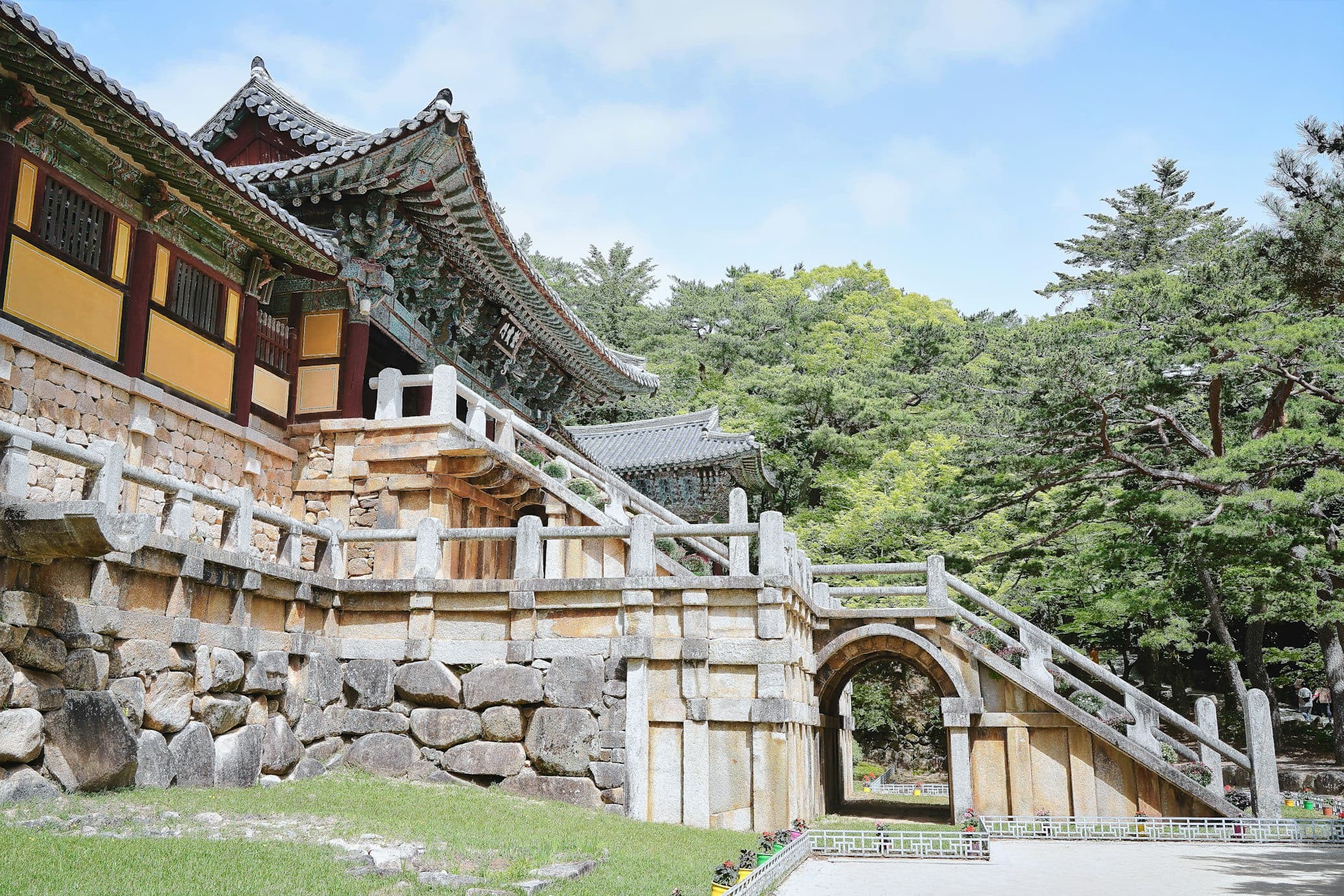
The entry courtyard offers the first teaching. Before the temple proper, visitors encounter the famous stone bridges: Cheongungyo (Blue Cloud Bridge) and Baegungyo (White Cloud Bridge), together forming a single stairway of thirty-three steps—representing the thirty-three heavens of Buddhist cosmology. These are not merely functional but symbolic: to climb is to leave the mundane world. The bridges, built in the eighth century, survive as National Treasure.
Cresting the stairs, visitors enter the Buddha Land. The central courtyard reveals immediately its organizing principle: two pagodas in dialogue. Seokgatap stands to the west, a three-story stone pagoda of austere simplicity, its undecorated surfaces representing spiritual clarity. Dabotap rises to the east in elaborate complexity—lotus motifs, bamboo pillars, lion guardians, octagonal roofs—representing the intricate texture of existence. The contrast is not accidental but doctrinal: the path from complexity to simplicity, from samsara to nirvana, from Dabotap's ornamentation to Seokgatap's clarity.
The main hall, Daeungjeon, contains Sakyamuni Buddha—the historical teacher who lived and taught in this world. The hall's architecture frames devotion: entering is not casual but intentional, shoes removed, bow offered. The Buddha sits in the posture of touching the earth, the gesture he made when challenged by Mara, calling the earth to witness his enlightenment.
Moving through the complex, visitors encounter the other Buddha realms. Geungnakjeon, the Hall of Supreme Bliss, houses a gilt-bronze Amitabha—Buddha of the Western Paradise, where devoted practitioners aspire to be reborn in better conditions for practice. Birojeon contains Vairocana, the cosmic Buddha whose illumination pervades all reality.
The rhythms of active practice texture the experience. Morning bells mark dawn; the low chant of sutras carries from halls where monks begin their day as monks have begun their days here for over a thousand years. Visitors who arrive early encounter the temple not as museum but as living monastery. Those who stay for Templestay—the overnight program—enter these rhythms fully: 4 AM chanting, meditation, prostrations, the silent concentration of temple meals.
The light changes through the day. Morning sun illuminates the eastern pagoda Dabotap, revealing details of its carving. Afternoon light moves to Seokgatap in the west, throwing shadows from its simple geometries. The experience of the twin pagodas shifts with the hours, as if the temple teaches differently at different times.
Enter through the main gate and approach the stone bridges. Take time before ascending to observe the thirty-three steps rising toward the Buddha realm. In the central courtyard, position yourself between the twin pagodas to experience their dialogue—Dabotap's complexity to the east, Seokgatap's simplicity to the west. Visit Daeungjeon for the main Sakyamuni image, then Geungnakjeon and Birojeon for the other Buddha realms. If time permits, consider the Templestay program for immersive experience.
Bulguksa stands as one of Asia's great Buddhist temples, its meaning emerging differently for art historians, practicing Buddhists, and seekers of various paths.
Art historians recognize Bulguksa as a masterpiece of the golden age of Silla Buddhist art. The twin pagodas—Dabotap's technical virtuosity and Seokgatap's austere perfection—represent distinct Korean aesthetic achievements. The discovery of the Dharani Sutra (706-751 CE) inside Seokgatap established it as the world's oldest extant woodblock-printed document, revolutionizing understanding of printing history. UNESCO inscription emphasizes the site's 'outstanding example of Buddhist religious architecture' and its expression of Buddhist belief through material form. The stone structures surviving from the eighth century provide irreplaceable evidence of Silla craftsmanship.
For Korean Buddhists, Bulguksa is the Buddha Land made visible—architecture expressing the aspiration that this world can become a Pure Land through practice. The twin pagodas embody Lotus Sutra teaching: truth verified across time, past Buddhas confirming present teachings. As a head temple of the Jogye Order, Bulguksa maintains living transmission of Korean Buddhist practice. The foundation story—Kim Daeseong honoring parents across lifetimes—expresses the Korean Buddhist emphasis on filial piety extended through rebirth. Pilgrimage to Bulguksa accumulates merit and deepens understanding.
The temple's geomantic positioning on Mount Tohamsan, facing the East Sea, has attracted interpretation in terms of Korean pungsu (feng shui). The contrasting pagodas—elaborate and simple, feminine and masculine—suggest yin-yang complementarity. The thirty-three steps of the stone bridges reference Buddhist cosmology but also find resonance in traditions that recognize vertical passage between realms. Some contemporary visitors experience the space as conducive to contemplation regardless of specific Buddhist belief.
Mysteries remain. The original Silla wooden buildings were destroyed in the sixteenth century—their exact appearance is uncertain. The method by which the Dharani Sutra came to be placed inside Seokgatap is unknown. The specific rituals performed at the temple's eighth-century consecration are not recorded in surviving texts. How the stone pagodas were constructed with Silla technology remains a subject of study.
Visit Planning
Located near Gyeongju in southeastern Korea, accessible by bus from Gyeongju station or by car. Plan 2-3 hours minimum; full day recommended to include Seokguram Grotto.
Hotels and guesthouses in Gyeongju, ranging from budget to luxury. Traditional hanok stays available. The Templestay program at Bulguksa itself offers overnight accommodation with full immersion in temple life—advance registration required through the Korean Templestay website.
As an active Buddhist temple, modest dress, quiet behavior, and respect for monastic routines are expected.
Bulguksa functions simultaneously as UNESCO site, tourist destination, and active monastery. Visitors should remember the third role: monks live and practice here, and their rhythms take precedence over tourism.
Approach the temple with awareness that you are entering sacred space. The stone bridges are not merely photogenic but symbolic—crossing them should be done mindfully, not as a photo opportunity. The courtyard between the pagodas has hosted centuries of devotion; behave accordingly.
Quiet conversation is appropriate; loud talk, calling across distances, or group noise is not. Cell phones should be silenced. If you encounter monks at practice or devotees at prayer, observe from respectful distance without interruption.
When entering halls, remove shoes and leave them on the provided racks. Bow at the entrance threshold. Inside, do not point feet toward Buddha images. Photography may be restricted or prohibited inside halls—look for posted signs. Flash is usually forbidden.
If you witness ceremonies, observe without attempting to participate unless specifically invited. Templestay participants receive instruction in proper participation.
Modest dress appropriate for a religious site. Shoulders and knees should be covered. Remove hats when entering halls. Shoes removed at all building entrances.
Generally permitted in outdoor areas. Flash photography typically prohibited inside halls. Do not photograph monks or devotees at worship without permission. Tripods may require special permission. Check for posted restrictions at each location.
Offerings of incense can be made at designated locations. Donation boxes support temple maintenance. Candles and flowers may be offered at certain altars. Monetary donations appreciated but never required.
Do not climb on structures or touch ancient carvings. Maintain silence or quiet speech. Do not enter roped-off areas. Some sections may be closed for ceremonies or restoration. Monks' living quarters are private.
Sacred Cluster
Nearby sacred places create the location cluster described in the growth plan. This block is intentionally crawlable and links into the wider regional graph.