Ephesus
Where the goddess became the mother, and three thousand years of devotion continue
Selçuk, Aegean Region, Turkey
At A Glance
- Coordinates
- 37.9124, 27.3328
- Suggested Duration
- Main Ephesus ruins: 2-3 hours minimum, half day with Terrace Houses included. House of the Virgin Mary: 1-2 hours (longer if attending Mass). Basilica of St. John: 1 hour. Temple of Artemis: 30 minutes. For all major sites: a full day or spread across two days.
- Access
- Located near Selçuk in İzmir Province, Turkey. İzmir Adnan Menderes Airport is 60 km away with connections to Istanbul and European cities. Kuşadası cruise port is 17 km from Ephesus. Regular buses and dolmuş from Selçuk to the sites. Taxis readily available. The sites are separate locations: main ruins near Selçuk, House of Virgin Mary 7 km up Mount Koressos, Basilica of St. John in Selçuk town, Temple of Artemis between Selçuk and main ruins.
Pilgrim Tips
- Located near Selçuk in İzmir Province, Turkey. İzmir Adnan Menderes Airport is 60 km away with connections to Istanbul and European cities. Kuşadası cruise port is 17 km from Ephesus. Regular buses and dolmuş from Selçuk to the sites. Taxis readily available. The sites are separate locations: main ruins near Selçuk, House of Virgin Mary 7 km up Mount Koressos, Basilica of St. John in Selçuk town, Temple of Artemis between Selçuk and main ruins.
- House of the Virgin Mary: shoulders and knees must be covered. Main ruins: comfortable walking shoes essential for marble surfaces; sun protection in summer. Basilica of St. John: no formal requirements but modest dress appropriate.
- Main ruins and Temple of Artemis: photography permitted freely. House of the Virgin Mary: photography permitted outside; restricted during Mass; be discreet in chapel. Basilica of St. John: photography permitted. No flash in enclosed spaces.
- Respect the active worship at the House of the Virgin Mary. Modest dress is required (shoulders and knees covered). Photography is restricted during Mass. The August 15 celebration draws enormous crowds—arrive early and expect waiting. At the main ruins, do not touch or climb on ancient structures. Summer heat can be intense; bring water and sun protection.
Overview
For three millennia, the hills above Ephesus have been sacred to feminine divinity—first Cybele, then Artemis whose temple was one of the Seven Wonders, and now Mary, mother of Jesus, whose traditional final home draws pilgrims from across the world. This is where the Council of 431 declared Mary 'Theotokos' (God-bearer), where St. John wrote his Gospel, and where Christians and Muslims share veneration of the same sacred figure.
On the western coast of Turkey, where the Aegean meets the hills of ancient Ionia, layers of sacred history accumulate across thirty centuries. The site drew pilgrims long before the Greeks arrived—devotees of the Anatolian mother goddess Cybele. The Greeks merged her with Artemis and built a temple so vast it became one of the Seven Wonders of the Ancient World. Pilgrims came from across the Mediterranean to honor the many-breasted goddess of fertility and abundance.
Then came Christianity. St. Paul preached here, famously provoking a riot among silversmiths who made shrines to Artemis: 'Great is Artemis of the Ephesians!' they shouted. St. John arrived, traditionally bringing with him the Virgin Mary, whom Jesus had entrusted to his care. In 431 CE, the Council of Ephesus met at the Church of Mary and declared her Theotokos—God-bearer—the theological foundation for Christian Marian devotion. The great basilica over John's tomb became a major pilgrimage destination.
The House of the Virgin Mary, rediscovered in 1891 following the visions of a German nun, now draws pilgrims from around the world. Daily Mass is celebrated in the small stone chapel. On August 15, thousands gather for the Feast of the Assumption, filling the hillside with candlelight. Remarkably, this is also a site of Muslim pilgrimage—Mary (Meryem Ana) is honored in Islam as the purest woman, mother of Prophet Jesus.
The Temple of Artemis is gone now, reduced to a single reconstructed column standing in a marshy field. But the impulse that built it—devotion to the divine feminine—has simply changed form. The goddess became the mother, and the pilgrimage continues.
Context And Lineage
Ephesus hosted successive sacred traditions across three millennia: Anatolian goddess worship, the Greek cult of Artemis (one of the Seven Wonders), and early Christianity including two ecumenical councils. The tradition that Mary lived her final years here makes it a major Marian pilgrimage site.
According to Christian tradition, Jesus on the cross entrusted his mother Mary to 'the disciple whom he loved' (John 19:26-27), identified as John the Apostle. After the crucifixion, John and Mary left Jerusalem to escape persecution and spread the Gospel. They came to Ephesus, where Mary lived until her Assumption (Catholic) or Dormition (Orthodox). John wrote his Gospel here, was exiled to Patmos (where he wrote Revelation), then returned to Ephesus and died.
The House of the Virgin Mary was identified in 1891 through an extraordinary chain of events. The German nun Anne Catherine Emmerich (1774-1824), a stigmatic and visionary who never traveled, described Mary's final home in detailed visions recorded by the poet Clemens Brentano. Following these descriptions, two Lazarist missionaries found a stone building on Mount Koressos matching her account. Local Christians of Şirince village had venerated the site for centuries, calling it Panaya Kapulu ('Doorway to the Virgin'). Pope Leo XIII blessed the first pilgrimage in 1896. Subsequent popes have visited and celebrated Mass, though the Church has not formally pronounced on the site's authenticity.
The sacred lineage of Ephesus flows through successive traditions: Bronze Age goddess worship → Greek cult of Artemis → early Christianity → Byzantine pilgrimage → Ottoman period (reduced but continued Christian presence) → modern Marian pilgrimage. The Council of Ephesus (431 CE) established the Theotokos doctrine that shaped Christian understanding of Mary. The city's connection to John connects it to the Johannine tradition in Christianity. The contemporary site serves both Catholic and Muslim pilgrimage, with Franciscan friars maintaining the House of the Virgin Mary.
St. John the Apostle
Evangelist, caretaker of Mary
St. Paul
Apostle to the Gentiles
Anne Catherine Emmerich
Visionary whose descriptions led to the site's discovery
Why This Place Is Sacred
Ephesus witnesses the transformation of sacred devotion across millennia: from ancient goddess worship to Christianity, with the divine feminine as the continuous thread. The same hills that once drew pilgrims to Artemis now draw them to Mary.
Three thousand years of sacred history leave deposits. At Ephesus, they layer visibly: Bronze Age goddess worship beneath the temple of Artemis beneath the churches of early Christianity beneath the Muslim veneration of Meryem Ana. Each layer transformed what came before without erasing it entirely.
The Greeks who arrived in the 10th century BCE found a site already sacred to the Anatolian mother goddess Cybele. Rather than suppress her, they merged her with Artemis—though the Ephesian Artemis bore little resemblance to the virgin huntress of Greek mythology. She was a many-breasted figure of fertility and abundance, her temple run entirely by female officials, offering sanctuary to those who fled there. For six centuries, pilgrims came from across the ancient world to honor her.
When Christianity arrived, the old temple's appeal did not simply disappear. Acts 19 records Paul's confrontation with the silversmiths of Ephesus who made shrines to Artemis. 'Great is Artemis of the Ephesians!' they chanted, sparking a near-riot. The old devotion was powerful.
What happened next is remarkable. The divine feminine was not suppressed but transformed. The Council of Ephesus (431 CE), meeting in a church named for Mary, declared her Theotokos—the one who bore God. This was not primarily a statement about Mary but about Christ: fully divine, not merely human, hence his mother bore not a man who became God but God himself. Yet the practical effect was to establish Mary as worthy of veneration, a figure of devotion, the recipient of prayers.
Did the city that had worshipped the mother goddess for millennia find it easier to embrace the Mother of God? Scholars debate this, but the continuity is striking. The same hills, the same landscape, the same impulse toward the sacred feminine—transformed but not broken.
Today, the House of the Virgin Mary draws Catholics for daily Mass and Muslims for the veneration of Meryem Ana. The Wishing Wall bears prayers in dozens of languages, left by pilgrims of many faiths. On August 15, thousands climb the hill by candlelight for the Feast of the Assumption.
The Temple of Artemis is gone—one reconstructed column stands in a marshy field, a memorial to impermanence. But the pilgrimage continues. The goddess became the mother, and devotion flows on.
The Temple of Artemis was built to honor the Ephesian goddess of fertility and abundance, drawing pilgrims from across the ancient world. The temple offered sanctuary, received offerings, and hosted festivals celebrating the divine feminine. Early Christian sites—the Church of Mary, the Basilica of St. John—were built for worship, pilgrimage, and the declaration of doctrine. The House of the Virgin Mary, if authentic, was simply a dwelling; it became a pilgrimage site after its 19th-century identification.
The ancient cult of Cybele merged with Greek Artemis worship at the monumental temple. Christianity arrived with St. Paul (c. 52-54 CE), coexisting and eventually superseding pagan worship. The Council of Ephesus (431 CE) established Marian doctrine that shaped Christian devotion. The Basilica of St. John (6th century) made the apostle's tomb a pilgrimage destination. After the Ottoman conquest, Christian pilgrimage declined but did not cease. The 1891 identification of the House of the Virgin Mary created a new pilgrimage site that now serves both Christian and Muslim devotees. UNESCO inscription in 2015 recognized the site's layered religious significance.
Traditions And Practice
Daily Mass is celebrated at the House of the Virgin Mary. The Feast of the Assumption (August 15) draws thousands for an all-night pilgrimage with candlelit processions. Muslims also venerate the site as the home of Meryem Ana.
The Temple of Artemis was the center of ancient fertility worship, with offerings, processions, and festivals drawing pilgrims from across the Mediterranean. The cult was run entirely by female officials. After Christianity's rise, pilgrimage shifted to Christian sites: the Church of Mary where the Council of 431 met, and the Basilica of St. John where pilgrims venerated the apostle's tomb and collected dust believed to have healing properties. Medieval pilgrims received flasks bearing John's image.
Daily Mass at the House of the Virgin Mary: Monday-Saturday 5:15 PM (winter) or 6:15 PM (summer); Sunday 10:30 AM (English) and evening. The Feast of the Assumption (August 15) is the major annual pilgrimage event, with special Mass, hymns sung in Turkish, Latin, and English, and candlelit processions at dusk. The Wishing Wall receives prayer intentions from visitors of all faiths. Water from the sacred spring is collected by pilgrims. Muslim visitors pay respect at the Quran Room (traditionally Mary's bedroom) and the spring. The Basilica of St. John receives Christian pilgrims who visit the reconstructed tomb area.
Attend Mass at the House of the Virgin Mary to experience the site as living pilgrimage rather than heritage tourism. The August 15 Assumption celebration is the most transformative experience, but requires advance planning and accommodation booking. The Wishing Wall is accessible to all—visitors may leave prayer intentions regardless of faith tradition. The sacred spring water is available to all visitors. Walking the marble streets of the ancient city mindfully, aware that Paul and early Christians walked these same stones, becomes a form of contemplative practice.
Roman Catholicism
ActiveEphesus is one of the most significant Marian pilgrimage sites in the Catholic world. The Council of Ephesus (431 CE) declared Mary Theotokos ('God-bearer'), establishing the theological foundation for Marian devotion. The House of the Virgin Mary is believed to be where Mary spent her final years before her Assumption. Pope Leo XIII blessed the first pilgrimage in 1896; Pope Pius XII elevated the house to Holy Place status in 1951. Multiple popes have visited and celebrated Mass, including Paul VI, John Paul II, and Benedict XVI.
Daily Mass at the House of the Virgin Mary (managed by Franciscan friars): Monday-Saturday at 5:15 PM (winter) or 6:15 PM (summer); Sunday 10:30 AM (English). The Feast of the Assumption (August 15) draws thousands for special Mass, hymns, and candlelit processions. Pilgrims collect water from the sacred spring and leave prayer intentions at the Wishing Wall. Plenary indulgences are available to pilgrims.
Islam
ActiveMary (Meryem Ana) is honored in Islam as the purest woman and mother of Prophet Jesus (Isa). She is mentioned more times in the Quran than in the New Testament and is the only woman named by name. The House of the Virgin Mary is one of the rare pilgrimage sites venerated by both Christians and Muslims, making it a symbol of interfaith connection.
Muslim visitors pay respect at the House of the Virgin Mary, particularly the 'Quran Room' (traditionally Mary's bedroom) and the sacred spring. Personal prayers and devotion are offered. The site represents shared reverence for a figure honored in both traditions.
Cult of Artemis / Cybele
HistoricalThe Temple of Artemis at Ephesus was one of the Seven Wonders of the Ancient World. The Ephesian Artemis was distinct from the Greek huntress—she was a many-breasted mother goddess of fertility, likely derived from the earlier Anatolian Cybele. The temple, twice the size of the Parthenon, drew pilgrims from across the Mediterranean. The cult was run entirely by female officials and offered sanctuary to those who fled there.
Worship included offerings, processions, rituals for fertility and childbirth, music, and large annual festivals. The silversmiths of Ephesus made shrines to Artemis, creating the economic conflict recorded in Acts 19. Today only one reconstructed column remains; no active worship occurs.
Experience And Perspectives
Visitors move between monumental Roman ruins, the intimate chapel of Mary's House, and the single column marking where a Wonder of the World once stood—experiencing three millennia of sacred history in a single day.
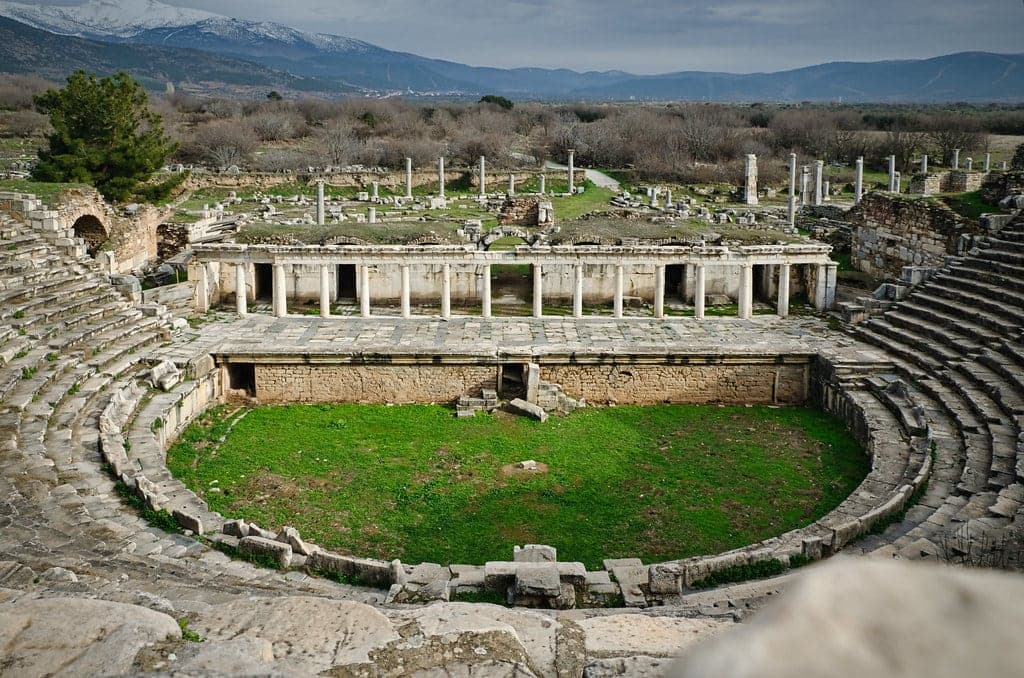
The approach to Ephesus proper offers the grandeur expected of a great Roman city. The Library of Celsus rises with its columned facade, one of the most photographed ancient structures in the world. The Great Theatre, where Paul's preaching sparked a riot, holds 25,000 spectators and still hosts performances. Marble streets carry the grooves of ancient cart wheels. This is where the power of Rome manifested in stone.
But the spiritual heart lies elsewhere—on a hillside seven kilometers away, where a small stone building sits among trees. The House of the Virgin Mary is intimate where the ruins below are monumental. A few rooms, a simple altar, an atmosphere of accumulated prayer. Pilgrims have come here since before the modern site was formally identified, the village of Şirince keeping the tradition alive through centuries. Today, Franciscan friars maintain the chapel and celebrate daily Mass.
The quality of the place is hard to articulate. Visitors speak of peace, of presence, of something that settles as they enter. The Wishing Wall outside the chapel holds thousands of paper prayers, tied with string, left by pilgrims of every faith. The sacred spring offers water believed to have healing properties.
On August 15, the Feast of the Assumption transforms the hillside. Thousands of pilgrims gather as darkness falls. Candles are lit, hymns rise in Turkish, Latin, and English, and the procession moves through the night. This is not heritage tourism but living pilgrimage.
The Temple of Artemis, once one of the Seven Wonders, requires imagination to perceive. One reconstructed column stands in a marshy field, storks nesting atop it. Foundation stones mark where 127 columns once soared sixty feet high, where pilgrims brought offerings from across the ancient world. The contrast with the living pilgrimage at Mary's House is instructive: this is what becomes of a sacred site when devotion ceases.
The Basilica of St. John, on a hill in Selçuk, has been partially reconstructed. The tomb area—where John the Apostle traditionally lies—receives visitors who come to honor the disciple whom Jesus loved. Medieval pilgrims collected dust from the tomb, believing it had healing properties. The church was once the second largest in Asia Minor, after Hagia Sophia.
Within the main ruins, the Church of Mary sits in partial remains. This is where the Council of 431 met and declared Mary Theotokos. Standing among the fallen columns, one can imagine the bishops gathered, the debates, the decision that shaped how Christians understand Mary.
Ephesus involves multiple sites that can be visited in a full day or spread across two. The main archaeological site (the Roman city) is near Selçuk, with two entrances—upper and lower. The House of the Virgin Mary is 7 km away on Mount Koressos, requiring transport. The Basilica of St. John is in Selçuk itself. The Temple of Artemis site is between Selçuk and the main ruins. Most visitors begin at the main ruins (arriving at 8:00 AM opening for cooler temperatures and fewer crowds), then visit the House of the Virgin Mary (attending afternoon or evening Mass if desired), with the Basilica of St. John and Temple of Artemis fitted in as time permits.
Ephesus invites multiple readings: as archaeological wonder, as the birthplace of Marian doctrine, as a site of living pilgrimage, or as evidence of how sacred devotion transforms across millennia without disappearing.
Archaeologists recognize Ephesus as one of the best-preserved Roman cities in the Mediterranean, providing exceptional evidence of Hellenistic, Roman, and Byzantine urban development. UNESCO's inscription acknowledges the site's layered religious significance. The Temple of Artemis is documented through ancient sources as one of the Seven Wonders, though almost nothing remains. The Church of Mary and Basilica of St. John are documented as major early Christian pilgrimage sites. Scholarly consensus holds that the House of the Virgin Mary's identification through Emmerich's visions is historically unverifiable—there is no archaeological evidence that Mary lived in Ephesus, and another strong tradition places her death in Jerusalem. However, the site's significance does not depend entirely on historical authenticity; it has accumulated devotional meaning through centuries of pilgrimage.
For Catholic Christians, Ephesus represents the authoritative declaration of Mary as Theotokos at the Council of 431—the theological foundation for Marian devotion. The tradition that Mary lived and was assumed into heaven from this place makes the House of the Virgin Mary a site of profound significance, regardless of questions about historical verification. Multiple popes have visited, celebrated Mass, and granted indulgences to pilgrims. For Muslims, Meryem Ana is honored as the purest woman, mother of Prophet Isa (Jesus), making this one of the rare sites of shared Christian-Muslim pilgrimage—a symbol of what the two faiths hold in common.
Some visitors perceive a continuous 'sacred feminine' energy at Ephesus—the same divine mother worshipped for three thousand years under different names: Cybele, Artemis, Mary. The many-breasted Artemis statue has become an icon for those who see the site as a repository of goddess energy. The feminine succession—from fertility goddess to Virgin Mother—prompts reflection on how cultures have understood the divine feminine. While this interpretation diverges from both ancient practice and current Christian theology, the historical continuity of feminine sacred presence at this site is factually undeniable.
Did Mary actually live in Ephesus? The tradition is ancient and devotionally significant, but no archaeological evidence confirms it. Another strong tradition places her death in Jerusalem. How should we understand Anne Catherine Emmerich's visions, which led to the site's discovery? The Catholic Church has not pronounced on their authenticity. What did the decorations on the Artemis statue actually represent? The 'many-breasted' interpretation is debated; scholars have proposed bee eggs, bull testicles, acorns, or something else entirely. These uncertainties do not diminish the site's significance—they deepen it, allowing pilgrims to engage with mystery rather than certainty.
Visit Planning
Multiple sites near Selçuk in İzmir Province, Turkey. Main ruins: €40 entry, 8:00 AM - 6:50 PM daily. House of the Virgin Mary: ~€12.50 cash only. Best visited spring or autumn. Allow a full day for all sites.
Located near Selçuk in İzmir Province, Turkey. İzmir Adnan Menderes Airport is 60 km away with connections to Istanbul and European cities. Kuşadası cruise port is 17 km from Ephesus. Regular buses and dolmuş from Selçuk to the sites. Taxis readily available. The sites are separate locations: main ruins near Selçuk, House of Virgin Mary 7 km up Mount Koressos, Basilica of St. John in Selçuk town, Temple of Artemis between Selçuk and main ruins.
Selçuk offers a range of accommodations from budget pensions to boutique hotels, all within walking distance of the Basilica of St. John and short transport to other sites. Kuşadası (17 km) has larger resort hotels. For the August 15 celebration, book months in advance.
Modest dress required at the House of the Virgin Mary. Photography restricted during Mass. Standard heritage site protocols at the main ruins.
The House of the Virgin Mary is an active pilgrimage site requiring behavior appropriate for a place of worship. Cover shoulders and knees before entering the chapel. Silence or hushed voices within. Photography is permitted outside but restricted during Mass; be discreet in the chapel area. The Wishing Wall accepts prayer intentions from all visitors—paper and string are provided.
The main Ephesus ruins are a heritage site with standard archaeological protocols: stay on paths, do not climb on structures, do not touch ancient surfaces. Comfortable walking shoes are essential for uneven marble. Summer heat can be dangerous; bring water, wear a hat, and pace yourself.
The Basilica of St. John and Temple of Artemis site have fewer formal requirements but deserve the same respect given to any sacred space, even one in ruins.
Local guides add enormously to the experience. The iconography, history, and layered significance of Ephesus are not immediately apparent; a knowledgeable guide reveals what casual visitors miss.
House of the Virgin Mary: shoulders and knees must be covered. Main ruins: comfortable walking shoes essential for marble surfaces; sun protection in summer. Basilica of St. John: no formal requirements but modest dress appropriate.
Main ruins and Temple of Artemis: photography permitted freely. House of the Virgin Mary: photography permitted outside; restricted during Mass; be discreet in chapel. Basilica of St. John: photography permitted. No flash in enclosed spaces.
Candles may be lit at the House of the Virgin Mary. Prayer intentions may be left at the Wishing Wall. Financial offerings support the Franciscan administration of the site.
House of the Virgin Mary: no food or drink in chapel; silence during Mass; modest dress required. Main ruins: do not climb on or touch structures; stay on designated paths. Sacred spring: water for spiritual purposes; do not bring large containers.
Sacred Cluster
Nearby sacred places create the location cluster described in the growth plan. This block is intentionally crawlable and links into the wider regional graph.