Holy Cave of the Apocalypse
Where John heard heaven speak through rock, and seekers still listen
Between Skala and Chora, Patmos, Greece
At A Glance
- Coordinates
- 37.3145, 26.5450
- Suggested Duration
- Plan 30 minutes to an hour for the cave itself, allowing time to absorb rather than rush through. Add 2-3 hours to visit the Monastery of Saint John on the hilltop and explore Chora. A full day on Patmos allows for a more contemplative pace. Staying overnight enables the deeper experience of multiple visits.
Pilgrim Tips
- Knees and shoulders must be covered. Long pants or skirts below the knee are required. Sleeveless tops are not permitted. Hats may need to be removed inside. Dress as you would for a church service, because that is what you are entering.
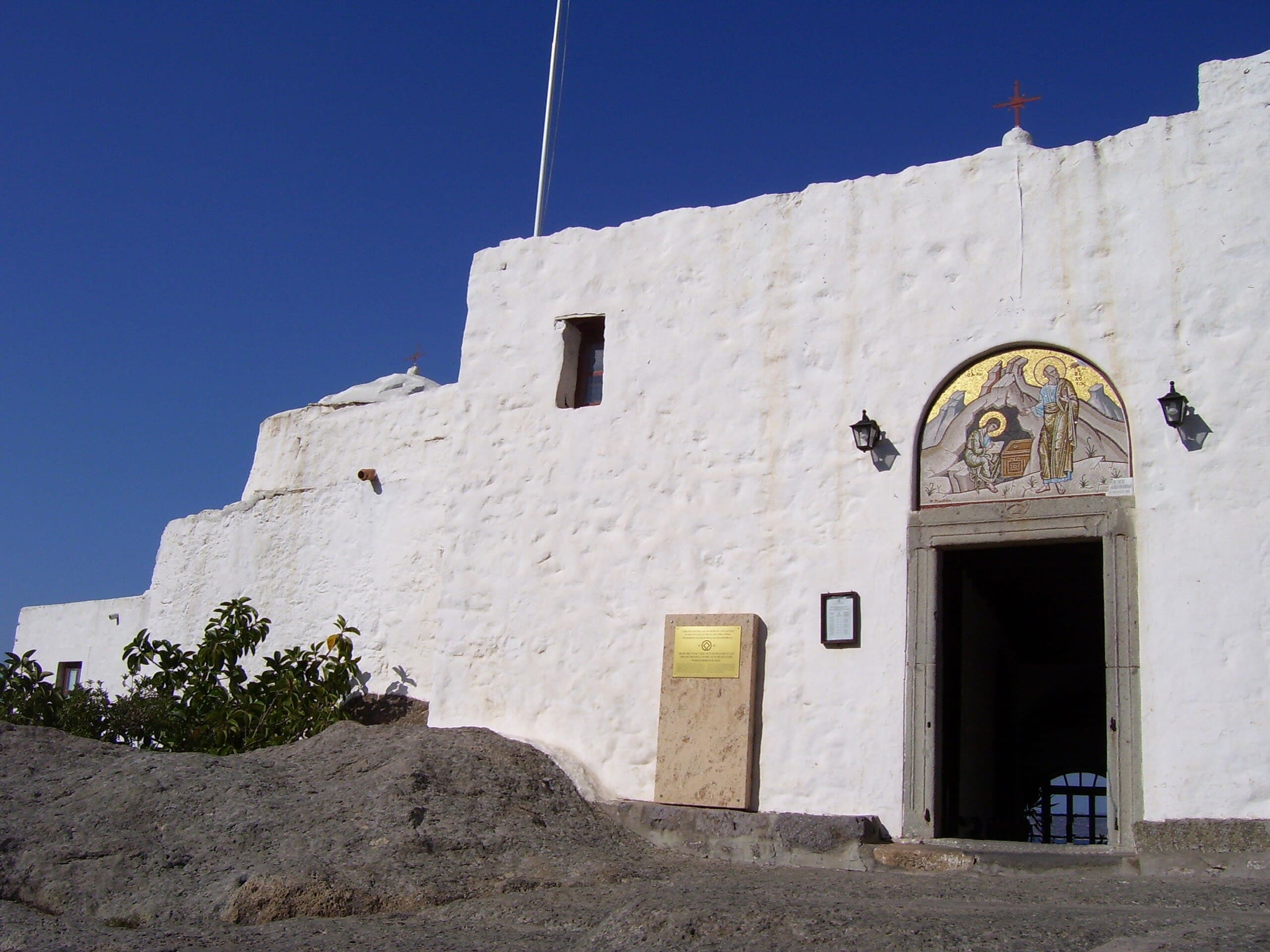
- Photography is not permitted inside the cave. This rule is strictly enforced. Exterior photographs of the chapel and monastery complex are allowed. Use the visual restriction as an invitation to see more deeply rather than more frequently.
- The cave is an active place of worship, not a museum. Behavior appropriate to a church is expected. Photography is prohibited inside, a restriction that actually serves visitors by preventing the space from becoming mere image-capture opportunity. Do not touch the sacred spots marked in silver. These markers protect the rock from erosion by countless hands. Venerate with your eyes and your prayer, not your fingers. Be aware that the cave may close during liturgical services. Plan around the schedule rather than being surprised by a locked door.
Overview
In this small cave on Patmos, tradition holds that Saint John received the Book of Revelation nearly two thousand years ago. The three fissures in the rock ceiling, understood as a sign of the Holy Trinity, frame the spot where divine voice met human hearing. Today, pilgrims and visitors enter the same stone chamber, lit by candles and ancient icons, seeking the presence that once spoke here.
The Holy Cave of the Apocalypse is a small place to hold so large a mystery. You descend a few steps from the Chapel of Saint Anne and enter a chamber carved by nature and shaped by faith. The walls close around you. Candles flicker against stone blackened by centuries of incense and devotion.
Here, around 95 AD, an exiled apostle named John heard something. The voice, according to tradition, came through three fissures in the rock ceiling, splitting the darkness with commands: write what you see. What followed became the Book of Revelation, the final and most visionary book of the Christian Bible, describing the end of all things and the birth of a new heaven and earth.
The physical markers remain. A silver ring marks where John laid his head. Another marks the handhold he used to rise from prayer. A natural rock ledge served as the writing desk of Prochorus, his scribe. The three-fold crack still opens overhead, its trinity of shadows unchanged since the Roman Empire ruled the Mediterranean.
There are few places on earth where sacred text and physical location remain so intimately joined. The Book of Revelation has shaped Christian imagination for two millennia, and here, in this intimate cave, is where tradition says it began. The candles still burn. The icons still watch. And something of what John encountered still seems to linger in the silence between the stones.
Context And Lineage
Around 95 AD, the apostle John was exiled to Patmos by Emperor Domitian. In this cave, he received the visions that became the Book of Revelation, dictating them to his disciple Prochorus. After Domitian's assassination, John returned to Ephesus, but the cave remained a place of veneration. In 1088, Saint Christodoulos founded the nearby monastery. The 17th-century Chapel of Saint Anne now encloses the cave while preserving its character.
The story begins with Roman persecution. Emperor Domitian, who ruled from 81 to 96 AD, launched campaigns against Christians who refused to worship him as a god. Among those exiled was John, traditionally identified as the beloved disciple of Jesus, author of the Fourth Gospel, last surviving apostle.
Patmos was a desolate place for exile, a small island in the Aegean used by Rome to dispose of political and religious inconveniences. Here John found refuge in a cave, accompanied by his disciple Prochorus. According to tradition, after three days of fasting and prayer, the earth shook, thunder rolled, and the rock above John's head split into three fissures. Through them came a voice: 'I am the Alpha and the Omega, the First and the Last. What you see, write in a book and send it to the seven churches.'
What followed was a series of visions of unprecedented scope: the four horsemen, the beast and the dragon, the fall of Babylon, the lake of fire, the descent of the New Jerusalem. Prochorus wrote as John spoke, capturing the apocalyptic imagery that would shape Christian eschatology for two millennia.
After Domitian's assassination in 96 AD, his successor Nerva released many exiles. John returned to Ephesus, where he died around 100 AD. But the cave remained, carrying the memory of what had happened there.
The cave's veneration appears to have been continuous since John's time, though formal documentation begins in the medieval period. Local Christian communities maintained the site through the centuries of Byzantine rule. When Saint Christodoulos arrived in 1088, he recognized the cave's significance and incorporated it into his new monastic foundation.
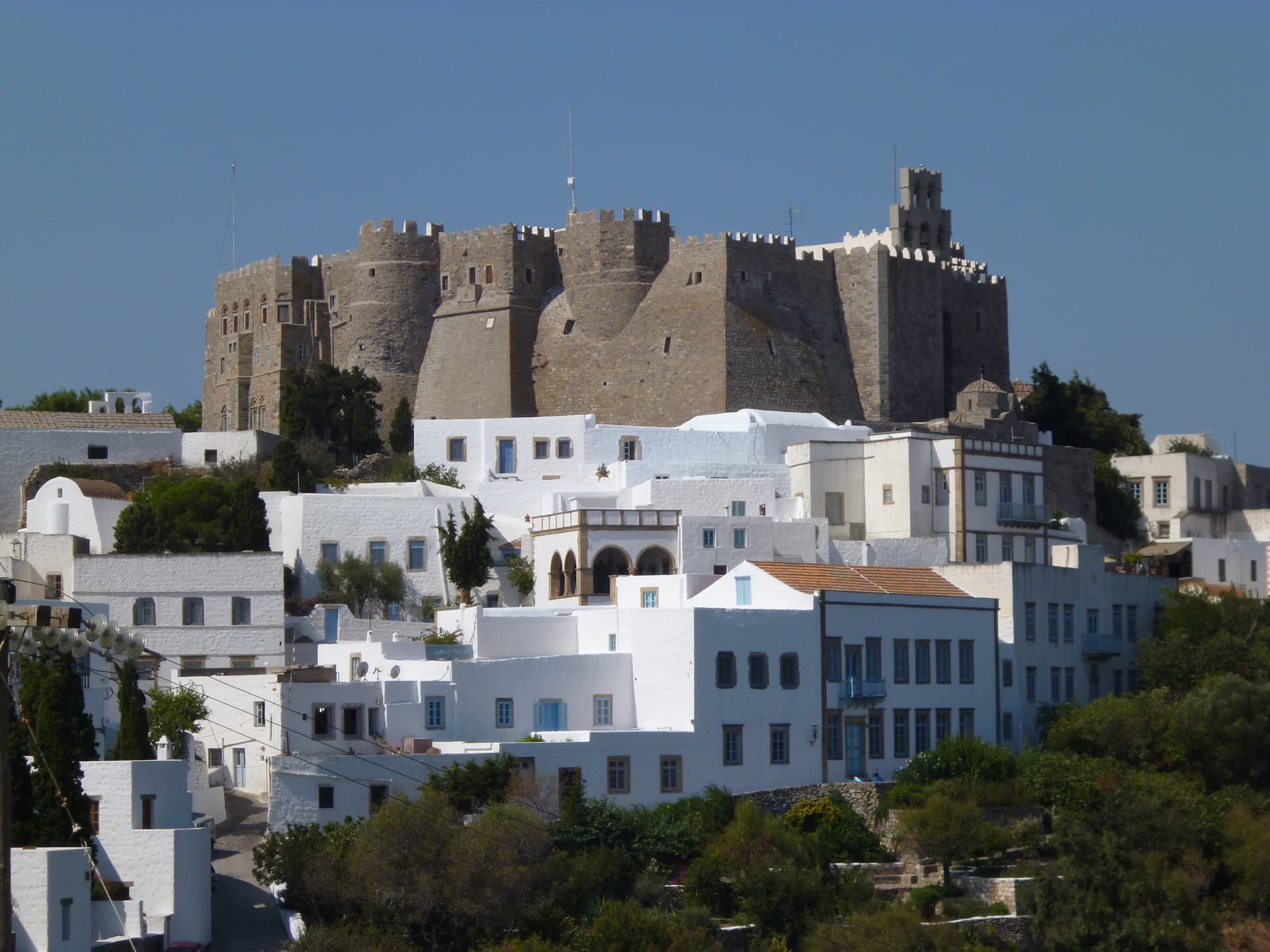
The fortified monastery he built above the cave protected both the sacred site and a growing library of manuscripts. The Chapel of Saint Anne, constructed in the 17th century, gave the cave its current form: a church built around and into the natural chamber, preserving the rock formations while adding iconography, altar, and the apparatus of Orthodox worship.
Today, the cave functions as part of the Monastery of the Apocalypse, itself subordinate to the Monastery of Saint John the Theologian on the hilltop. Monks maintain the site, welcome pilgrims, and continue the liturgical tradition that has animated these stones for nearly a millennium.
Saint John the Theologian
apostle
Known as the Beloved Disciple, traditionally the author of the Gospel of John, three epistles, and the Book of Revelation. Orthodox Christianity venerates him as the only apostle to die of natural causes.
Prochorus
disciple
John's disciple and scribe, traditionally identified as one of the seven deacons appointed in Acts 6. He wrote down the visions as John dictated them, using the rock ledge still visible in the cave as his desk.
Saint Christodoulos
founder
The Byzantine monk who founded the Monastery of Saint John in 1088, granted the island by Emperor Alexios I Komnenos. He built a hermitage around the cave, establishing it as a formal place of worship.
Why This Place Is Sacred
The cave's sacredness emerges from its role as the site of direct divine communication, the specific location where Holy Scripture was revealed and written. Nearly two thousand years of continuous veneration have layered prayer upon prayer, while the physical evidence remains: the rock fissures, the indentations, the atmosphere of a space designed for encounter with the transcendent.
What makes a place thin is often difficult to articulate. Here, it is unusually concrete. This is the site where, according to Christian tradition, God spoke audibly to a human being in the New Testament era. The voice came through the rock itself.
The cave sits halfway up a mountain on a small Greek island, an unlikely location for cosmic revelation. Yet the Book of Revelation opens by naming its origin precisely: 'I, John, your brother and companion in the suffering and kingdom and patient endurance that are ours in Jesus, was on the island of Patmos because of the word of God and the testimony of Jesus.' The tradition identifying this specific cave dates to at least the 11th century, when Saint Christodoulos built a hermitage around it.
The three fissures in the ceiling function as the cave's theological signature. Orthodox understanding holds that through these openings, God's voice descended in Trinitarian form, commanding John to write and send his visions to the seven churches of Asia Minor. Whether the fissures formed naturally or through the earthquake tradition describes, they have become central to the cave's meaning.
The accumulated weight of almost two thousand years of pilgrimage adds its own dimension. Countless believers have entered this space seeking the presence that once spoke here. The icons that cover the walls, some dating to the 17th century, watch with Byzantine stillness. The incense that fills the air carries the prayers of generations. The silence, when crowds permit, is not empty but charged with expectation.
For those who enter seeking more than history, the cave offers something increasingly rare: a place where the gap between sacred text and physical reality nearly closes, where the words of scripture can be read in the same space where they were first heard.
The cave's original use before John's exile remains unknown, though caves throughout the Mediterranean held religious significance in pre-Christian times. Once established as the site of John's revelation, it became a place of veneration, then formal worship. Saint Christodoulos incorporated it into a hermitage in the 11th century, and the Chapel of Saint Anne was constructed around it in the 17th century, transforming the natural cave into a functioning church while preserving its essential character.
From apostolic refuge to medieval hermitage to formal chapel to UNESCO World Heritage Site, the cave has moved through distinct phases while maintaining its core identity as a place of encounter. The Greek Parliament's 1981 declaration of Patmos as a Sacred Island recognized what pilgrims had known for centuries. Today, the cave serves simultaneously as functioning Orthodox chapel, pilgrimage destination, and heritage site, holding these roles in unusual harmony.
Traditions And Practice
The cave functions as an active Orthodox chapel where regular liturgical services are held. Pilgrims venerate the sacred spots where tradition locates John's head, hand, and Prochorus's writing desk. The annual cycle of Orthodox worship continues, with Holy Week and Easter bringing especially intense celebration to Patmos.
Orthodox worship in the cave follows patterns established over centuries. The Divine Liturgy is celebrated at the small altar, incorporating the cave's natural features into the liturgical space. Pilgrims venerate the silver-marked spots where John rested, crossing themselves and sometimes pressing foreheads to the cool stone. Candles are lit, prayers offered, and the space is treated as what Orthodox theology calls a 'holy place' where heaven and earth come particularly close.
The three-fold fissure draws special attention. Pilgrims gaze upward at the opening through which God's voice is said to have descended, contemplating the intersection of physical reality and divine communication.
The contemporary experience of the cave is shaped by its dual role as active chapel and pilgrimage destination. Liturgical services follow the Orthodox calendar, with the cave becoming particularly significant during feasts of Saint John the Theologian on September 26 and May 8.
Holy Week on Patmos offers the most immersive experience. The island hosts some of the most solemn Orthodox Easter celebrations in Greece, with the cave and monastery hosting services throughout the week. On Holy Thursday, the Niptira ceremony reenacts Jesus washing the disciples' feet. On Easter Sunday, the Liturgy of Love features the reading of the Book of Revelation in multiple languages, bringing John's words full circle to their place of origin.
If you seek more than a quick visit, consider these approaches:
Arrive at opening time, before tour groups. The cave is small; crowds transform the experience. Early morning allows the silence to speak.
Light a candle. The gesture is simple, the effect surprisingly powerful. Watching your small flame join the others, adding your light to centuries of light, creates connection across time.
Read from Revelation before or during your visit. Chapter 1 describes the vision's beginning in terms that match the cave: the loud voice, the command to write. Reading these words where they were first heard creates unusual resonance.
Sit if space allows. Let your eyes adjust. Let the icons become presences rather than objects. The cave rewards patience.
Eastern Orthodox Christianity
ActiveThe Holy Cave of the Apocalypse stands among the most sacred sites in Orthodox Christianity. It is venerated as the place where Saint John the Theologian received divine visions directly from God and dictated the Book of Revelation to his disciple Prochorus. The cave represents the location of direct divine communication, a New Testament Sinai where God's voice was heard through the three fissures symbolizing the Holy Trinity.
Regular liturgical services are celebrated in the Chapel of Saint Anne. Pilgrims venerate the sacred spots where John rested and received visions. The silver-marked locations of John's headrest and handhold receive particular devotion. Contemplation at the three-fold fissure connects worshippers to the Trinitarian revelation. Holy Week and Easter celebrations on Patmos center on the cave and monastery, culminating in the Easter Sunday Liturgy of Love where Revelation is read in multiple languages.
Experience And Perspectives
Visitors consistently describe the cave as producing effects beyond typical sacred site tourism: a profound sense of awe, an almost tangible spiritual presence, deep contemplation triggered by the intimate scale and layered history. The contrast between the cave's humble size and its immense significance in Christian history creates an impact that transcends religious background.
The first thing you notice is the smallness. After the journey to Patmos, after climbing toward the hilltop monastery, you descend into a space that could fit in a modest living room. The walls are covered with icons, silver markings, candle flames reflected on stone. The ceiling presses close.
This intimacy creates much of the effect. There is no monumental distance between you and the place where John heard the voice. You stand where he stood. The rock he touched is within arm's reach. The fissures through which tradition says God spoke are directly overhead. The gap between then and now, between sacred history and present moment, nearly vanishes.
Visitors across traditions report similar experiences. A sense of stepping outside time. Unexpected emotion welling up without clear cause. The feeling that the space is watching, listening, aware. Some describe it as the most spiritually powerful place they have encountered. Others, more reserved, simply note that something about the cave commands attention in a way they did not anticipate.
The candlelight helps. So does the incense. So does the required silence. The cave's atmosphere has been carefully cultivated for centuries to facilitate exactly this response. But the effect seems to exceed the staging. Even visitors who resist religious interpretation often leave acknowledging that something unusual happened in the cave, though they may decline to name it.
Those who return multiple times often describe a deepening relationship with the space. The first visit overwhelms with sensory and historical weight. Subsequent visits allow subtler dimensions to emerge: the quality of silence, the presence in the icons' gazes, the sense of being held within something vast.
The cave rewards stillness. The small space and frequent crowds can make contemplation challenging, but those who find a moment of quiet often report the deepest experiences. Consider arriving at opening time, when cruise ships have not yet disgorged their passengers. Sit rather than photograph. Let your eyes adjust not just to the darkness but to the cave's particular quality of presence.
You need not be Orthodox, or Christian, or religious at all to encounter something here. The cave seems to work on those who arrive open, regardless of their framework for understanding what they find. What it asks is simple: attention. Not belief, necessarily. Just genuine attention to what is here.
The Cave of the Apocalypse invites interpretation from multiple angles, each illuminating different dimensions of its significance. Historical questions about John's identity and the book's composition exist alongside Orthodox veneration and the personal experiences of contemporary pilgrims. Holding these perspectives together without forcing resolution honors the cave's complexity.
Historical and biblical scholars generally accept that the Book of Revelation was written on or is associated with Patmos, as stated in Revelation 1:9. The dating to approximately 95-96 AD during Domitian's reign rests on early church fathers including Irenaeus and Eusebius. The identification of this specific cave as the site dates to at least the 11th century when Saint Christodoulos established the monastery, though the tradition may be older.
Scholars debate whether 'John of Patmos' is the same figure as John the Apostle, the beloved disciple, and the author of the Fourth Gospel. Orthodox tradition affirms all these identities as one person. Academic scholarship is more cautious, noting differences in Greek style and theological emphasis between Revelation and the Gospel of John. What is not contested is Revelation's profound influence on Christian imagination and its association with this island.
The cave's significance lies in its nearly two millennia of continuous veneration rather than archaeological proof. The sacred spots marked within the cave cannot be verified as the actual locations of John's devotion, but their long acceptance has given them spiritual weight independent of historical confirmation.
Orthodox Christianity venerates the Cave of the Apocalypse as the literal location of direct divine revelation. The three fissures in the rock ceiling are understood as miraculous signs of the Holy Trinity, the channels through which God's voice reached human ears. The physical markings within the cave, the silver rings identifying where John rested his head and lifted himself with his hand, where Prochorus wrote, these are treated as authentic contact points with apostolic presence.
In Orthodox understanding, such places hold continuing spiritual power. The prayers of countless pilgrims have accumulated in the stone. The saints depicted in the icons are present, not merely represented. The Divine Liturgy celebrated here connects present worshippers with the eternal liturgy of heaven. To enter the cave is to enter a space where the barrier between earthly and divine has grown thin.
The cave ranks among the seven most important pilgrimage sites in Europe according to the COESIMA network. For Orthodox Christians worldwide, it represents one of the few places where the geography of the New Testament remains accessible and active.
Some spiritual seekers and alternative traditions approach the Cave of the Apocalypse through frameworks beyond traditional Christianity. The site may be understood as a powerful energy vortex or thin place where dimensional boundaries weaken. The apocalyptic visions John received might be interpreted through New Age lenses as channeled cosmic information rather than specifically Christian prophecy.
Some note that caves throughout human history have served as sites of vision and altered consciousness. The cave's isolation, its natural rock formations, and the sensory conditions of darkness and silence may have facilitated visionary states regardless of their theological interpretation. Whether John's experiences are understood as divine revelation, prophetic vision, or altered state, the cave remains a place where something unusual happened.
These interpretations lack Orthodox endorsement but sometimes emerge from genuine experiences visitors have in the cave. The language differs; the encounter may share common ground.
Mysteries remain. The precise mechanism by which John received his visions transcends explanation, understood within faith as divine action, unexplained by secular frameworks. Whether the cave held sacred significance before John's exile, perhaps connecting to earlier Greek oracle traditions, is unknown. The natural formation of the three-fold fissure, while geologically explainable, retains an element of wonder in its apparent Trinitarian symbolism. What else John did during his approximately eighteen months on Patmos, beyond receiving and dictating the Revelation, remains largely a matter of tradition and speculation.
Visit Planning
The cave is located between the port of Skala and the hilltop town of Chora on Patmos. It is open mornings daily with additional afternoon hours several days per week. Spring and autumn offer the best combination of pleasant weather and manageable crowds. Allow time to visit both the cave and the Monastery of Saint John above.
Patmos offers accommodation ranging from simple guesthouses to boutique hotels, concentrated in Skala and Chora. Staying overnight allows multiple visits to the cave and participation in the island's contemplative rhythm. Several monasteries and religious guesthouses may offer lodging to pilgrims by arrangement.
As an active Orthodox chapel, the cave requires modest dress, silence, and respectful behavior. Photography is not permitted inside. Visitors are guests of a living worshipping community, not tourists at a heritage attraction.
The Cave of the Apocalypse is a functioning church. This fundamental fact shapes all appropriate behavior. You are entering a space where people pray, where liturgy is celebrated, where the Orthodox Church maintains continuous worship of the God who spoke through these rocks.
Modest dress is strictly required. Knees and shoulders must be covered. Sleeveless shirts, shorts, and revealing clothing will prevent entry. Many visitors bring scarves or wraps to add coverage if needed. The requirement is not arbitrary; it reflects the Orthodox understanding that one approaches sacred space with physical preparation as well as spiritual intention.
Silence is expected. If you must speak, whisper. Better to communicate through gesture and eye contact. The cave's small size means voices carry. Respect others' prayer and contemplation.
The prohibition on photography serves multiple purposes: preservation, atmosphere, and the insistence that this is not a site for consumption but for encounter. Put away your phone. Be present to what is here.
Knees and shoulders must be covered. Long pants or skirts below the knee are required. Sleeveless tops are not permitted. Hats may need to be removed inside. Dress as you would for a church service, because that is what you are entering.
Photography is not permitted inside the cave. This rule is strictly enforced. Exterior photographs of the chapel and monastery complex are allowed. Use the visual restriction as an invitation to see more deeply rather than more frequently.
Candles can be purchased and lit as offerings. Donations to the monastery are welcomed and support the preservation of this ancient site. These are the appropriate forms of offering; do not leave other objects.
No photography inside the cave. Silence required. Modest dress enforced. Do not touch the silver-marked sacred spots or icons without permission. The cave is not wheelchair accessible, involving stairs. Some areas may be closed during services.
Sacred Cluster
Nearby sacred places create the location cluster described in the growth plan. This block is intentionally crawlable and links into the wider regional graph.