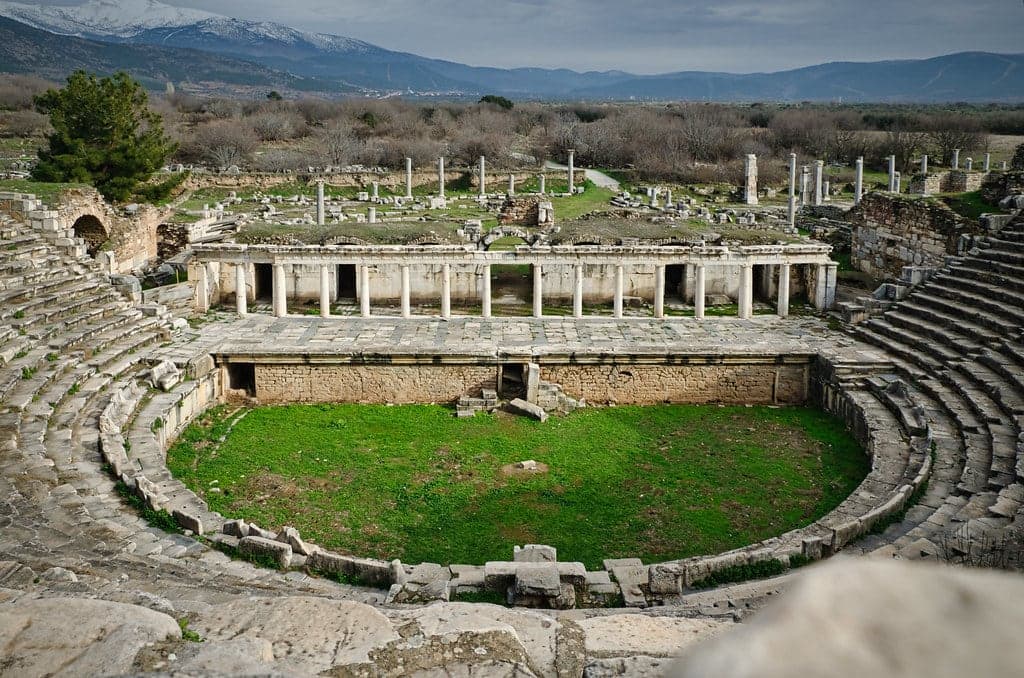
Aphrodisias
Where a city was built for a goddess who combined Anatolian earth with Hellenic love
Karacasu, Aydın, Turkey
At A Glance
- Coordinates
- 37.7092, 28.7236
- Suggested Duration
- Two to four hours for the major monuments and museum. A full day allows thorough exploration of the entire site.
Pilgrim Tips
- Comfortable outdoor clothing and walking shoes suitable for an archaeological site. No religious dress requirements.
- Generally permitted. Check current regulations at the museum. Tripods and flash may be restricted in certain areas.
- This is an archaeological site with no active religious tradition. Respect the archaeological remains and follow posted guidelines. Do not touch or remove anything. The site may be hot in summer; bring water and sun protection.
Overview
Aphrodisias existed because of Aphrodite. The city took her name, lived under her protection, and created the sculptors who gave divine form to marble across the Roman world. Here the Julio-Claudian emperors traced their ancestry, and here the goddess who made things beautiful presided over a city that was itself beautiful.
Aphrodisias stands as one of antiquity's clearest examples of a city defined entirely by its relationship to a deity. The goddess worshipped here was not simply the Greek Aphrodite transplanted to Anatolia—she was an older presence, a local fertility goddess whom the Greeks recognized as their own when they arrived, creating something new in the synthesis. The Julio-Claudian emperors claimed descent from Venus through Aeneas, making Aphrodisias a city connected by divine genealogy to Rome's ruling family. This brought privilege, patronage, and purpose. The marble quarried nearby became the raw material for a sculpture school whose works spread across the Mediterranean. The Sebasteion celebrated both goddess and emperors in monumental relief. The stadium seated thirty thousand. The city existed at the intersection of the sacred, the political, and the artistic—not as separate domains but as facets of one reality. When Christianity came, the temple became a cathedral, the city was renamed Stauropolis, and a new cross replaced the ancient goddess. What remains is the archaeology of devotion: the evidence that an entire city organized its identity around the divine feminine.
Context And Lineage
Aphrodisias rose as a cult center, flourished under Roman patronage, and faded when its goddess was replaced. The sculptors who worked here shaped divine images for the entire Mediterranean world.
The sanctuary predates the city. Worship of a fertility goddess at this site is attested from at least the seventh century BCE, and the tradition may be older. When Greeks arrived in Anatolia, they identified this local deity with their own Aphrodite, though the resulting goddess was distinctive—her canonical image showed her wrapped in bands of symbolic ornament, relating her visually to the Artemis of Ephesus rather than the nude Aphrodite of Greek tradition. The identification reflected genuine theological work: the Greeks saw in this Anatolian goddess the power they called Aphrodite, the force that draws beings together, that makes things beautiful, that generates life. The city that grew around the sanctuary took the goddess's name. When Rome rose to power, the Gens Julia—the family of Julius Caesar, Augustus, and their successors—claimed descent from Venus through Aeneas. Aphrodisias became a city connected to the imperial family through divine genealogy. The Senate recognized this in 39 BCE by granting the sanctuary asylum status. Privilege and patronage followed. The city's sculptors became the most sought-after in the Roman world.
The sacred tradition began with an Anatolian fertility goddess, predating Greek arrival. Hellenistic interpretation identified her with Aphrodite while preserving her distinctive character. Roman patronage through the Julio-Claudian connection brought monumental building and imperial cult worship at the Sebasteion. Christian conversion around 500 CE transformed temple to cathedral. No living tradition continues worship of the ancient goddess; the site's significance is now archaeological and historical.
The Aphrodite of Aphrodisias
The distinctive goddess who defined the city
The Sculptors of Aphrodisias
Artists who gave divine form to marble
Zoilos
Freedman who financed temple expansion
Why This Place Is Sacred
Aphrodisias was sacred because a goddess defined its identity—not as patron but as essence. The city existed for her, derived its name from her, and expressed its devotion in marble and monument.
The thinness of Aphrodisias lies in the completeness of its sacred identity. This was not a city that happened to have a temple; it was a city that existed because of a temple. The goddess came first. The Greeks who arrived found an Anatolian fertility deity already worshipped here, perhaps for centuries, and recognized her as their Aphrodite. The synthesis created something distinctive—an Aphrodite whose canonical image resembled the Lady of Ephesus more than the classical Greek goddess of love, whose roots reached into Anatolian earth religion rather than Olympian sky. When Rome conquered the east, the Gens Julia claimed Venus as ancestor through Aeneas, and Aphrodisias became a city tied to the ruling family by divine genealogy. The Senate granted asylum status in 39 BCE. Tax-free privilege followed. The Sebasteion rose as a monumental celebration of goddess and emperors together. The sculptors of Aphrodisias became famous throughout the Roman world, creating the images by which divinity was given visible form. Marble was quarried nearby, shaped by local hands, and sent across the Mediterranean carrying Aphrodisian style. The city was wealthy, beautiful, and defined at every level by its sacred identity. When the goddess was displaced, the city itself faded.
Center for the worship of a unique goddess who combined Anatolian fertility tradition with Hellenic Aphrodite. Political and sacred identity merged through the Julio-Claudian claim of descent from Venus.
The cult center predates the city, with worship attested from at least the seventh century BCE. The Hellenistic city was built in the second century BCE. Roman patronage brought monumental expansion. The temple-to-cathedral conversion around 500 CE marked the transition to Christianity. The city's renaming to Stauropolis erased the goddess from its identity. Decline followed the Byzantine period. Modern archaeology, particularly the NYU/Oxford excavations, has revealed the city's exceptional preservation.
Traditions And Practice
Ancient Aphrodisias was a pilgrimage center where devotees sought the goddess's blessing. The Sebasteion hosted imperial cult worship alongside veneration of Aphrodite. Today the site functions as an archaeological monument with no active religious practice.
The sanctuary of Aphrodite drew pilgrims from across Anatolia and the Aegean. Worship would have included sacrifices, offerings, and festivals celebrating the goddess. The connection to fertility, love, and civic prosperity suggests ceremonies related to marriage, harvest, and the city's well-being. The Sebasteion hosted imperial cult worship—sacrifices and festivals honoring deified emperors alongside the goddess. The asylum status granted by Rome in 39 BCE indicates the sanctuary's recognized holiness and the rights of those who sought its protection.
No active religious practice occurs at Aphrodisias. The site functions as an archaeological monument and museum. Some visitors with interest in goddess spirituality or the divine feminine find personal meaning here, though this represents contemporary engagement rather than continuation of ancient practice.
Visit the temple site and consider the goddess who defined this city. Examine the sculpture in the museum, particularly images of Aphrodite herself, to understand how the ancient world gave visible form to divinity. Walk the Sebasteion and observe the reliefs celebrating both goddess and emperors. Sit in the stadium and imagine the festivals that brought thirty thousand together. Notice the marble everywhere—quarried nearby, shaped by local hands, sent across the ancient world. The experience is archaeological and imaginative: reconstructing what it meant to live in a city defined by devotion to beauty and love.
Cult of Aphrodite
HistoricalAphrodisias was the primary center for a distinctive goddess who combined aspects of an archaic Anatolian fertility deity with Hellenic Aphrodite. The cult existed from at least the seventh century BCE and defined the city's identity, economy, and political relationships. The goddess's canonical image showed her wrapped in bands of symbolic ornament, relating her to the Artemis of Ephesus and older Anatolian tradition. She represented not erotic love alone but the cosmic force of attraction and generation.
Pilgrimage, sacrifice, offerings, and festivals. The sanctuary's asylum status, granted by Rome in 39 BCE, indicates its recognized holiness. The specific rituals performed are not fully documented, but the goddess's connection to fertility, love, and civic well-being suggests ceremonies related to marriage, harvest, and prosperity.
Imperial Cult
HistoricalThe Sebasteion, built between approximately 20 and 60 CE, was a monumental complex dedicated jointly to Aphrodite and the deified Roman emperors. The Gens Julia claimed divine descent from Venus through Aeneas, making Aphrodisias a city with special ties to the imperial house. The sculptural reliefs depicted emperors and mythological scenes together, blending religious and political meaning.
Imperial cult worship at the Sebasteion, including sacrifices, processions, and festivals honoring deified emperors alongside the goddess. The combination of divine and imperial worship expressed the Roman understanding of how earthly power connected to cosmic order.
Byzantine Christianity
HistoricalAround 500 CE, the Temple of Aphrodite was converted into a Christian cathedral through remarkable engineering that reoriented the building's sacred axis. The city was renamed Stauropolis—'City of the Cross'—replacing the goddess in its very identity. This conversion represents the transition from pagan to Christian sacred space while maintaining the site's religious centrality.
Christian liturgy in the converted temple-cathedral. The transformation required moving walls and reorienting the space, creating a new sacred architecture from the old.
Experience And Perspectives
Walking through Aphrodisias, visitors encounter a complete ancient city where religion, politics, and art formed a unified system. The goddess is gone, but the infrastructure of devotion remains: temple, stadium, sculptors' workshops, and the marble they worked.
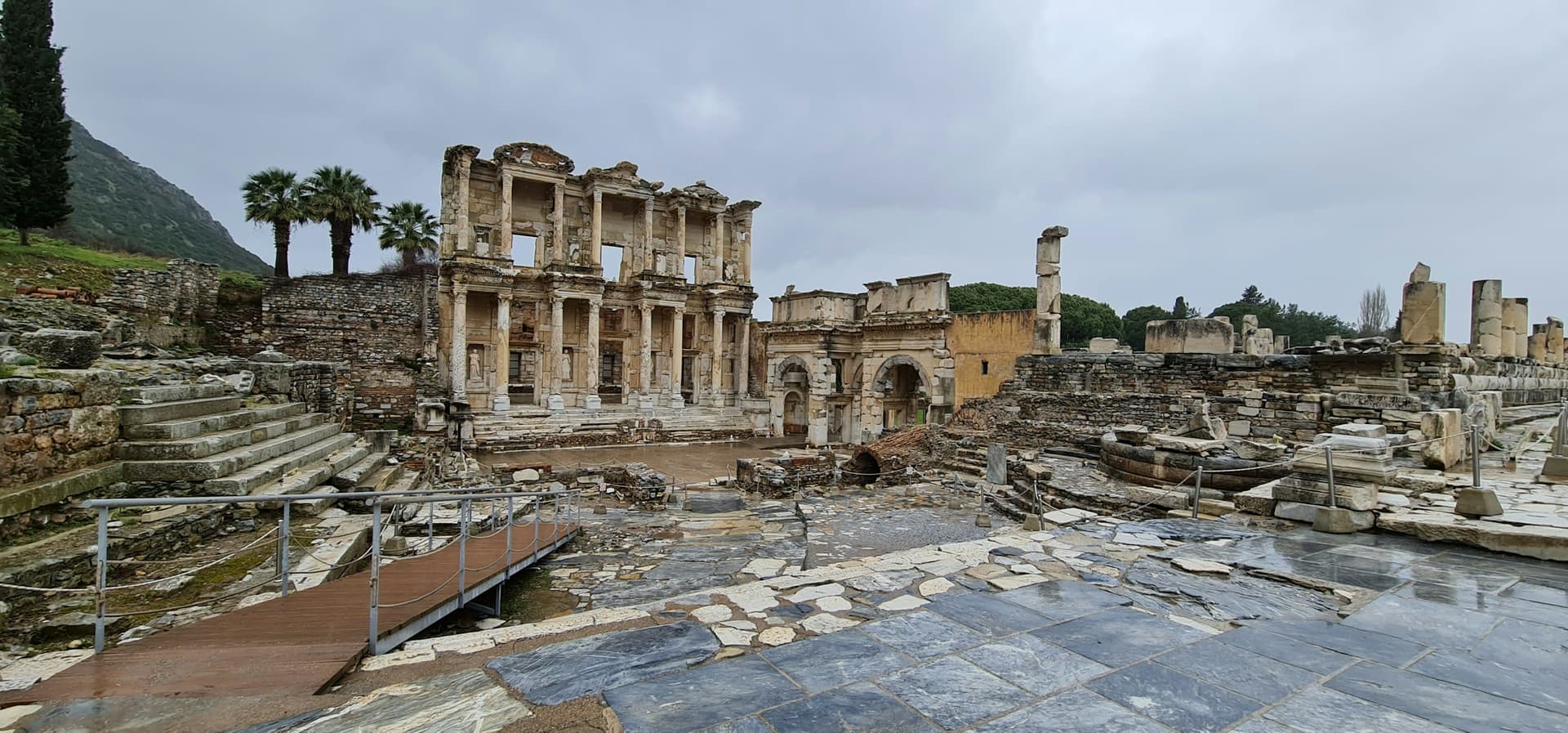
Aphrodisias offers something rare among ancient sites: a sense of the complete city. The ruins are extensive enough, and preserved enough, that the visitor can move between temple and stadium, marketplace and residence, understanding how these elements composed a functioning sacred polity. The Temple of Aphrodite, now visible in its converted cathedral form, shows both ancient and Christian sacred space in one structure. The Sebasteion's remaining reliefs depict emperors and mythological scenes with a power that explains why Aphrodisian sculptors were sought throughout the empire. The stadium, with its two curved ends, seats thirty thousand and remains one of the best-preserved ancient sports venues. The museum holds sculptures that have not traveled—works that can be seen where they were made, in the light of the landscape that produced their marble. Visitors commonly report the experience of encountering antiquity as a living system rather than a collection of fragments. The theme of love and beauty that Aphrodite represents pervades a city that was itself created to be beautiful. The marble is everywhere: in columns and carvings, in the unfinished pieces in the sculptors' workshop, in the quarries that supplied the raw material. This was a city that shaped stone into divine image and sent those images across the world.
The Temple of Aphrodite stands at the site's center, now visible in its cathedral conversion. The Sebasteion lies to the east, a ceremonial avenue with relief-carved porticoes. The stadium is to the north, remarkably preserved. The museum is on site, housing the exceptional sculpture collection. The Tetrapylon, a monumental gateway from around 200 CE, marks the approach to the sanctuary. Walking the site takes two to four hours for the major monuments; a full day allows thorough exploration including the museum.
Aphrodisias invites multiple readings: as archaeological evidence of a complete ancient city, as documentation of how religion organized urban life, and as a case study in the transmission and transformation of sacred traditions.
Archaeologists and historians view Aphrodisias as one of the most important and best-preserved Roman cities in the eastern Mediterranean. The ongoing NYU/Oxford excavations, now spanning decades, have produced exceptional documentation of ancient urban life, sculpture production, and religious practice. UNESCO inscription in 2017 recognizes Aphrodisias's outstanding value for understanding Greco-Roman civilization. The Aphrodisian sculpture school is considered among the most significant of the Roman world, and the systematic excavation of the sculptors' workshop has revealed production methods in unusual detail. The site documents the integration of Greek, Anatolian, and Roman religious traditions in ways that illuminate how ancient syncretism actually worked.
No living tradition claims Aphrodisias or continues worship of the goddess. The ancient religion has no modern practitioners. The site's significance is historical and archaeological rather than religiously active.
Some visitors with interest in goddess spirituality, the divine feminine, or alternative approaches to ancient religion find Aphrodisias meaningful as a place where feminine divinity was honored as the organizing principle of a city. These contemporary engagements represent modern interests projected onto an ancient site rather than continuation of ancient practice.
What were the specific rituals performed in the sanctuary? How did the original Anatolian goddess differ from the Hellenized Aphrodite who bears her Greek name? Why did the city decline so completely after the Byzantine period? What discoveries remain in unexcavated areas? How did worshippers understand the relationship between their goddess and the Artemis of Ephesus, whose image the Aphrodite of Aphrodisias resembled?
Visit Planning
Aphrodisias is located in southwestern Turkey, accessible from Denizli, Aydın, or Izmir. Allow two to four hours for major monuments; a full day for thorough exploration including the museum.
Accommodation is available in nearby towns including Karacasu and Nazilli. Denizli offers more extensive options. Many visitors combine Aphrodisias with Pamukkale/Hierapolis, staying in the Pamukkale area.
Standard archaeological site protocols apply. Respect the ancient remains, stay on designated paths, and follow posted guidelines.
Aphrodisias is an archaeological site and museum without active religious function. Visitor behavior should respect the preservation of irreplaceable ancient remains rather than religious observance. Do not touch, climb on, or remove anything. Stay on designated paths. Photography is generally permitted, but verify current regulations at the museum. The site is extensive and may be hot in summer months; appropriate outdoor clothing, walking shoes, water, and sun protection are recommended.
Comfortable outdoor clothing and walking shoes suitable for an archaeological site. No religious dress requirements.
Generally permitted. Check current regulations at the museum. Tripods and flash may be restricted in certain areas.
Not applicable. The site has no active religious tradition.
Do not touch, climb on, or remove any objects. Stay on designated paths. Follow all posted guidelines for protection of the archaeological remains.
Sacred Cluster
Nearby sacred places create the location cluster described in the growth plan. This block is intentionally crawlable and links into the wider regional graph.