Enchanted Rock, Texas
A billion-year-old granite dome where stone sings and spirits are said to linger
Fredericksburg, Texas, United States
At A Glance
- Coordinates
- 30.5065, -98.8189
- Suggested Duration
- Plan 3-4 hours minimum for the summit hike and time on top. A half-day visit allows for a more leisurely pace and extended summit time. A full day accommodates exploration of other trails and features. Overnight camping, available at walk-in primitive sites, enables sunrise and sunset visits plus stargazing, offering the most complete experience of the rock.
Pilgrim Tips
- Practical hiking attire is appropriate. Sturdy hiking shoes with good traction are essential for the steep granite surface. Sun protection is critical: hat, sunscreen, and sunglasses are strongly recommended. Layers are advisable for visits spanning sunrise, sunset, or nighttime, when temperature changes can be significant. There is no dress code related to spiritual practice, as no active worship takes place.
- Photography is permitted throughout the park. For meaningful images, arrive at sunrise or stay for sunset when the light on the granite is most dramatic. Respect other visitors by not disrupting their experiences for your shots. Avoid blocking trails or summit areas for extended photo sessions. Drone use requires special permit.
- Enchanted Rock is a public park, not a ceremonial site. Practices that might be appropriate elsewhere may not be appropriate here. Do not leave offerings, burn sage, create altars, or conduct group ceremonies without permission. The 120 archaeological sites within the park are protected; do not disturb bedrock mortars, artifacts, or any feature that might have historical significance. Respect other visitors who may be seeking silence or solitude. The rock's spiritual significance does not exempt anyone from park regulations or the principle of leaving no trace.
Overview
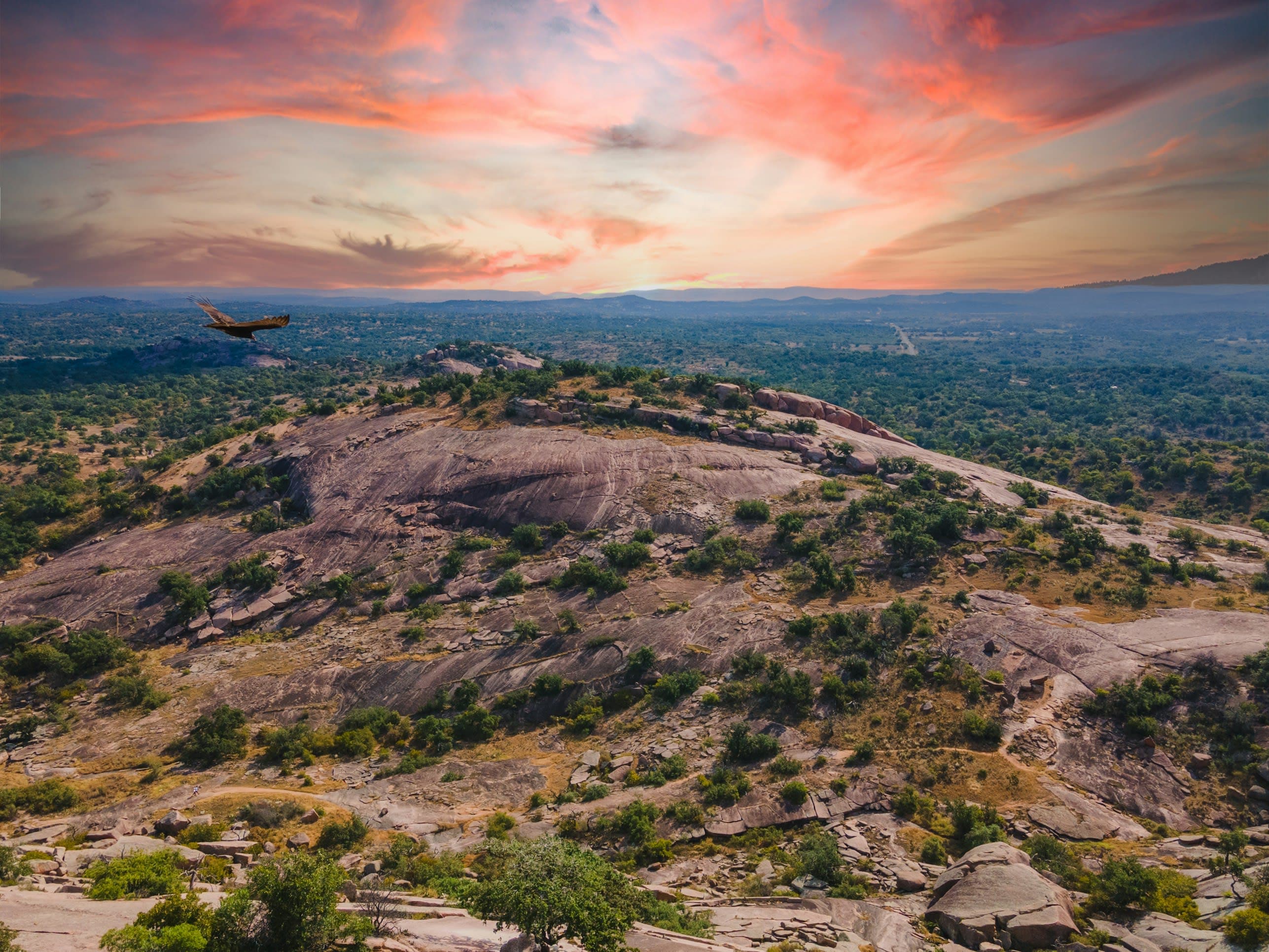
Rising from the Texas Hill Country, this massive pink granite dome has drawn humans for over ten thousand years. The Tonkawa called it the Glowing, Singing Rock for the eerie sounds it makes at night as stone contracts from the day's heat. For the Comanche and Apache who followed, it was a place of vision quests and ceremonies, guarded by phantom warriors. Today the rock still speaks to those who listen, offering summit silences and some of the darkest skies in Texas.
Long before any human stood at its base, Enchanted Rock was already ancient. Formed 1.1 billion years ago when magma cooled deep beneath the earth's surface, this granite batholith has been slowly revealing itself ever since, exposed grain by grain as the softer rock around it eroded away. What remains is one of the largest exposed batholiths in North America, a pink dome rising 425 feet above the surrounding Texas Hill Country.
The Tonkawa named it well. At night, as the rock releases the heat it has absorbed during the day, it groans and creaks, producing sounds that early peoples attributed to spirits within. They saw ghost fires flickering on the summit and felt the presence of something beyond the ordinary. The Comanche, who came later, performed vision quests here, seeking guidance from a realm they understood as accessible through this threshold between earth and sky.
Today, Enchanted Rock is a state natural area, its spiritual significance officially acknowledged through multiple heritage designations. Yet the rock does not require official recognition to produce its effects. Visitors who climb the summit at sunset, who stay for stargazing under pristine dark skies, who hear the strange sounds as night falls, consistently report experiences that mirror what Indigenous peoples described centuries ago. Something persists here that neither time nor categorization has diminished.
Context And Lineage
Enchanted Rock's significance emerges from the intersection of extraordinary geology and consistent human response. The granite batholith formed 1.1 billion years ago, making it among the oldest exposed rock formations in North America. Human presence extends back at least ten thousand years, with three Indigenous traditions, the Tonkawa, Comanche, and Apache, all recognizing the site as spiritually significant.
The rock itself has no single origin story but multiple narratives explaining its nature. One legend, shared across traditions, tells of a band of warriors who made their last stand on the summit. Overcome by enemies, they died on the rock, and their ghosts have haunted it ever since, producing the sounds heard at night. Another story tells of a princess who threw herself from the summit after witnessing her people's slaughter, her spirit remaining to mourn. A third speaks of a chief who sacrificed his daughter and was condemned to walk the summit forever, his footprints visible in the rock's indentations.
These narratives share a common structure: tragedy, death, and ongoing spiritual presence. They explain the rock's uncanny qualities through human drama, locating its power in events that happened here rather than in the rock's inherent nature. The geological story, by contrast, places the rock's significance in timescales beyond human comprehension. Formed when magma intruded into existing rock during the Grenville orogeny, the batholith cooled slowly underground for hundreds of millions of years before erosion exposed it to the surface. Both kinds of story, human and geological, contribute to the site's felt significance.
The lineage of Enchanted Rock's sacredness is not institutional but experiential. The Tonkawa, documented at the site from the 16th century, gave it its enduring name. When the Comanche and Apache displaced the Tonkawa around the 1700s, they maintained and elaborated the site's sacred status, adding their own ceremonies to those of their predecessors. European settlement disrupted these traditions, but the rock continued to attract visitors who sensed something significant about the place even without Indigenous frameworks. Today's visitors, whether they come for hiking, geology, or spiritual seeking, participate in a continuity of human response that crosses cultural boundaries. The land itself seems to be the teacher, instructing each generation in its own language.
Wanken Tanka
In Southwest Indian spiritual tradition, the Creator who sent the Wanbli Luta (Red Hawk Spirit) to sacred mountains like Enchanted Rock to offer vision, wisdom, and healing to those who sought it through proper ceremony.
Why This Place Is Sacred
Enchanted Rock exhibits multiple characteristics of what Celtic tradition calls a thin place. The rock produces audible phenomena, visible luminous effects, and commands the landscape in ways that human consciousness consistently registers as significant. Ten thousand years of human visitation, from Paleo-Indian hunters to contemporary seekers, suggests a site whose thinness does not depend on any single tradition's framework to be perceived.
The concept of thinness applies to places where the boundary between the ordinary and the transcendent seems more permeable than elsewhere. Enchanted Rock possesses this quality through multiple channels that reinforce each other.
First, there is the auditory dimension. At night, particularly as temperatures drop after hot days, the granite produces sounds that early observers described as moans, groans, and creaking. Modern geology explains this as thermal contraction of the rock surface, but the sounds are no less striking for having an explanation. They are audible, unexpected, and occur in the darkness when human perception is already heightened.
Second, there is the visual. The rock appears to glow at twilight and after dark, an effect produced by the slightly radioactive granite releasing stored solar energy. During direct sunlight, heat mirages create visible waves of energy rising from the surface. At certain angles and times, observers report a green-bluish halo surrounding the dome. These phenomena are real and observable, whatever their cause.
Third, there is the presence of the rock itself. Rising 425 feet above relatively flat terrain, Enchanted Rock dominates sight lines for miles. Its smooth, curved surface is unlike anything around it. The climb to the summit removes visitors from the everyday world below and places them on a surface where human structures disappear and only sky, rock, and distant hills remain.
Finally, there is accumulated history. For at least ten thousand years, humans have come here and found something worth returning to. The bedrock mortars where seeds were ground for millennia, the 120 archaeological sites scattered across the area, the legends and ceremonies of three documented Indigenous traditions, all point to a place that has consistently drawn human attention and reverence. Whatever causes this attraction has outlasted many traditions and continues to operate on visitors today.
For Indigenous peoples, Enchanted Rock functioned as a contact point between the human and spirit worlds. The Tonkawa made offerings at its base to the spirits they heard speaking at night. The Comanche conducted vision quests on its summit, seeking guidance and power. The Apache performed spirit dances here. The rock was not merely a landmark but a threshold, a place where ceremonies could achieve what they could not achieve elsewhere.
European settlers, arriving in the 19th century, inherited the name but not the practices. They saw the rock as a curiosity, a natural wonder to be conquered by climbing rather than honored through ceremony. By the 20th century, ranching and private ownership limited access. The Nature Conservancy's 1978 purchase began a new chapter, recognizing the site's significance and transferring it to public protection. Today, the park frames Enchanted Rock primarily as a natural and geological resource, though its cultural significance is acknowledged through heritage designations and the protection of 120 archaeological sites. The spiritual practices of the Tonkawa, Comanche, and Apache are no longer performed here in traditional form, but contemporary visitors often engage with the site in contemplative ways that echo earlier approaches.
Traditions And Practice
Traditional ceremonial practices at Enchanted Rock are no longer performed, but contemporary visitors engage the site through contemplative hiking, summit meditation, sunset observation, and stargazing. The park offers ranger-led programs that provide structure for those who want it, while the rock itself accommodates personal, unguided practice.
The Tonkawa made offerings at the base of the rock, acknowledging the spirits they heard within it. They understood the sounds and lights as evidence of supernatural presence and approached the site with corresponding respect.
The Comanche conducted more elaborate ceremonies. Vision quests, in which seekers isolated themselves on the summit to fast, pray, and receive guidance from the spirit world, were performed here. Sweat lodge ceremonies took place in the surrounding area. Offerings and sacrifices were made at the base. The Comanche understood the rock as guarded by phantom warriors who protected its sanctity.
The Apache performed spirit dances at the site and sought guidance from the spirits they believed inhabited sacred mountains. Like the Comanche, they made offerings at the base and understood the rock as a place of power where communication with the spiritual realm was possible.
These practices ceased with the displacement of Indigenous peoples from the region. No formal ceremonial use by traditional practitioners is currently documented at the site.
Contemporary visitors engage Enchanted Rock through practices that echo traditional approaches without replicating them. Contemplative hiking treats the ascent as a form of moving meditation, with attention to breath, footfall, and surroundings. Summit meditation uses the silence and expansive views as supports for stillness practice. Sunset and sunrise observation honors the rock's responsiveness to light, watching the color changes that mark the transition between day and night. Stargazing, particularly during the park's astronomy programs, creates conditions for the kind of cosmic perspective that Indigenous vision quests may have sought.
Some visitors bring explicit spiritual frameworks, treating the rock as an energy site, a vortex, or a place for ceremony adapted from various traditions. Others come with no framework at all and simply find themselves moved by what they encounter.
For visitors seeking meaningful engagement with Enchanted Rock, several approaches are possible. Arrive early, before crowds, to have the summit in relative solitude. Climb slowly, treating the ascent as preparation rather than obstacle. At the summit, sit in stillness for at least fifteen minutes before taking photographs or exploring. Face each cardinal direction in turn, attending to what each vista offers. If staying for sunset, position yourself where you can see the light change on the rock surface as well as the western horizon. After dark, lie on the granite and look at stars, allowing the warmth of the rock to ground your body while your attention opens to the sky. Listen for the rock's sounds. Before descending, offer silent gratitude for whatever you received.
These suggestions draw on common elements across contemplative traditions rather than appropriating specific Indigenous practices. They are offered as starting points, not prescriptions.
Tonkawa
HistoricalThe Tonkawa were among the earliest historically documented peoples to revere Enchanted Rock, giving it the name that persists today: the Glowing, Singing Rock. They attributed the strange sounds emanating from the rock at night to ghost fires and spirits, understanding the dome as enchanted in the literal sense of being inhabited by supernatural forces. Archaeological evidence shows Indigenous habitation in the area dating back at least 10,000 years, with Tonkawa presence documented from the 16th century until their displacement by the Comanche and Apache around the 1700s.
The Tonkawa made offerings and sacrifices at the base of the rock to honor and appease the spirits they heard speaking at night. They believed ghost fires flickered at the summit after dark, visible evidence of supernatural presence. Their approach to the site appears to have been one of respectful acknowledgment rather than the elaborate ceremonial practices developed by later peoples.
Comanche
HistoricalThe Comanche displaced the Tonkawa from the Enchanted Rock area approximately 300 years ago and developed what appears to be the most elaborate ceremonial relationship with the site. For them, the dome was not merely a landmark but a portal between worlds, a place where the spirit realm became accessible to those who sought it properly. They believed phantom warriors guarded the rock, protecting its sanctity from those who approached with wrong intention.
Comanche ceremonial practices at Enchanted Rock included vision quests, in which seekers isolated themselves on the summit to fast, pray, and receive guidance from spirits. Sweat lodge ceremonies were conducted in the surrounding area as purification before other practices. Offerings and sacrifices were made at the base of the rock. The vision quest tradition suggests that the Comanche understood the summit as a place where communication with the spirit world was especially possible, a threshold rather than simply a high place.
Apache
HistoricalThe Apache, along with the Comanche, revered Enchanted Rock as a site of spiritual power. Within broader Southwest Indian spiritual tradition, sacred mountains like Enchanted Rock were understood as dwelling places of benevolent spirits sent by the Creator to offer vision, wisdom, and healing to those who sought them through proper ceremony.
The Apache performed ritual spirit dances at Enchanted Rock and made offerings at the base. They sought guidance from spirits believed to inhabit sacred mountains, understanding these beings as sources of wisdom and protection. The spirit dance tradition suggests an active, embodied form of engagement with the site, using movement and perhaps music to open communication with the spirit realm.
Experience And Perspectives
Visitors report a consistent pattern of experiences at Enchanted Rock. The climb itself produces physical exertion and increasing separation from everyday concerns. The summit offers silence, scale, and perspective. At sunset and into evening, the rock's sounds and the emerging stars create conditions many describe as profound. The knowledge of deep time, both geological and human, adds layers of meaning.
The experience of Enchanted Rock unfolds in stages. It begins with arrival in the Texas Hill Country, where the landscape shifts from urban sprawl to rolling terrain dotted with oak and cedar. The dome becomes visible from a distance, an incongruous pink presence rising from the green. Parking, if you have secured a reservation, places you at the base, looking up at what you are about to climb.
The Summit Trail is not technically difficult, but it is strenuous. The granite slope is steep and smooth, offering no handholds. You ascend by friction, feet finding purchase on the rough surface, body leaning into the incline. This physical engagement serves as a threshold crossing, separating the walk from the parking lot and the arrival at the top.
The summit is not a peak but a plateau, a vast expanse of bare granite interrupted by weathering pits and occasional vegetation. The silence here is substantial. With no structures to interrupt sight lines, the view extends to the horizon in all directions. You are standing on rock that formed before multicellular life existed, on a surface that has been exposed to sky for millions of years.
If you stay for sunset, the experience deepens. The granite, which appears pink in midday light, shifts through rose and orange as the sun descends. Shadows lengthen across the surface. The temperature drops, and with it, the rock begins to speak. The creaking and groaning sounds are subtle but unmistakable once you know to listen for them.
After dark, Enchanted Rock offers some of the best stargazing in central Texas. The park's Dark Sky designation means minimal light pollution. The Milky Way becomes visible, a river of light across the sky. Many visitors describe the experience of lying on the still-warm granite, looking up at stars, as one of the most moving encounters with nature they have known.
Throughout, there is the awareness of continuity. You are doing what humans have done here for ten thousand years: climbing this rock, watching the sun set, hearing the sounds, looking at stars. The traditions that shaped those earlier encounters may be inaccessible, but the place itself remains, offering what it has always offered to those who come.
Approach Enchanted Rock as a pilgrimage, not a hike. Reserve your pass well in advance, as the park limits daily visitors and frequently reaches capacity. Arrive early for sunrise or stay late for sunset and stars. Bring water, sun protection, and layers for temperature changes. The summit is the destination, but the climb itself is part of the experience. Allow time to sit in silence at the top rather than rushing to photograph and descend. If possible, camp overnight to experience the rock at night, when its sounds and the quality of darkness reveal dimensions invisible during the day.
Understanding Enchanted Rock requires holding multiple perspectives simultaneously. Scientific analysis explains the rock's sounds and lights through physics and geology. Indigenous traditions locate the same phenomena within cosmologies where spirits dwell in the land. Contemporary spiritual seekers bring yet other frameworks. None of these perspectives fully contains what the site offers, yet each illuminates aspects the others might miss.
Geologists date the Enchanted Rock batholith to 1.1 billion years ago, formed during the Grenville orogeny when magma intruded into existing rock and cooled slowly underground. The exposed dome is among the largest batholiths in North America. The rock's sounds are explained as thermal expansion and contraction: granite heated by the sun during the day contracts as it cools at night, producing audible creaking. The luminous effects result from the slightly radioactive granite releasing stored thermal energy, creating visible glow after dark. Archaeologists confirm human presence at the site for at least 10,000-12,000 years, based on Paleo-Indian projectile points found in the area. Ethnographic and historical records document the site's significance to Tonkawa, Comanche, and Apache peoples, with legends and ceremonial practices recorded by early European observers.
For the Tonkawa, Comanche, and Apache, the scientific explanations would have been beside the point. The rock was alive with spirit presence. The sounds were voices of the dead or guardian spirits, evidence of ongoing activity in a realm coexisting with the physical. The ghost fires were not radiation but actual supernatural manifestation. The phantom warriors who guarded the rock were not metaphors but real beings accessible to those with appropriate perception. Vision quests conducted on the summit sought direct communication with these presences, and the guidance received was considered reliable and binding. Within these frameworks, Enchanted Rock was not merely a remarkable geological formation but a threshold between worlds, a place where the rules governing ordinary existence were partially suspended.
Contemporary spiritual practitioners often describe Enchanted Rock as an energy vortex, a place where Earth's energetic fields are concentrated or accessible. Some connect the site to ley lines or earth chakras. The rock's quartz and feldspar content, along with its slight radioactivity, fuel speculation about special properties that science has not yet measured. Others describe the site as a place where the veil between dimensions is thin, using language from various esoteric traditions. These interpretations are not endorsed by academic researchers or, to the extent it is possible to determine, by descendants of the traditional Indigenous practitioners. They represent contemporary attempts to articulate experiences that visitors continue to have at the site.
Several aspects of Enchanted Rock remain beyond current knowledge. The full extent of Indigenous ceremonial practices is incompletely documented, as much was lost during the displacement of these peoples from the region. The specific beliefs and practices of the earliest inhabitants, before the historically documented Tonkawa, are entirely unknown. The precise nature of spiritual experiences reported by Indigenous peoples cannot be fully understood through Western frameworks, which lack vocabulary for what was being described. And the question of why this particular place has drawn human reverence for so long, while other granite domes have not achieved similar significance, remains open. The site's power, if it exists as something beyond projection, has not been measured or explained.
Visit Planning
Enchanted Rock is located 18 miles north of Fredericksburg in the Texas Hill Country. Day pass reservations are essential and should be made 30 days in advance for weekends. The park is open daily from 6:30am to 10pm. Plan 3-4 hours minimum for a summit hike, longer for sunrise, sunset, or stargazing. Bring all water and supplies, as none are available in the park.
Fredericksburg offers extensive lodging options, from bed-and-breakfasts to hotels and vacation rentals. The town is a popular tourist destination with corresponding prices. Camping within the park provides the most immersive experience; primitive walk-in sites accommodate tents only (no RVs) and must be reserved in advance. Wild camping is not permitted.
Enchanted Rock requires practical respect for a challenging natural environment and cultural respect for a site with deep historical significance. Dress for hiking and weather conditions. Follow all park regulations. Protect archaeological resources. Maintain the quiet that allows others to experience the rock's subtle qualities.
The etiquette for Enchanted Rock bridges two domains: it is both a strenuous natural area requiring physical preparation and a site of historical sacred significance deserving thoughtful engagement.
Physically, the rock demands respect. The granite surface can be slippery when wet, extremely hot in summer sun, and deceptively difficult to descend. Sturdy hiking shoes are essential. Sun protection, including hat and sunscreen, is necessary year-round. Water is critical: bring at least one gallon per person, as none is available in the park. Weather can change quickly; layers allow adjustment.
Culturally, the site asks for awareness. You are walking where Indigenous peoples conducted ceremonies for millennia. The bedrock mortars, where countless generations ground seeds into flour, are visible throughout the area. These are archaeological resources protected by law, but beyond legal protection, they deserve the respect accorded to any site of sustained human meaning-making. Do not touch, scratch, or remove anything.
Socially, Enchanted Rock attracts visitors seeking different experiences. Some come for physical challenge, some for photography, some for contemplation. The rock is large enough to accommodate all, but this requires mutual respect. If you encounter others in silence or stillness, give them space. Keep noise to a minimum, particularly on the summit. If playing music, use headphones.
Environmentally, Leave No Trace principles apply strictly. Pack out everything you bring in. Do not leave offerings, flowers, crystals, or other items. The rock has remained relatively pristine for a billion years; visitors have responsibility to continue that condition.
Practical hiking attire is appropriate. Sturdy hiking shoes with good traction are essential for the steep granite surface. Sun protection is critical: hat, sunscreen, and sunglasses are strongly recommended. Layers are advisable for visits spanning sunrise, sunset, or nighttime, when temperature changes can be significant. There is no dress code related to spiritual practice, as no active worship takes place.
Photography is permitted throughout the park. For meaningful images, arrive at sunrise or stay for sunset when the light on the granite is most dramatic. Respect other visitors by not disrupting their experiences for your shots. Avoid blocking trails or summit areas for extended photo sessions. Drone use requires special permit.
Do not leave offerings of any kind. The park follows Leave No Trace principles, and any items left behind must be removed by staff. This includes flowers, crystals, candles, written notes, and any other objects. If you wish to make an offering, consider a silent intention, a moment of gratitude, or an action taken elsewhere in service of what you received here.
{"Day pass reservation required; book 30 days in advance for weekends","Summit Trail closes during wet or inclement weather","All trails close 30 minutes after sunset except Loop Trail, which remains open until 10pm","Pets are prohibited on Summit Trail and the seven peaks; allowed only in picnic areas, campgrounds, and Loop Trail","No swimming or biking on trails","Slacklines are prohibited","120 archaeological sites are protected; do not disturb artifacts or bedrock mortars"}
Sacred Cluster
Nearby sacred places create the location cluster described in the growth plan. This block is intentionally crawlable and links into the wider regional graph.
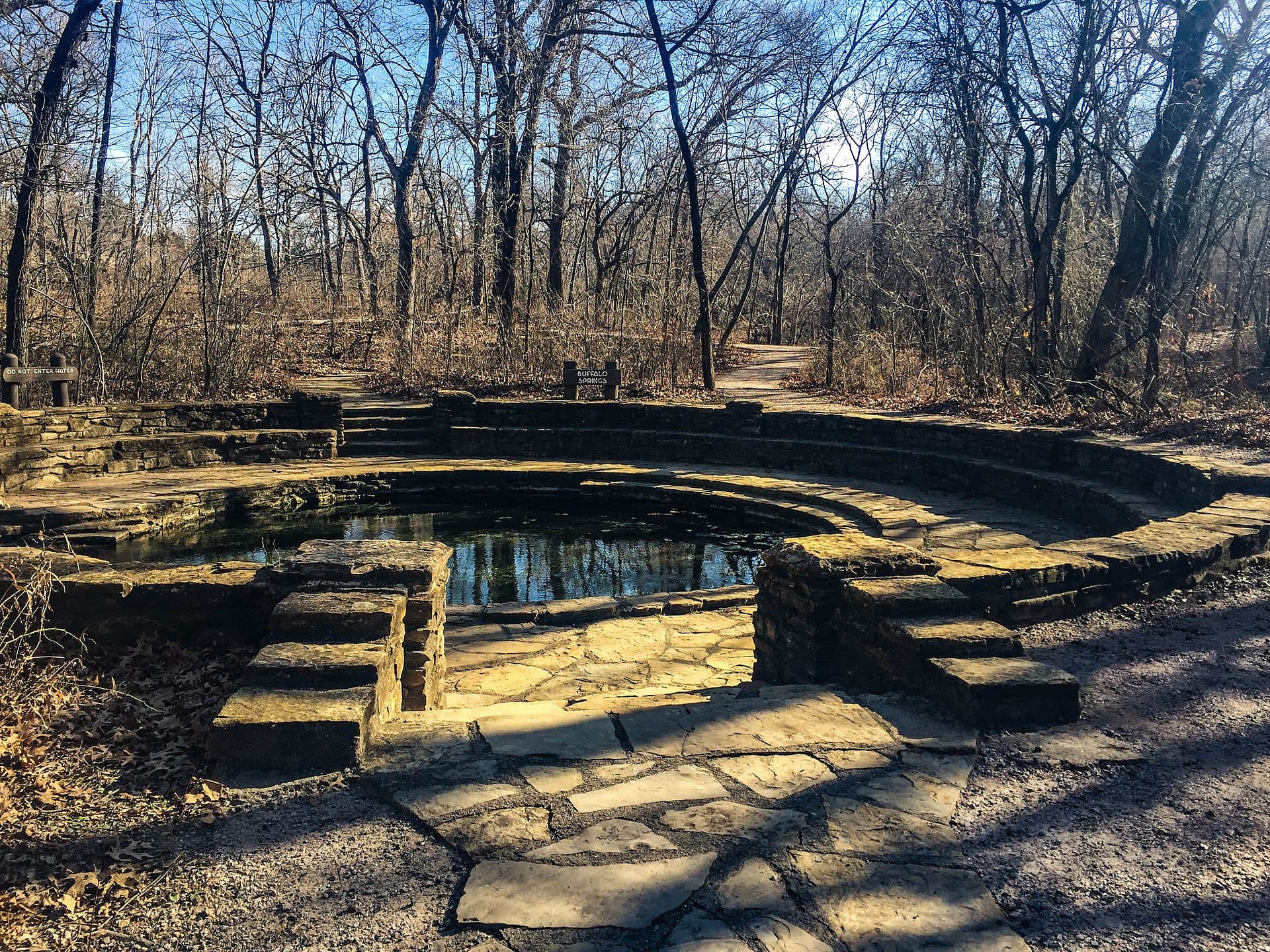
Antelope and Buffalo Springs (Chickasaw National Recreation Area)
Sulphur, Oklahoma, United States
477.5 km away
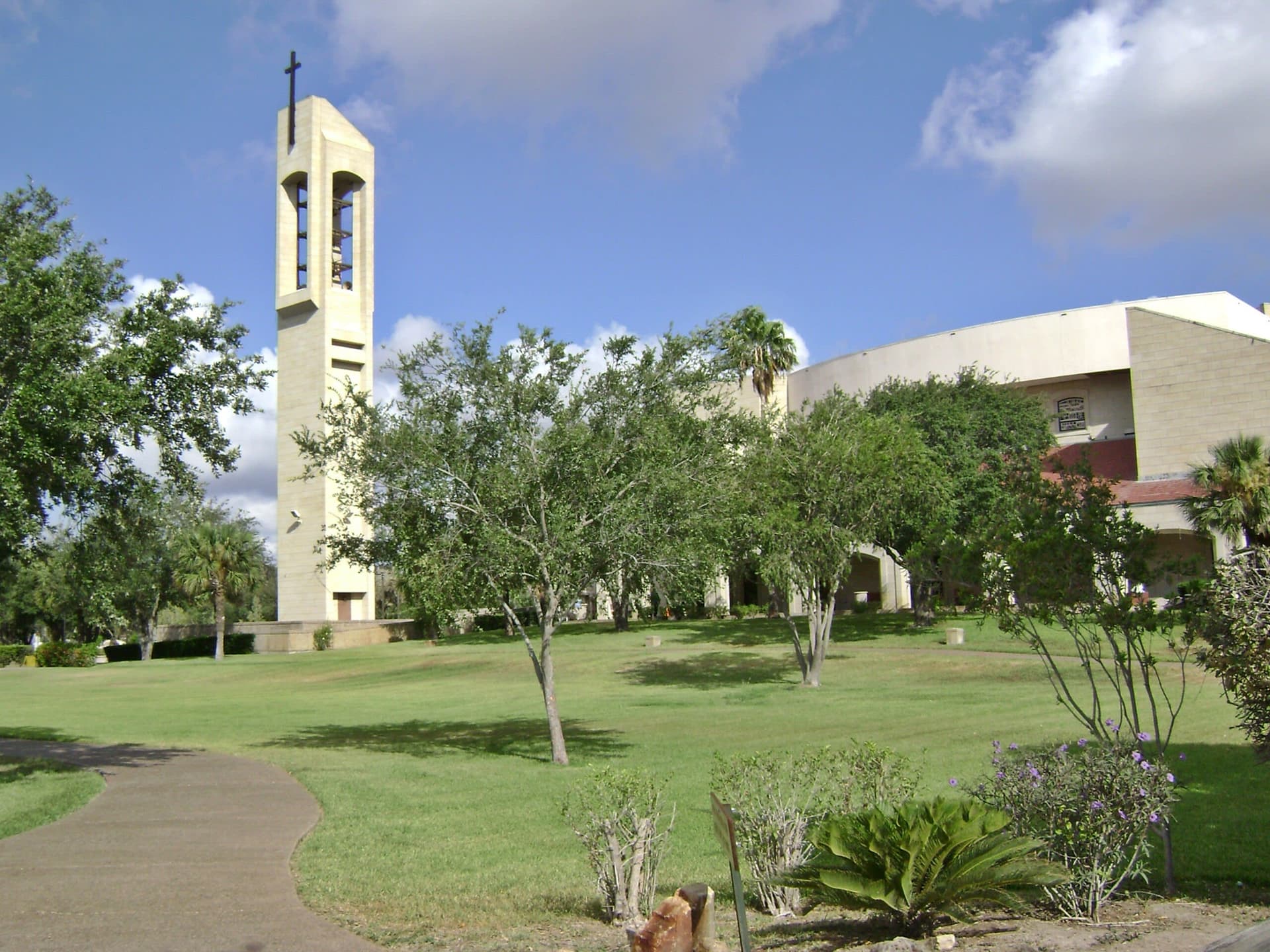
Basilica of Our Lady of San Juan del Valle, San Juan, Texas
San Juan, Texas, United States
483.4 km away
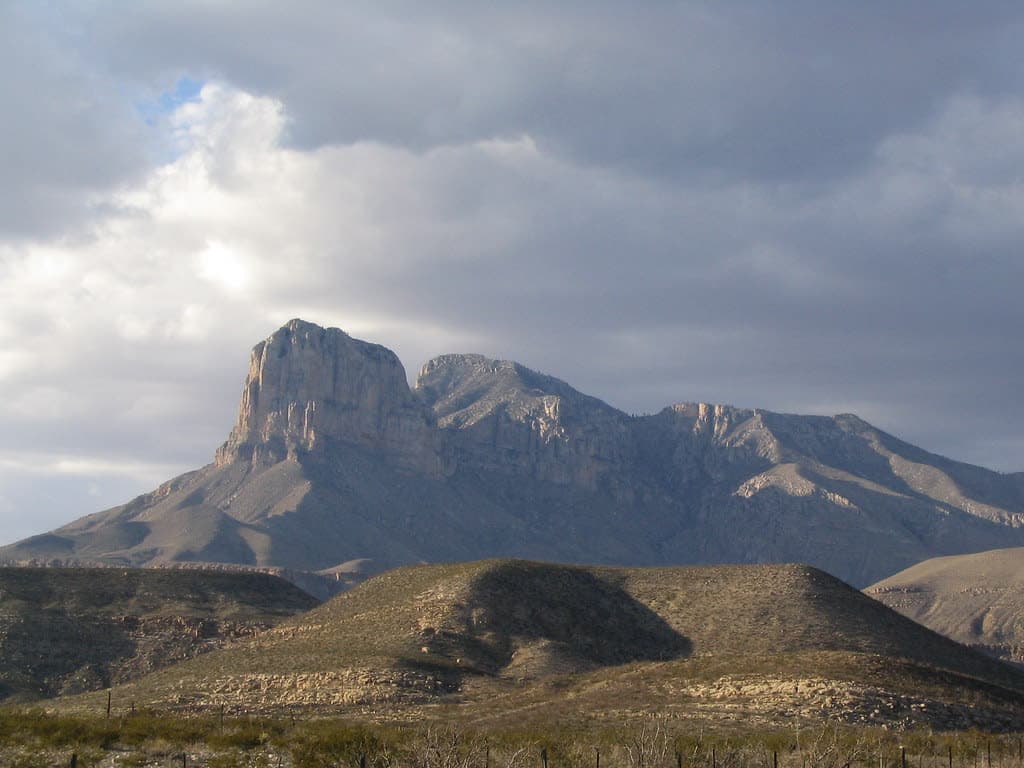
Guadalupe Peak, Texas
Salt Flat, Texas, United States
594.8 km away
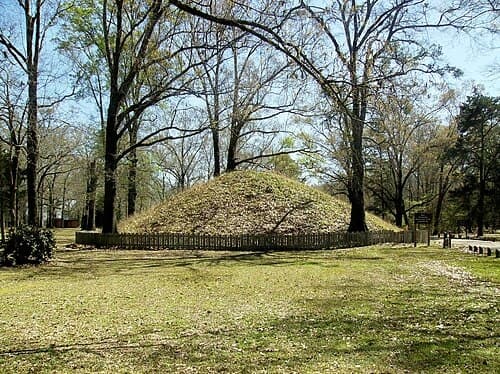
Marksville mounds
Marksville, Louisiana, United States
648.2 km away