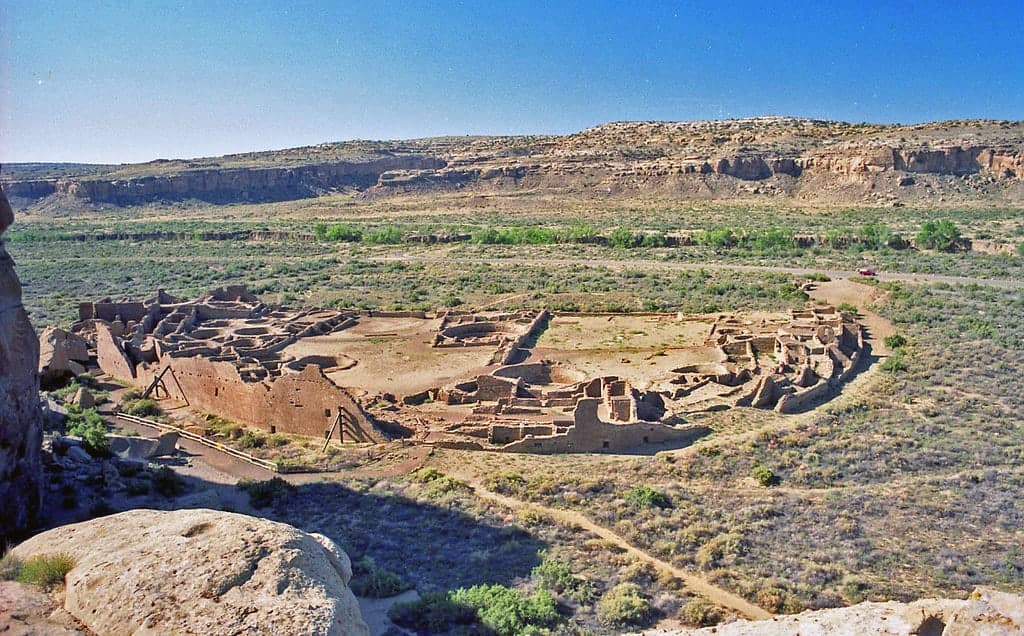
Chaco Canyon, New Mexico
Where ancient astronomers aligned stone with sky, and ancestors still dwell
San Juan County, New Mexico, United States
At A Glance
- Coordinates
- 36.0591, -107.9578
- Suggested Duration
- A day trip allows basic exploration of the major great houses along the Canyon Loop Drive but feels rushed. Two days permit thorough exploration including backcountry hikes. Overnight camping at Gallo Campground enables night sky observation and a less hurried pace. The Canyon Loop Drive is 9 miles; allow 30-60 minutes at each major site.
- Access
- Located in northwestern New Mexico, approximately 90 minutes from Farmington, Bloomfield, or Aztec. The final 13+ miles are on unpaved roads that require 1-2 hours of cautious driving. Two access routes exist: from the north (via US 550 and CR 7900) and from the south (via NM 57). Both involve rough roads. High-clearance vehicles are not required but are recommended. RVs and trailers must not exceed 35 feet. The roads become impassable when wet—check conditions before visiting, especially during monsoon season (July-September) or after winter storms. No gas, food, or services are available in the park. The nearest supplies are in Farmington, about 80 miles away. Fill your tank before departing and bring all food and water needed for your visit. Park entrance fee applies; National Park passes are accepted. The visitor center provides orientation, a bookstore, and restrooms. Water is available at the visitor center and campground.
Pilgrim Tips
- Located in northwestern New Mexico, approximately 90 minutes from Farmington, Bloomfield, or Aztec. The final 13+ miles are on unpaved roads that require 1-2 hours of cautious driving. Two access routes exist: from the north (via US 550 and CR 7900) and from the south (via NM 57). Both involve rough roads. High-clearance vehicles are not required but are recommended. RVs and trailers must not exceed 35 feet. The roads become impassable when wet—check conditions before visiting, especially during monsoon season (July-September) or after winter storms. No gas, food, or services are available in the park. The nearest supplies are in Farmington, about 80 miles away. Fill your tank before departing and bring all food and water needed for your visit. Park entrance fee applies; National Park passes are accepted. The visitor center provides orientation, a bookstore, and restrooms. Water is available at the visitor center and campground.
- No specific dress code applies, but practical desert attire is essential. Temperatures can vary by forty degrees between day and night, and between seasons. Summer days are hot; winter nights are cold. Bring layers. Sun protection—hat, sunscreen, sunglasses—is critical in the high-desert environment. Sturdy footwear with good traction is necessary for walking on uneven terrain.
- Photography is permitted throughout the park for personal use. Commercial photography and filming require advance permits. Inside structures, flash photography is prohibited. Do not photograph tribal members if encountered during ceremonial visits. Drones are prohibited without special permit.
- Chaco is sacred to living peoples whose relationship to the site differs from that of casual visitors. The ruins may seem ancient and abandoned, but for Pueblo peoples, ancestors dwell here. Approach with the respect you would bring to someone's family home. Do not attempt to participate in or observe tribal ceremonies. If you encounter tribal members engaged in private practice, withdraw quietly. Their relationship to Chaco is not for your observation or understanding. The archaeological significance of Chaco depends on leaving artifacts in place. Do not pick up pottery sherds, no matter how tempting. Possession of artifacts from national parks is illegal. Do not touch rock art, climb on walls, or enter closed areas.
Overview
In the high desert of New Mexico, the ruins of Chaco Canyon stand as testimony to a civilization that achieved extraordinary things. Between 850 and 1150 CE, the Ancestral Puebloans built great houses aligned to the movements of sun and moon, at the center of a network spanning 25,000 square miles. For their descendants—the Hopi, Zuni, and other Pueblo peoples—this is not merely an archaeological site but a sacred ancestral homeland where spirits remain present.
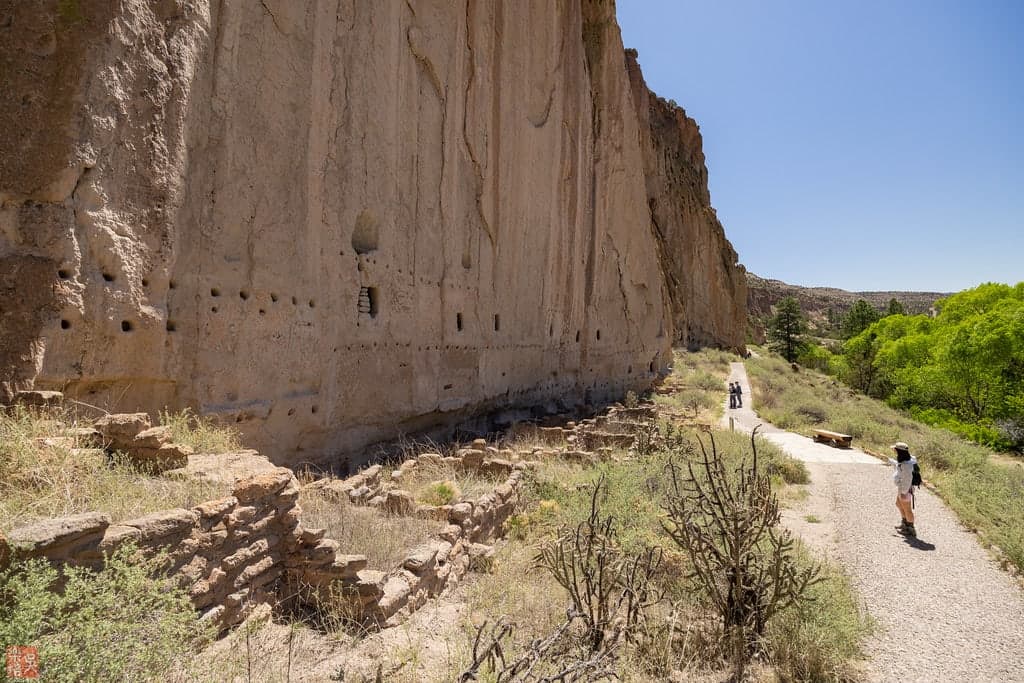
Chaco Canyon lies at the end of rough roads, far from any town, in a high-desert landscape of mesas and arroyos. The journey to reach it is itself significant—you must want to be here. When you arrive, what you find defies expectation: the ruins of massive stone buildings, some rising four stories, their walls constructed with precision that rivals modern work. Pueblo Bonito alone contained over 650 rooms and 35 kivas, the circular ceremonial chambers that mark Puebloan sacred architecture.
A thousand years ago, Chaco was the center of the Ancestral Puebloan world. Roads converged here from outlying communities across the San Juan Basin. The great houses were aligned to solstices and equinoxes, their builders encoding astronomical knowledge into stone. On Fajada Butte, three sandstone slabs cast light onto spiral petroglyphs, marking the sun's position through the year with remarkable accuracy.
For the Hopi, Zuni, Acoma, Laguna, and other Pueblo peoples, Chaco remains sacred. Their ancestors built this place and passed through it on clan migration journeys. The spirits of those ancestors dwell here still. The Navajo Nation, within whose lands Chaco lies, holds its own complex relationship to the site. Archaeological excavation halted in 1981 at the request of tribal communities who believe disturbing ancestral sites violates sacred trust.
Chaco is managed as a National Historical Park and UNESCO World Heritage Site. Visitors walk among the ruins, attend ranger programs, and camp beneath some of the darkest skies in America. But this is not merely a museum of ancient achievement. It is a place where the past remains present, where descendants return to honor their ancestors, and where the landscape itself speaks of purposes we do not fully understand.
Context And Lineage
Chaco was the center of the Ancestral Puebloan world from approximately 850 to 1150 CE. The great houses contained hundreds of rooms and dozens of kivas, connected by roads to outlying communities across 25,000 square miles. The builders—ancestors of today's Pueblo peoples—achieved this without metal tools, wheeled vehicles, or draft animals.
Pueblo oral traditions describe Chaco as a stop on ancestral migration journeys. Different clans passed through at different times, each leaving traces of their presence before continuing to their final destinations. The Hopi speak of migrations that brought their ancestors from the south, through places like Chaco, to their current mesa-top villages. These migrations were not merely physical but spiritual—each clan was seeking its proper place, guided by signs and ceremonies.
Navajo traditions offer a different perspective. The Gambler Myth tells of a powerful trickster who came to the canyon and enslaved the people through gambling, using sacred datura seeds to manipulate his victims. He forced them to build the great houses, growing ever more powerful until the Sun sent his twin sons to defeat him. This story may encode memories of the labor mobilization required for Chaco's construction—the transportation of 200,000 wooden beams from mountains fifty miles distant, the quarrying and fitting of millions of sandstone blocks.
Archaeological evidence traces the development of Chaco from small farming settlements in the early centuries CE through the florescence of the great houses beginning around 850 CE. What triggered this transformation—the concentration of resources, the alignment of architecture with sky, the construction of roads—remains debated. Something happened at Chaco that did not happen elsewhere, concentrating power and purpose in this remote canyon.
Chaco's lineage flows in two directions. Looking backward, the Ancestral Puebloans developed from earlier peoples who settled the region over millennia, gradually elaborating farming, architecture, and ceremony. Looking forward, the Chacoans' descendants include today's Pueblo peoples—the Hopi, Zuni, Acoma, Laguna, and others who maintain continuous cultural traditions stretching back to Chaco and beyond.
The physical lineage is visible in later sites. When Chaco declined in the twelfth century, some populations moved to Aztec Ruins, sixty miles north, where construction in Chacoan style continued for another century. Others dispersed to pueblos in the Rio Grande valley and elsewhere. The kiva architecture that defines Chaco remains central to Pueblo ceremony today.
The archaeological lineage connects Chaco to the scholarly frameworks that interpret it. Early researchers used the term 'Anasazi'—a Navajo word meaning 'ancient enemies' or 'ancient ones'—to describe the builders. At the request of Pueblo peoples, who objected to being defined by Navajo terminology, scholars now prefer 'Ancestral Puebloan,' recognizing the living connection between past builders and present descendants.
The Chacoan Builders
Architects and astronomers
Anna Sofaer
Archaeoastronomer
Why This Place Is Sacred
The thinness of Chaco Canyon emerges from the deliberate alignment of human construction with cosmic order. The Chacoans did not simply build—they created architecture that connected earth to sky, marking the passage of time through stone. Standing among the ruins, beneath the same stars their builders observed, visitors sense a thinning of the boundary between then and now.
Chaco's power begins with scale. Pueblo Bonito rises from the canyon floor in tiers of carefully fitted stone, its curved rear wall sweeping in an arc that faces cardinal south. Across the canyon, Chetro Ketl presents a different geometry, its great kiva once able to hold hundreds. Una Vida, Hungo Pavi, Kin Kletso—the great houses line the canyon, each massive, each precisely oriented.
But scale alone does not create a thin place. What makes Chaco extraordinary is the integration of architecture with astronomy. The great houses were not merely shelter but instruments for observing the sky. Corners and doorways align to catch the rising sun on specific days. The famous Sun Dagger on Fajada Butte—now closed to visitors to protect the fragile site—marked solstices and equinoxes with daggers of light passing through spiral petroglyphs. The Chacoans tracked an 18.6-year lunar cycle, encoding their observations in stone.
This deliberate connection between building and cosmos suggests that the Chacoans understood Chaco as a place where heaven and earth met. The convergence of roads from distant communities reinforces this sense of centrality—Chaco as the hub of a wheel, the navel of a world. The roads themselves are puzzling: perfectly straight, too wide and too formal for mere transportation, they seem designed for ceremonial procession rather than practical travel.
The silence of the canyon amplifies these qualities. Chaco is remote, surrounded by miles of undeveloped land. The night sky, certified as an International Dark Sky Park, reveals stars in their ancient brilliance. Visitors who camp report the profound quiet broken only by wind, the same wind that moved through the canyon when the great houses stood complete.
For Pueblo peoples, the thinness has another dimension: their ancestors built this place, lived and died here, and their spirits remain. This is not metaphor but lived belief. The boundary between living and dead, between present generation and ancestral presence, is thin at Chaco because ancestors actually dwell here. Visiting means entering their home.
Archaeologists continue to debate Chaco's original purpose. Was it primarily a ceremonial center where people gathered for seasonal observances? A political capital wielding power over outlying communities? An economic hub controlling trade in turquoise, macaw feathers, and other precious goods? The evidence supports all of these and perhaps more. The concentration of kivas suggests intense ceremonial activity. The scale of construction implies organized social power capable of mobilizing massive labor. The presence of luxury goods indicates participation in trade networks extending to Mesoamerica. Whatever Chaco was, it was central—the place where roads converged, where the calendar was kept, where something essential happened.
Chaco's florescence lasted roughly three centuries, from about 850 to 1150 CE. Construction occurred in phases, with the great houses growing over generations. By the mid-twelfth century, activity declined. Drought, deforestation, social conflict—various factors have been proposed for Chaco's abandonment. The population migrated, some to Aztec Ruins to the north, others to pueblos that still exist today.
For centuries after the Chacoans departed, the ruins stood in silence, known to Navajo and Pueblo peoples but distant from European awareness. Spanish explorers passed through the region but left no detailed records of Chaco. The first documented visit by outsiders came in 1823. Formal archaeological work began in 1896, and Theodore Roosevelt established Chaco Canyon National Monument in 1907.
The twentieth century brought both revelation and violation. Excavations uncovered the sophistication of Chacoan culture but disturbed burials and sacred sites. Anna Sofaer's 1977 discovery of the Sun Dagger revealed the astronomical dimensions of Chacoan knowledge. In 1981, intrusive excavation was halted in response to tribal concerns. The Chaco American Indian Consultation Committee, established in 1991, gave tribal representatives voice in park management. UNESCO World Heritage inscription came in 1987.
Today, Chaco exists in tension between archaeological preservation and sacred site protection, between tourism and tribal access, between industrial development in the surrounding landscape and conservation of the cultural and spiritual values the site embodies.
Traditions And Practice
No public ceremonies occur at Chaco Canyon. Tribal members visit for private ceremonial purposes that are not publicized. Visitors can participate in ranger-led tours and night sky programs. The park requests that visitors approach the site with the respect due to a sacred ancestral homeland.
The great houses hosted ceremonial gatherings that drew participants from across the Ancestral Puebloan world. The concentration of kivas—circular underground chambers accessed by ladder—indicates intense ritual activity. In Pueblo tradition, kivas represent the sipapu, the emergence place where humans came into this world. Ceremonies conducted in kivas reenact that emergence and maintain the balance between human and cosmic realms.
The Chacoans tracked solar and lunar cycles with precision, marking the solstices and equinoxes through architectural alignments and the Sun Dagger on Fajada Butte. These observations likely informed ceremonial calendars, timing rituals to cosmic events. The straight roads connecting Chaco to outlying communities may have served as processional routes, bringing pilgrims to seasonal gatherings.
Turquoise held particular significance. Approximately 200,000 pieces have been excavated from Chaco, along with workshops for bead manufacture. Turquoise connected sky and water, embodying the sacred values central to Puebloan worldview. Macaw feathers, imported from tropical Mesoamerica, carried their own symbolic weight.
No public ceremonies occur at Chaco Canyon. The National Park Service manages the site for preservation and visitation, not for active worship. However, tribal members from Hopi, Zuni, and other Pueblos visit for private ceremonial purposes. These visits are not scheduled, announced, or open to observers. If you encounter tribal members engaged in private practice, maintain respectful distance.
The Chaco American Indian Consultation Committee, established in 1991, meets regularly to advise on park management from traditional perspectives. This represents institutional recognition that Chaco is not merely an archaeological site but a living sacred place whose descendants must have voice in its care.
The park offers ranger-led tours of the great houses, providing historical and archaeological context. Night sky programs offer astronomical observation in one of America's darkest skies—an appropriate practice at a site whose builders were sophisticated astronomers.
Approach Chaco as pilgrims rather than tourists. The difficulty of reaching the site is not obstacle but preparation. Take time at the Visitor Center to orient yourself before entering the ruins.
Walk through Pueblo Bonito slowly. Pause at doorways and windows, noticing how they frame the landscape. Enter the kivas that are accessible, sitting with the enclosed space and imagining it roofed, firelit, full of people gathered for ceremony. The ruins speak differently to those who take time to listen.
If staying overnight, attend a night sky program if offered. Lie beneath the stars after the program ends and observe as the Chacoans observed. The experience of the same sky they knew—undiminished by light pollution—connects across centuries.
Before leaving, acknowledge what you've received. Chaco offers encounter with human achievement and ancestral presence. Some visitors pause at a high point and offer silent thanks—not as ritual requiring specific form, but as simple recognition of the gift.
Ancestral Puebloan Ceremonial Center
HistoricalBetween 850 and 1150 CE, Chaco Canyon was the ceremonial, trade, and political center of the Ancestral Puebloan world. The great houses—massive multi-story structures containing hundreds of rooms and dozens of kivas—were built with extraordinary precision and served as the hub of a network spanning 25,000 square miles. The architecture aligned to solar and lunar events suggests Chaco functioned as a monumental calendar, marking cosmic time in stone. Pueblo Bonito alone contained over 650 rooms and 35 kivas, embodying a concentration of ritual activity unmatched in the ancient Southwest.
The great houses hosted periodic ceremonial gatherings that drew participants from across the region. Kivas served as spaces for ritual activities, representing the sipapu—the emergence place where humans came into this world. The Chacoans tracked solar and lunar cycles, marking solstices and equinoxes through architectural alignments and the Sun Dagger on Fajada Butte. Turquoise, macaw feathers, and other precious items were used in ritual contexts. The straight roads connecting outlying communities to Chaco may have served as ceremonial pathways.
Pueblo Ancestral Connection
ActiveThe Hopi, Zuni, Acoma, Laguna, and other Pueblo peoples regard Chaco Canyon as a sacred ancestral homeland and a key stop on their clans' migration paths. Oral traditions maintain accounts of the historical migration from Chaco and the spiritual relationship to the land. The site is not merely historical but a living connection to ancestors whose spirits remain present. Pueblo participation in the Chaco American Indian Consultation Committee, established in 1991, represents formal recognition of this ongoing relationship.
Tribal members visit Chaco for private ceremonies and to pay respect to ancestors. These practices are not publicized or open to outsiders. Traditional knowledge informs both personal visits and institutional consultation on park management. The 1981 halt of intrusive archaeological excavation resulted from Pueblo advocacy for respecting ancestral sites.
Navajo (Diné) Cultural Relationship
ActiveChaco Canyon lies within the sovereign lands of the Navajo Nation, cradled between four sacred mountains. The Diné relationship to Chaco is complex: oral traditions include the Gambler Myth, which describes a trickster who enslaved people to build the great houses before being defeated by the Sun's twin sons. Some Navajo traditions hold that the ruins are inhabited by spirits and were traditionally avoided. Despite this ambivalence, the Navajo Nation is deeply involved in protecting the Greater Chaco landscape from industrial development that threatens cultural and spiritual values.
The Navajo Nation participates in the Chaco American Indian Consultation Committee, contributing to park management decisions. Navajo communities in the surrounding area maintain cultural connections to the landscape. The All Pueblo Council of Governors and Navajo Nation leadership jointly advocate for protection of the Greater Chaco region from oil and gas development. This advocacy represents the active dimension of Navajo relationship to Chaco—not participation in Chacoan traditions but stewardship of a sacred landscape.
Archaeoastronomy and Solar Observation
HistoricalThe Chacoans were sophisticated astronomers who built structures aligned to solar and lunar events. The Sun Dagger on Fajada Butte—three stone slabs casting light onto spiral petroglyphs—marks the solstices, equinoxes, and the 18.6-year lunar cycle with remarkable precision. This represents one of the most complex astronomical observation systems in ancient North America. The great houses incorporate numerous alignments to cardinal directions and solar events. Anna Sofaer's 1977 discovery of the Sun Dagger revealed the depth of Chacoan astronomical knowledge.
The Sun Dagger casts a dagger of light through the center of a spiral petroglyph at summer solstice and brackets the spiral at winter solstice. A smaller spiral marks the equinoxes. Architectural alignments in the great houses marked cardinal directions and significant solar positions. These observations likely informed ceremonial calendars and agricultural timing. The combination of multiple astronomical markers in a single petroglyph—solar and lunar, daily and seasonal—indicates systematic integration of celestial knowledge.
Experience And Perspectives
Visitors describe profound awe at the scale and precision of the architecture. The isolation and silence create a contemplative atmosphere. Many report sensing the presence of ancient inhabitants, particularly in the kivas. The night sky produces powerful experiences. The difficulty of reaching Chaco adds to the sense of pilgrimage.
The experience of Chaco Canyon begins with the approach. The final miles are on unpaved roads that wind through scrubland, testing both vehicle and patience. This difficulty is not merely inconvenient—it filters visitors, ensuring that those who arrive have chosen to make the journey. You cannot stumble upon Chaco. You must seek it.
When the first great house comes into view, the scale startles. These are not modest structures half-hidden in the landscape but massive constructions that dominate the canyon. Pueblo Bonito alone covers nearly three acres. The stonework, fitted with precision that seems impossible for people without metal tools, speaks of skill and time and organized purpose.
Walking through the ruins, the experience deepens. You pass through doorways that have framed the same views for a thousand years. You descend into kivas, the circular ceremonial chambers, and feel the containment of stone walls rising around you. Light enters through the original openings, falling as it fell when the Chacoans gathered here. The absence of roofs and floors that have long since collapsed does not diminish the power—if anything, the ruins speak more eloquently for their incompleteness.
The silence of Chaco is remarkable. Beyond the occasional murmur of other visitors, beyond the ranger programs, the canyon is profoundly quiet. Wind moves through, carrying the scent of sage and juniper. In this silence, something opens. Visitors report feeling the presence of those who built and lived here—not as apparition but as atmosphere, as accumulated intention that has saturated the stone.
Those who camp overnight discover another dimension. As darkness falls and the night sky emerges, Chaco reveals itself as the Chacoans knew it. The stars appear in numbers impossible from light-polluted cities. The Milky Way arcs overhead with startling clarity. The International Dark Sky Park certification recognizes what visitors experience: these are the same stars the Chacoan astronomers observed, tracked, and encoded in architecture. To lie beneath them is to share, for a moment, their cosmic awareness.
For many visitors, Chaco produces lasting change. The encounter with a civilization that achieved such things without modern technology recalibrates assumptions about human capability. The integration of building with sky invites reflection on humanity's place in the cosmos. The knowledge that descendants of the builders still honor this place as sacred adds a dimension beyond archaeology—a reminder that the past is not dead but continues in those who remember.
Enter the park and stop at the Visitor Center for orientation. Watch the introductory film and speak with rangers about current conditions and programs. The Canyon Loop Drive is 9 miles of paved road accessing the major great houses. Begin at Pueblo Bonito, the largest and most complex structure. Allow 45-60 minutes for thorough exploration. Continue to Chetro Ketl across the canyon. Hiking trails access additional sites including Pueblo Alto on the mesa top. Night sky programs, when offered, provide guided astronomical observation.
Chaco Canyon sits at the intersection of multiple ways of knowing. Archaeologists study the material remains, developing theories about Chacoan society based on evidence in the ground. Pueblo peoples hold traditional knowledge passed down through generations, understanding Chaco as a sacred ancestral homeland. The Navajo maintain their own relationship to a place that lies within their lands. These perspectives overlap but do not fully align.
Archaeologists agree that Chaco was the center of a regional system that unified the San Juan Basin between approximately 850 and 1150 CE. The great houses, containing hundreds of rooms and dozens of kivas, were constructed with remarkable precision and aligned to astronomical events. Roads connected Chaco to over 150 outlying communities across 25,000 square miles.
Debate continues about the nature of Chacoan society. Was Chaco primarily a ceremonial center where people gathered for seasonal rituals? A political capital wielding power over subject communities? An economic hub controlling trade in turquoise and exotic goods? The evidence supports various interpretations, and the answer may be 'all of the above.'
The astronomical dimensions of Chaco have become increasingly recognized. The Sun Dagger, discovered in 1977, marks solstices, equinoxes, and the 18.6-year lunar cycle. Architectural alignments throughout the canyon indicate sophisticated observation of celestial events. The Chacoans were, among other things, astronomers of considerable skill.
Archaeologists have largely abandoned the term 'Anasazi' in favor of 'Ancestral Puebloan' at the request of Pueblo peoples. Since 1981, intrusive excavation has been halted in deference to tribal concerns about disturbing ancestral sites.
For Pueblo peoples, Chaco is not primarily an archaeological puzzle to be solved but a sacred ancestral homeland to be honored. Their ancestors built this place and passed through it on clan migration journeys. The spirits of those ancestors dwell here still. This is not metaphor but lived understanding, shaping how Pueblo people relate to Chaco.
Traditional knowledge about Chaco's purpose and practices is held within tribal communities and is not fully shared with outsiders. The archaeological record provides one kind of information; oral traditions provide another. These ways of knowing are not interchangeable, and Pueblo peoples are not obligated to resolve questions that archaeologists find puzzling.
The Navajo Gambler Myth offers a different perspective, describing Chaco's construction as the work of enslaved people forced to build by a trickster figure who was eventually defeated. This story may encode memories of the labor mobilization required for Chaco's massive construction projects.
Some alternative interpretations focus on Chaco's possible connections to other world cultures, suggesting external influences on the astronomical knowledge. Others emphasize perceived energetic or spiritual properties of the site, proposing that Chaco was built at a location of unusual power. These interpretations are not supported by archaeological evidence and should be distinguished from both scholarly consensus and Indigenous traditional knowledge. The Chacoans' achievements were their own, emerging from local cultural development, not borrowed from distant civilizations.
Many questions about Chaco remain unanswered, and some may never be answered. Why did Chaco decline in the twelfth century? Environmental factors—drought, deforestation—and social factors—inequality, conflict—have been proposed, but no single explanation has gained consensus. What was the social organization of Chacoan society? Was there an elite class, or was power more distributed? Were the great houses permanent residences or periodic gathering places used only during ceremonies? Why were the roads so straight, so wide, so unsuitable for practical foot traffic? What ceremonies occurred in the kivas? The archaeological record can suggest but not confirm answers to these questions. Tribal communities may hold knowledge not shared with researchers, but that knowledge belongs to them to share or withhold as they choose.
Visit Planning
Chaco Canyon is remote and requires planning. The final miles are on unpaved roads that become impassable in wet weather. No food, gas, or services are available in the park. Camping at Gallo Campground allows overnight stays and night sky observation. Spring and fall offer the best conditions.
Located in northwestern New Mexico, approximately 90 minutes from Farmington, Bloomfield, or Aztec. The final 13+ miles are on unpaved roads that require 1-2 hours of cautious driving. Two access routes exist: from the north (via US 550 and CR 7900) and from the south (via NM 57). Both involve rough roads.
High-clearance vehicles are not required but are recommended. RVs and trailers must not exceed 35 feet. The roads become impassable when wet—check conditions before visiting, especially during monsoon season (July-September) or after winter storms.
No gas, food, or services are available in the park. The nearest supplies are in Farmington, about 80 miles away. Fill your tank before departing and bring all food and water needed for your visit.
Park entrance fee applies; National Park passes are accepted. The visitor center provides orientation, a bookstore, and restrooms. Water is available at the visitor center and campground.
Gallo Campground offers 49 sites for tents and RVs (no hookups). Sites include picnic table and fire ring with grill. Firewood is not available and gathering is prohibited—bring your own or cook on a camp stove. Drinking water is available at the campground and visitor center. Reservations are recommended, especially for spring and fall weekends.
The nearest motels are in Bloomfield and Farmington, each about 60-90 miles away. Nageezi, the closest community, has very limited services. Day-tripping from Farmington is possible but exhausting.
Chaco is sacred to multiple Native American nations. Do not touch or climb on walls. Do not collect artifacts. Do not disturb tribal members if encountered during ceremonial visits. Approach with the respect due to an ancestral homeland where spirits dwell.
The etiquette of Chaco Canyon begins with recognition of what this place is. For Pueblo peoples, Chaco is not a museum of ancient achievement but a sacred ancestral homeland where their forebears built, lived, died, and remain present in spirit. For the Navajo Nation, within whose lands Chaco lies, the relationship is complex but equally significant. Visitors enter a place that belongs, in the deepest sense, to others.
The ruins are fragile. Walls that have stood for a thousand years can be damaged by the touch of modern hands, the pressure of modern feet, the oils and weight of modern bodies. The National Park Service maintains designated trails and viewing areas. Stay on these paths. Do not walk on, climb, sit, or lean on the walls. Do not enter areas that are closed.
Artifacts remain throughout the site—pottery sherds eroding from the soil, flakes of worked stone, fragments of bone. These belong where they lie. Do not pick up or collect anything. Possession of artifacts from national parks is a federal crime, but the ethical imperative runs deeper: these objects are part of an ongoing story that removal would violate.
Rock art—petroglyphs and pictographs—appears throughout the canyon. Do not touch these images. The oils from human hands accelerate deterioration. Photography is permitted, but flash can damage pigments. Document without contact.
If you encounter tribal members during your visit, recognize that their relationship to Chaco is different from yours. They may be engaged in private ceremonial activities. Do not photograph, approach, or observe. Withdraw quietly and continue your own visit elsewhere.
The journey to Chaco passes through private lands, including Navajo Nation territory. Respect your neighbors. Do not stop on private property or leave any trace of your passage. The communities surrounding Chaco have their own relationships to the landscape; you are passing through their home.
No specific dress code applies, but practical desert attire is essential. Temperatures can vary by forty degrees between day and night, and between seasons. Summer days are hot; winter nights are cold. Bring layers. Sun protection—hat, sunscreen, sunglasses—is critical in the high-desert environment. Sturdy footwear with good traction is necessary for walking on uneven terrain.
Photography is permitted throughout the park for personal use. Commercial photography and filming require advance permits. Inside structures, flash photography is prohibited. Do not photograph tribal members if encountered during ceremonial visits. Drones are prohibited without special permit.
Do not leave offerings at Chaco. Unlike some sacred sites where offerings are welcomed or expected, Chaco requests that visitors take only photographs and leave only footprints. The archaeological integrity of the site depends on leaving it undisturbed.
Do not walk on, climb, sit, or lean on walls. Do not touch rock art. Do not collect pottery, stone, bone, or any other material. Stay on designated trails. Fajada Butte is closed to all visitation to protect the Sun Dagger site. Backcountry areas require permits. Pets are restricted from ruins. Smoking is prohibited. The park is open sunrise to sunset; after-hours presence is prohibited except for registered campers.
Sacred Cluster
Nearby sacred places create the location cluster described in the growth plan. This block is intentionally crawlable and links into the wider regional graph.