Bandelier National Monument
Cliff dwellings where ancestors still live, according to those who descend from them
Sandoval County, New Mexico, United States
At A Glance
- Coordinates
- 35.7647, -106.3228
- Suggested Duration
- Main Loop Trail with cavates: one to two hours. Add Alcove House: an additional hour. Tsankawi Trail (separate section, twelve miles north): approximately ninety minutes. Stone Lions and Painted Cave backcountry loop: a full day, approximately twenty miles round trip. Multi-day backcountry trips are possible with permits.
- Access
- Bandelier National Monument is located at 15 Entrance Road, Los Alamos, NM 87544. From Santa Fe, take US-84/285 north to NM 502 west, then NM 4 south. Entrance fee: $15-25 per vehicle (America the Beautiful pass accepted). From June through mid-October, a mandatory shuttle bus operates from White Rock Visitor Center to Frijoles Canyon between 9 AM and 3 PM; outside shuttle hours, visitors may drive directly into the canyon. The Tsankawi section is located separately, twelve miles north along NM 4, and does not require the shuttle. The monument is open daily from dawn to dusk. The visitor center is open 9 AM to 5 PM. Mobile phone signal is limited within Frijoles Canyon due to the steep canyon walls; signal is generally available at the mesa-top parking areas and White Rock Visitor Center. For emergencies in the backcountry, the nearest reliable signal is at the visitor center or along NM 4. Contact the monument at (505) 672-3861 for current conditions and program schedules.
Pilgrim Tips
- Bandelier National Monument is located at 15 Entrance Road, Los Alamos, NM 87544. From Santa Fe, take US-84/285 north to NM 502 west, then NM 4 south. Entrance fee: $15-25 per vehicle (America the Beautiful pass accepted). From June through mid-October, a mandatory shuttle bus operates from White Rock Visitor Center to Frijoles Canyon between 9 AM and 3 PM; outside shuttle hours, visitors may drive directly into the canyon. The Tsankawi section is located separately, twelve miles north along NM 4, and does not require the shuttle. The monument is open daily from dawn to dusk. The visitor center is open 9 AM to 5 PM. Mobile phone signal is limited within Frijoles Canyon due to the steep canyon walls; signal is generally available at the mesa-top parking areas and White Rock Visitor Center. For emergencies in the backcountry, the nearest reliable signal is at the visitor center or along NM 4. Contact the monument at (505) 672-3861 for current conditions and program schedules.
- Sturdy hiking shoes with good traction are essential. Trails involve uneven surfaces, carved-rock paths, and wooden ladders. The elevation ranges from approximately 6,000 to 7,000 feet, with strong high-altitude sun. Bring sun protection, layers for temperature changes, and sufficient water. No specific dress code applies beyond practical considerations.
- Personal photography is permitted throughout most of the monument. Do not photograph evidence of recent ceremonial activity, especially offerings at shrine sites. Photographing petroglyphs is permitted from a respectful distance but never touch the rock surface. At Tsankawi, be especially careful not to step on petroglyphs while photographing them. Commercial or professional photography may require a permit; check with the visitor center.
- Do not attempt to participate in or imitate Puebloan ceremonial practices. The kivas, while accessible for brief observation, are sacred spaces and should be treated with the respect you would extend to any active place of worship. If you encounter the Stone Lions Shrine or any evidence of recent ceremonial activity in the backcountry, do not disturb, photograph, or linger at the site. The offerings left there are private communications with the sacred, not archaeological artifacts. Be aware that the Cerro Grande Fire of 2000 left lasting ecological changes. Some areas show fire damage. Flash floods during the July-August monsoon season can create dangerous conditions in the canyon. Check conditions before venturing into the backcountry.
Overview
In a volcanic canyon carved by centuries of water and wind, the Ancestral Puebloans built homes into the soft tuff cliffs, dug kivas into the earth, and left petroglyphs on the canyon walls. They departed five centuries ago. Their descendants, the people of Cochiti, San Ildefonso, and other Pueblos, say the ancestors never left. Bandelier holds the rare quality of being both archaeological ruin and living sacred landscape.
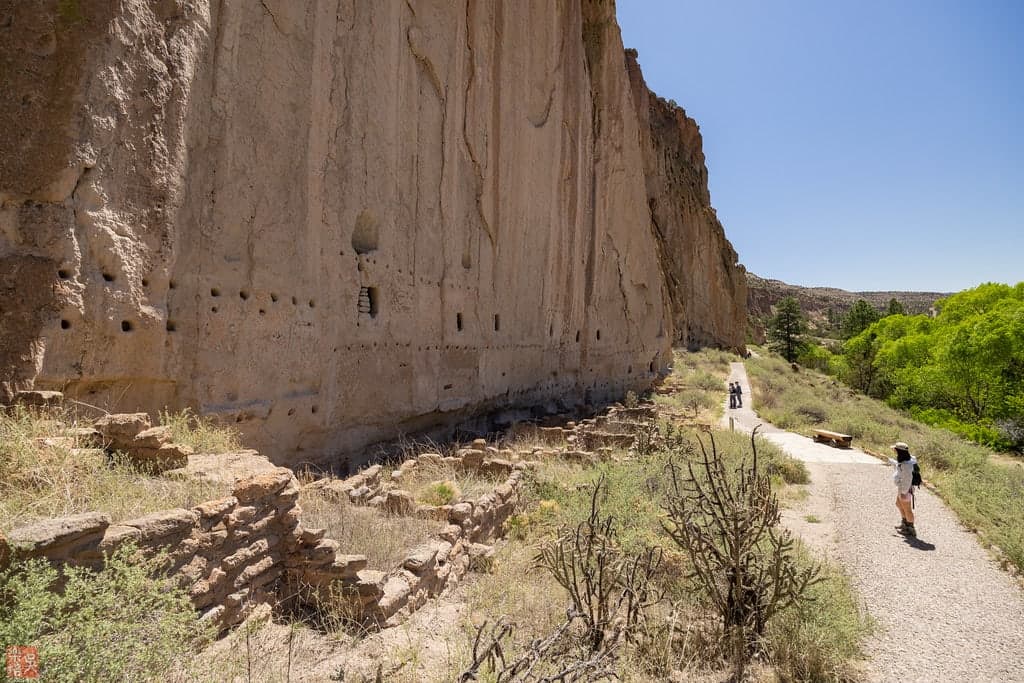
Frijoles Canyon cuts through the Pajarito Plateau in northern New Mexico, its walls of volcanic tuff riddled with hundreds of hand-carved rooms. Some are visible from the canyon floor, dark openings in the pale rock face like eyes that have been watching for eight centuries. Others require ladders to reach. All of them were homes.
From roughly 1150 to 1550 CE, Ancestral Puebloan people built an elaborate community here. Tyuonyi, the main pueblo, formed a rough oval around a central plaza, its masonry walls rising multiple stories. Along the cliffs, cavates, rooms carved directly into the soft volcanic stone, served as dwellings, storage, and ceremonial spaces. Below the canyon floor, kivas held the community's deeper life: the ceremonies, initiations, and rituals that bound people to each other and to forces larger than themselves.
By the mid-sixteenth century, drought and resource depletion drove the inhabitants to the Rio Grande, where their descendants live today in the pueblos of Cochiti, San Ildefonso, San Felipe, and Santo Domingo. The canyon emptied of daily life. It did not empty of presence.
At least twenty-three tribal nations maintain spiritual connections to Bandelier. The Stone Lions Shrine, deep in the backcountry, shows evidence of recent ceremonial activity. Kivas are treated not as artifacts but as sacred spaces. When Pueblo representatives speak of Bandelier, they use the present tense: the ancestors still live here.
This is what visitors encounter, whether they recognize it or not. Not a dead site preserved under glass, but a landscape where the past breathes and the living still come to listen.
Context And Lineage
Bandelier preserves the ancestral homeland of multiple Puebloan nations, settled during migrations from the Four Corners region beginning around 1150 CE. At its peak, the community at Tyuonyi sustained several hundred people across multi-story masonry buildings and hundreds of cliff-carved rooms. Environmental stress drove departure by the mid-1500s. The monument was established in 1916 following Adolph Bandelier's pioneering documentation. Today, at least twenty-three tribal nations maintain active connections to the site.
The people who built Frijoles Canyon's cliff dwellings came from elsewhere, and they knew they would eventually move on.
Around 1150 CE, severe drought in the Four Corners region drove Ancestral Puebloan populations south and east. The Pajarito Plateau, with its workable volcanic tuff, reliable water sources, and defensible canyons, offered what the drought-stricken north could not. Small communities formed first on the mesa tops. Over two centuries, they consolidated into the larger settlements of Frijoles Canyon.
The Puebloan migration narrative, shared across descendant communities, understands this movement not as displacement but as part of a longer pattern. The people moved, settled, built, and eventually moved again, each place adding to their collective experience and identity. Frijoles Canyon was one chapter in a story that stretches back millennia and continues today in the living pueblos along the Rio Grande.
For the Zuni, the Stone Lions carved at Bandelier hold a specific cosmological role: they guard the entrance to Shipapolima, the dwelling place of the supernatural being Poshaiyanki. This places the monument within a sacred geography that extends far beyond its physical boundaries.
The lineage at Bandelier runs unbroken from the Ancestral Puebloan builders through their descendant communities. Cochiti Pueblo, located approximately ten miles south along the Rio Grande, maintains the strongest connection to Frijoles Canyon. San Ildefonso Pueblo claims ancestral ties to Tsankawi. San Felipe and Santo Domingo (Kewa) Pueblos also trace lineage to the monument's inhabitants.
This is not speculative history. The connections are established through oral tradition, linguistic analysis, architectural continuity, and ceremonial practice. The people of Cochiti do not describe Bandelier as a place their ancestors once lived. They describe it as a place their ancestors still live.
As of 2024, tribal involvement in the monument's management reached unprecedented levels. The descendants are not merely stakeholders. They are the inheritors of a relationship with this landscape that predates the monument, the nation, and the colonial project by centuries.
Adolph Bandelier
archaeologist and anthropologist
Swiss-American scholar (1840-1914) who first visited Frijoles Canyon in 1880, guided by Jose Montoya of Cochiti Pueblo. His documentation of the ruins, oral histories, and cultural practices, published in works including 'The Delight Makers' (1890), laid the groundwork for the site's preservation. The monument bears his name.
Jose Montoya
guide and cultural intermediary
A member of Cochiti Pueblo who guided Adolph Bandelier to Frijoles Canyon in 1880, sharing knowledge of the ancestral homeland. His willingness to bring Bandelier to the site was an act of trust that ultimately led to the canyon's preservation.
Edgar Lee Hewett
archaeologist and preservationist
Archaeologist who led early twentieth-century excavations at Bandelier and was instrumental in the campaign to establish the national monument. His advocacy helped secure the 1916 presidential proclamation.
Evelyn Frey
custodian and steward
One of the early custodians of Bandelier National Monument who maintained the site during its formative years as a protected area, building the infrastructure that made visitor access possible while preserving the archaeological resources.
Ancestral Puebloan Builders
original inhabitants
The unnamed generations of Keresan and Tewa-speaking peoples who carved cavates from volcanic tuff, built Tyuonyi pueblo, dug ceremonial kivas, carved the Stone Lions, and sustained a community in Frijoles Canyon for approximately four centuries. Their descendants live in the pueblos along the Rio Grande.
Why This Place Is Sacred
Bandelier's quality as a thin place emerges from the convergence of dramatic geology, eight centuries of human habitation, and the ongoing spiritual connection maintained by descendant Puebloan communities. The volcanic tuff cliffs, pocked with ancient dwellings, create a visceral sense of deep time. The winter solstice alignment at Tyuonyi's entrance suggests that the builders deliberately encoded their architecture with celestial awareness. The dark sky above preserves the same canopy of stars the Ancestral Puebloans observed.
The volcanic tuff that forms Frijoles Canyon's walls is itself a record of catastrophe and transformation. Over a million years ago, the Jemez volcanic field erupted in two massive events, blanketing the region in ash that compressed into the soft, workable stone the Ancestral Puebloans would later carve into homes. The material remembers violence. What was built from it speaks of something gentler: the patient work of carving room after room into cliff faces, creating a community that endured for four centuries.
Walking through the canyon, the thinness manifests in layers. The first layer is geological: the sheer scale of the cliffs, the depth of the canyon, the way light shifts across the rock face throughout the day, turning the pale tuff gold at dawn and violet at dusk. The second layer is archaeological: the visible evidence of human presence in every direction, from the cavates above to the circular ruin of Tyuonyi below to the petroglyphs scratched into the rock at eye level. The third layer is what cannot be seen but what descendant communities insist is present: the continuing spiritual occupation of a place their ancestors built and never truly left.
The winter solstice offers a moment when these layers converge. On the shortest day of the year, the rising sun aligns with the entrance to Tyuonyi, sending light directly into the pueblo's central plaza. This was not an accident. The builders oriented their community to the cosmos, encoding their architecture with an awareness of celestial cycles that modern visitors can still witness.
At night, the canyon becomes something else entirely. Bandelier's dark sky conditions are exceptional: far from urban light pollution, the Milky Way arcs overhead with a clarity that most modern humans have never experienced. The Ancestral Puebloans observed these same stars, likely integrating their movements into the ceremonial and agricultural calendar that governed community life. To lie on your back in Frijoles Canyon and watch the stars is to share, however briefly, a direct sensory experience with people who lived here eight centuries ago.
The Stone Lions Shrine adds a dimension that exceeds the archaeological. Located deep in the backcountry, the two life-sized mountain lions carved from volcanic tuff are enclosed within a stone circle. In Cochiti tradition, this is a place of pilgrimage for the hunters' society. In Zuni understanding, the lions guard the entrance to Shipapolima, the dwelling place of the supernatural being Poshaiyanki. The shrine is not historical. It is active. Evidence of recent ceremonial offerings has been documented. The Park Service has stopped publicizing its exact location at the request of Puebloan communities. Some thin places are protected by their remoteness.
The settlements at Bandelier served as both homes and ceremonial centers for Ancestral Puebloan communities during a period spanning roughly 1150 to 1550 CE. The kivas, subterranean ceremonial chambers accessed through roof openings, were the spiritual heart of community life. The Stone Lions Shrine served as a place of pilgrimage for hunters' societies. The petroglyphs and pictographs throughout the canyon likely served communicative, commemorative, and possibly ritual functions. The architecture itself, oriented to solstice alignments, suggests a community whose daily life was inseparable from cosmological awareness.
The human story at Bandelier began long before the cliff dwellings. Archaeological evidence places human presence on the Pajarito Plateau over ten thousand years ago, though permanent settlement began around 1150 CE when migrants from the Four Corners region arrived during a period of severe drought.
The Coalition phase (1150-1350 CE) saw small settlements scattered across the mesa tops. During the Classic phase (1350-1550 CE), communities consolidated into larger pueblos like Tyuonyi. Cavates were carved into the cliff faces. Kivas were dug. The community reached its peak, sustaining several hundred people through farming, hunting, and gathering.
By the mid-1500s, environmental stress, primarily drought, drove the inhabitants to the Rio Grande, where they established the pueblos that exist today. The canyon was not abandoned in the sense of being forgotten. Descendant communities maintained their connections, returning for ceremonial purposes even as they built new lives along the river.
Adolph Bandelier's arrival in 1880, guided by Jose Montoya of Cochiti Pueblo, began the monument's modern chapter. His documentation, though shaped by the assumptions of his era, led to the site's preservation. The monument was established in 1916. The Cerro Grande Fire of 2000, a prescribed burn that escaped control and devastated 43,000 acres, marked a period of ecological crisis followed by natural recovery that continues today.
In recent years, tribal involvement in the monument's management has reached unprecedented levels, reflecting a broader recognition that the people whose ancestors built these places hold essential knowledge about their care.
Traditions And Practice
Bandelier spans two modes of practice: the ongoing but private ceremonial life maintained by descendant Puebloan communities, and the contemplative engagement available to all visitors through the site's architecture, landscape, and celestial phenomena. Visitors cannot participate in Puebloan ceremonies but can enter cavates, stand in kivas, walk ancestral trails, witness the winter solstice alignment, and stargaze under one of the darkest skies in the region.
The Ancestral Puebloans centered their ceremonial life in kivas, subterranean chambers accessed through openings in the roof via ladders. These spaces held the community's deeper practices: ceremonies tied to seasonal cycles, agricultural rituals, initiations, and the social gatherings that bound the community together. The Big Kiva in Frijoles Canyon served as the principal ceremonial center.
The Stone Lions Shrine, located in the backcountry, served as a place of pilgrimage. In Cochiti tradition, it was used by the hunters' society for sacred rites. The two life-sized mountain lions, carved from volcanic tuff and enclosed within a stone circle, represent a tradition of sacred animal imagery that runs deep in Puebloan culture.
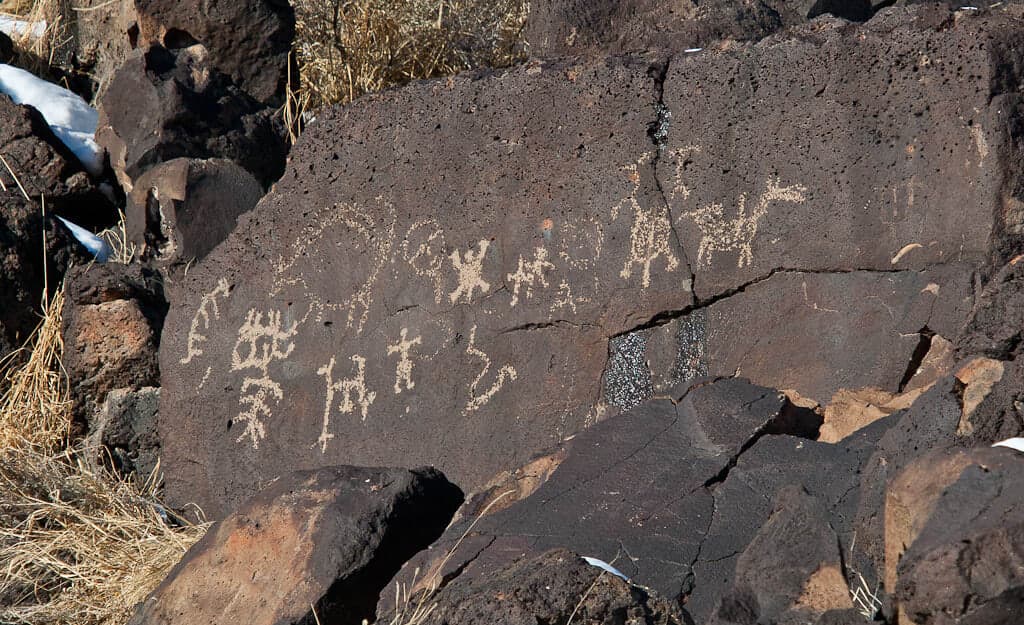
Petroglyphs and pictographs throughout the canyon served communicative and likely ritual functions. Not all of them are understood today, and many may have carried meanings accessible only to those who created them.
Descendant Pueblo communities continue to visit sacred sites within the monument for ceremonial purposes. The Stone Lions Shrine shows evidence of recent offerings and ceremonial activity. The specific nature of these contemporary practices is not publicly documented, a privacy that the National Park Service actively supports by declining to publicize the shrine's exact location.
Tribal involvement in the monument's management has increased significantly, with at least twenty-three tribal nations maintaining formal connections. This engagement is not merely administrative. It reflects the recognition that the monument holds living significance for communities whose ancestors built what visitors come to see.
The National Park Service offers interpretive programs that bridge the archaeological and the experiential: ranger-led walks through the ruins, winter solstice sunrise programs at Tyuonyi, sunset walks at Tsankawi, full-moon hikes, and stargazing events. These programs respect the boundary between public interpretation and private ceremony while offering visitors meaningful engagement with the site's layered significance.
Begin with the cavates. Climb the ladders into one of the cliff dwellings and sit inside. The space is small, low-ceilinged, carved by hand from volcanic tuff. Let the sound of the canyon fall away. Notice the texture of the walls, the traces of plaster and soot, the way light enters through the small opening. Someone made this room. Someone slept here, warmed themselves by a fire here, looked out at this same view of the canyon. The intimacy of the encounter is available to anyone willing to be still.
At Tyuonyi, stand in the central plaza and face the entrance. On the winter solstice, the rising sun enters directly through this gap. Even on other days, the orientation is legible. The builders placed their community in conversation with the sky.
At Alcove House, after the climb, sit beside the reconstructed kiva. The round shape, the subterranean depth, the single point of entry through the roof: these are not architectural choices but cosmological ones. The kiva represents the sipapu, the emergence place, in Puebloan understanding. Entering a kiva is symbolically entering the earth and connecting with what lies beneath the surface of the visible world.
At Tsankawi, walk slowly and look down. The trail follows grooves worn into the soft tuff by ancestral feet. You are walking where thousands walked before you, in paths their passage carved into stone. This is not metaphor. The grooves are physical, measurable, and deepening still with each visitor's footstep.
For the most immersive experience, attend one of the park's stargazing programs. Under Bandelier's dark sky, the Milky Way becomes visible in a way that most modern humans have never seen. The Ancestral Puebloans observed this same sky and wove its movements into their calendar and architecture. Looking up from the canyon floor at night, the distance between centuries collapses.
Ancestral Puebloan (Keresan and Tewa)
HistoricalThe Ancestral Puebloan peoples who settled the Pajarito Plateau built an elaborate community in Frijoles Canyon, carving hundreds of cavates into volcanic tuff, constructing the multi-story Tyuonyi pueblo, and establishing ceremonial life centered around subterranean kivas. Their settlement spanned approximately four centuries (1150-1550 CE) and represents one of the most significant concentrations of Ancestral Puebloan sites in the Southwest. The Stone Lions Shrine and extensive petroglyphs attest to a rich spiritual and symbolic culture.
Ceremonial life centered on kivas, subterranean chambers accessed through roof openings via ladders. The Big Kiva served as the principal ceremonial center. The Stone Lions Shrine served as a pilgrimage destination for hunters' societies. Agricultural rituals tied to seasonal cycles, including apparent solstice-aligned architecture at Tyuonyi, governed community life. Petroglyphs and pictographs served communicative and likely ritual functions.
Cochiti Pueblo
ActiveCochiti Pueblo maintains the strongest ancestral connection to Frijoles Canyon. The Stone Lions Shrine is venerated by the Cochiti people and was historically used for sacred pilgrimage by the hunters' society. Cochiti considers Bandelier part of their homeland, and the community's oral tradition preserves knowledge of the site's significance that extends beyond what archaeology can document.
Cochiti Pueblo members continue to visit sacred sites within the monument for ceremonial purposes. Evidence of recent ceremonial activity has been documented at the Stone Lions Shrine. The specific nature of these practices is not publicly disclosed.
San Ildefonso Pueblo (Tewa)
ActiveSan Ildefonso Pueblo is most closely connected to the Tsankawi section of the monument. The ancestral Tewa pueblo at Tsankawi was occupied approximately six hundred years ago before the people relocated to their present site along the Rio Grande. Tsankawi continues to hold spiritual significance for San Ildefonso.
San Ildefonso Pueblo members maintain spiritual connections to Tsankawi and other ancestral sites within the monument. Specific current practices are not publicly documented.
Archaeological and Conservation Stewardship
ActiveBandelier has been a site of active archaeological research since Adolph Bandelier's visits in the 1880s. The monument's establishment in 1916 began an ongoing program of preservation, research, and public interpretation managed by the National Park Service. The Cerro Grande Fire of 2000 and subsequent recovery have added ecological restoration to the stewardship mission.
Ongoing archaeological survey and research, trail and ruin maintenance, interpretive programs including ranger-led walks and solstice and stargazing events, ecological monitoring of post-fire recovery, and increasing collaboration with twenty-three affiliated tribal nations on management decisions.
Experience And Perspectives
Bandelier offers the rare opportunity to physically enter the spaces where people lived and worshipped for centuries. Visitors climb ladders into cavates carved from volcanic tuff, walk trails worn into bedrock by ancestral footsteps, and stand inside a reconstructed kiva. The Main Loop Trail winds past Tyuonyi pueblo and along the cliff face. Alcove House, reached by four wooden ladders 140 feet above the canyon floor, provides a visceral encounter with the scale and ambition of Ancestral Puebloan building.
The descent into Frijoles Canyon begins the experience before you reach a single ruin. The road drops from the mesa top through switchbacks, the canyon walls rising around you, the light changing as the plateau closes overhead. By the time you reach the visitor center at the canyon floor, the modern world feels distant.
The Main Loop Trail leads first to Tyuonyi, the great pueblo. What remains is a circular foundation of masonry walls, the rooms barely knee-high, but the shape is legible: an oval community centered on a shared plaza with three kivas sunk into the ground. Stand in the center and look outward. The cliff face rises to your left, dotted with the dark openings of cavates. The creek runs nearby. The community chose this location with care: water, shelter, southern exposure, defensible terrain.
The trail continues along the base of the cliff face, where cavates open at various heights. Some are accessible via short ladders. Duck inside one and notice how the volcanic tuff feels under your hands, soft and slightly warm. The rooms are small. The ceilings are low. Some retain traces of plaster and soot from ancient fires. The acoustics shift perceptibly: the canyon noise drops away and your own breathing fills the space. People slept here, stored food here, gathered here. The intimacy is startling.
Alcove House requires more commitment. Four wooden ladders lead up 140 feet to a large natural alcove in the cliff face, where a reconstructed kiva sits alongside the remains of several rooms. The climb is physical but manageable. At the top, the canyon spreads below, and the scale of what was built here becomes real. A community did not merely occupy this canyon. They inhabited it vertically, carving living space out of the rock itself at heights that required daily climbing.
For those with more time and stamina, the Tsankawi section, located twelve miles north along NM 4, offers a different quality of encounter. Here, the trail follows paths worn into the soft tuff by centuries of ancestral footsteps, the rock eroded into smooth grooves by the passage of countless feet. Petroglyphs appear along the trail. The ruins are less reconstructed, more wild. San Ildefonso Pueblo considers this their ancestral site, and the connection feels tangible in the worn rock beneath your feet.
Arrive early. Before the shuttle bus period begins (if visiting June through mid-October) or before the morning crowds, Frijoles Canyon holds a quality of stillness that rewards the first visitors of the day.
Begin at the visitor center, where a short orientation film provides context. Then walk the Main Loop Trail at a pace slower than your instinct suggests. Pause at Tyuonyi. Do not rush past the foundations looking for more dramatic ruins. Stand in the central plaza and look at the cliff face. Imagine the sounds of a community: children, cooking, conversation, ceremony. This oval of stone was the center of a world.
At the cavates, enter the ones with ladders. Sit inside for a moment. Let your eyes adjust. Touch the walls if permitted and notice the texture of the tuff. These rooms are small enough to hold one or two people comfortably. The intimacy of the space is the point.
If you climb to Alcove House, do so with attention to the physical experience. The ladders demand your full presence. At the top, rather than immediately photographing the view, sit beside the reconstructed kiva and look down into the canyon. Let the height register in your body.
For the winter solstice alignment at Tyuonyi, check with the park for ranger-led programs typically offered around December 21. Watching the sunrise enter the pueblo's main entrance is a direct encounter with the astronomical awareness the builders encoded into their architecture.
Stargazing on a clear night is one of the most profound experiences available at Bandelier. The dark sky conditions reveal the Milky Way with a clarity that most visitors have never witnessed. The park offers periodic full-moon hikes and stargazing programs.
Bandelier sits at the intersection of archaeological science, indigenous oral tradition, and the direct experience of visitors who encounter the ruins and landscape. Each perspective illuminates something the others cannot fully capture. Academic archaeology documents the settlement patterns and material culture. Descendant Pueblo communities maintain knowledge of the site's spiritual dimensions. Visitors bring their own encounters with the silence, scale, and intimacy of the canyon.
Archaeological consensus places the primary occupation of Bandelier between approximately 1150 and 1550 CE, with the major construction phase at Tyuonyi occurring during the Classic period (1350-1550 CE). The settlement reflects a broader pattern of migration from the Four Corners region driven by severe drought beginning around 1175 CE.
Adolph Bandelier's pioneering work in the 1880s established the site's significance within Southwestern archaeology, though his methods and assumptions reflected his era. Subsequent excavations and research have refined the chronology and cultural affiliations. Linguistic and archaeological evidence confirms that different areas within the monument were associated with different cultural groups: Frijoles Canyon with Keresan-speaking peoples (ancestors of Cochiti), Tsankawi with Tewa-speaking peoples (ancestors of San Ildefonso).
The winter solstice alignment at Tyuonyi has been documented but not comprehensively studied. Scholars acknowledge that additional astronomical alignments may exist throughout the monument. The precise meanings of many petroglyphs remain unclear, a reminder that material culture only partially reveals the worldview of its creators.
For descendant Pueblo communities, Bandelier is not a ruin. It is an ancestral home where the spirits of those who built it remain present. When Pueblo representatives say the ancestors still live here, this is not metaphor but an expression of a cosmology in which the boundary between the living and the dead is permeable, and in which place and presence are inseparable.
The Stone Lions Shrine holds particular significance for Cochiti Pueblo, whose hunters' society maintains connections to it. The Zuni understanding of the Stone Lions as guardians of Shipapolima places Bandelier within a sacred geography that spans hundreds of miles and connects multiple Puebloan nations.
Kivas are understood not merely as gathering spaces but as representations of the sipapu, the place of emergence, connecting the human world with what lies beneath. Entering a kiva is symbolically entering the earth. The circular shape, the subterranean depth, the single point of entry through the roof: these are cosmological statements, not just architectural choices.
The growing involvement of tribal nations in the monument's management reflects a broader shift toward recognizing that indigenous knowledge is not supplementary to scientific understanding but essential to it.
Significant gaps remain in our understanding of Bandelier. The precise meaning of many petroglyphs and pictographs is unknown and may remain so, as the symbolic language of their creators was likely context-dependent and community-specific. The full extent of astronomical alignments encoded in the architecture has not been comprehensively studied.
The reasons for the abandonment of Frijoles Canyon are debated. Drought is the leading theory, supported by tree-ring data, but social, political, and spiritual factors likely contributed. The decision to leave a place where a community had invested four centuries of building and ceremony was not simple, and the factors that tipped the balance remain partially obscure.
The ongoing ceremonial practices of descendant Pueblo communities at sites within the monument are deliberately undocumented. This is not a failure of scholarship but a recognition that some knowledge belongs to those who practice it.
Visit Planning
Bandelier National Monument is located fifteen miles south of Los Alamos and forty-six miles northwest of Santa Fe, New Mexico. The Main Loop Trail through Frijoles Canyon takes one to two hours; Alcove House adds another hour. From June through mid-October, a mandatory shuttle bus serves Frijoles Canyon between 9 AM and 3 PM. The winter solstice sunrise alignment at Tyuonyi and periodic stargazing programs offer the most contemplatively rich experiences.
Bandelier National Monument is located at 15 Entrance Road, Los Alamos, NM 87544. From Santa Fe, take US-84/285 north to NM 502 west, then NM 4 south. Entrance fee: $15-25 per vehicle (America the Beautiful pass accepted). From June through mid-October, a mandatory shuttle bus operates from White Rock Visitor Center to Frijoles Canyon between 9 AM and 3 PM; outside shuttle hours, visitors may drive directly into the canyon. The Tsankawi section is located separately, twelve miles north along NM 4, and does not require the shuttle. The monument is open daily from dawn to dusk. The visitor center is open 9 AM to 5 PM. Mobile phone signal is limited within Frijoles Canyon due to the steep canyon walls; signal is generally available at the mesa-top parking areas and White Rock Visitor Center. For emergencies in the backcountry, the nearest reliable signal is at the visitor center or along NM 4. Contact the monument at (505) 672-3861 for current conditions and program schedules.
Los Alamos, fifteen miles north, offers the nearest lodging options. Santa Fe, forty-six miles southeast, provides a full range of accommodations and serves as the most common base for visitors. The monument itself offers no lodging, but backcountry camping is available with a permit. Juniper Campground within the monument provides tent and RV sites on a seasonal basis. For those seeking extended immersion, the backcountry permits allow multi-day trips into the deeper areas of the monument.
Bandelier is both a national monument and an active sacred landscape. Stay on designated trails. Treat kivas as sacred spaces, not playground features. Never disturb petroglyphs, offerings, or archaeological structures. If you encounter evidence of recent ceremonial activity, especially in the backcountry, leave the area quietly without photographing. The ruins are the ancestors' homes, and their descendants ask that you treat them accordingly.
The essential principle at Bandelier is recognizing that what appears to be an archaeological site is also a living sacred landscape. The distinction matters. Archaeological sites invite study. Sacred landscapes invite respect.
The cavates and cliff dwellings are physically accessible in ways that many archaeological sites are not. You can climb ladders into rooms, touch walls, and stand where the builders stood. This access is a privilege that depends on visitors treating the spaces with care. Do not carve, mark, or add graffiti to any surface. Do not collect artifacts, pottery fragments, or stone. What looks like a random piece of broken pottery may be an important archaeological resource.
Kivas deserve particular attention. These circular, subterranean chambers were the ceremonial heart of the community. They remain sacred to descendant Pueblo communities. Enter briefly to observe, but do not linger, sit in the kiva, or treat it as a rest stop. The reconstructed kiva at Alcove House is available for quiet observation; treat it as you would a chapel.
Petroglyphs and pictographs must never be touched, traced, or chalked. The oils from human hands accelerate deterioration. What has survived eight centuries of weather should not be eroded by a single afternoon of careless contact.
In the backcountry, the same principles apply with greater urgency. If you find the Stone Lions Shrine or encounter any evidence of recent ceremonial activity, leave the area quietly. Do not photograph offerings. Do not move anything. The Park Service deliberately does not publicize the shrine's location at the request of Puebloan communities. Respect that decision by not sharing the location if you find it.
Sturdy hiking shoes with good traction are essential. Trails involve uneven surfaces, carved-rock paths, and wooden ladders. The elevation ranges from approximately 6,000 to 7,000 feet, with strong high-altitude sun. Bring sun protection, layers for temperature changes, and sufficient water. No specific dress code applies beyond practical considerations.
Personal photography is permitted throughout most of the monument. Do not photograph evidence of recent ceremonial activity, especially offerings at shrine sites. Photographing petroglyphs is permitted from a respectful distance but never touch the rock surface. At Tsankawi, be especially careful not to step on petroglyphs while photographing them. Commercial or professional photography may require a permit; check with the visitor center.
Do not leave offerings at any site within the monument. If you encounter offerings or ceremonial objects, particularly at the Stone Lions Shrine or other backcountry locations, do not disturb, move, or photograph them. These are sacred communications left by descendant Pueblo members.
Stay on designated trails at all times. Do not climb on walls, ruins, or cliffs outside of provided ladders. Enter only cavates with NPS-provided access. Do not collect any artifacts, plants, or geological specimens. Pets are not permitted on trails or in buildings. Backcountry overnight trips require a permit from the visitor center. From June through mid-October, a mandatory shuttle bus operates between 9 AM and 3 PM for access to Frijoles Canyon.
Sacred Cluster
Nearby sacred places create the location cluster described in the growth plan. This block is intentionally crawlable and links into the wider regional graph.