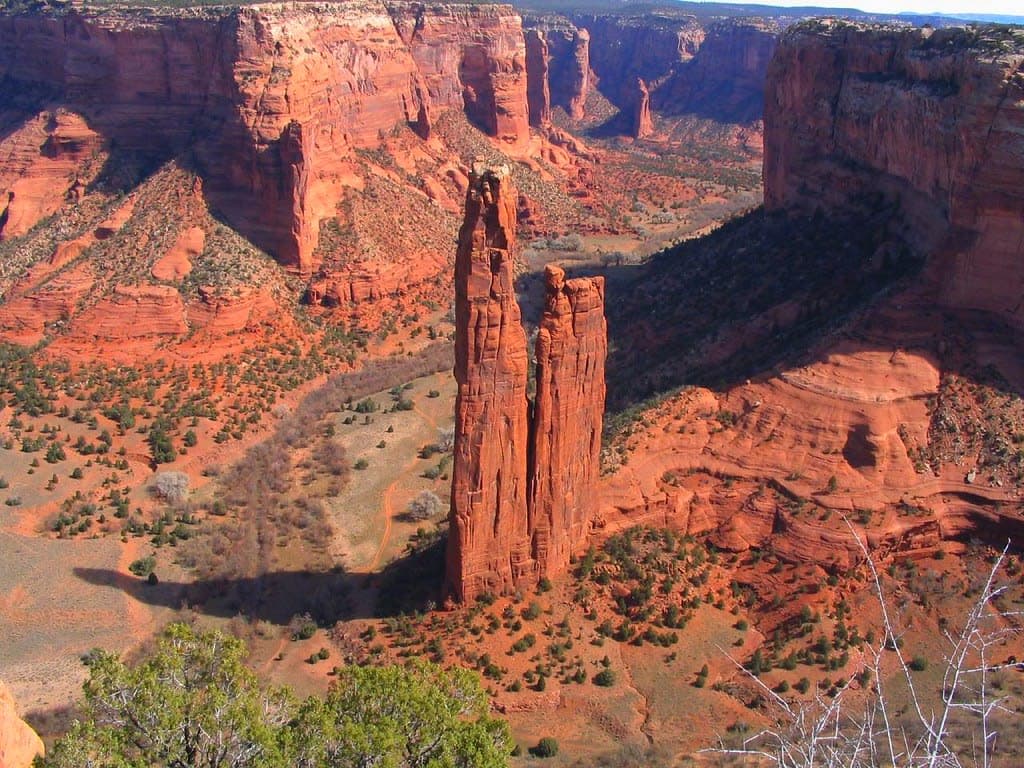
Canyon de Chelly, Arizona
Where Spider Woman still weaves from her spire, and the Navajo have never left home
Chinle Agency, Arizona, United States
At A Glance
- Coordinates
- 36.1553, -109.5329
- Suggested Duration
- Half day for rim drives and overlooks. Full day or multiple days for comprehensive canyon floor tours. The spread of the monument across 84,000 acres means thorough exploration requires extended time.
- Access
- Located near Chinle, Arizona, on the Navajo Reservation. From Gallup, NM: approximately 2 hours via US-491 and US-264. From Flagstaff, AZ: approximately 4 hours via I-40 and US-191. No public transportation. Nearest airports: Gallup, NM (100 miles); Flagstaff, AZ (200 miles). No entrance fee. Backcountry permit: $15 per person (cash, payable to Navajo Parks and Recreation). Guided tours: approximately $75-90 per person; prices vary by operator.
Pilgrim Tips
- Located near Chinle, Arizona, on the Navajo Reservation. From Gallup, NM: approximately 2 hours via US-491 and US-264. From Flagstaff, AZ: approximately 4 hours via I-40 and US-191. No public transportation. Nearest airports: Gallup, NM (100 miles); Flagstaff, AZ (200 miles). No entrance fee. Backcountry permit: $15 per person (cash, payable to Navajo Parks and Recreation). Guided tours: approximately $75-90 per person; prices vary by operator.
- No specific dress code, but practical clothing appropriate for desert conditions is recommended. Layers advisable as temperatures vary significantly. Comfortable walking shoes essential for hiking tours.
- Photography from rim overlooks permitted. On guided tours, always ask permission before photographing Navajo residents, their homes, or property. Tips or fees may be expected. Commercial filming requires permits from NPS and Navajo Nation TV and Film Office.
- Do not attempt to access the canyon floor without an authorized Navajo guide. This is not merely rule but requirement for respectful engagement. The canyon is community space, not public park. Do not photograph Navajo residents, their homes, or their livestock without explicit permission. Tip or fee may be expected and is appropriate. Do not enter, climb on, or touch archaeological ruins. Do not touch or trace rock art. Do not take any artifacts, pottery shards, rocks, or plants. The canyon holds the memory of the Long Walk. Awareness of this history should inform how visitors conduct themselves.
Overview
Canyon de Chelly rises 1,000 feet above a valley where Navajo families still farm, herd sheep, and practice traditions their ancestors carried here three centuries ago. At the canyon's heart, Spider Rock pierces the sky: the dwelling place of Spider Woman, who taught the Dine the art of weaving and the Beauty Way. This is the only National Park unit owned entirely by a Native American tribe, and entrance to the canyon floor requires a Navajo guide.
The canyon walls rise like stone prayers, red and ochre and white, lifting toward a sky that has watched five thousand years of human presence. Cliff dwellings cling to alcoves where the Ancestral Puebloans built their homes eight centuries ago. But Canyon de Chelly is not a ruin. Navajo families live here still, farming the bottomlands, tending sheep, maintaining a relationship with this landscape that stretches back three hundred years and shows no sign of ending.
This is the heart of the Navajo Nation, and the Navajo know it. They call it Tseyi', the place within the rocks. Here, according to their tradition, Spider Woman descended from the top of her 830-foot spire to teach the people the art of weaving and, more importantly, the Beauty Way, how living in harmony with the world creates balance in mind, body, and soul. Young weavers are instructed to find a spider web glistening with morning dew and place their palm upon it without destroying it, to receive Spider Woman's gift.
The canyon holds also the memory of trauma. In 1864, Kit Carson's forces swept through, destroying hogans, orchards, and livestock, forcing the Navajo to surrender. What followed was the Long Walk, a forced march of 8,000 people to imprisonment at Bosque Redondo, 250 miles away. Thousands died. When the survivors returned four years later, the Treaty of 1868 consecrated Canyon de Chelly as sacred ground under sole Navajo administration.
This dual quality, of ongoing life and profound historical wound, shapes everything about what visitors encounter. The canyon is not a museum but a community. The cliff dwellings honor previous inhabitants whom the Navajo respect. The overlooks offer views but not access: to enter the canyon floor requires a Navajo guide, someone whose family may have farmed here for generations, someone who can share what is appropriate to share and protect what must be protected. This is not restriction but invitation, the opportunity to encounter a living sacred place through relationship with those who hold it sacred.
Context And Lineage
Canyon de Chelly has been inhabited for 5,000 years, with major Ancestral Puebloan development from 700 to 1300 CE and Navajo presence since approximately 1700. The 1864 Long Walk forced removal of the Navajo, but the 1868 Treaty returned them to their homeland. The canyon became a National Monument in 1931, the only NPS unit entirely owned by a Native American tribe.
In the Navajo creation story, Spider Woman was given life in the Second World and descended to the Third World by spinning a silken web from the top of Spider Rock. She wove the web of the universe and taught the Dine the art of weaving, along with the Beauty Way, how living in harmony with the world creates balance in mind, body, and soul.
Spider Woman serves as advisor to the heroic twins Monster-Slayer and Born-for-Water. She taught the people agriculture and weaving, appears in many legends to protect the innocent, and restores harmony to the world. Her dwelling at the top of Spider Rock makes the canyon the location of cosmic instruction.
The teaching story told to children is darker: Spider Woman takes mischievous and disobedient children to the top of Spider Rock, where she boils and eats them. The white streaks at the top are the bleached bones of bad children. This story encourages proper behavior while acknowledging that the sacred is not merely comforting but also awesome.
The canyon's human lineage stretches back 5,000 years through Archaic peoples, Basketmaker culture, Ancestral Puebloans, and Navajo. Each culture built upon what came before while adding distinct contributions.
The Ancestral Puebloans, whom the Navajo call 'ancient enemies' or 'ancient ones,' constructed the cliff dwellings between 700 and 1300 CE. Their departure, likely due to prolonged drought, left structures the Navajo later encountered and honored.
Navajo presence began around 1700 CE. Unlike the cliff-dwelling builders, the Navajo settled the canyon floor, farming the bottomlands and herding sheep. Their relationship with the canyon has continued unbroken except for the Long Walk period, now over 150 years of continuous presence.
The National Monument designation in 1931 created unique arrangement: federal protection with tribal ownership and administration. This model has preserved both archaeological resources and living cultural continuity.
Spider Woman
deity
The deity who dwells atop Spider Rock and taught the Navajo the art of weaving and the Beauty Way. Central to Navajo cosmology and the canyon's sacred significance.
Kit Carson
historical
The U.S. Army officer who led the 1864 campaign through Canyon de Chelly, forcing Navajo surrender and initiating the Long Walk.
Saint Christodoulos
historical
The Treaty of 1868 allowed the Navajo to return to their homeland, consecrating Canyon de Chelly as sacred ground under sole Navajo administration.
Why This Place Is Sacred
Canyon de Chelly possesses the quality of thinness through Spider Rock's presence as Spider Woman's dwelling, the 5,000-year accumulation of human sacred activity, the living Navajo community that continues traditional practices, the over 2,700 archaeological sites and rock art panels, and the canyon's role as refuge and sanctuary across cultures.
Spider Rock rises 830 feet from the canyon floor, a sandstone spire that dominates the confluence of Canyon de Chelly and Monument Canyon. According to Navajo tradition, Spider Woman lives at its summit. The white streaks at the top are said to be the bleached bones of mischievous children she has taken, a teaching story, but beneath the warning lies the deeper truth: this is where the sacred touches the ordinary, where divine teaching entered human culture.
Spider Woman's gift was not merely craft but cosmology. The Beauty Way she taught is hozho, the Navajo concept of balance and harmony that structures everything from healing ceremonies to daily conduct. To weave is to participate in the pattern that holds the world together. The canyon where she dwells is therefore not merely beautiful landscape but the setting of cosmic instruction.
The walls themselves carry testimony. Over 2,700 archaeological sites have been documented, ranging from 5,000-year-old Archaic campsites to Ancestral Puebloan cliff dwellings to Navajo rock art and hogans. Mummy Cave, the largest site, contains nearly seventy rooms occupied from 300 to 1300 CE. White House Ruin, accessed by the only self-guided trail, shows eight centuries of construction. Each site represents generations who recognized something in this place worth building upon.
The Navajo honor these predecessors while maintaining their own distinct relationship. The ancient ones were here, but the Dine are here now, living as their ancestors lived, farming, herding, and conducting ceremonies within the canyon's embrace. The thread of sacred presence has not broken. The canyon continues to shelter those who seek shelter in it.
The Long Walk's trauma adds another dimension. Sacred ground is often ground where suffering has occurred, where the intensity of human experience has concentrated. The Navajo return from Bosque Redondo, their insistence on coming home to this particular place despite easier options, testifies to what the canyon means beyond practical utility.
The canyon has served as sanctuary for five millennia. Archaic peoples established seasonal camps. The Basketmaker culture developed agriculture. The Ancestral Puebloans built the cliff dwellings that still stand. The Navajo, arriving around 1700, found a protected landscape with water, arable land, and defensive possibilities. For all these peoples, the canyon offered not merely resources but sacred geography, a place where the relationship between human and more-than-human could be cultivated.
The canyon's significance has only deepened through time. The Ancestral Puebloan departure around 1300 CE, likely due to drought, left the cliff dwellings as testimony. When the Navajo arrived, they did not displace but built upon, adding their own sacred understanding to what was already present.
The Long Walk nearly severed this continuity. Kit Carson's 1864 campaign destroyed the material basis of Navajo life in the canyon. But the return from Bosque Redondo restored what occupation could not permanently break. The 1868 treaty recognized the canyon as Navajo homeland.
The 1931 National Monument designation created unique partnership: federal protection with tribal ownership. Today, approximately forty to fifty Navajo families maintain residence, farming the bottomlands as their ancestors did, ensuring that the canyon remains not historical artifact but living community.
Traditions And Practice
The Navajo continue traditional practices in Canyon de Chelly including farming, sheepherding, weaving, ceremonial gatherings, and oral tradition. Visitors cannot participate in ceremonies but can engage respectfully through guided tours where appropriate cultural knowledge is shared.
The Yeibichai (Night Chant/Nightway) is among the most sacred Navajo ceremonies, a nine-night healing ritual involving masked dancers, sand paintings, songs, prayers, and chants. The ceremony aims to restore hozho, beauty, balance, and harmony, to those who are ill. Demand is so great that as many as fifty ceremonies may be held during the winter season. While the ceremony occurs throughout Navajo land, the Canyon de Chelly region has long been a center for such practice.
Traditional weaving, taught by Spider Woman, remains a living practice. Young weavers receive instruction to find a spider web glistening with morning dew and place their palm upon it without destroying it, to receive Spider Woman's gift. Many weavers incorporate a Spider Woman cross into their textiles to honor these teachings.
Navajo families continue farming and sheepherding on the canyon floor, maintaining practices their ancestors established three centuries ago. Hogans, traditional Navajo dwellings, are still used for ceremonies. Oral traditions pass from elders to younger generations through family gatherings.
The cultural gatherings that occur in the canyon reinforce bonds between families and community. The land itself is understood as teacher: children grow up knowing the stories associated with specific locations, the history their families have lived here, the obligations that come with belonging to this place.
Visitors cannot participate in Navajo ceremonies; these are private, sacred practices. However, guided tours offer respectful engagement with the canyon's cultural significance.
When your guide shares stories or cultural information, receive it as the gift it is. Ask questions when appropriate but recognize that some things will not be shared. The boundary between what can be told and what cannot be told is itself teaching about the nature of sacred knowledge.
Purchasing Navajo arts and crafts from canyon residents supports the community while providing opportunity to learn about weaving and other traditional arts. Ask artisans about their work; many will share aspects of the cultural significance of what they create.
Approach the cliff dwellings with awareness that the Navajo honor these predecessors. The ancient ones were here before the Dine, and their dwelling places deserve the same respect given to the canyon's Navajo heritage.
Navajo (Dine)
ActiveCanyon de Chelly is one of the most sacred places in the Navajo Nation, known as Tseyi', the place within the rocks. The canyon lies within Dinetah, the traditional homeland. It is the dwelling place of Spider Woman, who taught the Dine weaving and the Beauty Way. The canyon appears in numerous creation stories, songs, and ceremonies and represents the heart of Navajo cultural identity.
Traditional weaving honoring Spider Woman's teachings. Ceremonial gatherings and healing rituals including Yeibichai. Agricultural practices on the canyon floor. Preservation and transmission of oral traditions, stories, and songs. Traditional hogan-based ceremonies.
Ancestral Puebloan
HistoricalFrom approximately 200 BCE to 1300 CE, Ancestral Puebloan peoples built sophisticated cliff dwellings throughout the canyon. At peak, the canyon supported 600-800 inhabitants. Major sites include White House Ruin, Mummy Cave with nearly 70 rooms, and Antelope House. The Navajo honor these predecessors while maintaining their own distinct relationship.
Cliff dwelling construction, agricultural cultivation on canyon floor, petroglyph and pictograph creation, ceremonial kiva rituals, basket weaving and pottery traditions.
Experience And Perspectives
Visitors to Canyon de Chelly consistently describe awe at the scale of the canyon walls and Spider Rock, a feeling of entering ancient and sacred space, and enriched understanding from Navajo guides who share personal and cultural stories. The experience of being guided by someone whose family has lived here for generations creates intimate, authentic connection.
The first overlooks deliver immediate impact. A thousand feet below, the canyon floor stretches green with cottonwoods and fields. Cliff dwellings appear in alcoves so high they seem impossible to reach. Spider Rock rises at the confluence, its twin spires catching light that shifts through the day from gold to rose to violet.
But the overlooks, however dramatic, offer only preview. To enter the canyon floor requires a Navajo guide, and this requirement transforms everything. Suddenly you are not a tourist viewing scenery but a guest being welcomed into someone's home. Your guide may be a fourth-generation resident. Their family may have farmed the land you walk upon. What they choose to share carries the authority of lived relationship.
Guides often share stories that visitors could not access otherwise: personal narratives of growing up in the canyon, cultural teachings about Spider Woman and the Beauty Way, the history of specific sites known to their families. The rock art that seems mysterious gains context. The cliff dwellings become not ancient ruins but places where people, though different from the Navajo, lived lives the Navajo respect.
Many visitors describe the canyon's silence as distinctive, a quality of stillness that city-trained ears have forgotten. The walls create acoustic conditions that seem to absorb noise and return peace. Walking the canyon floor, looking up at formations that dwarf human scale, visitors often fall into a contemplative state quite different from ordinary sightseeing.
Those who visit during the right season may observe Navajo families at work: planting, harvesting, herding sheep along the canyon floor. These encounters remind visitors that the sacred and the ordinary are not separate here. The same land that holds Spider Woman's dwelling also grows corn. The same people who preserve ancient ceremonies also live contemporary lives. This integration of the sacred with the everyday is itself instruction.
Canyon de Chelly rewards those who approach as guests rather than tourists. The requirement for Navajo guides is not obstacle but opportunity: the chance to encounter this landscape through the perspective of those who know it most intimately.
The rim drives, North Rim Drive and South Rim Drive, provide accessible overlooks without guides. Spider Rock Overlook on the South Rim offers the most iconic view. White House Overlook provides vantage of the best-known cliff dwelling. These drives allow appreciation of scale and setting.
For deeper experience, book a guided tour of the canyon floor. Options include hiking, vehicle tours, and horseback riding. Different guides offer different emphases: some focus on archaeology, others on Navajo culture and story, others on photography. Consider what draws you and choose accordingly.
Approach with awareness that you enter sacred ground, community space, and a place of historical trauma. The Navajo who welcome visitors do so with generosity. Return that generosity with respect.
Canyon de Chelly invites interpretation from archaeological, Navajo traditional, and contemporary perspectives. Each illuminates aspects of why this landscape holds such significance across cultures and millennia.
Archaeologists recognize Canyon de Chelly as one of the longest continuously inhabited landscapes in North America, with over 2,700 documented sites spanning 5,000 years. The cliff dwellings represent sophisticated Ancestral Puebloan architecture. The canyon's unique status as the only NPS unit entirely owned by a Native American tribe reflects evolving approaches to heritage management and indigenous sovereignty.
The integration of archaeological preservation with living community represents a model rarely achieved elsewhere. Research continues under collaborative arrangements respecting both scientific inquiry and Navajo cultural protocols.
For the Navajo, Canyon de Chelly is not historical or archaeological site but living sacred landscape central to cultural identity. The canyon is the home of Spider Woman, woven into creation stories and ceremonial songs, part of the ancestral homeland bounded by four sacred mountains.
The land embodies hozho, beauty, balance, and harmony. The Long Walk represents defining trauma, but also resilience: the determination to return home and remain home. Contemporary Navajo families living in the canyon maintain continuity that makes the sacred present rather than past.
Some visitors perceive the canyon as a powerful energy site, drawn by the dramatic landscape and millennia of spiritual practice. Spider Rock attracts particular attention as a site of concentrated spiritual energy. These perspectives, while sincere, should be held in awareness that the canyon is primarily living Navajo community and sacred site, not spiritual tourism destination.
Mysteries remain. The precise reasons for Ancestral Puebloan departure around 1300 CE, drought is the leading theory, but social and religious factors may have contributed. The full meaning of many petroglyphs and pictographs remains unknown. Details of ceremonies that are sacred-secret are not shared with outsiders. The extent of pre-Archaic human presence in the canyon remains to be fully documented.
Visit Planning
Canyon de Chelly is located near Chinle, Arizona, on the Navajo Reservation. No entrance fee is charged, but canyon floor access requires guide and backcountry permit. Spring and fall offer the most pleasant conditions for tours.
Located near Chinle, Arizona, on the Navajo Reservation. From Gallup, NM: approximately 2 hours via US-491 and US-264. From Flagstaff, AZ: approximately 4 hours via I-40 and US-191. No public transportation. Nearest airports: Gallup, NM (100 miles); Flagstaff, AZ (200 miles). No entrance fee. Backcountry permit: $15 per person (cash, payable to Navajo Parks and Recreation). Guided tours: approximately $75-90 per person; prices vary by operator.
Limited lodging in Chinle, including Thunderbird Lodge within the monument. More options in Window Rock or Gallup. Camping available at Cottonwood Campground within the monument.
Canyon de Chelly requires respectful engagement with an active Navajo community. Canyon floor access requires authorized guides. Photography of residents requires permission. Archaeological sites must not be touched. Modest, practical dress is appropriate.
Canyon floor access requires an authorized Navajo guide and backcountry permit from Navajo Parks and Recreation. This requirement is not bureaucratic obstacle but recognition that the canyon is community space, not public park. Guides provide not only access but context, relationship, and appropriate mediation between visitors and sacred ground.
Photography from rim overlooks is permitted. On guided tours, always ask permission before photographing Navajo residents, their homes, livestock, or personal property. Tips or fees may be expected and are appropriate. Do not photograph without consent.
Stay on designated trails and overlooks. Do not enter, climb on, or touch archaeological ruins. Do not touch, trace, or disturb rock art. Do not take any material from the canyon, including pottery shards that may seem insignificant.
Respect private property. Navajo families live and farm in the canyon. Their homes and fields are not tourist attractions but their living space. Maintain appropriate distance unless invited closer.
Keep noise levels respectful. Pack out all trash. Pets are not permitted on canyon floor tours.
No specific dress code, but practical clothing appropriate for desert conditions is recommended. Layers advisable as temperatures vary significantly. Comfortable walking shoes essential for hiking tours.
Photography from rim overlooks permitted. On guided tours, always ask permission before photographing Navajo residents, their homes, or property. Tips or fees may be expected. Commercial filming requires permits from NPS and Navajo Nation TV and Film Office.
Do not leave offerings at archaeological sites or sacred locations without guidance from a Navajo companion. Do not take anything from the canyon.
Canyon floor access requires authorized Navajo guide and backcountry permit. Stay on designated trails and overlooks. Do not enter, climb on, or touch archaeological ruins. Do not touch or disturb rock art. Respect private property. Pets not permitted on canyon floor.
Sacred Cluster
Nearby sacred places create the location cluster described in the growth plan. This block is intentionally crawlable and links into the wider regional graph.