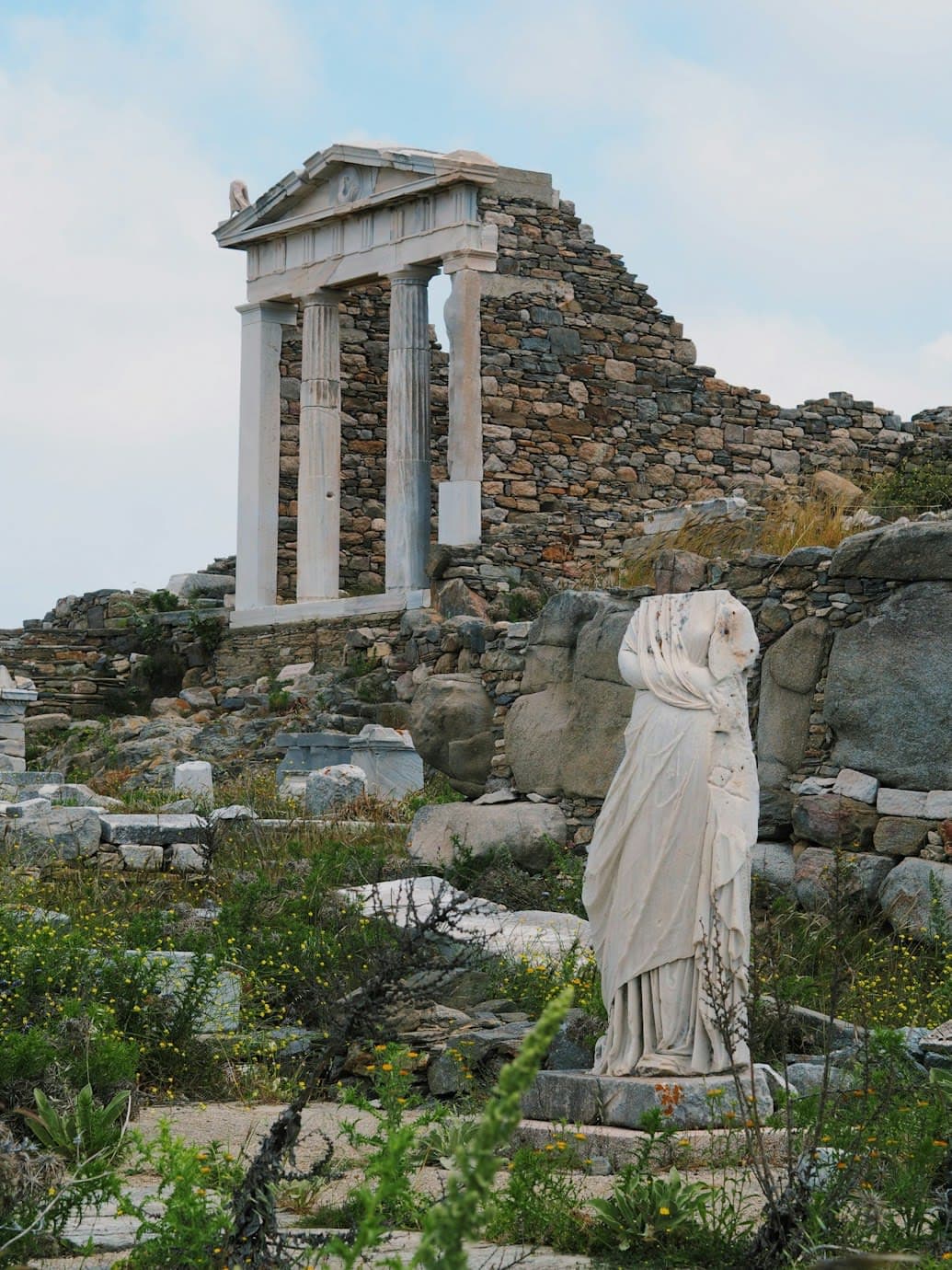
Delos
Where the floating island stopped when the sun god was born beneath the palm tree
Municipality of Mykonos, Aegean, Greece
At A Glance
- Coordinates
- 37.4011, 25.2692
- Suggested Duration
- Three self-guided routes are marked, ranging from 90 minutes to 5 hours. Most visitors spend 2-4 hours exploring the main sanctuary, Lion Terrace, and theater area. A comprehensive visit including Mount Kynthos climb and the archaeological museum requires 4-5 hours. Allow buffer time for the return ferry.
- Access
- Ferries depart from Mykonos Old Port, reaching Delos in 30-45 minutes. Up to four departures daily in high season; fewer in shoulder seasons. Tours also operate from Naxos and Paros. Weather conditions can cancel crossings—the Aegean can be rough, especially in spring and fall. No accommodation exists on the island; all visits are day trips only.
Pilgrim Tips
- Ferries depart from Mykonos Old Port, reaching Delos in 30-45 minutes. Up to four departures daily in high season; fewer in shoulder seasons. Tours also operate from Naxos and Paros. Weather conditions can cancel crossings—the Aegean can be rough, especially in spring and fall. No accommodation exists on the island; all visits are day trips only.
- No dress code applies. Practical, weather-appropriate clothing is essential: lightweight layers for sun protection, comfortable walking shoes with good grip for uneven terrain. Hat and sunglasses are strongly recommended. The site involves significant walking and potential scrambling on Mount Kynthos.
- Photography is permitted throughout the site for personal use. Standard archaeological restrictions apply: no touching monuments to position shots, no climbing on structures. Professional photography and drone use require advance permission.
- The lack of shade and facilities creates genuine physical challenges in summer heat. Bring abundant water, food, sun protection, and wear comfortable walking shoes for uneven terrain. The site is extensive; attempting to see everything in one visit may lead to exhaustion rather than contemplation. The ferry schedule is non-negotiable; missing the last boat means being stranded. Weather can cancel crossings entirely. Book ferry tickets in advance during peak season.
Overview
Delos stands where light entered the world. According to Greek myth, this tiny island was floating and rootless until Leto gave birth to Apollo and Artemis here, and the island anchored itself to the sea floor. For a millennium, Greeks considered it 'the most sacred of all islands.' The Cyclades—the 'circling islands'—take their name from their arrangement around this spiritual center. Birth and death were forbidden here; even Socrates had to wait thirty days after his death sentence because the sacred ship was at Delos.
Delos is where the gods of light were born. Greek mythology placed the birth of Apollo—god of the sun, prophecy, healing, and music—and his twin Artemis—goddess of the moon, the hunt, and wilderness—on this barren island at the center of the Cyclades. Leto, pregnant by Zeus and fleeing Hera's jealous pursuit, found refuge on the one piece of land that could not refuse her: a floating island with no roots in the earth. When she gave birth after nine days of labor, the island stopped floating and became anchored by four pillars to the ocean floor.
This origin story shaped everything that followed. For over a thousand years, Delos functioned as one of the most important religious sites in the Greek world, rivaling Delphi and Olympia. City-states sent sacred delegations to the quadrennial Delia festival. The Athenians dispatched their sacred ship, and during its absence, no executions could take place in Athens—a law that gave Socrates thirty extra days of life after his death sentence. The island's sacredness was so absolute that birth and death were forbidden on its soil; women in labor and the dying were transported to neighboring Rineia.
The sanctuary has been uninhabited since the 7th century AD. The French School of Athens has excavated since 1873, revealing an archaeological site UNESCO describes as 'exceptionally extensive and rich.' Visitors arrive by ferry and must leave by nightfall—the ancient pattern of pilgrimage preserved by modern circumstance. The Lion Terrace still guards the Sacred Way. Mount Kynthos still rises 112 meters above the ruins. The twins Apollo and Artemis took their epithets—Cynthius and Cynthia—from that summit.
Context And Lineage
Delos served as one of the most important Panhellenic sanctuaries for over a millennium. The Ionians established Apollo's cult in the 9th-10th century BCE; the Athenians purified the island in 540 and 426 BCE, forbidding birth and death; the Delian League stored its treasury here. After Roman conquest, the island became a major Mediterranean port before being sacked by Mithridates' forces in 88 BCE.
The mythology is older than the sanctuary's stone temples. According to the Homeric Hymn to Apollo, composed around 700 BC, Leto wandered the world pregnant with Zeus's children, fleeing Hera's jealous persecution. Hera had forbidden any land from giving her shelter. Every place Leto approached refused her—all except a floating island called Delos, which had no roots in the earth and thus had not sworn Hera's oath.
Leto labored for nine days on the barren, floating rock. All the goddesses attended her except Hera and Eileithyia, goddess of childbirth, whom Hera deliberately kept away. Finally, the other goddesses bribed Eileithyia with a golden necklace, and she came to Delos. Leto grasped a palm tree on the slopes of Mount Kynthos, and Apollo was born. At that moment, the floating island became anchored to the ocean floor by four pillars, fixed forever at the center of the Cyclades.
Apollo spoke immediately at birth, asking for a lyre and a bow, claiming prophecy as his domain. He became Cynthius, the god from Kynthos; his sister Artemis became Cynthia. The island that had been barren and worthless was transformed by divine birth into 'the most sacred of all islands.' The Greeks understood this as the moment when light entered the world.
Delos represents the Ionian religious tradition within broader Greek sacred geography. The Ionians established the major sanctuary; the Naxians contributed monuments including the Lion Terrace; the Athenians claimed administrative control and performed the purifications. The site existed in dialogue with Delphi—the two greatest oracles of Apollo, one on the mainland, one at the center of the Aegean. Modern Hellenic polytheism, officially recognized in Greece since 2017, considers the Olympian sites part of living spiritual heritage, though specific ceremonial activities at Delos are not well documented.
Apollo
God born on Delos
Artemis
Goddess born on Delos
Leto
Mother of the divine twins
Why This Place Is Sacred
Delos was sacred before mythology made it the birthplace of Apollo and Artemis. The floating island that anchored itself, the prohibition on birth and death, the Oracle second only to Delphi, and the Cyclades circling around it—all pointed to a place where the boundary between divine and mortal had collapsed entirely.
What made Delos thin? The Greeks would have answered: the gods were born here. Light itself—sun and moon, Apollo and Artemis—entered the world on this island.
But the deeper answer lies in the story's structure. Delos was floating, rootless, unattached to the earth, when Leto arrived. It had no place in the world's geography. It was, in a sense, already liminal—neither here nor there, belonging to no category. When the divine twins were born, the island stopped floating and became fixed. The sacred event anchored it to existence.
This is thinness as creation: the moment when something that was formless becomes formed, when potential becomes actual. The birth of the light gods transformed a non-place into the most sacred place in Greece. The floating island became the fixed center around which the Cyclades circled.
The prohibition on birth and death—enforced after the Athenian purifications of 540 and 426 BCE—preserved this original thinness. Delos was frozen at the moment of divine birth, not allowed to participate in the ordinary cycle of mortal beginning and ending. Women in labor were transported to Rineia. The dying were carried away. The island existed in perpetual sacred present.
The Oracle of Delos, second only to Delphi, drew seekers from across the Greek world. The sanctuary attracted pilgrims for a millennium before the Olympian mythology even existed—suggesting the island's sacredness preceded the story that explained it. What was worshipped here before Apollo? The question remains unanswered.
The thinness persists in the island's character today: barren, uninhabited, accessible only by day, the ancient pattern of pilgrimage enforced by ferry schedules. Visitors walk the same Sacred Way that pilgrims walked for a thousand years. They stand where mythology placed the birth of light.
Delos served as a Panhellenic sanctuary—one of the dozen or so sites that transcended individual city-states and unified the Greek world in common worship. The Delian League (478 BCE) chose it as headquarters, storing the alliance's treasury in the temple precincts. The quadrennial Delia festival, comparable to the Olympic Games, drew sacred delegations from across Greece for athletic, musical, and equestrian contests. The sanctuary housed temples to Apollo, Artemis, Leto, and eventually foreign deities including Isis and Syrian gods.
Inhabited since the 3rd millennium BC, Delos became a major sanctuary when the Ionians brought the cult of Leto in the 9th-10th century BCE. The great building period spanned the 7th-5th centuries BC, with the Naxians contributing the Lion Terrace (c. 600 BC) and Athenians building temples after the 426 BCE purification. After 166 BCE, Rome made Delos a free port, and it became a major Mediterranean trading center. Mithridates' forces sacked the island in 88 BCE and again in 69 BCE, killing thousands and ending its prosperity. By the 7th century AD, the island was abandoned. Excavations by the French School of Athens began in 1873. UNESCO inscribed the site in 1990.
Traditions And Practice
The Delia festival was celebrated every four years with athletic, musical, and equestrian contests, along with theatrical performances and communal banquets. City-states sent sacred delegations. The Athenian sacred ship's departure purified the city; no executions could take place until it returned. Birth and death were forbidden on the island to maintain its sacred purity.
The Delia festival, celebrated quadrennially, rivaled the Olympic and Pythian Games in importance. It fell on the 6th and 7th of Thargelion—the birthdays of Apollo and Artemis. City-states sent sacred delegations called theoroi, who arrived in ceremonial dress with their families and offerings. Contests included athletics, horse racing, and music. Choruses of maidens performed the geranos, the 'crane dance,' which commemorated Theseus's escape from the Cretan Labyrinth.
The Athenian theoria had particular significance. The sacred ship, the theoris, was adorned with laurel branches by the priest of Apollo and sailed to Delos with the delegation aboard. A sacrifice at the Delion sanctuary in Marathon preceded departure. During the ship's absence, which could last up to forty days, Athens underwent ritual purification. No criminal executions could take place. This law famously delayed Socrates' death by thirty days after his trial—the sacred ship had just departed for Delos.
The Lesser Delia, called Apollonia by the Delians, was celebrated annually with smaller observances. Offerings accumulated in the sanctuary over centuries: bronze and marble statues, golden treasures, architectural dedications from grateful city-states. The treasury of the Delian League (478 BCE onwards) was stored here until the Athenians moved it to Athens in 454 BCE.
The prohibition on birth and death, enforced after the Athenian purifications, required the removal of pregnant women and the dying to neighboring Rineia. Burials were forbidden; existing tombs were excavated and relocated. The island existed in a state of perpetual sacred purity, frozen at the moment of divine birth.
No active religious ceremonies are documented at the archaeological site. The island functions as a protected heritage zone managed by the Greek government, and visitors experience it as an archaeological park. Modern Hellenic polytheism was officially recognized in Greece on April 9, 2017, granting practitioners the right to worship the Olympian gods openly. Whether and how practitioners conduct ceremonies specifically at Delos is not documented in available sources. The site's restrictions—no overnight stays, closure in winter—may limit ceremonial activities.
Approach Delos as the ancients did: arrive by sea, walk the Sacred Way, acknowledge the Lion Terrace guardians, enter the sanctuary, and climb Mount Kynthos to stand where Apollo was born. The island's austerity—no shade, no food, no accommodation—is not a flaw but a feature. Bring water and allow the discomfort of sun and stone to sharpen attention. Consider the prohibition on birth and death: you are standing in a place that was set apart from the ordinary human cycle. The ferry schedule that requires departure by afternoon preserves the ancient pattern—pilgrims came for the festival and left when the rites were complete.
Ancient Greek Religion
HistoricalDelos was considered 'the most sacred of all islands' by the 3rd century BC poet Callimachus. According to mythology, the floating island became anchored when Leto gave birth to the twin deities Apollo and Artemis—gods of light who governed sun and moon, prophecy and wilderness, healing and the hunt. The sanctuary rivaled Delphi and Olympia in importance, drawing sacred delegations from across the Greek world. The Oracle of Delos was second only to Delphi. The prohibition on birth and death enforced a sacred purity unmatched by any other Greek site.
The Delia festival was celebrated every four years, likely on the 6th and 7th of Thargelion—the birthdays of Apollo and Artemis. Contests in athletics, music, and horsemanship drew competitors from across Greece. Choruses of maidens performed the geranos (crane dance). City-states sent sacred delegations (theoroi) with offerings for the sanctuary. The Athenian sacred ship (theoris), adorned with laurel, sailed each year to Delos; during its absence, Athens underwent purification and suspended all executions. The annual Lesser Delia (Apollonia) maintained continuous devotion. Offerings accumulated over centuries—bronze and marble statues, golden treasures, architectural dedications from grateful city-states.
Hellenistic Foreign Cults
HistoricalDuring the 2nd-1st centuries BC, when Delos served as a major Mediterranean trading port under Roman protection, the island's cosmopolitan population brought foreign cults to the sanctuary. The Terrace of the Foreign Gods on Mount Kynthos hosted temples to Isis, Serapis, and Syrian deities. This mixing of traditions reflected the broader Hellenistic pattern of religious syncretism and Mediterranean cultural exchange.
Egyptian cults worshipped Isis and Serapis with their own ritual forms, likely including processions and offerings distinct from Greek practice. Syrian cults brought their own deities and ceremonial traditions. These sanctuaries were built on the slopes of Mount Kynthos, spatially separate from but coexisting with the traditional Greek sanctuary of Apollo. The architecture reflects both Greek and foreign influences.
Modern Hellenic Polytheism
ActiveHellenic polytheism was officially recognized as a 'known' religion in Greece on April 9, 2017, granting practitioners the right to openly worship the Olympian gods, build temples, and perform ceremonies. While Delos was the most sacred site of Apollo worship in antiquity, specific information about modern ceremonial activities at the archaeological site is not documented in available sources. The site's protected status and restrictions on overnight stays may limit traditional ceremonial observance.
Modern Hellenic polytheists practice worship centered on kharis—the reciprocal grace between humans and gods, cultivated through offerings, hymns, and ritual observances. Key organizations include YSEE (Supreme Council of Ethnikoi Hellenes) in Greece and Hellenion in the United States. Estimated practitioners number 2,000-100,000 in Greece as of 2005 estimates. Whether and how these practitioners conduct specific ceremonies at Delos is not documented in available sources.
Experience And Perspectives
The ferry from Mykonos takes thirty to forty-five minutes—time enough to watch the island grow from a speck on the horizon to a landscape of columns and terraces. Visitors land at the ancient commercial harbor and walk the Sacred Way past the Lion Terrace to the sanctuary of Apollo. Mount Kynthos rises behind everything, the summit where the twins were born.
The experience of Delos begins with the sea crossing. The ferry from Mykonos takes thirty to forty-five minutes, and the approach reveals the island gradually: first a brown shape on the horizon, then distinguishable terraces and columns, then the white marble of the Lion Terrace catching Mediterranean light. Ancient pilgrims made the same approach in sacred ships. The arrival by water is not incidental but fundamental to the site's character.
You land at the ancient commercial harbor, where traders from across the Mediterranean once unloaded goods. The path leads through what was once a cosmopolitan port city—the House of Dionysus preserves a mosaic of the god riding a tiger; the Ancient Theater could seat 5,000 spectators. But the commercial city existed to serve the sanctuary, and the Sacred Way draws you toward it.
The Lion Terrace stops visitors. Five marble lions remain of the original nine to twelve (sources vary) that the Naxians dedicated to Apollo around 600 BC. They crouch facing the Sacred Lake, where Leto was said to have given birth. The lions are weathered now, and the originals have been moved to the museum to protect them from the elements. But replicas hold their ancient positions, and the experience of their collective gaze—guardian animals watching over sacred ground for twenty-six centuries—creates a threshold moment.
Beyond the lions, the sanctuary of Apollo opens: three temples stood side by side, with treasuries and altars clustered around them. A colossal statue of Apollo once rose nine meters here; now only the base remains. The Propylaea marked the formal entrance. The Sacred Way, forty-five feet wide and lined with marble pedestals where statues and offerings once stood, traces the path of ancient processions.
Mount Kynthos rises 112 meters behind the sanctuary. The climb takes fifteen to twenty minutes and passes the Terrace of the Foreign Gods—sanctuaries to Isis, Serapis, and Syrian deities built when Delos served as a trading port. Near the summit, a man-made cave with massive granite slabs forming a gabled roof marks the sanctuary of Heracles. The summit itself, where Zeus and Hera were also worshipped, offers panoramic views of the Cyclades circling in every direction. This is where mythology placed Apollo's birth, under a palm tree, at the moment when the floating island became fixed.
The descent allows different angles on the ruins below. The site's scale becomes apparent from above: this was not a single temple but an entire sacred landscape, temple upon treasury upon altar, accumulated over centuries of devotion. The barren island itself becomes visible as a character in the story—no trees, little shade, stone and sky and sea.
The museum houses original sculptures removed for protection, including the Naxian lions and archaic statuary. Visitors must catch the return ferry by afternoon; there is no accommodation on the island. This restriction preserves something of the ancient pattern: pilgrims arrived by sea for the festival and departed when the rites were complete. The island belongs to no one.
Ferries depart Mykonos Old Port in the morning, typically 9:00-10:00 AM. Plan to arrive early to secure tickets in high season. Three self-guided routes are marked: the shortest takes 90 minutes, the comprehensive route 4-5 hours. For a balanced experience, allow at least 3 hours: explore the Sacred Way and Lion Terrace, enter the sanctuary of Apollo, and climb Mount Kynthos for the panoramic view. The museum requires additional time. Bring water, food (nothing is sold on the island), sun protection, and comfortable walking shoes. There is almost no shade. Guided tours in English, French, Italian, and Spanish offer historical context. Return ferries typically depart between 1:00 and 5:00 PM depending on the season.
Delos invites interpretation through multiple lenses: as archaeological site preserving over a millennium of Greek religious practice, as mythological birthplace of the gods of light, as commercial port revealing Mediterranean connectivity, and as a place that was sacred before any story explained why. These perspectives layer upon each other without resolution.
Archaeologists and historians recognize Delos as one of the most important religious sites of ancient Greece, essential for understanding Panhellenic sanctuaries, Greek architecture, and Mediterranean trade networks. The site's preservation—owed to its abandonment in the 7th century AD—makes it exceptionally valuable for scholarship. The French School of Athens has excavated continuously since 1873, producing foundational research on Greek religion and material culture. UNESCO's inscription in 1990 recognized both the site's artistic influence and its testimony to Aegean civilizations from the 3rd millennium BC onward. Scholars note that Delos exemplifies how Greek religious practice unified the city-states: festivals like the Delia created common identity across political divisions.
For ancient Greeks, Delos was literally sacred—the birthplace of Apollo and Artemis, deities governing fundamental aspects of existence: light, healing, prophecy, the hunt, wilderness, childbirth. The prohibition on birth and death was not mere custom but sacred law enforcing absolute purity. The pilgrimage to Delos was a defining religious obligation. Modern Hellenic polytheists, officially recognized in Greece since 2017, hold similar views of the Olympian sites as places of living spiritual significance, though specific contemporary perspectives on Delos from this community are not well documented in available sources.
Some visitors experience Delos as an 'energy center' or place of spiritual power beyond its historical significance. The island's location at the center of the Cyclades (the 'circling islands') and its transformation from floating barrenness to anchored sacred ground in mythology resonates with those who see sacred geography as reflecting underlying energetic realities. The site attracts visitors interested in goddess spirituality (Artemis), solar spirituality (Apollo), and the broader pattern of ancient Mediterranean sacred landscapes.
Significant mysteries remain. Delos was sacred 'for a millennium before Olympian mythology made it the birthplace of Apollo and Artemis'—what was worshipped here before the Ionians brought Leto's cult? The exact nature of the Oracle of Delos, second only to Delphi in importance, is less documented than its mainland counterpart. Did the Cyclades really 'circle' Delos conceptually in ancient Greek understanding, or is this a modern interpretation? How did Greek, Egyptian, and Syrian cults function together on the island during the cosmopolitan Hellenistic period? The site continues to generate questions that exceed the evidence.
Visit Planning
Delos is accessible by ferry from Mykonos (30-45 minutes), with departures several times daily in season. Site and museum entry costs €20. No accommodation or food on the island—bring water and snacks. Allow 2-4 hours minimum; comprehensive exploration requires 4-5 hours. The site is closed December-March.
Ferries depart from Mykonos Old Port, reaching Delos in 30-45 minutes. Up to four departures daily in high season; fewer in shoulder seasons. Tours also operate from Naxos and Paros. Weather conditions can cancel crossings—the Aegean can be rough, especially in spring and fall. No accommodation exists on the island; all visits are day trips only.
Mykonos offers abundant accommodation at all price levels, from luxury resorts to budget hostels. The town's proximity to the ferry port makes it the natural base for Delos visits. Naxos and Paros, from which tours also depart, offer quieter alternatives. Book accommodation well in advance during July-August.
Delos functions as an archaeological site with standard protections: no touching monuments, no climbing structures, no leaving objects. Practical preparation matters more than ritual protocol—bring water, food, and sun protection, as nothing is sold on the island. Depart in time for the return ferry.
Delos operates as a protected archaeological zone, and the etiquette is that of any major heritage site: respect the remains, follow marked paths, do not climb on or touch monuments. The stone that has survived twenty-six centuries deserves careful treatment.
But Delos also rewards a particular attitude. The island was sacred before it was archaeological, and visitors who bring contemplative attention often report a richer experience than those who rush through for photographs. The ancients approached this site after sea voyages and ritual preparations. Modern visitors can at least give it unhurried time.
The practical requirements are genuine: nothing is sold on the island, so water and food must be brought. The sun is intense and shade is nearly nonexistent. Comfortable walking shoes matter on uneven ancient paving. Sun protection—hat, sunglasses, sunscreen—is essential, not optional. The ferry schedule creates hard boundaries; missing the last boat creates serious problems.
No dress code applies. Practical, weather-appropriate clothing is essential: lightweight layers for sun protection, comfortable walking shoes with good grip for uneven terrain. Hat and sunglasses are strongly recommended. The site involves significant walking and potential scrambling on Mount Kynthos.
Photography is permitted throughout the site for personal use. Standard archaeological restrictions apply: no touching monuments to position shots, no climbing on structures. Professional photography and drone use require advance permission.
Visitors should not leave offerings at the site. The island is managed as an archaeological zone, and objects left behind complicate conservation and interpretation. This differs from active sacred sites where offerings may be appropriate.
No overnight stays under any circumstances. No food or water is sold on the island. The site closes in late afternoon; visitors must catch the return ferry. Some areas may be closed for conservation. Standard archaeological rules apply: stay on paths, do not touch or climb on monuments, do not remove anything.
Sacred Cluster
Nearby sacred places create the location cluster described in the growth plan. This block is intentionally crawlable and links into the wider regional graph.