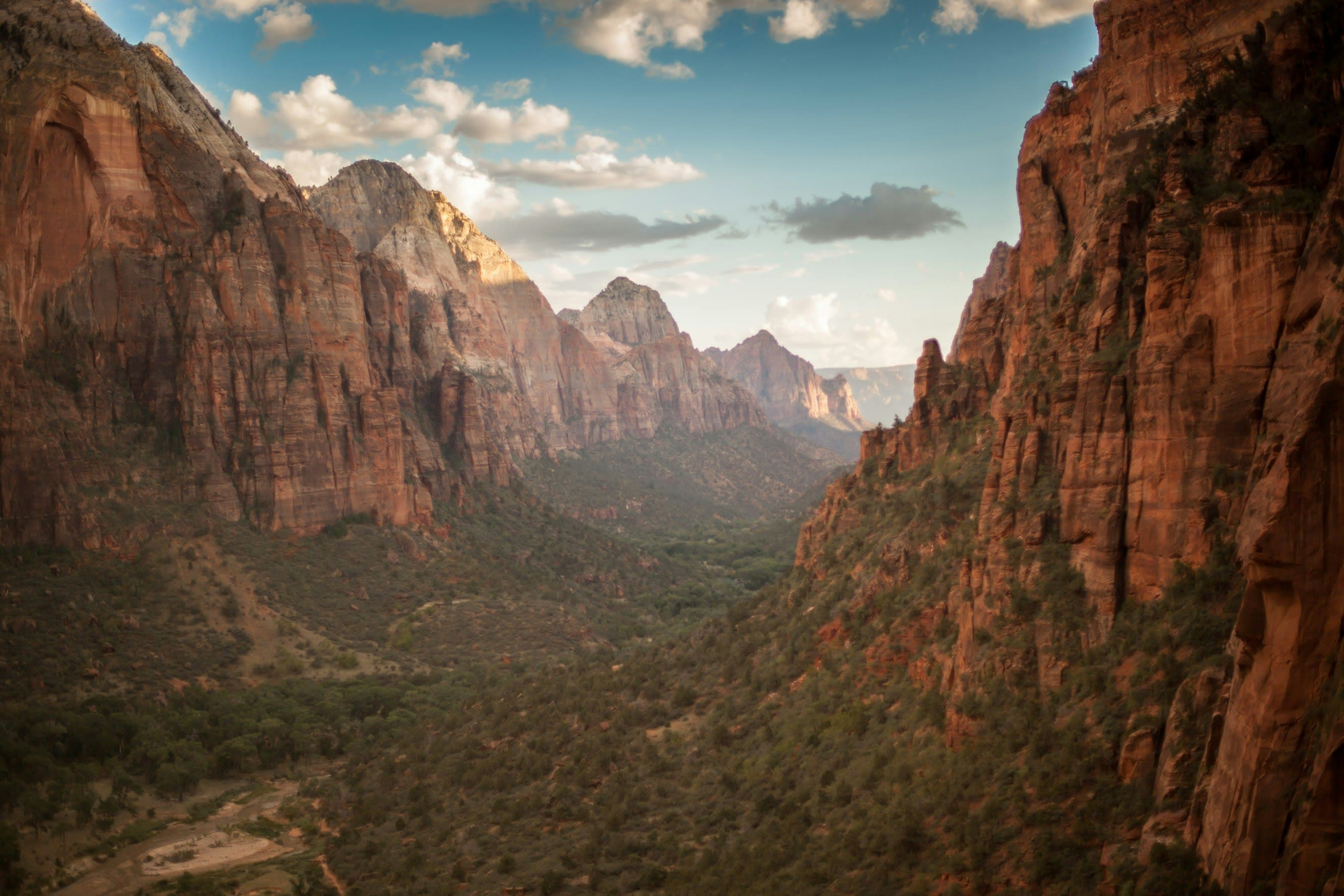
Zion National Park
Where towering sandstone cathedrals hold the prayers of millennia
Springdale, Utah, United States
At A Glance
- Coordinates
- 37.2982, -113.0263
- Suggested Duration
- A single day allows only surface encounter. Those passing through might see the Temple of Sinawava and walk partway into the Narrows before the shuttle schedule compels return. Two days permit one major hike and more contemplative engagement. Three days allow exploration of both Zion Canyon and the less-visited Kolob Canyons section. A week or more opens possibilities for backcountry permits and deeper rhythm. The canyon rewards those who stay.
- Access
- The park is open twenty-four hours daily, year-round, though some facilities observe seasonal hours. Primary access is through Springdale, Utah, via Utah Route 9. From mid-March through late October, private vehicles cannot drive the Zion Canyon Scenic Drive; a free shuttle system operates instead. Shuttles run from early morning until late evening, departing every few minutes during peak hours. The east entrance remains accessible by car year-round, offering dramatic views and access to different trails. The Kolob Canyons section in the northwest corner is accessible from Interstate 15 and sees far fewer visitors. Parking lots fill by eight or nine in the morning during peak season; arriving earlier or using the town shuttle from Springdale is essential.
Pilgrim Tips
- The park is open twenty-four hours daily, year-round, though some facilities observe seasonal hours. Primary access is through Springdale, Utah, via Utah Route 9. From mid-March through late October, private vehicles cannot drive the Zion Canyon Scenic Drive; a free shuttle system operates instead. Shuttles run from early morning until late evening, departing every few minutes during peak hours. The east entrance remains accessible by car year-round, offering dramatic views and access to different trails. The Kolob Canyons section in the northwest corner is accessible from Interstate 15 and sees far fewer visitors. Parking lots fill by eight or nine in the morning during peak season; arriving earlier or using the town shuttle from Springdale is essential.
- No religious dress code applies, but practical considerations shape appropriate attire. Sturdy footwear is essential for all but the shortest trails. Sun protection matters given the canyon's exposure and desert climate. For the Narrows and other water routes, appropriate wading footwear and quick-drying clothing make the difference between misery and immersion.
- Photography is permitted throughout most of the park. However, rock art and archaeological sites should not be photographed in ways that reveal their locations. The more fundamental question is whether photography serves or hinders your encounter with this landscape. Many visitors experience the canyon primarily through their screens, returning home with images but no memories of unmediated presence. Consider periods of intentional camera-free walking.
- The Southern Paiute have not opened their ceremonies to outsiders, and visitors should not attempt to simulate or appropriate indigenous practices. Interest in traditional spirituality is best expressed through respect for the land and support for indigenous cultural programs rather than mimicry. The canyon demands physical preparation. Heat, altitude, and strenuous trails have caused deaths. Spiritual seeking does not protect against flash floods, dehydration, or falls from exposed trails. Honor the landscape by preparing adequately for your chosen route. Rock art and archaeological sites exist throughout the park but are not advertised to prevent damage. If you encounter such sites, observe from a distance without touching. These are cultural patrimony, not tourist attractions.
Overview
For over eight centuries, the Southern Paiute have known these canyon walls as sacred homeland, a landscape alive with spiritual power they call Puha. Mormon settlers, overwhelmed by the vertical grandeur, named it after the biblical holy city. The same quality that moved both cultures persists today: something in these 3,000-foot cliffs and narrow corridors that makes the world feel thin, permeable, charged with presence.
Long before the name Zion was spoken here, this canyon held other names. Mukuntuweap. Ioogoon. Names that carry different meanings depending on who translates them, but all pointing toward the same recognition: this is not ordinary ground.
The Southern Paiute, who call themselves Nuwuvi, have walked these corridors for over eight hundred years. They understand the landscape as alive with Puha, a spiritual power that flows through places, objects, and beings. The canyon is not merely scenery but a living relative, home to deities and spirits whose names now mark the peaks and narrows: Sinawava, the Coyote god. Kinesava, the trickster who might roll rocks down the cliffs or help with your hunting, depending on his mood.
When Mormon settlers arrived in the 1860s, they encountered a landscape that seemed to confirm their deepest convictions about divine creation. The sheer walls rising nearly three thousand feet, the way light moves through the canyon at different hours, the overwhelming scale that makes human concerns feel small, they called it Zion, the biblical name for the holy city, a place of refuge and sanctuary.
The canyon holds both understandings without contradiction. Something here consistently moves those who enter it, whether they arrive with indigenous cosmology, Abrahamic faith, or no framework at all. Visitors speak of feeling watched, held, small in the best sense. The Paiute once said it was not a good place to be after dark. The quality they were naming has not left.
Context And Lineage
Human presence in Zion spans at least eight thousand years, from ancient Basketmaker cultures through Ancestral Puebloans to the Southern Paiute who remain connected to the land today. Mormon settlement brought the current name and transformed the region, while national park designation in 1919 opened the canyon to visitors worldwide.
The Nuwuvi recognize a specific location within their lands where they were created and given responsibility for the surrounding territory. At the time of creation, the landscape was inscribed with sacred places forming pilgrimage networks. The canyon was not discovered but inherited, already charged with meaning and power that required human stewardship to maintain.
Paiute stories describe a landscape filled with powerful beings. Sinawava, the Coyote god, gives his name to the Temple of Sinawava at the canyon's head. Kinesava, a trickster spirit, inhabits a prominent formation bearing his name. Wynopits, the god of evil, represents the dangers that required Paiute caution about remaining in the canyon after dark.
Mormon origin narratives focus on the encounter with landscape. Settlers arriving in the 1860s had traveled far seeking a place of refuge, the Zion prophesied in their scriptures. Whether the canyon matched their expectations or exceeded them, they saw in its grandeur confirmation of divine handiwork. The name Zion was not chosen lightly but represented recognition of something already present.
The Southern Paiute relationship with this land predates written history. Archaeological evidence places the Virgin Anasazi and Fremont cultures in the region from roughly 300 to 1300 CE, with Paiute presence following and continuing to the present. The land passed through Spanish, Mexican, and finally American administration, though the Paiute never ceded their spiritual connection. Mormon settlement beginning in the 1860s transformed the region economically and demographically. National park designation removed the land from exploitation while also limiting traditional indigenous access. The Paiute Indian Tribe of Utah now maintains formal collaboration with the National Park Service, a partial restoration of their role as stewards.
Isaac Behunin
Mormon settler credited with naming the canyon Zion around 1863, reportedly declaring he had found his Zion, his place of refuge and sanctuary
John Wesley Powell
Explorer who recorded the Paiute name Mukuntuweap during his 1872 expedition, though later research suggested the Paiute may have actually called the canyon Ioogoon
President William Howard Taft
Established Mukuntuweap National Monument in 1909, though the name was soon changed due to pronunciation difficulties
Sinawava
Coyote god in Southern Paiute tradition, a powerful deity associated with the canyon's spiritual landscape
Why This Place Is Sacred
Zion's thinness arises from the collision of overwhelming scale and intimate enclosure. Walls that took millions of years to form dwarf human time, while the narrow canyon floor creates a sense of being held, even cradled. Multiple traditions have independently recognized this quality, suggesting something beyond cultural projection.
The concept of a thin place, where the distance between the ordinary world and something else collapses, finds geological expression in Zion. Three thousand feet of vertical sandstone create an architecture that no human could design, cathedral walls that curve and narrow, opening into chambers of light before tightening again.
The Southern Paiute recognized this thinness through their understanding of Puha, the spiritual power concentrated in certain locations. Their creation stories speak of being given stewardship of these lands precisely because the power here required careful tending. The canyon was not empty space but a populated landscape, home to spirits who could help or harm depending on how humans conducted themselves.
Mormon settlers experienced the same quality through a different lens. The Great White Throne, a massive monolith of white Navajo sandstone, became in local legend the seat of God, a place from which the worthiness of those passing through the valley could be judged. This was not imposed mythology but organic response to what the landscape seemed to communicate.
Contemporary visitors, most arriving without knowledge of either tradition, report experiences that mirror the traditional accounts. A sense of being watched. Unusual emotional release. Clarity that arrives without being sought. The consistency across cultures and centuries suggests the canyon is not merely a screen for human projection but possesses some quality that resists full explanation.
Zion sits at the junction of three distinct ecological regions: the Colorado Plateau, the Great Basin, and the Mojave Desert. This convergence creates biological diversity, but also, perhaps, a kind of energetic meeting point. Whether this contributes to the felt thinness remains beyond scientific measurement. What can be measured is the consistency of human response across millennia.
For the Nuwuvi, the canyon was not created for a purpose but given to them as responsibility. They were designated at the time of creation as stewards of these lands, which were already inscribed with sacred sites networked like pearls on a string. The landscape was not backdrop for human activity but the primary reality within which human activity found meaning.
The canyon's role has shifted dramatically over the past two centuries. What was once homeland for the Southern Paiute, then agricultural territory for Mormon settlers, became a national monument in 1909 and a national park in 1919. This transformation brought millions of visitors but also severed the land from its traditional stewards. Recent decades have seen renewed collaboration between the Paiute Indian Tribe of Utah and park management, a partial restoration of indigenous voice in how this landscape is understood and cared for.
Traditions And Practice
Traditional Paiute practices centered on stewardship, ceremony, and pilgrimage along routes like the Salt Song Trail. Contemporary engagement ranges from indigenous cultural programs to contemplative hiking. Visitors cannot participate in Paiute ceremonies but can engage respectfully with the sacred landscape.
The Nuwuvi understood their relationship with this land as one of ongoing reciprocal obligation. Ceremonies were performed at power places to communicate with spiritual beings and maintain proper balance. The Salt Song Trail, a sacred route traveled during mourning rituals, passes through Zion as part of a larger pilgrimage network. During these ceremonies, the soul of the deceased travels the trail through song, enabling transition between worlds.
Men used certain locations for ceremonies seeking knowledge and power. These sites were chosen based on concentration of Puha and topographical features that concentrated spiritual energy. Caves throughout the region served as spaces for storytelling, ceremony, and encounters with the spirit world.
Harvest and seasonal rituals involved music performed with drums, flutes, and rattles crafted from animal bones. Dances showed reverence for Mother Earth and honored the natural spirits inhabiting the landscape. These practices were not separate from daily life but woven throughout the seasonal round of hunting, gathering, and travel that sustained the Paiute people.
The Paiute Indian Tribe of Utah maintains active cultural programs in collaboration with park management. The Kwanants Pi'yum youth camps, held in conjunction with the Zion Forever Project, teach Paiute language skills, cultural values, oral history, and customs to new generations. These programs represent ongoing effort to maintain connection with ancestral lands despite the displacement caused by park creation.
Trailblazing agreements between the tribe and nearby Springdale have opened new possibilities for cultural presence and interpretation. Traditional ecological knowledge is increasingly incorporated into park management discussions. While specific ceremonial practices remain private, the broader relationship between the Paiute people and this landscape continues to evolve.
Visitors seeking meaningful encounter with Zion's sacred dimensions might begin at the Zion Human History Museum, which provides context for indigenous heritage through exhibits and film. The museum grounds the visitor experience in something larger than personal recreation.
Contemplative walking serves as perhaps the most accessible practice. Choose a trail appropriate to your fitness and give yourself more time than efficiency requires. Pause frequently. Let attention move between the scale of the canyon walls and the intimacy of water-carved stone at your feet. Notice what arises when you stop hurrying.
Dawn and dusk offer particular richness for those seeking more than physical exertion. The light in the canyon transforms dramatically at these hours, and visitor density drops. Finding a place to sit and simply attend to the landscape, without agenda or expectation, opens the door to experiences that rushing through forecloses.
The Narrows, where the Virgin River fills the entire canyon floor, invites literal immersion in the landscape. Wading through water that carved these walls over millions of years creates embodied connection that photographs cannot capture.
Southern Paiute (Nuwuvi)
ActiveThe Nuwuvi have inhabited this region for over eight centuries, understanding the canyon as sacred homeland imbued with Puha, the spiritual power that connects all existence. They were given stewardship of these lands at the time of creation and continue that responsibility despite displacement. The landscape is home to deities and spirits including Sinawava, Kinesava, and Wynopits. Sacred sites form pilgrimage networks traveled ceremonially, including the Salt Song Trail that enables souls to transition between worlds.
Stewardship of sacred lands as spiritual responsibility inherited from creationCeremonies at power places to communicate with spiritual beingsSalt Song Trail pilgrimage during mourning ritualsHarvest and seasonal rituals with drums, flutes, and bone rattlesKwanants Pi'yum youth cultural camps preserving language and customs
Latter-day Saints (Mormon)
ActiveMormon pioneers arriving in the 1860s encountered a landscape that seemed to confirm their deepest convictions about divine creation. The name Zion, meaning place of refuge and the biblical name for Jerusalem, was not chosen casually but represented recognition of something already present. The Great White Throne became in local legend the seat of God. The canyon offered sanctuary where settlers could find peace and divine inspiration.
Pilgrimage and spiritual retreat to experience divine creationContemplation of natural beauty as encounter with God's handiwork
Nature Spirituality
ActiveMany contemporary visitors experience profound spiritual encounters with the landscape regardless of religious background. The towering sandstone, narrow canyons, and dramatic geological formations inspire awe and reflection that visitors describe using various vocabularies, from energy and vibration to presence and thinness.
Hiking as spiritual practice and moving meditationPhotography and artistic contemplation as form of attentionSitting meditation in natural settingsWilderness solitude and retreat
Experience And Perspectives
Visitors consistently report feeling simultaneously small and held, the canyon's overwhelming scale producing not intimidation but a kind of release. Many describe unexpected emotional responses, clarity of thought, and a sense that ordinary concerns have been placed in proper proportion.
The experience of entering Zion Canyon is first an experience of enclosure. The walls rise on either side, blocking the wider world, creating a corridor that channels attention inward. The Virgin River runs alongside or beneath the trail, its sound constant, the reminder of what carved this space over millions of years.
Then comes the opening. A turn in the canyon reveals new formations, new play of light on sandstone that shifts from red to white to pink depending on the hour. The scale reasserts itself. Humans become small, but the smallness feels appropriate, a return to proper proportion after lives spent in artificial environments that flatter human importance.
The most commonly reported experiences include a sudden quieting of mental chatter, as if the canyon's silence were contagious. Visitors describe clarity about decisions they have been avoiding, relationships that need attention, directions their lives need to take. This clarity often arrives unbidden, without meditation or intention, as if the landscape itself were thinking through those who walk it.
Physical challenge amplifies these effects. Those who hike the challenging trails, especially Angels Landing with its exposed final approach, report experiences that border on the mystical. The combination of exertion, exposure, and sensory immersion creates conditions where ordinary mental patterns break down. What rushes in to fill the gap varies by person, but the pattern is consistent enough to take seriously.
Evening and dawn carry particular charge. As shadows lengthen, the canyon takes on qualities that support the Paiute warning about remaining after dark. Not danger exactly, but a shift in atmosphere, a sense that different presences move through the space when human activity quiets. Those who camp or stay nearby often describe the night sounds of the canyon, the feeling of being held in something far larger than themselves.
Arrive without agenda. The canyon will organize your time more effectively than any itinerary. Begin at the Temple of Sinawava, where the canyon narrows and the shuttle ends, and walk as far as the Narrows trail as water conditions allow. Let the enclosure work on you before seeking the expansive views from higher trails. If seeking solitude, come at dawn or walk the less-traveled Kolob Canyons section. The canyon reveals different aspects of itself to different paces; rushing through guarantees missing what drew you here.
Zion has been understood through multiple frameworks, from indigenous cosmology to Mormon theology to contemporary nature spirituality. These perspectives need not compete. The consistency of human response across cultures suggests the canyon possesses qualities that exceed any single interpretation. What follows represents the major frameworks through which Zion has been and continues to be understood.
Archaeological evidence confirms human presence in the Zion area spanning at least eight thousand years. The earliest inhabitants left limited material culture, but by 300 CE, the Virgin Anasazi and Parowan Fremont cultures had established settlements. These populations departed around 1300 CE, likely due to drought conditions, followed by Southern Paiute peoples who remain connected to the land today.
The canyon's dramatic landscape results from geological processes spanning hundreds of millions of years. The Navajo sandstone that forms the iconic walls was deposited as sand dunes during the Jurassic period, later compressed into rock. The Virgin River, cutting through the uplifted Colorado Plateau over millions of years, carved the canyon to its present form. The process continues; the river deepens the canyon by roughly one foot per thousand years.
Scholarly consensus holds that the Southern Paiute occupied this region for at least eight centuries prior to European contact, developing sophisticated cultural, ecological, and spiritual relationships with the landscape. Their displacement by Mormon settlement and later park creation represents a familiar pattern of indigenous dispossession, currently being partially addressed through collaborative management agreements.
The Nuwuvi understanding of Zion cannot be separated from their broader cosmology. The land is not resource or backdrop but living being, imbued with Puha that connects all existence. At the time of creation, the Nuwuvi were given specific responsibility for these lands, a responsibility that colonization interrupted but did not terminate.
Sacred sites form pilgrimage networks across the landscape, networked like pearls on a string. The Salt Song Trail, traveled ceremonially during mourning rituals, passes through Zion as part of a larger sacred geography. The soul of the deceased travels this route through song, demonstrating how deeply the landscape is woven into Paiute understanding of life, death, and transition.
Specific deities and spirits inhabit the canyon. Their names now mark park features, though this naming should not be mistaken for mere mythology. For traditional practitioners, these beings are present realities requiring appropriate relationship. The Paiute caution about remaining in the canyon after dark reflects not superstition but recognition of powers that move through the landscape on their own schedule.
Mormon understanding frames the canyon as evidence of divine creation. The name Zion carries specific weight in Latter-day Saint theology: it refers to the pure in heart, to the New Jerusalem, to any place where the faithful gather. Applying this name to the canyon represented recognition that the landscape itself communicated divine reality.
Contemporary visitors sometimes describe Zion as an energy vortex or spiritual portal, language borrowed from New Age interpretations of Sedona and similar sites. These perspectives suggest the canyon concentrates or transmits energies that affect human consciousness, potentially explaining the consistent reports of unusual experiences.
Some frame Zion within earth-based spirituality, understanding the canyon as a manifestation of Gaia or Earth consciousness. From this perspective, the geological processes that created the canyon are not merely physical but expressions of planetary intelligence, and human response to the landscape represents communication across categories of being.
These interpretations are not endorsed by traditional Southern Paiute practitioners. However, they represent attempts to articulate experiences that exceed conventional explanation. The question of whether vortex language captures something real or imposes inappropriate frameworks remains open.
The exact meaning and origin of Mukuntuweap remains uncertain despite various translations offered. Straight canyon, straight river, place where the Great Spirit dwells, sacred cliffs: these translations may all be partially correct, partially projection. Naturalist A.M. Woodbury complicated matters by suggesting the Paiute actually called the canyon Ioogoon, meaning arrow quiver, raising questions about the accuracy of Powell's recorded name.
The reasons behind the Paiute belief that the canyon was not a good place after dark have not been fully explained. Whether this reflected dangerous wildlife, spiritual caution, or experiences that fell outside ordinary categories remains unknown.
Many ceremonial and sacred practices have not been disclosed to researchers. This is not a gap to be filled but a boundary to be respected. Traditional knowledge remains with traditional keepers for reasons that those keepers understand better than outsiders seeking comprehensive documentation.
Visit Planning
Zion is open year-round though seasonal access varies. Spring and fall offer optimal conditions; summer brings extreme heat and crowds. The mandatory shuttle system operates mid-March through late October. Angels Landing requires advance permits. Allow at least two days for meaningful engagement.
The park is open twenty-four hours daily, year-round, though some facilities observe seasonal hours. Primary access is through Springdale, Utah, via Utah Route 9. From mid-March through late October, private vehicles cannot drive the Zion Canyon Scenic Drive; a free shuttle system operates instead. Shuttles run from early morning until late evening, departing every few minutes during peak hours. The east entrance remains accessible by car year-round, offering dramatic views and access to different trails. The Kolob Canyons section in the northwest corner is accessible from Interstate 15 and sees far fewer visitors. Parking lots fill by eight or nine in the morning during peak season; arriving earlier or using the town shuttle from Springdale is essential.
Springdale, at the park's south entrance, offers lodging ranging from camping to luxury hotels. Watchman and South campgrounds provide the only in-park camping; reservations are essential during peak season. Staying in Springdale allows early morning access before day-trippers arrive. The town itself has transformed from agricultural settlement to tourist economy, though enough character remains to reward evening exploration. For deeper solitude, consider the Kolob area or nearby BLM lands where dispersed camping is permitted.
Zion remains sacred indigenous land though open to all visitors. Leave No Trace principles are mandatory. Archaeological sites and rock art should never be touched. Permits are required for Angels Landing. The Paiute request that visitors treat the land as living relative rather than recreational resource.
The etiquette for visiting Zion begins with recognition that this is not neutral ground. For the Southern Paiute, it remains ancestral homeland imbued with spiritual significance. For many contemporary visitors, it becomes a place of personal transformation. Both relationships impose obligations.
Leave No Trace principles are not suggestions but requirements, and in sacred context they become something more than environmental ethics. Leaving marks on rocks, carving trees, removing stones or plants, these acts are not merely illegal but represent fundamental misunderstanding of the relationship between visitor and place. You are a guest in someone's home.
The canyon's popularity creates tension between access and preservation. Over four million visitors annually walk trails that traditional stewards once traveled in small groups. This volume has consequences for the landscape and for the quality of experience. Consider timing your visit for shoulder seasons or early morning hours. Consider trails beyond the iconic few.
Archaeological sites and rock art require particular care. The location of most sites is not publicized precisely because publicity leads to damage. If you encounter rock art or structural remains, observe from a distance without touching or photographing in ways that reveal location. These sites connect to living cultures and deserve more than curiosity.
The Paiute understanding of this landscape as alive invites a different mode of presence than recreational hiking typically involves. Moving through the canyon as if it were merely obstacle course or photograph opportunity misses what brought you here. Attending to the landscape as one would attend to a conversation, with openness and reciprocity, honors both indigenous teaching and your own deeper intentions.
No religious dress code applies, but practical considerations shape appropriate attire. Sturdy footwear is essential for all but the shortest trails. Sun protection matters given the canyon's exposure and desert climate. For the Narrows and other water routes, appropriate wading footwear and quick-drying clothing make the difference between misery and immersion.
Photography is permitted throughout most of the park. However, rock art and archaeological sites should not be photographed in ways that reveal their locations. The more fundamental question is whether photography serves or hinders your encounter with this landscape. Many visitors experience the canyon primarily through their screens, returning home with images but no memories of unmediated presence. Consider periods of intentional camera-free walking.
Leaving offerings is a traditional Paiute practice but should not be attempted by visitors. The park requires that all items brought in be removed. More importantly, leaving objects at perceived power spots reflects misunderstanding of how reciprocity works in indigenous context. The appropriate offering is attention, care, and advocacy for the land and its traditional stewards.
{"Angels Landing hiking permit required year-round (lottery system)","Private vehicles prohibited on Zion Canyon Scenic Drive during peak season","Wilderness permit required for overnight backpacking","Leave No Trace principles mandatory, pack out all waste","Tree carving, rock etching, and spray painting are federal crimes","Drones prohibited throughout the park","Feeding wildlife prohibited","Collecting rocks, plants, or artifacts prohibited","Pets prohibited on most trails"}
Sacred Cluster
Nearby sacred places create the location cluster described in the growth plan. This block is intentionally crawlable and links into the wider regional graph.