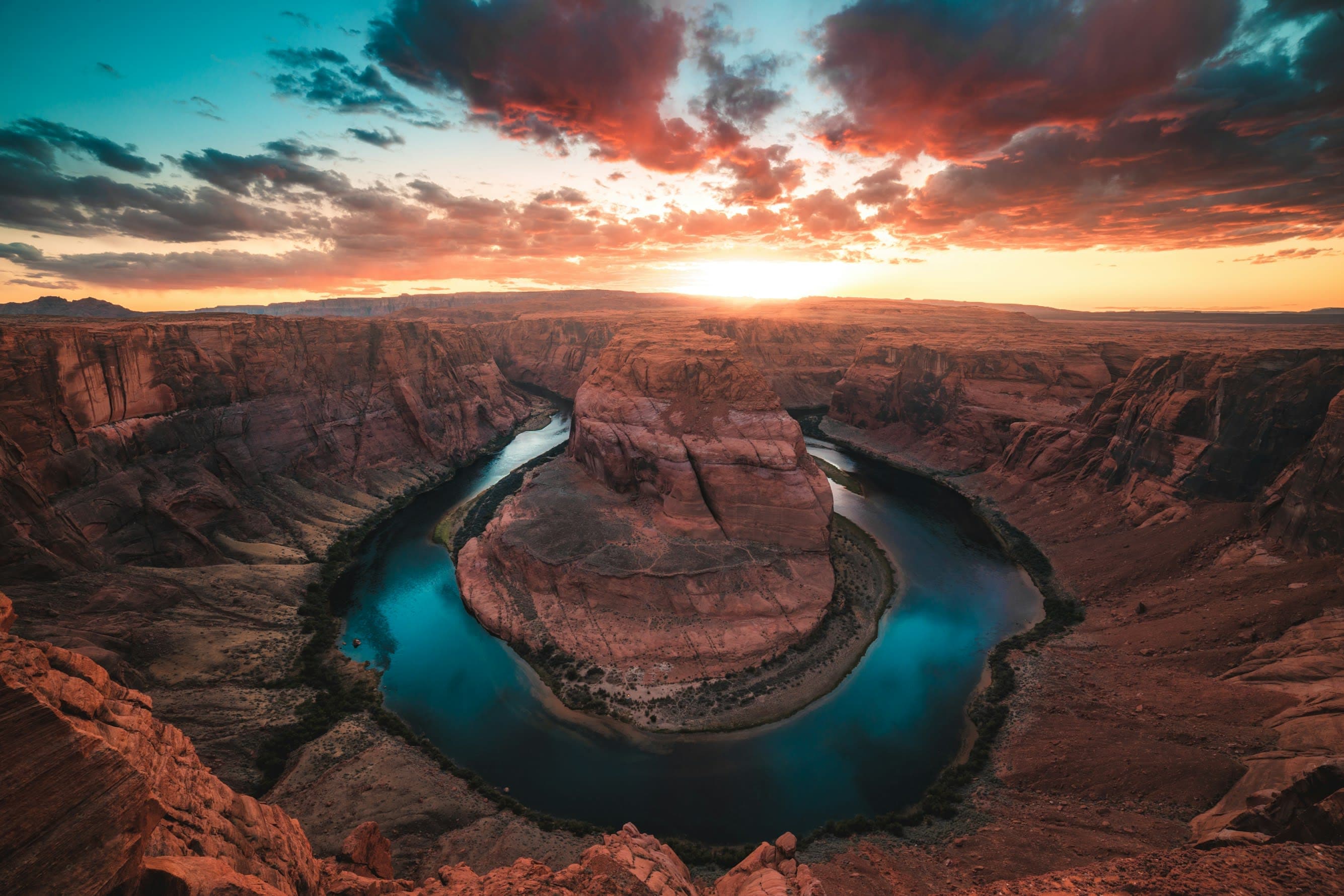
Horseshoe Bend
Where the Colorado River carved a temple from stone over six million years
Page, Arizona, United States
At A Glance
- Coordinates
- 36.8791, -111.5104
- Suggested Duration
- Allow one to two hours minimum: the walk to the overlook takes fifteen to twenty minutes each way, and the site itself warrants more than a quick photograph. Those seeking deeper engagement often spend an hour or more at the overlook, finding spots away from the main viewing area to sit in quiet.
- Access
- The turnoff from US-89 lies 0.2 miles south of mile marker 545, approximately four miles southwest of Page, Arizona. The parking lot includes restrooms and a shaded structure. From the lot, a paved and then sand trail leads 0.75 miles to the overlook. The elevation gain is minimal but the terrain is exposed and can be hot.
Pilgrim Tips
- The turnoff from US-89 lies 0.2 miles south of mile marker 545, approximately four miles southwest of Page, Arizona. The parking lot includes restrooms and a shaded structure. From the lot, a paved and then sand trail leads 0.75 miles to the overlook. The elevation gain is minimal but the terrain is exposed and can be hot.
- Hiking attire is appropriate. Sun protection is essential—there is no shade at the overlook. Closed-toe shoes with good grip provide safety on the sandy, sometimes slippery trail. Layers help with temperature variation between the exposed overlook and the parking area.
- Photography is permitted and popular—this is one of the most-photographed sites in Arizona. However, consider being present before being productive. See the site before you try to capture it. When photographing, remain conscious of your position relative to edges and to other visitors. Selfies taken while stepping backward toward a thousand-foot drop are a predictable kind of tragedy.
- The edges are unfenced and the drops are lethal. People have died here. Whatever spiritual practice you bring, let it include attention to your own body and its position relative to a thousand-foot fall. Do not disturb any petroglyphs or artifacts you may encounter in the surrounding area. These are protected by law and by basic respect for those who made them. Be wary of those who claim to offer 'Navajo ceremonies' or 'authentic rituals' at the site. Legitimate practitioners do not sell ceremonies to tourists at overlooks. If ceremony is important to your journey, seek it through proper channels, respecting the traditions from which it comes.
Overview
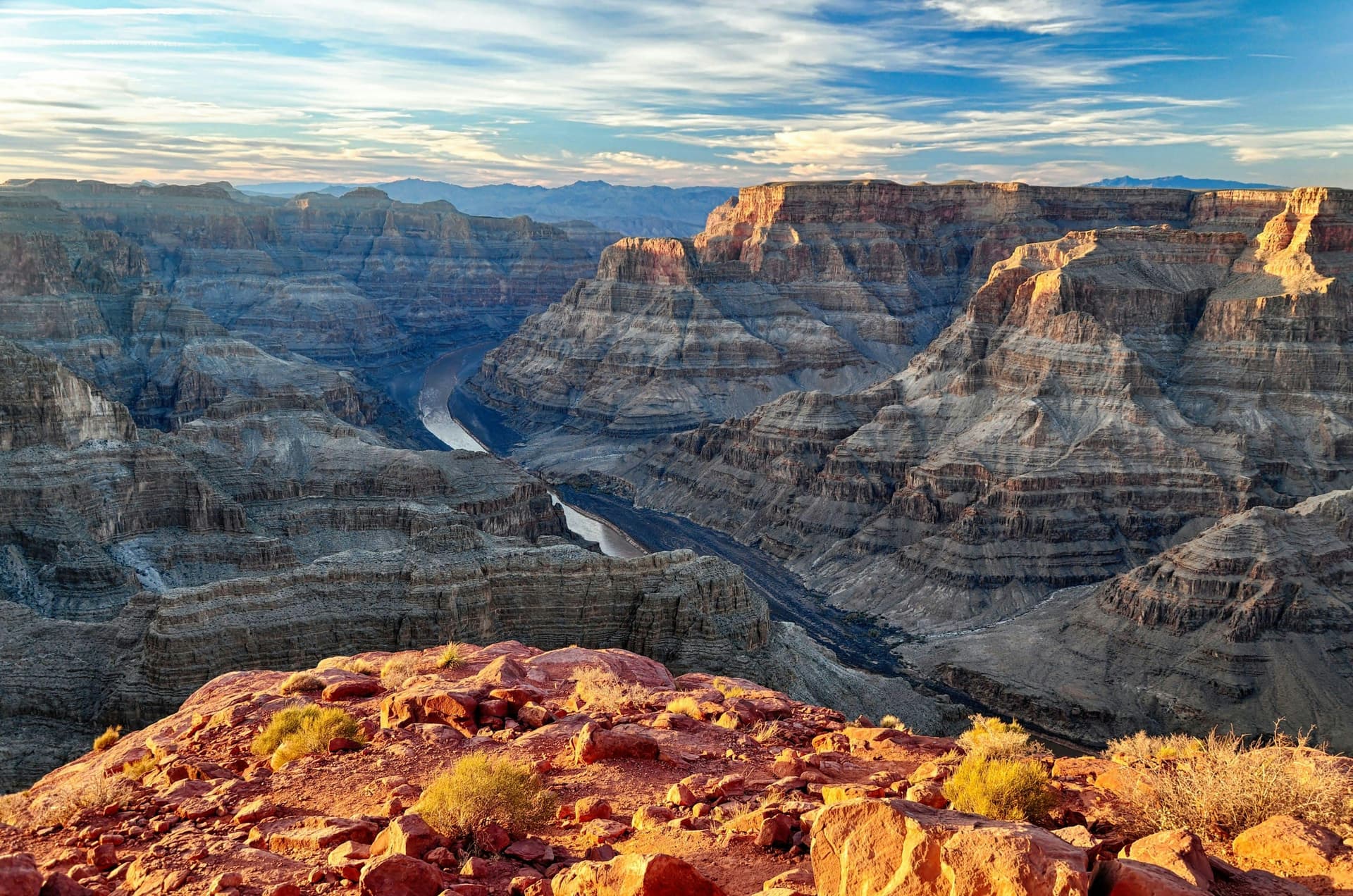
A thousand feet below the overlook, the Colorado River completes its patient arc through Navajo Sandstone, forming the near-perfect horseshoe that has drawn both indigenous peoples and modern seekers to this edge. For the Navajo and Hopi, this land holds ancestral significance, part of a sacred landscape where water and stone speak of forces older than human memory. Standing here, the scale of geological time becomes visceral.
Some places announce themselves through architecture or ritual. Horseshoe Bend announces itself through absence—the void carved by water over millions of years, a thousand feet of emptiness between where you stand and the emerald ribbon of river below.
The Colorado has been making this turn for longer than humans have existed. Six million years ago, the Colorado Plateau began to rise, and the river, trapped in its course, began cutting downward through soft sandstone. The result is not a view so much as a confrontation: with geological time, with the persistence of water against rock, with your own smallness against scales that dwarf human concerns.
For the Navajo and Hopi, whose ancestors walked this land for millennia, the site exists within a web of sacred geography. The Colorado River itself is holy in Navajo tradition. The land south of the overlook parking area lies on Navajo Nation territory. Ancient petroglyphs in the surrounding canyon country testify to long recognition that something here deserves attention.
Visitors of all backgrounds report something beyond scenic appreciation: vertigo that borders on the spiritual, a silence that feels inhabited, a sense of encounter with forces that proceed without reference to human timelines. You do not have to believe in anything in particular to feel it. The bend speaks for itself.
Context And Lineage
Horseshoe Bend exists at the intersection of geological and human time. The formation itself began when tectonic forces lifted the Colorado Plateau six million years ago, trapping the river in its course and initiating the slow excavation of canyon from sandstone. Human presence in the region extends back at least eight thousand years, with the Ancestral Puebloans, Paiute, Navajo, and Hopi all leaving traces of their relationship with this land.
The story begins not with humans but with stone and water. Six million years ago, the Colorado Plateau was near sea level, and the Colorado River meandered lazily across a flat plain. Then the earth began to rise. The plateau lifted—hundreds, eventually thousands of feet—and the river, unable to change its course, began cutting downward.
The stone it carved through tells its own ancient story. The Navajo Sandstone formed during the Jurassic period, nearly 200 million years ago, when this region was a vast desert of windblown dunes. The iron oxide that gives the rock its red and orange hues was already present, locked in the sand. When the river began its work, it exposed these layers to light—and to human eyes, when humans finally arrived.
The first people to see this bend left no written records. The Ancestral Puebloans, ancestors of today's Pueblo peoples, inhabited the region at least eight thousand years ago. Their petroglyphs remain scattered through the canyon country, images carved into the same rock the river was carving. The Paiute traveled through the area. Then came the Navajo, the Diné, who arrived in the Southwest some five hundred years ago and wove this landscape into their sacred geography.
The river's name itself—Colorado, Spanish for 'colored red'—gestures toward what centuries of travelers have noticed: the water runs the color of the stone it carries.
The human story at Horseshoe Bend traces through successive peoples who recognized this landscape as significant. The Ancestral Puebloans, also called Hisatsinom or historically Anasazi, used the canyon country as hunting grounds and travel routes, leaving petroglyphs that remain as testimony to their presence. The Paiute followed, then the Navajo and Hopi, each developing their own understanding of and relationship with the land.
The modern era brought different visitors. Surveyors, prospectors, and eventually dam builders transformed the river itself—Glen Canyon Dam, completed in 1963, altered the hydrology upstream—while the bend remained largely undiscovered by the outside world. Not until the late twentieth century did photographers begin seeking out this particular overlook, and not until social media amplified their images did Horseshoe Bend become a destination drawing millions.
Colorado River
natural feature
The river sacred in Navajo tradition that carved Horseshoe Bend over six million years. Its waters shaped not only the canyon but the relationship between the land and the peoples who came to know it.
Why This Place Is Sacred
Horseshoe Bend's power emerges from convergence: the sacred Colorado River, the dramatic geometry carved by water over epochs, the ancestral significance to Navajo and Hopi peoples, and the overwhelming scale that strips away ordinary mental frameworks. Standing at the edge, the usual categories—time, self, permanence—become suddenly negotiable.
The geometry alone is enough to disorient. The bend curves 270 degrees, creating an almost-island of sandstone that rises a thousand feet from the river's surface. The colors shift through the day—rust, amber, rose—as iron oxide in the Navajo Sandstone catches changing light. The river below appears still from this height, though it moves constantly, continuing the work it began when this region was near sea level.
In Navajo understanding, the land is not backdrop but relative. The Colorado River—Tó Bits'oosí, the river that cuts through rock—carries spiritual significance that extends beyond its utility for irrigation or navigation. To stand where water has demonstrated such patient power over stone is to stand in the presence of something the tradition already names as sacred.
The Hopi, too, hold this landscape in their cosmological geography. The canyon country of northern Arizona features in stories and ceremonies that connect living people to ancestors and to the land itself. The specific ceremonies and names remain protected—not from secrecy but from the appropriation that often follows disclosure. What is known: this place mattered long before visitors began arriving with cameras.
Contemporary visitors often struggle to articulate what they experience here. Words like 'vertigo' and 'awe' recur, but they point toward something less nameable—a sense that the ordinary filters of perception have momentarily lifted. The scale defeats comprehension. The silence, despite the crowds, has a quality of depth. Time, usually experienced as a sequence of moments, suddenly presents itself as a vast process in which human lifespans barely register.
Whether this experience reflects the site's geological drama, the accumulated recognition of countless predecessors, or something inherent in places where water and stone meet, the effect is consistent enough to take seriously.
The Colorado River did not intend to create a sacred site. Water follows gravity; rock yields to erosion. Yet the result of six million years of this simple process is a formation that compels spiritual response. For indigenous peoples of the region, the area served as hunting grounds, travel routes, and ceremonial space. The Ancestral Puebloans and Paiute camped along the shoreline deltas, leaving petroglyphs that remain as testimony to their presence. The Navajo and Hopi who followed incorporated the river and its canyons into living traditions of reciprocity with the land.
For most of its existence, Horseshoe Bend was known only to those who lived nearby or traveled the river. The Ancestral Puebloans used the area over eight thousand years ago. The Navajo arrived centuries later, incorporating the landscape into their sacred geography.
The modern tourist phenomenon is remarkably recent. Through the mid-20th century, the site remained largely inaccessible. The completion of Glen Canyon Dam in 1963 transformed the hydrology upstream, creating Lake Powell, but the bend itself stayed quiet. Only in the 1990s did photographers begin discovering the view, and only in the 2010s did social media transform it into one of Arizona's most-visited destinations.
Today, over two million people visit annually. The city of Page began charging parking fees in 2019 to manage the impact. The trails have been hardened, the overlook platforms built. What was once a remote canyon view is now a pilgrimage destination of a new kind—secular, image-driven, yet still producing genuine experiences of awe in those who arrive open to more than photographs.
Traditions And Practice
No formal ceremonies take place at Horseshoe Bend's public overlook—it is a natural landmark within the Glen Canyon National Recreation Area, not a designated sacred site. However, the landscape invites contemplative practice, and visitors seeking more than photographs often find ways to engage meaningfully.
The Navajo and Hopi have used the broader region for ceremonies and gatherings for centuries. Specific practices at Horseshoe Bend itself are not publicly documented, in keeping with the appropriate protection of sacred privacy. The site served as a navigation marker for indigenous travelers moving through the canyon country. The Colorado River held ceremonial significance extending far beyond this particular bend.
Ancient petroglyphs in the surrounding area testify to practices we can no longer fully reconstruct—images carved into rock by people whose relationship with this landscape we can only glimpse through the marks they left behind.
The site's formal status as a recreational area rather than sacred site means no organized spiritual practice occurs at the overlook. However, the experience of standing at the edge, confronting the scale of geological time and the persistence of natural forces, constitutes its own form of practice for many visitors.
Navajo guides occasionally offer tours that include cultural interpretation, providing context for understanding the landscape through indigenous perspectives. These encounters, when available, offer a bridge between secular tourism and something deeper.
For those arriving from contemplative traditions—Buddhism, Quakerism, various meditation practices—the site offers a ready-made object for attention. The bend itself becomes a kind of mandala: a form that holds the gaze, organizes perception, and opens onto something vaster than the form itself.
If you come seeking more than a photograph, consider these invitations.
Find a place at the overlook where you can sit—away from the crowds if possible, though the main viewpoint may be unavoidable. Let your gaze rest on the curve of the river. Do not try to comprehend the scale; simply let it register.
Notice the silence beneath the sound of other visitors. Even at crowded times, something in the quality of space here creates pockets of quiet. Let your attention follow that silence.
If you are aware that you stand on land sacred to the Navajo and Hopi, let that awareness shape your presence. You are not the first to recognize that something here exceeds the ordinary. You can choose to be a visitor who honors that lineage.
Before leaving, pause. The tendency is to photograph and depart, to move on to the next destination. But the site has given something. Acknowledgment costs nothing.
Navajo (Diné)
ActiveFor the Navajo, whose ancestral territory includes the lands surrounding Horseshoe Bend, the landscape exists within a living relationship of reciprocity. The Colorado River itself carries spiritual significance; the canyon country constitutes a sacred geography that connects present-day Diné to their ancestors and to the land itself. The Navajo Nation boundary lies immediately south of the site's parking area, marking the continuation of indigenous presence on this land.
Specific ceremonial practices at Horseshoe Bend are not publicly documented, in keeping with appropriate protection of sacred knowledge. The site served historically as a navigation marker for travelers moving through the canyon country. Navajo understanding emphasizes relationship with the land rather than extraction from it—a perspective that shapes how one should approach any site within their ancestral territory.
Hopi
ActiveThe Hopi also hold the canyon country of northern Arizona within their sacred geography. The traditions and stories connecting them to this landscape are not publicly shared, but the region's significance is attested by scholars and by the continued presence of Hopi people in the broader Four Corners area.
Practices specific to Horseshoe Bend are not publicly documented. The Hopi maintain ceremonies and pilgrimages throughout their ancestral territory, of which this landscape forms a part.
Ancestral Puebloan (Anasazi) and Paiute
HistoricalThe Colorado River Basin has been inhabited for at least eight thousand years. The Ancestral Puebloans—also called Hisatsinom by their Hopi descendants—used the area as hunting grounds, camping sites, and travel routes. Their petroglyphs remain scattered through the surrounding canyon country, images whose full meaning we cannot recover but whose presence testifies to long recognition that this land deserved marking.
Historical practices included hunting, camping along shoreline deltas, and the creation of petroglyphs. The specific ceremonies or beliefs connected to this particular bend, if any were distinct to the site, are not recorded.
Experience And Perspectives
Visitors to Horseshoe Bend consistently report experiences that exceed typical scenic tourism: vertigo at the scale, unexpected emotional intensity, a sense of geological time becoming tangible. The unfenced edges, the thousand-foot drop, the patient curve of the river—together they produce something visitors struggle to name but reliably describe.
The walk from the parking area takes fifteen to twenty minutes—enough time for anticipation to build, not enough to prepare for what appears at the overlook. The trail crests a small rise, and then the earth simply opens.
Vertigo is the first response for many. The edges are unfenced in most areas, and the sandstone drops away without warning or barrier. Some visitors cannot approach closer than twenty feet from the rim. Others sit at the edge, legs dangling into the void, apparently unbothered. The body knows something the mind cannot calculate—just how far a thousand feet extends.
Once the vertigo settles, something else emerges. The scale defeats the usual strategies of comprehension. You cannot compare this to anything. You cannot hold it in a single glance. The eyes return again and again to the river, which seems motionless from this height but carries the force that carved everything you see.
Visitors frequently report unexpected emotion—a tightness in the chest, sometimes tears without apparent cause. Some describe it as confronting their own mortality; others as glimpsing eternity. The language varies, but the phenomenon is consistent enough to constitute a pattern rather than an anomaly.
The best times are sunrise and sunset, when the sandstone ignites with color and the shadows deepen the canyon's geometry. At these hours, the crowds thin slightly, and something closer to solitude becomes possible. Those who arrive early often describe the experience as meditative—a word that might seem out of place at a tourist destination but fits the quality of attention the site demands.
Horseshoe Bend does not require belief or preparation—only presence. But those seeking something beyond a photograph might approach it differently.
Arrive early or stay late. The midday crowds, the selfie sticks, the performative poses for social media—all of this dissipates somewhat at the edges of the day. Dawn and dusk also bring the light that transforms the stone from scenic backdrop to something more alive.
Approach the edge at your own pace. There is no shame in stopping twenty feet back if that is where your body tells you to stop. The view is still immense. Some visitors find that sitting down lowers their center of gravity enough to calm the vertigo; others prefer to stand.
Consider leaving the camera in your pocket for the first ten minutes. The site will still be there after you have actually seen it. Let your eyes trace the curve of the river, the layers of sandstone, the impossible depth. Let the scale register before you try to capture it.
If you are aware of the site's significance to the Navajo and Hopi, let that knowledge inform your presence. You are standing on land that has been recognized as sacred for millennia. How you carry yourself here is a choice.
Horseshoe Bend invites multiple frameworks for understanding, from geological science to indigenous cosmology to the immediate visceral experience of standing at the edge. These perspectives need not compete; the site is large enough to hold contradiction and ambiguity. Honest engagement means holding them together without forcing false resolution.
Geologists understand Horseshoe Bend as a classic entrenched meander—a formation that occurs when a river, previously meandering across a flat floodplain, becomes trapped in its course by tectonic uplift and cuts downward rather than shifting laterally. The Colorado Plateau's rise, beginning around six million years ago, initiated this process; the soft Navajo Sandstone made the river's work relatively swift in geological terms.
The formation provides a textbook example of the power of erosion over time. The river drops approximately eight feet per mile through this reach, carrying sediment that acts as a cutting tool against the rock. The reddish colors of the sandstone derive from iron oxide deposited in ancient sand dunes during the Jurassic period, nearly 200 million years ago.
Archaeologically, the region shows human presence extending back at least eight thousand years, with the Ancestral Puebloans leaving petroglyphs and other artifacts throughout the canyon country.
For the Navajo, the land is not separate from those who live upon it. Relationships of reciprocity connect human beings with mountains, rivers, plants, and all aspects of the living world. The Colorado River holds significance within this web of relationship; the canyon country constitutes ancestral territory whose meanings extend beyond what outsiders can readily access.
The Hopi, too, hold this landscape within their sacred geography, though the specific nature of that relationship is not mine to articulate. What matters for visitors is the recognition that long before this became a tourist destination, it was a place where people understood themselves as embedded in larger patterns of meaning and responsibility.
This perspective does not conflict with geological explanation; it sits alongside it, adding dimensions that science does not measure. For those who hold this view, the land's power is not metaphor but relationship.
Many contemporary visitors describe Horseshoe Bend in terms of 'energy' or 'vortex'—language borrowed from metaphysical traditions that map the Earth's surface as a network of power points. Sedona, 130 miles to the south, has popularized such frameworks, and some seekers extend them to the broader canyon country.
These interpretations lack scientific validation. However, they often emerge from genuine experiences—the vertigo, the unexpected emotion, the sense of encounter that visitors consistently report. The language of energy and vortex may be an attempt to describe something real that resists conventional vocabulary. Taking the experience seriously does not require accepting the explanatory framework.
Genuine mysteries remain, particularly regarding the full scope of indigenous understanding and practice at this specific site. Traditional Navajo and Hopi names for the bend, if they exist, are not publicly documented. The ceremonies and stories connected to this landscape remain appropriately protected from outsider access.
The experience visitors report—the vertigo that exceeds physical explanation, the emotion that arrives without obvious cause—also resists easy categorization. Whether this reflects the site's geological drama, the psychological impact of scale, or something in the land itself that accumulated recognition has amplified, remains open to interpretation. Perhaps multiple explanations are true simultaneously.
Visit Planning
Horseshoe Bend is located approximately four miles southwest of Page, Arizona, within the Glen Canyon National Recreation Area. The site requires a ten-dollar parking fee and a 1.5-mile round-trip hike to the overlook. Sunrise and sunset offer the best light for photography and somewhat fewer crowds.
The turnoff from US-89 lies 0.2 miles south of mile marker 545, approximately four miles southwest of Page, Arizona. The parking lot includes restrooms and a shaded structure. From the lot, a paved and then sand trail leads 0.75 miles to the overlook. The elevation gain is minimal but the terrain is exposed and can be hot.
Page, Arizona, four miles from the site, offers lodging at various price points. The town serves as a hub for visitors to the Glen Canyon area, including Lake Powell and Antelope Canyon. Camping is available within the Glen Canyon National Recreation Area for those seeking to remain closer to the land.
Horseshoe Bend requires practical caution at the unfenced edges and cultural respect for a landscape sacred to indigenous peoples. Stay aware of your surroundings, remain on designated paths, and approach the site as more than a photo opportunity.
The most immediate etiquette is survival: pay attention to where you stand. The sandstone edges are not fenced, and the drop is absolute. Wind gusts occur. Loose rock exists. No photograph is worth a fall. Children and pets require vigilant supervision.
Beyond physical safety, consider what kind of presence you bring to a place with deep cultural significance. The Navajo Nation boundary lies just south of the parking area. The broader landscape holds meaning for peoples who have lived here for centuries. Your visit can honor that meaning or ignore it; the choice shapes the person you become.
Stay on designated trails. The desert ecosystem is fragile, and foot traffic damages the cryptobiotic soil crust—the biological layer that prevents erosion and supports plant life. What looks like bare sand may be a living system that takes decades to recover from trampling.
Mindfulness about noise and behavior serves both the site and fellow visitors. Many people come here seeking something beyond entertainment. Loud conversation, music, and performative behavior diminish the experience for those seeking contemplation.
Hiking attire is appropriate. Sun protection is essential—there is no shade at the overlook. Closed-toe shoes with good grip provide safety on the sandy, sometimes slippery trail. Layers help with temperature variation between the exposed overlook and the parking area.
Photography is permitted and popular—this is one of the most-photographed sites in Arizona. However, consider being present before being productive. See the site before you try to capture it. When photographing, remain conscious of your position relative to edges and to other visitors. Selfies taken while stepping backward toward a thousand-foot drop are a predictable kind of tragedy.
Physical offerings are not traditional at this site for visitors and would constitute litter in a national recreation area. If you wish to offer something, make it internal: acknowledgment, gratitude, or simple attention. The land does not require your gifts; it requires your respect.
The site is open year-round. Parking costs ten dollars per vehicle or five dollars per motorcycle. The trail is 1.5 miles round trip. The overlook is not wheelchair accessible, though the parking area includes accessible restrooms. Pets are permitted but must be leashed and supervised near edges.
Sacred Cluster
Nearby sacred places create the location cluster described in the growth plan. This block is intentionally crawlable and links into the wider regional graph.