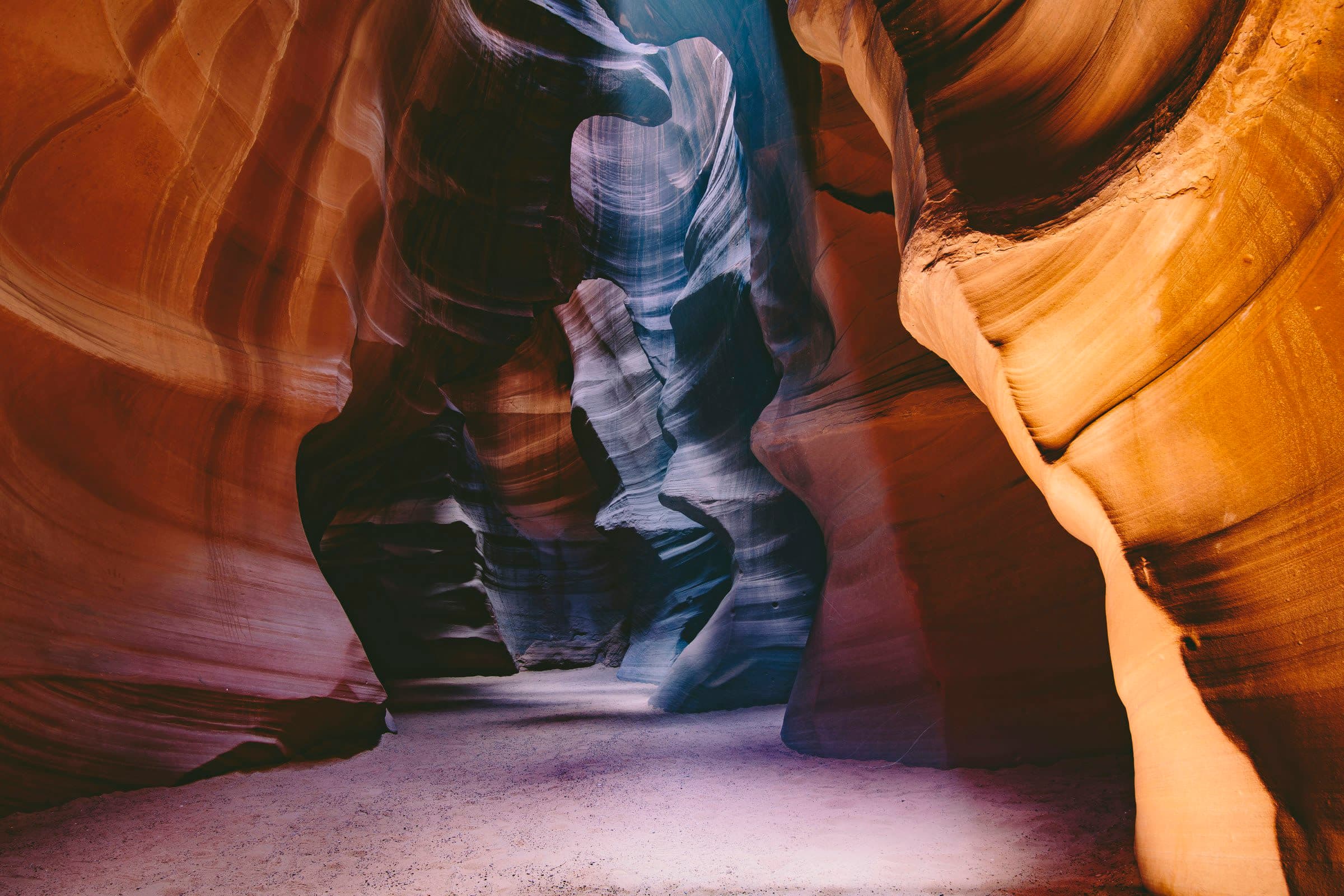
Antelope Canyon
Where water and time carved a cathedral, and the Navajo still hear the Holy People speak
Page, Arizona, United States
At A Glance
- Coordinates
- 36.8619, -111.4216
- Suggested Duration
- Upper Antelope Canyon tours run approximately 1 to 1.5 hours. Lower Antelope Canyon tours take approximately 1 to 1.25 hours. The experience is condensed but intense; do not expect to linger. If you seek extended time, consider booking multiple tours on different days or at different times of day.
- Access
- Antelope Canyon is located east of Lechee, Arizona, on Navajo Nation land near the town of Page. Access is exclusively through authorized Navajo tour operators; no self-guided visits are possible. Book well in advance, especially for midday tours during peak season. Arrive 45 minutes before your tour time for check-in. The Navajo Tribal Park fee for 2026 is $15 per person for ages 8 and older, separate from tour operator fees. Upper Antelope Canyon involves an easy, flat walk of about 100 yards and is accessible for most fitness levels. Lower Antelope Canyon is more challenging, requiring descent and ascent via ladders through approximately 600 yards of passage with some boulders to navigate.
Pilgrim Tips
- Antelope Canyon is located east of Lechee, Arizona, on Navajo Nation land near the town of Page. Access is exclusively through authorized Navajo tour operators; no self-guided visits are possible. Book well in advance, especially for midday tours during peak season. Arrive 45 minutes before your tour time for check-in. The Navajo Tribal Park fee for 2026 is $15 per person for ages 8 and older, separate from tour operator fees. Upper Antelope Canyon involves an easy, flat walk of about 100 yards and is accessible for most fitness levels. Lower Antelope Canyon is more challenging, requiring descent and ascent via ladders through approximately 600 yards of passage with some boulders to navigate.
- Closed-toe, sturdy shoes are required. The canyon floor includes sand, uneven surfaces, and in Lower Antelope Canyon, ladders and stepped passages. Sandals and open-toed shoes are not permitted. Layers accommodate temperature variations—the canyon is cooler than the desert above. A hat or handkerchief helps manage sand that occasionally falls from above. Sunscreen is advisable for the desert portions of the experience.
- Handheld cameras and smartphones are permitted. Tripods, monopods, selfie sticks, and drones are not allowed. Dedicated photography tours have been discontinued. Guides pause at key chambers for approximately two minutes—enough time for careful shots but not extended setups. Step aside quickly after capturing your images; the narrow passages mean others wait behind you. Do not throw sand or dust into light beams. This once-common practice has been prohibited due to damage to stone surfaces and respiratory harm to subsequent visitors. Do not photograph guides in traditional attire without asking permission. Do not record songs or prayers.
- Do not attempt to perform rituals within the canyon. The Navajo maintain authority over ceremonial practice on their land; visitors improvising their own ceremonies violate this authority regardless of intention. Do not throw sand or dust into light beams for photographs. This practice, once common, damages both the stone surfaces and the lungs of those who follow. Guides will stop visitors who attempt it. Do not scatter cremated ashes within the canyon. This prohibition is explicit and reflects both Navajo spiritual understanding and practical site management. Do not record private songs or prayers. If a guide sings, they are offering something; receiving it does not include capturing it. Ask permission before photographing guides in traditional attire. Do not remove anything from the canyon—not sand, not stone, not anything. The land is not yours to take from.
Overview
Deep within Navajo land, narrow sandstone passages open into chambers of flowing stone and cascading light. The Navajo call this place Tse bighanilini, where water runs through rocks, and understand it as a meeting point between physical and spiritual worlds. Visitors descend into darkness and emerge changed, having walked through what many describe as Earth itself made visible.
Light falls differently here. It does not simply illuminate; it becomes substance, a tangible presence descending through narrow openings to strike stone that has been carved, over millennia, into something that resembles frozen water. Or perhaps breathing stone. The language fails because Antelope Canyon exists at the edge of what words can hold.
The Navajo have known this place for generations. They call it Tse bighanilini—the place where water runs through rocks—and understand it as sacred ground where the physical and mystical worlds intersect. According to their teaching, the Holy People shaped these walls, and their presence remains. This is not metaphor. When Navajo guides lead visitors through the passages, they are conducting them through territory that holds living significance, not merely geological interest.
What the monsoon floods carved into Navajo Sandstone over millions of years, light completes each day. Between late morning and early afternoon, when the sun aligns with the canyon's narrow openings, shafts of illumination pierce the darkness—what some call God beams, others a kiss from Father Sky. The effect is not subtle. Visitors stop mid-step, silenced by something that registers before thought can name it.
You do not have to share the Navajo cosmology to feel what they describe. The canyon teaches its own lessons about time and transformation, about the patient work of water, about what emerges when light meets the record of ancient seas. Those who enter with attention often leave speaking of cathedrals and temples, reaching for sacred vocabulary even when they did not bring it with them.
Context And Lineage
Antelope Canyon formed over millions of years as flash floods carved through Navajo Sandstone—rock that itself began as sand dunes during the Jurassic period. The Navajo have understood it as sacred territory for generations. In recent decades, it has become both globally famous and more carefully protected, managed as a Navajo Tribal Park where all visits require Navajo guides who share cultural knowledge alongside geological information.
The Navajo tell of a young girl herding sheep who followed an antelope into what appeared to be solid rock, only to discover a hidden passage opening into chambers of extraordinary beauty. She understood immediately that she had found something sacred—a gift from the gods, a place blessed by nature. She returned to tell her family, and knowledge of the canyon passed through generations.
Another tradition places the discovery earlier, in 1864, during the Long Walk—the forced relocation of the Navajo by the U.S. military. A group of Navajo fleeing this tragedy found refuge in the canyon's hidden passages, their survival owing something to a place that had been waiting for them.
Both stories speak truth that geology cannot measure: the canyon as refuge, as gift, as territory that reveals itself to those who need it.
The Navajo understanding goes deeper than discovery. According to their teaching, the Holy People shaped these walls. The formations, the passages, the way light enters—these are not merely results of erosion but spiritual manifestations. Tse Yalti and Tse Naajiin, Holy People of specific character, are believed to reside within. To enter Antelope Canyon is to enter their home.
The Navajo have been stewards of this land for centuries, understanding Antelope Canyon within a larger sacred geography that includes the four sacred mountains marking the boundaries of their homeland. When tourism began in the 1980s, it was Navajo families who operated the first tours, and it remains Navajo guides who lead every visitor through the passages today.
The 1997 flash flood that killed eleven tourists led to the establishment of formal Tribal Park status and mandatory guide requirements. What might have been tragedy alone became also transformation—the institutionalization of Navajo authority over their sacred site, the installation of safety systems, and the creation of a framework that ensures every visitor encounters the canyon through Navajo interpretation.
Today, Antelope Canyon draws seekers the Navajo ancestors could not have imagined: photographers from every continent, spiritual tourists speaking of energy and vortexes, travelers checking items off bucket lists. The Navajo guides hold all of this, sharing what they choose to share, maintaining what must remain private, conducting millions through territory that remains, despite its fame, fundamentally theirs.
The Holy People
deity
Supernatural beings who, according to Navajo tradition, shaped Antelope Canyon and whose presence remains within it. They created the unique rock formations, narrow passageways, and light beams as spiritual manifestations, not merely geological features.
Tse Yalti and Tse Naajiin
deity
Specific Holy People believed to reside within Antelope Canyon. Their presence is part of why the site holds living significance rather than merely historical or geological interest.
Father Sky
deity
The light beams that enter the canyon are understood as gifts from Father Sky, maintaining the natural balance and connecting the canyon to the larger Navajo cosmology of sacred elements.
Why This Place Is Sacred
Antelope Canyon's sacredness emerges from the convergence of elements the Navajo hold sacred: water that carved the passage, earth that holds its form, and light from Father Sky that completes the space each day. The Navajo understand the Holy People as present here, and the canyon's immersive quality—narrow passages opening to soaring chambers of flowing stone—creates an environment that consistently produces threshold experiences across cultures and belief systems.
The Navajo did not need to build temples here. The land itself accomplished what other cultures construct in stone and ritual. Water, over millions of years, did the work of architect and sculptor, carving passages through sandstone that once lay at the bottom of ancient seas. What remains is a space that functions like a sanctuary without human intervention—narrow enough to require single-file passage, tall enough to inspire awe, shaped in flowing curves that seem organic rather than geological.
In Navajo understanding, three sacred elements converge at Antelope Canyon. Water, the sculptor, represents spiritual renewal and the flow of life. Earth, the Navajo Sandstone formed from ancient dunes, holds the record of deep time. And light—Father Sky's gift—enters through openings above to animate the space, creating the beams that visitors describe in terms usually reserved for religious experience.
The Holy People, Diyin Dine'e, are understood to have shaped this place. Two in particular—Tse Yalti and Tse Naajiin—are believed to reside within the canyon. This is why Navajo tradition asks visitors to pause at the entrance, to collect themselves and prepare their spirits before entering. The threshold matters. What lies beyond is not merely different geography but different territory altogether.
Contemporary visitors, most arriving without knowledge of Navajo cosmology, consistently report experiences that mirror the traditional understanding. The narrow passages create a natural progression from ordinary space into something set apart. The light beams produce what many describe as transcendent moments. The swirling patterns in the stone—visual records of water's patient work—invite contemplation of time scales that dwarf human concerns. Whether this reflects the accumulated weight of Navajo recognition, the psychological impact of the environment, or something the land itself holds, the effect is consistent enough to take seriously.
According to Navajo tradition, Antelope Canyon serves as a meeting point between worlds—a place where the boundary between physical and spiritual reality becomes permeable. The Holy People created it as a way of connecting with nature and the spirit world. The canyon is also understood as home to the wildlife spirits of Navajo ancestors, a place where the sacred geography of Navajo homeland finds particular concentration.
For generations, Antelope Canyon was known only to the Navajo and perhaps neighboring peoples. Two origin stories exist: one places its discovery in 1864, when Navajo fleeing the tragic Long Walk found refuge in its passages; another tells of a young Navajo girl who stumbled upon the hidden entrance in 1931 while herding sheep, following an antelope to discover what lay within. Both stories speak to the canyon's quality of revelation—something hidden that opens to those who approach rightly.
In 1983, the Pearl Begay family began operating the first tours. In 1997, after a flash flood tragedy claimed eleven lives, the site became an official Navajo Tribal Park with mandatory guide requirements. Today, over a million visitors annually descend into its passages. The meanings have multiplied—photography destination, geological wonder, spiritual pilgrimage—but the Navajo maintain authority over access, ensuring their understanding remains central to the experience.
Traditions And Practice
Antelope Canyon remains under Navajo spiritual authority, and traditional protocols shape how visitors engage with the space. While formal ceremony does not occur during public tours, the practice of pausing to prepare one's spirit before entering, listening to Navajo guides' teachings, and maintaining reverent silence during light beam moments constitute meaningful engagement with the site's sacred character.
According to Navajo tradition, proper approach to the canyon begins before entering. One pauses at the threshold to collect oneself, to prepare mind and spirit for what lies ahead. This is not mere ritual but recognition that what follows is different territory—that crossing from ordinary desert into the canyon's passages means entering the home of Holy People.
The Navajo understand themselves in reciprocal relationship with the land. To enter sacred space is to participate in that relationship, to acknowledge the presence of powers that the visitor may or may not recognize but that are present regardless. Traditional storytelling passes knowledge of the canyon through generations, interpreting formations as symbols that teach lessons about life and nature.
Navajo guides sometimes sing within the canyon, demonstrating its acoustics but also offering something to the space itself. These songs are not performances for tourists but communications with place. Visitors may witness such moments without recording them.
The structure of contemporary tours emerged from the intersection of Navajo tradition and practical necessity. All visitors must be accompanied by Navajo guides who share cultural stories and spiritual teachings as part of the experience. This is not optional narrative; it is the framework through which the canyon is encountered.
Guides pause at key chambers—approximately two minutes per stop in most tours—allowing photography but also creating natural moments of stillness. For those who choose to set cameras aside, these pauses become opportunities for the kind of attention the Navajo practice invites: being present to what surrounds you rather than capturing it.
Moments of silence are encouraged for reflection. The canyon's acoustics—the way sound behaves in narrow passages and tall chambers—reward quietness. What guides choose to share and what they keep private reflects ongoing Navajo discernment about appropriate transmission.
If you seek more than photographs, consider these approaches:
At the entrance, before descending, take the Navajo invitation literally. Pause. Breathe. Set an intention for what you are about to encounter. The transition from desert above to cathedral below deserves acknowledgment.
When your guide speaks, listen fully. The stories they share are not filler between photo opportunities but transmissions of understanding that has traveled through generations. Their interpretation of what you see is part of seeing it.
During the light beam moments—if you are fortunate with timing—consider watching rather than only photographing. The beam moves slowly across the stone. Let it move across you as well. Notice what arises when you stop trying to capture and simply receive.
Silent gratitude, offered internally at the end of your visit, completes something. You have been a guest in someone's sacred home.
Navajo (Dine)
ActiveAntelope Canyon is sacred land within the Navajo homeland, understood as a place where the physical and spiritual worlds intersect. The Holy People shaped these walls, and specific Holy People reside within them. The canyon serves as a site of spiritual renewal and connection to the forces the Navajo hold sacred: Earth, water, and Father Sky. Its Navajo name, Tse bighanilini, means 'the place where water runs through rocks,' naming the creative force that continues to shape the space.
Navajo tradition asks visitors to pause at the entrance, collecting themselves and preparing their spirits before entering sacred territory. Guides share cultural stories and spiritual teachings during tours, interpreting formations as symbols that teach about life and nature. Traditional songs may be sung to honor the canyon and demonstrate its acoustics. The practices visitors can observe are only part of a larger tradition that maintains privacy around ceremony and deeper knowledge.
Experience And Perspectives
Visitors to Antelope Canyon consistently report experiences that exceed typical tourism: awe at the sculpted walls, wonder at the light beams, a sense of being inside a natural cathedral, and moments of transcendence that catch them off guard. These reports come from photographers seeking the perfect shot and pilgrims seeking transformation alike, suggesting the canyon's effect transcends the intentions people bring to it.
The descent begins in ordinary desert. Nothing prepares you for what lies below. And then the passage opens, the walls close in, and suddenly you are inside something that behaves like architecture but was never built—chambers of flowing stone reaching 120 feet overhead, surfaces carved into waves and spirals by water that last passed through perhaps decades or centuries ago.
The colors shift as you move and as light changes: red deepening to burgundy, orange warming to gold, purple shadows emerging in recesses the sun cannot reach. Visitors speak of feeling both small and held, as though the canyon were a living presence acknowledging their arrival. The scale shifts constantly—passages so narrow shoulders brush both walls opening into chambers that demand your neck crane upward.
Then the light comes. When sun angles align with the canyon's openings—typically between late morning and early afternoon—shafts of illumination pierce the darkness, made visible by the dust particles suspended in still air. These are the God beams, the kiss from Father Sky, the phenomenon that fills photographers' memory cards and empties visitors of words. Time seems to pause. The beam moves slowly, tracing its path across stone, and those who watch often find themselves holding breath without deciding to.
The most consistent report is of feeling simultaneously photographer and pilgrim—drawn to capture the beauty, yet aware that something is happening beyond what any camera can hold. Many describe the experience as being inside a cathedral, though no human hands carved these walls. Others reach for words like presence or thinness, struggling to articulate an encounter that registers before language can frame it.
Those who return to their lives often find the canyon stayed with them. Not just the images, but something less nameable—a recalibration of what they thought they knew about Earth's capacity for the sacred.
Antelope Canyon rewards presence over performance. The temptation to photograph every surface is understandable—the visual splendor is extraordinary—but those who report the deepest experiences often describe moments when they lowered the camera and simply stood within what surrounded them.
Consider entering with the Navajo practice in mind: pause at the threshold, collect yourself, prepare your spirit for what lies ahead. You need not share the Navajo cosmology to find value in crossing from one kind of space into another with intention rather than momentum.
Listen to your guide. They are not merely showing you geology; they are conducting you through their sacred land, sharing stories and interpretations that have been passed through generations. Their songs, if they choose to sing, are offerings to the canyon itself. The two minutes allotted at each chamber for photographs can also be two minutes of stillness, of letting the space work at its own pace.
The canyon is narrow enough that rushing defeats itself. Those ahead of you and behind create a rhythm you cannot control. Surrender to it. Some of the most profound moments come in the spaces between designated stops, in the passages themselves, where the stone flows around you and the light above shifts imperceptibly.
Antelope Canyon invites multiple ways of knowing, and honest engagement requires holding them together. The geological story of water carving stone over millions of years, the Navajo understanding of Holy People and sacred convergence, and the phenomenological reality of what visitors consistently experience all offer genuine insight. None alone exhausts what the canyon holds.
Geological consensus traces Antelope Canyon's formation through two timescales. The Navajo Sandstone itself dates to approximately 190 million years ago, when this region lay beneath sand dunes during the Jurassic period. The slot canyon formation began 5 to 6 million years ago, as flash floods carved narrow passages through the soft sandstone.
The process continues. Each monsoon season brings floods that further shape the canyon, carrying sand and debris through the passages at speeds that can reach dangerous velocities. The 1997 flash flood that killed eleven visitors demonstrated this ongoing geological activity in tragic terms.
The swirling patterns visible in the canyon walls record the flow of water over time—erosion as slow sculpture. The light effects result from the canyon's narrow openings and deep passages; when sun angles align, light becomes visible as it passes through dust suspended in the still air. These phenomena require no supernatural explanation, though neither does scientific description exhaust their significance.
For the Navajo, Antelope Canyon is not a geological curiosity but a place where the physical and mystical worlds meet. The Holy People, Diyin Dine'e, shaped these walls—not through erosion alone but through sacred intention. Specific Holy People, Tse Yalti and Tse Naajiin, reside within the canyon. Their presence is why the space holds power and why respect is required.
The Navajo understand Earth as a living entity, and Antelope Canyon as a particularly significant organ within that body. The three elements present—water that carved the passage, earth that holds its form, light that enters from Father Sky—represent the harmony of existence and the cyclical nature of life. Water flowing through the canyon symbolizes spiritual renewal. The journey through the passages, from darkness toward light, mirrors larger movements of the soul.
This perspective does not conflict with geological findings; it sits alongside them, adding dimensions that measurement cannot reach. For the Navajo, the canyon's power is not historical artifact but present reality.
New Age interpretations sometimes describe Antelope Canyon as an energy vortex or power point—part of a network of spiritually significant locations on Earth. Some frame the experience in terms of chakras, ley lines, or Earth energy grids.
These interpretations lack endorsement from the Navajo, who maintain their own understanding of why the canyon holds power. However, such interpretations often emerge from genuine experiences visitors have had—the language of energy and vortex may be attempts to describe something real that resists conventional vocabulary.
Taking the experience seriously does not require accepting any particular explanatory framework. The canyon produces consistent effects across cultures and belief systems; what those effects mean remains open to interpretation.
Genuine mysteries persist around Antelope Canyon. The specific nature of traditional Navajo ceremonies that may have been or may still be conducted at the site appropriately remains private knowledge. The full extent of oral traditions and stories associated with specific formations is not publicly shared.
Whether the site served particular ceremonial purposes historically, beyond its general sacred significance, is unknown to outside scholars. The Navajo maintain knowledge that they do not transmit to visitors, and this is as it should be. Not everything sacred is meant for sharing.
The consistency of visitor experiences—the emotional responses, the sense of presence, the threshold quality—remains partly unexplained. Whether this reflects psychological response to dramatic environment, the accumulated weight of Navajo recognition, geological features we do not fully understand, or something beyond current explanation, the pattern is clear even if its cause is not.
Visit Planning
Antelope Canyon requires advance booking through authorized Navajo tour operators. The site is located on Navajo Nation land near Page, Arizona. Tours run year-round, with the famous light beams appearing from late spring through early summer when the sun is high. Flash flood risk is real, particularly during monsoon season, and all safety instructions from guides must be followed immediately.
Antelope Canyon is located east of Lechee, Arizona, on Navajo Nation land near the town of Page. Access is exclusively through authorized Navajo tour operators; no self-guided visits are possible.
Book well in advance, especially for midday tours during peak season. Arrive 45 minutes before your tour time for check-in. The Navajo Tribal Park fee for 2026 is $15 per person for ages 8 and older, separate from tour operator fees.
Upper Antelope Canyon involves an easy, flat walk of about 100 yards and is accessible for most fitness levels. Lower Antelope Canyon is more challenging, requiring descent and ascent via ladders through approximately 600 yards of passage with some boulders to navigate.
Page, Arizona offers lodging ranging from budget motels to comfortable hotels. Most visitors stay in Page and book morning or midday tours. For those seeking a more immersive experience, spending a night before and after allows time to sit with what the canyon offered before returning to ordinary life.
The surrounding Navajo Nation includes other sacred sites and cultural experiences. Those with multiple days might combine Antelope Canyon with Monument Valley or Canyon de Chelly, encountering the broader landscape the Navajo call home.
Visitors to Antelope Canyon are guests on Navajo sacred land. Respect requires following guide instructions, maintaining reverent quietness, refraining from touching or taking anything, and recognizing that the cultural teachings shared are gifts rather than entertainment. The canyon is not a backdrop but a place that asks something of those who enter.
The most important principle is recognition: you are entering someone else's sacred space. The Navajo have welcomed you, but welcome is not the same as ownership. Every guide has authority to remove disrespectful visitors—and this authority is exercised.
Stay with your tour group at all times. The canyon's passages invite exploration, but wandering disrupts both the flow of groups and the safety protocols established after the 1997 tragedy. Flash floods remain a risk; guide instructions during weather warnings are not suggestions.
Maintain an atmosphere appropriate to the site's significance. Loud conversation, music played from devices, and performative behavior for social media diminish the experience for others and violate the reverent approach the Navajo ask of visitors. The canyon's chambers have acoustic properties; noise carries. Your voice reaches further than you might think.
Do not touch the canyon walls excessively. The oils from hands accumulate over millions of touches, affecting the stone that took millions of years to form. Brief contact is acceptable; leaning, rubbing, or pressing leaves traces that outlast your visit.
When guides share stories, be present to receiving them. The Navajo understanding of this place is not legend or mythology in the dismissive sense; it is living knowledge. Treating it as entertainment rather than teaching misses what is being offered.
Closed-toe, sturdy shoes are required. The canyon floor includes sand, uneven surfaces, and in Lower Antelope Canyon, ladders and stepped passages. Sandals and open-toed shoes are not permitted.
Layers accommodate temperature variations—the canyon is cooler than the desert above. A hat or handkerchief helps manage sand that occasionally falls from above. Sunscreen is advisable for the desert portions of the experience.
Handheld cameras and smartphones are permitted. Tripods, monopods, selfie sticks, and drones are not allowed. Dedicated photography tours have been discontinued.
Guides pause at key chambers for approximately two minutes—enough time for careful shots but not extended setups. Step aside quickly after capturing your images; the narrow passages mean others wait behind you.
Do not throw sand or dust into light beams. This once-common practice has been prohibited due to damage to stone surfaces and respiratory harm to subsequent visitors. Do not photograph guides in traditional attire without asking permission. Do not record songs or prayers.
Physical offerings are not appropriate within the canyon. If you wish to offer something, make it internal: silent gratitude, a moment of prayer in your own tradition, acknowledgment of what you have received. The canyon does not require your gifts; it asks only for your respect.
Mandatory Navajo guide for all visits. No unaccompanied access is possible or permitted.
Bags, purses, and fanny packs are prohibited inside the canyon. Storage is available at tour departure points.
Food and drinks are prohibited except for one water bottle. No smoking or vaping. No loud music.
Nothing may be removed from the canyon—no sand, no stone, no organic material.
Scattering cremated ashes is explicitly prohibited.
National Park passes are not accepted. Antelope Canyon is on Navajo Nation land; separate Tribal Park fees apply.
Sacred Cluster
Nearby sacred places create the location cluster described in the growth plan. This block is intentionally crawlable and links into the wider regional graph.