Stanton Drew stone ring
Britain's most ambitious Neolithic monument hides in a Somerset farm field, waiting to be discovered
Stanton Drew, England, United Kingdom
At A Glance
- Coordinates
- 51.3674, -2.5756
- Suggested Duration
- 1-2 hours including Cove and quiet contemplation
Pilgrim Tips
- The field can be muddy, sometimes extremely so. Appropriate footwear is essential. There are no dress requirements.
- Photography is freely permitted. The lack of other visitors often allows extended engagement with individual stones.
- The stones are in a working farm field. Watch for livestock. Gates must be left as found. The ground can be very muddy after rain. The southwest circle is not generally accessible. Respect the agricultural setting and the stones themselves.
Overview
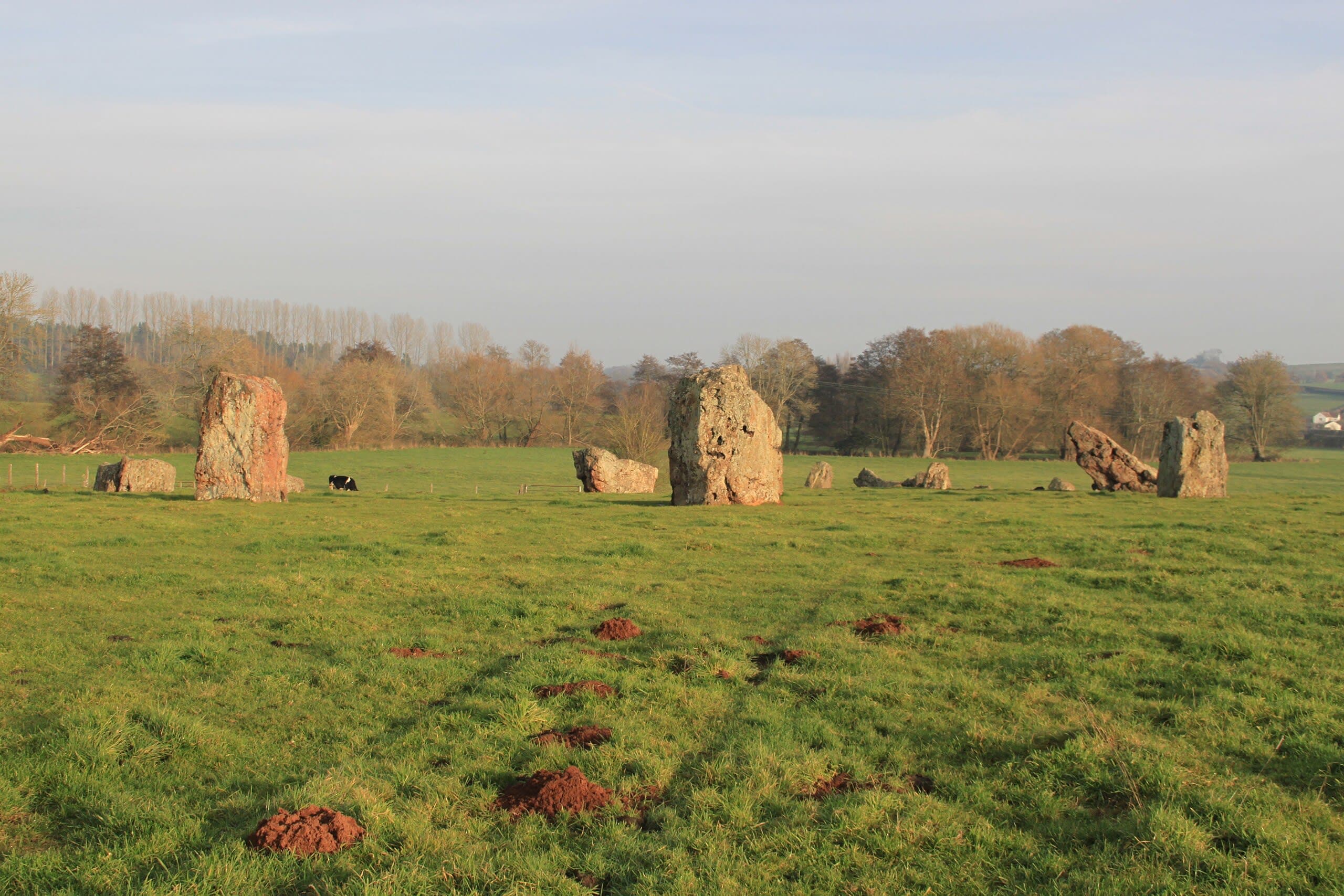
In a field outside a small Somerset village stands Britain's second largest stone circle. Few visitors know it exists. The Great Circle at Stanton Drew stretches 113 meters across, its surviving stones rising from grass cropped by sheep. What most visitors never see lies beneath the surface: in 1997, geophysical surveys revealed Britain's largest known timber monument, nine concentric rings of massive posts that once stood within the stones. This was not a minor site. This was something as significant as Stonehenge or Avebury, hidden in plain sight.
The road from Bristol winds through unremarkable Somerset countryside before reaching the village of Stanton Drew. Nothing prepares you for what waits in the farm field beyond. The Great Circle announces itself slowly: first one stone, then another, scattered survivors of what once may have been many more. Twenty-six uprights remain, marking a perimeter 113 meters across. This is Britain's second largest stone circle, surpassed only by Avebury. Yet most people have never heard of it. The smaller North-East Circle contains some of the heaviest individual stones, blocks that would have required tremendous organized labor to move. In the garden of the Druid's Arms pub, three massive stones form the Cove, possibly a ritual focus separate from the main circles. But the revelation came in 1997, when English Heritage's geophysical survey detected what lies beneath the grass: over four hundred postholes arranged in nine concentric rings within the Great Circle. Britain's largest and most complex known timber monument had stood here, posts several meters tall creating an enclosed ceremonial space unlike anything else in the British Isles. Stanton Drew was not minor. It was not secondary. It was one of the great sacred centers of Neolithic Britain, and it remains available to anyone willing to seek it out.
Context And Lineage
Neolithic communities constructed this ceremonial complex between 3000-2000 BCE. The 1997 discovery of Britain's largest timber monument transformed understanding of the site's significance.
Four and a half thousand years ago, communities across Somerset and beyond came together to build something extraordinary. They quarried dolomitic conglomerate from the Mendip Hills and transported massive blocks to this spot. They dug hundreds of postholes and raised timber posts meters tall. They created a ritual complex comparable in ambition to anything in prehistoric Britain. Why here? We do not know. What ceremonies took place within the nine concentric timber rings? We cannot say. But the scale of effort indicates that Stanton Drew mattered profoundly to the people who built it. For centuries or perhaps longer, this landscape held sacred significance. Then, like most Neolithic ceremonial centers, it passed out of active use as cultures changed. The stones remained, acquiring folklore. Local legend made them a petrified wedding party, dancers frozen for their Sabbath-breaking revelry. The story appears at other stone circles across Britain, a folk explanation for inexplicable monuments.
Stanton Drew belongs to the tradition of Late Neolithic ceremonial monuments that includes Stonehenge, Avebury, and Woodhenge. The timber element connects to henge monuments across Britain. The site represents the emergence of complex ceremonial architecture in prehistoric Britain and the organized labor systems that made such monuments possible.
Why This Place Is Sacred
The combination of monumental scale and intimate accessibility creates a rare opportunity for direct encounter with prehistoric sacred landscape.
What allows Stanton Drew to feel so different from its famous cousins? Perhaps simply this: you can walk among the stones. No barriers, no ropes, no interpretation panels interrupting the encounter. You enter the field through a farm gate, pay your pound into an honesty box, and suddenly you are standing where people stood four and a half thousand years ago, raising stones they had quarried from the Mendip Hills and dragged across the landscape for purposes we can only guess. The relative obscurity works in favor of anyone seeking genuine connection. Stonehenge now requires timed tickets and offers only distant viewing behind barriers. Avebury, though accessible, can feel overwhelmed by visitors. Stanton Drew offers neither crowds nor infrastructure. You and the stones. The sheep. The Mendip Hills on the horizon. Whatever brought those Neolithic communities to this spot four millennia ago, something of that draws seekers still. Contemporary druids and pagans mark the solstices here. Visitors report subtle vibrations, heightened awareness, unexpected emotional release. Whether these sensations represent accumulated energy, psychological openness, or simply the effect of standing somewhere genuinely ancient, they contribute to the sense that Stanton Drew is alive in ways that transcend tourism.
The specific purpose remains unknown, as no excavation has occurred. The 1997 geophysical discovery of the timber monument suggests the site went through multiple phases, with wooden structures possibly preceding or accompanying the stones. Comparative analysis with other Neolithic sites suggests funerary ritual, astronomical observation, seasonal gatherings, and community ceremonies. The scale indicates this was a regional center drawing people from across the surrounding landscape.
The site developed over centuries during the Late Neolithic to Early Bronze Age (approximately 3000-2000 BCE). The relationship between timber and stone phases remains unclear. After its period of active use, the site entered folk memory, generating the 'petrified wedding' legend that explains the stones as dancers frozen for their Sabbath-breaking revelry. The Druid's Arms pub name reflects 18th-century antiquarian association with druids. Contemporary pagan and druid practice has revived ritual use since the late 20th century.
Traditions And Practice
Contemporary druids and pagans mark seasonal rituals at the circles. Individual visitors practice meditation and energy work. The openness of the site allows direct, unmediated encounter.
The original practices are unknown. The timber monument suggests large enclosed gatherings. The multiple circles may have served different ceremonial functions. The Cove may have been a separate ritual focus. Comparative analysis with other Neolithic sites suggests funerary rites, astronomical observations, seasonal celebrations, and rites of passage. The scale indicates this was a gathering place for regional communities.
Druid and pagan groups mark solstices and equinoxes at Stanton Drew. Individual practitioners visit for meditation, energy work, and personal ritual. The relative obscurity attracts those seeking genuine connection rather than spectacle. The Druid's Arms pub serves as informal community center for those drawn to the site. Gordon Strong's book 'The Sacred Stone Circles of Stanton Drew' provides contemporary spiritual interpretation.
Enter the field slowly. Let the stones reveal themselves gradually rather than rushing to catalog them. Walk the Great Circle's perimeter to feel its scale. Sit with one of the uprights, back against ancient stone, and wait. The Cove rewards similar patient attention. If you are drawn to ritual, Stanton Drew welcomes it. If you prefer silent contemplation, the site accommodates that equally. The key is intentionality: this is not a destination for quick photographs but for genuine encounter.
Neo-druidry
ActiveStanton Drew is recognized as a significant druid site, featured in Gordon Strong's work and the 2010 documentary 'Druid's Grove.' Its scale and atmosphere attract serious practitioners.
Seasonal rituals at solstices and equinoxes. Group ceremonies. The Cove may serve as ritual focus. The site's relative obscurity compared to Stonehenge allows more authentic practice.
Contemporary paganism
ActiveThe stone circles serve as pilgrimage destination for pagans across traditions. Many consider visiting major stone circles essential spiritual practice.
Full moon gatherings, seasonal celebrations, personal pilgrimage. Offerings. Meditation among the stones. The Druid's Arms provides informal community gathering.
Earth-based spirituality
ActiveThe site fits within sacred landscape patterns connecting major Neolithic monuments. Ley line theories position it at intersections of earth energies.
Dowsing, energy work, landscape meditation. Walking the circles with intention. Connecting with earth energies and ancestral patterns.
Neolithic ceremonial practice
HistoricalThe original builders created one of Britain's most ambitious sacred complexes. The timber monument within the Great Circle has no known parallel.
Unknown specifically, but the scale suggests major regional gatherings, funerary rites, astronomical observations, and rites of passage.
Experience And Perspectives
The first view across the field reveals stones scattered like survivors of something immense. Walking among them, scale becomes visceral. The Cove at the pub offers intimate encounter with three massive megaliths.
You park by a farm gate and read the sign. An honesty box requests one pound. You lift the latch and enter a field where sheep graze around stones that have stood here longer than recorded history. The Great Circle reveals itself gradually. Stones emerge from the grass at intervals, some fallen, some still upright, none quite prepared for by anything else in the landscape. The scale becomes clear only when you try to walk the perimeter. This circle is vast, nearly as large as Avebury, yet there are no visitor facilities, no interpretation boards, nothing but you and the stones and the Somerset sky. The North-East Circle contains monsters: some of the heaviest individual megaliths at the site, stones that demanded extraordinary effort to move and raise. Standing beside them, you feel the weight of both the stones and the intention that placed them here. The Cove requires a separate visit. In the garden of the Druid's Arms pub (the name itself a remnant of antiquarian imagination), three massive stones stand in rough alignment. This may have been a ritual focus, a gathering point for ceremonies whose content we cannot recover but whose power the stones still somehow hold. Many visitors report sensations here: a settling, an opening, something not quite nameable but definitely present.
The main circles are accessed from the road east of Stanton Drew village (BS39 4EW). Park by the gate and pay at the honesty box. The Cove is in the garden of the Druid's Arms pub (BS39 4EJ), accessible during pub hours. Hautville's Quoit, a single standing stone, lies to the northwest and can be visited as part of a walking circuit.
Stanton Drew occupies a curious position: monumentally significant yet largely unknown. Different communities engage with the site through different frameworks.
The 1997 English Heritage geophysical survey transformed understanding of Stanton Drew. The discovery of Britain's largest and most complex known timber monument elevated the site from interesting regional center to monument of national significance. The Great Circle is Britain's second largest, and the timber structure within it has no parallel. No excavation has occurred due to protected status, limiting interpretation. Dating is estimated at 3000-2000 BCE based on comparison with other sites. Stone was sourced from the Mendip Hills, indicating organized regional labor. The multi-phase development suggests centuries of use and modification.
The 'petrified wedding' story belongs to a tradition of British folklore explaining stone circles as people turned to stone for transgression. This particular story involves a wedding party that continued dancing past midnight into the Sabbath, frozen by the Devil disguised as a fiddler. Such stories provided explanation for monuments whose actual origins were lost to memory. The Druid's Arms pub name reflects 18th/19th century antiquarian association of megalithic monuments with druids, now understood to be anachronistic.
Contemporary druids and pagans see Stanton Drew as a functioning sacred site. Gordon Strong's work explores the spiritual dimensions of the complex. Visitors report subtle vibrations, heightened awareness, and emotional release. Ley line theories position Stanton Drew within a sacred landscape pattern connecting to Stonehenge and Avebury. The Cove is sometimes interpreted as a portal or gateway between worlds. The accumulated energy of millennia of ritual use is believed to remain accessible to those with sensitivity.
Fundamental questions remain unanswered. What specific ceremonies took place here? How did the timber and stone phases relate? What was the function of the nine concentric timber rings? Why has this site received so much less attention than Stonehenge or Avebury? What lies beneath the surface, waiting for archaeology that protected status currently prevents? Stanton Drew holds its mysteries close.
Visit Planning
Stanton Drew is 9km south of Bristol. The circles are accessed through a farm gate with honesty box. The Cove is free in the Druid's Arms garden.
Limited accommodation in Stanton Drew village itself. Bristol (9km) offers extensive options. Bath (10 miles) provides historic charm. The Druid's Arms pub may direct to local B&Bs.
Stanton Drew operates on trust. An honesty box collects the modest entrance fee. The site expects visitors to treat both stones and farmland with respect.
There are no staff at Stanton Drew, no ticket office, no security. An honesty box by the gate requests one pound. This system works because those who seek out Stanton Drew generally come with intention and treat the site accordingly. The stones are on private farmland owned by people who have chosen to allow access. Respecting that generosity means following the few simple guidelines: close gates, avoid disturbing livestock, leave no trace. The stones themselves have survived four and a half millennia. They do not need protection from touch, but they deserve respect. Many visitors feel moved to leave offerings. Small, biodegradable items are acceptable. Nothing should damage the stones or litter the field. Ritual practice is welcome but should not exclude other visitors or disturb the agricultural operation.
The field can be muddy, sometimes extremely so. Appropriate footwear is essential. There are no dress requirements.
Photography is freely permitted. The lack of other visitors often allows extended engagement with individual stones.
Small biodegradable offerings are sometimes left. Nothing should damage the stones or remain as litter.
The southwest circle is not generally accessible. Dogs should be kept under control around livestock. Gates must be left as found.
Sacred Cluster
Nearby sacred places create the location cluster described in the growth plan. This block is intentionally crawlable and links into the wider regional graph.