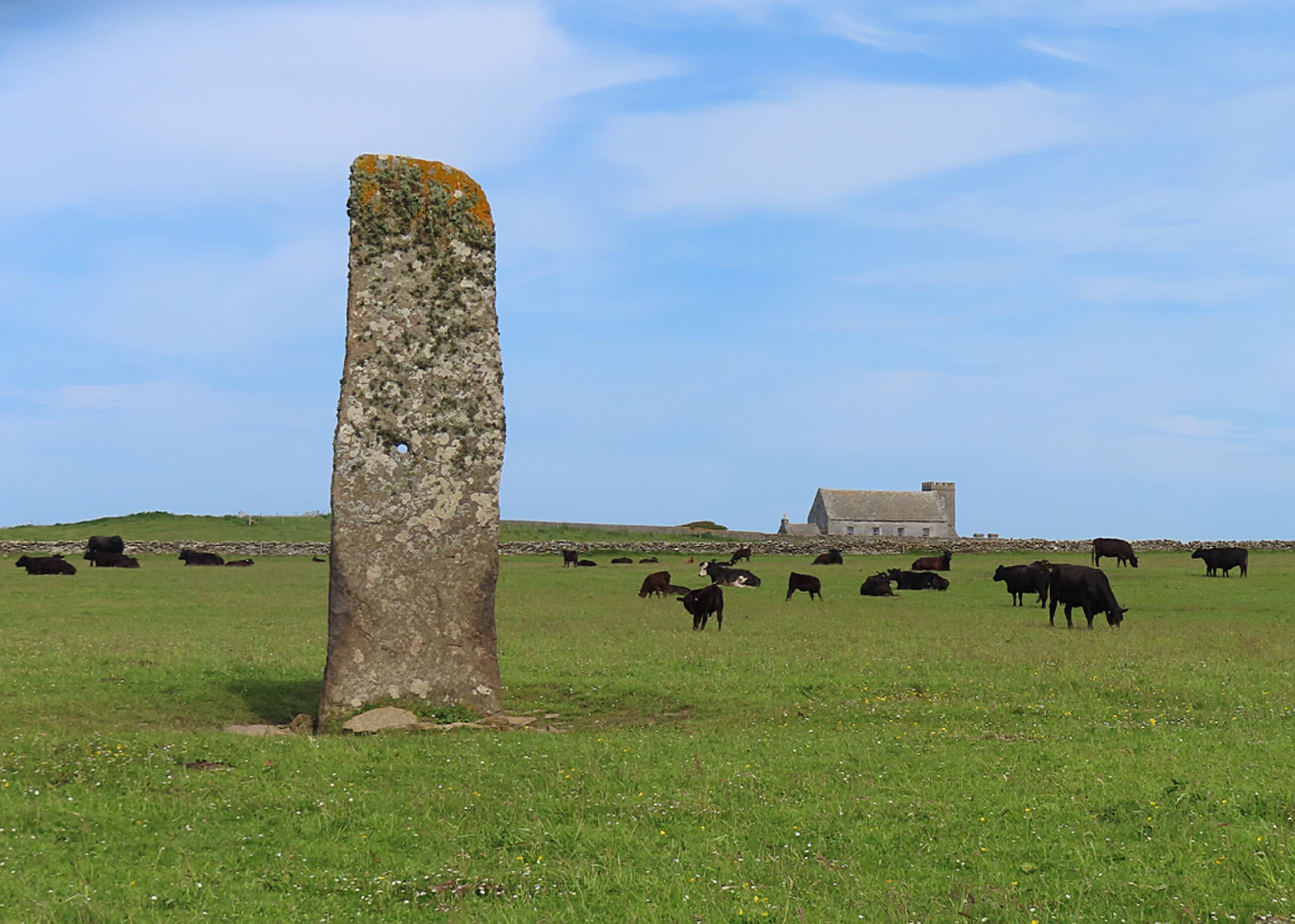
Standing Stone of Hollandstoun
A perforated standing stone on Orkney's northernmost island, aligned to midwinter solstice and once the centre of New Year dancing by moonlight
North Ronaldsay, Orkney Islands, United Kingdom
At A Glance
- Coordinates
- 59.3670, -2.4330
- Suggested Duration
- One hour to combine the stone visit with exploration of the surrounding landscape.
- Access
- North Ronaldsay is reached by Orkney Ferries from Kirkwall (approximately two and a half hours, limited sailings, often weekly) or by Loganair flight from Kirkwall Airport (approximately two minutes). Advance booking is essential for both services. On the island, the stone is a quarter-mile walk from Hollandstoun.
Pilgrim Tips
- North Ronaldsay is reached by Orkney Ferries from Kirkwall (approximately two and a half hours, limited sailings, often weekly) or by Loganair flight from Kirkwall Airport (approximately two minutes). Advance booking is essential for both services. On the island, the stone is a quarter-mile walk from Hollandstoun.
- No specific requirements. Windproof and waterproof clothing advisable.
- Unrestricted. The hole through the stone creates interesting framing opportunities. The flat island landscape provides dramatic backdrops.
- North Ronaldsay is extremely exposed to weather. Dress for conditions. The terrain around the stone is flat and open, offering no shelter.
Overview
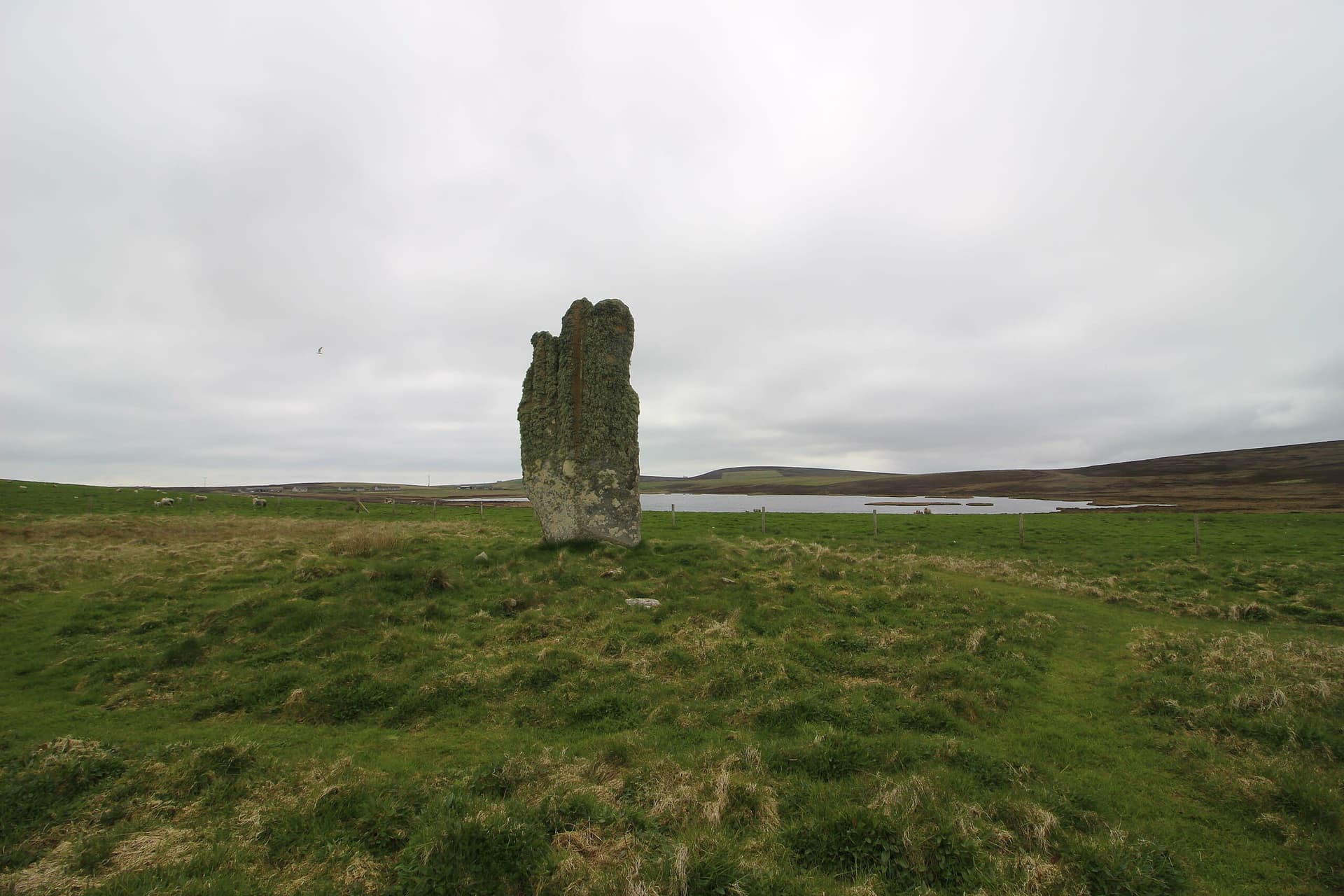
On North Ronaldsay, the most northerly of Orkney's inhabited islands, a standing stone known as the Stan Stane rises approximately four metres from the ground. What distinguishes this stone from Orkney's many menhirs is a small hole pierced through its body, possibly a sighting hole aligned to a celestial event or to another, now-vanished stone. A parish minister recorded that until the early eighteenth century, islanders gathered at the stone to dance on the first day of the year by moonlight. The stone appears to have a midwinter solstice connection, making it one of the most remarkable standing stones in northern Europe for its combination of astronomical alignment and documented folk practice.
The Stan Stane stands a quarter-mile southwest of Hollandstoun on North Ronaldsay, visible across the island's flat terrain. At approximately four metres tall and between 0.9 and 1.2 metres wide, it is a substantial monument, though it does not compete with the tallest stones of the Orkney Mainland. Its power lies not in scale but in detail: the perforated hole, the documented folk traditions, and the possible astronomical alignment.
The hole through the stone is small but deliberate. Whether it was created at the time of the stone's erection or added later is unknown. Various interpretations have been offered: a sighting hole for astronomical observation, a feature for ritual purposes such as the clasping of hands through the stone to seal agreements, or a connection point to another monument now lost. The midwinter solstice alignment that has been suggested would place the stone in the tradition of Neolithic and Bronze Age astronomical monuments, connecting it to Maeshowe's famous midwinter light show and to the broader Orcadian practice of marking the year's turning points in stone.
The recorded folk tradition of New Year dancing adds a documented layer of human engagement. A parish minister noted that islanders gathered at the stone on the first day of the year to dance by moonlight, a practice that continued until the early 1700s. Whether this tradition preserved some echo of the stone's original purpose, or whether it was a later accretion, is unknowable. What it establishes is that the stone retained its hold on the community's imagination for millennia after its erection.
North Ronaldsay's remoteness amplifies the stone's presence. This is the outermost inhabited island of Orkney, a place where the sky is enormous, the sea ever-present, and the human population numbers in the dozens. A standing stone with a hole through it, aligned to the darkest day of the year, once the centre of midwinter celebration, carries particular weight in such a setting.
Context And Lineage
The Stan Stane belongs to Orkney's Neolithic tradition of standing stone erection, but its perforated hole and documented folk traditions set it apart from most Orcadian menhirs. The recorded New Year dancing tradition, combined with the possible midwinter solstice alignment, suggests a connection between the stone and the marking of temporal cycles that persisted from prehistory into the early modern period.
No origin narrative survives from the Neolithic builders. The stone's style and construction are consistent with the Neolithic period, approximately five thousand years ago. The New Year dancing tradition, documented in the early eighteenth century, is the oldest recorded cultural practice associated with the stone, but it is unlikely to represent the original purpose of the monument.
The lineage connecting the stone's original builders to the documented New Year dancers spans approximately four and a half thousand years. Whether any continuous thread of practice ran through this period is unknowable. The parish minister's record suggests that the stone retained cultural significance into the early modern period, long after its original meaning had been lost.
Parish Minister (unnamed)
Why This Place Is Sacred
The Stan Stane's thinness is layered. The stone itself is ancient, its hole enigmatic, its alignment potentially astronomical. The folk tradition of New Year dancing by moonlight adds a human dimension that most standing stones lack: documented evidence of a community gathering at this stone, at a specific time, for a specific purpose, within recorded memory. The stone marks not only space but time, the turning of the year, the boundary between darkness and returning light.
Standing stones mark places. The Stan Stane may also mark time. If the midwinter solstice alignment is accurate, the stone was erected not merely to stand but to observe, to register the moment when the sun reaches its lowest arc and begins its return. In Orkney, where midwinter days offer only six or seven hours of grey light, the solstice is not an abstract concept but a lived reality. The stone would have served as a calendar of the most elemental kind: a marker that said, 'The light returns.'
The perforated hole adds mystery. A hole through a standing stone is unusual in Orkney. It invites looking through, and whatever is visible through the aperture becomes framed, selected, given significance. Whether the builders intended a specific sighting, to a star, a sunrise, another monument, or whether the hole served a ritual function, the effect is the same: the stone directs attention, focuses the gaze, creates a relationship between the viewer, the stone, and something beyond.
The folk tradition of New Year dancing brings the stone into the realm of lived experience. These were not anonymous prehistoric rituals but documented gatherings of named people in a known community, dancing at a known time. The transition from this recorded practice back through the centuries to the stone's original erection creates a thread of human engagement that, while not continuous, is remarkably persistent.
The island setting completes the experience. North Ronaldsay is a place where weather dominates, where the sea is audible from every point, where the human presence is minimal. A stone that marks the solstice and once drew dancers by moonlight stands here as evidence that even at the edge of the habitable world, people have found ways to celebrate the passage of time and the promise of returning light.
The stone is believed to date from the Neolithic period, approximately five thousand years ago. Its purpose likely involved astronomical observation, possibly marking the midwinter solstice. The perforated hole may have served as a sighting aperture. Standing stones of this period also served as gathering points and markers within sacred landscapes.
The stone was erected during the Neolithic period. The New Year dancing tradition, documented by a parish minister as continuing until the early 1700s, represents the most recent recorded use. Whether any practice continued between the Neolithic and the early modern period is unknown. The stone is now a heritage monument visited primarily by those exploring North Ronaldsay's archaeological heritage.
Traditions And Practice
No formal ceremonies are conducted at the Stan Stane today. The documented tradition of New Year dancing by moonlight ceased in the early eighteenth century. The site is visited by those with archaeological and spiritual interests.
The most significant documented practice was the New Year moonlight dancing, recorded as continuing until the early 1700s. The original Neolithic practices are unknown. The perforated hole may have been used for astronomical sighting, for ritual purposes such as oath-swearing or hand-clasping, or for functions we cannot reconstruct.
No organised ceremonies take place. Some visitors with interest in earth-based spirituality or astronomical alignments visit the stone, particularly around the winter solstice.
The stone rewards attention to its hole. Look through it at different times of day. Consider what the builders might have intended the aperture to frame. If visiting near the winter solstice, observe the stone's relationship to the low sun. At any season, the stone invites reflection on the human impulse to mark time and place.
Neolithic Megalithic Tradition
HistoricalThe Stan Stane belongs to the Neolithic tradition of erecting standing stones across Orkney, approximately five thousand years ago. Its perforated hole and possible astronomical alignment set it apart from most Orcadian menhirs, suggesting a specific observational or ritual function.
The original practices are unknown. The perforated hole may have served astronomical, ritual, or social functions. The stone's possible midwinter solstice alignment connects it to the broader Orcadian tradition of marking celestial events in stone.
Early Modern Folk Practice
HistoricalUntil the early eighteenth century, islanders gathered at the Stan Stane to dance on the first day of the year by moonlight. This documented tradition represents one of the few instances in Orkney where a standing stone retained active community use into the historical period.
New Year dancing by moonlight at the stone. The practice was communal and seasonal, linked to the turning of the year. Whether it involved other ritual elements beyond dancing is not recorded.
Experience And Perspectives
The Stan Stane is reached on foot across North Ronaldsay's flat terrain. The stone is visible from some distance, its four-metre height notable on this low-lying island. The perforated hole is the feature that draws the eye: a window through stone, framing sky or sea depending on your vantage point. The island's quiet and remoteness amplify the encounter.
North Ronaldsay is flat. The sky occupies most of the visual field. In this landscape, even a modest standing stone becomes a significant vertical element, and the Stan Stane, at four metres, is not modest.
The walk from the nearest road takes fifteen to twenty minutes across grassland. The stone appears as a dark upright form, its outline more regular than the heavily weathered Stone of Setter on Eday. As you approach, the hole becomes visible, a small aperture through the stone's body that catches the light.
Close up, the stone has the weathered texture of all Orkney's ancient monuments. The surface is rough, pitted by millennia of salt wind and rain. The hole, whether drilled or carved, is clearly deliberate. Looking through it, you see whatever the stone frames: sky, sea, the low profile of North Ronaldsay's farmland.
If you visit near the midwinter solstice, the stone's possible alignment becomes experiential rather than theoretical. The low arc of the sun, barely clearing the horizon, the brevity of daylight, the darkness pressing in from all sides, these conditions give the solstice connection a visceral quality.
The absence of other visitors is likely. North Ronaldsay receives few tourists. The encounter with the stone is typically solitary, conducted in the company of seabirds, sheep, and wind.
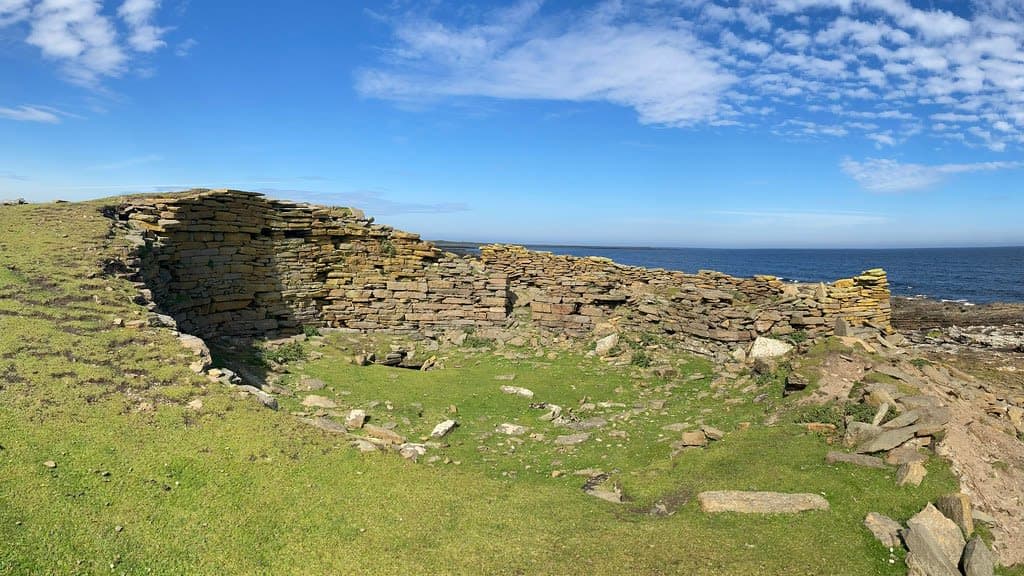
The Stan Stane is located a quarter-mile southwest of Hollandstoun on North Ronaldsay. It is accessible on foot from the island's road network. The North Ronaldsay Bird Observatory, at the southern end of the island, can provide local guidance. The Broch of Burrian is approximately 1.5 kilometres to the south.
The Stan Stane combines architectural, astronomical, and folkloric significance in a way that few standing stones in Orkney can match. The perforated hole, the possible solstice alignment, and the documented dancing tradition together create a layered site that invites multiple interpretive approaches.
The stone is classified as a Neolithic standing stone, approximately five thousand years old. Its height of approximately four metres and its perforated hole are documented by the Gazetteer for Scotland and by the Megalithic Portal. The midwinter solstice alignment has been noted by researchers but has not, to my knowledge, been formally verified by archaeoastronomical survey. The New Year dancing tradition is recorded in parish records from the early eighteenth century. A 3D photogrammetric model of the stone has been created by Dr Hugo Anderson-Whymark, contributing to the archaeological record.
The parish minister's account of New Year dancing by moonlight is the most significant piece of traditional evidence. This practice connects the stone to the broader Northern European tradition of marking the turning of the year at significant landscape features. Whether the dancing tradition preserved any genuine memory of the stone's original purpose, or whether it was a later accretion, cannot be determined.
The perforated hole invites interpretations involving sighting, alignment, and connection. Some visitors see it as a window between worlds, a frame for celestial observation, or a feature for ritual oath-making. The stone's position on Orkney's most remote inhabited island enhances its appeal for those seeking the spiritual margins of the known world.
Whether the hole is original to the stone's erection or was added later. Whether the midwinter solstice alignment is genuine or coincidental. What the hole was intended to frame or sight. Whether the New Year dancing preserved any authentic memory of Neolithic practice. What lies beneath the surface around the stone's base.
Visit Planning
The Stan Stane is located on North Ronaldsay, Orkney's most remote inhabited island. Reaching the island requires advance planning. Facilities are minimal but include a bird observatory, limited accommodation, and a heritage centre.
North Ronaldsay is reached by Orkney Ferries from Kirkwall (approximately two and a half hours, limited sailings, often weekly) or by Loganair flight from Kirkwall Airport (approximately two minutes). Advance booking is essential for both services. On the island, the stone is a quarter-mile walk from Hollandstoun.
Very limited accommodation on North Ronaldsay: the Bird Observatory offers hostel-style rooms with full board, and a small number of B&Bs operate. Book well in advance.
The Stan Stane is a freely accessible heritage monument on North Ronaldsay. Standard protection for scheduled monuments applies.
The stone is accessible at all times without admission charge. The approach crosses flat grassland. Sturdy walking shoes are sufficient. Wind and rain are common at any season; dress accordingly.
Do not damage, disturb, or excavate the stone or its surrounding ground. Do not attempt to enlarge or alter the hole. The stone is a protected monument.
North Ronaldsay's famous sheep may be grazing nearby. Keep dogs under control.
No specific requirements. Windproof and waterproof clothing advisable.
Unrestricted. The hole through the stone creates interesting framing opportunities. The flat island landscape provides dramatic backdrops.
Not traditional in the modern period. Do not leave objects at the stone.
Do not damage or disturb the monument. Respect the island's agricultural land and livestock.
Sacred Cluster
Nearby sacred places create the location cluster described in the growth plan. This block is intentionally crawlable and links into the wider regional graph.