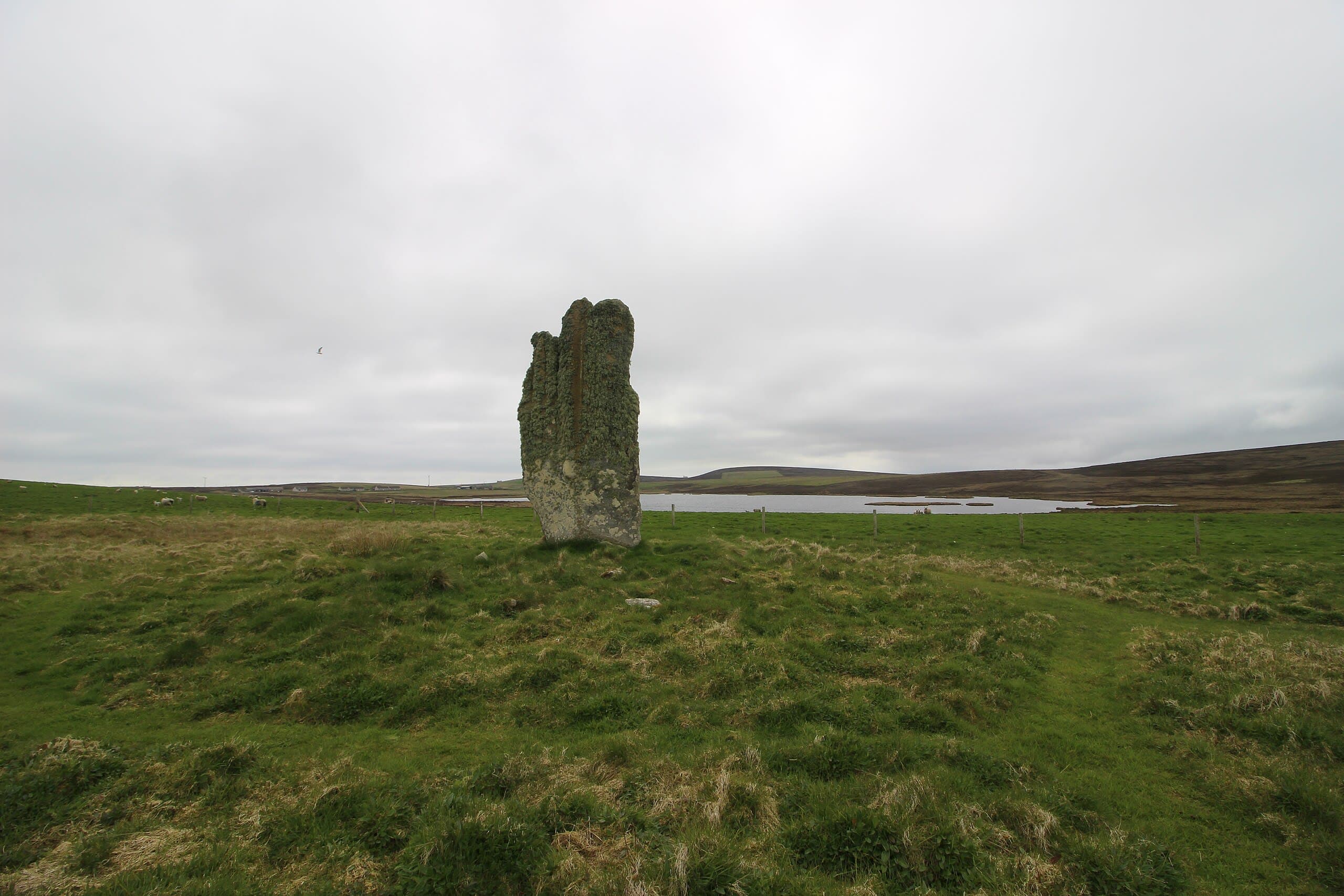
The Setter Stone
Orkney's tallest standing stone, a weathered red sentinel on a remote island shaped by millennia of wind
Eday, Orkney Islands, United Kingdom
At A Glance
- Coordinates
- 59.2190, -2.7645
- Suggested Duration
- Thirty to forty-five minutes to appreciate the stone, its setting, and the views across Calf Sound.
- Access
- Eday is reached by Orkney Ferries from Kirkwall, with sailings taking approximately seventy-five minutes. The stone is located along the signposted Eday Heritage Trail, accessible via a kissing gate from the road. Limited roadside parking near the Heritage Trail access point. No vehicular access directly to the stone. The terrain is open moorland, potentially boggy, with no formal accessible paths.
Pilgrim Tips
- Eday is reached by Orkney Ferries from Kirkwall, with sailings taking approximately seventy-five minutes. The stone is located along the signposted Eday Heritage Trail, accessible via a kissing gate from the road. Limited roadside parking near the Heritage Trail access point. No vehicular access directly to the stone. The terrain is open moorland, potentially boggy, with no formal accessible paths.
- No specific requirements beyond practical outdoor clothing. Sturdy walking boots and windproof, waterproof layers are essential for the moorland walk.
- Unrestricted. The stone is particularly photogenic in low-angled light, against dramatic Orkney skies, and with Calf Sound or the Calf of Eday in the background.
- As a scheduled monument, it is illegal to damage, disturb, or excavate the stone or its surrounding ground. Do not climb on the stone or attempt to remove fragments. Leave no trace.
Overview
On the island of Eday, one of Orkney's less-visited northern isles, a single standing stone rises approximately four and a half metres from the moorland. The Stone of Setter is the tallest individual standing stone in Orkney, a monolith of local red sandstone so weathered by millennia of Atlantic exposure that its silhouette has become ragged and organic, sometimes described as resembling a giant's hand. It stands on a saddle of high ground between Mill Loch and the sea, commanding views across Calf Sound, in a landscape rich with Neolithic burial cairns.
The Stone of Setter announces itself gradually. Walking the signposted Eday Heritage Trail across open moorland, the stone appears on the skyline as an irregular dark form, taller than expected, its outline rough against the sky. At four and a half metres, it is the tallest lone standing stone in Orkney, excluding the Stones of Stenness which belong to a circle complex.
The stone is composed of Eday's distinctive red sandstone, a geologically ancient material from the Devonian period, far older than the monument itself. Millennia of Atlantic weather have sculpted its surface into ridges, hollows, and projections. The weathering gives the stone an almost biological quality, as though it were growing from the ground rather than placed there. Some observers see the profile of a giant's hand. Others simply see deep time made visible in rock.
The location was carefully chosen. The stone stands on a saddle of elevated ground, roughly twenty-five metres above sea level, between Mill Loch to the southwest and the Bay of Carrick to the northeast. From this position it is visible across much of northern Eday and from the sea. The builders intended it to be seen.
Within walking distance, three Neolithic chambered cairns, Vinquoy, Huntersquoy, and Braeside, occupy the slopes of Vinquoy Hill to the northwest. The Bronze Age enclosure known as the Fold of Setter lies three hundred metres to the south. The Setter Stone was not an isolated gesture but part of a landscape shaped over centuries by communities who invested enormous effort in marking, honouring, and inhabiting their territory.
No excavation has been conducted at the stone itself, so what lies beneath the surface remains unknown. The builders left no text, no explanation. What they left is this: a stone taller than two people, standing where they placed it, enduring the same weather they knew, five thousand years later.
Context And Lineage
The Stone of Setter belongs to the megalithic tradition of Orkney and Atlantic Europe, erected by Neolithic or early Bronze Age farming communities between roughly 3000 and 2000 BCE. It stands within a rich prehistoric landscape on Eday that includes three chambered burial cairns and Bronze Age features, suggesting it was part of a broader sacred geography.
No origin narrative survives from the builders. The stone's erection belongs to the widespread Neolithic tradition of raising standing stones across Orkney, a practice shared with the Ring of Brodgar, the Stones of Stenness, and dozens of other monuments across the archipelago. The communities who raised the Setter Stone were farmers who had inhabited Eday for generations, transforming the island with permanent monuments. Their specific beliefs and motivations are irrecoverable.
No continuous tradition of practice connects present-day visitors to the Neolithic builders. The stone passed through millennia of human habitation on Eday without any recorded traditions of use or veneration. Its modern significance is primarily archaeological and contemplative.
Historic Environment Scotland
Why This Place Is Sacred
The Stone of Setter's thinness derives from scale, isolation, and endurance. At four and a half metres, it is the largest object the Neolithic inhabitants of Eday ever created. It stands on open moorland with no modern encroachment, surrounded by the same sky and wind its builders knew. The effort required to reach Eday itself creates a natural threshold. The stone rewards that effort with an encounter stripped of everything but itself.
Thin places are sometimes understood as locations where the boundary between the ordinary and the sacred becomes permeable. The Stone of Setter achieves this through radical simplicity. It is a single stone in an open landscape, and yet the encounter with it can be unexpectedly powerful.
The scale contributes. Four and a half metres is taller than most rooms. Standing at the base, you look up at a monument that took considerable communal effort to quarry, transport, and erect. The labour encoded in the stone, hours and days of work by people whose names are lost, gives it a weight beyond its physical mass.
The weathering adds another dimension. Five thousand years of Orkney weather have transformed the stone's surface into something that resembles natural formation rather than human placement. The ridges and hollows catch light differently throughout the day. The stone appears to change, to be alive in some sense, responsive to the conditions around it.
The landscape amplifies the experience. Eday is treeless moorland, open to the sky in every direction. The stone is the tallest vertical element in the landscape, a human assertion against the horizontal world of grass, water, and sky. Standing beside it, you become aware of wind, of distance, of the sea audible from this elevated position.
The remoteness of Eday itself creates a threshold. Reaching the stone requires a ferry from Kirkwall, a journey that separates the visitor from the Orkney Mainland and the patterns of daily life. Few people visit Eday. Fewer still walk the Heritage Trail to the stone. Those who arrive find a monument that has been waiting, in its own quiet way, for five millennia.
The exact purpose of the Stone of Setter is unknown. Standing stones of this period are generally interpreted as markers, though what they marked remains debated. Possibilities include ceremonial gathering points, astronomical reference points, territorial boundaries, or memorial monuments. The stone's proximity to three chambered burial cairns suggests a connection to funerary or ancestral rites, though the nature of that connection is unconfirmed.
The stone was erected during the late Neolithic or early Bronze Age, roughly 3000 to 2000 BCE. No subsequent modifications are documented. It was scheduled as a protected monument by Historic Environment Scotland in 1936, one of the earliest scheduled monuments in the Orkney Islands. Today it stands as part of the signposted Eday Heritage Trail.
Traditions And Practice
No formal ceremonies are conducted at the Stone of Setter. The site functions as an archaeological monument and a landmark on the Eday Heritage Trail. Individual visitors engage in personal contemplation.
The original practices associated with the stone are unknown. Its position among burial cairns suggests possible connections to funerary or ancestral rites, but no specific rituals can be reconstructed. No folklore or ceremonial traditions have been documented for this stone.
No organised ceremonies or rituals take place at the stone. It is visited as part of the Eday Heritage Trail and appreciated as an archaeological monument and natural landmark.
The stone rewards unhurried engagement. Allow time to walk around it, to observe the weathering patterns, to take in the views across Calf Sound. Stand at its base and consider the scale of labour its erection required. The absence of interpretation materials means the encounter is direct and unmediated.
Neolithic/Bronze Age Megalithic
HistoricalThe Stone of Setter is a monumental standing stone erected during the late Neolithic or early Bronze Age, part of the widespread tradition of erecting standing stones across Orkney and Atlantic Europe. At approximately 4.5 metres tall, it is the tallest individual standing stone in Orkney. Its deliberate placement on elevated ground between Mill Loch and the Bay of Carrick, visible from much of northern Eday and potentially from the sea, indicates it was intended as a commanding focal point in the island's ritual landscape.
The exact ritual or ceremonial practices associated with the stone are unknown. Standing stones of this period are generally interpreted as markers for ceremonial gatherings, astronomical observations, territorial boundaries, or commemorative purposes. The stone's position within a wider landscape of burial cairns suggests possible connections to funerary or ancestral rites.
Experience And Perspectives
The Stone of Setter is encountered as part of the Eday Heritage Walk, a five-mile circular route through the island's prehistoric landscape. The stone appears on the skyline as the trail crosses open moorland. There is nothing between the visitor and the monument but wind and grass. The absence of interpretation panels or visitor infrastructure at the stone itself heightens the encounter.
The Heritage Walk begins at the Eday Community Enterprises Shop and follows a signposted route across the island. The terrain is open moorland, uneven in places, potentially boggy underfoot. The walk to the stone takes roughly thirty minutes from the nearest road access point.
As you cross the moorland, the stone appears on the horizon, initially as a dark vertical mark against the sky. It grows as you approach, until its full four-and-a-half-metre height becomes apparent. The weathered red sandstone catches the light, the surface scored and sculpted by millennia of exposure.
There is no fence, no interpretation panel, no barrier between you and the stone. You can walk up to it, stand at its base, place a hand on the weathered surface. The texture is rough, the sandstone eroded into channels and ridges. The broad faces of the stone align roughly north-south, though whether this orientation was intentional remains unknown.
From the stone's elevated position, views extend across Calf Sound to the Calf of Eday and beyond. The chambered cairns on Vinquoy Hill are visible to the northwest. The landscape of death and ceremony that the Neolithic builders created is still legible, five thousand years later.
The wind is near-constant. Silence, in the ordinary sense, is rare on Eday. But there is a particular quality of quiet at the stone, a sense that the wind has been blowing here for longer than human memory, and the stone has stood through all of it.
The stone is located along the Eday Heritage Trail, accessible via a kissing gate from the road. The full Heritage Walk is approximately five miles (eight kilometres) and takes three to four hours, including the stone, the Vinquoy and other chambered cairns, and the Fold of Setter. Eday is reached by Orkney Ferries from Kirkwall, with sailings taking approximately seventy-five minutes.
The Stone of Setter speaks through its physical presence rather than through text or tradition. No written record, no oral tradition, no surviving legend illuminates its purpose. What we have is the stone itself, its location, its relationship to the surrounding monuments, and the questions it raises.
Archaeologists classify the Stone of Setter as a late Neolithic or early Bronze Age standing stone, part of the broader megalithic tradition of Orkney and Atlantic Europe. Historic Environment Scotland describes it as a monument of national importance, the tallest individual standing stone in Orkney apart from the Stones of Stenness. The stone is composed of local Eday red sandstone from the Middle Old Red Sandstone geological formation. Its positioning on elevated ground between water features, visible from across northern Eday and from the sea, is interpreted as evidence of deliberate landscape planning. Its proximity to three chambered cairns suggests integration into a wider ceremonial landscape. No excavation has been conducted at the stone itself.
No indigenous oral tradition survives from the builders. No specific folklore has been documented for the Setter Stone, unlike some Orkney standing stones that have accrued legends over time. The stone's weathered profile has prompted some observers to describe it as resembling a giant's hand, but this is an informal observation rather than a recorded folk tradition.
Some visitors and writers note the stone's position between water features and its commanding presence in the landscape as consistent with theories about sacred geography and earth energy. These interpretations are not supported by archaeological evidence but represent frameworks through which some contemporary seekers engage with prehistoric monuments.
The exact purpose of the stone remains unknown. Whether it served as a territorial marker, astronomical indicator, ceremonial gathering point, memorial, or something else entirely cannot be determined. Its relationship to the nearby chambered cairns is suggested by proximity but unproven. What lies beneath the surface around the stone's base, including packing stones, deposits, or earlier ground surfaces, remains unexamined.
Visit Planning
The Stone of Setter is located on the island of Eday, one of Orkney's northern isles. Reaching it requires a ferry from Kirkwall and a walk along the Eday Heritage Trail. Facilities on Eday are limited; visitors should plan provisions in advance.
Eday is reached by Orkney Ferries from Kirkwall, with sailings taking approximately seventy-five minutes. The stone is located along the signposted Eday Heritage Trail, accessible via a kissing gate from the road. Limited roadside parking near the Heritage Trail access point. No vehicular access directly to the stone. The terrain is open moorland, potentially boggy, with no formal accessible paths.
Very limited accommodation on Eday. A small number of B&Bs and self-catering options. Book well in advance. More extensive accommodation in Kirkwall on the Orkney Mainland. Day trips from Kirkwall are possible but require careful ferry scheduling.
The Stone of Setter is a freely accessible scheduled monument on open moorland. No formal restrictions apply beyond standard heritage protection.
The stone is accessible at all times via the signposted Eday Heritage Trail. No admission fee is charged. The approach crosses open moorland, which may be boggy. Sturdy, waterproof footwear is essential. Orkney weather is changeable; windproof and waterproof clothing is advisable at any season.
As a scheduled monument, it is illegal to damage, disturb, or excavate the stone without consent from Historic Environment Scotland. Do not climb on the stone, lean against it, or remove fragments. Leave no trace.
No specific requirements beyond practical outdoor clothing. Sturdy walking boots and windproof, waterproof layers are essential for the moorland walk.
Unrestricted. The stone is particularly photogenic in low-angled light, against dramatic Orkney skies, and with Calf Sound or the Calf of Eday in the background.
Not traditional or expected. Do not leave objects at the stone.
Do not climb on, lean against, or damage the stone. As a scheduled monument, it has legal protection against unauthorised disturbance.
Sacred Cluster
Nearby sacred places create the location cluster described in the growth plan. This block is intentionally crawlable and links into the wider regional graph.