Shanti Stupa, Pokhara
A white dome of peace rises above Phewa Lake, facing the Annapurna range
Pokhara, Gandaki Province, Nepal
At A Glance
- Coordinates
- 28.2008, 83.9448
- Suggested Duration
- 1-2 hours at the pagoda; add time for the approach depending on route chosen.
- Access
- Three main approaches: (1) Boat across Phewa Lake from Lakeside followed by one-hour uphill hike; (2) Drive approximately 9 km by road via the southern route; (3) Hike from Lakeside via forested trails (2-3 hours). Each offers a different experience of approach and arrival.
Pilgrim Tips
- Three main approaches: (1) Boat across Phewa Lake from Lakeside followed by one-hour uphill hike; (2) Drive approximately 9 km by road via the southern route; (3) Hike from Lakeside via forested trails (2-3 hours). Each offers a different experience of approach and arrival.
- Modest dress is appropriate but not strictly required.
- Permitted throughout the grounds.
Overview
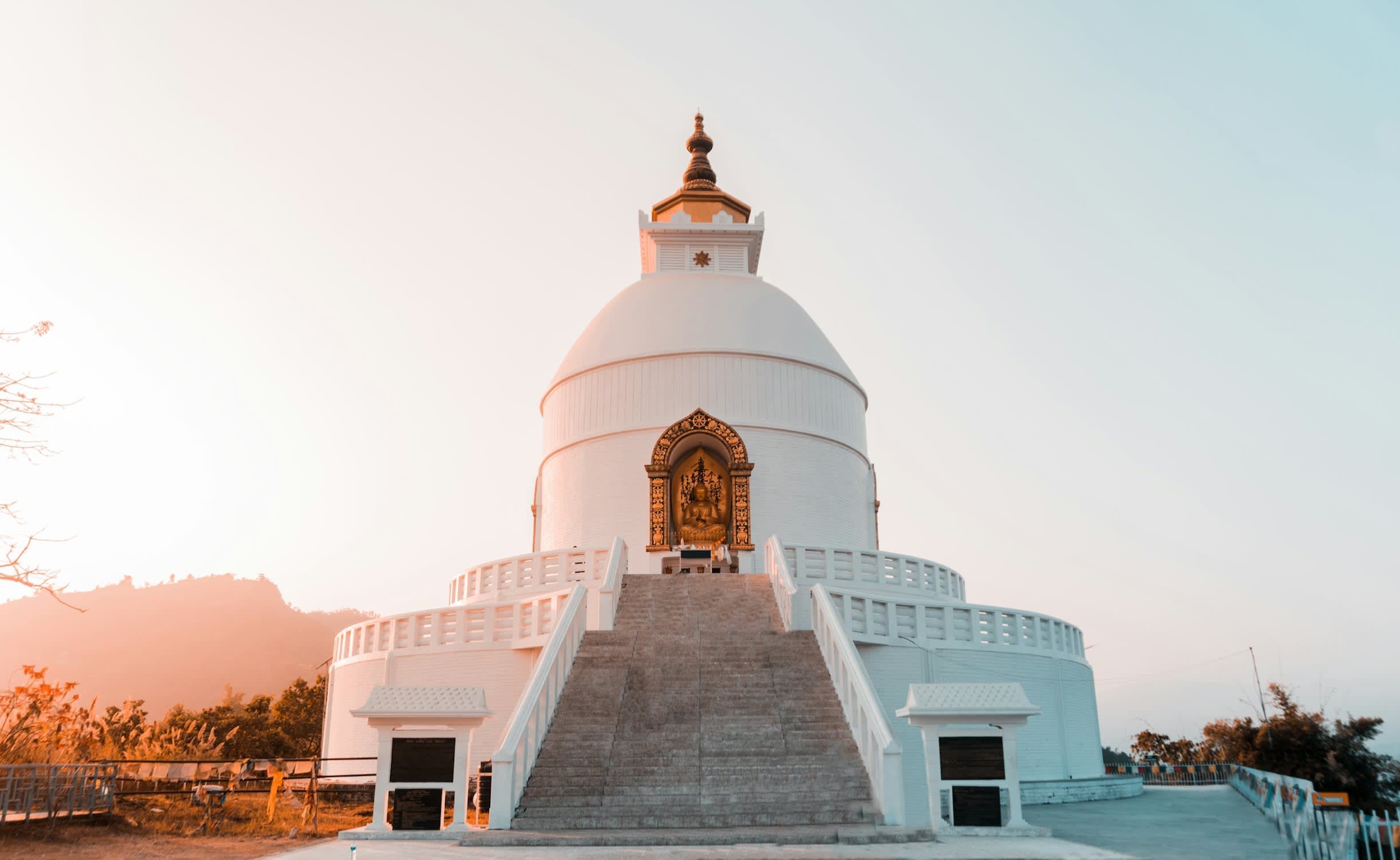
On a ridge above Phewa Lake, the brilliant white World Peace Pagoda commands views that span from Pokhara's lakeside to the Annapurna massif. Built by Japanese Buddhist monks following the vision of Nichidatsu Fujii—who met Gandhi and dedicated his life to non-violence—the stupa contains relics of the Buddha and serves as the 71st peace pagoda in a worldwide network. Sunrise here transforms the mountains into gold while the city below still sleeps.
The World Peace Pagoda announces itself before you reach it—a white dome rising from the ridge like a second moon, visible from across the lake and valley. Japanese Buddhist monks spent over two decades realizing this vision, from the foundation stone ceremony in 1973 to the inauguration in 1999. The completed stupa stands 115 feet tall, its pure white surface reflecting whatever light the sky offers.
Four statues of the Buddha face the cardinal directions, each representing a key moment in his life: birth (gifted from Nepal), enlightenment (from Sri Lanka), first sermon (from Japan), and passing into parinirvana (from Thailand). The gifts from four nations embody the pagoda's aspiration—peace extending in all directions, transcending borders.
The setting amplifies the message. Phewa Lake spreads below, reflecting clouds and mountains. The Annapurna range fills the northern horizon, ice and rock monuments to geological time that dwarf human timescales. Yet here humans have built something that speaks of eternity in its own register—a structure dedicated to the cessation of violence, to the possibility that beings might stop harming one another.
Context And Lineage
Nichidatsu Fujii, a Japanese Buddhist monk who met Gandhi in 1931, dedicated his life to building peace pagodas worldwide. The Pokhara stupa was Nepal's first, completed in 1999 after 26 years of construction.
In 1931, a Japanese Buddhist monk named Nichidatsu Fujii met Mahatma Gandhi in India. The encounter transformed both men. Gandhi later said of Fujii: 'He is a man who has a burning passion for peace.' Fujii returned to Japan and devoted the remainder of his life to what he called 'beating the drum for peace'—literally, as his monks chant while drumming.
Fujii's vision centered on building peace pagodas—stupas containing relics of the Buddha—in locations around the world. Each would serve as a physical reminder of the possibility of non-violence. The Nipponzan-Myōhōji order he led has now built over 80 such pagodas globally.
The Pokhara pagoda began on September 12, 1973, when Fujii himself laid the foundation stone and placed Buddha relics in the base. Local monk Morioka Sonin led the construction with local supporters. Progress was slow—26 years slow—before the stupa reached completion. The inauguration on October 30, 1999 was attended by former Prime Minister Girija Prasad Koirala.
The pagoda belongs to the Nichiren Buddhist tradition as practiced by the Nipponzan-Myōhōji order. This Japanese school emphasizes the Lotus Sutra and the practice of Na-Mu-Myo-Ho-Ren-Ge-Kyo chanting. The peace pagoda movement represents the order's distinctive contribution to contemporary Buddhism.
Nichidatsu Fujii
Founder of Nipponzan-Myōhōji order and visionary behind the worldwide peace pagoda movement
Morioka Sonin
The monk who led the actual construction over 26 years
Why This Place Is Sacred
The pagoda's elevated position between lake and mountains creates natural conditions of thinness, while the presence of Buddha relics and decades of peace prayers add a cultivated dimension.
Several factors converge to make the World Peace Pagoda a thin place in the Celtic sense—a location where the boundary between worlds becomes permeable. The elevation itself matters: at 1,100 meters, the ridge stands between valley floor and mountain summit, a middle ground neither fully of the earth nor of the sky.
The Buddha relics placed in the foundation add a different dimension. These physical remnants of the awakened one serve as conduits in Buddhist understanding, carrying the blessing of enlightenment into the present. Around this sacred core, years of prayers and circumambulations have accumulated, each visitor adding to the field of intention.
The view works on consciousness in its own way. Facing the Himalayas from this vantage, the ordinary boundaries of selfhood seem less fixed. The mountains predate human presence by millions of years and will persist long after. Sitting in their presence, one's own concerns diminish to appropriate scale.
The pagoda was built as a monument to world peace, following the vision of Nichidatsu Fujii that stupas containing Buddha relics could help heal humanity's tendency toward violence.
Since its 1999 inauguration, the pagoda has become one of Pokhara's most visited sites. It functions simultaneously as active Buddhist monument, tourist destination, and secular symbol of peace. The resident monks maintain the practice dimension while welcoming visitors of all backgrounds.
Traditions And Practice
Circumambulation, meditation, and quiet contemplation are the primary practices. The resident monks maintain daily prayers, welcoming visitors to observe or join.
Buddhist practice at the pagoda centers on circumambulation—walking clockwise around the stupa while maintaining mindful attention. The direction follows the movement of the sun and symbolizes progress along the spiritual path. Many visitors naturally fall into this pattern even without instruction.
The resident monks chant and drum in the Nipponzan-Myōhōji tradition, their practice audible to visitors during certain hours. The distinctive Na-Mu-Myo-Ho-Ren-Ge-Kyo chant invokes the Lotus Sutra's promise that all beings possess Buddha nature.
Most visitors combine spiritual and secular motivations—seeking both the view and something harder to name. Sunrise meditation brings dedicated practitioners. Yoga groups sometimes use the grounds. Photography features prominently in most visits.
Arrive for sunrise if possible. The light transforms the mountains while the city below remains quiet, creating conditions of unusual stillness. Walk around the stupa clockwise, pausing at each of the four Buddhas. Sit facing the Himalayas long enough for the view to work its effect—at least fifteen minutes, ideally longer.
Buddhism (Nichiren)
ActiveNepal's first and the world's 71st peace pagoda built by Nipponzan-Myōhōji, containing Buddha relics and dedicated to world peace.
Circumambulation, Na-Mu-Myo-Ho-Ren-Ge-Kyo chanting, meditation, offerings.
Experience And Perspectives
The journey to the pagoda—by boat, hike, or road—prepares visitors for the arrival. The white dome appears, the mountains reveal themselves, and something in ordinary consciousness quiets.
Most visitors encounter the World Peace Pagoda after a journey that itself serves as preparation. The classic approach crosses Phewa Lake by rowboat, landing at a trailhead from which the path ascends through forest. The hike takes about an hour, the white dome appearing and disappearing through trees as the altitude increases. By the time the forest gives way to the pagoda grounds, the body has been engaged enough to quiet the mind.
Other approaches exist—driving the road that winds up from behind, or hiking from the Lakeside area along a longer trail. Each route offers its own rhythm of revelation, the stupa gradually coming into view.
The arrival itself rarely disappoints. The white surface seems to glow, especially in morning or evening light. The four Buddhas face outward with expressions of serene attention. And behind them, always, the Himalayas assert their presence—Machapuchare's distinctive fishtail peak, Annapurna South, the long wall of snow and rock that defines the northern horizon.
Most visitors walk clockwise around the stupa, following Buddhist circumambulation tradition even if they've never heard the term. The circuit takes only minutes but reveals the view in all directions: mountains to the north, Pokhara city to the east, forested ridges to the south and west, and Phewa Lake shimmering below.
Sunrise draws the most dedicated visitors, who arrive in darkness to watch the first light catch the mountain peaks, turning them gold and pink before the sun itself appears. These moments possess a quality hard to name—awe tinged with stillness, beauty that seems to ask nothing except attention.
The pagoda sits on Ananda Hill at the southern end of Phewa Lake. A single circumambulation path circles the stupa. Views extend in all directions. The grounds include the stupa, gardens, and basic facilities.
The World Peace Pagoda exists at the intersection of traditional Buddhist practice, post-Gandhian peace activism, and contemporary tourism. These currents converge without fully resolving.
The Nipponzan-Myōhōji movement represents a distinctly modern form of Buddhist activism, born from Fujii's encounter with Gandhi and developed through the post-war Japanese context. Scholars note how the peace pagoda project translates Buddhist symbolism into a globally accessible language of non-violence.
Within Nichiren Buddhism, the stupa serves as a physical embodiment of the Lotus Sutra's teaching that all beings possess Buddha nature. The relics create a direct connection to the historical Buddha, while the structure itself generates merit for all who encounter it.
Visit Planning
The pagoda is accessible by boat and hike, by road, or by hiking trails from Pokhara. Sunrise offers the best lighting and quietest atmosphere.
Three main approaches: (1) Boat across Phewa Lake from Lakeside followed by one-hour uphill hike; (2) Drive approximately 9 km by road via the southern route; (3) Hike from Lakeside via forested trails (2-3 hours). Each offers a different experience of approach and arrival.
Day trip from Pokhara accommodations. No lodging at the site, though some visitors wild camp nearby for sunrise access.
The pagoda welcomes all visitors. Walk clockwise around the stupa. Maintain quiet near the monks' quarters.
The World Peace Pagoda operates with minimal restrictions, reflecting its aspiration toward universal peace. Visitors of any religion or none are welcome. No entrance fee is charged.
Follow Buddhist custom by walking clockwise around the stupa. This direction, matching the sun's movement, symbolizes alignment with the natural order. The practice requires no belief—it simply creates a shared pattern of movement that contributes to the site's atmosphere.
Maintain relative quiet, especially near the monks' quarters. The pagoda serves as a meditation site for many visitors, and loud conversation disrupts this possibility.
Modest dress is appropriate but not strictly required.
Permitted throughout the grounds.
Flowers and incense are traditional and can sometimes be purchased on site.
{"Walk clockwise around the stupa","Maintain quiet atmosphere"}
Sacred Cluster
Nearby sacred places create the location cluster described in the growth plan. This block is intentionally crawlable and links into the wider regional graph.