Muktinath Temple
Where all five elements meet at the threshold of liberation
Muktinath, Gandaki Province, Nepal
At A Glance
- Coordinates
- 28.8167, 83.8667
- Suggested Duration
- Day visit from Jomsom is possible by jeep (2-3 hours each way). Most Annapurna Circuit trekkers spend one night in Muktinath or Ranipauwa. Allow at least 2-3 hours at the temple complex for bathing ritual and worship.
- Access
- By air: Fly Kathmandu or Pokhara to Jomsom, then jeep to Muktinath (2-3 hours). By trek: Annapurna Circuit crosses Thorong La (5,416m) to reach Muktinath (typically 10-14 days from Besisahar). By helicopter: Direct helicopter pilgrimage from Kathmandu or Pokhara available. Required permits: Annapurna Conservation Area Permit (ACAP) and TIMS card, obtained in Kathmandu or Pokhara.
Pilgrim Tips
- By air: Fly Kathmandu or Pokhara to Jomsom, then jeep to Muktinath (2-3 hours). By trek: Annapurna Circuit crosses Thorong La (5,416m) to reach Muktinath (typically 10-14 days from Besisahar). By helicopter: Direct helicopter pilgrimage from Kathmandu or Pokhara available. Required permits: Annapurna Conservation Area Permit (ACAP) and TIMS card, obtained in Kathmandu or Pokhara.
- Modest clothing covering shoulders and knees. For water ritual, lightweight quick-dry clothing or bathing attire. Bring warm layers—temperatures are cold at this altitude.
- Generally permitted in outdoor areas. Ask before photographing inside temples or during rituals. Be respectful photographing pilgrims, especially during bathing.
- The water is extremely cold; be prepared for shock. The altitude (3,710m) can cause symptoms of altitude sickness; acclimatize properly before ascending. Weather can change rapidly; bring layers. If trekking over Thorong La (5,416m), proper acclimatization and preparation are essential.
Overview
At 3,710 meters in Nepal's Mustang district, Muktinath Temple stands where Hindus and Buddhists have worshipped together for centuries. Pilgrims bathe under 108 sacred water spouts, then witness the miracle: eternal flames burning from earth, rock, and water. One of Hinduism's 108 Divya Desam and Buddhism's 24 Tantric places, Muktinath means 'Lord of Liberation'—the site where all five elements converge and moksha becomes possible. Hindu priests perform morning rites; a Buddhist nun tends the shrine by day.
Liberation has a location. At 3,710 meters in Nepal's Mustang district, Muktinath Temple marks the place where, according to both Hindu and Buddhist traditions, the boundary between bondage and freedom grows thin. Pilgrims have climbed to this high valley for centuries, drawn by the promise encoded in the name itself: Mukti-nath, Lord of Liberation.
What they find here defies ordinary categories. Earth, water, fire, air, and sky—the five elements from which all existence is composed—manifest together in one place. One hundred and eight brass spouts pour icy water from the mountainside, each stream believed to wash away a different defilement. Nearby, eternal flames burn from the ground, from rock, and impossibly, from within water itself—natural gas meeting earth's moisture in a phenomenon that devotees understand as divine signature.
Hindus know this as Mukti Kshetra, the field of liberation, one of the eight most sacred Vishnu sites on earth. Buddhists call it Chumig Gyatsa, Hundred Waters, where Guru Rinpoche meditated on his way to Tibet. Both traditions share the temple in daily rotation: Hindu priests open and close with morning and evening aarti; a Buddhist nun tends the shrine through the day. This is not mere tolerance but genuine sharing—an embodiment of Nepal's gift for holding multiple truths.
Context And Lineage
Muktinath's sacred history extends at least two millennia. Both Hindu and Buddhist traditions claim deep connections: Hinduism lists it among Vishnu's 108 Divya Desam and one of 8 Svayam Vyakta Ksetras; Buddhism counts it among 24 Tantric power places associated with Guru Rinpoche.
The origins of Muktinath's sanctity predate documented history. By the 1st century AD, the site was already recognized as sacred. According to Buddhist tradition, Guru Rinpoche (Padmasambhava), the 8th-century master who brought Buddhism to Tibet, meditated here during his journey northward. The site is believed to have been blessed by numerous mahasiddhas (great adepts) across centuries. Hindu tradition associates the site with Adi Shankaracharya, who is said to have elevated its status as a pilgrimage destination. The Shakti Peetha tradition holds that the goddess Sati's head fell here when Vishnu's discus dismembered her body.
The temple maintains a unique dual priesthood. Hindu priests (typically Brahmin) perform morning and evening aarti rituals and open/close the temple. Buddhist nuns (Jhuma or Aani) tend the temple during daytime hours, accepting offerings and maintaining the shrine. This arrangement embodies the religious harmony that has characterized Muktinath across centuries.
Guru Rinpoche (Padmasambhava)
8th-century Buddhist master
Adi Shankaracharya
8th-century Hindu philosopher
Why This Place Is Sacred
Muktinath's thinness arises from the convergence of elements, traditions, and extremes. At 3,710 meters, where oxygen is thin, the five elements that compose all existence—earth, water, fire, air, sky—manifest together. Eternal flames burn beside freezing springs. Hindu and Buddhist priests share the same altar. The ordinary boundaries that separate one thing from another seem to relax here.
What makes a place thin? At Muktinath, the answer begins with physics and extends into mystery. The site sits at 3,710 meters, high enough that every breath requires attention. The landscape is dramatic: brown mountains under vast blue sky, the Himalayan giants visible on clear days. But altitude and scenery don't fully explain what pilgrims have experienced here for two millennia.
The five elements converge at Muktinath in literal, visible ways. Earth forms the mountain on which the temple stands. Water pours from 108 brass spouts and fills sacred pools. Fire burns eternally in three places: from the earth itself, from rock, and—most remarkably—alongside water. Air at this altitude is thin and carries the snap of prayer flags. Sky opens vast overhead, the dome of heaven seeming closer than at lower elevations.
For Hindus, this elemental convergence signals a place where the material world is especially transparent to the divine. The Gandaki River, flowing from nearby, carries shaligrama stones—black fossils that devotees recognize as natural embodiments of Vishnu, sacred without human shaping. The land itself produces the divine.
For Buddhists, Muktinath is one of 24 Tantric power places where enlightened masters have practiced and where their blessings remain accessible. Guru Rinpoche meditated here on his way to Tibet. The 108 water spouts correspond to the 108 defilements that obscure enlightened mind; bathing under each is understood as washing away accumulated obstacles.
The daily sharing of the temple between Hindu and Buddhist clergy adds another dimension to Muktinath's thinness. The boundaries that elsewhere separate traditions—different gods, different practices, different ultimate goals—dissolve here into mutual worship of the same site. If traditions can share space so harmoniously, perhaps other boundaries are also more permeable than they appear.
Muktinath's sacred significance dates to at least the 1st century AD. The site was recognized as a place where liberation (moksha) could be attained, where the five elements converged, and where multiple traditions could worship authentically. The current temple structure dates to the early 19th century, though the Vishnu image inside is believed to be 16th century.
The site has maintained remarkable continuity of purpose across two millennia. What has changed is accessibility: the development of roads and air service to nearby Jomsom now allows pilgrims to reach Muktinath in a day rather than the weeks once required. The Annapurna Circuit trek, which crosses Thorong La pass to reach Muktinath, has brought international trekkers alongside traditional Hindu and Buddhist pilgrims, creating a new layer of seeking alongside the ancient one.
Traditions And Practice
The central practice at Muktinath is ritual bathing under the 108 water spouts, believed to purify pilgrims of accumulated defilements. Pilgrims also bathe in the sacred pools, circumambulate the temple, and witness the eternal flames. Both Hindu puja and Buddhist prostrations are performed.
The traditional pilgrimage to Muktinath involves purification by water and worship by fire. Pilgrims begin by bathing under all 108 water spouts (Mukti Dhara), the freezing water believed to wash away sins corresponding to the 108 defilements in Buddhist cosmology or the 108 combinations of planets and zodiac signs in Hindu astrology. Many then immerse in Mukti Kunda, the liberation pool, and in the Saraswati/Laxmi Kunda pools.
At the main temple, Hindu pilgrims offer flowers, incense, and food to Vishnu, receiving tika and prasad in return. Buddhist pilgrims circumambulate the temple, perform prostrations, and make offerings according to Vajrayana practice. Both traditions treat the Jwala Mai eternal flames with reverence, understanding them as miraculous manifestation of divine presence.
The circumambulation of the entire temple complex, moving clockwise, is practiced by both traditions. Prayer flags are common, strung by pilgrims seeking to have their prayers carried by wind.
Contemporary practice at Muktinath includes both traditional pilgrims and international trekkers encountering the site at the end of the Annapurna Circuit. Many trekkers—even those without Hindu or Buddhist background—participate in the water ritual, finding the physical shock of the cold water meaningful in itself. The temple area now has better facilities for pilgrims and visitors, though the core rituals remain unchanged.
Helicopter pilgrimage has become increasingly common, allowing elderly or disabled Hindus to visit despite the challenging location. Jeep roads from Jomsom have shortened what once required days of walking to a few hours of driving.
Visitors seeking meaningful engagement might consider bathing under at least some of the 108 spouts—even a few streams of freezing water create a visceral experience of purification. Taking time to sit quietly near the eternal flames, watching fire and water coexist, can be as valuable as any formal practice. Observing how pilgrims from different traditions share the space with mutual respect offers a lesson in religious harmony. The altitude itself invites slowness and attention.
Hinduism (Vaishnavism)
ActiveMuktinath is one of 108 Divya Desam (sacred Vishnu temples) and one of 8 Svayam Vyakta Ksetras (self-manifested holy places). The name means 'Lord of Liberation'—moksha is believed attainable here. The nearby Gandaki River is the only source of shaligrama stones, natural Vishnu icons.
Morning and evening aarti by Hindu priests, puja offerings to Vishnu, ritual bathing under 108 spouts, circumambulation, worship of Vishnu image.
Hinduism (Shaktism)
ActiveMuktinath is a Shakti Peetha, associated with goddess Sati's head (face). The Shakti here is called Gandaki Chandi; the Bhairav (Shiva aspect) is Chakrapani.
Worship at Jwala Mai Temple, offerings to the goddess, reverence for eternal flames as divine feminine power.
Tibetan Buddhism
ActiveOne of 24 Tantric sacred places. Known as Chumig Gyatsa (Hundred Waters). Guru Rinpoche meditated here en route to Tibet. Venerated as abode of Avalokiteshvara.
Buddhist nun (Jhuma) tends temple during daytime, prostrations, circumambulation, prayer flag offerings, meditation.
Experience And Perspectives
The Muktinath experience is visceral: freezing water shocking the body under 108 spouts, the surreal sight of flames burning from rock and water, thin air demanding attention to every breath. Whether you arrive by jeep from Jomsom or on foot over Thorong La, you arrive having earned your arrival. The temple itself is modest; the location is everything.
However you reach Muktinath—trekking over the world's highest pass or bouncing in a jeep through the deepest gorge—you arrive knowing you've traveled somewhere extraordinary. The Kali Gandaki valley that leads here is deeper than the Grand Canyon. Thorong La, if you cross it, stands at 5,416 meters. By the time you see the temple complex, your body has already been teaching you about limits and transcendence.
The ritual bathing under the 108 spouts is not symbolic. The water is freezing, fed by mountain snowmelt. You strip down—to whatever degree modesty and temperature permit—and move along the semicircular arrangement of brass bull heads, letting each stream pour over your head and shoulders. Some pilgrims move quickly, gasping; others take their time, treating each spout as meditation point. By the time you've passed under the final stream, you are cold through and alert in ways that comfort rarely produces.
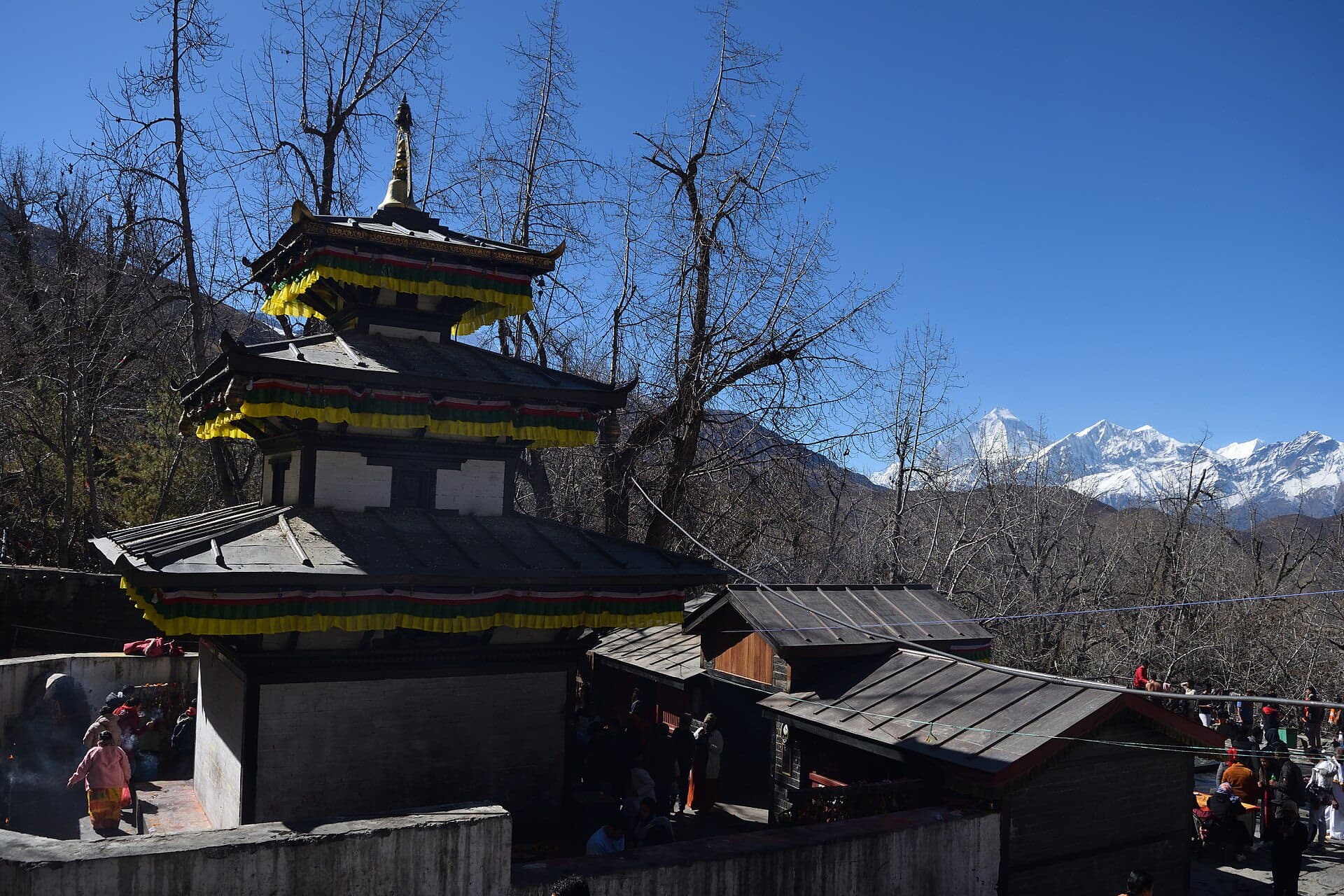
The main temple, a pagoda-style structure painted in reds and golds, houses the Vishnu image that has received worship for at least five centuries. The interior is dark, smoky with incense, crowded with offerings. The deity is small, blackened with the oils and pastes of countless puja. Hindu pilgrims prostrate, offer flowers, receive tika on foreheads. Buddhist pilgrims circumambulate, spin prayer wheels, make prostrations according to their practice. The priests—Hindu in morning and evening, Buddhist through the day—move through their respective rituals, the traditions overlapping without conflict.
The Jwala Mai temple, set slightly apart, contains the eternal flames. Here you witness what should be impossible: fire burning steadily from within a small spring, flames and water coexisting. Natural gas seeping through water-bearing rock creates this phenomenon, but explanation doesn't diminish wonder. Pilgrims stand before the flames in silence, understanding that they are seeing something that exceeds ordinary categories.
The return—descent if trekking, the long jeep ride to Jomsom—offers time to process. What happened at Muktinath? A bath in cold water, a visit to a temple, the sight of flames. Yet pilgrims consistently report something more: a sense of having been cleaned, lightened, released from something they couldn't have named before arriving but recognize having shed.
Muktinath Temple sits at 3,710 meters in a valley below Thorong La pass. The complex includes the main Vishnu temple, the Jwala Mai flame temple, 108 water spouts arranged in a semicircle, and two sacred pools (Mukti Kunda). The area is part of the Annapurna Conservation Area and offers views of Himalayan peaks on clear days.
Muktinath can be understood through Hindu theology as a liberation site, through Buddhist cosmology as a Tantric power place, through geology as a natural gas phenomenon, or through Nepal's genius for religious synthesis. Each lens illuminates different aspects of why this high-altitude temple draws seekers across traditions.
Scholars note Muktinath's exceptional status in multiple religious cartographies: one of 108 Divya Desam, one of 8 Svayam Vyakta Ksetras, one of 24 Tantric places, a Shakti Peetha. This overdetermination suggests the site was recognized as sacred by different traditions independently, each developing theological explanations for what they encountered. The Hindu-Buddhist sharing of the temple offers a model of religious coexistence that scholars of religion find instructive.
For Hindu devotees, Muktinath is one of the few places on earth where moksha—complete liberation from the cycle of rebirth—can be attained. The presence of all five elements signals completion, wholeness, the point where categories collapse into unity. For Buddhist practitioners, the site's association with Guru Rinpoche and its status as a Tantric power place mean that practice here is supercharged, accelerated by the blessings of masters who came before.
Some visitors approach Muktinath through frameworks of earth energy, ley lines, or universal sacred geography. The convergence of elements, the eternal flames, and the high altitude are seen as markers of a power point that different traditions have recognized using their own vocabularies.
Why fire burns from water here has a geological explanation—natural gas seeping through water-bearing rock—but why this particular phenomenon occurs at a site already considered sacred raises questions about the relationship between natural wonder and religious recognition. Did the flames create the sacredness, or did their appearance at an already-sacred site confirm it?
Visit Planning
Muktinath is accessible by jeep from Jomsom (2-3 hours) or by trekking the Annapurna Circuit over Thorong La pass. The temple sits at 3,710 meters; proper acclimatization is essential. Best visited March-May or September-November.
By air: Fly Kathmandu or Pokhara to Jomsom, then jeep to Muktinath (2-3 hours). By trek: Annapurna Circuit crosses Thorong La (5,416m) to reach Muktinath (typically 10-14 days from Besisahar). By helicopter: Direct helicopter pilgrimage from Kathmandu or Pokhara available.
Required permits: Annapurna Conservation Area Permit (ACAP) and TIMS card, obtained in Kathmandu or Pokhara.
Basic guesthouses available in Muktinath and nearby Ranipauwa village. Jomsom (24km) offers more options. Standards are simple at this altitude—expect shared bathrooms and limited heating.
Muktinath welcomes visitors of all faiths. Remove shoes before entering temples, walk clockwise around sacred structures, and dress modestly. Respect both Hindu and Buddhist practices—this is a shared sacred space.
Muktinath is remarkable for welcoming all who come with respect. Unlike some Hindu temples that restrict entry to non-Hindus, Muktinath's doors open to everyone. This hospitality asks something in return: genuine respect for the multiple traditions that share this space.
The most basic gestures matter. Remove shoes before entering the temple building. Walk clockwise around the temple, the spouts, and any stupas or shrines. If you encounter a ceremony—Hindu aarti or Buddhist offerings—remain quiet and observe without disruption.
For the water ritual, modest bathing attire is appropriate. Many pilgrims bathe in lightweight clothing that dries quickly. Complete nudity is not practiced. If you don't wish to get fully wet, passing under a few spouts or simply touching the water to your forehead is still meaningful.
At the eternal flames, approach with awareness that you're witnessing something that many consider miraculous. Whether you share that view or understand it as natural gas, behave accordingly.
Modest clothing covering shoulders and knees. For water ritual, lightweight quick-dry clothing or bathing attire. Bring warm layers—temperatures are cold at this altitude.
Generally permitted in outdoor areas. Ask before photographing inside temples or during rituals. Be respectful photographing pilgrims, especially during bathing.
Flowers, incense, and food offerings are traditional and can be purchased near the temple. No offering is required for visitors.
{"Remove shoes in temple","Walk clockwise","Maintain quiet during ceremonies","No pointing feet toward altars"}
Sacred Cluster
Nearby sacred places create the location cluster described in the growth plan. This block is intentionally crawlable and links into the wider regional graph.