Manakamana Temple
Where the goddess of the heart's desire grants wishes above the clouds
Gorkha, Gandaki Province, Nepal
At A Glance
- Coordinates
- 28.0003, 84.6322
- Suggested Duration
- Half-day trip from Kathmandu (3-4 hours each way by road plus temple time) or day trip from Pokhara (2-3 hours each way). Allow 10 minutes for cable car each direction, 1-2 hours at temple including queue time. During festivals, plan for 3-4 hours at temple.
- Access
- The cable car departs from Kurintar, approximately 100km west of Kathmandu on the Prithvi Highway (toward Pokhara). Buses from Kathmandu or Pokhara stop at Kurintar. Private vehicles can park at the base station. The cable car operates 8:00 AM to 5:00 PM daily with a lunch break from 12:00 to 1:30 PM. Ticket price is approximately $10 USD for foreigners, Rs 250 for Nepali citizens. Alternative access is a 4-hour hiking trail from the valley floor, passing through villages and forests.
Pilgrim Tips
- The cable car departs from Kurintar, approximately 100km west of Kathmandu on the Prithvi Highway (toward Pokhara). Buses from Kathmandu or Pokhara stop at Kurintar. Private vehicles can park at the base station. The cable car operates 8:00 AM to 5:00 PM daily with a lunch break from 12:00 to 1:30 PM. Ticket price is approximately $10 USD for foreigners, Rs 250 for Nepali citizens. Alternative access is a 4-hour hiking trail from the valley floor, passing through villages and forests.
- Modest clothing covering shoulders and knees. Traditional dress appreciated but not required. Remove shoes before entering temple buildings.
- Exterior photography generally permitted. Ask permission before photographing inside the temple, during rituals, or capturing individuals. Do not photograph animal sacrifices without explicit consent.
- Animal sacrifice occurs regularly at Manakamana, particularly on Saturdays and during festivals. If witnessing sacrifice would be disturbing, visit on weekdays and avoid the main sacrificial areas. The practice is integral to traditional worship and should be approached with respect rather than judgment. The temple can be extremely crowded during Dashain and weekends—queues of two to three hours are common. If seeking a contemplative experience, visit on weekday mornings.
Overview
Perched at 1,300 meters in Nepal's Gorkha hills, Manakamana Temple draws hundreds of thousands of pilgrims yearly to petition the goddess Bhagwati, an incarnation of Parvati believed to fulfill sincere wishes. Reached by Nepal's first cable car—a ten-minute ascent from the valley floor—the temple traces its origin to a 17th-century miracle: blood and milk flowing from a split stone, marking where a queen who was secretly divine promised to return. Newlyweds seek sons, families seek health, the desperate seek deliverance.
The name says everything: Manakamana—the wish of the heart. This is a temple where people come to ask, and where many believe they receive. Perched on Kafakdada Hill in Nepal's Gorkha district, the shrine to goddess Bhagwati has drawn pilgrims for four centuries. What they carry up the mountain are the things that matter most: longing for children, prayers for health, hopes for prosperity, requests too personal to speak aloud.
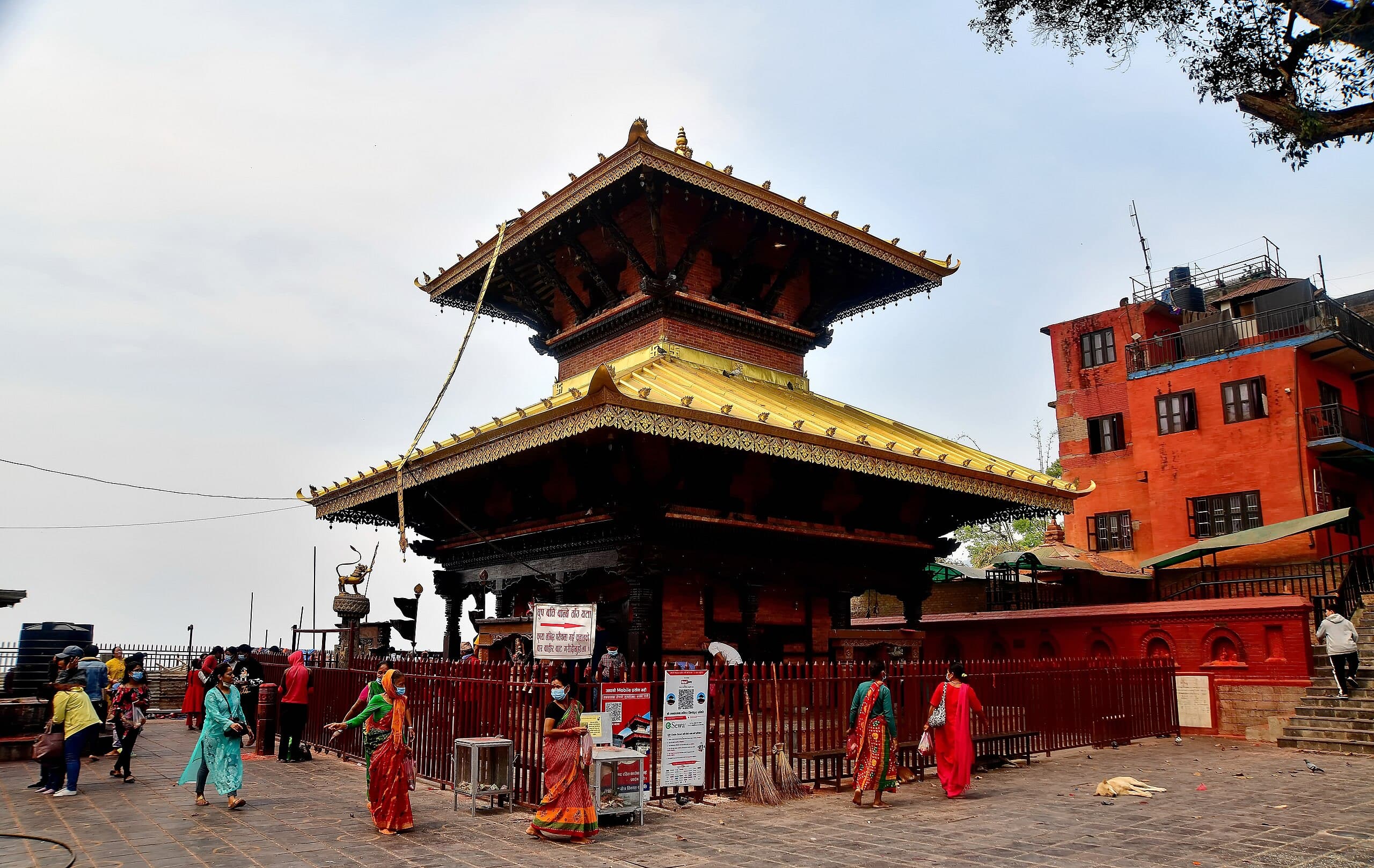
The temple itself is modest—a two-story pagoda in traditional Nepali style, red and weathered, crowded with devotees pressing forward to glimpse the goddess. Yet what makes Manakamana distinctive is not its architecture but its reputation. Among Nepal's many shrines, this one is known specifically for answering prayers. Newari newlyweds travel here seeking sons. Families facing illness come seeking cures. Business owners seek fortune. The goddess, devotees say, listens.
Since 1998, a cable car has transformed the pilgrimage. What once required hours of hiking now takes ten minutes, the cabin rising from subtropical valley to mountain shrine while the Trisuli and Marsyangdi rivers gleam below. Some purists lament the ease; others see it as the goddess making herself accessible. What has not changed is the essential transaction: a devotee approaches with a wish, makes an offering, and waits to see what unfolds.
Context And Lineage
Manakamana Temple emerged in 17th-century Nepal when a miraculous stone revealed the goddess's continued presence. The shrine is maintained by Magar priests descended from the original devotee who recognized the miracle. The 1998 cable car transformed an arduous pilgrimage into accessible mass devotion.
The legend of Manakamana begins with Queen Champavati of Gorkha, who secretly possessed divine powers. Only her devoted priest, Lakhan Thapa of the Magar community, knew her true nature. One day, the king discovered his wife in her goddess form—some versions say he saw her as Manakamana Devi with Lakhan Thapa appearing as her lion vehicle. The king died mysteriously after this revelation. The queen, following the practice of sati, immolated herself on her husband's funeral pyre, but promised Lakhan Thapa she would return.
Six months later, a farmer splitting stones while plowing struck one from which blood and milk streamed forth. Lakhan Thapa recognized the sign immediately. He performed tantric rituals to halt the flow and established the first shrine on that spot. The stone became the sacred image of the goddess, and Lakhan Thapa became the first priest of a lineage that continues to the 17th generation today.
The priesthood of Manakamana Temple follows a unique hereditary system. By tradition and continuing practice, priests must be Magar—members of the indigenous ethnic group to which Saint Lakhan Thapa belonged. The current chief priest is the 17th generation descendant of Lakhan Thapa. This unbroken lineage connects contemporary worship directly to the temple's miraculous founding.
Queen Champavati
Divine incarnation
Saint Lakhan Thapa Magar
Temple founder and first priest
King Ram Shah
Gorkha king
Why This Place Is Sacred
Manakamana occupies a ridge where the veil between human desire and divine response is said to be particularly permeable. Four centuries of concentrated prayer—millions of wishes offered with genuine need—have created what devotees experience as a field of possibility. The goddess is not distant here but present, listening, inclined to respond.
The thinness at Manakamana is less about landscape than about accumulated intention. Yes, the setting contributes: the temple sits at 1,300 meters, where the foothills give way to views of the Himalayan giants, where clouds drift at eye level and the world below becomes small and distant. The cable car ascent literalizes the spiritual movement—rising from the mundane to the sacred, leaving the valley of ordinary concerns for a hilltop where wishes might be heard.
But what makes Manakamana thin is primarily the density of human longing concentrated here. For four hundred years, people have climbed this hill (now ridden this cable) with wishes they could not fulfill themselves. The temple has absorbed millions of prayers—for children, for health, for deliverance from suffering. According to devotees, this accumulated devotion has created a kind of spiritual charge, a responsiveness in the divine that makes petitions here more likely to be answered than prayers offered elsewhere.
The goddess herself is understood as both incarnate and responsive. Unlike deities who are remote or abstract, Manakamana Devi is believed to pay attention. She notices sincerity. She rewards devotion. She has, by reputation, actually delivered: the children who were born, the illnesses that receded, the fortunes that turned. These testimonies, passed down and believed, intensify the thinness. Each granted wish makes the next seem more possible.
The origin story reinforces this porousness. The goddess did not simply appear in a vision but manifested physically—blood and milk from split stone, a miracle witnessed and confirmed. The queen who secretly held divine power promised to return, and she did. The boundary between human and divine was crossed once in spectacular fashion; at Manakamana, it remains more crossable than elsewhere.
Manakamana Temple was established in the 17th century when Saint Lakhan Thapa Magar recognized the miraculous reappearance of goddess Bhagwati in a stone that bled blood and milk. The site was consecrated to continue the goddess's promise to fulfill devotees' wishes, a purpose it has served continuously since.
The temple's core function—wish fulfillment—has remained unchanged for four centuries. What has evolved is accessibility. The traditional pilgrimage required a four-hour hike through forests and villages, creating a natural selection for serious devotees. The 1998 cable car installation, Nepal's first, transformed Manakamana into a mass pilgrimage destination accessible to elderly, disabled, and casual visitors. Annual attendance now reaches hundreds of thousands. Animal sacrifice, once central, is increasingly supplemented or replaced by symbolic offerings as attitudes shift.
Traditions And Practice
Worship at Manakamana centers on making offerings to the goddess while presenting one's heartfelt wish. Traditional offerings include animal sacrifice, particularly goats and chickens, though symbolic offerings of flowers, coconuts, and sweets are increasingly common. The goddess is approached with specific requests—for children, health, prosperity, or resolution of difficulties.
The traditional worship at Manakamana involves approaching the goddess with a specific wish and making an offering proportional to the request's significance. Animal sacrifice—goats and chickens—has been the most powerful form of offering, understood as giving one's most valuable possession to the goddess. The animal's blood is offered to the deity, and the meat becomes prasad, shared among devotees and the community.
Other traditional practices include lighting oil lamps and incense, applying vermillion tika to the goddess's image and receiving it on one's own forehead, circumambulating the temple clockwise, tying sacred threads at designated spots, and placing coins in offering boxes. Pilgrims may also perform ritual bathing before ascending to the temple, purifying themselves before approaching the divine.
Contemporary practice at Manakamana reflects shifting attitudes toward animal sacrifice. While traditional offerings continue, particularly on Saturdays and during festivals, many devotees now choose symbolic alternatives: coconuts (whose breaking represents sacrifice), flowers, fruits, sweets, and incense. This shift has accelerated as younger and urban devotees prefer offerings that feel less violent.
The cable car has also transformed pilgrimage patterns. The traditional four-hour hike created a separation between ordinary life and sacred encounter; the ten-minute ride compresses this transition. Some devotees still choose to walk, seeing physical effort as part of the offering. Others make multiple quick visits throughout the year rather than one annual pilgrimage.
Festival periods, especially Dashain (Navaratri) and Nag Panchami, see the temple at maximum capacity. During Dashain, the goddess receives special worship as one of the forms of Durga, and pilgrims often wait hours in queue to reach the inner shrine.
Visitors seeking meaningful engagement might consider approaching the temple with a genuine intention—something you actually wish for or need. Whether you make a traditional offering or a symbolic one matters less than the sincerity of your approach. Taking time to sit quietly in the courtyard after worship, reflecting on what you've asked, can deepen the experience. Observing how Nepali families approach the goddess—with directness, familiarity, and confidence—offers a window into lived Hindu devotion.
Hinduism (Shaktism)
ActiveManakamana is considered a Shakti Peetha—a site of concentrated divine feminine power. The goddess Bhagwati is worshipped as an incarnation of Parvati with the specific capacity to fulfill devotees' heartfelt wishes. The temple is especially important for Newari newlyweds seeking blessings and for anyone facing circumstances beyond human control.
Daily puja by hereditary Magar priests, animal sacrifice (goats and chickens), offerings of flowers, fruits, coconuts, and sweets, application of vermillion tika, lighting of oil lamps, clockwise circumambulation, tying of sacred threads. Special ceremonies during Dashain and Nag Panchami.
Experience And Perspectives
The Manakamana experience begins with ascent—ten minutes suspended above rice terraces and river gorges as the cable car rises toward the temple ridge. At the top, crowds press toward the small pagoda, offerings in hand. The atmosphere is devotional, earnest, sometimes desperate. After making your wish, you descend carrying hope—and later, perhaps, a story of the goddess's response.
The approach to Manakamana now begins at Kurintar, a small town where the cable car base station sits beside the Prithvi Highway. The queue here can stretch for hours on weekends and festivals—pilgrims clutching tickets and offerings, some carrying chickens in baskets or leading goats that will ride the cargo cars. The atmosphere is neither solemn nor festive but expectant: people have come with specific requests, and the waiting is charged with the weight of what they hope to receive.
The cable car rises through a dramatic landscape—rice terraces giving way to forest, the Trisuli River shrinking to a silver thread below. Fellow passengers may be a family with a newborn seeking blessings, an elderly couple on what might be their final pilgrimage, businesspeople hoping to seal a deal with divine favor. No one speaks much during the ascent. The cabin sways gently. Clouds drift at window level. The temple complex appears ahead, red rooftops and prayer flags against green hills.
At the top station, the final approach is on foot—a short walk past vendors selling offerings (flowers, coconuts, vermillion powder, small bells) and food stalls serving traditional snacks. The temple courtyard is typically crowded, with pilgrims queuing to enter the inner shrine. The air smells of incense, marigolds, and something sharper when sacrifices are being performed.
Inside, the space is intimate and overwhelming. The goddess—represented by a stone image believed to be the very stone from which blood and milk once flowed—receives devotees in rapid succession. Priests accept offerings, apply tika to foreheads, and move the line along. The moment before the deity is brief but dense: this is when you make your wish, silently or whispered, focusing everything on what you most need.
After circumambulating the temple, pilgrims often sit in the courtyard or at viewpoints overlooking the valley, processing what they've done and what they hope will follow. Some eat prasad, the blessed food distributed after puja. Some take photographs with the Himalayan panorama behind them. The descent by cable car offers time for reflection: the wish has been made, the offering given. What remains is waiting, and faith.
The temple complex sits atop Kafakdada Hill at 1,302 meters elevation. The main temple is a modest two-story pagoda housing the sacred stone image of the goddess. Surrounding structures include rest houses, food stalls, and shops. The cable car top station is a short walk from the temple. Views extend to the Manaslu, Himchuli, and Annapurna ranges on clear days.
Manakamana can be understood as a site of living faith, a cultural artifact of the Gorkha kingdom, a case study in how modern infrastructure transforms pilgrimage, or a nexus where human longing and divine response are believed to meet. Each lens reveals something different about why this hilltop temple draws hundreds of thousands yearly.
Scholars situate Manakamana within the broader context of Shakti worship in the Himalayan region and the political history of the Gorkha kingdom that unified Nepal. The temple's founding coincided with the rise of the Shah dynasty, linking goddess worship to royal power. The mandatory Magar priesthood represents indigenous ethnic participation in Hindu religious structures, complicating simple narratives about Hinduism as an upper-caste import. The 1998 cable car installation offers a case study in how modern infrastructure transforms sacred geography—increasing access while potentially diluting the pilgrimage experience.
For devotees, Manakamana Devi is simply present and responsive. The theological questions scholars raise matter less than the practical reality: the goddess listens, and she grants wishes. Testimonies of fulfilled prayers—the long-awaited pregnancy, the successful surgery, the business that turned around—circulate through families and communities, reinforcing faith. The Magar priests, now in their 17th generation from Lakhan Thapa, maintain the connection to the original miracle. Animal sacrifice, while questioned by outsiders, is understood as the highest form of offering—giving what is most valuable to receive what is most needed.
Some visitors approach Manakamana through a lens of manifestation or law of attraction, seeing the temple as a place where focused intention becomes reality. The concentration of prayers over four centuries may have created, in this view, an energetic field that amplifies intention. The cable car's dramatic ascent through clouds literalizes the movement from ordinary to sacred consciousness.
The exact circumstances of Queen Champavati's divine nature remain unclear—was she born divine or did divinity awaken in her? Why did the king die upon discovering her form? The mechanism by which blood and milk flowed from the stone is not explained. Most fundamentally, the question of whether wishes are actually granted more often at Manakamana than they would be by chance remains a matter of faith rather than documentation.
Visit Planning
Manakamana is accessible via Nepal's first cable car from Kurintar, a ten-minute ride costing approximately $10 for foreigners. The temple is a popular day trip from Kathmandu or Pokhara. Weekdays offer shorter queues; Dashain festival and Saturdays are extremely crowded.
The cable car departs from Kurintar, approximately 100km west of Kathmandu on the Prithvi Highway (toward Pokhara). Buses from Kathmandu or Pokhara stop at Kurintar. Private vehicles can park at the base station. The cable car operates 8:00 AM to 5:00 PM daily with a lunch break from 12:00 to 1:30 PM. Ticket price is approximately $10 USD for foreigners, Rs 250 for Nepali citizens. Alternative access is a 4-hour hiking trail from the valley floor, passing through villages and forests.
Most visitors treat Manakamana as a day trip. Basic guesthouses exist near the temple for those wishing to stay overnight. The nearest comfortable hotels are in Mugling (30 minutes by road from Kurintar) or Gorkha town.
Manakamana is an active temple where Hindu worship continues daily. Visitors should dress modestly, remove shoes before entering the temple, walk clockwise around sacred structures, and maintain respectful behavior during prayers and ceremonies.
Entering Manakamana Temple, you enter a space of active devotion. This is not a heritage site or museum but a living shrine where people come with urgent requests and genuine faith. The Magar priests who tend the goddess are maintaining a four-hundred-year lineage. The devotees pressing toward the inner shrine may be asking for things that matter desperately to them: a child after years of trying, healing for a sick parent, relief from poverty that has crushed their family.
Respect begins with attire. Cover shoulders and knees. Traditional Nepali dress is appreciated but not required—clean, modest clothing in any style is acceptable. Remove shoes before entering the temple building; sandals make this easier.
Move with the flow. Walk clockwise around the temple and any sacred objects. Don't push ahead of others in line; wait your turn to approach the goddess. When you reach the inner shrine, you'll have only a moment—make your offering, receive tika if offered, and move along so others can approach.
Be thoughtful about photography. Exterior photos are generally fine. Inside the temple, during ceremonies, or of the goddess herself, ask permission first. Never photograph animal sacrifices unless you have explicit consent from those involved and can do so without being voyeuristic.
If you witness sacrifice, observe without interference or visible distaste. This is a sacred act for those performing it, whatever your personal feelings. You may choose not to watch, but don't express disgust or try to intervene.
Modest clothing covering shoulders and knees. Traditional dress appreciated but not required. Remove shoes before entering temple buildings.
Exterior photography generally permitted. Ask permission before photographing inside the temple, during rituals, or capturing individuals. Do not photograph animal sacrifices without explicit consent.
Flowers, fruits, coconuts, sweets, incense, and oil lamps are common offerings available from vendors near the temple. Animal sacrifice (goats, chickens) is traditional; animals can be purchased locally or transported via cable car. No offering is required—you may simply receive darshan (viewing of the goddess) and blessings.
{"Remove shoes before entering temple","Walk clockwise around temple and sacred objects","Do not point feet toward the deity","Maintain quiet during prayers and ceremonies","Do not touch the sacred image or enter restricted priest areas"}
Sacred Cluster
Nearby sacred places create the location cluster described in the growth plan. This block is intentionally crawlable and links into the wider regional graph.