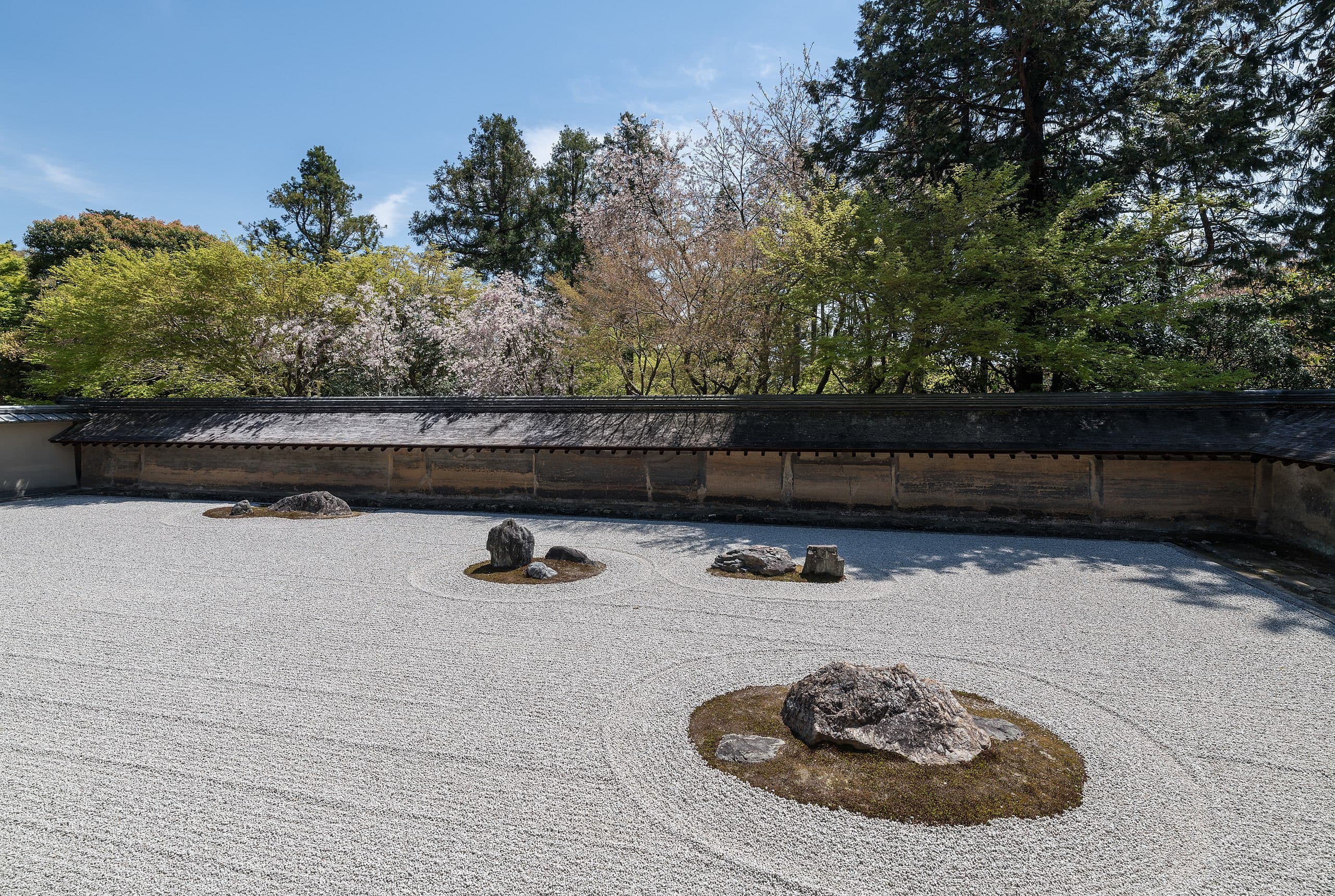
Ryoan-ji
Fifteen stones in raked gravel, one always hidden - a Zen koan rendered in rock and silence
Kyoto, Kyoto Prefecture, Japan
At A Glance
- Coordinates
- 35.0340, 135.7177
- Suggested Duration
- 1-2 hours for a thoughtful visit that includes both the rock garden and pond garden
- Access
- Open 8:00 AM - 5:00 PM (March-November), 8:30 AM - 4:30 PM (December-February). Admission approximately 500 yen. Accessible by bus from Kyoto Station or walking distance from Kinkaku-ji.
Pilgrim Tips
- Open 8:00 AM - 5:00 PM (March-November), 8:30 AM - 4:30 PM (December-February). Admission approximately 500 yen. Accessible by bus from Kyoto Station or walking distance from Kinkaku-ji.
- No specific dress code, though respectful casual attire is appropriate for a Buddhist temple.
- Photography is permitted in most areas including the rock garden. However, visitors should be mindful not to disturb others' contemplation.
- The rock garden can be very crowded, especially during peak tourist seasons. This may interfere with contemplative experience. Early morning or late afternoon visits are recommended for those seeking quieter encounters.
Overview
Ryoan-ji in Kyoto holds the world's most celebrated Zen rock garden. Fifteen stones rest on raked white gravel, arranged so that from any viewing point, one remains hidden. This puzzle in stone has invited contemplation for over five centuries, teaching without words that human perception can never grasp the whole.
In northwest Kyoto stands Ryoan-ji, the Temple of the Dragon at Peace. Within its walls lies what many consider the supreme expression of Zen Buddhist art: a garden of fifteen stones arranged on raked white gravel, enclosed by an earthen wall stained with age.
The garden appears deceptively simple - just rocks and gravel in a rectangle of about 250 square meters. Yet its effect is profound. From the wooden veranda of the hojo (abbot's quarters), visitors gaze at what cannot be solved. The stones are arranged so that from any viewing point, only fourteen are visible. One is always hidden.
This is no accident. In Asian thought, fifteen represents perfection. We cannot perceive perfection because we ourselves are imperfect. The garden is a visual koan - a puzzle that cannot be solved by intellect but may open a door to direct insight.
Since 1450, when the warrior Hosokawa Katsumoto converted his villa into a Zen temple, Ryoan-ji has offered this teaching. The Onin War destroyed the original temple; the garden was likely created during the reconstruction. Who designed it remains unknown - perhaps a master gardener, perhaps the monks themselves. This mystery adds another layer of emptiness to the enigma.
Today Ryoan-ji is both a UNESCO World Heritage Site and an active Rinzai Zen temple. Monks still practice here. The garden continues its teaching, patient as stone, inviting each visitor to sit, to look, and perhaps to see.
Context And Lineage
A Rinzai Zen temple since 1450, home to the world's most famous rock garden and seven imperial tombs.
Ryoan-ji's story begins before the temple existed. In the 11th century, this was a Fujiwara clan estate, featuring Daiju-in temple and a beautiful pond garden (Kyoyochi) that still exists today.
In 1450, the powerful warrior Hosokawa Katsumoto acquired the estate and converted it into a Zen temple. He invited Giten Gensho, the 5th abbot of the great Myoshin-ji temple, to serve as founding master. The temple took the name Ryoan-ji - Temple of the Dragon at Peace.
The Onin War (1467-1477) devastated Kyoto and destroyed Ryoan-ji. Hosokawa's son Masamoto rebuilt it, and it is during this reconstruction that the famous rock garden likely appeared. Who designed it remains unknown - one of the great mysteries of Japanese art history.
In 1797, fire destroyed the main hall (hojo). The current hojo was brought from Seigenin temple, and with it came the rock garden exactly as we see it today. The Seven Imperial Tombs on the grounds connect the temple to Japan's imperial spiritual tradition.
Ryoan-ji belongs to the Myoshin-ji school of Rinzai Zen Buddhism, one of the largest and most important Zen lineages in Japan. This school traces its origin to the Chinese Lin-chi (Rinzai) tradition, which emphasizes sudden enlightenment through direct insight. The temple maintains connection to Myoshin-ji, its parent temple, and continues as an active place of Zen practice with monks in residence.
Hosokawa Katsumoto
Temple founder
Giten Gensho
First abbot
Unknown garden designer
Creator of the rock garden
Why This Place Is Sacred
Ryoan-ji is thin where thought dissolves, where the simplest arrangement reveals the limits of perception.
The thinness of Ryoan-ji is unlike any other sacred site. Most thin places work through grandeur, age, or natural power. Ryoan-ji works through emptiness.
The rock garden strips away everything extraneous. There are no flowers, no trees, no water, no movement except the slow changes of light across raked gravel. What remains are rocks, space, and the quality of attention the visitor brings.
In this reduction, something opens. The mind, seeking meaning in the arrangement, finds itself running in circles. Why these stones? Why this placement? What do they represent - islands, mountains, tigers crossing a river? Every interpretation proposed over the centuries has failed to exhaust the garden's meaning.
This failure is the teaching. The mind wants to grasp, categorize, solve. The garden refuses. In that refusal, some visitors experience a loosening of the grip of thought itself - a moment when the separation between observer and observed, between self and world, grows thin.
The hidden fifteenth stone ensures that the perception of completeness is never possible. There is always more than can be seen. This is the truth about reality that Zen practice aims to reveal - and Ryoan-ji's garden teaches it without a word.
Ryoan-ji's rock garden was created as a meditation tool for Zen monks. In Rinzai Zen tradition, enlightenment comes through direct insight, often catalyzed by koans - puzzles that cannot be solved through logic. The garden serves as a visual koan, training the mind to release its grip on conceptual understanding and open to direct perception.
Over five centuries, Ryoan-ji's garden has evolved from a monastic meditation tool to a global symbol of Japanese Buddhist culture. Queen Elizabeth II's 1975 visit brought international attention. Yet the garden itself remains unchanged - the same stones, the same gravel, the same teaching. What has evolved is the range of people who encounter it, from practicing monks to tourists to seekers who may never have heard of Zen but find themselves transformed by sitting in silence before the stones.
Traditions And Practice
The primary practice is contemplation of the rock garden; the temple also maintains traditional Zen services.
Traditional Zen practice at Ryoan-ji includes zazen meditation, koan study, and the various ceremonies and rituals of Rinzai Zen monasticism. The rock garden serves as a contemplation tool, its form functioning as a visual koan. Tea ceremony also has deep roots here, connected to Zen aesthetics.
Today, Ryoan-ji's resident monks maintain traditional Zen practice and temple services. For visitors, the primary practice is contemplation of the rock garden from the hojo veranda. Walking meditation in the pond garden is also possible. A tea shop on the grounds offers the opportunity to drink tea in connection with the Zen aesthetic.
Visitors seeking spiritual experience at Ryoan-ji might arrive early or late to avoid peak crowds. Find a place on the veranda and simply sit. Allow time - not just to look at the garden but to let the garden work on you. Try counting the stones; notice the moment when you realize one is always hidden. Let go of trying to 'understand' the garden and simply perceive it. After the rock garden, walk slowly around the pond garden, practicing mindfulness with each step.
Rinzai Zen Buddhism
ActiveRyoan-ji belongs to the Myoshin-ji school of Rinzai Zen Buddhism. The Rinzai tradition emphasizes sudden enlightenment through direct insight, often catalyzed by koan study and zazen meditation. The famous rock garden exemplifies Zen aesthetics and functions as a visual koan - inviting the viewer to look beyond apparent simplicity to perceive deeper truths.
Zazen meditation, koan study, mindful contemplation of the rock garden, tea ceremony
Experience And Perspectives
Contemplating the rock garden from the hojo veranda invites a shift from looking to seeing, from thinking to perceiving.
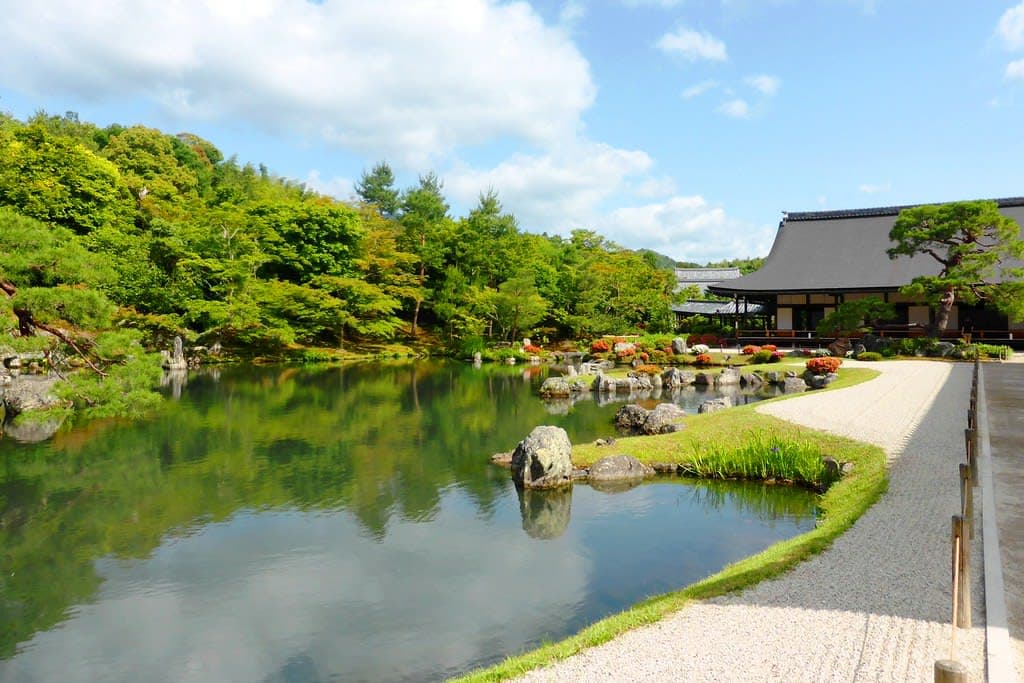
Visitors to Ryoan-ji typically enter through the temple gate and follow a path past the Kyoyochi pond, remnant of the original Fujiwara estate. The walk itself begins to shift awareness - the beauty of the surroundings, the absence of rush.
The approach to the rock garden leads through the hojo, the abbot's quarters. Removing shoes, visitors step onto the wooden veranda that runs along the garden's edge. Here, often crowded, sometimes quiet, the viewing begins.
The first response is often intellectual: counting the stones, trying to see all fifteen, analyzing the arrangement. This is natural. The garden invites this response so that it can demonstrate its failure.
With time, if time is given, something else can emerge. The gravel's raked lines, maintained by monks each morning, draw the eye in patterns that suggest water or waves. The stones seem to hold their positions with great stillness. The earthen wall, stained by centuries of oil from the clay, creates a boundary that focuses attention inward.
What happens next varies. Some visitors feel calm. Some feel irritated by the crowds or their own inability to 'get it.' Some experience a subtle shift - the sense that they are not looking at the garden but the garden is looking at them, or that the distinction no longer matters.
The temple offers more than the rock garden: the pond garden with its walking path, the temple buildings, a tea shop for rest. But it is the rock garden that draws visitors back, some returning year after year to sit again with the stones.
Ryoan-ji stands in northwest Kyoto's Ukyo ward, within walking distance of Kinkaku-ji (Golden Pavilion). The temple complex includes the famous rock garden viewed from the hojo, the Kyoyochi pond garden, and temple buildings. The rock garden cannot be entered; it is viewed from the wooden veranda.
Ryoan-ji's rock garden has been interpreted through multiple frameworks, though it resists reduction to any single meaning.
Art historians recognize the rock garden as the supreme example of karesansui, the dry landscape garden tradition that flourished during the Muromachi period alongside Zen Buddhism. Scholars debate its authorship, date of creation, and original meaning, but agree it represents sophisticated expression of Zen aesthetic principles: simplicity, asymmetry, and pregnant emptiness (ma). The garden demonstrates how reduction to essentials can create greater meaning than elaboration.
In Zen Buddhist understanding, the garden is not a puzzle to be solved but a meditation tool. Its meaning is found not in intellectual interpretation but in the direct experience of contemplation. The garden teaches without words - which is exactly how Zen masters teach. The hidden stone demonstrates that complete perception is impossible for limited beings, an insight that can catalyze release from the illusion of comprehensive understanding.
Various theories propose the stones represent islands in a sea, tigers crossing a river with cubs, mountain peaks above clouds, or encode geometric principles. Some see the garden as a mandala or cosmological diagram. These interpretations may each contain partial truth, or they may miss the point entirely - which is itself a teaching.
The great mysteries of Ryoan-ji include who designed the rock garden, exactly when it was created, what meaning (if any) was intended in the stone arrangement, and whether the 'hidden stone' effect was intentional or serendipitous. These mysteries may never be solved, and perhaps should not be. The unknown is part of the teaching.
Visit Planning
Open year-round with admission fee; 1-2 hours for thoughtful visit; arrive early or late to avoid crowds.
Open 8:00 AM - 5:00 PM (March-November), 8:30 AM - 4:30 PM (December-February). Admission approximately 500 yen. Accessible by bus from Kyoto Station or walking distance from Kinkaku-ji.
Abundant accommodation options throughout Kyoto; some temple stays available in the region
Maintain quiet contemplation; remove shoes in the hojo; do not enter the rock garden.
Ryoan-ji requires the reverent behavior appropriate to a Buddhist temple and UNESCO World Heritage Site. The rock garden is viewed from the veranda; entering the garden is prohibited. The raked gravel is maintained each morning by the monks and must remain undisturbed.
Remove shoes when entering the hojo (abbot's quarters). Maintain quiet appropriate to contemplation - this is not a place for loud conversation or phone calls. The garden is a meditation tool, and respecting others' contemplative experience is essential.
The temple is an active place of Buddhist practice. While visitors are welcomed, they are guests in a monastic setting.
No specific dress code, though respectful casual attire is appropriate for a Buddhist temple.
Photography is permitted in most areas including the rock garden. However, visitors should be mindful not to disturb others' contemplation.
Offerings are not traditional at this site; temple admission fee supports maintenance.
{"Do not enter the rock garden","Remove shoes when entering the hojo","Maintain quiet, contemplative atmosphere","Some private temple areas are not accessible"}
Sacred Cluster
Nearby sacred places create the location cluster described in the growth plan. This block is intentionally crawlable and links into the wider regional graph.