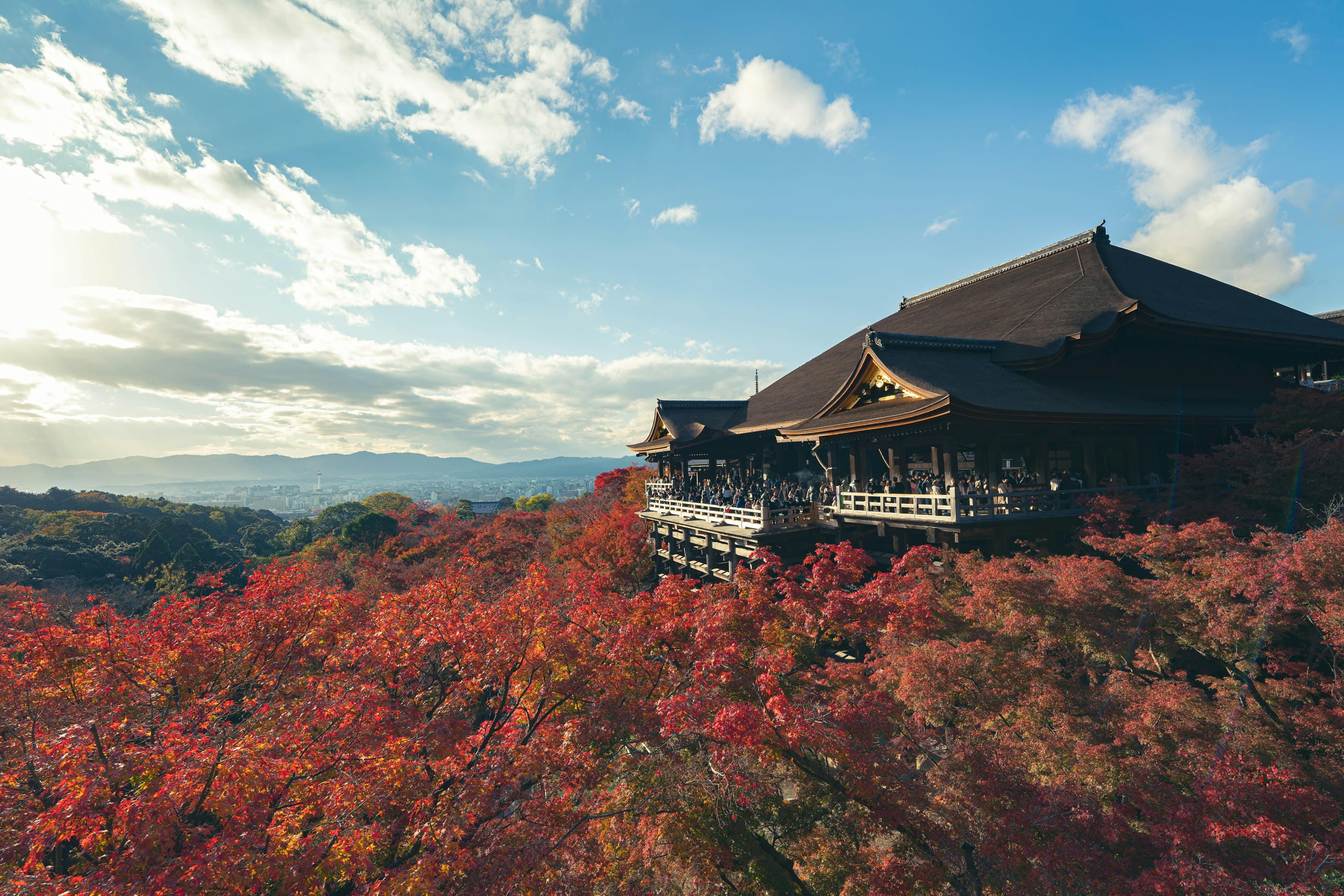
Kiyomizu-dera Temple
A wooden stage suspended between mountain and sky, where water has been pure for twelve centuries
Kyoto, Kyoto Prefecture, Japan
At A Glance
- Coordinates
- 34.9948, 135.7850
- Suggested Duration
- 1.5 to 2.5 hours for a thorough visit covering the main grounds, stage, Otowa waterfall, and subsidiary halls. Add additional time for the Tainai Meguri (30 minutes) or detailed exploration of Jishu Shrine. During peak seasons, additional time should be allowed for crowds.
Pilgrim Tips
- Modest clothing covering shoulders and legs is appreciated. Comfortable walking shoes are essential for the inclined paths, stone stairs, and sandy areas. Shoes must be removed before entering certain buildings.
- Permitted on temple grounds and from the stage. Flash prohibited inside buildings. Drones, tripods, and monopods forbidden. Commercial shoots, wedding photography, and cosplay sessions not permitted. Be mindful of worshippers and monks.
- The temple becomes extremely crowded during peak seasons—cherry blossom time (late March to early April), autumn foliage (mid-November to early December), and holidays. Early morning visits avoid the worst crowds. The stone paths and stairs can be slippery when wet. The Tainai Meguri is not recommended for those with severe claustrophobia, though the passage is neither long nor narrow—only completely dark.
Overview
On the forested slopes of Mount Otowa in eastern Kyoto, a vast wooden stage juts out over the valley—built without a single nail, supported by pillars of four-hundred-year-old zelkova, defying gravity and time. Kiyomizu-dera, the Temple of Pure Water, takes its name from the sacred spring that has flowed here since before Kyoto was a capital. For over 1,250 years, pilgrims have climbed this hillside to drink from its three streams and stand suspended between earth and heaven.
Kiyomizu-dera belongs to the category of places that alter perception. The famous stage extends thirteen meters over the wooded valley, creating a threshold experience: the city spreads below, the mountains rise behind, and the visitor stands on a platform of interlocking timber that holds through geometry alone. No nails. No metal. Only the ancient knowledge of Japanese joiners who understood that flexibility outlasts rigidity, that what can move together will not break apart.
The temple was founded in 778 CE—sixteen years before Kyoto became Japan's capital—when a monk named Enchin followed a golden stream to its source and discovered a white-robed ascetic who had been praying beneath the waterfall for two centuries. That ascetic was understood to be Kannon herself, the bodhisattva of compassion, appearing in human form. Today the eleven-faced, thousand-armed Kannon enshrined in the main hall remains hidden from view, unveiled only once every thirty-three years—a reminder that the sacred often works through concealment.
Three streams still descend from the sacred spring called Otowa, each believed to bestow a different blessing: longevity, academic success, romantic fulfillment. Visitors choose one stream and drink. The tradition teaches that choosing all three is greedy—that a clear heart knows what it truly seeks. Perhaps this is the temple's deepest teaching: that standing at the source, we must know ourselves well enough to ask for only what matters.
As the sixteenth station on Japan's oldest Buddhist pilgrimage route, Kiyomizu-dera has witnessed over a millennium of seekers ascending these slopes. They came in white robes and straw hats, chanting devotional poems composed by an emperor who walked this path a thousand years ago. They still come—now in tour groups and solitary contemplation alike—drawn by something that photographs cannot capture: the particular quality of standing where water runs pure and wood holds without iron, where the view extends farther than sight.
Context And Lineage
Founded in 778 CE by the monk Enchin, Kiyomizu-dera predates Kyoto's establishment as Japan's capital. The current main hall and famous stage date to 1633, rebuilt under the Tokugawa shogunate using traditional nail-less joinery. The temple serves as the sixteenth station on the Saigoku Kannon Pilgrimage, Japan's oldest Buddhist pilgrimage route. UNESCO World Heritage designation came in 1994 as part of the Historic Monuments of Ancient Kyoto.
In 778 CE, a monk named Kenshin—later known as Enchin—left Kofuku-ji Temple in Nara following a dream. An elderly figure in white robes had appeared to him, directing him north to Mount Otowa. Following a golden stream to its source, Enchin discovered a waterfall where a white-robed ascetic named Gyoei Koji had been practicing austerities and praying to the Thousand-Armed Kannon for two hundred years.
Gyoei told Enchin he had waited many years for his arrival and was now departing for the eastern provinces. Before leaving, he entrusted a sacred log to Enchin. Understanding that Gyoei was an incarnation of Kannon herself, Enchin carved a statue of the Eleven-Faced, Thousand-Armed Kannon from the wood and enshrined it in the hermitage.
Two years later, the military general Sakanoue no Tamuramaro entered the mountain seeking deer blood as medicine for his ailing wife. Upon encountering Enchin, the monk persuaded him of the sin of taking life. Tamuramaro converted to faith in Kannon and donated his own house as the temple's main hall, naming it Kiyomizu-dera—Temple of Pure Water—for the spring that had drawn Enchin to this place.
The temple burned repeatedly over the centuries—during the Onin War of 1467-1477, and again in 1629. The current main hall was rebuilt in 1633 under the patronage of the third Tokugawa shogun, Iemitsu. It stands today largely as it did then: a masterwork of traditional Japanese joinery, holding without nails through the knowledge of medieval carpenters.
Kiyomizu-dera belongs to the Kita-Hosso sect of Japanese Buddhism, which it has headed since 1965. The Hosso school is one of Japan's oldest Buddhist traditions, originating when Nara was the capital and emphasizing the study of consciousness and reality. The temple's primary focus, however, is devotion to Kannon—the bodhisattva of compassion who vows to save all beings and manifests in thirty-three forms. As the sixteenth temple on the Saigoku Kannon Pilgrimage, Kiyomizu-dera connects to a network of thirty-three temples spanning the Kansai region, a pilgrimage route over 1,300 years old and certified as Japan Heritage by the Agency for Cultural Affairs in 2019.
Enchin (Kenshin)
Founder
Gyoei Koji
Legendary figure / Bodhisattva manifestation
Sakanoue no Tamuramaro
Patron and benefactor
Tokugawa Iemitsu
Reconstructor
Why This Place Is Sacred
Kiyomizu-dera creates thinness through threshold architecture and elemental purity. The wooden stage suspends visitors between solid ground and empty space, between the mountain behind and the city below. The spring that gives the temple its name has flowed unchanged for twelve centuries. The hidden Buddha teaches that presence need not be visible to be felt. The darkness of the womb passage offers symbolic death and rebirth. Multiple thresholds converge: between nature and craft, concealment and revelation, form and formlessness.
What makes a place thin? At Kiyomizu-dera, the answer involves the interplay of elements: wood, water, air, and the human body moving through space designed to transform it.
The stage is the most obvious threshold. Projecting over the valley on its massive wooden pillars, it creates the visceral experience of standing beyond solid ground. The famous Japanese proverb—'to jump off the stage at Kiyomizu'—means to take a leap of faith, to make a decisive commitment. During the Edo period, some people actually jumped, believing that survival would grant their wish. The practice is now forbidden, but the architecture still produces the feeling: you are suspended, supported by nothing you can see from where you stand.
The three streams of Otowa waterfall create another threshold—between the pure and the ordinary, between nature and blessing. The water that has flowed here since before Japanese history was written represents continuity that outlasts human life spans. Drinking from one stream while consciously forgoing the others becomes an act of self-knowledge: what do I actually want?
Beneath the main hall, Zuigudo Hall offers the Tainai Meguri—the 'womb passage.' Visitors descend into complete darkness, guided only by prayer beads along the wall, walking through what represents the womb of Buddha's mother. At the center, a glowing stone bearing a Sanskrit character offers a moment to make a wish. Then the passage continues into light. This is symbolic death and rebirth, enacted through the body in darkness.
The hidden Buddha—the eleven-faced, thousand-armed Kannon that is the temple's principal image—creates thinness through absence. Shown to the public only once every thirty-three years (reflecting the thirty-three forms Kannon takes to save beings), this concealment generates a different kind of presence. What cannot be seen becomes more fully imagined. The veil becomes the teaching.
The mountain location itself separates sacred from mundane. Pilgrims must climb—through the shops and tea houses, up the sloping streets, through the vermilion gates—before arriving at the temple. The journey creates transition. By the time visitors reach the stage, they have already left ordinary life behind.
Kiyomizu-dera was founded as a site of Kannon worship, established where the monk Enchin discovered a sacred spring and encountered what he understood to be the bodhisattva herself in human form. The temple's purpose was devotional: to provide a place where the compassion of Kannon could be accessed through prayer, pilgrimage, and the drinking of pure water. As the sixteenth station on the Saigoku Kannon Pilgrimage—Japan's oldest Buddhist pilgrimage route—it served as a waypoint on a journey of spiritual transformation spanning thirty-three temples.
The temple has burned and been rebuilt repeatedly—most recently in 1633 under the Tokugawa shogunate, when the current main hall and stage were constructed. In 1965, Kiyomizu-dera became the head temple of a new Kita-Hosso sect, separating from the Hosso tradition while maintaining its essential practices. The Blue Dragon Festival, initiated in 2000, added a new layer of public ceremony. UNESCO World Heritage designation in 1994 recognized the temple's cultural significance. Today Kiyomizu-dera functions simultaneously as one of Japan's most visited temples, an active Buddhist sanctuary, and a site of continuing pilgrimage—millions pass through annually, but morning visitors and those who walk the womb passage still encounter something of what the temple was built to provide.
Traditions And Practice
Drinking from one stream of Otowa waterfall remains the central visitor practice—choosing among longevity, academic success, and romantic fulfillment while tradition warns against greedy selection of all three. The Tainai Meguri womb passage offers symbolic death and rebirth through complete darkness. As a pilgrimage station, the temple receives travelers walking the ancient Saigoku Kannon route, who collect stamps and chant devotional poems composed by an emperor a thousand years ago.
Kiyomizu-dera's role as the sixteenth temple on the Saigoku Kannon Pilgrimage defines its traditional practice context. Pilgrims walking this oldest of Japan's Buddhist pilgrimage routes wear white robes and conical straw hats, carry staffs, and collect stamps and calligraphy in prayer books called Nokyo-cho. At each temple they recite a waka-style devotional poem—Goeika—composed by the retired Emperor Kazan during his pilgrimage in 985 CE.
The principal Kannon image—eleven-faced and thousand-armed—is a hibutsu, a 'hidden Buddha' shown to the public only once every thirty-three years. This concealment reflects the Buddhist teaching that Kannon appears in thirty-three forms to save all beings. The hiddenness generates anticipation and mystery; the unveiling becomes an event of tremendous spiritual significance.
The Tainai Meguri in Zuigudo Hall offers an older form of practice: walking through complete darkness, guided by prayer beads, to symbolically enter the womb of Buddha's mother. This death-and-rebirth experience—emerging from darkness into light—constitutes an initiatory practice available to any visitor willing to enter the black.
Contemporary practice centers on drinking from Otowa waterfall. Visitors queue to use long-handled cups to drink from one of the three streams, each believed to confer a different blessing. The tradition teaches restraint: choosing all three streams is considered greedy and may nullify the blessing. This forced choice becomes a meditation on desire and self-knowledge.
Many visitors purchase omamori—protective charms—and ema—wooden plaques for writing wishes. At Jishu Shrine, which occupies a section of the temple grounds and is dedicated to the deity of love, visitors attempt to walk blindfolded between two stones set ten meters apart; success predicts romantic fortune.
The Blue Dragon Festival (Seiryu-e), initiated in 2000, brings processions on certain dates featuring an eighteen-meter dragon crafted by the Academy Award-winning costume designer Emi Wada. Seasonal illumination events during cherry blossom and autumn foliage seasons extend visiting hours into evening and create spectacular photographic opportunities.
Arrive at 6:00 AM when the temple opens for the most contemplative experience. Walk the grounds slowly, allowing the architecture to work on perception. At Otowa waterfall, choose one stream deliberately—let the choice become a practice of self-inquiry. Consider the Tainai Meguri: the darkness is complete and the passage is not long, but the experience of navigating by touch alone, of symbolic rebirth into light, offers something unavailable elsewhere on the grounds. If walking the Saigoku Pilgrimage, acquire a Nokyo-cho and receive the temple's calligraphy stamp. Even if not formally on pilgrimage, walking the grounds with the awareness that you trace paths walked for over a thousand years changes the quality of attention.
Kita-Hosso Buddhism
ActiveKiyomizu-dera has served as head temple of the Kita-Hosso sect since 1965, when it separated from the broader Hosso school—one of Japan's oldest Buddhist traditions originating in the Nara period. While Hosso philosophy emphasizes the study of consciousness and reality, Kiyomizu-dera's focus is primarily devotional, centered on worship of Kannon, the bodhisattva of compassion. The temple represents a synthesis of philosophical Buddhism and popular devotionalism.
Central practices include devotion to the eleven-faced, thousand-armed Kannon image; participation in the Saigoku Kannon Pilgrimage as the sixteenth station; recitation of Goeika devotional songs composed by Emperor Kazan in 985 CE; drinking from Otowa waterfall for blessing; and visiting during the rare unveilings of the hidden Buddha. The Blue Dragon Festival (Seiryu-e), initiated in 2000, adds ceremonial processions honoring the guardian dragon of eastern Kyoto.
Shinto
ActiveJishu Shrine, located within Kiyomizu-dera's grounds, is dedicated to Okuninushi, the deity of love and matchmaking. The shrine predates the Buddhist temple, with origins in Japan's prehistoric Jomon era. Its continued presence within Buddhist temple grounds demonstrates the syncretic relationship between Buddhism and Shinto that characterizes Japanese religious practice—not competing traditions but complementary approaches to the sacred.
Visitors to Jishu Shrine pray for romantic fortune, purchase love charms and talismans, and attempt to walk blindfolded between the two Love Stones (Koiuranai-no-ishi) set ten meters apart. Success in navigating between the stones is believed to predict success in love. Ema (wooden prayer plaques) are inscribed with romantic wishes and hung at the shrine.
Experience And Perspectives
The approach through Higashiyama's traditional streets prepares the transition from city to sanctuary. Vermilion gates mark the entrance to the mountain realm. The temple grounds reveal themselves in stages: pagoda, halls, and finally the famous stage with its commanding view of Kyoto. Those who descend to Otowa waterfall and choose a stream, or who walk the womb passage in complete darkness, encounter the temple's more intimate teachings.
Kiyomizu-dera should be approached slowly. The temple sits at the top of Higashiyama's eastern slopes, and the journey upward through narrow streets lined with traditional shops and tea houses is itself a form of preparation. The modern world recedes with each step. By the time visitors pass through the towering Niomon gate—fourteen meters high, flanked by fierce guardian kings—they have already begun to cross from ordinary to sacred space.
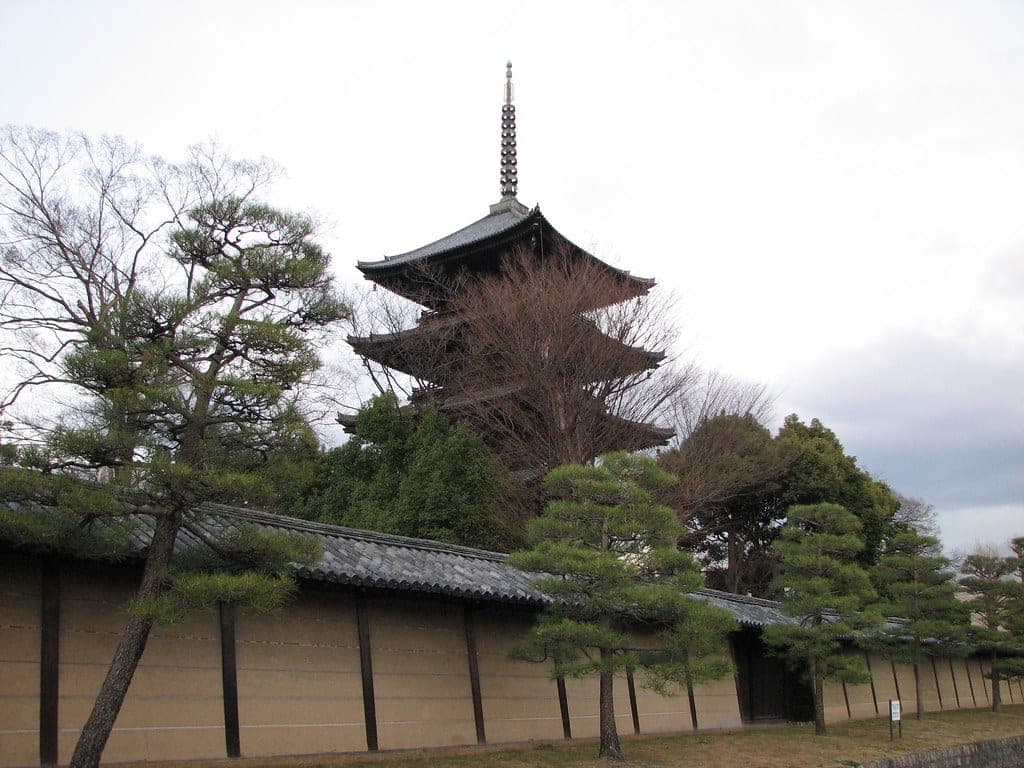
The temple grounds open in layers. The three-story pagoda, one of Japan's tallest at thirty-one meters, rises against the hillside. Various halls dedicated to different Buddhist figures invite exploration. But the magnetic center is the main hall and its extending stage.
Stepping onto the stage produces a specific quality of attention. The view over Kyoto is panoramic—on clear days the entire city spreads below, with mountains rising beyond. But the more immediate sensation is architectural: standing on a platform of ancient wood, supported by massive pillars visible below, held by joints and geometry rather than metal. The engineering becomes teaching: what holds through connection rather than force.
Seasons transform the experience. Cherry blossoms in spring create a pink sea surrounding the temple. Autumn foliage—particularly during the illumination events when the trees are lit against the night—produces views that border on the hallucinatory. Winter snow, rare but possible, renders the temple ethereal. Each season draws different crowds and offers different light.
The deeper experiences require choosing. Most visitors photograph the stage and depart. Those who descend to Otowa waterfall join a line of pilgrims waiting to drink from one of the three streams with long-handled cups. The choice of stream—longevity, academic success, or romantic fulfillment—becomes a moment of self-reflection. What do I actually want? The tradition teaches that choosing all three betrays greed.
The Tainai Meguri in Zuigudo Hall offers the most intimate encounter. For a small additional fee, visitors descend into complete darkness, touching only the prayer beads along the wall to navigate. In the absolute black, the ordinary senses fail. Only the beads guide movement. At the center, a glowing stone bearing the Sanskrit word for 'womb' provides a moment to pause and wish. Then the passage continues, emerging finally into light. The symbolism is explicit—death and rebirth—but the bodily experience of walking blind creates something beyond symbolism.
Early morning offers the most contemplative visit. The temple opens at six, and in the first hour, before the crowds arrive, the stage and grounds retain something of their original character: a mountain sanctuary where water has been pure for over twelve centuries.
Enter through the Niomon gate and proceed upward through the temple grounds. Explore the pagoda and subsidiary halls before approaching the main hall and stage. For the fullest experience, descend to Otowa waterfall after viewing from the stage—the waterfall is reached by continuing past the main hall and descending stone steps. Zuigudo Hall and the Tainai Meguri require a separate fee and are located to the northwest of the main hall. If time permits, walk the entire circuit of the grounds rather than retracing steps. The Jishu Shrine, dedicated to the deity of love, occupies a section of the temple grounds and offers its own distinct experience, including the famous Love Stones.
Kiyomizu-dera invites interpretation through multiple lenses: as architectural achievement, Buddhist sanctuary, pilgrimage station, and liminal space. Scholarly analysis emphasizes the temple's historical and structural significance. Traditional Buddhist understanding sees it as a place of exceptional Kannon presence. Alternative perspectives explore the site's function as a threshold between worlds. All acknowledge that something at this place exceeds documentation.
Architectural historians regard the main hall's stage as a masterwork of traditional Japanese construction. The kakezukuri (suspended building) technique uses no metal nails, relying entirely on the traditional joinery system known as kigumi—interlocking joints, mortises, and wedges that allow the structure to flex during earthquakes rather than resist and break. The eighteen main pillars are cut from Japanese zelkova trees four hundred years old; the floor consists of over four hundred cypress boards. This engineering has maintained the structure since 1633.
Historians date the temple's founding to 778 CE based on temple records (Kiyomizu-dera Engi) and references in the Konjaku Monogatari collection. The temple's position within the Saigoku Kannon Pilgrimage—Japan's oldest Buddhist pilgrimage route—demonstrates its importance in medieval Japanese Buddhism. The integration of the Jishu Shrine, a Shinto site predating the Buddhist temple, illustrates the syncretic relationship between Buddhism and Shinto that characterizes Japanese religious history.
As one of seventeen sites comprising the UNESCO World Heritage designation 'Historic Monuments of Ancient Kyoto,' Kiyomizu-dera represents the cultural continuity of Japan's former capital.
Within the Kita-Hosso Buddhist tradition, Kiyomizu-dera is understood as a 'Kannon Reijo'—a holy place where the compassion of Kannon is especially accessible. The founding legend establishes this status: the site was revealed through divine vision, and the mysterious ascetic Gyoei who awaited Enchin for two hundred years was an incarnation of Kannon herself. The pure water of Otowa spring represents not merely natural purity but spiritual blessing.
The hidden Buddha tradition—showing the principal image only every thirty-three years—reflects the teaching that Kannon manifests in thirty-three forms. Concealment generates presence of a different kind; what cannot be seen becomes more fully imagined. The Tainai Meguri womb passage offers an initiatory experience: symbolic death in darkness, rebirth in light. These are not metaphors but technologies of transformation.
For pilgrims walking the Saigoku Kannon route, Kiyomizu-dera is one station in a journey that physically enacts the spiritual path. The white robes, the devotional poems, the stamps collected in the Nokyo-cho—these create continuity with pilgrims who have walked these paths for over a millennium.
Some visitors experience Kiyomizu-dera as a threshold between worlds—a thin place where the membrane separating ordinary and sacred reality becomes permeable. The architecture supports this reading: the stage suspends visitors between ground and sky, the womb passage moves through darkness to light, the hidden Buddha creates presence through absence. These are liminal structures, designed to alter consciousness.
The temple's mountain location contributes to this quality. Before Japanese Buddhism, before Enchin's arrival, Mount Otowa likely held significance in the indigenous Japanese relationship with sacred mountains. The spring that gives the temple its name flows from sources deeper than history. Jishu Shrine's Love Stones, dating to the prehistoric Jomon era, suggest this place was recognized as special long before any temple rose here.
The famous proverb—'to jump off the stage at Kiyomizu'—points to the temple's function as a site of decisive transformation. The stage creates the feeling of being on an edge, of having to choose. The records show that during the Edo period, over two hundred people actually jumped, believing that survival would grant their wish. Eighty-five percent survived. The practice is now forbidden, but the architecture still produces the psychological state it describes: standing at a threshold, knowing that something must change.
Significant questions remain unanswered. What was the exact nature of the pre-Buddhist sacred site on Mount Otowa, and how did it influence the temple's founding? Who was Gyoei Koji—was he an actual historical figure, and if so, what tradition did he represent? Why does the hidden Buddha principle apply with such strictness to the principal Kannon image—what does the temple understand about the relationship between concealment and sacred power? How did the traditional pilgrimage practices differ from their modern forms? What did the original 778 CE structures look like before centuries of fire and reconstruction? The temple holds memory beyond documentation.
Visit Planning
Kiyomizu-dera opens at 6:00 AM, with closing times varying by season. Entry fee is 500 JPY for adults. The temple is reached by bus from Kyoto Station or by walking from the Gion district. Autumn foliage and cherry blossom seasons bring the largest crowds; winter offers the most solitude. Allow 1.5 to 2.5 hours for a thorough visit.
Kyoto offers extensive accommodation options ranging from traditional ryokan (Japanese inns) to international hotels and budget hostels. Staying in the Gion or Higashiyama areas allows walking access to Kiyomizu-dera and other eastern Kyoto temples. For early morning visits to avoid crowds, staying nearby reduces transit time.
Modest dress is appreciated; shoes must be removed before entering certain buildings. Photography is permitted on the grounds and stage but prohibited inside temple buildings; drones, tripods, and commercial shoots are forbidden. Quiet voices honor the temple's character as a place of prayer. Drink from only one stream at Otowa waterfall.
Kiyomizu-dera welcomes visitors of all backgrounds but remains an active Buddhist sanctuary. The temple has witnessed over 1,250 years of prayer; contemporary visitors join that lineage.
Dress modestly, with shoulders and legs covered when possible. No strict dress code is enforced on the general grounds, but respectful attire demonstrates awareness of where you are. Shoes must be removed before entering certain temple buildings.
Maintain quiet voices throughout. The temple explicitly requests that visitors remember this is a sacred place of prayer for over 1,200 years. Cell phones should be silenced.
Photography is permitted throughout the grounds and from the stage, but flash photography is prohibited inside buildings. Drones, tripods, and monopods are forbidden. Commercial photography, wedding shoots, and cosplay photo sessions are not permitted. Avoid photographing monks or worshippers in prayer.
At Otowa waterfall, use the provided ladles and drink from only one stream. Avoid touching the water directly. The tradition holds that drinking from all three streams is greedy and may nullify blessings.
Do not lean over or climb on the railings of the main hall stage. Do not touch the relief carvings or Buddha statues. Take all trash with you. Smoking is prohibited throughout. Eating and drinking while walking are discouraged except in designated tea houses and cafes.
Pets are not permitted except for service animals.
Modest clothing covering shoulders and legs is appreciated. Comfortable walking shoes are essential for the inclined paths, stone stairs, and sandy areas. Shoes must be removed before entering certain buildings.
Permitted on temple grounds and from the stage. Flash prohibited inside buildings. Drones, tripods, and monopods forbidden. Commercial shoots, wedding photography, and cosplay sessions not permitted. Be mindful of worshippers and monks.
Incense offerings may be made at the main hall. Ema (wooden prayer plaques) may be purchased and inscribed with wishes. Candles and incense are available for purchase on the grounds.
Do not climb on railings or structures. Do not touch Buddha statues or carvings. Drink from only one stream at Otowa waterfall. No smoking. No pets except service animals. No eating or drinking while walking except in designated areas.
Sacred Cluster
Nearby sacred places create the location cluster described in the growth plan. This block is intentionally crawlable and links into the wider regional graph.