Tenryu-ji Temple
Where a 700-year-old garden teaches the art of stillness
Kyoto, Kyoto, Japan
At A Glance
- Coordinates
- 35.0162, 135.6746
- Suggested Duration
- One to two hours for the temple and garden. A half-day allows for the bamboo grove, neighboring temples, and a meal at the temple restaurant.
Pilgrim Tips
- Modest clothing is appropriate. During zazen sessions, wear loose-fitting clothes that allow comfortable sitting—tight jeans make seated meditation difficult. Socks or bare feet are fine inside buildings.
- Photography is generally permitted in the garden and grounds. Tripods and monopods are prohibited to avoid blocking pathways. Check signs for restrictions in specific areas. During zazen sessions, no photography is permitted.
- The training hall (Sodo) remains closed to the public—this is a working monastery, and some spaces are reserved for resident monks. The Dharma Hall opens only on weekends, holidays, and special periods. Early morning visits require patience; the famous bamboo grove can be crowded even at opening time during peak seasons.
Overview
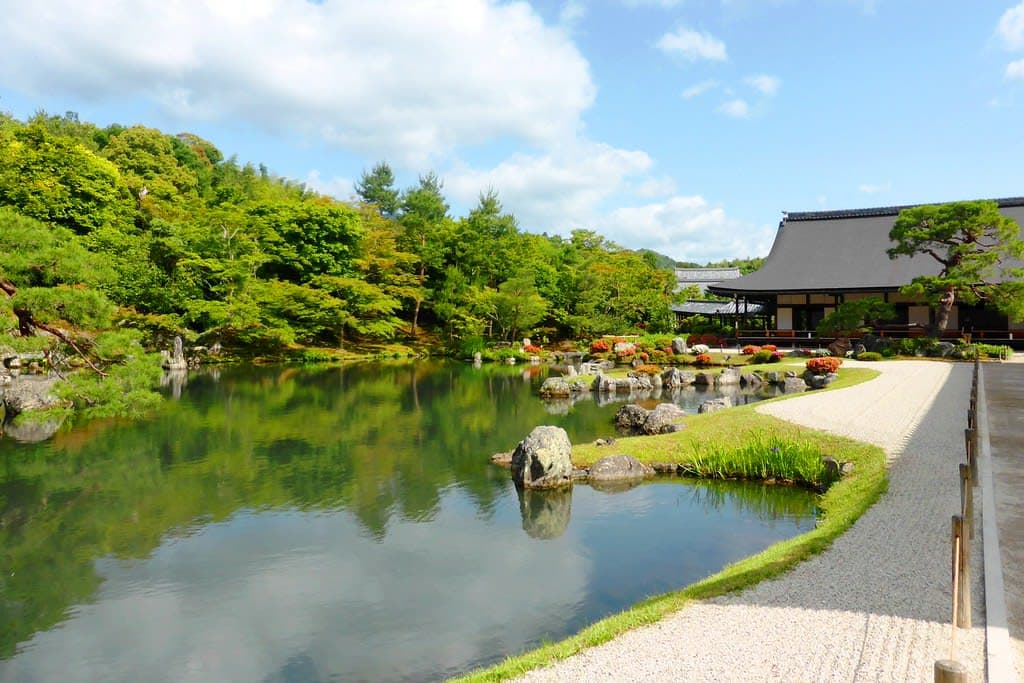
At the foot of the Arashiyama mountains in western Kyoto, Tenryu-ji preserves a garden designed by Zen master Musō Soseki for a single purpose: meditation. The pond reflects borrowed peaks. A waterfall symbolizes transformation. For nearly seven centuries, monks and seekers have sat before this arrangement, learning to see what was always there.
Tenryu-ji rises where the Ōi River curves past Arashiyama's forested slopes—a location considered sacred since the ninth century when Japan's first Zen temple stood on this ground. The current temple was founded in 1339 to appease the spirit of Emperor Go-Daigo, named for a dragon that appeared in a priest's dream rising from the river's waters.
What draws seekers today is the Sogenchi garden, a masterwork of Musō Soseki that has remained essentially unchanged since the fourteenth century. Unlike ornamental gardens designed for viewing pleasure, this landscape was created for contemplation practice. The pond's still surface mirrors the mountains behind it, dissolving the boundary between made and natural worlds. A stone arrangement at one end suggests a waterfall—the Dragon Gate, symbol of the carp's transformation into a dragon, the seeker's journey toward enlightenment.
Tenryu-ji ranks first among Kyoto's Five Mountains of Zen and remains the head temple of an active Rinzai lineage. Monks still train here. Monthly zazen sessions open to the public maintain the tradition of offering practice to all who seek it. The temple has burned eight times across the centuries, yet the garden persists—a 700-year-old teaching in stone and water, waiting for anyone willing to sit still long enough to receive it.
Context And Lineage
Tenryu-ji was born from political violence and spiritual ambition. The shogun who founded it had betrayed the emperor in whose memory it was built. The Zen master who designed its garden was the most influential monk of his era. The temple's name came from a dragon that appeared in a dream, rising from the river where the emperor's soul was said to linger.
In 1336, Ashikaga Takauji seized power from Emperor Go-Daigo, whom he had previously helped restore to the throne. When Go-Daigo died in exile in 1339, Takauji sought to appease his spirit by building a magnificent temple. A priest friend dreamed of a golden dragon rising from the Ōi River south of the site—an auspicious sign interpreted as the emperor's spirit finding peace. The temple was named Tenryu-ji, Temple of the Heavenly Dragon.
But the site itself was already sacred. In the ninth century, Empress Tachibana no Kachiko had founded Danrin-ji here, considered by some scholars to be Japan's first Zen temple. The location at Arashiyama had drawn imperial attention for centuries before that. Takauji was not creating sacredness but reclaiming it.
Tenryu-ji heads the Tenryū-ji branch of Rinzai Zen Buddhism, one of the largest Rinzai lineages in Japan. The temple ranks first among Kyoto's Gozan, the Five Mountains system that organized Zen temples under government patronage during the Muromachi period. The lineage traces through Musō Soseki back to Chinese Chan masters. Today the temple maintains an active training hall where monks prepare to become Zen priests.
Ashikaga Takauji
Founder
Musō Soseki
Founding abbot and garden designer
Empress Tachibana no Kachiko
Founder of predecessor temple
Why This Place Is Sacred
The garden at Tenryu-ji operates as what Zen practitioners call a koan made visible—an arrangement that cannot be solved by thinking, only by perceiving. The technique of shakkei, borrowing the surrounding mountains as part of the composition, dissolves the frame between garden and world, inner and outer. Seekers report a particular quality of stillness here that differs from mere quiet.
Musō Soseki designed this garden with the precision of a master calligrapher choosing each stroke. The pond is positioned so that the mountains of Arashiyama rise directly behind it, their peaks reflected in water that holds both sky and stone. This is shakkei—borrowed scenery—but the borrowing goes deeper than aesthetics. The garden teaches that the distinction between what is made and what is given is itself an illusion.
At the far end of the pond, a stone arrangement rises from the water. This is the Dragon Gate, ryūmon-baku, depicting the legendary waterfall where carp struggle upward against the current. Those who succeed transform into dragons. The symbolism is explicit: enlightenment requires effort against resistance, and the effort transforms the seeker.
What makes Tenryu-ji thin is not romantic atmosphere but disciplined design. Every element serves meditation practice. The garden's stillness is not passive but active—the same quality sought in zazen. Visitors who come expecting scenic beauty often find themselves sitting longer than planned, pulled into a contemplation they didn't intend. The garden does not demand attention; it makes attention possible.
Musō Soseki created the garden as a tool for Zen practice—a visual koan, an aid to the cultivation of mind. The temple itself was founded to transfer merit to the spirit of Emperor Go-Daigo, with whom the founding shogun Ashikaga Takauji had a complicated relationship of rebellion and regret.
Fire has destroyed Tenryu-ji eight times since its founding. The buildings visitors see today date largely from the Meiji period. Yet the Sogenchi garden has survived essentially intact, its rocks and pond outlasting all human structures around it. The temple complex once covered nearly ten million square meters with 150 sub-temples; today it is a fraction of that size. What remains is the essential: the garden, the practice, the lineage.
Traditions And Practice
Tenryu-ji continues to offer what Zen temples have always offered: a place to sit. Monthly zazen sessions welcome beginners. The garden itself is a form of practice—not merely beautiful but designed to train attention. Visitors may also experience shōjin ryōri, the Buddhist vegetarian cuisine that nourishes body and practice alike.
Rinzai Zen emphasizes koan practice alongside seated meditation. Monks training at Tenryu-ji engage in intensive practice periods, attending the abbot for dokusan (private interview), working on assigned koans, and participating in manual labor as a form of moving meditation. The formal dharma hall ceremonies continue traditions established at the temple's founding.
The temple offers public zazen sessions on the second Sunday of each month, except during February, July, and August. Sessions begin at 9:00 AM with fifteen minutes of instruction, followed by two twenty-minute meditation periods with a five-minute walking break between them. Afterward, participants may stay for an hour-long dharma talk by the abbot. No reservation is required. Shakyo, the meditative practice of copying sutras by brush, is available by appointment.
Arrive before the temple opens to walk the bamboo grove in relative solitude. When the garden opens, find a place on the veranda to sit without agenda—not looking for anything in particular, just looking. If visiting on the second Sunday, the zazen session offers a rare opportunity to practice in a space designed for exactly this purpose. The Shigetsu restaurant serves authentic shōjin ryōri; consider this a continuation of practice rather than a break from it.
Rinzai Zen Buddhism
ActiveTenryu-ji heads the Tenryū-ji branch of Rinzai Zen and ranks first among Kyoto's Five Mountains. The temple has maintained continuous practice since 1339, training monks in the rigorous Rinzai method of koan study and intensive meditation.
Zazen (seated meditation) forms the core practice, supplemented by koan work with the teacher, manual labor as moving meditation, and study of Zen texts. Monthly public zazen sessions open this practice to lay practitioners. Shakyo (sutra copying) offers another entry point for visitors.
Experience And Perspectives
The garden asks nothing of visitors except presence. Most find themselves slowing without deciding to slow, breathing more deeply without noticing the change. Time here moves differently—not stopped, but less urgent. The mountains reflected in the pond seem more real than the mountains themselves.
The approach to Tenryu-ji passes through Arashiyama's famous bamboo grove, already priming visitors for a different kind of attention. The temple grounds feel like an exhale after the grove's enclosed verticality. Paths lead toward the garden, but there is no hurry.
The Sogenchi pond comes into view from the covered veranda of the Hōjō, the abbot's former quarters. Most visitors stop here, often without intending to. The composition reveals itself gradually: foreground stones, middle-ground water, background mountains merging into sky. The reflections in the pond hold everything in doubled stillness.
Walking the garden's perimeter path changes the relationship. The Dragon Gate waterfall arrangement comes into focus. Stone bridges invite crossing. The borrowed mountains shift angle but never leave. Some visitors complete the circuit quickly; others circle multiple times, seeing something new with each pass.
For those who arrive early or on the second Sunday, the temple offers what it has always offered: a place to sit. The zazen sessions require no background, only willingness. Fifteen minutes of instruction, two periods of meditation, a break for walking, then the option to stay for the abbot's teaching. The garden becomes what it was designed to be—not something to look at but something to look with.
Enter through the main gate and purchase admission at the ticket window. The path leads left toward the Hōjō and garden. The veranda offers the primary viewing position. A walking path circles the pond, best approached slowly. Allow time to sit. The bamboo grove exit connects to the famous Sagano bamboo path—continue your walk there if time allows.
Tenryu-ji holds different meanings for different observers. Art historians study Musō Soseki's garden as a masterpiece of spatial composition. Political historians see the temple as a monument to Ashikaga power and religious patronage. Zen practitioners experience it as an active training ground in an unbroken lineage. Casual visitors often find themselves unexpectedly moved without quite understanding why.
Academic consensus recognizes Tenryu-ji as one of Japan's most significant Zen temples, important for its role in the Gozan system and for Musō Soseki's garden design. The Sogenchi garden is considered a foundational example of the shakkei (borrowed scenery) technique that became central to Japanese garden aesthetics. Art historians debate the extent to which the current garden reflects Musō's original design after centuries of maintenance and repair.
Within the Rinzai lineage, Tenryu-ji represents living transmission of Musō Soseki's teaching. The garden is not primarily an art object but a practice tool—a visual koan that teaches without words. The temple's continuation of training and public zazen maintains the dharma gate that Musō opened here seven centuries ago.
Some visitors experience the garden as a place of unusual energetic quality, using language of sacred geometry, ley lines, or feng shui principles. The temple's founding in response to a dragon dream invites mythological interpretation. These perspectives, while not part of traditional Rinzai teaching, reflect authentic visitor experiences of the site's atmosphere.
The full extent of Musō Soseki's original design intentions remains uncertain—how much of the current garden reflects fourteenth-century vision versus later intervention? The temple's eight fires destroyed records along with buildings. The exact rituals performed at the site before Tenryu-ji's founding, during Danrin-ji's existence, are largely lost. What continues is the practice itself, transmitted person to person regardless of what documents survived.
Visit Planning
Tenryu-ji lies in Arashiyama, western Kyoto, easily reached by train from central Kyoto. The temple opens at 8:30 AM; arriving early helps avoid crowds. Allow one to two hours for the garden, longer if continuing to nearby sites. The garden opens early during autumn foliage season.
Arashiyama has ryokan and hotels at various price points. Staying overnight allows for early morning temple visits before day-trippers arrive. Central Kyoto accommodations offer more dining options with easy train access to Arashiyama.
Tenryu-ji welcomes visitors warmly but asks that the contemplative atmosphere be respected. Dress modestly, move quietly, remove shoes when entering buildings. Photography is permitted but tripods are not—the restriction exists to keep pathways clear for walking meditation.
The temple operates as both tourist attraction and active monastery. This dual nature asks something of visitors: awareness that for some present, this is not a historical site but a living practice place. Shoes come off at building entrances. Voices lower naturally. The temple does not enforce these standards rigidly; the garden itself seems to request them.
During zazen sessions, follow instructions from the monks. Sit where directed. If meditation becomes difficult, remain still rather than leaving early. The bell that ends each period comes; waiting for it is part of the practice. Afterward, questions may be asked respectfully.
Modest clothing is appropriate. During zazen sessions, wear loose-fitting clothes that allow comfortable sitting—tight jeans make seated meditation difficult. Socks or bare feet are fine inside buildings.
Photography is generally permitted in the garden and grounds. Tripods and monopods are prohibited to avoid blocking pathways. Check signs for restrictions in specific areas. During zazen sessions, no photography is permitted.
Candles and incense offerings are not part of the typical visitor experience at Tenryu-ji. The offering here is attention—the willingness to be present.
The Sodo (monks' training hall) is closed to the public. The Dharma Hall (Hatto) with its famous ceiling painting of a cloud dragon opens only on weekends, holidays, and special periods. Check current hours before visiting if the dragon painting is important to you.
Sacred Cluster
Nearby sacred places create the location cluster described in the growth plan. This block is intentionally crawlable and links into the wider regional graph.