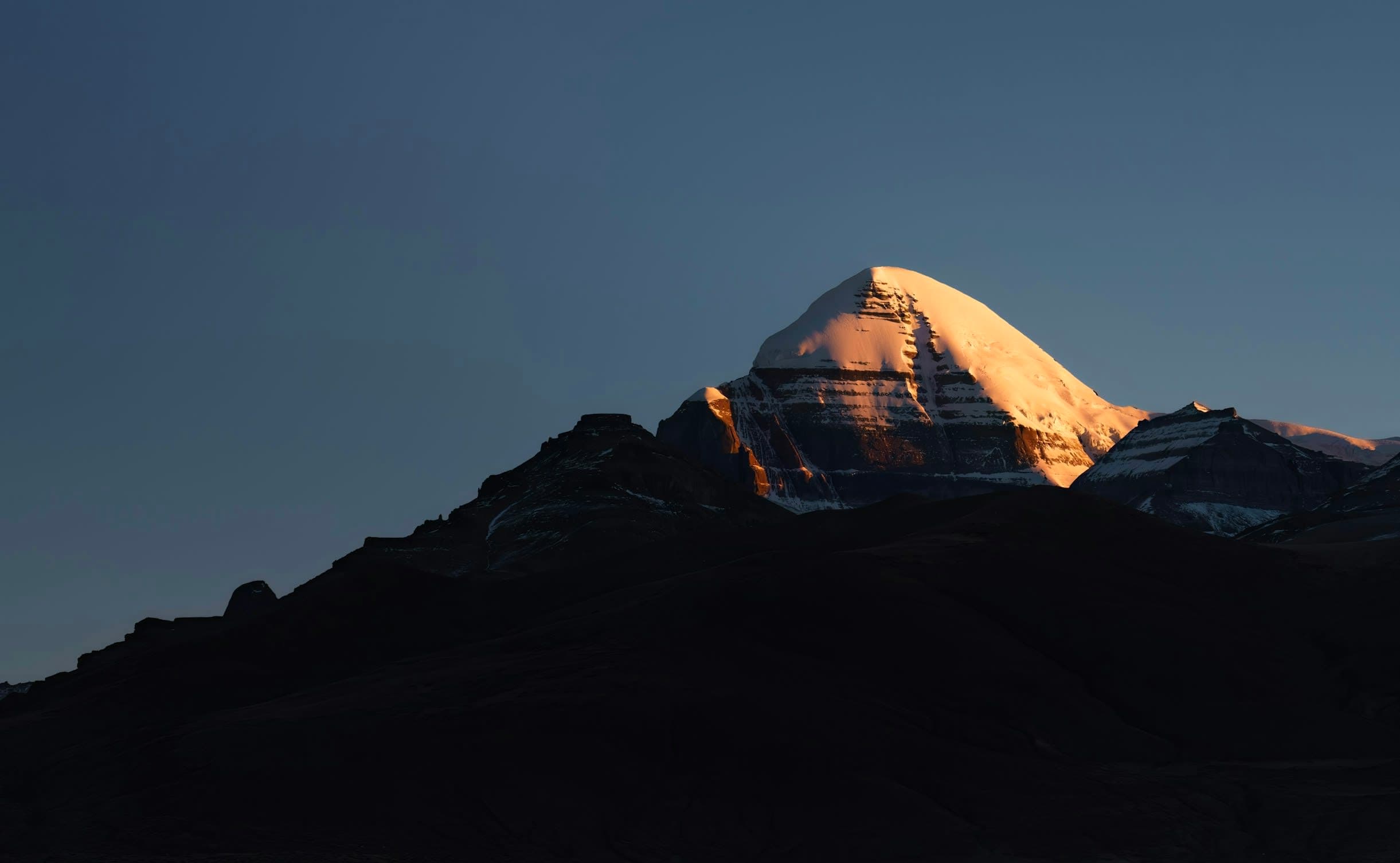
Mt. Kailash
Where Shiva dwells and the universe has its center, a peak no one may climb
Darchen, Tibet, China
At A Glance
- Coordinates
- 31.0675, 81.3119
- Suggested Duration
- 2-3 weeks for full pilgrimage from Nepal or Lhasa, including travel and acclimatization
Pilgrim Tips
- Warm, practical clothing for extreme altitude and cold. Layering essential. Good boots. At monasteries, remove shoes as directed. Respectful attire appropriate for religious sites.
- Permitted of the mountain and landscape. Ask permission before photographing pilgrims or ceremonies. Photography inside monastery meditation halls may be restricted.
- High altitude requires serious acclimatization—altitude sickness can be dangerous or fatal. The kora should not be attempted without adequate preparation. Medical facilities are essentially nonexistent. Political situation in Tibet means access can be restricted without warning. Book well in advance through registered operators. The mountain cannot be climbed and attempting to do so would be deeply offensive.
Overview
Mount Kailash rises 6,638 meters from the Tibetan plateau—four sheer faces matching the four cardinal directions, standing in geometric solitude that seems more architecture than geology. No one has ever reached its summit; no one is permitted to try. For Hindus, this is where Shiva practices eternal austerities with Parvati. For Tibetan Buddhists, it is Mount Meru, the center of the universe. For Jains, the first Tirthankara achieved liberation here. For Bon practitioners, it is the axis mundi, the nine-story Swastika Mountain where heaven and earth connect. Four religions, one mountain, universal prohibition against climbing.
There are mountains that invite climbing and mountains that forbid it. Mount Kailash belongs entirely to the second category. Rising 6,638 meters from the western Tibetan plateau, its four faces oriented precisely to the compass points, it presents itself with a geometric perfection that seems designed rather than accidental. No neighboring peaks diminish it; no foothills soften its approach. It simply rises, alone and absolute, demanding recognition as something other than ordinary rock. For over a billion people, Mount Kailash is the most sacred place on Earth. Hindus know it as the abode of Shiva—where the great god sits in eternal meditation with his consort Parvati, where Kubera the god of wealth maintains his palace, where the demon king Ravana once tried to uproot the entire mountain and was trapped beneath it for a thousand years. Tibetan Buddhists identify it as Mount Meru, the center of the universe around which sun, moon, and stars revolve, its four sides made of crystal, ruby, gold, and lapis lazuli in cosmological tradition. Jains venerate it as the site—or near the site—where Rishabhanatha, the first Tirthankara, achieved liberation from the cycle of rebirth. Followers of Bon, Tibet's pre-Buddhist tradition, know it as the axis mundi where the Sky Goddess Sipaimen dwells and the founder of their religion descended from heaven. No one has ever stood on the summit. The prohibition crosses every tradition: there are places humans are not meant to go, peaks that exist for purposes other than conquest. Chinese mountaineering authorities do not issue permits; religious communities would oppose any attempt. In an age when nearly every peak has been climbed, Kailash remains inviolate. The pilgrimage is the circumambulation, not the ascent. For three days, pilgrims walk the 52-kilometer kora around the mountain's base—Hindus and Buddhists clockwise, Jains and Bon practitioners counterclockwise—crossing the Dolma La pass at 5,630 meters, sleeping in simple monasteries, transformed by altitude and effort and proximity to whatever it is that dwells here.
Context And Lineage
Four religions, one mountain—sacred since before written records, pilgrimage site for thousands of years, summit forever unclimbed.
The origins of Mount Kailash's sanctity disappear into prehistory. By the time written records exist, the mountain is already sacred to multiple traditions. Hindu texts describe Shiva's eternal residence there—the great god in meditation, his consort Parvati beside him, their children Ganesha and Kartikeya, the bull Nandi standing guard. The demon king Ravana once attempted to uproot the entire mountain to carry it to his island kingdom; Shiva pressed it down with his toe, trapping Ravana beneath for a thousand years. Released finally, the demon became Shiva's devoted worshipper. Buddhist cosmology identifies Kailash with Mount Meru, the center of the universe. In the mandala of existence, all things revolve around this point. The four sides—crystal, ruby, gold, lapis lazuli in mythological description—match the four directions and the four continents of Buddhist geography. The deity Chakrasamvara dwells there. Jain tradition associates the mountain with Ashtapada, where Rishabhanatha, the first of the twenty-four Tirthankaras, achieved liberation. Whether Kailash is Ashtapada or near it, the mountain is a tirtha—a sacred ford, a crossing place between ordinary existence and liberation. For Bon, Tibet's pre-Buddhist religion, Kailash is the nine-story Swastika Mountain, the axis mundi connecting earth and sky. The Sky Goddess Sipaimen dwells there. The founder of Bon descended from heaven via the mountain's cosmic pillar. These are not competing claims but accumulated layers of sacred meaning—four traditions finding what each needed in the same extraordinary peak.
Mount Kailash represents the convergence of South Asian and Tibetan sacred geography. The synthesis of esoteric Buddhism and Shaivism may have brought Kailash and nearby Lake Manasarovar into shared sacred space for both traditions. The mountain connects Hindu Shaiva tradition, Tibetan Buddhist cosmology, Jain soteriology, and Bon shamanic geography—a unique intersection in world religion.
Lord Shiva
Chakrasamvara (Demchog)
Rishabhanatha
Milarepa
Tonpa Shenrab Miwoche
Why This Place Is Sacred
Four religions, each with its own cosmology and practice, converge on the same mountain—a convergence so improbable that it seems to demand explanation beyond coincidence.
What makes Mount Kailash sacred? The question seems answerable: this is where Shiva lives, where the universe has its center, where liberation was achieved, where heaven touches earth. But these are four different answers from four different traditions, and the deeper question is why they all point to the same peak. The mountain's physical presence offers partial explanation. Those four faces matching the cardinal directions, that isolated prominence, the striated south face with its vertical crack forming what appears, from certain angles, like a swastika—the mountain presents itself as meaningful, as structured, as intended. Add the extreme altitude, the thin air that alters consciousness, the harshness of the landscape that strips away ordinary concerns, and you have conditions conducive to religious experience. But other mountains share these qualities without attracting four independent traditions. The convergence at Kailash suggests something more: either that all four traditions recognized something genuinely present, or that the power of belief across millennia has created what it describes. Perhaps the distinction does not matter. The kora—the three-day circumambulation—works on pilgrims regardless of their theology. The altitude exhausts. The cold strips comfort. The pass at 5,630 meters, symbolically named for the goddess Dolma (Tara), represents a death and rebirth enacted in landscape. Pilgrims ascend, cross over, descend changed. What changes them? The mountain? The effort? The presence of thousands of others who have walked this path? The accumulated devotion of a billion believers across thousands of years? All of these, perhaps. The thinness of Kailash may be that it refuses to resolve into a single explanation. The mountain simply stands, holding four cosmologies simultaneously, permitting human presence around its base while maintaining its summit as inviolate. Something dwells there. Four traditions agree on that much, even if they disagree on what.
Center of the universe in Hindu and Buddhist cosmology. Abode of deities. Site of liberation. Axis mundi connecting heaven and earth.
Sacred significance extends into prehistory. Tibetan records confirm Buddhist pilgrimage by the 12th century. Hindu texts reference Kailash from ancient times. The synthesis of esoteric Buddhism and Shaivism likely expanded shared sacred geography. Political circumstances (Chinese control of Tibet) have affected but not ended pilgrimage access.
Traditions And Practice
The kora (circumambulation) is the central practice—52 kilometers around the mountain's base, taking three days for walkers or three weeks for those performing full-body prostrations.
Clockwise circumambulation for Hindus and Buddhists, counterclockwise for Jains and Bon practitioners. The direction reflects cosmological differences: clockwise follows the sun's apparent motion, keeping the sacred object on the right as a gesture of respect; counterclockwise in Jain and Bon tradition may preserve older practices. Full-body prostrations—bending, kneeling, stretching fully prone, marking the spot, rising, stepping to the mark, repeating—represent the most extreme form of devotion. Ritual bathing in Lake Manasarovar purifies pilgrims of sins. The Saga Dawa festival, held at the full moon of the fourth Tibetan month (usually May or June), multiplies the merit of kora performed during this time.
The Indian government organizes annual Kailash Mansarovar Yatra for Hindu pilgrims, selected by lottery. Independent pilgrims arrange tours through registered operators in Tibet or Nepal. Three-day kora is most common. Inner kora, a shorter circuit closer to the mountain, is reserved for those who have completed 13 outer circuits. Meditation retreats at caves and monasteries along the route. Photography and documentation, though phones and cameras struggle at altitude.
Complete the three-day kora if physically capable—this is the pilgrimage, the reason to come. Begin early each day to allow time for altitude adjustment. At Dolma La pass, pause to recognize the symbolic crossing. If you cannot complete the full kora, a visit to Darchen and prostrations toward the mountain still constitute meaningful pilgrimage. Visit Lake Manasarovar before or after the kora; collect water if that aligns with your practice. Accept the discomfort as part of the teaching.
Hinduism (Shiva worship)
ActiveMount Kailash is the eternal abode of Lord Shiva, where he practices tapas (austerities) with his consort Parvati. It is also the location of Alaka, palace of Kubera the god of wealth. Merely seeing the mountain constitutes darshan—vision of the sacred.
Clockwise parikrama (circumambulation). Ritual bathing in Lake Manasarovar. The Kailash Mansarovar Yatra, organized annually by the Indian government, enables Hindu pilgrims to complete the pilgrimage.
Tibetan Buddhism
ActiveMount Kailash (Gang Rinpoche) is identified with Mount Meru, the center of the universe around which everything revolves. It is home to the deity Chakrasamvara and the center of a great natural mandala. Lake Manasarovar represents the mother while Kailash represents the father.
Clockwise kora. Full-body prostrations around the entire circuit (approximately three weeks). Meditation at caves associated with Milarepa. Pilgrimage during Saga Dawa festival. The belief that 108 circumambulations ensure enlightenment.
Jainism
ActiveMount Kailash is associated with Ashtapada, where Rishabhanatha, the first Tirthankara, achieved liberation. The mountain is itself a tirtha—a sacred ford, a crossing point between bondage and freedom.
Counterclockwise circumambulation. Pilgrimage to the mountain as tirtha-yatra (journey to a sacred ford).
Bon
ActiveIn Tibet's Bon religion, Mount Kailash (Tise) is the axis mundi—the nine-story Swastika Mountain where the Sky Goddess Sipaimen dwells and where the founder of Bon descended from heaven.
Counterclockwise circumambulation (same direction as Jains, opposite to Hindus and Buddhists). The mountain is central to Bon cosmology and shamanic practice.
Experience And Perspectives
The kora takes three days, 52 kilometers, and one pass at 5,630 meters. It is designed to transform you, and it does.
You arrive in Darchen after days of overland travel—from Lhasa, from Nepal, across rough roads at altitudes that thin the blood before you even begin. The town barely exists: a few hundred people, basic guesthouses, the last preparation before the mountain. And then you see it. Kailash rises beyond the town like an assertion. Those four faces, that snow, that geometric isolation—photographs cannot prepare you. This is a mountain that looks like what it is: the center of everything, the dwelling of gods. The kora begins with a ride to Tarboche, where prayer flags stream in the wind, then walking. The first day covers about 13 kilometers to Dirapuk Monastery on the mountain's north side. Here, the nearest and most dramatic view: Kailash's north face rising directly above, its pyramid shape revealed. Pilgrims from multiple traditions share the simple monastery—Hindus and Buddhists who walked clockwise, Jains and Bon practitioners who came the other way. The second day is the hardest. Twenty-four kilometers, and in the middle, Dolma La—the pass at 5,630 meters named for the goddess of compassion. The ascent is steep, the altitude punishing. Some pilgrims perform full-body prostrations the entire way, taking three weeks to complete what walkers do in hours. At the pass, prayer flags mark the crossing point. This is the death and rebirth: you leave something behind ascending, receive something descending. Below the pass lies Lake Gauri Kund, sacred, frozen much of the year. Beyond, the path descends to Zutulpuk Monastery, where Milarepa, the great Tibetan saint, is said to have meditated. The third day returns you to Darchen—thirteen kilometers of gradual descent, the mountain now behind you, its presence receding into memory. But you are not the same. The altitude, the cold, the effort, the proximity to whatever dwells on that summit—these have worked on you. Pilgrims do not merely visit Kailash; they are processed by it.
Darchen is the base town, accessible via overland travel from Lhasa (3-4 days) or Nepal border crossings. The kora proceeds clockwise for Hindus and Buddhists, counterclockwise for Jains and Bon. Key points: Tarboche (start), Dirapuk Monastery (Day 1, north face views), Dolma La Pass (Day 2, highest point at 5,630m), Zutulpuk Monastery (Day 2 overnight), Darchen (return Day 3).
Mount Kailash stands at the unique intersection of four world religions, each finding ultimate significance in the same peak—a convergence that challenges explanation and invites wonder.
Scholars document the separate development of Kailash's significance in each tradition and note the possible synthesis of esoteric Buddhism and Shaivism that brought the mountain into shared sacred geography. The prohibition against climbing is studied as rare cross-religious consensus. The mountain's physical characteristics—four faces matching cardinal directions, isolated prominence—are analyzed as contributing to its sacred interpretation. Archaeological and textual evidence confirms pilgrimage for at least a millennium.
For Hindus, Buddhists, Jains, and Bon practitioners, Mount Kailash is not metaphorically sacred but actually the dwelling place of divine beings and the center of cosmic geography. The traditions differ in detail but agree on essence: something ultimate resides here, and humans relate to it through circumambulation rather than ascent. The prohibition against climbing is not custom but recognition of sacred inviolability.
Some esoteric traditions associate Kailash with special energies, ley line convergences, or extraterrestrial contact. The swastika pattern visible on the south face invites various interpretations. New Age practitioners sometimes incorporate Kailash into eclectic frameworks, though the mountain's remoteness and permit requirements limit casual spiritual tourism.
Why did four independent traditions converge on this particular mountain? What lies at the summit—no human has stood there. What is the full history of pilgrimage before written records? What geological processes created the four-faced structure that seems so deliberately oriented? How old is the sacred significance—does it predate all four current traditions?
Visit Planning
Remote, high altitude, politically complex. Access requires permits, organized tours, and physical preparation. The journey is difficult; that is part of the point.
Very basic. Simple guesthouses in Darchen. Monastery guesthouses at Dirapuk and Zutulpuk along the kora route. No heating, no running water. Camping possible with equipment. Most pilgrims use organized tours with pre-arranged accommodation.
Walk your kora. Respect the direction appropriate to your tradition or follow the majority. Do not attempt to climb. The mountain is not for conquest.
Mount Kailash demands respect in ways that transcend any single tradition. The universal prohibition against climbing reflects recognition—shared across four religions—that some places are not meant for human presence. There has never been a recorded ascent, and the Chinese mountaineering authorities do not issue permits. Anyone attempting to climb would face opposition from all four religious communities. Walk the kora in the appropriate direction: clockwise for Hindus and Buddhists, counterclockwise for Jains and Bon practitioners. If you do not identify with any tradition, clockwise is conventional as it follows the majority of pilgrims. Do not disturb pilgrims performing prostrations—they may take weeks to complete what you do in days. At monasteries along the route, observe silence in meditation halls. Ask before photographing religious practitioners.
Warm, practical clothing for extreme altitude and cold. Layering essential. Good boots. At monasteries, remove shoes as directed. Respectful attire appropriate for religious sites.
Permitted of the mountain and landscape. Ask permission before photographing pilgrims or ceremonies. Photography inside monastery meditation halls may be restricted.
Prayer flags at Dolma La pass. Offerings at monasteries. Some pilgrims leave items at the pass as symbols of what they release through the crossing.
Do not climb the mountain. Do not disturb pilgrims. Respect monastery rules. Be aware that your presence in this politically sensitive region carries responsibilities.
Sacred Cluster
Nearby sacred places create the location cluster described in the growth plan. This block is intentionally crawlable and links into the wider regional graph.