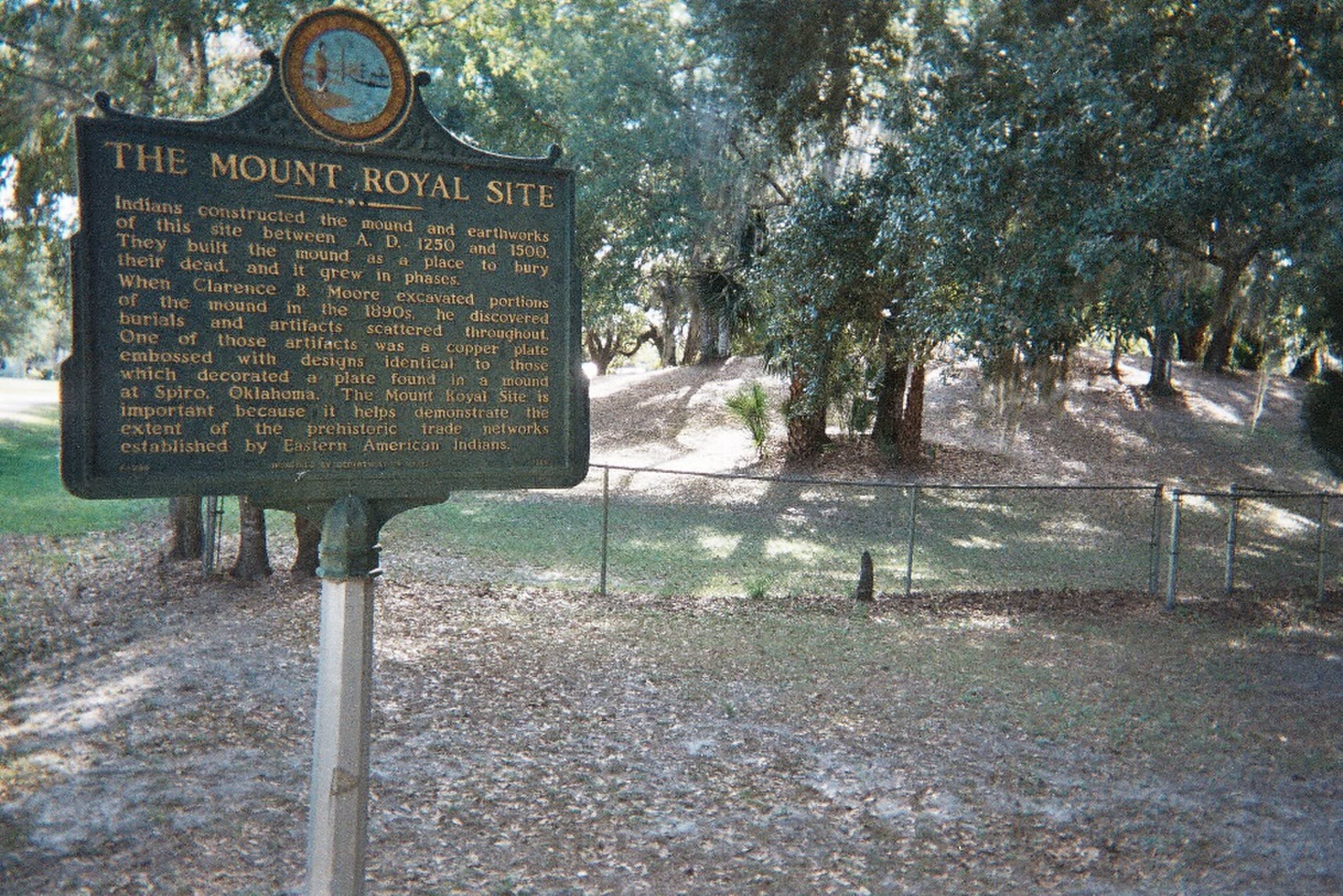
Mount Royal Mound, Florida
A burial ground where ancestors rest beneath hematite-red earth, connecting Florida to sacred networks spanning half a continent
Welaka, Florida, United States
At A Glance
- Coordinates
- 29.4364, -81.6603
- Suggested Duration
- 30 minutes to 1 hour. The preserved mound area is approximately one acre. There is no visitor center, no interpretive programming, no facilities. The experience is contemplative rather than educational.
Pilgrim Tips
- Casual outdoor attire appropriate for Florida's climate. No specific requirements, but dress as you would for visiting a cemetery in warm weather.
- Photography is permitted. Use it respectfully, as you would at any burial site. Do not stage disrespectful poses on or near the mound.
- Mount Royal is a burial ground. Treat it as you would treat any cemetery. Do not climb on, dig in, or disturb the mound. Do not remove any objects. The dead deserve respect regardless of how many centuries have passed since their burial.
Overview
At the edge of Lake George in northeast Florida, a mound rises from the wetlands where the St. Johns River flows north. For a thousand years, Indigenous peoples brought their dead here, layering red-tinted sand and precious offerings of copper and shell. By 1050 CE, Mount Royal had become the center of a chiefdom connected through trade and ceremony to sites as distant as Oklahoma. The Timucua tended this sacred ground until disease and colonization ended their world. Today the mound stands diminished but present, asking visitors to recognize it for what it has always been: the final resting place of ancestors.
There is a reason people speak softly at Mount Royal. The mound that rises here, now sixteen feet where once it may have reached forty, holds the remains of generations. This is not mere archaeology. This is a cemetery.
For a thousand years, beginning around 700 CE, peoples of the St. Johns River basin brought their important dead to this place at the outlet of Lake George. They constructed the mound layer by layer, tinting the sand with hematite to create bands of red that early archaeologist Clarence Moore described as 'crushed strawberry,' 'brick red,' and 'Indian red.' They placed grave goods with the dead: copper plates bearing designs identical to those found at Spiro Mounds in Oklahoma, shell beads carried from the Gulf Coast, polished stone tools that must have taken lifetimes to perfect.
The copper alone tells a story of connection. These artifacts belonged to what archaeologists call the Southeastern Ceremonial Complex, a network of shared religious beliefs, iconography, and ritual practices stretching from the Great Lakes to Florida. Mount Royal was not isolated. It was a node in a vast sacred geography, linked by river and trail to distant peoples who shared visions of how the dead should be honored, how the cosmos should be maintained.
When Europeans arrived in the 1560s, the village of Enacape stood at Mount Royal. The Timucua who lived there continued to venerate the mound built by ancestors they may or may not have recognized as their own. Spanish missionaries established San Antonio de Anacape in 1587, adding another layer of sacred use. By 1675, the mission had failed. By 1750, the Timucua were effectively extinct as a people, their populations destroyed by disease, warfare, and displacement.
What remains is the mound. Diminished by erosion, damaged by excavation, yet still present. The state of Florida now owns the site, managing it as sacred ground. And it is sacred, not because any living tradition claims it, but because of what it holds: the bones and offerings of people who lived, died, and were carried here to rest.
Context And Lineage
Mount Royal was built by peoples of the St. Johns archaeological culture, ancestors of or predecessors to the Timucua who occupied the site when Europeans arrived. The Timucua are extinct as a cultural group, leaving no descendant community to maintain traditions. The site is recognized as sacred by virtue of being a burial ground.
The builders of Mount Royal left no written record, and no oral tradition has been passed down through surviving cultures. The Timucua who cared for the mound at European contact are extinct. What we know comes from archaeology.
Archaeology tells us that the mound was built over centuries, layer upon layer of sand colored with hematite. The choice of red was deliberate, though its meaning is lost. Red appears in burial contexts across Native American cultures, often associated with blood, life, and the passage between worlds. The builders of Mount Royal may have understood the red sand as helping the dead make their transition.
The grave goods placed with burials suggest beliefs about an afterlife where status mattered, where the dead would need the objects of power they possessed in life. Copper plates, shell beads, polished stone tools: these were not merely valuable but meaningful, marking the dead as persons of importance who would retain that importance in whatever came next.
The site's connection to the Southeastern Ceremonial Complex suggests participation in shared beliefs about cosmic maintenance. The designs on copper plates from Mount Royal are identical to those from sites across the Southeast. Whatever specific meaning these designs carried, they represented ideas that were understood from Oklahoma to Florida. The builders of Mount Royal were not isolated villagers but participants in a continental conversation about the sacred.
No contemporary peoples claim descent from or ceremonial connection to the builders of Mount Royal. The Timucua who tended the site at European contact were effectively extinct by the mid-18th century. Their populations, once among the largest in Florida, were destroyed by disease, warfare, and forced relocation during the Spanish and British colonial periods.
This absence creates a particular relationship with the site. There is no living tradition to interpret Mount Royal, no descendant community to speak for the ancestors buried here. The site is heritage without heirs, a burial ground whose meanings must be reconstructed through archaeology and imagination. What remains is the obligation to recognize the dead as persons, not artifacts, and to treat their resting place with the respect due to any cemetery.
The Builders
Peoples of the St. Johns archaeological culture who constructed and maintained the burial mound from approximately 700-1300 CE. They may have been ancestors of the historic Timucua or a distinct earlier population.
The Timucua of Enacape
Indigenous peoples who occupied the village of Enacape at Mount Royal when Europeans arrived. They continued to venerate the mound until disease and colonial violence destroyed their population.
William Bartram
Naturalist who visited Mount Royal in 1765-66 and 1774, providing the earliest detailed descriptions of the mound, causeway, and artificial pond. His account in Travels (1791) remains a primary source.
Clarence Bloomfield Moore
Archaeologist who excavated Mount Royal in 1893-1894, removing most of the mound's contents. His work documented the site but also stripped it of artifacts now held by the National Museum of the American Indian.
Why This Place Is Sacred
Mount Royal's thinness emerges from its function as a burial ground. For a thousand years, the most important dead of the St. Johns River chiefdom were brought here and interred with ceremony. The accumulation of human remains, offerings, and ritual creates a presence that persists. The veil thins where the dead are honored.
What makes a place thin? At Mount Royal, the answer is death attended with care.
This mound was built specifically to receive the dead. Not all dead, but important dead: chiefs, elders, those whose lives mattered enough that the community would carry them here, would construct layers of red-tinted earth, would place copper and shell and polished stone beside their bodies. Each burial was an act of love and obligation. Each layer of hematite sand was a color chosen for meaning we can only guess at.
The accumulation is profound. Clarence Moore, excavating in 1893 and 1894, removed hundreds of burials from the mound. Countless more remain. The site has been absorbing the dead for over a millennium. That weight of human remains, of grief and ceremony and hope for what comes after death, creates a presence that archaeologists can measure in artifacts and visitors sense in quieter ways.
Mount Royal's thinness is also geographical. The site sits where Lake George releases into the St. Johns River, a place of ecological abundance where fresh water meets wetland, where fish and shellfish and waterfowl provided sustenance for those who gathered here. Liminal places, boundaries between one thing and another, have been recognized as spiritually significant across cultures. Mount Royal occupies exactly such a boundary.
And the site participates in a larger sacred geography. The copper artifacts found here bear designs identical to those at Spiro Mounds in Oklahoma, over a thousand miles away. Whatever ceremonies were performed at Mount Royal, whatever beliefs about the dead and the cosmos guided the builders, they were shared beliefs, part of a vast network of ritual practice stretching across the Southeast. The thinness here is not local but continental, a place where Florida connected to a spiritual world that spanned half of North America.
Mount Royal was constructed as a burial mound for the leaders of a chiefdom that emerged along the St. Johns River during the St. Johns II period (700-1300 CE). The mound grew over centuries as successive generations brought their important dead here, layering sand tinted with hematite and placing grave goods that testified to the deceased's status and to connections maintained across vast distances.
Charcoal found at the mound's base suggests ceremonial fires marked the beginning of construction, though whether this represented a single founding event or repeated ritual remains unclear. The mound was not merely a repository for the dead but a monument to the living community's power and piety. Building it required sustained effort across generations, a commitment that only made sense if the mound served purposes beyond simple burial.
Those purposes likely included ancestor veneration. The dead were not abandoned here but remained present, available for consultation or propitiation. The mound connected the living to a lineage of power extending back through time. It also connected the living to distant peoples through shared ceremonial practice. The copper artifacts, the shell gorgets, the designs that appear at Mount Royal and at Spiro and at sites across the Southeast, suggest participation in what archaeologists call the Southeastern Ceremonial Complex: a network of shared religious beliefs that may have addressed cosmic concerns far beyond local politics.
Mount Royal's history stretches across four thousand years, though most of what we see today dates to the St. Johns II period (700-1300 CE).
The site was first occupied around 2000 BCE, then largely abandoned between 500 BCE and 750 CE. Reoccupation began around 750 CE, and over the following centuries the mound grew and the chiefdom expanded. By 1050 CE, Mount Royal had become a major center, its chief wealthy enough to acquire copper from the Great Lakes region and powerful enough to maintain trade relationships spanning the Southeast.
Around 1300 CE, the site's importance declined, though occupation continued. When Europeans arrived in 1565, they found the Timucua living at Enacape, the village beside the mound. In 1587, Spanish missionaries established San Antonio de Anacape, introducing Catholic worship to a site that had been sacred for centuries. The mission operated until approximately 1675.
The Timucua did not survive colonization. Disease, warfare, and displacement destroyed their populations. By the mid-18th century, they had effectively ceased to exist as a distinct people. The mound they had tended was inherited by no one.
William Bartram visited in 1765-66 and again in 1774, providing the earliest detailed descriptions. He described a mound forty feet high with a causeway and artificial pond, a monumental landscape that impressed even a traveler who had seen many Native American sites. When Clarence Moore excavated in 1893-1894, he found the mound only sixteen feet tall, whether from erosion, deliberate destruction, or Bartram's faulty memory remains debated. Moore removed most of the mound's contents, sending artifacts to what is now the National Museum of the American Indian.
The site was listed on the National Register of Historic Places in the 1970s and is now owned by the State of Florida. Public access is limited but protected by deed.
Traditions And Practice
Mount Royal was used for burial of important leaders, with ceremonies that likely included ritual fires, the deposit of grave goods, and participation in the Southeastern Ceremonial Complex. No active traditions continue at the site. The Timucua are extinct as a cultural group.
The mound at Mount Royal was constructed specifically for burial. Charcoal at its base suggests ceremonial fires marked construction beginnings. The layering of hematite-tinted sand, creating bands of red within the mound, indicates ritualized building practices that may have taken place over extended periods or at specific times.
Burial goods were placed with the dead: copper plates bearing designs from the Southeastern Ceremonial Complex, shell beads from the Gulf Coast, polished stone tools, and decorated ceramics. These objects suggest beliefs about an afterlife where the dead would need or want the markers of their earthly status.
The mound did not stand alone. Bartram described a causeway running from the mound to an artificial pond, suggesting processional rituals. The connection to the Southeastern Ceremonial Complex implies participation in ceremonies shared across the Southeast, though the specific practices performed at Mount Royal cannot be recovered.
During the Spanish mission period (1587-1675), Catholic worship was introduced at the site. Archaeological excavations have revealed six structures containing Spanish artifacts, indicating that the mission coexisted with the older sacred landscape.
No active ceremonial practices occur at Mount Royal today. The Timucua people are extinct as a cultural group. No descendant community maintains traditions at the site. The mound is managed as an archaeological and historical preserve.
Visitors cannot participate in ceremonies at Mount Royal. There are no living traditions to join. What the site offers is contemplation of mortality, of what it means to honor the dead, of how cultures can vanish leaving only their burial grounds behind.
Approach the mound as you would approach any cemetery. Stand quietly. Consider the people buried here: chiefs, elders, persons important enough that their community carried them to this place and built earth over their bodies. Consider the offerings placed beside them: copper from the Great Lakes, shell from the Gulf, objects that traveled hundreds or thousands of miles to accompany the dead.
If you are moved to do so, speak to the ancestors. You do not need to share their beliefs to acknowledge their presence. The dead are here. They have been here for a thousand years.
St. Johns II Period Mound Culture
HistoricalMount Royal was the center of an important chiefdom during the St. Johns II period (700-1300 CE). The mound served as a burial place for important leaders, and the site grew to become the major settlement complex within the Lake George area. The chief of Mount Royal achieved considerable prosperity by around 1050 CE, as evidenced by exotic trade goods including copper artifacts from the Southeastern Ceremonial Complex.
Mound construction using hematite-tinted sand layers, burial of important leaders with grave goods, ceremonial fires at the base of mound construction, causeway and artificial pond construction for processional and ritual purposes, participation in the Southeastern Ceremonial Complex.
Timucua Ancestral Veneration
HistoricalWhen Europeans arrived in the 1560s, the site was part of the Timucua chiefdoms. The village of Enacape stood at Mount Royal, and the Timucua continued to venerate the mound built by their ancestors. They were one of the largest indigenous groups in Florida at contact but were effectively extinct as a cultural group by the mid-18th century.
Village life centered around the ancient mound, continuation of burial and ceremonial traditions, subsistence based on fish, shellfish, and wetland resources. Specific practices are not well documented.
Spanish Mission San Antonio de Anacape
HistoricalIn 1587, Spanish missionaries established San Antonio de Anacape at Mount Royal, one of several missions built along Florida's east coast to convert the Timucua to Christianity. The mission operated until approximately 1675, adding a layer of Catholic practice to a site sacred for centuries.
Catholic mass and sacraments, conversion and baptism of Timucua inhabitants, mission-era European-style architecture alongside traditional Timucua structures.
Experience And Perspectives
Visiting Mount Royal means entering a gated residential community to stand before a diminished but still present burial mound, reading historical markers that explain what once was here and what was lost. The site requires advance arrangement to visit but rewards those who come with the contemplative weight of standing on sacred ground.
The road to Mount Royal winds through northeast Florida, past Welaka and the state fish hatchery, through pine flatwoods and alongside the wetlands that line the St. Johns River. This is not tourist Florida. There are no theme parks, no beaches, no crowds. The landscape is quiet, green, slow.
The mound itself lies within Mount Royal Airpark, a gated residential community. Public access is guaranteed by deed but requires advance arrangement through the Bartram Trail Society or subdivision management. This barrier serves an accidental purpose: it filters visitors, ensuring that those who come have done the work to learn what they are visiting.
What you find is a mound perhaps sixteen feet high, set within a fenced area of approximately one acre. Historical markers explain the site's significance. The mound is grassed over, its layers of hematite-tinted sand invisible beneath the surface. The causeway and artificial pond that Bartram described are gone, absorbed into the landscape over two centuries.
The site asks for imagination. You must picture what was here: a forty-foot mound dominating the landscape, a processional causeway leading to an artificial pond, a village of Timucua surrounding the sacred precinct, and before that a chiefdom center where traders arrived from a thousand miles away bearing copper and shell. You must understand that beneath the grass lie the bones of ancestors, hundreds of burials that Clarence Moore did not remove, countless more that remain undiscovered.
The St. Johns River flows nearby, visible through the trees. Lake George opens to the south. This remains a place of ecological abundance, where water and wetland create conditions for life. The ancestors who built Mount Royal chose this location for reasons both practical and sacred. Standing here, you can sense both.
What visitors often report is a feeling of presence, a weight in the air that comes from standing on a burial ground. This is not imagination. This is recognition. The dead are here. They have been here for a thousand years. They ask only to be remembered.
Plan for 30 minutes to an hour at the site, longer if you wish to walk the surrounding area and contemplate the St. Johns River landscape. The preserved mound area is approximately one acre. There are no facilities, no visitor center, no interpretation beyond historical markers. Bring water, sun protection, and insect repellent. Florida's climate is warm and humid year-round, with mosquitoes particularly active near the river.
Mount Royal invites reflection on burial, memory, and what survives when a people vanish. The site can be understood through multiple lenses: archaeological, historical, and spiritual. What unifies these perspectives is recognition that the mound is a burial ground, a place where the dead were placed with care and intention.
The scholarly consensus recognizes Mount Royal as a major chiefdom center during the St. Johns II period (700-1300 CE), serving as a burial mound for important leaders and a hub for long-distance trade. The copper artifacts found by Clarence Moore are understood as part of the Southeastern Ceremonial Complex, a network of shared religious iconography and practice stretching from Oklahoma to Florida.
Debate continues about the relationship between the mound builders and the historic Timucua. Some researchers see continuity, arguing that the Timucua descended from the peoples who built Mount Royal. Others suggest the mound builders were a distinct population, with the Timucua arriving later and inheriting, rather than creating, the sacred landscape.
Bartram's description of a forty-foot mound conflicts with Moore's measurement of sixteen feet in the 1890s. Either Bartram exaggerated, the mound eroded significantly over 120 years, or deliberate destruction occurred during the plantation period. The discrepancy remains unresolved.
The artifacts Moore removed from Mount Royal are now held by the National Museum of the American Indian, part of ongoing conversations about repatriation and the ethics of 19th-century archaeology.
The Timucua people who venerated this mound are extinct as a cultural group. Their populations, once numbering perhaps 200,000 across Florida and southern Georgia, were destroyed by European diseases and colonial violence. No direct descendants maintain oral traditions about Mount Royal.
This absence creates both loss and obligation. The loss is irretrievable: we cannot know what the Timucua believed about the mound, what ceremonies they performed, what stories they told. The obligation is ongoing: to treat the site as sacred despite the absence of living tradition, to recognize the dead as ancestors deserving respect even when no descendants remain to speak for them.
No significant alternative interpretations have attached to Mount Royal. Unlike some archaeological sites that attract theories of lost civilizations or extraordinary origins, Mount Royal has remained understood within the framework of Indigenous North American cultures.
Some early archaeologists, including Moore, speculated that the mound builders were a distinct and more 'advanced' culture than the historic Timucua. This view reflected 19th-century assumptions about Native American capabilities and has been rejected by modern scholarship, which recognizes the St. Johns culture as ancestral to or closely related to the Timucua.
Significant mysteries remain. What specific ceremonies were performed at Mount Royal? What meaning did the hematite-colored sand layers hold for the builders? Why did the site decline in importance around 1300 CE? What is the exact relationship between the mound builders and the historic Timucua? How tall was the mound originally, and what accounts for the discrepancy between Bartram's description and Moore's measurements? These questions cannot be answered with available evidence, inviting continued research and contemplation.
Visit Planning
Mount Royal is located within a gated residential community in Putnam County, Florida, about 3 miles south of Welaka. Access requires advance arrangement. The site is free to visit but has no facilities. Plan 30 minutes to an hour.
Welaka has limited lodging. Palatka, approximately 15 miles north, offers more options including motels and bed-and-breakfasts. The town of Crescent City, on Crescent Lake, is another option about 20 miles south.
Mount Royal is a burial ground and should be treated as sacred space. Do not disturb the mound. Do not remove artifacts. Approach with the quiet respect you would show at any cemetery.
Mount Royal is first and foremost a cemetery. The specific beliefs of those buried here are lost, but the fact of their burial is not. Hundreds of people were carried to this place and interred with care. Their descendants are gone, but their remains persist.
This understanding should shape your visit. Walk quietly. Speak softly. Do not treat the mound as a curiosity but as what it is: the final resting place of human beings.
The site explicitly asks visitors to treat it as sacred ground. This request should be honored regardless of your personal beliefs. You do not need to share the cosmology of the mound builders to respect their dead.
Practical etiquette follows from this recognition. Do not climb on the mound. Do not dig or probe the earth. Do not remove any artifacts, shells, or natural objects. Take only photographs and memories. Leave only footprints, and those only in designated areas.
Casual outdoor attire appropriate for Florida's climate. No specific requirements, but dress as you would for visiting a cemetery in warm weather.
Photography is permitted. Use it respectfully, as you would at any burial site. Do not stage disrespectful poses on or near the mound.
Not traditionally practiced by visitors. Do not leave objects on or near the mound. Unlike some sacred sites, Mount Royal does not have a living tradition that includes offerings.
{"Do not climb on, dig in, or otherwise disturb the mound","Treat the site as a cemetery: it is the burial place of ancestors","Do not remove any artifacts, shells, or natural objects","Access requires advance arrangement through the Bartram Trail Society or subdivision management","The site is within a private airpark; respect residents' privacy","Private boat ramps are for residents only; use public ramps at Fort Gates Ferry or Renegades on the River"}
Sacred Cluster
Nearby sacred places create the location cluster described in the growth plan. This block is intentionally crawlable and links into the wider regional graph.
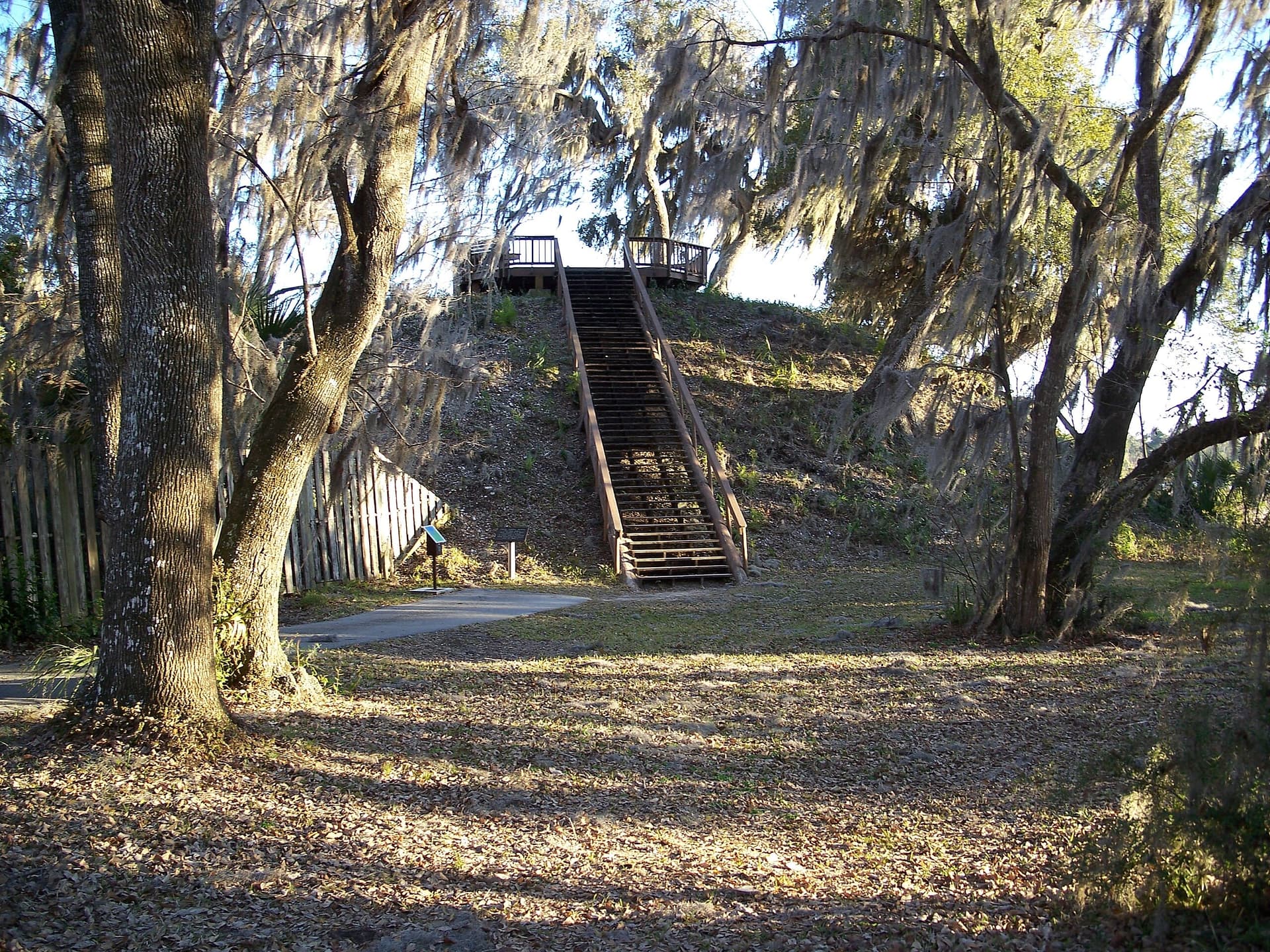
Crystal River Mounds, Florida
Crystal River, Florida, United States
110.8 km away
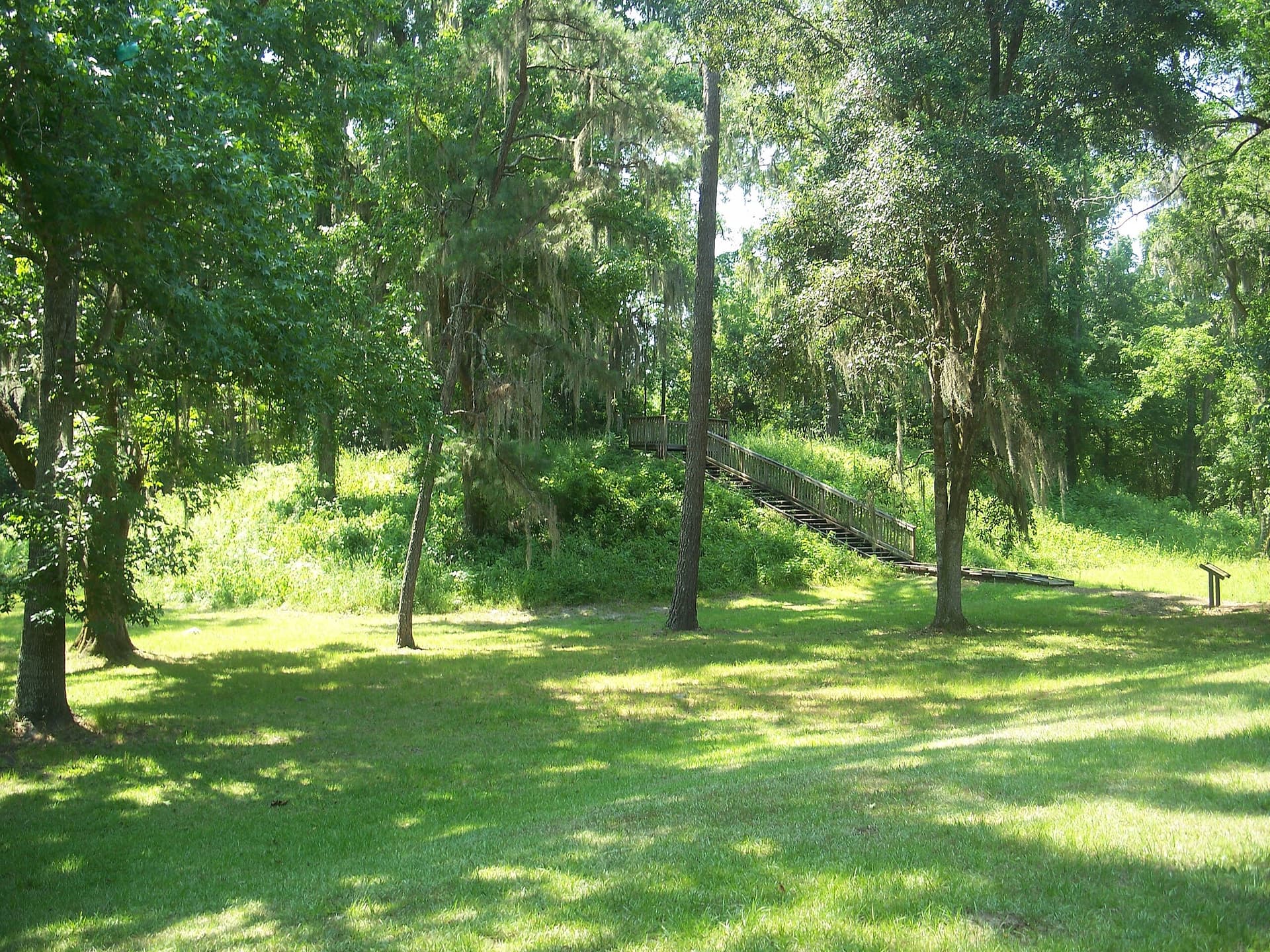
Lake Jackson Mounds, Tallahassee, Florida
Tallahassee, Florida, United States
281.6 km away
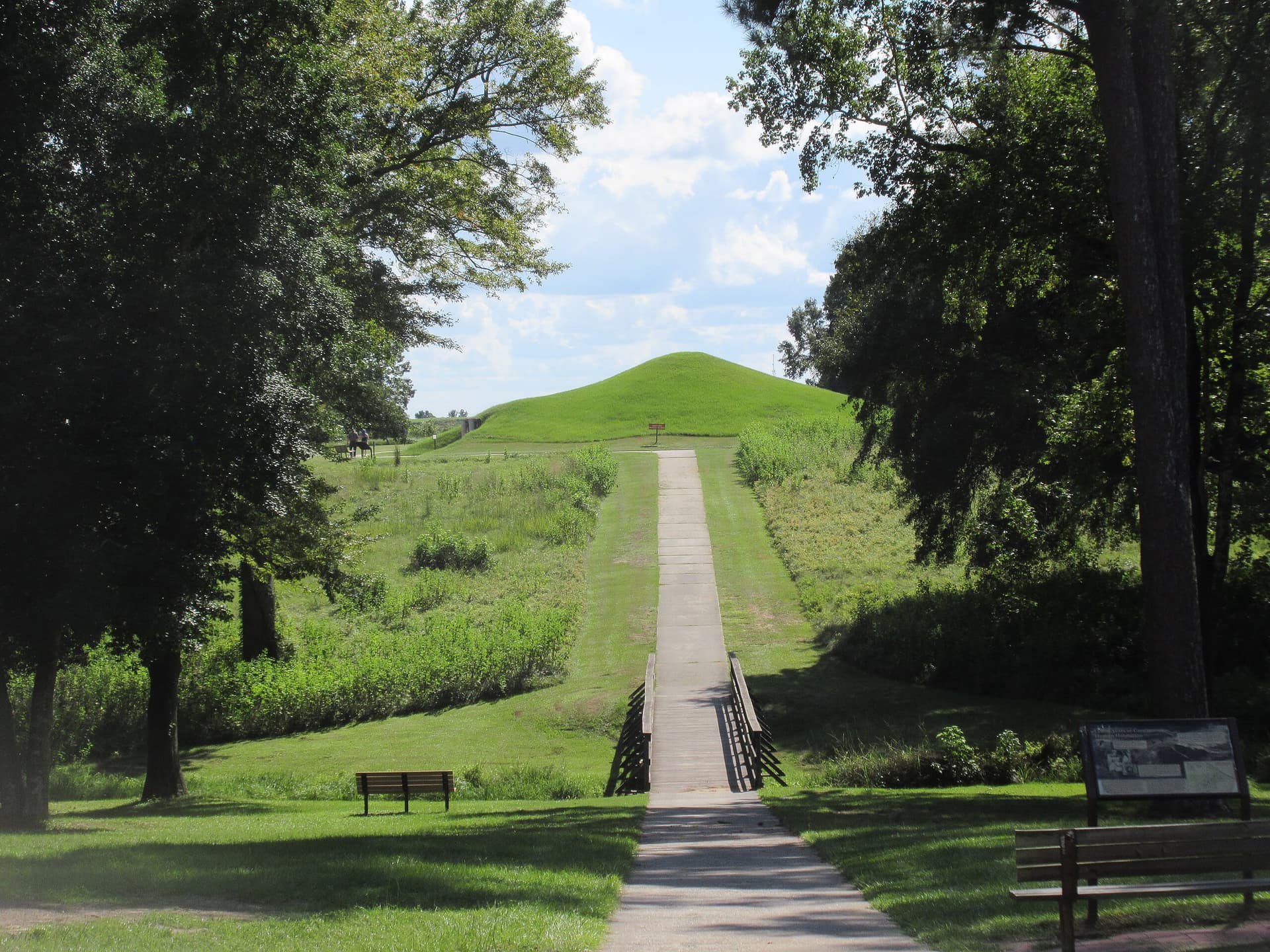
Ocmulgee Mounds, Georgia
Macon, Georgia, United States
421.0 km away
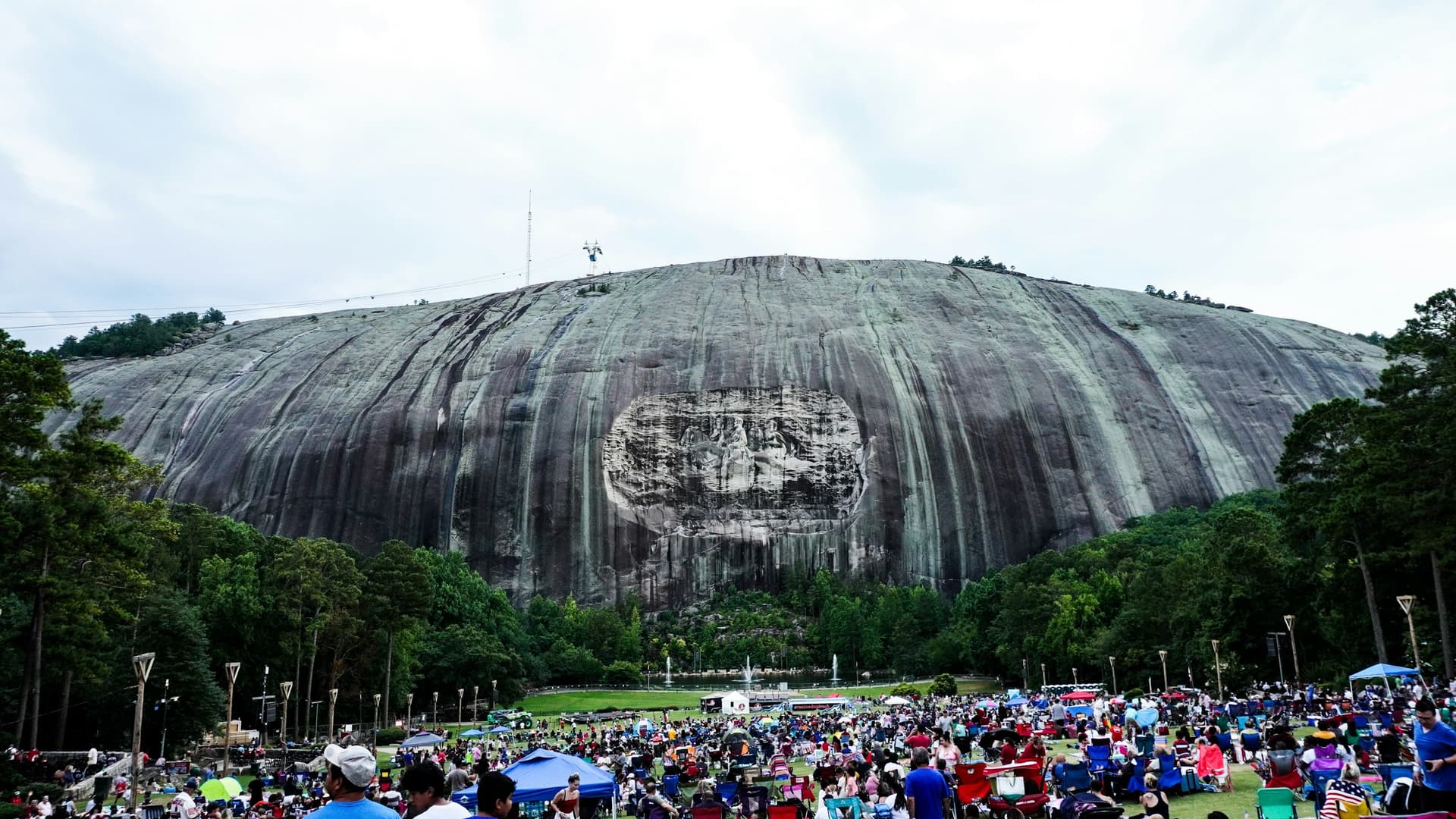
Stone Mountain, Georgia
Stone Mountain, Georgia, United States
539.8 km away