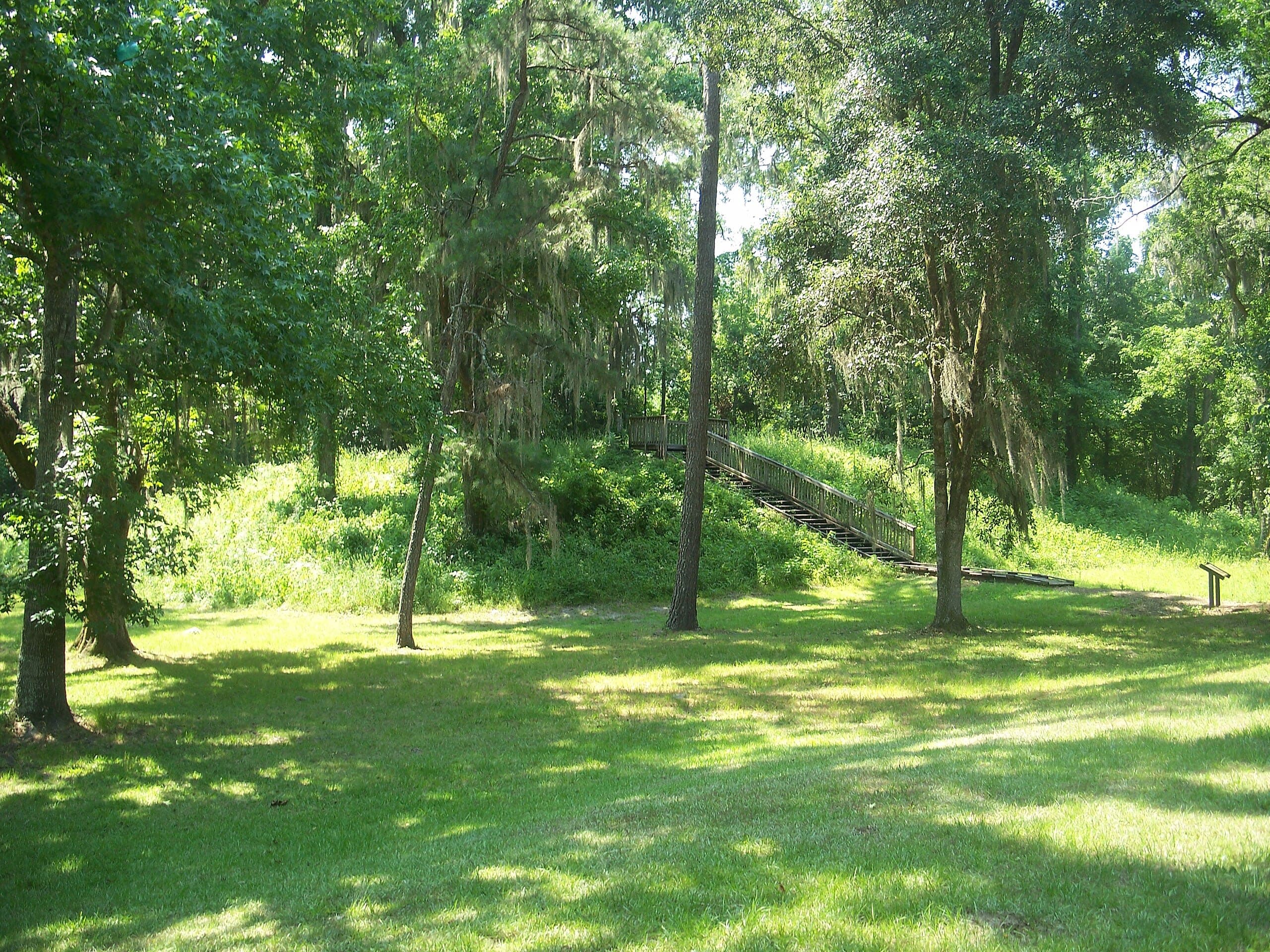
Lake Jackson Mounds, Tallahassee, Florida
Where Florida's mightiest chiefdom built temples toward the sky for five hundred years
Tallahassee, Florida, United States
At A Glance
- Coordinates
- 30.4997, -84.3136
- Suggested Duration
- 1-2 hours for a comprehensive visit. The 0.75-mile interpretive trail and mound climbs take approximately one hour. The 2.2-mile nature trail extends the experience. Ranger-guided tours, available with advance notice, provide deeper context.
Pilgrim Tips
- Comfortable outdoor attire appropriate for Florida weather. Sturdy walking shoes recommended for trails. Summer visitors should prepare for heat, humidity, and mosquitoes.
- Photography is permitted throughout the park. Respectful photography that honors the site's sacred and ancestral significance is encouraged.
- Lake Jackson contains human remains. Mound 3, now destroyed, contained 24 documented burials. The remaining mounds likely contain additional burials. This demands respect. The site is sacred to the Apalachee descendants even as it is managed as a public state park. Visitors should recognize that they are walking on ancestral ground, not merely archaeological curiosity. Do not disturb the ground or collect any artifacts. Surface finds have meaning only in context; removing them destroys information that can never be recovered.
Overview
In the rolling hills north of Tallahassee, six earthen mounds rise from the red clay of Florida's Panhandle. For half a millennium, beginning around 1000 CE, this was the ceremonial heart of a chiefdom that commanded the region. Chiefs were buried here with copper plates from Georgia bearing images of falcon warriors and severed heads. The Apalachee people, descendants of those who built these mounds, survive today in Louisiana. Their ancestors' handiwork endures in the Florida landscape, asking questions about power, belief, and what it means to build toward the heavens.
Lake Jackson Mounds challenges what many believe about pre-Columbian Florida. Here, near what is now the state capital, the largest ceremonial center of the Fort Walton culture flourished for five centuries. Platform mounds elevated temples and elite residences toward the sky. Trade networks stretched north to Georgia and the great Mississippian centers beyond. Chiefs were interred with elaborate grave goods: copper plates bearing falcon imagery, shell gorgets, thousands of pearls, bundles wrapped according to traditions shared across the Southeast.
The site speaks of ambition and connection. The copper plates found here were made at Etowah, 300 miles north in Georgia, demonstrating that Lake Jackson was no isolated outpost but a participant in a continental network of trade and ceremony. The imagery on those plates, depicting supernatural beings and ritual violence, linked local practices to a shared spiritual vocabulary spanning from Florida to Illinois.
Around 1500 CE, Lake Jackson was abandoned. The chiefdom did not collapse but relocated. When Hernando de Soto arrived in 1539, he encountered the Apalachee at Anhaica, the successor to Lake Jackson's power. The Apalachee maintained their traditions through Spanish missionization until colonial violence dispersed them in the early 18th century. Today, approximately 250-300 descendants, known as the Talimali Band of Apalachee Indians, live in Louisiana. They are the only documented surviving descendants of any of Florida's prehistoric peoples.
Lake Jackson Mounds is now an Archaeological State Park, protected since 1966. Six of the original seven mounds survive. Visitors can climb stairs to the summits of two, looking out over the landscape toward the lake that gave the site its modern name. What they see is ancestral ground, where the forebears of the Apalachee built monuments to connect earth and sky.
Context And Lineage
Lake Jackson Mounds was built by the Fort Walton culture, the southernmost expression of Mississippian tradition, between approximately 1000-1500 CE. The Apalachee people are the documented descendants of the site's builders, with approximately 250-300 descendants living today in Louisiana.
The scholarly interpretation positions Lake Jackson within the broader transformation that swept the Southeast during the Mississippian period. Around 1000 CE, local Weeden Island peoples began adopting Mississippian traits: platform mound construction, intensive maize agriculture, new ceramic traditions. Lake Jackson emerged as the largest center of this Fort Walton culture.
The site's location was strategic: rich agricultural lands near the lake, access to Gulf Coast resources for trade, a position commanding the Florida Panhandle. Here, chiefs built mounds, accumulated prestige goods, and maintained connections to the great centers of the Mississippian world.
Researchers believe the inhabitants were the ancestors of the Apalachee Indians documented by Spanish explorers. When Lake Jackson was abandoned around 1500 CE, the chiefdom relocated to Anhaica. There, in 1539, Hernando de Soto encountered a sophisticated society still practicing traditions rooted in Mississippian culture: the ball game, sun veneration, the black drink ceremony.
The Apalachee descendants, the Talimali Band of Apalachee Indians in Louisiana, maintain cultural connections to their ancestral homeland. They are the only documented surviving descendants of any of Florida's prehistoric native populations, a living link to the people who built the mounds at Lake Jackson.
The name 'Lake Jackson' comes from the nearby lake, named by European settlers. The original name of the site and its inhabitants is unknown. The people who built the mounds belonged to what archaeologists call the Fort Walton culture, the southernmost expression of the Mississippian cultural tradition.
Multiple lines of evidence connect Lake Jackson's builders to the historic Apalachee. When the site was abandoned around 1500 CE, the chiefdom relocated rather than collapsed. The successor site, Anhaica, was where de Soto encountered the Apalachee in 1539. The Apalachee maintained their culture through Spanish missionization until colonial violence dispersed them in the early 18th century.
Today, the Talimali Band of Apalachee Indians in Louisiana represents the surviving descendants. They are seeking federal recognition and work to preserve knowledge of their ancestors' traditions. For them, Lake Jackson is ancestral sacred ground, a tangible connection to their heritage. The lineage persists not through unbroken occupation but through cultural memory maintained across centuries of displacement.
Chiefs of Lake Jackson
The individuals buried in Mound 3 with elaborate grave goods including copper plates, shell gorgets, and thousands of pearls. Their identities are unknown, but their burials reveal them as figures of great religious and political significance.
B. Calvin Jones
Archaeologist who conducted salvage excavations of Mound 3 in 1975-1976 before its destruction by road construction. His work recovered the burial goods that now provide the primary window into Lake Jackson's elite culture.
Talimali Band of Apalachee Indians
The approximately 250-300 descendants of the Apalachee people living today in Louisiana. They maintain cultural connections to their ancestral Florida homeland and represent the living continuation of the tradition that built Lake Jackson.
Why This Place Is Sacred
Lake Jackson's thinness emerges from concentrated purpose across five centuries. Platform mounds elevated sacred structures toward the heavens, creating vertical connections between worlds. Chiefs were buried with objects linking them to a pan-regional spiritual network. The site remains sacred to Apalachee descendants, who maintain cultural memory of their ancestors' homeland.
What makes a place thin at Lake Jackson is the accumulation of intention. For 500 years, people gathered here to build, to worship, to bury their leaders. The mounds rose basket by basket, each load of earth carried by hands that believed this work mattered. The temples on the summits were stages for ceremonies now lost to direct knowledge but preserved in the landscape they shaped.
The platform mounds function as axis mundi, cosmic centers connecting the earth to the heavens above. Their flat summits once held wooden structures where priests and chiefs performed rituals that maintained the order of their world. The mounds were oriented along an east-west axis, aligned with the sun's path, embedding cosmological meaning in the very layout of the site.
Mound 3, before its destruction in 1975-1976, yielded burials that reveal the spiritual investments made here. Chiefs were interred with copper plates, shell gorgets, and thousands of pearls. Their bodies were wrapped in cloth, then leather, then cane matting, placed in log-lined pits. This bundling practice has deep roots in Native North American sacred traditions. The objects buried with them, bearing imagery of falcon warriors and severed heads, connected these local leaders to a spiritual vocabulary shared across the Mississippian world.
The thinness at Lake Jackson is amplified by what persists beyond the physical. The Apalachee descendants in Louisiana maintain cultural memory of their ancestral homeland. For them, Lake Jackson is not merely archaeological but ancestral, not merely historical but sacred. The veil thins where memory persists across centuries of displacement, and at Lake Jackson, that memory endures.
Around 1000 CE, the people living near Lake Jackson began transforming their society through contact with Mississippian culture centers to the north. What archaeologists call the Fort Walton culture emerged, characterized by platform mound construction, intensive maize agriculture, and participation in a pan-regional ceremonial complex.
Lake Jackson became the largest ceremonial center of this culture, the political and religious capital of a chiefdom that controlled much of what is now the Florida Panhandle. The mounds were not merely civic architecture but sacred stages. Platform mounds elevated temples and elite residences closer to the heavens, symbolizing the divine connections of those who dwelt upon them.
The site functioned as both religious and political center, though for the Fort Walton people these categories may not have been distinct. Chiefs likely served as intermediaries between the human community and the spiritual powers that governed agriculture, warfare, and cosmic order. The plaza between the mounds was space for ritual games and gatherings. The temples on the summits were stages for ceremonies that maintained the world.
Trade networks connected Lake Jackson to the broader Mississippian world. Shells and pearls from the Gulf Coast traveled north; copper plates from Georgia traveled south. These exchanges were not merely economic but spiritual, linking communities across vast distances through shared sacred objects and imagery.
Lake Jackson's occupation spans approximately 500 years, from around 1000 CE to 1500 CE. The site emerged as the local expression of a broader transformation sweeping the Southeast, as Mississippian influences reached the Florida Panhandle.
The peak period, roughly 1100-1300 CE, saw the most intensive construction and the strongest connections to other Mississippian centers. The copper plates found at Lake Jackson date to this era, demonstrating active participation in long-distance exchange networks. Chiefs accumulated prestige goods that connected them to a continental spiritual vocabulary.
Around 1500 CE, Lake Jackson was abandoned. The reasons remain unclear. Climate change, political fragmentation, epidemic disease, or simple exhaustion of local resources all remain plausible. What is clear is that the chiefdom did not disappear but relocated. The successor site, Anhaica, became the center of Apalachee power that Spanish explorers would encounter.
After European contact, the Apalachee initially resisted but eventually accepted Spanish missionization in the 17th century. Colonial violence in the early 18th century dispersed the Apalachee, with survivors eventually settling in Louisiana. The mounds at Lake Jackson fell silent, becoming farmland, their significance forgotten by the newcomers who plowed around them.
Modern recognition began in 1966 when the site became a Florida State Park. In 1971, it was listed on the National Register of Historic Places. Tragically, Mound 3 was destroyed by road construction in 1975-1976, though archaeologist B. Calvin Jones conducted salvage excavations that recovered the remarkable burial goods now displayed at the Museum of Florida History.
Traditions And Practice
The Fort Walton people practiced ceremonies associated with the Southeastern Ceremonial Complex, including elaborate mortuary rituals, ritual games, and the black drink ceremony. No active ceremonial practices occur at the site today, but the Apalachee descendants maintain cultural traditions in Louisiana.
Religious practice at Lake Jackson was rooted in the Southeastern Ceremonial Complex, a broad similarity of artifacts, iconography, and ceremonies shared across Mississippian culture sites. The copper plates found in Mound 3 bear Classic Braden style imagery associated with the great center of Cahokia: winged figures, severed heads, ceremonial maces. These items connected Lake Jackson's practices to a spiritual vocabulary spanning from Florida to Illinois.
Mortuary rituals for chiefs were elaborate. Bodies were wrapped in cloth, with copper plates placed on chests. They were then wrapped in leather and cane matting and placed in log-lined pits. This bundling practice has deep roots in Native North American traditions. Accompanying grave goods included shell gorgets, pearl beads, and ritual objects.
The black drink ceremony, using tea made from yaupon holly, was likely practiced for purification. Sun veneration was central to Apalachee spirituality, with ceremonies conducted at sunrise and sunset. The ritual ball game, played in spring and summer, was believed to obtain favor from gods of thunder and rain for successful crops.
The plaza between the mounds served as ceremonial space. Chunkey games and ritual gatherings would have taken place here. The temples on mound summits were stages for rituals that maintained the relationship between the community and cosmic order.
No active ceremonial practices occur at Lake Jackson Mounds today. The site is managed as an archaeological and educational resource by Florida State Parks.
The Apalachee descendants in Louisiana, the Talimali Band of Apalachee Indians, maintain cultural traditions but have been geographically separated from their ancestral Florida homeland for centuries. They preserve knowledge of their ancestors' practices and seek to maintain cultural continuity despite displacement. The site remains sacred to these descendants as ancestral ground.
Visitors can engage with Lake Jackson through contemplative practices suited to an ancestral site. Climbing the mound stairs and sitting at the summit allows the scale and age of the place to register. Looking out toward the lake, visitors can imagine the landscape as it was: the mounds crowned with temples, the plaza alive with ceremony, the community gathering to maintain their world.
Walking the interpretive trail slowly, reading the panels, pausing at each mound offers meditative engagement. The site asks for attention and imagination. Understanding that for 500 years people gathered here to build, worship, and bury their leaders gives weight to what might otherwise seem simply peaceful parkland.
Visitors should recognize that this is ancestral land. The descendants of those who built these mounds are still here, maintaining memory in Louisiana. Walking at Lake Jackson is walking on ground that remains sacred to living people.
Fort Walton Culture / Mississippian Tradition
HistoricalLake Jackson was the largest ceremonial center of the Fort Walton culture, the southernmost expression of the Mississippian cultural tradition. The Fort Walton people built platform mounds, practiced intensive maize agriculture, and participated in a pan-regional ceremonial complex that connected them to major centers like Etowah and Cahokia. The site served as both political capital and religious ceremonial center for a chiefdom that controlled much of the Florida Panhandle for 500 years.
Construction of platform mounds for temples and elite residences. Burial of chiefs with elaborate grave goods including copper plates, shell gorgets, and pearls. Participation in the Southeastern Ceremonial Complex. Ritual games in the plaza. Black drink ceremony using yaupon holly. Agricultural rituals tied to maize cultivation. Sun veneration.
Southeastern Ceremonial Complex (SECC)
HistoricalLake Jackson was a participant in the Southeastern Ceremonial Complex, a broad regional similarity of artifacts, iconography, ceremonies, and mythology shared across Mississippian culture sites. The copper plates found at Lake Jackson bear Classic Braden style imagery associated with Cahokia, featuring winged figures, severed heads, and ceremonial maces. These items demonstrate Lake Jackson's participation in a vast trade and ceremonial network stretching from Florida to Illinois.
Exchange of prestige goods with other Mississippian centers, especially Etowah. Creation and use of copper plates with SECC iconography. Shell gorget production and trade. Ritual use of marine shells for black drink cups. Chunkey games. Mortuary rituals for elites involving bundling and grave goods.
Apalachee Ancestral Connection
ActiveResearchers believe the occupants of Lake Jackson were the ancestors of the Apalachee Indians documented by Spanish explorers. After Lake Jackson was abandoned around 1500 CE, the chiefdom relocated to Anhaica, where de Soto encountered the Apalachee in 1539. Today, approximately 250-300 descendants, the Talimali Band of Apalachee Indians, live in Louisiana. They are the only documented descendants of any of Florida's prehistoric native populations.
Contemporary Apalachee descendants maintain cultural memory, seek federal recognition, and work to preserve knowledge of their ancestors' traditions including the ball game, sun veneration, and agricultural ceremonies. They represent a living link to the people who built Lake Jackson.
Experience And Perspectives
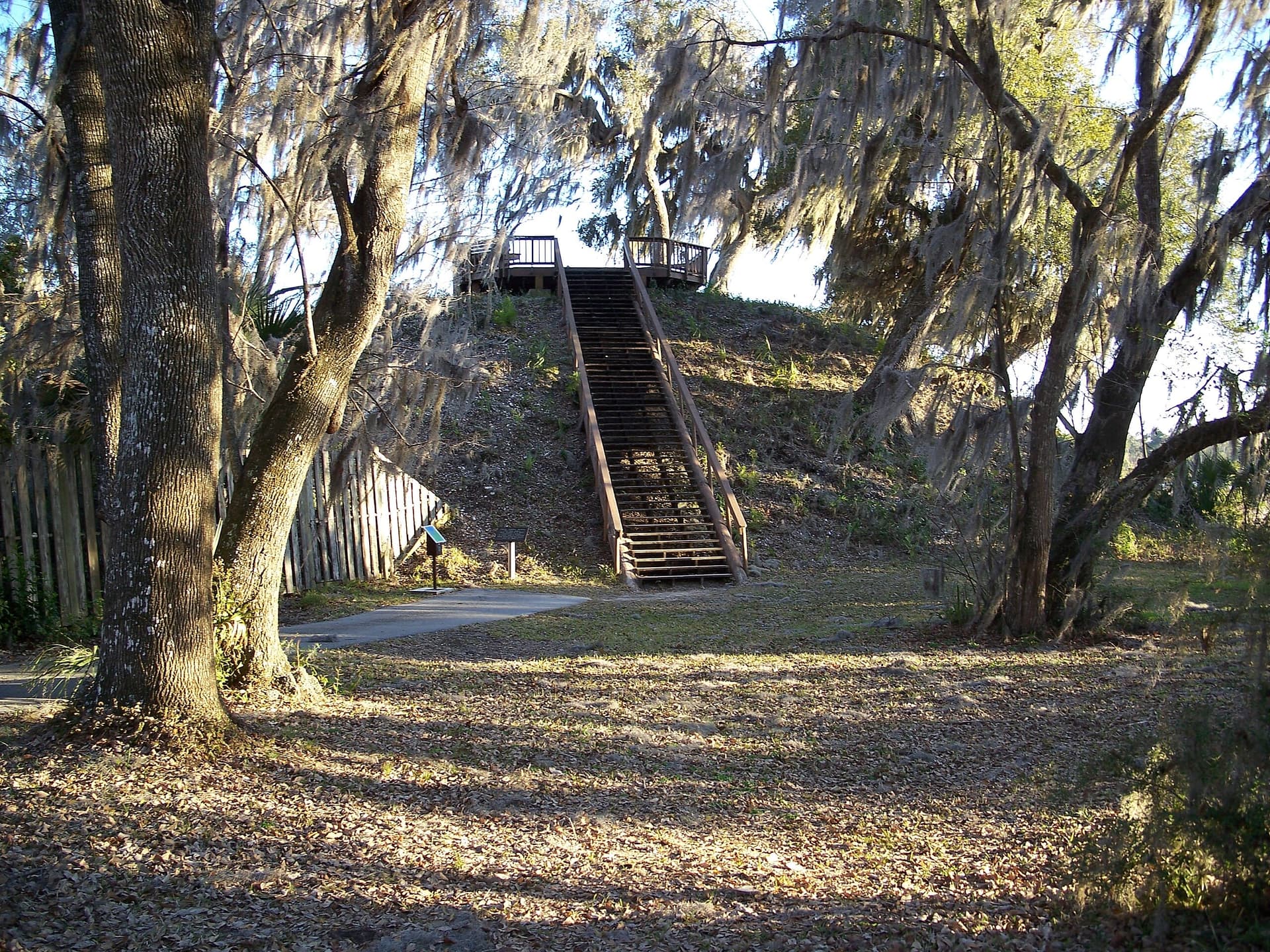
Visiting Lake Jackson Mounds means walking among earthworks that once anchored a 500-year chiefdom. Stairs lead to the summits of two mounds, offering views across the site toward the lake. The interpretive trail and panels provide context for what the landscape once held.
The drive north from downtown Tallahassee takes fifteen minutes. Indian Mounds Road curves through residential neighborhoods before arriving at a parking area shaded by live oaks. The transition is sudden: from state capital to ancestral ground.
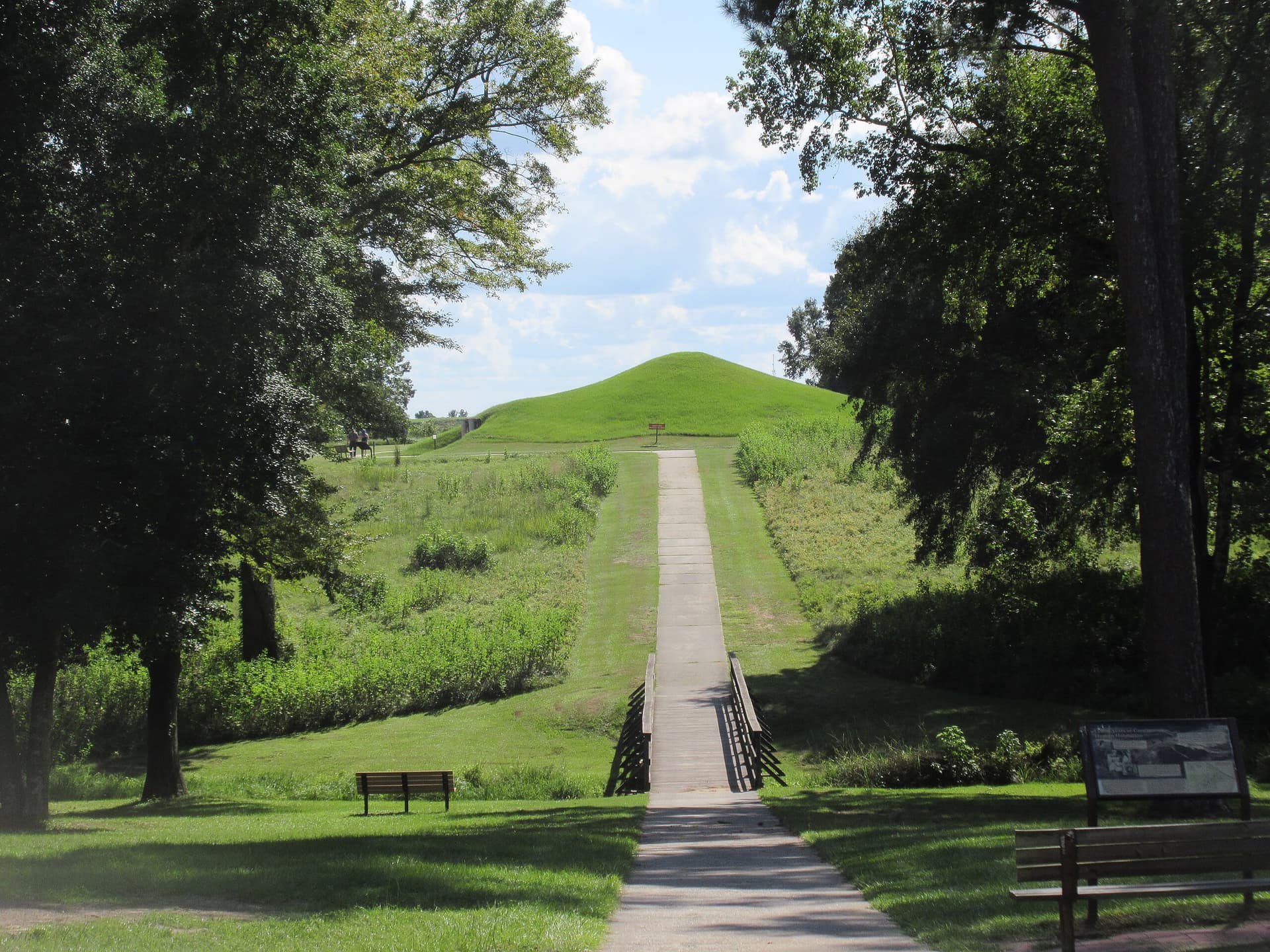
The site opens with subtlety. The mounds do not announce themselves from the parking lot. A covered pavilion holds an interpretive exhibit, providing essential context before exploring. Here visitors learn that these grass-covered rises are not natural hills but monuments built by hand over centuries.
Two mounds are accessible via stairs. The ascent is brief but contemplative. At the summit, the view extends across the site: the other mounds visible as rises in the landscape, the treeline marking the lake, the Florida sky overhead. Here, where temples once stood, visitors stand where priests and chiefs once stood, looking out over a world they believed they helped to maintain.
The 0.75-mile interpretive trail winds among the mounds, with panels explaining the site's history and significance. The 2.2-mile nature trail extends the experience into the surrounding landscape, offering glimpses of the ecology that sustained the Fort Walton people: hardwood forest, wetlands, the lake that provided fish and waterfowl.
What strikes many visitors is the quiet. This was a center of power. It is now peaceful. Birds call from the forest edge. Wind moves through the live oaks. The gap between what was and what is creates space for contemplation. Lake Jackson asks visitors to imagine: to populate these mounds with temples and dwellings, to fill the plaza with ceremonies and games, to understand that for 500 years this place mattered profoundly to those who built it.
Plan 1-2 hours for a comprehensive visit. The interpretive trail and mound climbs take approximately one hour. The longer nature trail extends the visit. Bring water, especially in summer. Mosquitoes can be prevalent near the lake. The park is open from 8 AM to sundown year-round. Ranger-guided tours are available with two weeks advance notice.
Lake Jackson Mounds invites multiple interpretations: the capital of a 500-year chiefdom, evidence of continental trade networks, ancestral homeland for the Apalachee people, or testimony to the depth of Florida's indigenous history. These perspectives coexist, each illuminating different aspects of what the mounds mean.
The scholarly consensus recognizes Lake Jackson as the largest and most important ceremonial center of the Fort Walton culture, the southernmost major expression of the Mississippian cultural tradition. Archaeological evidence demonstrates extensive trade connections with Etowah in Georgia, from which Lake Jackson received copper plates in exchange for Gulf Coast shells and pearls.
The site functioned as the political and religious capital of a regional chiefdom for approximately 500 years (c. 1000-1500 CE). The burials excavated from Mound 3 reveal a stratified society where chiefs were interred with elaborate grave goods bearing Southeastern Ceremonial Complex iconography.
Researchers believe the site's inhabitants were ancestors of the historic Apalachee people. The connection is established through continuity of territory, cultural practices, and the absence of evidence for population replacement between Lake Jackson's abandonment and European contact.
The Apalachee descendants, the Talimali Band of Apalachee Indians in Louisiana, represent the living connection to Lake Jackson's builders. For these approximately 250-300 people, Lake Jackson is ancestral sacred ground, a tangible link to their heritage.
The Apalachee maintained their culture through Spanish missionization in the 17th century, preserving traditions including the ball game, sun veneration, and the black drink ceremony. Colonial violence dispersed them, but they survived. Today, they are the only documented surviving descendants of any of Florida's prehistoric peoples.
The indigenous perspective emphasizes that Lake Jackson represents living heritage. The mounds were built by ancestors whose descendants still carry cultural memory. The site is not merely archaeological but ancestral, not merely historical but sacred.
Lake Jackson's participation in the Southeastern Ceremonial Complex has attracted attention from those interested in pre-Columbian spiritual traditions. The iconography on the copper plates, depicting supernatural beings and ritual violence, suggests a rich cosmology only partially understood.
Some have speculated about the deeper meanings of these images and the ceremonies conducted atop the mounds. The scholarly view emphasizes that these practices developed within the Mississippian world, representing indigenous spiritual achievement rather than outside influence.
Significant mysteries persist at Lake Jackson. What specific religious beliefs and ceremonies were practiced at the site? The material evidence, rich as it is, cannot fully reconstruct the beliefs that animated it.
Why was the site abandoned around 1500 CE? Climate change, political fragmentation, disease, and resource exhaustion all remain plausible. The chiefdom relocated rather than collapsed, but the reasons for departure remain unclear.
What was the original name of the site and its inhabitants? The name 'Lake Jackson' is modern; the Apalachee name for this ancestral place, if it survives, is not publicly documented.
What ceremonial activities took place in the plaza between the mounds? What rituals were performed in the temples on the mound summits? How did the cosmological worldview of the Fort Walton people shape the site's layout and orientation? These questions remain open, inviting continued research and contemplation.
Visit Planning
Lake Jackson Mounds is located in northern Tallahassee, Florida. The park is open daily 8 AM to sundown. Admission is $3 per vehicle. Allow 1-2 hours for interpretive trail and mound exploration.
Tallahassee offers full hotel and lodging services. The park is located in northern Tallahassee, approximately 8 miles from downtown, easily accessible as part of a visit to the state capital.
Treat Lake Jackson as both archaeological site and ancestral land. Stay on designated trails, climb mounds only via provided stairs, and do not disturb ground or collect artifacts. Photography is permitted throughout the park.
Lake Jackson requires the etiquette appropriate to a place that is simultaneously archaeological monument and ancestral sacred ground. The mounds contain human remains. The site is claimed by descendant peoples who maintain it sacred. Respect is essential.
The physical preservation of the site depends on visitor behavior. The mounds are earthen structures that erode when disturbed. Climbing mounds except via designated stairs damages their integrity. Digging destroys archaeological context. Artifacts found on the surface have meaning only in their location; removing them erases irreplaceable information.
The site does not currently host ceremonial gatherings by descendant communities, but this does not diminish its sacred character. Visitors should approach with the respect appropriate to ancestral ground, recognizing that for some people these mounds hold meaning beyond the educational or recreational.
Comfortable outdoor attire appropriate for Florida weather. Sturdy walking shoes recommended for trails. Summer visitors should prepare for heat, humidity, and mosquitoes.
Photography is permitted throughout the park. Respectful photography that honors the site's sacred and ancestral significance is encouraged.
Do not leave offerings at the site. Do not remove any objects.
{"Stay on designated trails and paths","Climb mounds only via provided stairs","Do not dig or disturb the ground","Do not collect or remove any artifacts","Pets must be on leash no longer than 6 feet","No alcohol or glass containers","No camping or fires"}
Sacred Cluster
Nearby sacred places create the location cluster described in the growth plan. This block is intentionally crawlable and links into the wider regional graph.