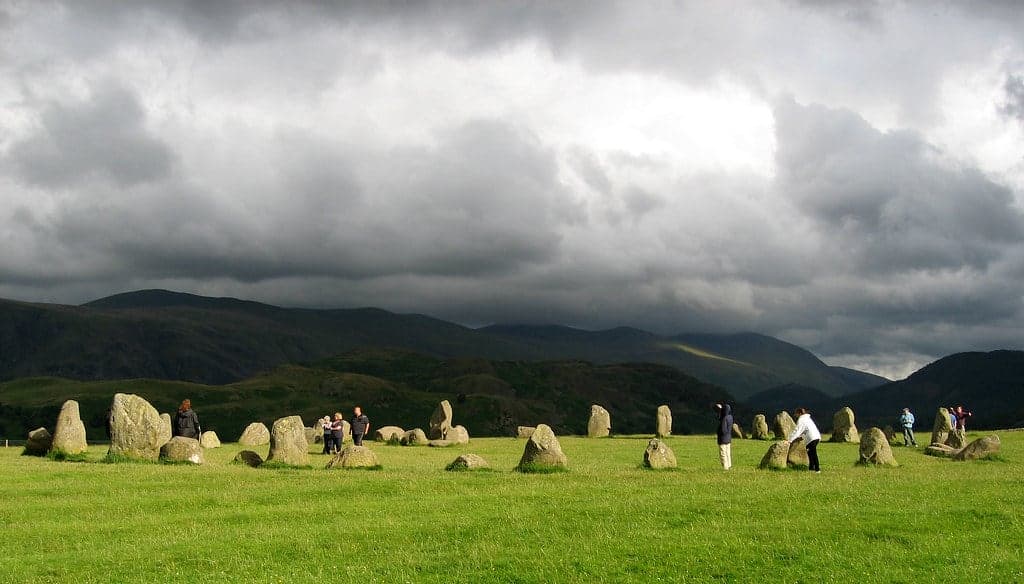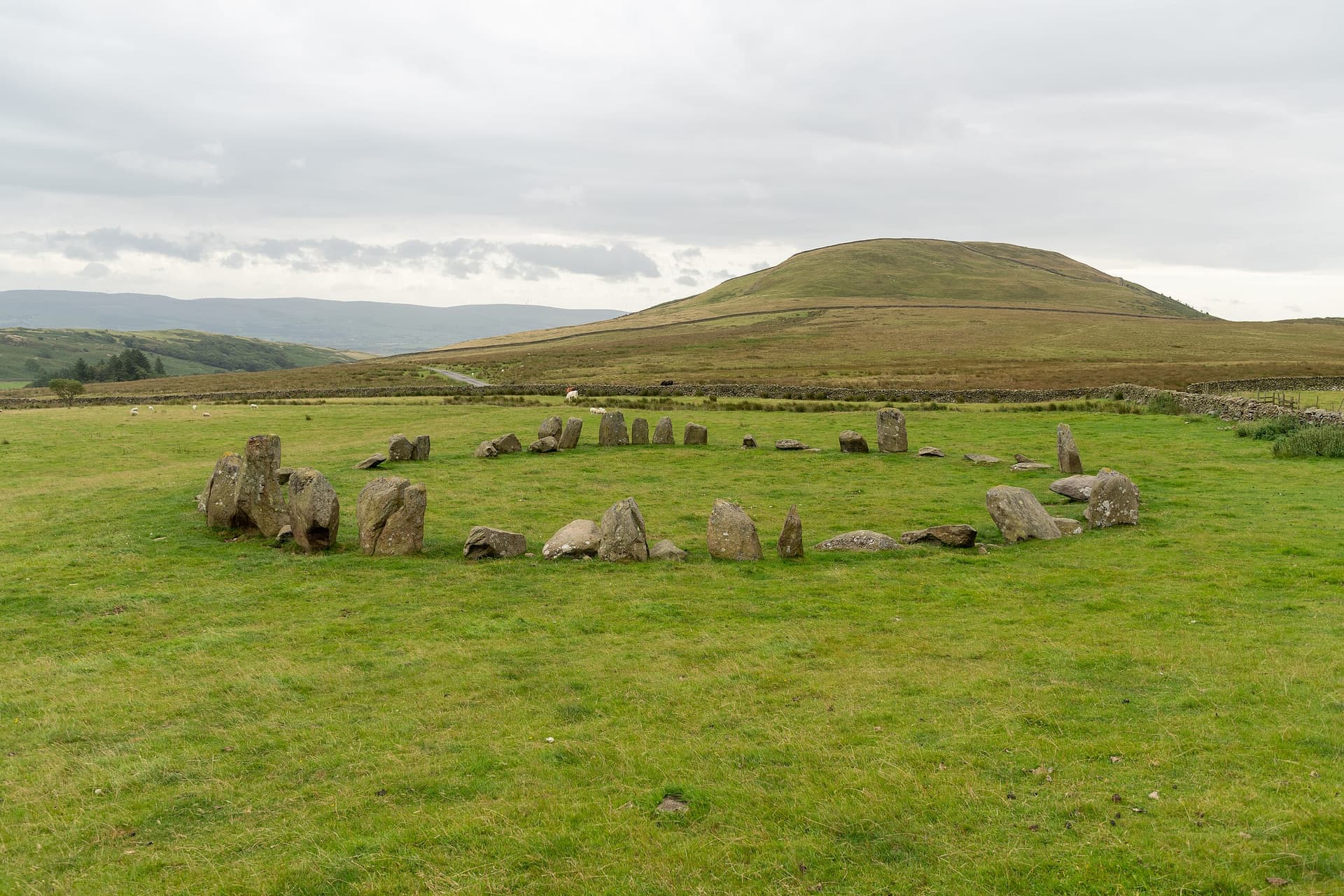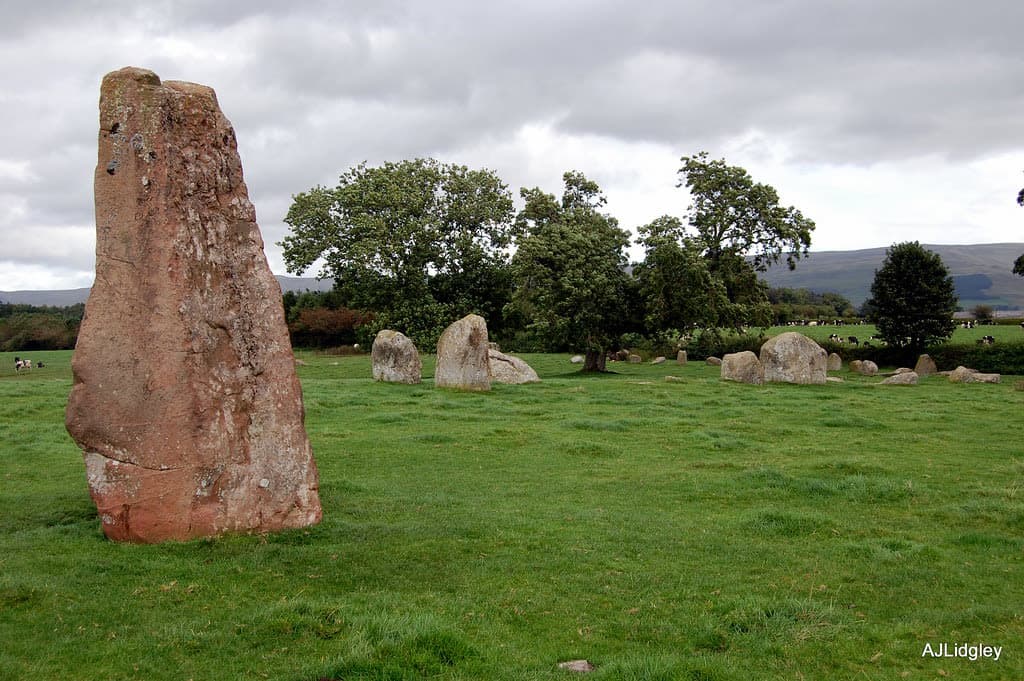
Long Meg and Her Daughters stone ring
Where Neolithic builders marked the sun's return, and the stones still stand sentinel over sacred ground
Little Salkeld, England, United Kingdom
At A Glance
- Coordinates
- 54.7280, -2.6675
- Suggested Duration
- A brief visit takes thirty minutes to an hour. A meaningful encounter requires at least two hours, allowing time to walk the full circle, examine Long Meg's carvings, and sit in silence. Those coming for the winter solstice should arrive well before sunset. Some visitors return multiple times across a day or across seasons.
- Access
- From Penrith, take the A686 northeast for approximately 6.5 kilometers. At Langwathby, take the minor road north toward Little Salkeld. About 0.5 kilometers beyond Little Salkeld, a track on the left leads to the site and car park. The address for navigation is Hunsonby, Penrith, CA10 1NW. The walk from the car park to the stones takes approximately ten minutes on a relatively flat but potentially muddy path. Disabled access is available closer to the site.
Pilgrim Tips
- From Penrith, take the A686 northeast for approximately 6.5 kilometers. At Langwathby, take the minor road north toward Little Salkeld. About 0.5 kilometers beyond Little Salkeld, a track on the left leads to the site and car park. The address for navigation is Hunsonby, Penrith, CA10 1NW. The walk from the car park to the stones takes approximately ten minutes on a relatively flat but potentially muddy path. Disabled access is available closer to the site.
- No formal dress code applies. Dress practically for outdoor conditions in northern England. Sturdy footwear is recommended, as paths may be muddy after rain and the terrain is uneven among the stones. The site is exposed to weather, so dress in layers and be prepared for changeable conditions.
- Personal photography is permitted and the site rewards it. The textures of the stones, the quality of northern light, and the atmospheric Eden Valley setting provide abundant opportunity. There are no restrictions on personal cameras or phones. Drone photography may require permissions. Be present before being productive. Consider spending time simply looking before reaching for your device.
- Long Meg and Her Daughters is a Scheduled Ancient Monument protected by law. Do not climb on, damage, or deface the stones. Do not chip Long Meg, regardless of what the legend says about her bleeding. If leaving offerings, use only small biodegradable items that will not harm the environment or detract from the site's appearance. Many visitors find that internal offerings, silent prayers or intentions, are more appropriate to the character of the place. The site is on working farmland. Close any gates you pass through. Be aware of livestock and farm vehicles. Respect the land that hosts these ancient stones.
Overview
One of Britain's largest and oldest stone circles rises from the Eden Valley in Cumbria, its massive ring of granite daughters watched over by a single sandstone monolith carved with spirals over five thousand years ago. On the winter solstice, Long Meg's shadow reaches across the circle as the sun sets behind her, marking the same astronomical moment her builders observed when the world was young.
Some places hold time differently. Long Meg and Her Daughters is one of them.
Nearly sixty-nine stones form an immense oval on a Cumbrian terrace above the River Eden, while a solitary pillar of red sandstone stands apart to the southwest, her surface inscribed with spirals and rings that connect her to ceremonial sites across the Irish Sea. The circle is among England's largest, the sixth largest in all of Europe. Those who built it worked with purpose we can only partly reconstruct.
What we know is this: the builders aligned their monument with precision. On the winter solstice, the shortest and darkest day, the setting sun passes directly behind Long Meg when viewed from the circle's center. Her shadow stretches across the stones at the moment the year begins to turn. For five millennia, this alignment has held.
The Neolithic communities who gathered here left no written record. Their ceremonies, their cosmology, their names for the powers they honored have all passed beyond recovery. What remains is the circle itself, the carved stone, and the quality of attention that persists in this landscape. Visitors speak of feeling watched, held, witnessed. The legends that accrued in later centuries gave voice to something people sensed: that Long Meg stands guard, and that the Daughters keep their own counsel about matters beyond mortal knowing.
You do not need to believe anything to feel it. You only need to stand where others have stood, in the presence of stones that were ancient before Rome was founded, and notice what arises.
Context And Lineage
Long Meg and Her Daughters was constructed during the Late Neolithic period, around 3340-3100 BCE, making it one of Britain's earliest stone circles. The site formed part of a larger ceremonial landscape that included earthen enclosures and a processional cursus. Though the community that built it left no written records, the scale, precision, and artistry of the monument speak to sophisticated understanding of astronomy, engineering, and the relationship between human ceremony and cosmic rhythm.
No founding narrative survives from the Neolithic communities who built Long Meg and Her Daughters. Their voices reach us only through stone.
What archaeology reveals is this: sometime around 3340-3100 BCE, people gathered on this terrace above the River Eden to construct one of the largest stone circles in Europe. They hauled Long Meg, over three meters tall and weighing several tons, from near the riverbank. They collected the Daughters, granite boulders deposited by glaciers, from across the landscape. They arranged them in an oval aligned with the winter solstice sunset. They carved spirals and rings into Long Meg's face.
The effort required was immense. The engineering sophistication was considerable. The precision of the alignment speaks to generations of observation and knowledge. These were not casual builders but people working from deep understanding, creating a monument intended to endure.
An earlier enclosure, dating perhaps from the Early Neolithic, already occupied the land to the north. The stone circle was added to a place already marked as significant. A cursus, a processional avenue, connected the complex to the River Eden. Water, earth, stone, sun: the elements wove together into a site where communities could gather to enact what they understood as sacred.
The legends that arose in later centuries tell a different story. According to folklore, Long Meg was a witch who led her daughters in wild dancing on the Sabbath. The Scottish wizard Michael Scot, offended by their profanity, turned them all to stone. Alternatively, Long Meg was named for a legendary giantess, 'Long Meg of Westminster,' known for her formidable height.
These stories are not true in a literal sense. But they preserve something important: the recognition that this place holds power, that the stones are not mere geological objects but presences, that something watches here.
For perhaps a thousand years after construction, Neolithic and then Bronze Age communities likely used this site for purposes we cannot fully recover. Then the practices shifted or ended. The circle entered the long centuries of silence, standing without practitioners who remembered its original meaning.
Later peoples gave it new meaning through story. The witch legend, first recorded in early modern times, has persisted for centuries. The tradition that the stones cannot be counted twice to the same number dates at least to the seventeenth century. The belief that Long Meg will bleed if chipped speaks to the sense that the stones are alive.
Antiquarians documented the site from the sixteenth century onward. William Camden noted approximately seventy-seven stones standing in his time, more than remain today. William Wordsworth wrote of the circle in 'The Prelude,' finding in it 'a weight of awe not easy to be borne.' The Romantics saw in these stones evidence of Britain's deep past, a connection to ancestors who preceded written history.
Today, modern pagans, druids, and spiritual seekers have added their practices to the site's accumulated meaning. The wheel continues to turn.
Long Meg
legendary
According to legend, Long Meg was a witch who led her coven of daughters in dancing on the Sabbath. For this profanity, they were transformed to stone by the wizard Michael Scot. The tale gives narrative form to the site's palpable presence. Alternatively, she may have been named for 'Long Meg of Westminster,' a legendary giantess mentioned in Tudor-era texts.
Michael Scot
legendary
The Scottish wizard who, according to legend, cursed Long Meg and her daughters. Michael Scot was a historical figure (c. 1175-1232), a mathematician and scholar at the court of Emperor Frederick II, who became associated with magic and wizardry in later folklore. His inclusion in the legend connects the site to broader traditions of magical power.
Unknown Neolithic Community
historical
The builders of Long Meg and Her Daughters left no names or written records. They were part of the Neolithic cultures of Britain who constructed stone circles, henges, and burial mounds across the landscape. Their astronomical knowledge, engineering capability, and ceremonial practices speak through the monuments they left behind.
Why This Place Is Sacred
Long Meg and Her Daughters occupies a location chosen with evident care by Neolithic builders who understood landscape as alive with meaning. The site combines monumental scale, precise astronomical alignment, rare megalithic art, and connection to a broader ritual landscape that includes processional avenues, enclosures, and the sacred waters of the River Eden. Something drew people here for ceremonial gathering over five thousand years ago, and something continues to draw them today.
The Neolithic people of Britain did not build their great circles at random. They chose locations where the land itself spoke to them, where the relationship between earth and sky achieved particular expression, where communities could gather to enact the rhythms that sustained their world.
Long Meg stands at such a place. The circle occupies a sandstone terrace on the eastern bank of the River Eden, with views toward both the Pennine hills and the distant Lake District fells. Water flows near. Mountains watch. The ground itself is geologically complex, sitting above fault lines that some suggest produce unusual effects.
The builders demonstrated sophisticated understanding of astronomy. The alignment between Long Meg and the winter solstice sunset is precise enough that scholars call it the one undisputed astronomical feature of the site. When the year reaches its nadir, when darkness has grown as long as it will grow, the sun sets directly behind the outlying stone. For those gathered within the circle, her shadow would have reached toward them at the moment the cosmic wheel began to turn.
The spirals carved on Long Meg's face belong to a tradition found at Irish passage graves like Newgrange. These marks, whatever they meant to those who carved them, connect this Cumbrian circle to a wider world of Neolithic ceremony stretching across the Irish Sea. The art speaks of journeys, transitions, the turning of things from one state to another.
Aerial photography has revealed that the visible circle formed part of a larger complex. A massive earthen enclosure lies to the north. A cursus, a processional avenue, once led from the circle toward a cliff above the River Eden, the only such monument known in northwest England. Water, procession, enclosure, alignment: the elements of Neolithic sacred architecture converge here.
Contemporary visitors, most arriving without knowledge of these details, consistently report a sense of presence at the site. The feeling of being watched, of standing within protected space, of the boundary thinning between ordinary experience and something larger. The language varies. The reports are remarkably consistent.
Archaeological evidence suggests Long Meg and Her Daughters served as a major ceremonial gathering place for Neolithic communities across a wide region. The circle's immense size, third largest in England, indicates it was built for large assemblies. The winter solstice alignment points to ceremonies marking the turning of the year, the death and rebirth of the sun, the moment when light begins its return. The spiral carvings on Long Meg, belonging to the passage grave art tradition, hint at beliefs about transition, transformation, and movement between states of being. The cursus leading to the River Eden suggests water held spiritual significance, perhaps as a boundary between worlds or a source of purification. Though the specific rituals performed here remain unknown, the site appears to have been designed as a place where human community and cosmic rhythm could meet.
The builders of Long Meg and Her Daughters worked in the Late Neolithic period, with radiocarbon dating placing construction around 3340-3100 BCE. This makes the circle among the earliest in Britain. For perhaps a thousand years, communities gathered here for purposes we can only partly imagine.
Then the practices shifted. Bronze Age people may have used the site differently, or not at all. By the Iron Age, any continuous tradition of ceremony had likely ended. The circle entered the long centuries when it stood without practitioners who remembered its purpose.
Later generations made sense of the stones through storytelling. Long Meg became a witch, her daughters her coven, all turned to stone by a wizard for dancing on the Sabbath. The legend gave shape to the site's undeniable presence, translating ancient power into familiar narrative.
In the eighteenth century, Colonel Lacy attempted to destroy the stones with explosives to clear his land for farming. According to local tradition, a violent storm arose, terrifying his workmen, who refused to continue. The stones remained. Whether the story is true matters less than what it reveals: people felt that the circle protected itself, that some force watched over it.
Today, Long Meg draws heritage tourists, photographers, and seekers of various kinds. Modern pagans gather at the solstices. The meanings have multiplied across millennia, but the quality of the place persists.
Traditions And Practice
No formal religious ceremonies have been conducted at Long Meg and Her Daughters since antiquity, though the original practices likely involved gatherings at solar events, particularly the winter solstice. Today, the site draws modern pagans, druids, and seekers who visit for personal meditation and ritual, especially around the solstices and Celtic calendar festivals.
The original practices at Long Meg and Her Daughters cannot be recovered with certainty. No written records survive from the Neolithic communities who built the circle. What we can infer comes from archaeology, astronomical alignment, and comparison with similar sites.
The winter solstice alignment suggests ceremonies marking the turning of the year. When the sun set behind Long Meg on the shortest day, casting her shadow across the circle, those gathered would have witnessed the moment when darkness reached its height and began to yield to returning light. This would have been a time of profound significance, perhaps involving offerings, feasting, and rituals whose specifics we cannot know.
The spiral carvings on Long Meg belong to the passage grave art tradition found at sites like Newgrange in Ireland. This art is associated with burial and transformation, suggesting the site may have held funerary significance. The cursus leading to the River Eden hints at processional practices, perhaps involving movement between the circle and the sacred water.
The immense size of the circle indicates it was built for large gatherings. Whatever ceremonies took place here, they likely brought together communities from across the region at significant moments in the ceremonial calendar.
Modern visitors engage with Long Meg and Her Daughters in various ways. Heritage tourists come to appreciate the site's archaeological significance. Photographers seek the interplay of stone and light. Seekers of different traditions come for contemplation, meditation, and personal ritual.
Modern pagans and druids recognize the site as sacred ground, though the road signs still call it 'Druids Circle' in error, as Druids were Iron Age rather than Neolithic. Practitioners visit throughout the year, with particular gatherings at the solstices and Celtic calendar festivals such as Samhain, Imbolc, Beltane, and Lughnasadh.
The winter solstice remains the most significant time for those seeking to experience what the builders intended. On and around December 21-22, visitors gather to watch the sun set behind Long Meg, participating in an astronomical moment that has occurred at this site for over five thousand years.
If you come seeking more than photography, consider these invitations.
Arrive early or late, when the site is likely to be quiet. The quality of the place emerges more clearly without crowds. Walk the perimeter before entering the circle, acknowledging the Daughters as individuals. Greet Long Meg. Examine the carvings on her east face.
Find a place within the circle to sit in silence. You need not believe anything about the site's power. Simply notice what arises when you stop moving, when you allow your attention to settle, when you breathe with the stones that have stood here for fifty centuries.
If you come at the winter solstice, position yourself to watch the sunset. Feel the cold. Watch the light change. Notice Long Meg's shadow lengthening toward the circle. You are witnessing what the builders built this place to contain.
Before leaving, offer silent acknowledgment to whatever you understand as worthy of acknowledgment: the builders, the land, the turning year, your own journey. The form matters less than the sincerity.
Neolithic Ceremonial Practice
HistoricalLong Meg and Her Daughters was constructed as a ceremonial site during the Late Neolithic period, around 3340-3100 BCE. The site appears to have been built for community gatherings, particularly at the winter solstice when the sun's setting position aligned with Long Meg. The spiral carvings connect the site to the passage grave art tradition found across the Irish Sea. For the communities that built and used this place, it represented a node where human activity and cosmic rhythm could meet, where the turning of the year could be marked with ceremony.
Specific practices cannot be recovered from the archaeological record. The solstice alignment suggests ceremonies marking the sun's return at midwinter. The spirals may relate to beliefs about transition and transformation. The cursus leading to the River Eden hints at processional practices. The scale of the circle indicates large gatherings. Beyond these inferences, the details of Neolithic ceremony remain unknown.
British Folklore
ActiveOver centuries, local communities developed rich folklore around Long Meg and Her Daughters. The witch legend, which names Long Meg as a coven leader turned to stone by a wizard for dancing on the Sabbath, gives narrative form to the site's numinous quality. The tradition that the stones cannot be counted twice speaks to their uncanny nature. The belief that Long Meg will bleed if chipped treats her as alive. The story of Colonel Lacy's failed destruction attempt reinforces the sense that the circle protects itself.
Folklore traditions at the site include the practice of attempting to count the stones, with the expectation that no two counts will match. Some visitors speak to Long Meg, acknowledging her presence as the legend suggests she is aware. The tradition of not damaging the stones carries weight beyond legal protection.
Modern Paganism and Druidry
ActiveContemporary pagans, druids, and spiritual practitioners recognize Long Meg and Her Daughters as sacred ground. Though the road signs still misattribute the site to 'Druids' (an Iron Age rather than Neolithic tradition), modern Druid orders do include it among sites of spiritual significance. For practitioners of various earth-based spiritualities, the circle represents connection with ancestral sacred landscapes and the continuing power of places marked as holy long before recorded history.
Modern practitioners visit for meditation, personal ritual, and connection with the sacred landscape. The solstices draw particular gatherings, with the winter solstice alignment making December 21-22 especially significant. Celtic calendar festivals throughout the year also draw visitors. Practices tend to be individual or small-group rather than large organized ceremonies.
Experience And Perspectives
Visitors to Long Meg and Her Daughters consistently describe a distinctive quality of presence at the site. The scale of the circle creates a sense of enclosure, while Long Meg herself seems to stand watch. Many report feeling held or witnessed by the landscape. The rural setting, distant from modern development, enhances the sense of stepping outside ordinary time.
The first thing visitors notice is scale. The circle is vast, stretching over a hundred meters across, large enough that the stones on the far side appear diminished by distance. This is not a site that can be taken in at a glance. Walking among the Daughters, each stone an individual presence, takes time.
The second thing they notice is Long Meg herself. Standing apart from the circle, taller than any of the Daughters, carved with marks that predate recorded history, she draws the eye and holds it. Many describe feeling that she watches the circle, that she stands sentinel. The sense of being observed is remarkably common.
The third thing, harder to name, emerges over time. Those who stay, who sit in silence, who return at different hours or seasons, speak of a quality they struggle to articulate. Enclosure, though the site is open. Protection, though nothing threatens. A listening quality in the silence. Some call it energy. Others say presence. The language varies; the reports converge.
The winter solstice experience is particularly powerful for those who make the pilgrimage. To stand in the circle as the sun sets behind Long Meg, watching her shadow lengthen toward the stones as it has for fifty centuries, is to participate in something the builders intended. The darkness of midwinter becomes meaningful rather than merely cold.
Photographers and artists find the site inexhaustible. The quality of light changes constantly with the northern weather. The textures of the stones reward close attention. Yet many discover that their most vivid experiences come when they put down the camera and simply sit with what is here.
Long Meg and Her Daughters rewards unhurried attention. The site can be walked through in fifteen minutes by those merely checking it off a list, but those who report the deepest encounters almost always describe slowing down.
Consider beginning at the new car park, using the ten-minute walk to the stones as transition. Let the modern world recede. As you approach the circle, notice that Long Meg stands apart, watching. Many find it meaningful to greet her first, to acknowledge her presence before entering the space her Daughters enclose.
Walk the perimeter before entering. Notice that the stones are individuals, different sizes and shapes, each with its own character. Some lean; some stand upright; some have fallen and been re-erected. The granite Daughters were gathered from the landscape by glaciers; Long Meg alone is local sandstone, deliberately chosen for difference.
Examine the carvings on Long Meg's east face. The spirals are best seen in morning light or evening shadow, when the angle reveals what direct light obscures. These marks connect you to the hand that made them five thousand years ago.
If you come at the winter solstice, position yourself within the circle as sunset approaches. Watch the sun descend toward Long Meg. Feel the shadow reach toward you. The builders intended this moment. You are participating in what they built this place to contain.
Long Meg and Her Daughters invites multiple interpretations. Archaeologists, folklorists, modern practitioners, and casual visitors each bring different frameworks to the site. Honest engagement requires holding these perspectives together without forcing resolution. The circle is large enough, and old enough, to contain contradiction.
Archaeological consensus places the construction of Long Meg and Her Daughters in the Late Neolithic period, around 3340-3100 BCE, based on radiocarbon dating of hazel charcoal found in one of the stoneholes. This makes the site early for a British stone circle. The third largest in England after Avebury and Stanton Drew, and sixth largest in Europe, the monument represents a major investment of communal effort.
Scholars interpret the site as a ceremonial gathering place. The winter solstice alignment is the one undisputed astronomical feature. The spiral carvings on Long Meg belong to the Irish passage grave art tradition, suggesting cultural connections across the Irish Sea during the Neolithic. The discovery of a cursus monument and large enclosure through aerial photography revealed the true scale of the ritual landscape.
Debate continues regarding the relative emphasis of different functions. Was the site primarily for solar observation, community gathering, funerary ritual, or all of these? The relationship between Long Meg's construction and the stone circle remains an open question. What is clear is the sophistication of the builders and the intentionality with which they placed this monument in the landscape.
From the perspective of folklore and local tradition, Long Meg and Her Daughters is a place of enchantment and power. The legend of the witch turned to stone gives narrative form to the site's palpable presence. The tradition that the stones cannot be counted twice to the same number speaks to their uncanny quality. The belief that Long Meg will bleed if chipped treats the stone as alive.
These traditions are not literal history, but they preserve something true: the recognition that this place holds power exceeding ordinary explanation. The storm that allegedly stopped Colonel Lacy's destruction attempt may or may not have occurred, but the story's persistence reflects the sense that the circle protects itself.
For those who hold the land sacred, whether through reconstructed Celtic spirituality, modern druidry, or other paths, Long Meg stands as witness to the deep past of British spiritual life, a connection to ancestors who honored the earth before recorded time.
Some interpret Long Meg and Her Daughters as a site of earth energy, positioned on ley lines or energy channels flowing through the landscape. The stones are sometimes described as collectors or conductors of this energy. The spiral carvings on Long Meg are interpreted as maps of energy flow or symbols of spiritual transformation.
These interpretations lack archaeological support. No scientific measurement confirms the 'energy' visitors describe. However, the consistency of reports across different types of visitors, many of whom arrive without New Age frameworks, suggests something worth attending to, even if we lack adequate vocabulary for it. The experience is more consistent than the explanations offered for it.
Genuine mysteries remain. The specific rituals performed at the site cannot be recovered. The relationship between the spiral carvings and the solar alignment is unclear. The sequence of construction, whether Long Meg or the circle came first, requires further research. The nature of the community that built and used the site, their beliefs, their names for the powers they honored, all remain beyond reach.
The meaning of Neolithic rock art is extensively debated with no consensus. The spirals and rings may represent cosmological concepts, altered states of consciousness, or meanings we cannot now recover. The connection to Irish passage graves is clear, but what that connection meant is not.
This uncertainty is worth preserving. It keeps the site alive to questioning rather than pinned down by false certainty. The stones have stood for five thousand years without requiring us to fully understand them.
Visit Planning
Long Meg and Her Daughters is freely accessible year-round with no admission fee. A new dedicated car park provides visitor access, with approximately a ten-minute walk to the stones. The site is located in the Eden Valley of Cumbria, about eight kilometers northeast of Penrith. The winter solstice sunset alignment makes late December particularly significant for those seeking to experience the monument as intended.
From Penrith, take the A686 northeast for approximately 6.5 kilometers. At Langwathby, take the minor road north toward Little Salkeld. About 0.5 kilometers beyond Little Salkeld, a track on the left leads to the site and car park. The address for navigation is Hunsonby, Penrith, CA10 1NW. The walk from the car park to the stones takes approximately ten minutes on a relatively flat but potentially muddy path. Disabled access is available closer to the site.
The nearest substantial town is Penrith, offering a full range of accommodation and amenities. Little Salkeld village has the Watermill Cafe. The Lake District National Park, approximately 20 kilometers west, provides extensive lodging options. For those seeking spiritual retreat context, the Lake District hosts various centers offering programs that could incorporate a visit to Long Meg.
Long Meg and Her Daughters is a protected Scheduled Ancient Monument requiring preservation-minded behavior. While no formal religious protocol applies, visitors should treat the site with respect befitting its age and significance. Do not touch or climb on the stones. Leave no trace. Be mindful of other visitors seeking quiet contemplation.
The most important principle at Long Meg and Her Daughters is preservation. These stones have stood for over five thousand years. Their survival depends on visitors treating them as irreplaceable heritage rather than playground equipment or photo props.
Do not climb on, lean against, or sit atop the stones. Do not touch them unnecessarily. The oils from human hands, repeated thousands of times across decades of tourism, damage stone surfaces. The carvings on Long Meg, already weathered by fifty centuries, do not need additional wear.
Maintain an atmosphere appropriate to the site's significance. While no active religious practice governs the space, many visitors come seeking quiet contemplation. Loud conversation and performative behavior diminish the experience for others seeking something deeper.
The site is open access, freely available at any reasonable time. This privilege depends on visitors respecting the monument and the landowner's hospitality. Stay on designated paths. Close any gates you pass through. Keep dogs under close control, especially if livestock are present in adjacent fields.
Leave no trace. Take all litter with you. If you feel moved to leave an offering, make it internal: a silent prayer, a moment of gratitude. Physical offerings accumulate as litter and are inappropriate at a heritage site.
No formal dress code applies. Dress practically for outdoor conditions in northern England. Sturdy footwear is recommended, as paths may be muddy after rain and the terrain is uneven among the stones. The site is exposed to weather, so dress in layers and be prepared for changeable conditions.
Personal photography is permitted and the site rewards it. The textures of the stones, the quality of northern light, and the atmospheric Eden Valley setting provide abundant opportunity. There are no restrictions on personal cameras or phones. Drone photography may require permissions. Be present before being productive. Consider spending time simply looking before reaching for your device.
Physical offerings are inappropriate at a protected archaeological site and will be treated as litter. If you wish to make an offering, make it internal: a silent acknowledgment, a moment of gratitude, an intention held in the heart. The site does not require objects to receive what you bring.
The stones are protected under the Ancient Monuments and Archaeological Areas Act 1979. Damaging or defacing them is a criminal offense. The surface of the road to Longmeg Farm and the track beyond the farm are excluded from scheduling protection. Visitors should keep to designated access routes and not disturb the working farm.
Sacred Cluster
Nearby sacred places create the location cluster described in the growth plan. This block is intentionally crawlable and links into the wider regional graph.