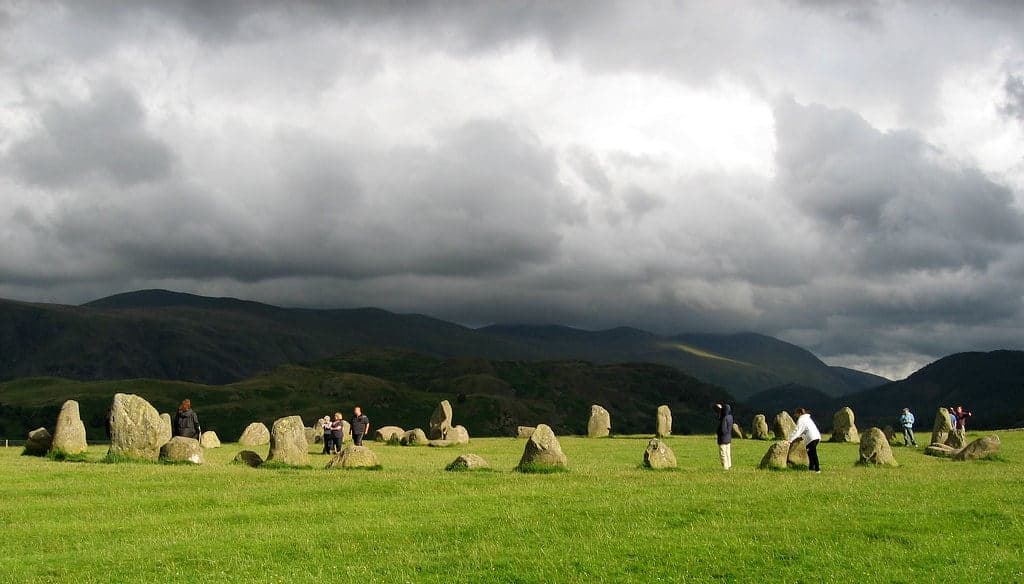
Castlerigg stone ring
Forty stones within a mountain amphitheatre, among the oldest circles in Britain
Keswick, Cumbria, United Kingdom
At A Glance
- Coordinates
- 54.6028, -3.0986
- Suggested Duration
- A focused visit takes thirty minutes to an hour. Those seeking deeper engagement, waiting for particular light, or participating in ceremony may stay considerably longer. The site rewards extended time.
- Access
- The circle lies 2.5 kilometres southeast of Keswick, off the A591. A small free car park is located near the site. A short walk on grass leads to the circle. The path is uneven and can be muddy; the site is not fully wheelchair accessible.
Pilgrim Tips
- The circle lies 2.5 kilometres southeast of Keswick, off the A591. A small free car park is located near the site. A short walk on grass leads to the circle. The path is uneven and can be muddy; the site is not fully wheelchair accessible.
- No specific dress code applies. Wear appropriate footwear for walking on uneven, often wet ground. Dress for changeable Lake District weather.
- Photography is permitted and encouraged. The site is popular with photographers; be mindful of others seeking particular compositions or lighting. Tripods are allowed.
- Do not touch, lean against, or climb on the stones. Do not leave offerings of non-biodegradable materials. If you encounter a ceremony in progress, observe from a respectful distance unless invited to participate.
Overview
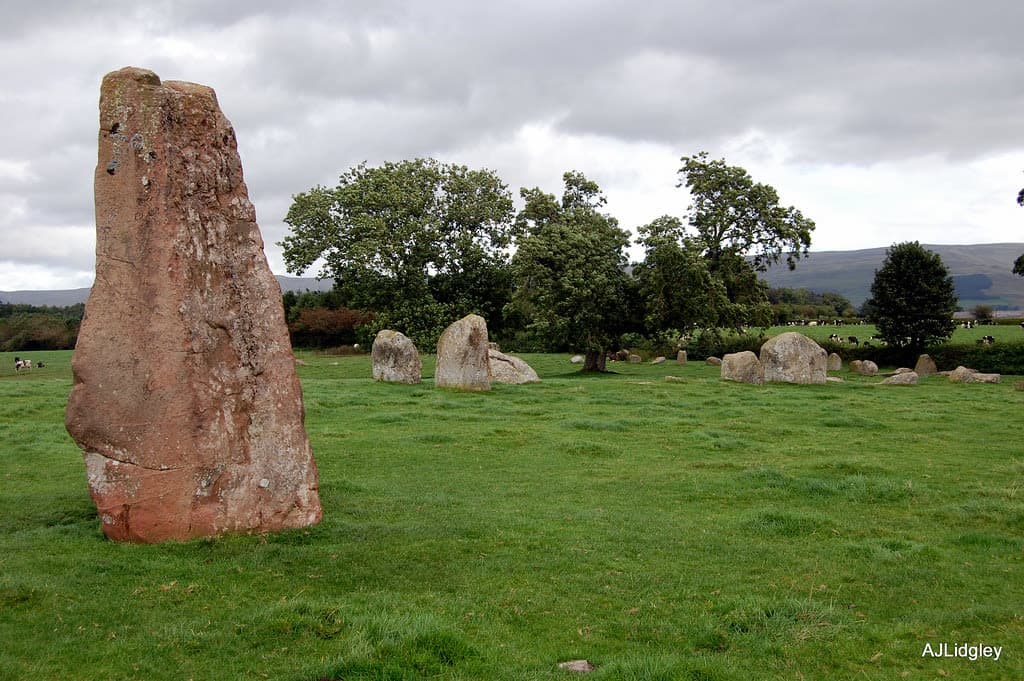
On a plateau near Keswick in the Lake District, forty stones form one of Britain's earliest and most atmospheric prehistoric monuments. Constructed around 3200 BC, Castlerigg predates even Stonehenge. The circle sits within a natural amphitheatre of fells, their peaks visible through the gaps between stones, as though the builders intended the mountains themselves to participate in whatever rites were performed here.
Some places teach immediately that they were chosen, not merely found. Castlerigg is one such place. The moment you crest the slight rise that leads to the circle, the intention becomes visible: forty stones arranged within a bowl of mountains, Skiddaw and Blencathra and the Helvellyn range forming walls of a natural cathedral.
The builders who raised these stones around 3200 BC were among the first in Britain to attempt such construction. Castlerigg may be the oldest stone circle on these islands, certainly among the oldest. Whatever knowledge allowed them to choose this location, to position the stones so that the mountains frame the horizon precisely, has not survived in any form we can read. Only the stones remain, and what they taught the builders, they continue to teach.
One feature sets Castlerigg apart from other circles: a rectangular 'sanctuary' of ten stones attached to the eastern side. No other British circle has this element. Its purpose is unknown, but its presence suggests that Castlerigg served some function unique among the monuments of its time.
The Lake District in the Neolithic period was a center of axe production, the stone from these mountains traded across Britain for its quality. Castlerigg may have been a gathering place for this trade, or a ceremonial counterpart to it, or both. The axes that helped clear the forests of Britain may have been blessed here, exchanged here, or understood here as more than tools. The name later given to the stones, Keswick Carles, suggests folk memory of human figures frozen to stone, the standard explanation for what could not otherwise be explained.
Context And Lineage
Castlerigg was constructed around 3200 BC, making it one of the earliest stone circles in Britain. The site may have served astronomical, ceremonial, and social functions, possibly connected to the Lake District axe trade. The unique rectangular sanctuary suggests specialized ritual use.
No founding narrative survives from the Neolithic. The folk name Keswick Carles, meaning the old men of Keswick, reflects later attempts to explain the stones as petrified humans, a common pattern for prehistoric monuments throughout Britain and Europe. Stories of people frozen to stone for dancing on the Sabbath or breaking other sacred laws were applied to many stone circles, suggesting widespread unease about their pagan origins.
What the Neolithic builders themselves believed about the site, what ceremonies they performed, what gods they invoked, remains beyond recovery. Only the stones speak, and they speak a language we can only partially interpret.
The lineage at Castlerigg spans over five millennia but remains largely unknown until recent centuries. The Neolithic builders and their successors left no written records. Whatever traditions of use persisted into the Bronze Age, Iron Age, and beyond have not survived.
Recognition of the site as significant returned in the antiquarian period, when scholars began documenting stone circles. William Stukeley visited in the 18th century. John Keats mentioned the circle in his letters. By the 19th century, Castlerigg was established as a destination for those seeking to encounter the prehistoric past.
English Heritage assumed responsibility for the site, ensuring protection and access. Contemporary visitors continue the pattern of engagement, adding modern spiritual practice to the long history of human presence.
The Lake District Axe Traders
historical
The Lake District was a major source of high-quality stone for axe production, traded across Britain. Castlerigg may have served this trade network, as a meeting place, ceremonial center, or both. The traders who gathered here helped shape Neolithic Britain.
Why This Place Is Sacred
Castlerigg's sacred quality emerges from the fusion of ancient human intention with a landscape that seems itself intentional. The mountains that surround the circle are not backdrop but participants, their presence so integral to the site that the builders must have understood this. Something about the junction of stone and sky, of human work and natural form, creates a quality visitors consistently describe as numinous.
What did the builders of Castlerigg know that allowed them to choose this location? The question haunts anyone who stands within the circle and looks out at the mountains. The arrangement is too precise for coincidence. Skiddaw dominates the north. Blencathra looms to the northeast. The Helvellyn range guards the southeast. Each mountain is framed by the gaps between stones as though the circle were designed as an instrument for viewing them.
The land itself is a plateau, a natural stage raised above the valley. The approach from the road below allows the circle to emerge gradually, the stones revealing themselves as you climb. This too seems deliberate, a choreography of arrival that builds anticipation.
The age of the monument adds weight to the experience. To stand within stones placed over five thousand years ago is to confront a scale of time that dislocates ordinary consciousness. The mountains that watched the builders at work still watch. The sky that received their rituals still receives.
The rectangular sanctuary on the eastern side introduces another dimension of mystery. Its uniqueness in Britain suggests either a function found nowhere else or a tradition that did not spread. Ten stones forming a rectangle attached to the circle, like a chamber or annexe. Whatever happened there, it happened only here.
Contemporary visitors, whatever their beliefs, consistently report experiences that suggest more than scenery. The word 'presence' appears often in accounts, as though something were attending to those who enter the circle. Whether this reflects the accumulated intention of millennia of visitors, the psychological effect of the landscape, or something beyond explanation, the consistency is notable.
Scholars believe Castlerigg may have served multiple interconnected purposes. The astronomical alignments suggest use as a calendar, marking solstices and other significant dates. The location at the junction of trade routes through the Lake District implies social function, perhaps as a gathering place for exchange. The Lake District axe industry, which traded stone tools across Britain, may have had ceremonial dimensions that Castlerigg served.
The rectangular sanctuary adds another possibility: a ritual chamber or annexe for practices that required separation from the main circle. Its uniqueness prevents comparison with other sites.
After its construction around 3200 BC, Castlerigg continued in use for perhaps a millennium or more. The Neolithic gave way to the Bronze Age, which eventually yielded to the Iron Age and the arrival of Celtic peoples. By the time the Romans came, the circle was already ancient, though whether it retained religious significance is unknown.
The folk name Keswick Carles, suggesting petrified people, preserves recognition that the stones were placed deliberately, even as their origin faded from memory. In the 18th and 19th centuries, antiquarians began documenting the circle, drawing it to wider attention. English Heritage now manages the site, maintaining free access while protecting the stones from damage.
Today, Castlerigg draws thousands of visitors annually, including photographers, heritage tourists, and those seeking spiritual experience. Contemporary Pagan groups use the site for seasonal ceremonies, adding another layer to its long history of human engagement.
Traditions And Practice
Castlerigg is maintained by English Heritage as a freely accessible heritage site. Contemporary Pagan groups use it for seasonal ceremonies. Individual visitors practice meditation, contemplation, and photography. No formal programme exists.
Neolithic practices at Castlerigg cannot be reconstructed with confidence. The astronomical alignments suggest seasonal ceremonies marking solstices or other significant dates. The connection to the axe trade may have involved ritual exchange or consecration of the stone tools that were reshaping Britain's forests. The rectangular sanctuary may have served specialized ritual purposes unknown at other sites.
The pattern of stone circles more broadly suggests gatherings for ceremony, the marking of sacred time, and possibly divination or communication with otherworldly powers. Whether Castlerigg specifically served such functions remains uncertain.
Today, Castlerigg serves as a heritage site, a photographic destination, and for some, a place of spiritual practice. Contemporary Pagan and Druidic groups gather here for solstice and equinox ceremonies. Individual practitioners use the circle for meditation, ritual, and connection with the land.
The site requires no formal engagement. Many visitors simply walk among the stones, sit for a time, and leave changed in ways they cannot articulate. The circle seems to work on those who enter it regardless of intention.
Arrive before the crowds if possible. Early morning and late afternoon offer the best light and the closest approach to solitude. Enter the circle only after walking its perimeter, allowing the full composition to reveal itself.
Within the circle, find a stone that calls to you and spend time with it. The stones are individuals, each with its own character. The one that attracts your attention may have something to offer.
Visit the rectangular sanctuary with particular attention. Consider stepping into it as an act of transition, crossing from ordinary space into something set apart.
Before leaving, take a moment of gratitude. The builders of this circle could not have imagined you. Yet they built for you as much as for themselves.
Neolithic/Bronze Age Religion
HistoricalCastlerigg was constructed within the Neolithic tradition of monument-building that produced stone circles, henges, and burial mounds across Britain. As one of the earliest stone circles known, it represents a foundational moment in this tradition, when the practice of marking sacred space with arranged stones was still new.
We cannot reconstruct specific rituals with confidence. The astronomical alignments suggest seasonal ceremonies. The location suggests gatherings for exchange, perhaps of the Lake District axes traded across Britain. The rectangular sanctuary suggests specialized practices found nowhere else.
Contemporary Paganism
ActiveFor contemporary Pagan and Druidic practitioners, Castlerigg is a power site where seasonal ceremonies may be performed. The circle's antiquity, mountain setting, and atmosphere make it a natural choice for groups seeking to connect with the land and the ancestors.
Contemporary groups gather for solstice and equinox celebrations, often at sunrise or sunset. Practices may include ritual, meditation, chanting, drumming, and offerings. Individual practitioners use the site for personal ceremony and spiritual development.
Heritage and Landscape Tradition
ActiveFor many visitors, Castlerigg is significant not through any specific religious framework but through its combination of antiquity and natural beauty. The heritage tradition sees the site as precious evidence of human prehistory; the landscape tradition values it as one of Britain's most atmospheric locations.
Photography, walking, contemplation, and the general appreciation of historic sites. Many visitors engage deeply without adopting any particular spiritual framework, finding meaning in the connection to the past and the beauty of the present.
Experience And Perspectives
Visitors to Castlerigg consistently describe the experience as exceeding expectation. The combination of ancient stones and surrounding mountains creates an atmosphere that many find numinous. Early morning and late afternoon, when light and shadow dramatize the landscape, are particularly affecting.
The first impression at Castlerigg is scale, not of the stones themselves, which are modest compared to Stonehenge or Avebury, but of the setting. The mountains seem impossibly close, as though the circle were placed at the center of something that required witnesses. On clear days, the peaks are knife-edged against the sky. On cloudy days, they emerge and disappear from mist like thoughts forming and dissolving.
Walking among the stones, many visitors describe a settling quality, a quieting of mental noise that the landscape itself seems to induce. The sky is large here. The wind has traveled far to reach this plateau. Something about the proportions recalibrates attention.
The rectangular sanctuary often draws particular focus. Its ten stones form a kind of room within the larger circle, a space set apart. Visitors report that the atmosphere intensifies within this area, though whether this reflects suggestion, subtle proportion, or something else cannot be determined.
Photographers know Castlerigg as one of Britain's most rewarding sites. The interplay of stone, sky, and mountain offers compositions that change with every shift of light and weather. Dawn and dusk are particularly prized, when low sun casts long shadows and the stones seem to lean into the light. Mist can transform the circle entirely, isolating the stones from their surroundings and creating an otherworldly quality.
Those who stay beyond the quick visit often report the experience deepening. The circle seems to work slowly, revealing what it has to offer to those who remain.
Castlerigg rewards time. A rushed visit captures photography but misses what the site offers. Arrive early if possible, before other visitors, when the circle holds something closer to its original solitude.
Circumambulate the circle before entering. The stones frame different mountains from different angles; walking the perimeter reveals the whole composition. Enter when it feels right to enter.
Spend time in the rectangular sanctuary. Its uniqueness suggests it held special purpose. Consider what it might have meant to step from the larger circle into this enclosed space, what transition that might have marked.
If weather permits, sit within the circle and simply observe. The mountains have witnessed five thousand years of human visitors. They can witness another hour of stillness.
Castlerigg invites interpretation from multiple angles: archaeological, artistic, spiritual, and personal. The combination of antiquity and landscape creates a site that refuses to be reduced to a single meaning.
Archaeologically, Castlerigg is significant as one of the earliest stone circles in Britain, possibly in Europe. The construction date around 3200 BC predates Stonehenge by several centuries. The flattened circle shape, the rectangular sanctuary, and the location at the junction of natural routes through the mountains all suggest careful planning for purposes we can only partly reconstruct.
The connection to the Lake District axe trade has attracted scholarly attention. Stone axes from this region were traded across Britain; Castlerigg may have served as a ceremonial or social hub for this network. The rectangular sanctuary, unique in Britain, suggests specialized functions that await explanation.
Astronomical alignments have been proposed for various stone positions, though consensus has not emerged on specific observations the circle may have enabled.
For heritage communities, Castlerigg represents the deep roots of human presence in the British landscape. The builders who raised these stones were among our earliest monument-makers, their achievement remaining visible five millennia later. The site connects present inhabitants of Britain to ancestors they cannot name but whose work endures.
The folk tradition of the Keswick Carles preserves recognition that the stones were placed deliberately, even as specific memory faded. The stories of petrification that attached to the circle reflect unease about pagan origins and attempts to incorporate the inexplicable into Christian frameworks.
Contemporary spiritual interpretations understand Castlerigg as an energy site, a location where earth forces concentrate and can be accessed. The mountain amphitheatre is seen as amplifying or focusing these energies. Some believe the circle marks an intersection of ley lines, the hypothetical network of prehistoric alignments.
The astronomical alignments propose that the builders possessed sophisticated knowledge of celestial mechanics, encoding this knowledge in stone positions. The rectangular sanctuary is interpreted as a specialized ritual space for practices beyond ordinary ceremony.
Significant mysteries remain. The purpose of the rectangular sanctuary is unknown; its uniqueness prevents comparison with other sites. The exact functions of the circle, beyond generalized ceremonial and gathering use, are uncertain. The relationship to the Lake District axe trade is suggested but not proven. Why the builders chose this specific location, with its particular views of specific mountains, cannot be determined. These uncertainties are not problems awaiting solution but the natural condition of engaging with five-thousand-year-old monuments whose creators left no explanatory records.
Visit Planning
Castlerigg Stone Circle is located southeast of Keswick in the Lake District, accessible by car and walking. English Heritage maintains the site with free access at any reasonable time. Sunrise and sunset offer particularly dramatic conditions.
The circle lies 2.5 kilometres southeast of Keswick, off the A591. A small free car park is located near the site. A short walk on grass leads to the circle. The path is uneven and can be muddy; the site is not fully wheelchair accessible.
Keswick offers accommodation at all levels, from hostels to hotels. The Lake District as a whole has extensive tourism infrastructure. No retreat facilities exist at the site, but several meditation and retreat centres operate in Cumbria.
Castlerigg is managed by English Heritage with free access at any reasonable time. The stones should not be touched or climbed. Natural biodegradable materials only should be left as offerings. Ceremonies, when in progress, deserve respectful non-interference.
English Heritage maintains Castlerigg as an open-access site with no admission charge. This generosity requires responsible behavior in return. The stones are protected as a Scheduled Monument; any damage is a criminal offence.
Visitors should treat the circle with the respect its age and significance deserve. Do not touch, lean against, sit on, or climb the stones. Do not use metal detectors or dig in any area. Leave no litter and take nothing from the site.
The surrounding land is a working farm. Stay within the fenced circle area. Close gates behind you. Keep dogs under control.
If you encounter others at the site, be mindful that approaches differ. Some come for archaeology, some for photography, some for spiritual practice. Each deserves space to engage in their own way. If a ceremony is in progress, observe quietly from outside unless invited to join.
No specific dress code applies. Wear appropriate footwear for walking on uneven, often wet ground. Dress for changeable Lake District weather.
Photography is permitted and encouraged. The site is popular with photographers; be mindful of others seeking particular compositions or lighting. Tripods are allowed.
If you wish to leave an offering, use only natural, fully biodegradable materials: flowers, seeds, water. Do not leave candles, crystals, coins, or other non-degradable items. Place offerings discreetly, not prominently on the stones.
Do not damage, touch, or climb on the stones. Do not dig, use metal detectors, or remove anything from the site. Do not light fires. Camping is not permitted.
Sacred Cluster
Nearby sacred places create the location cluster described in the growth plan. This block is intentionally crawlable and links into the wider regional graph.