Kabah Archaeological Zone
Where 250 stone masks of the rain god cover a palace, pleading for water in a land without wells
Santa Elena, Yucatán, Mexico
At A Glance
- Coordinates
- 20.2536, -89.6553
- Suggested Duration
- 60-120 minutes for thorough exploration.
Pilgrim Tips
- Comfortable walking shoes. Sun protection essential.
- Photography permitted throughout.
- Respect all barriers and preservation requirements. Do not touch carved surfaces. The site can be hot; bring water and sun protection.
Overview
In the Puuc hills of western Yucatan, where no cenotes break the limestone and rain alone sustains life, the Maya built Kabah and covered its greatest palace with the faces of Chaac. The Palace of the Masks displays 250 stone representations of the rain god, each assembled from 30 separate pieces fitted without mortar—originally 358 masks covering all four walls in what must have been the most intense architectural prayer for water ever carved. An 18-kilometer raised causeway once connected Kabah to Uxmal, pilgrimage route between regional powers.
The Puuc region of western Yucatan presents a paradox: limestone hills that absorb rainfall rather than holding it, no cenotes to tap underground rivers, no surface water to sustain the cities the Maya nonetheless built here. In this challenging terrain, where rain meant survival and drought meant death, the Maya responded with architecture that was simultaneously practical and devotional. At Kabah, they built the Palace of the Masks.
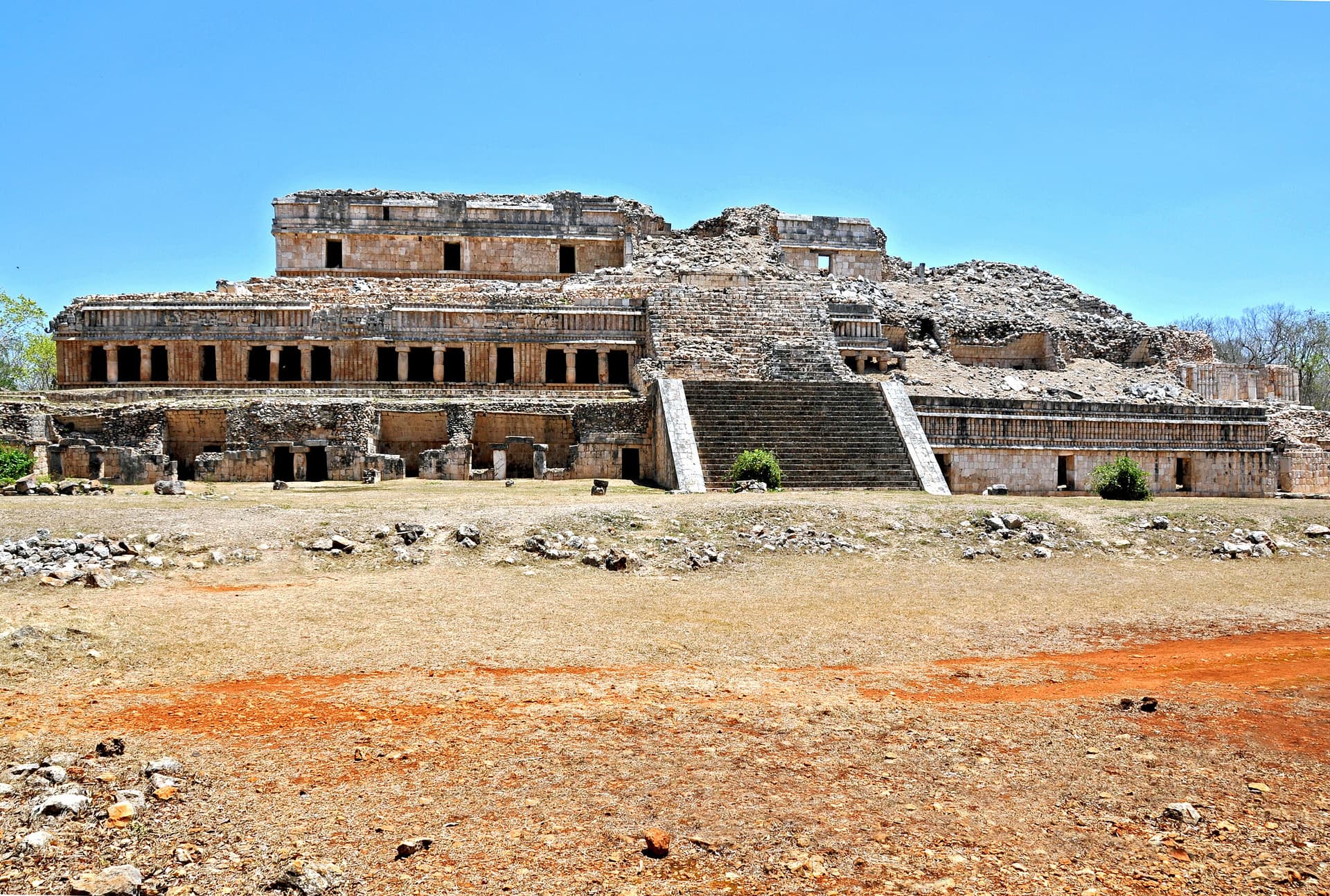
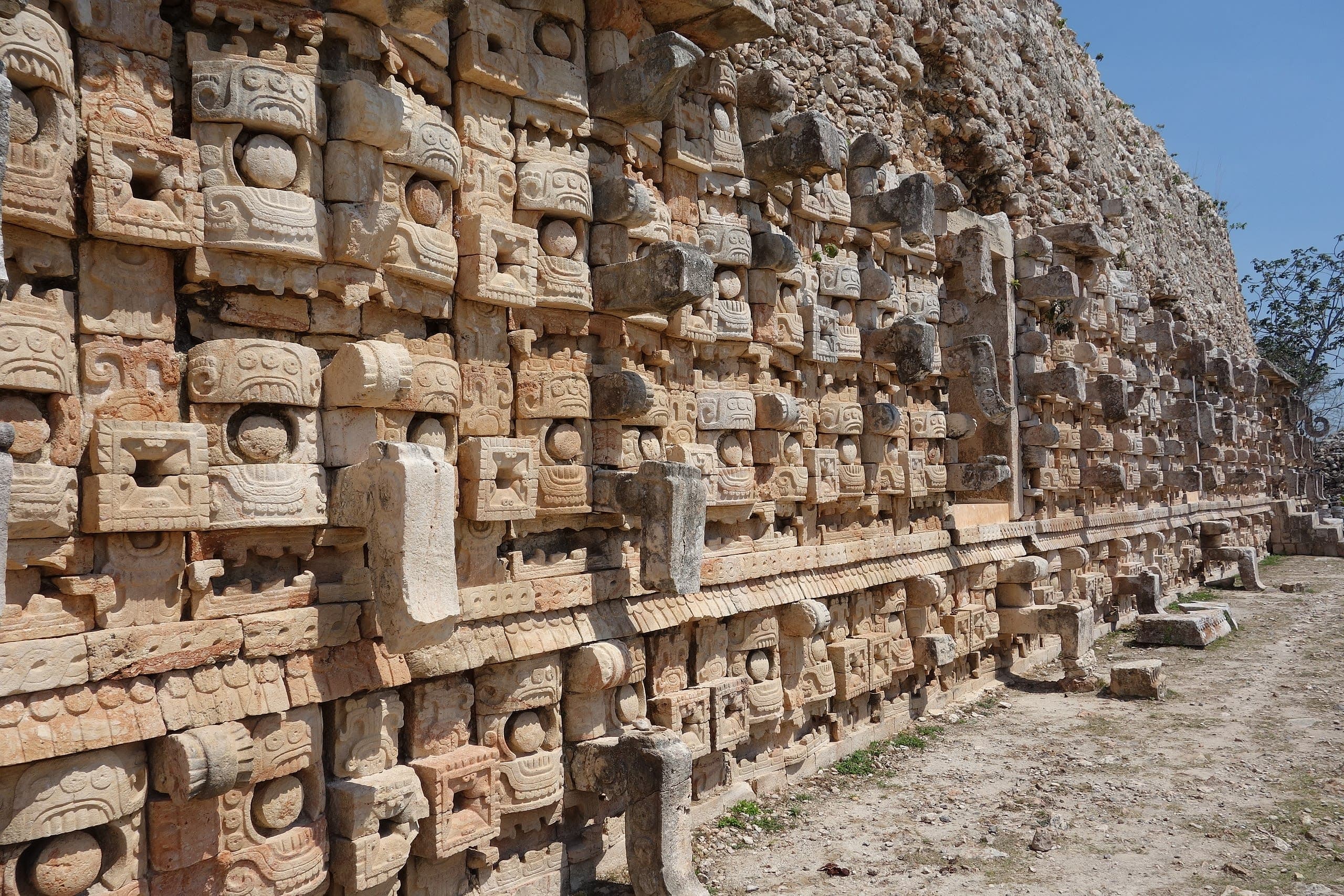
The Codz Poop—Rolled Matting in Maya—stretches 45 meters along the North Plaza, its facade covered with what scholars estimate were originally 358 stone masks of Chaac, the rain god. Each mask is a mosaic of 30 separate pieces, carved and fitted without mortar, the long-nosed deity repeated across all four walls in overwhelming repetition. Where 250 masks survive, the effect remains extraordinary: an entire building that is simultaneously architecture and prayer.
The masks speak to desperation made beautiful. In a land without wells, where chultunes (underground cisterns) had to capture and store every drop of rain, Chaac's favor meant everything. The labor that created these masks—each piece carved, each pattern fitted, each face assembled—represents devotion proportional to need. When the rains came, Chaac had responded. When drought struck, more masks must have seemed reasonable.
Kabah was the second largest city of the Puuc region, subordinate only to Uxmal. An 18-kilometer raised causeway (sacbe) connected the two cities, with monumental arches at each end. Kabah's arch still stands, disconnected from any building, marking the beginning of the pilgrimage route to regional power. Visitors who walk beneath it today walk where Maya pilgrims walked when the cities still functioned, when the masks still received offerings, when Chaac still answered.
The architectural style called Puuc—two-part facades with smooth lower walls and elaborately decorated upper sections—reaches sophisticated expression throughout Kabah. But nothing else at the site, nothing else in the Puuc region, approaches the Palace of the Masks in intensity. The Maya built many structures to honor Chaac; at Kabah, they built one that is nothing but Chaac, repeated until the building becomes deity, until stone becomes prayer, until architecture dissolves into petition for the rain that meant life.
Context And Lineage
The second largest Puuc city after Uxmal, Kabah built architecture that was simultaneously practical and devotional, with the Palace of the Masks representing the most intense architectural petition for rain in the Maya world.
Settlement at Kabah began during the Middle Preclassic (700-300 BCE), but the visible architecture dates from the Classic Maya era (600-900 CE). By this period, Kabah had become the second largest city of the Puuc region, connected to regional capital Uxmal by an 18-kilometer raised causeway with monumental arches at each end.
The Puuc region presented challenges that shaped its architecture. Unlike the northern lowlands with their cenotes, the Puuc hills absorbed rainfall rather than holding it. No surface water existed; no natural wells could be tapped. Survival depended on chultunes—underground cisterns that captured and stored rainwater—and on the favor of Chaac, the rain god who controlled what the cisterns would hold.
The Palace of the Masks embodied this dependence. Its 45-meter facade, originally covered with an estimated 358 masks of Chaac, each assembled from 30 mosaic pieces, represented petition proportional to need. Every mask required skilled labor; the cumulative effect created a building that was itself a prayer, architecture that became deity.
The causeway connecting Kabah to Uxmal served practical and ceremonial purposes. Trade and communication flowed along the raised road; pilgrims processed between ceremonial centers. The arch at Kabah marked the journey's beginning or end—threshold structure for transitions between cities and between ordinary and sacred space.
By the 11th century, Kabah and surrounding sites had been abandoned. Drought is considered the primary cause—the very disaster the masks had been built to prevent. The irony did not diminish the architecture; the masks remained, petitioning a god who had not answered, pleading for rain that had not come.
UNESCO recognized Kabah's significance in 1996, designating it (with Uxmal, Sayil, and Labna) as World Heritage Site. The masks continue their work: watching the sky, waiting for rain, embodying devotion that drought could not destroy.
Maya civilization of the Puuc region; no continuous lineage of practitioners. UNESCO World Heritage Site since 1996.
Chaac
Rain deity
Why This Place Is Sacred
Kabah's thin quality emerges from desperation made architectural—250 masks of the rain god covering a palace in a land without wells, where the relationship between petition and survival was direct and undeniable.
The threshold at Kabah opens where need becomes visible. In the Puuc region, where no cenotes provide water and only rain can fill the underground cisterns that sustain life, the relationship between devotion and survival was direct. Petition Chaac properly, and rain falls; fail to petition, and drought kills. The Palace of the Masks makes this relationship architectural.
The repetition creates the thinness. One Chaac mask would be decoration; 250 masks become something else—petition so intense it dissolves into environment, prayer so repeated it becomes the building itself. Standing before the Codz Poop, surrounded by the long-nosed face of the rain god reproduced beyond counting, visitors experience what desperation constructed: beauty born from necessity, art born from fear.
Each mask required 30 separate stone pieces carved and fitted without mortar. The labor investment is extraordinary—thousands of pieces per facade, precision fitting across 45 meters of wall, the same face achieved through slightly varying arrangements of the same elements. This labor was not wasteful but proportional: in a land where rain meant life, no effort was too great to secure Chaac's favor.
The causeway to Uxmal extends the thin quality. The 18-kilometer sacbe connected Kabah to regional power, creating pilgrimage route between ceremonial centers. The arch at Kabah marks where this journey began or ended—a threshold structure, passage point, the architectural equivalent of crossing from ordinary space into sacred geography. Walking beneath it today participates in what Maya pilgrims experienced when the causeway still functioned.
The Puuc architectural style—smooth lower walls, elaborate upper decoration—creates visual language throughout the site. But the Palace of the Masks exceeds this language, pushing decoration into obsession, pattern into prayer. The upper facade does not merely display Chaac masks; it becomes Chaac masks, the architectural surface dissolving into divine face.
The site's abandonment by the 11th century—likely due to drought—adds bitter irony. The masks that pleaded for rain did not prevent the drought that emptied the city. Yet they remain, still facing the sky from which rain must fall, still petitioning a god who may or may not respond. The thinness at Kabah includes this uncertainty: intense devotion that may or may not have worked, repeated prayer that the rain god may or may not have heard.
Kabah served as major Puuc ceremonial and administrative center, with the Palace of the Masks (Codz Poop) functioning as architectural petition for rain from Chaac in a region where water scarcity threatened survival.
Settled in the Middle Preclassic (700-300 BCE); major structures from the Classic era (600-900 CE); abandoned by the 11th century due to drought. UNESCO World Heritage Site since 1996 as part of the Uxmal group.
Traditions And Practice
Ancient practices included rain petitions to Chaac at the Palace of the Masks and ceremonial processions along the sacbe to Uxmal. No continuous practice remains at this protected archaeological site.
Rain petitions and offerings at the Chaac-masked facade. Ceremonial processions along the sacbe to Uxmal. Elite residential and administrative activities in the palace complexes.
As a protected archaeological zone, Kabah does not host active religious practice. Visitors can contemplate the architectural intensity of the Chaac masks and walk beneath the ceremonial arch.
Stand before the Palace of the Masks until the repetition creates appropriate overwhelm. Walk beneath the ceremonial arch imagining pilgrimage procession to Uxmal. Allow the site's relative quiet (compared to Uxmal) to create contemplative space.
Maya Civilization / Chaac Veneration
HistoricalThe Palace of the Masks represents the most intense architectural expression of rain-god devotion in the Maya world, with 250+ Chaac masks covering a building in a region where rain meant survival.
Rain petitions, offerings at Chaac masks, ceremonial processions along the sacbe to Uxmal.
Experience And Perspectives
Stand before the Palace of the Masks where 250 Chaac faces create the most intense architectural prayer in the Maya world, walk beneath the ceremonial arch marking the sacbe to Uxmal, and explore one of the Puuc region's major sites with fewer crowds than neighboring Uxmal.
Arrive at Kabah via Highway 261, the Puuc Route that connects the region's major sites. Fewer tour buses reach Kabah than Uxmal, offering quieter, more intimate experience with architecture that deserves sustained attention.
Cross to the Palace of the Masks (Codz Poop) in the North Plaza. The first view already conveys what makes Kabah unique: an entire building facade covered with the long-nosed face of Chaac, the rain god, repeated 250 times in surviving masks (originally perhaps 358). Let the scale register. Each mask comprises 30 separately carved and fitted stone pieces; the entire facade represents thousands of precision elements assembled without mortar.
Approach closely. Study individual masks: the curling nose, the open mouth, the geometric patterns that compose the face. Then step back and let repetition overwhelm distinction. This is what the Maya intended—not a building decorated with masks but a building that becomes masks, architecture dissolving into deity, stone prayer for the rain that meant survival.
The Palace sits on a low platform decorated with a single row of mask panels; above rises the rich lower molding, then three rows of masks, then the medial molding described as perhaps the most ornate of any in Yucatan. The elaboration serves purpose: in a land without wells, Chaac's favor justified any investment.
Cross the highway to find the ceremonial arch. This structure stands alone, disconnected from any building, marking the beginning of the 18-kilometer causeway (sacbe) that once connected Kabah to Uxmal. Walk beneath it. The arch has survived whatever destroyed the rest of the gateway complex; it marks passage from ordinary space into pilgrimage route that Maya travelers walked when both cities still functioned.
Explore the rest of Kabah: the Palace in the North Plaza with its 32 vaulted rooms (16 per floor), the forested paths connecting structural groups, the broad plazas that hosted ceremonies we cannot fully reconstruct. The site is larger than first impression suggests; allow time to discover its extent.
The relative quiet at Kabah—compared to Uxmal's crowds—creates opportunity for contemplation. Sit in one of the plazas. Let the masks watch you as they have watched everyone who has entered this space since the Classic period. Consider what it meant to invest such labor in petitioning for rain, and consider that the drought came anyway.
Located on Highway 261 (Puuc Route), approximately 22 km south of Uxmal. The Palace of the Masks (Codz Poop) is in the North Plaza. The ceremonial arch is across the highway, marking the sacbe to Uxmal.
Kabah can be understood as architectural prayer for rain, as political center connected to Uxmal by ceremonial causeway, as masterpiece of Puuc architectural style, or as testimony to desperation that drought ultimately vindicated.
Art historians analyze the Palace of the Masks as the most elaborate Chaac representation in Maya architecture. Archaeologists study Kabah's relationship to Uxmal and its role in Puuc regional politics.
For Maya communities, Kabah represents ancestral achievement—the capacity to create beauty even when survival was uncertain.
Some visitors sense the masks as still active, still watching, still petitioning a god who may yet respond to devotion carved in stone.
The specific ceremonies performed before the Palace of the Masks are not documented. The precise political relationship between Kabah and Uxmal remains partially understood.
Visit Planning
Located on Highway 261 (Puuc Route), 22 km south of Uxmal. Open daily 8:00 AM - 5:00 PM. Part of UNESCO World Heritage Site since 1996. Fewer crowds than neighboring Uxmal.
Limited facilities near site. Full services at Uxmal or in Merida.
Approach Kabah as testimony to human desperation made beautiful—architectural prayer for survival in a land where rain meant everything. Respect the preservation that maintains these extraordinary structures.
Kabah is a UNESCO World Heritage Site under INAH administration. While no active religious practice continues, the site deserves respect as one of the most intense expressions of Maya devotion.
Comfortable walking shoes. Sun protection essential.
Photography permitted throughout.
Contemporary offerings not part of the site's practice. Entrance fees support preservation.
Stay on designated paths. Do not touch carved surfaces.
Sacred Cluster
Nearby sacred places create the location cluster described in the growth plan. This block is intentionally crawlable and links into the wider regional graph.