Horyuji
The world's oldest wooden buildings and Prince Shōtoku's spiritual legacy
Ikaruga, Nara Prefecture, Japan
At A Glance
- Coordinates
- 34.6143, 135.7342
- Suggested Duration
- 2-3 hours minimum to appreciate the main areas. Half day recommended to explore thoroughly, including the Treasure Gallery.
- Access
- From JR Nara Station: Yamatoji Line to Hōryū-ji Station (12 minutes, 240 yen), then 20-minute walk or bus #72 (220 yen, every 20 minutes). The station is on a local line; check connection times.
Pilgrim Tips
- From JR Nara Station: Yamatoji Line to Hōryū-ji Station (12 minutes, 240 yen), then 20-minute walk or bus #72 (220 yen, every 20 minutes). The station is on a local line; check connection times.
- Modest dress appropriate for a Buddhist temple. Comfortable walking shoes recommended for the extensive grounds.
- Generally permitted in outdoor areas. Restrictions may apply inside certain buildings and the Treasure Gallery. Check current policies before photographing interior spaces.
- The extensive grounds and multiple precincts require significant walking. The temple's wealth of National Treasures can be overwhelming; it may be better to focus deeply on a few pieces than to rush through everything.
Overview
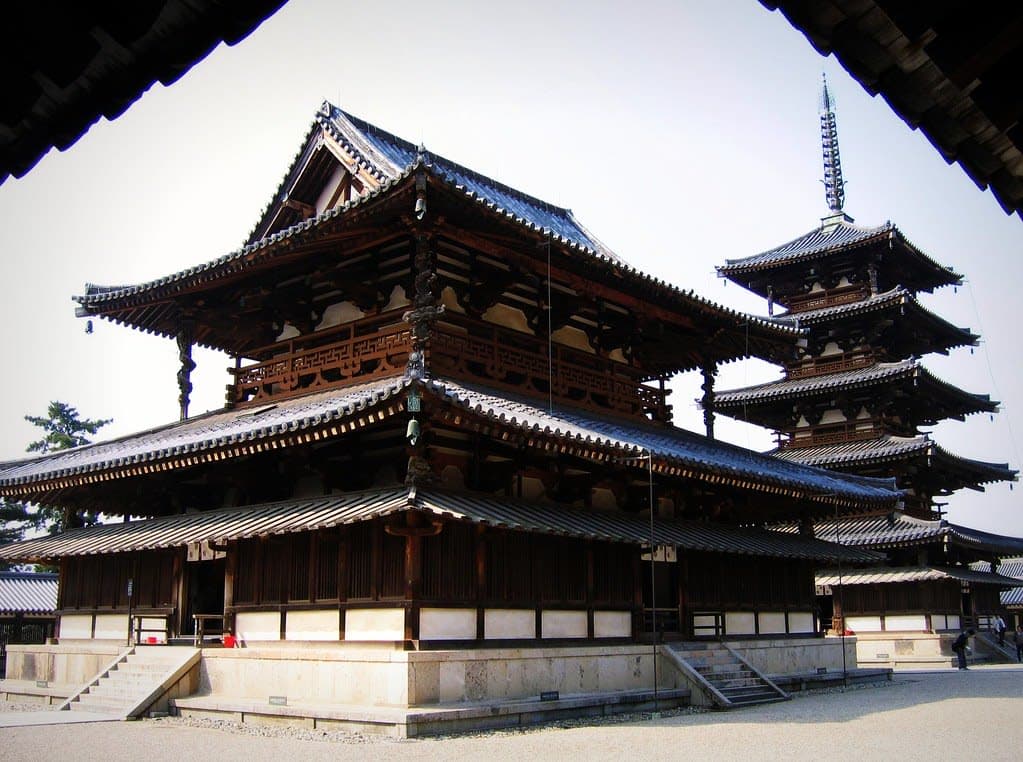
The pagoda and main hall of Hōryū-ji have stood for over 1,300 years—the oldest surviving wooden structures on earth. Founded by Prince Shōtoku in 607 CE to fulfill his father's dying wish, the temple became Japan's first UNESCO World Heritage Site and remains a living repository of Buddhist practice. Within its halls and treasure houses, over 180 National Treasures preserve the artistic flowering of early Japanese Buddhism. In the octagonal Yumedono, a hidden Buddha awaits those who visit during its brief seasonal openings.
There is something disorienting about standing before buildings that have survived 1,300 years. At Hōryū-ji, the five-story pagoda and the Kondō (Golden Hall) have weathered earthquakes, typhoons, fires at neighboring structures, wars, and the simple passing of time—and they remain. Dendrochronology dates the pagoda's central pillar to 594 CE. These are not reconstructions or replicas but the actual structures that early Japanese Buddhists built, using techniques learned from Korea and China, to house their most sacred images. Prince Shōtoku founded this temple in 607 CE to fulfill the dying wish of his father, Emperor Yōmei, who had prayed for recovery from illness. The emperor died before seeing the temple completed, but his son created something that would outlast dynasties. Today, Hōryū-ji is not merely a museum of early Buddhism but an active temple where 14 centuries of monastic practice continue. The Great Treasure Gallery houses irreplaceable Buddhist art: the ethereal Kudara Kannon, the Yumechigai Kannon who transforms nightmares into good dreams, the earliest examples of temple murals and textile arts. In the Eastern Precinct, the octagonal Yumedono (Hall of Dreams) marks where Prince Shōtoku meditated. Inside, normally hidden from view, the Guze Kannon awaits—a statue believed by many to represent the prince himself, revealed only during spring and autumn opening periods. Japan designated this their first UNESCO World Heritage Site in 1993, acknowledging what the world already knew: there is nothing else like it anywhere.
Context And Lineage
Prince Shōtoku founded Hōryū-ji in 607 CE to fulfill his father's dying wish. The temple became the center of early Japanese Buddhism and remains the world's oldest surviving wooden structure complex.
Emperor Yōmei fell gravely ill and made a vow: if he recovered, he would build a temple and Buddha statue. He died before fulfilling this wish, but his son Prince Shōtoku and Empress Suiko carried out his intent, founding Hōryū-ji in 607 CE. The temple's full name—Hōryū Gakumonji, or Learning Temple of the Flourishing Law—reflects its purpose as both monastery and seminary. According to the Nihon Shoki, the temple burned in 670 CE, but the rebuild happened rapidly enough that today's Western Precinct structures remain among the oldest wooden buildings on earth. Prince Shōtoku's association with the temple extended beyond founding: the Eastern Precinct's Yumedono was built in 739 at the site where he meditated, and the Guze Kannon housed within is believed by many to represent the prince himself.
Hōryū-ji is the head temple of the Shōtoku sect of Buddhism. It has maintained continuous monastic practice for 14 centuries.
Prince Shōtoku (Shōtoku Taishi)
The founder of Hōryū-ji, one of the most revered figures in Japanese Buddhism, credited with establishing Buddhism as the spiritual foundation of Japanese civilization
Emperor Yōmei
Prince Shōtoku's father, whose dying wish for a temple dedicated to Yakushi Nyorai (Medicine Buddha) led to the founding of Hōryū-ji
Empress Suiko
The regent who, with Prince Shōtoku, fulfilled Emperor Yōmei's wish and oversaw the temple's construction
Why This Place Is Sacred
The survival of 1,300-year-old wooden structures creates direct physical connection to early Japanese Buddhism. The accumulated devotion of 14 uninterrupted centuries of practice and the presence of hidden Buddhas add layers of sacred intensity.
What makes Hōryū-ji thin is time made visible. Wood does not last. Temples burn, decay, collapse, and are rebuilt—the normal cycle of Japanese religious architecture. Yet here stand buildings from the 7th century, their beams and columns arranged by craftsmen who had learned continental techniques only recently. To touch these walls (where permitted) is to touch what they touched. To stand in the spaces they created is to occupy the same sacred geography that Prince Shōtoku intended. The thinness deepens in layers. The Western Precinct contains the oldest structures, but the Eastern Precinct adds another dimension: the Yumedono, the Hall of Dreams, built in 739 on the site where Prince Shōtoku meditated. Inside this octagonal hall rests the Guze Kannon—a wooden figure wrapped in silk for centuries, its discovery in 1884 shocking the art world with its exquisite preservation. Some believe this statue represents the prince himself, transformed into bodhisattva form. It is classified as a hibutsu, a hidden Buddha, viewable only during limited spring and autumn opening periods. This concealment charges the image with additional sacred power—the anticipation of revelation, the rarity of access. The Great Treasure Gallery extends the experience with over 180 National Treasures and Important Cultural Properties: Buddhas, bodhisattvas, guardians, textiles, ritual implements. Each piece represents devotion made material, prayer given form.
The temple was founded by Prince Shōtoku in 607 CE to fulfill the dying wish of his father, Emperor Yōmei, who had prayed for recovery from illness.
According to the Nihon Shoki, the temple burned in 670 CE but was rebuilt shortly afterward. Whether the current Western Precinct structures predate or postdate that fire has been debated, but dendrochronology confirms their extraordinary age. The temple has maintained continuous Buddhist practice for 14 centuries, adapting while preserving its core identity.
Traditions And Practice
Fourteen centuries of Buddhist practice continue at Hōryū-ji, including daily worship, monastic activities, and seasonal openings of the Yumedono to reveal the hidden Guze Kannon.
The temple has maintained Buddhist ceremonies and monastic practices continuously since its founding. The Guze Kannon in the Yumedono was kept wrapped in silk for centuries, revealed only during special ceremonies. Its discovery by Ernest Fenollosa in 1884 caused sensation when the statue proved to be in remarkable condition.
Daily worship services and monastic activities continue. The Yumedono opens twice yearly to allow viewing of the Guze Kannon: spring (April 11-May 18) and autumn (October 22-November 22). Visitors can worship at the Kondō before the Shaka Triad and Yakushi Nyorai. The Great Treasure Gallery preserves and displays sacred art for public education.
For those who can time their visit to coincide with the Yumedono opening periods, witnessing the Guze Kannon is a profound opportunity to encounter a hibutsu (hidden Buddha). In the Kondō, allow eyes to adjust to the dimness before attempting to see the ancient Buddha statues. The Treasure Gallery deserves unhurried attention—consider returning if initial visit feels rushed.
Buddhism (Shōtoku Sect)
ActiveHōryū-ji was founded by Prince Shōtoku in 607 CE and represents the earliest phase of established Buddhism in Japan. The temple served as both seminary and monastery, with its name meaning 'Learning Temple of the Flourishing Law.' It embodies Prince Shōtoku's vision of Buddhism as transformative force for Japanese civilization.
Fourteen centuries of continuous monastic practice and worship services. Special seasonal openings of the Yumedono (April 11-May 18; October 22-November 22) allow veneration of the Guze Kannon. Daily worship continues at the Kondō before the ancient Buddha statues.
Experience And Perspectives
Visitors encounter the world's oldest wooden structures, the serene spaces of ancient Buddhist architecture, and an unparalleled collection of early Buddhist art in the Treasure Gallery.
The experience of Hōryū-ji requires time. The extensive grounds contain multiple precincts, dozens of buildings, and a treasury of Buddhist art that demands unhurried attention. Enter through the Great South Gate and the Middle Gate to reach the Western Precinct, where the five-story pagoda and Kondō face each other across an ancient courtyard. Simply standing here, surrounded by 1,300-year-old architecture, induces contemplation. These structures have witnessed everything—the rise and fall of dynasties, the transformation of Japanese Buddhism, the entire sweep of Japanese history. Inside the Kondō, the Shaka Triad and Yakushi Nyorai rest in dim light, bronze figures that have received devotion since the 7th century. The pagoda's interior (not always accessible) contains clay statuary depicting scenes from the Buddha's life. The Great Treasure Gallery requires additional time—perhaps an hour or more for those drawn to Buddhist art. The Kudara Kannon, slender and ethereal, is among the finest surviving early Buddhist sculptures anywhere. The Yumechigai Kannon, the Tamamushi Shrine, the earliest examples of textile arts—each piece rewards careful attention. The Eastern Precinct, reached through a covered corridor, offers different atmosphere. The octagonal Yumedono marks Prince Shōtoku's meditation site. During the spring (April 11-May 18) and autumn (October 22-November 22) openings, visitors can witness the Guze Kannon—otherwise, the hall's exterior and the knowledge of what waits within create their own form of presence.
Begin with the Western Precinct's ancient buildings: pagoda, Kondō, lecture hall. Allow time simply to be in the presence of 1,300-year-old architecture. Visit the Great Treasure Gallery with unhurried attention. Proceed to the Eastern Precinct and the Yumedono. If visiting during the Guze Kannon opening periods, plan your trip accordingly—witnessing the hidden Buddha is a rare opportunity.
Hōryū-ji can be experienced as architectural miracle, as art historical treasury, or as the living legacy of Prince Shōtoku's vision for Japanese Buddhism.
Art historians and archaeologists confirm that Hōryū-ji's Western Precinct contains the world's oldest surviving wooden buildings, dated by dendrochronology. The temple is recognized as a 'capsule of Buddhist art' preserving irreplaceable examples of 6th-7th century religious artistry influenced by continental traditions. UNESCO designation acknowledges its unique value for understanding cultural exchange between Japan, China, and Korea during Buddhism's transmission. The Guze Kannon's discovery in 1884 caused sensation in the art world.
Within Buddhist tradition, Hōryū-ji embodies Prince Shōtoku's sacred vision and the Dharma's firm establishment in Japan. The Guze Kannon is believed to be a manifestation of Kannon Bodhisattva that may represent Prince Shōtoku himself. The temple's survival through 14 centuries is understood as protection by the Buddhas and bodhisattvas. The Yumechigai Kannon is venerated for its power to transform nightmares into good dreams.
Some visitors experience the ancient buildings as repositories of accumulated spiritual energy, time crystallized in wood and clay. The hidden nature of the Guze Kannon adds to perceptions of its spiritual power—concealment charging presence.
The exact circumstances of the 670 CE fire mentioned in the Nihon Shoki and the subsequent reconstruction timeline remain debated by scholars. Some question whether certain 'pre-fire' structures actually predate the fire or represent remarkably faithful reconstructions. The precise meaning and iconography of some treasures remain subjects of scholarly interpretation.
Visit Planning
Located in Ikaruga, Nara Prefecture, accessible by train and bus from Nara or Osaka. Plan 2-3 hours minimum; half day recommended.
From JR Nara Station: Yamatoji Line to Hōryū-ji Station (12 minutes, 240 yen), then 20-minute walk or bus #72 (220 yen, every 20 minutes). The station is on a local line; check connection times.
Most visitors stay in Nara or Osaka and day-trip to Hōryū-ji. Consider combining with other Nara temples for a full day.
Standard Buddhist temple etiquette applies. This is an active monastic site, not merely a museum.
Hōryū-ji welcomes visitors while maintaining the decorum appropriate to an active monastery with 14 centuries of continuous practice. Buddhist etiquette applies: bow with palms together (gassho) before Buddha statues; do not clap (unlike at Shinto shrines); remove shoes where indicated; speak quietly. Photography policies vary by building—check before shooting. The Treasure Gallery's artifacts deserve respectful viewing; treat them as sacred objects, not merely as museum pieces. When viewing the Guze Kannon during opening periods, maintain silence and reverence—you are witnessing a hibutsu that has been deliberately concealed for much of its history.
Modest dress appropriate for a Buddhist temple. Comfortable walking shoes recommended for the extensive grounds.
Generally permitted in outdoor areas. Restrictions may apply inside certain buildings and the Treasure Gallery. Check current policies before photographing interior spaces.
Monetary offerings may be made at worship halls. Incense is available at the Kondō.
Entrance fee required (1,500 yen includes Treasure Gallery and Chūgū-ji Temple). Buddhist etiquette applies throughout.
Sacred Cluster
Nearby sacred places create the location cluster described in the growth plan. This block is intentionally crawlable and links into the wider regional graph.