Mount Miwa
Where the mountain itself is the kami, not its dwelling place but its body
Sakurai, Nara Prefecture, Japan
At A Glance
- Coordinates
- 34.5267, 135.8567
- Suggested Duration
- A focused shrine visit takes 30-60 minutes. Tohai requires 2-3 hours including ascent, time at the summit, and descent. A thorough experience combining shrine visit, tohai, and time at subsidiary shrines including Sai Shrine takes a half day.
- Access
- By train: From Nara or Osaka, take the JR Sakurai Line to Miwa Station. The shrine is approximately 10 minutes' walk from the station. By car: Parking is available near the shrine. The approach from major highways is straightforward. Sai Shrine, where tohai registration occurs, is located within the Omiwa Shrine complex. Look for signs directing to tohai registration.
Pilgrim Tips
- By train: From Nara or Osaka, take the JR Sakurai Line to Miwa Station. The shrine is approximately 10 minutes' walk from the station. By car: Parking is available near the shrine. The approach from major highways is straightforward. Sai Shrine, where tohai registration occurs, is located within the Omiwa Shrine complex. Look for signs directing to tohai registration.
- No specific dress requirements apply for shrine visits. For tohai, practical hiking clothing and proper footwear are essential. The white tasuki sash provided at registration is worn over whatever clothing you have.
- Photography is permitted within the shrine grounds. Photography is strictly prohibited on the mountain during tohai. This prohibition is actively enforced and essential to the mountain's sacred character.
- Tohai registration closes at noon, and all climbers must descend by 15:00. The mountain is closed on specific dates (January 1-3, February 17, April 9, April 18 morning, October 24, November 23). The climb requires reasonable fitness; the trail is not technically difficult but involves continuous ascent. Respect all protocols. The prohibition on speaking about the mountain experience is not a suggestion but an expectation. Photography on the mountain is strictly forbidden.
Overview
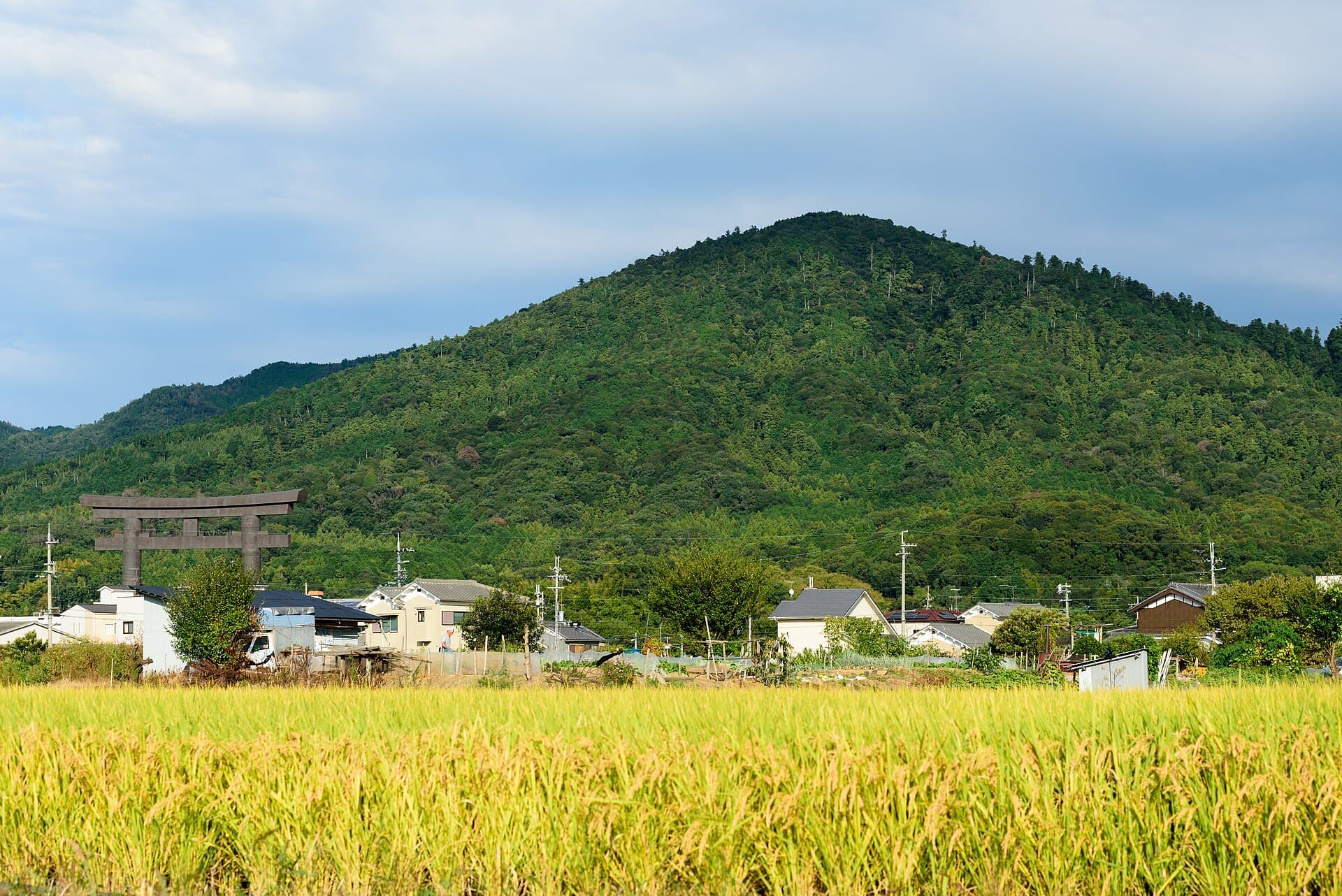
Mount Miwa does not house a deity. The mountain is the deity. This 467-meter peak in the Nara Basin represents the oldest stratum of Japanese spirituality, a form of worship so ancient it predates shrine buildings entirely. At Omiwa Shrine, there is no main hall because none is needed. Worshippers pray through a distinctive three-part torii gate directly toward the sacred peak, whose forests have never been logged throughout recorded history.
At the base of Mount Miwa stands Omiwa Shrine, one of the oldest and strangest of Japan's sacred sites. Strange because it lacks what almost every other Shinto shrine possesses: a main hall to house its deity. Here, there is no need for such a structure. Mount Miwa itself is the shintai, the sacred body of the kami Omononushi. The mountain does not merely shelter the divine. The mountain is divine.
This concept, called shintai-zan, represents worship so old it predates the formal development of Shinto as a distinct tradition. The forests covering Mount Miwa have never been cut throughout recorded history, preserving primeval vegetation that visitors to the shrine glimpse through the distinctive Mitsu Torii, a three-part gate through which prayers are directed toward the peak.
To climb Mount Miwa is not to hike. It is to worship. The Japanese term is tohai, and the protocols surrounding it reflect the mountain's sacred character. Climbers register at Sai Shrine, pay a fee, receive a white sash to wear, and agree to strict conditions: no photography, no eating except water, no mobile phones, and most significantly, no speaking of what one sees on the mountain. This prohibition has protected the mountain's mysteries while ensuring that each encounter remains personal and unmediated by others' descriptions.
The kami of this mountain appears in Japan's oldest chronicles as essential to the nation's wellbeing. When plague ravaged the land during Emperor Sujin's reign, it was Omononushi who demanded proper worship and, when his requirements were met, ended the devastation. The Miwa priestly lineage traces its origin to that mythic resolution. Today, pilgrims still drink the sacred spring water at Sai Shrine, believed to carry healing properties from the mountain deity's body.
Context And Lineage
Mount Miwa's worship extends into prehistory and figures prominently in Japan's oldest written records. The Nihon Shoki and Kojiki present the mountain's kami as essential to the nation's health, with formal worship established during Emperor Sujin's reign to end devastating plague.
The Nihon Shoki records that during Emperor Sujin's reign, plague devastated Japan. The emperor received a dream in which a deity appeared, identifying himself as Omononushi and demanding proper worship. The deity specified that his rites must be performed by his half-human son, Otataneko. When Otataneko was found and the required rituals conducted, the plague ended.
This narrative establishes several crucial elements: the kami's power over national wellbeing, the requirement of proper worship conducted by those with appropriate lineage, and the founding of the Miwa priestly family that would serve the mountain-deity. Earlier myths in the Kojiki connect Omononushi to Okuninushi, the 'Great Land Master' who built Japan before ceding it to Amaterasu's descendants.
Behind these literary accounts lies likely prehistorical mountain worship that the later texts sought to incorporate into imperial mythology. The prominence of Mount Miwa in these foundational narratives reflects its centrality to early Yamato culture.
The Miwa priestly family traces its origin to Otataneko, establishing one of Japan's oldest documented religious lineages. The shrine's continuous operation from prehistoric times through the present represents one of the longest unbroken traditions in Japanese religion.
More broadly, Mount Miwa represents the deep root from which much of Japanese religion grew. The shintai-zan concept visible here likely reflects widespread prehistoric practice before the development of shrine architecture. As Shinto formalized in later centuries, the Omiwa model of shrine-without-honden remained exceptional, a preserved glimpse of how worship was conducted before buildings became standard.
Omononushi
The kami whose body is Mount Miwa
Emperor Sujin
Traditionally credited with establishing formal worship
Otataneko
Half-human son of Omononushi
Why This Place Is Sacred
Mount Miwa represents the shintai-zan concept at its purest: the mountain itself is the kami's body, not a residence for deity but deity made manifest in earth and stone and tree. The boundary between divine and natural dissolves entirely.
The thin place concept finds its most radical Japanese expression in mountains like Miwa. Here, the question is not where the veil between worlds grows thin but whether such a veil exists at all. The mountain does not mediate between human and divine realms. The mountain is itself the divine realm made geographically present.
This understanding predates the architectural traditions that would eventually define Shinto. Before there were shrine buildings to house sacred objects or images, there were mountains like Miwa where the sacred required no housing because it was the landscape itself. The absence of a main hall at Omiwa Shrine is not an architectural choice but a theological necessity. Building a honden, a main hall, would imply that the kami needed containment, that the divine could be brought inside. Here, the divine is already outside, vast and encompassing, everywhere on the mountain's slopes.
The Mitsu Torii through which worshippers face the mountain creates a different kind of threshold. Rather than marking entrance to sacred space, it frames the direction of prayer. The three-part gate focuses attention toward the peak while acknowledging that what lies beyond is too vast for human structures to contain. Passing through the torii does not bring one into the presence of the kami. One is already in that presence. The mountain is everywhere visible from the shrine grounds.
The prohibition on logging has preserved forests that have stood since before recorded history. These are not merely old trees but the living hair of the kami's body. Walking among them during tohai, pilgrims move through divine flesh. The prohibition on speaking about the experience afterward protects not secrets but intimacy, ensuring that each person's encounter with the mountain-deity remains their own.
Mount Miwa's worship appears to extend into prehistory, making it among the oldest religious sites in Japan. The mountain likely served as a focus for early Yamato clan worship before anything like formalized Shinto existed. Archaeological evidence suggests human attention to this mountain from very early periods.
The formalization of worship at Mount Miwa is traditionally attributed to Emperor Sujin, who established proper rites when plague threatened the land. This mythic account marks the transition from informal veneration to organized cult. During the Meiji period, the mountain was opened to general public tohai, allowing ordinary people to undertake the worship-climb previously restricted to religious practitioners. Today's protocols preserve the mountain's sacred character while making the experience accessible to sincere seekers.
Traditions And Practice
Worship at Omiwa Shrine continues daily, with prayers directed through the Mitsu Torii toward Mount Miwa. Tohai, the worship-climb of the sacred mountain, remains available to visitors who register at Sai Shrine and observe strict protocols. Drinking the kusurimizu healing water is a common practice.
The central practice at Mount Miwa involves directing worship toward the mountain itself. At Omiwa Shrine, this occurs through the Mitsu Torii, the three-part gate that frames the sacred peak. Standard shrine offerings and prayers are appropriate, but the orientation differs from most shrines: one faces the mountain, not a building.
Tohai represents the intensified form of this worship. The climb is undertaken as religious practice, not recreation. White sashes mark participants as engaged in worship. The prohibition on photography, eating, and phone use removes distractions. The requirement of silence about the experience afterward protects the encounter's sacred intimacy.
The kusurimizu at Sai Shrine offers another mode of practice. Drinking this spring water connects the worshipper physically to the mountain-deity's body. Carrying water away extends this connection beyond the shrine visit.
All traditional practices continue at Mount Miwa. Daily worship occurs at Omiwa Shrine. Tohai remains available most days of the year, with restrictions on certain dates. The kusurimizu spring continues to flow, and pilgrims continue to drink. Annual festivals mark the ritual year.
The Meiji-period opening of tohai to the general public expanded access while maintaining sacred protocols. Today, visitors from across Japan and internationally undertake the worship-climb, bringing contemporary seekers into contact with prehistoric practice.
For those who undertake tohai, approach it as the religious practice it is. The white sash is not costume but identification of your purpose. The prohibitions on photography and sharing are not arbitrary rules but protection of sacred encounter.
For those who do not climb, significant practice remains available at the shrine level. Stand before the Mitsu Torii and direct your attention toward Mount Miwa. Understand that you are facing a deity, not merely a mountain. Drink the kusurimizu at Sai Shrine. Allow time for the sacred atmosphere to permeate your experience.
Shinto
ActiveMount Miwa represents perhaps the purest surviving example of primitive Japanese mountain worship, predating the formal development of Shinto. The mountain itself is the kami, not a residence for a deity but the deity's actual body. This shintai-zan concept represents the most ancient form of Japanese spirituality. Omiwa Shrine, with its unique lack of main hall and its Mitsu Torii directing worship toward the peak, preserves architectural and liturgical practices from before shrine buildings became standard.
Worship through the Mitsu Torii toward Mount Miwa. Tohai, the worship-climb of the sacred mountain under strict protocols. Drinking kusurimizu healing water at Sai Shrine. Annual festivals throughout the year. The prohibition on speaking about mountain experiences protects the encounter's sacred intimacy.
Experience And Perspectives
Visitors to Omiwa Shrine encounter a major Shinto complex distinguished by the absence of a main hall and the presence of the Mitsu Torii facing Mount Miwa directly. Those who undertake tohai climb the sacred mountain under strict protocols, experiencing something they are bound not to describe.
Approaching Omiwa Shrine from JR Miwa Station, visitors walk through an area steeped in the atmosphere of ancient Yamato. The shrine complex reveals itself gradually, its scale and antiquity becoming apparent as one moves deeper into the grounds.
The most distinctive feature strikes immediately: there is no main hall where most Shinto shrines concentrate their sacred presence. Instead, the Mitsu Torii, a unique three-part torii gate, directs attention toward Mount Miwa itself. Standing before this gate and looking through toward the peak, visitors understand viscerally what the theological concept of shintai-zan means. The mountain fills the frame. The mountain is what you worship.
For many visitors, the shrine grounds offer sufficient encounter with this ancient tradition. The complex includes multiple subsidiary shrines, gardens, and structures of considerable age. The sacred atmosphere pervades the entire area. But for those drawn deeper, tohai awaits.
Registration occurs at Sai Shrine, a subsidiary shrine within the Omiwa complex. Here, pilgrims sign in, pay the 300-yen fee, and receive the white tasuki sash that marks them as engaged in worship rather than recreation. The rules are explained: no photography, no eating, no mobile phones, no speaking of what you see. Registration hours run from 9:00 to 12:00, with all climbers required to descend by 15:00.
What happens on the mountain belongs to those who climb it. The prohibition on sharing details honors both the mountain's sacred character and the personal nature of each encounter. Reports speak only of the climb's physical reality: approximately one hour up, one hour down, with time at the summit. Visitors emerge having experienced something they carry privately.
Begin at Omiwa Shrine to establish relationship with the site's sacred geography. Spend time before the Mitsu Torii, understanding what it means to face a mountain that is itself divine. If tohai calls you, proceed to Sai Shrine for registration, understanding that what follows is worship rather than hiking. The kusurimizu spring at Sai Shrine offers tangible connection: drink the healing water, fill a container to take with you. Whether or not you climb, the mountain's presence pervades the entire area.
Mount Miwa can be understood as Japan's oldest surviving example of mountain-as-deity worship, as a site crucial to early imperial mythology, as a window into pre-architectural Shinto, or as a living practice that connects contemporary seekers to prehistoric spirituality.
Scholars recognize Omiwa Shrine and Mount Miwa as representing the oldest stratum of Japanese religion. The shintai-zan concept visible here, where the mountain itself is the deity's body, likely reflects widespread prehistoric practice before the development of shrine buildings. The untouched forest and continuous worship over millennia make this site unparalleled for understanding Japanese religious origins.
The shrine's prominent place in the Nihon Shoki and Kojiki indicates its importance to the Yamato court that produced these texts. The myths connecting Omononushi to Okuninushi and to imperial lineage through figures like Emperor Sujin reveal how Mount Miwa was incorporated into the emerging state ideology. Yet behind these literary elaborations lies mountain worship of indeterminate antiquity.
In Shinto belief, Mount Miwa is the sacred body of Omononushi-no-kami. The mountain is not merely sacred; it is the kami. This understanding has been maintained through continuous worship since before recorded history. The strict tohai protocols preserve the mountain's sacred integrity, ensuring that those who climb encounter the deity directly rather than through mediation.
The kusurimizu spring at Sai Shrine offers the kami's healing power in tangible form. Drinking this water connects the worshipper physically to the mountain-deity. The healing attributed to this water reflects Omononushi's association with medicine and health, established in the myths of plague-ending.
Contemporary spiritual seekers are drawn to Mount Miwa as one of Japan's most potent sacred sites. The combination of prehistoric worship, untouched ancient forest, continuing ritual practice, and the prohibition on speaking of the mountain experience creates an atmosphere many describe as energetically charged. The concept of the mountain as divine body resonates with various contemporary understandings of earth as alive and sacred.
The specific nature of prehistoric worship at Mount Miwa remains largely unknown. Why this particular mountain became so central to early Japanese religion is not fully understood. The Nihon Shoki's uncertainty about the kami's identity, mentioning both Omononushi and Okuninushi, suggests complexity in the mountain's divine associations that later tradition may have simplified. What occurs on the mountain during tohai remains protected by the prohibition on speaking of it, maintaining mystery at the heart of the tradition.
Visit Planning
Mount Miwa and Omiwa Shrine are located in Sakurai City, Nara Prefecture, accessible from JR Miwa Station. The shrine is open daily; tohai requires registration at Sai Shrine between 9:00 and 12:00 on days when the mountain is open.
By train: From Nara or Osaka, take the JR Sakurai Line to Miwa Station. The shrine is approximately 10 minutes' walk from the station.
By car: Parking is available near the shrine. The approach from major highways is straightforward.
Sai Shrine, where tohai registration occurs, is located within the Omiwa Shrine complex. Look for signs directing to tohai registration.
Sakurai City offers limited accommodations. Nara City, accessible by train, provides extensive options. For those wishing to experience the area more deeply, staying overnight allows for early morning shrine visits and unhurried tohai.
Respectful behavior appropriate to a major Shinto shrine applies throughout. For tohai, strict protocols govern conduct: no photography, no food except water, no mobile phones, no sharing of what is seen.
Omiwa Shrine is one of Japan's most important Shinto sites, and behavior should reflect this significance. The usual shrine etiquette applies: approach with clean hands, bow at appropriate places, offer prayers with focused attention.
The distinctive element here is the orientation toward the mountain. When standing before the Mitsu Torii, understand that you are facing the kami's body, not merely its residence. The respect due to a deity is due to what you see through that gate.
Tohai requires more specific observance. Registration at Sai Shrine involves acknowledging the rules, which exist not as arbitrary restrictions but as protections of sacred space. The white tasuki sash identifies you as engaged in worship; wear it properly throughout the climb. The prohibition on photography means all photography, not merely photography of restricted areas. The prohibition on speaking of the experience means not describing what you see on the mountain to others afterward. These rules apply equally to all participants regardless of religious background.
No specific dress requirements apply for shrine visits. For tohai, practical hiking clothing and proper footwear are essential. The white tasuki sash provided at registration is worn over whatever clothing you have.
Photography is permitted within the shrine grounds. Photography is strictly prohibited on the mountain during tohai. This prohibition is actively enforced and essential to the mountain's sacred character.
Standard shrine offerings are appropriate at Omiwa Shrine. Coins are commonly offered. At the subsidiary shrines within the complex, similar offerings apply.
Tohai is closed on January 1-3, February 17, April 9, the morning of April 18, October 24, and November 23. Registration hours are 9:00-12:00, with mandatory descent by 15:00. The prohibition on speaking about the mountain experience is a traditional expectation that visitors should honor.
Sacred Cluster
Nearby sacred places create the location cluster described in the growth plan. This block is intentionally crawlable and links into the wider regional graph.