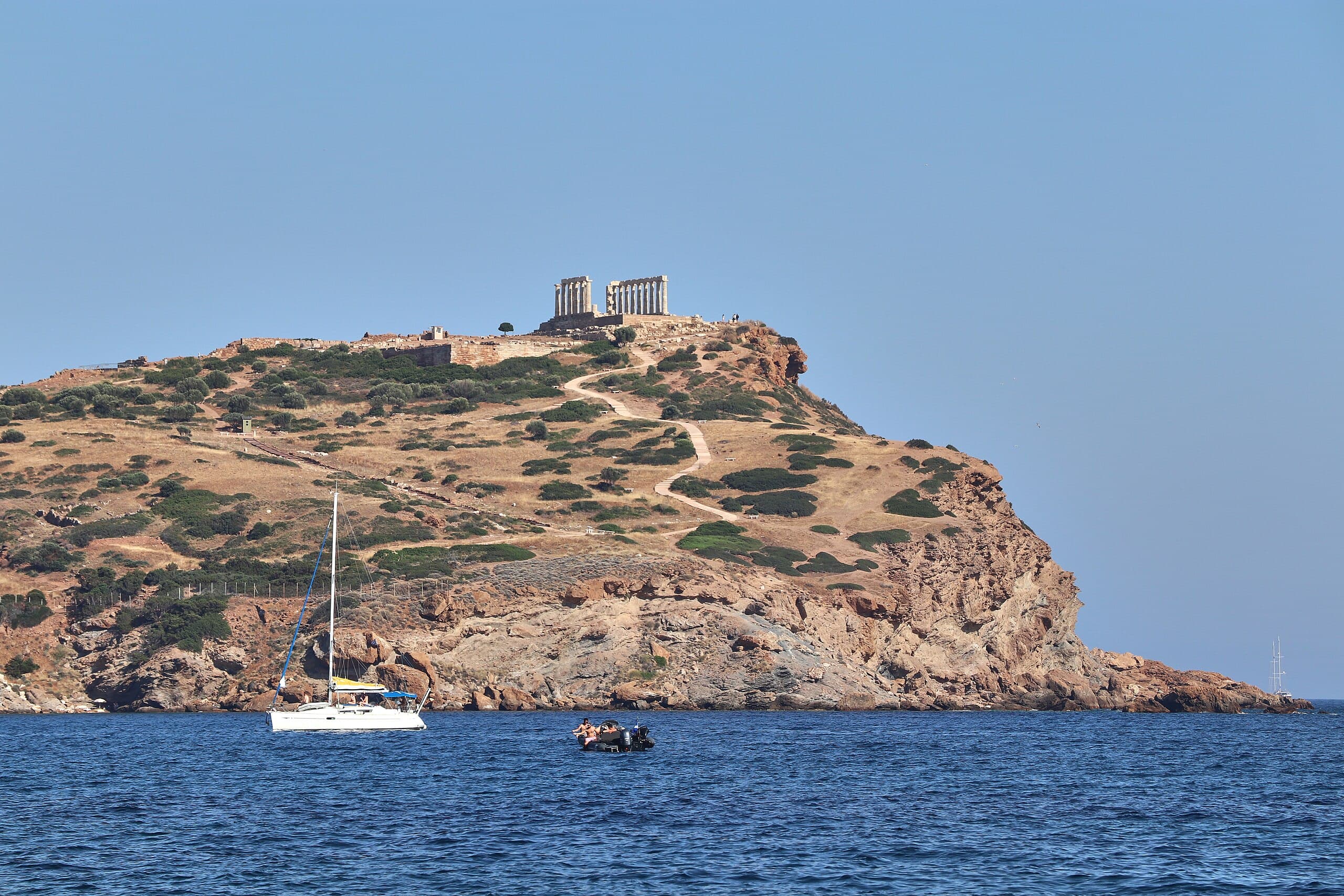
Cape Sounion
Where ancient columns frame the edge of the known world and the Aegean takes its name
Lavreotiki Municipal Unit, Attica, Greece
At A Glance
- Coordinates
- 37.6502, 24.0246
- Suggested Duration
- Allow 1.5 to 2 hours. This provides time to walk the full precinct including the Temple of Athena site, examine the Poseidon temple from multiple angles, and — if timing permits — stay through sunset. Those combining the visit with a swim at the nearby beach should allow an additional hour.
- Access
- Cape Sounion is 70 km southeast of Athens, approximately 1 to 1.5 hours by car along the scenic coastal road that follows the Saronic Gulf. KTEL buses run regular service from Athens to Sounion. Organized tour buses are common, especially for sunset visits. The site is open 9:30 AM to sunset year-round, with extended hours in summer. Admission is approximately 10 euros. The terrain within the site is uneven and mostly unpaved. There is limited accessibility for wheelchair users, though portions of the main path offer views of the temple. A small cafe and gift shop operate near the entrance. Mobile phone signal is reliable. A public beach sits below the cape on the eastern side.
Pilgrim Tips
- Cape Sounion is 70 km southeast of Athens, approximately 1 to 1.5 hours by car along the scenic coastal road that follows the Saronic Gulf. KTEL buses run regular service from Athens to Sounion. Organized tour buses are common, especially for sunset visits. The site is open 9:30 AM to sunset year-round, with extended hours in summer. Admission is approximately 10 euros. The terrain within the site is uneven and mostly unpaved. There is limited accessibility for wheelchair users, though portions of the main path offer views of the temple. A small cafe and gift shop operate near the entrance. Mobile phone signal is reliable. A public beach sits below the cape on the eastern side.
- No formal dress code applies. Comfortable, sturdy shoes are strongly recommended — the terrain is rocky and uneven, with loose gravel on some paths. In summer, bring sun protection: hat, sunscreen, and water. The headland is fully exposed with no shade. In spring and autumn, a light jacket is wise — the wind at the cliff edge can be strong and cold even on mild days.
- Photography is freely permitted throughout the site. Tripods may face restrictions during peak hours; check at the entrance. The sunset light creates extraordinary conditions for photography, but be aware that hundreds of others will be seeking the same images. The most distinctive photographs often come from the less-visited Temple of Athena site to the north, which offers views of the Poseidon temple with the sea beyond.
- Do not touch or climb on the temple columns or foundations. Do not carve names into the marble — Byron's graffiti is a historical curiosity, not an invitation. The site is a protected archaeological monument, and damage to the ruins carries legal penalties. In summer, the headland offers no shade; bring water and sun protection. The cliff edges are real and unguarded in places. Keep to designated paths, especially if visiting with children.
Overview
Fifteen white marble columns stand on a headland sixty meters above the sea, marking the southernmost point of Attica. For three thousand years, this promontory was the last sight of home for sailors leaving Athens and the first on return. The Temple of Poseidon, built in the age of Pericles, still holds the threshold between solid land and the vast uncertainty of open water.
Cape Sounion is the place where Greece ends and the Aegean begins. The promontory juts into the sea at the southeastern tip of Attica, a windswept headland of limestone and scrub that drops sixty meters to the water below. On its highest point, fifteen columns of the Temple of Poseidon remain standing after twenty-four centuries, their white marble darkened by salt wind and time but still unmistakable against the sky.
This was never a place of ordinary devotion. It was the boundary — the point where the known world of the Greek mainland gave way to the unpredictable domain of Poseidon. Ancient sailors offered sacrifices here before departing, and gave thanks here on return. The myth embedded in the rock is older than the temple: King Aegeus stood on this headland watching for his son's ship, saw the black sails of mourning, and threw himself into the water below. The sea that received him still carries his name.
Today, Cape Sounion draws visitors who come for the sunset — the temple columns silhouetted against the Aegean as the light descends — and who find themselves standing in a place where the line between contemplation and awe dissolves. The ruins are beautiful. But what lingers is the position itself: the land narrowing to a point, the sea opening in every direction, and the sense that this headland was sacred long before anyone thought to build on it.
Context And Lineage
Cape Sounion has been a sacred headland for over three thousand years, serving as the maritime gateway of ancient Athens. The Temple of Poseidon, built in the age of Pericles, crowned a sanctuary that had existed since the Bronze Age.
The founding of sanctuaries at Cape Sounion predates written history. Archaeological evidence places the earliest offerings at the headland in the eleventh century BC, during the period of transition between the Mycenaean collapse and the rise of the Greek city-states. By the eighth century BC, formal temples stood on the cape — but the impulse to mark this place as sacred almost certainly reaches further back, to the first moment a sailor recognized the headland as the point where land yielded to the open sea.
The myth that gives the site its deepest resonance is the story of Aegeus, legendary king of Athens. His son Theseus had sailed to Crete to enter the labyrinth and slay the Minotaur — a beast that demanded the sacrifice of Athenian youth. Father and son agreed on a signal: if Theseus survived, he would raise white sails on his return voyage. If the ship came back under black sails, it would mean death. Theseus killed the Minotaur but forgot to change the sails. Aegeus, standing on the cape and seeing the dark canvas approaching, believed his son was dead. In his grief, he threw himself from the cliff into the sea. The waters that received him were named the Aegean — and they carry that name still. The story makes Cape Sounion the birthplace of the sea's identity, a place where human sorrow became geography.
Homer knew the headland. In the Odyssey, he calls it the sacred promontory of the Athenians, the place where Menelaus's helmsman Phrontis was struck dead by Apollo's arrows during the return from Troy. The reference confirms what the archaeology suggests: by the time the great epics were composed, Sounion was already recognized as a place where the divine and the human intersected.
The sanctuary at Cape Sounion belongs to the tradition of ancient Greek religion, specifically the worship of Poseidon as master of the sea and protector of sailors. The temple was built during the same period and likely by the same architects as the Temple of Hephaestus in the Athenian Agora, connecting it to the broader program of civic and religious construction under Pericles. The adjacent sanctuary of Athena Sounias reflects the dual patronage of Athens's two most important deities — Poseidon for naval power and Athena for civic wisdom. The site's religious function ended with the Christianization of the Roman Empire in the fourth and fifth centuries AD. Its cultural lineage continued through the Romantic period, when Byron and other European travelers reinterpreted ancient Greek sites as touchstones of civilization, beauty, and loss.
Pericles
Athenian statesman whose building program (circa 449-430 BC) produced both the Parthenon and the Temple of Poseidon at Sounion. His vision of Athenian greatness expressed through monumental architecture gave the cape its most enduring monument.
King Aegeus
Legendary king of Athens whose suicide from the cape — leaping into the sea upon seeing the black sails of his son's returning ship — gave the Aegean Sea its name. His story makes Sounion the place where grief became geography.
Lord Byron
English Romantic poet who visited Sounion in 1810, carved his name on a temple column, and celebrated the site in verse. His attention made Sounion a destination for European travelers and embedded it in the literary imagination of the West.
Valerios Stais
Greek archaeologist who led the first systematic excavations at Sounion beginning in 1897, uncovering the foundations of both temples and the votive offerings that confirmed the site's sacred function across many centuries.
Homer
Ancient Greek poet who referenced Sounion in the Odyssey as the sacred promontory of Athens, providing the earliest literary testimony of the cape's sanctity and its role in the mythic landscape of the Greek world.
Why This Place Is Sacred
Cape Sounion gathers its power from location — the point where land ends, sea begins, and the myths that shaped Greek civilization were set in stone. Three millennia of human reverence for this threshold have left a residue that the ruins alone cannot explain.
The sacredness of Cape Sounion does not originate with the temple. It originates with the headland itself — a narrow promontory that extends into the Aegean like the prow of a ship, dropping away on three sides into deep water. Stand at its edge and the geometry is unmistakable: behind you, the fields and hills of Attica; before you, nothing but sea and light extending to the curve of the earth. This is a natural threshold, a place where one world ends and another begins, and human beings have recognized it as such for at least three thousand years.
The thinness deepens through myth. King Aegeus waited here for his son Theseus, who had sailed to Crete to face the Minotaur. Theseus had promised to raise white sails if he survived, but forgot, returning under the black sails of mourning. Aegeus saw the dark canvas approaching and, believing his son dead, threw himself from the cliff into the waters below. The sea that received his body has been called the Aegean ever since. This is not merely a legend attached to a landmark. It is the story of how a father's grief named an entire sea — and the place where it happened still holds the weight of that naming.
The temple adds a third layer. Built during the golden age of Athens, in the same years as the Parthenon, the Temple of Poseidon was not simply a place of worship but a declaration visible from the sea. Approaching sailors could see its columns from miles away, a signal that they had reached the boundary of Athenian territory, the edge of home. Its placement was as much about identity as devotion — a statement that Athens claimed not only the land but the threshold between land and sea.
What remains today — fifteen columns against the sky, the wind, the changing light — carries all three layers simultaneously. The natural edge, the mythic grief, the architectural ambition. Visitors who arrive for the sunset often find that the experience exceeds what they anticipated, and the reason is this accumulation: three thousand years of human attention focused on a single headland where the world narrows to a point.
Cape Sounion served as a maritime sanctuary dedicated to Poseidon, god of the sea. Sailors departing from Athens offered sacrifices here seeking safe passage across the open water. Returning sailors gave thanks for survival. The sanctuary was also dedicated to Athena, whose smaller temple occupied an adjacent hill, reflecting the dual protection — divine and civic — that Athens sought for its naval power. The cape functioned as a sacred boundary marker, the spiritual edge of the Athenian world.
Sanctuaries existed at the cape from at least the eleventh century BC, making it one of the oldest continuously venerated sites in Attica. The first temples were built around 700 BC. When Persian forces under Xerxes invaded in 480 BC, they likely destroyed the Archaic temple of Poseidon — though some scholars attribute its destruction to natural causes. The current temple was built between 444 and 440 BC, during the building program of Pericles that also produced the Parthenon. The Temple of Athena Sounias was destroyed in the first century AD and never rebuilt. By late antiquity, active worship had ceased. The site entered a long period of ruin and romantic rediscovery, culminating in Lord Byron's visit in 1810, when he carved his name on one of the columns — an act of literary vandalism that made Sounion famous throughout Europe. Archaeological excavations began in 1897 and continue to inform understanding of the site. Today, Cape Sounion functions as a protected archaeological monument and one of Greece's most visited cultural landmarks.
Traditions And Practice
Ancient worship at Sounion centered on sacrifice and offering to Poseidon before and after sea voyages. No active religious practice continues today. The sunset pilgrimage has become a secular ritual of its own.
The practices at Cape Sounion were inseparable from the sea. Before departing on a voyage, Athenian sailors climbed to the sanctuary and offered sacrifice to Poseidon — animal offerings, libations of wine poured onto the earth, prayers spoken into the wind. The purpose was direct: to secure the god's protection against storms, shipwrecks, and the thousand dangers of the open water. On safe return, the same sailors came back to give thanks, dedicating offerings that ranged from simple clay votives to elaborate bronze and marble statues.
The Sounion festivals, mentioned in ancient sources, included athletic competitions held in honor of Poseidon. These were not merely sporting events but religious observances — contests dedicated to the god, carried out within the sacred precinct. Maritime processions brought worshippers from Athens to the cape by sea, arriving at the small harbor below the headland and ascending to the temple on foot.
At the adjacent sanctuary of Athena Sounias, similar offerings were made, though the emphasis shifted from maritime protection to civic wisdom and strategic insight. The dual dedication reflects the Athenian understanding that survival at sea required both divine favor and human intelligence.
No formal religious practice takes place at Cape Sounion today. The temples have been ruins since late antiquity, and no tradition of worship has been revived. What has emerged instead is something the ancient worshippers might have recognized: a pilgrimage to the edge. Thousands of visitors travel to the cape each year specifically to watch the sunset from the temple precinct, arriving in the late afternoon and staying until the light is gone. This is not worship in any conventional sense, yet it shares the essential structure of the ancient practice — the journey to a threshold, the act of watching, the acknowledgment that something larger than the human is at work in the meeting of light and water.
Cultural events and concerts are occasionally held at the site. Wedding parties sometimes gather on the headland. These are secular uses, but they carry an echo of the ancient function: the marking of significant moments at a place recognized as extraordinary.
Arrive before the crowds and walk the site in silence. Stand at the cliff edge and look south — let the scale of the sea register. Read the myth of Aegeus before you come, and let it inhabit the headland as you stand where he is said to have stood. If you come for sunset, choose a position slightly apart from the main viewing areas; the experience deepens with even a few meters of solitude. Notice the wind — it was the same wind that filled the sails of ancient ships. Notice the columns, how they frame the sea rather than the land. This was a temple built to face outward, toward the unknown. Let it orient you the same way.
Ancient Greek Religion — Poseidon
HistoricalCape Sounion was one of the most important sanctuaries of Poseidon in the ancient Greek world. Positioned at the southernmost point of Attica, it served as the spiritual gateway for all maritime activity departing from or arriving at Athens. The temple was a visible landmark for sailors and a site of active worship from at least the eleventh century BC through late antiquity.
Animal sacrifice to Poseidon before sea voyages, seeking divine protection against storms and shipwreckThanksgiving offerings by sailors returning safely to Athenian watersAthletic competitions held as part of the Sounion festivals in honor of PoseidonMaritime processions from Athens to the cape by seaLibations and votive offerings at the temple precinct
Ancient Greek Religion — Athena
HistoricalThe smaller sanctuary of Athena Sounias occupied a separate hill adjacent to the Poseidon temple, reflecting the dual patronage that Athens sought for its maritime and civic enterprises. While Poseidon governed the sea itself, Athena provided the wisdom and strategic intelligence that allowed sailors to navigate it.
Worship and offerings at the Temple of Athena SouniasVotive dedications seeking wisdom and protection
Experience And Perspectives
Cape Sounion is best experienced as an arrival at the edge — the coastal road narrows, the headland appears, and the temple columns emerge against the sky. The sunset transforms the ruins into a silhouette that has moved visitors for centuries.
The approach matters. The coastal road from Athens follows the Saronic Gulf southeast for seventy kilometers, the landscape gradually shedding its suburban density until only dry hillsides and the sea remain. The cape appears around a final bend — a headland rising from the water with the unmistakable outline of columns on its crest. Even at a distance, the position communicates something: this is a place set apart, lifted above the ordinary plane of the coast.
The site itself is compact. A path leads from the entrance through low walls and foundations — the remains of the temenos, the sacred enclosure that once surrounded the temple. The ground is uneven, the stone warm underfoot. Olive trees and scrub mark the edges of the precinct. To the north, a second path leads to the remains of the Temple of Athena Sounias, less visited, more fragmentary, but occupying its own hill with views back toward the Poseidon temple.
The Temple of Poseidon commands the headland. Fifteen of the original thirty-four columns still stand, their white marble weathered to a warm grey. They are thinner than standard Doric proportions — built with only sixteen flutes instead of the usual twenty, an adaptation that some scholars attribute to the relentless salt wind at this exposed position. The columns frame the sea in every direction: east toward the Cyclades, south toward Crete, west toward the Peloponnese. On clear days, the Temple of Aphaia on Aegina is visible across the Saronic Gulf.
Look for Byron's name carved on a column at the temple's southeast corner. It is faint now, weathered by two centuries of wind, but still legible — a signature left by a young poet who would die in Greece fourteen years later. Other names surround his, carved by visitors who followed his precedent, though the practice is now strictly forbidden.
The sunset experience is what draws most visitors, and it deserves its reputation. As the sun descends toward the western sea, the temple columns darken into silhouettes. The sky moves through gold, copper, rose, and violet. The sea turns from blue to amber to black. The wind typically picks up in the late afternoon, carrying salt and the smell of wild herbs. There is rarely silence — groups gather, cameras click, conversations continue in a dozen languages — but the scale of the setting absorbs the noise. The horizon is large enough to hold everything.
For those seeking a quieter encounter, arrive in the early morning. The light is different — clear, direct, without the drama of sunset — and the site is often nearly empty. The columns cast long shadows across the temple platform. The sea is calmer. The headland feels less like a stage and more like what it was for millennia: a place where a person could stand at the edge of the known world and consider what lay beyond.
Approach Cape Sounion as a threshold, not merely a ruin. If coming for sunset, arrive at least an hour before to walk the site slowly without the pressure of fading light. Begin at the Temple of Athena to the north — fewer visitors gather there, and the view back toward the Poseidon temple provides essential perspective. Then move to the main temple and allow yourself time to stand at the cliff edge, where the headland drops to the sea. Notice the wind. Notice how the columns frame the water rather than the land. If you have read the myth of Aegeus, let the story inhabit the place — stand where a father might have watched for sails. The sunset will come on its own terms.
Cape Sounion invites multiple readings — as an archaeological monument of the Periclean age, as a mythic landscape where human grief became geography, as a natural threshold that has drawn human reverence since before recorded history.
Archaeological and architectural analysis places the Temple of Poseidon firmly within the building program of Pericles, dating its construction to 444-440 BC. The temple's architect is debated — some scholars identify him as the designer of the Temple of Hephaestus in the Athenian Agora, based on stylistic similarities, while others argue for a distinct hand. The unusual thinness of the columns and their reduced fluting (sixteen rather than the standard twenty) have prompted discussion about whether these features represent aesthetic choice or practical adaptation to the extreme wind exposure of the site. Excavations beginning in 1897 revealed that the Periclean temple replaced an earlier Archaic structure, probably destroyed during the Persian invasion of 480 BC, and that the sanctuary's origins extend to at least the eleventh century BC. The site's strategic significance is well understood: it commanded the sea approach to Athens and served as both a religious center and a lookout point for the Athenian navy.
For modern Greeks, Sounion embodies something foundational about their relationship with the sea. The myth of Aegeus is not a quaint legend but the origin story of the Aegean itself — the sea that has defined Greek life, trade, warfare, and identity for millennia. The headland is a place where cultural memory concentrates. Greeks who visit Sounion are not merely viewing ruins but standing at the spot where their civilization declared its relationship with the waters that surround it. The temple's position — facing outward, toward the open sea — speaks to a cultural identity that has always been oriented toward the horizon.
The sunset at Sounion has generated its own body of interpretation beyond the archaeological. Some visitors describe the experience in terms borrowed from mystical tradition — a sense of the veil thinning, of time collapsing, of standing simultaneously in the present and in a deeper past. The alignment of the temple with the setting sun over the western Aegean has led some writers to suggest intentional solar orientation, though this remains debated among scholars. What is not debated is the experiential power of the event: the columns, the light, the sea, and the wind combine to produce a moment that exceeds its component parts. Byron recognized this in 1810 and carved his response into the marble. Modern visitors photograph it, but the impulse is the same — to capture something that seems to exceed the ordinary.
Several mysteries persist at Sounion. The architect of the temple has never been definitively identified. The exact circumstances of the Archaic temple's destruction — whether by Persian forces or by earthquake and storm — remain debated. The nature of the Sounion festivals, mentioned in ancient sources, is not fully documented: what were the athletic events, and how did they relate to the maritime rituals? The sanctuary of Athena Sounias, less studied than the Poseidon temple, holds unanswered questions about its role in Athenian religion and its relationship to the larger sanctuary. And the fundamental question: why this headland, among all the capes of Attica, was chosen for such sustained and elaborate devotion stretching across three millennia remains, in the end, a question the wind answers better than scholarship.
Visit Planning
Open 9:30 AM to sunset year-round. Located 70 km southeast of Athens via the coastal road. Allow 1.5-2 hours. Arrive before sunset for the quintessential experience.
Cape Sounion is 70 km southeast of Athens, approximately 1 to 1.5 hours by car along the scenic coastal road that follows the Saronic Gulf. KTEL buses run regular service from Athens to Sounion. Organized tour buses are common, especially for sunset visits. The site is open 9:30 AM to sunset year-round, with extended hours in summer. Admission is approximately 10 euros. The terrain within the site is uneven and mostly unpaved. There is limited accessibility for wheelchair users, though portions of the main path offer views of the temple. A small cafe and gift shop operate near the entrance. Mobile phone signal is reliable. A public beach sits below the cape on the eastern side.
The nearest accommodations are in Sounion village, within walking distance of the site, where several hotels offer sea-view rooms. The town of Lavrio, 10 km north, provides additional options at more modest prices. Most visitors come as a day trip from Athens, returning along the coast road after sunset. For those wishing to stay near the cape, booking in advance is advisable during July and August.
Standard archaeological site rules apply. Stay on paths, do not touch the marble, and do not carve anything on the columns. No formal dress code, though comfortable shoes are essential for uneven terrain.
Cape Sounion is a protected archaeological site managed by the Greek Ministry of Culture. The expectations are practical rather than devotional: treat the ruins with the respect due to structures that have survived twenty-four centuries and remain vulnerable to human contact. Do not lean against, sit on, or touch the marble columns. The oils from human skin accelerate weathering, and the cumulative effect of thousands of daily touches would damage what wind and salt have not.
Stay on the designated paths that wind through the precinct. The ground between the foundations is uneven and may conceal archaeological material not yet excavated. The temptation to wander off-path for a better photograph is understandable, but the site's integrity depends on visitors resisting it.
The matter of Byron's graffiti deserves direct address. His name carved on a column is now a protected historical artifact in its own right — a record of the Romantic encounter with antiquity. It is not, however, permission to add your own. Dozens of subsequent visitors carved their names in imitation, and the cumulative damage is visible. Modern visitors who carve on the ruins face fines and legal consequences. Carry a journal if you need to mark the moment.
No formal dress code applies. Comfortable, sturdy shoes are strongly recommended — the terrain is rocky and uneven, with loose gravel on some paths. In summer, bring sun protection: hat, sunscreen, and water. The headland is fully exposed with no shade. In spring and autumn, a light jacket is wise — the wind at the cliff edge can be strong and cold even on mild days.
Photography is freely permitted throughout the site. Tripods may face restrictions during peak hours; check at the entrance. The sunset light creates extraordinary conditions for photography, but be aware that hundreds of others will be seeking the same images. The most distinctive photographs often come from the less-visited Temple of Athena site to the north, which offers views of the Poseidon temple with the sea beyond.
Not applicable. This is an archaeological site with no active worship. Do not leave objects, flowers, or personal items at the temple.
Do not touch or climb on ruins. Do not carve or write on any surface. Stay on designated paths. The site closes at sunset — visitors must leave when the light is gone. Drones may require special permission from archaeological authorities.
Sacred Cluster
Nearby sacred places create the location cluster described in the growth plan. This block is intentionally crawlable and links into the wider regional graph.