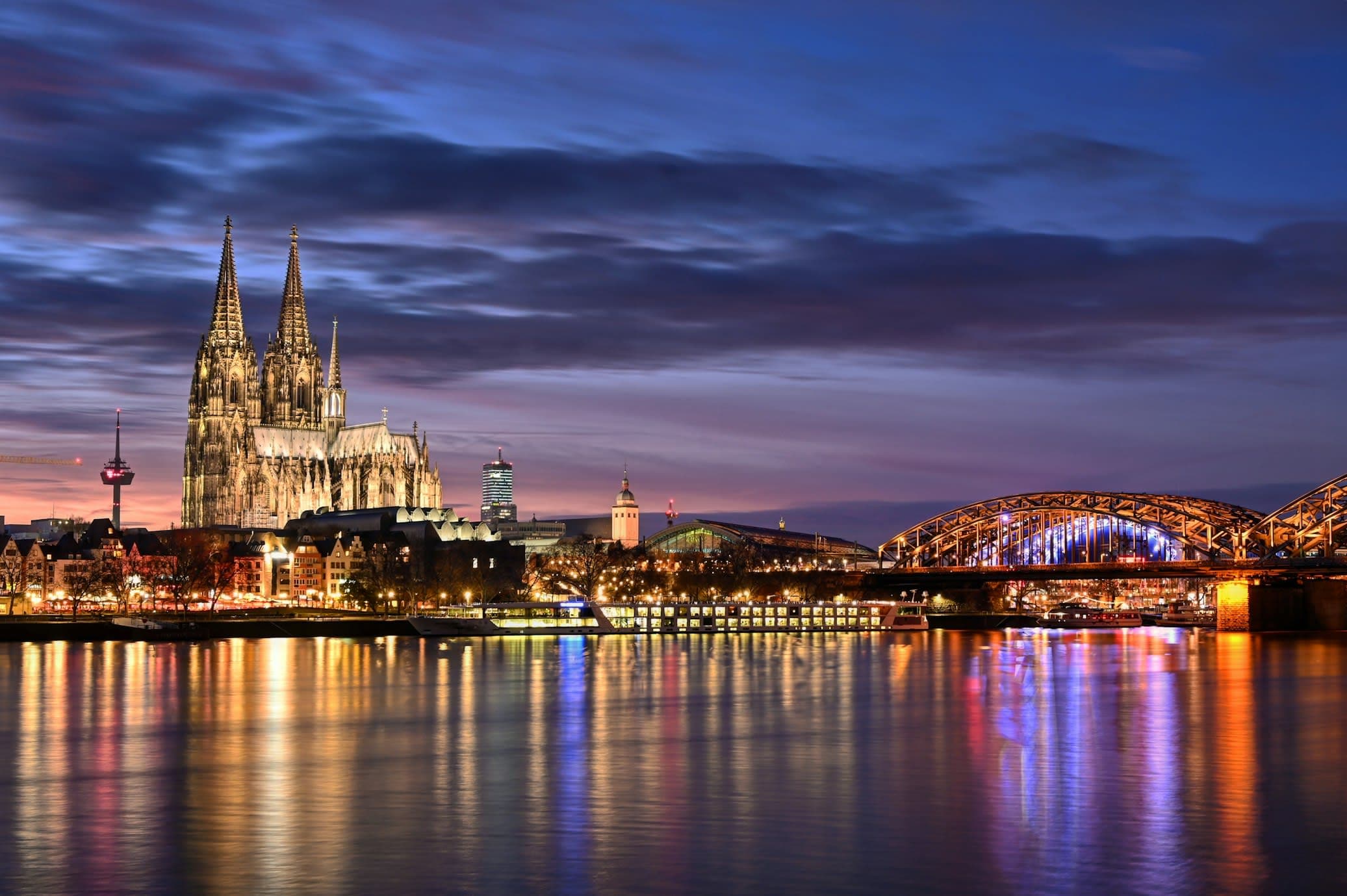
Cologne Cathedral
Where the bones of the first pilgrims rest beneath 632 years of aspiring stone
Köln, Nordrhein-Westfalen, Germany
At A Glance
- Coordinates
- 50.9413, 6.9583
- Suggested Duration
- The cathedral interior rewards 1-2 hours of unhurried exploration. Add 30-45 minutes for the tower climb (533 steps). The Treasury requires 30-60 minutes. Attending a service extends the visit significantly—the Sunday High Mass lasts 75-90 minutes. A full experience including tower, treasury, and service requires a half-day.
- Access
- Cologne Cathedral stands at Domkloster 4, 50667 Cologne, directly adjacent to Cologne Hauptbahnhof (central train station). Exit the station and the cathedral towers over you immediately. High-speed trains connect to Frankfurt (1 hour), Amsterdam (2.5 hours), Brussels (2 hours), and Paris (3.5 hours). Cologne/Bonn Airport is 15 km distant; Düsseldorf Airport 45 km. The city center location offers abundant hotels, restaurants, and transit connections.
Pilgrim Tips
- Cologne Cathedral stands at Domkloster 4, 50667 Cologne, directly adjacent to Cologne Hauptbahnhof (central train station). Exit the station and the cathedral towers over you immediately. High-speed trains connect to Frankfurt (1 hour), Amsterdam (2.5 hours), Brussels (2 hours), and Paris (3.5 hours). Cologne/Bonn Airport is 15 km distant; Düsseldorf Airport 45 km. The city center location offers abundant hotels, restaurants, and transit connections.
- No specific dress code is enforced, but the cathedral remains a place of worship. Modest clothing appropriate for a church is respectful. Shorts and revealing attire, while not prohibited, may draw disapproving glances, particularly during services.
- Personal photography is permitted throughout the cathedral without flash. Tripods and professional equipment require advance permission from cathedral administration. Photography is restricted or prohibited during religious services. The Richter window photographs well in afternoon light.
- The main Sunday service (10 AM) restricts access for sightseeing; plan accordingly. The tower climb requires reasonable fitness—533 steps with no elevator. Large bags and luggage are prohibited for security reasons; use the luggage storage at Roncalliplatz. During major feasts and World Youth Day events, crowds can be overwhelming.
Overview
Cologne Cathedral rises from the Rhine plain in twin spires that took six centuries to complete. Within rests the golden Shrine of the Three Kings—the Magi who, tradition holds, were the first pilgrims. This is a place where pilgrimage itself began, where medieval builders worked from the same plans their distant successors would finally complete, and where daily mass continues in a space designed to lift the eye and spirit toward heaven.
Cologne Cathedral embodies an impossible patience. For 632 years, from 1248 until 1880, successive generations raised this Gothic basilica according to the same medieval drawings, each builder trusting that others would continue the work they themselves would never see completed. The twin spires that now define Cologne's skyline stood unfinished for three centuries, a truncated dream waiting for a society that believed in completion.
At the heart of this vast stone vessel rests the reason for it all: the golden Shrine of the Three Kings, believed to contain the relics of the Magi who journeyed to worship the infant Christ. They were, tradition holds, the first pilgrims—the first to travel toward the holy. And so Cologne became a place where pilgrimage met its source, where medieval seekers came to honor those who showed the way.
The cathedral survives as a living church in a living city. Daily masses draw worshippers to the same altar that has hosted liturgy for over seven centuries. The organ fills the 43-meter nave with sound designed to penetrate stone and soul alike. And in the south transept, Gerhard Richter's contemporary window—11,263 colored glass squares in seemingly random pattern—offers a modern meditation on order, chaos, and the divine hidden in the apparently arbitrary. Ancient and contemporary, museum and church, Cologne Cathedral holds its contradictions in a single vast space, 157 meters of stone reaching toward whatever waits above.
Context And Lineage
Christians have worshipped on this site since the 4th century. The current cathedral began construction in 1248, immediately after the relics of the Three Kings arrived from Milan in 1164. Six centuries of building, interrupted by religious wars and revolution, finally concluded in 1880 when the twin spires were completed—briefly making Cologne Cathedral the world's tallest structure.
The relics of the Three Wise Men traveled a long path to Cologne. According to tradition, Empress Helena—Constantine's mother—brought them first to Constantinople. In 314, Constantine entrusted them to Eustorgius I, Bishop of Milan, who transported them by oxcart across the Alps. For eight centuries, the relics remained in Milan.
In 1164, Holy Roman Emperor Frederick Barbarossa conquered Milan. As reward for political support, he gave the relics to Rainald of Dassel, Archbishop of Cologne. Rainald brought them north, and Cologne transformed immediately from regional city to international pilgrimage center. The Magi were understood as 'the first pilgrims'—the first Gentiles to worship Christ. To possess their relics was to possess the very origin of pilgrimage itself.
The existing Romanesque cathedral proved insufficient for this treasure. In 1248, fire destroyed much of the old building, and construction began on a new Gothic cathedral scaled to match the significance of what it would contain. Master Gerhard designed a structure based on Amiens Cathedral but larger, more ambitious—a reliquary the size of a city block.
Construction proceeded for three centuries before halting around 1560. The south tower stood incomplete at 59 meters, a crane atop it that would remain for 300 years. Religious wars, shifting priorities, and changing tastes all played roles. The incomplete cathedral became a symbol of abandoned ambition.
The Gothic Revival of the early 19th century brought renewed interest. Original medieval drawings were rediscovered, and advocates including Sulpiz Boisserée championed completion. In 1842, King Frederick William IV of Prussia laid a new cornerstone. Using the 1300 plans faithfully, architects Ernst Friedrich Zwirner and Richard Voigtel raised the towers to their full 157-meter height. On August 14, 1880, the cathedral was completed—632 years after construction began.
The cathedral continues the oldest Christian lineage in the German Rhineland, with worship documented on this site since the 4th century. It serves as seat of the Archbishop of Cologne, one of Germany's most important ecclesiastical positions—historically, the Archbishop was a prince-elector who voted for the Holy Roman Emperor. The diocese traces its origins to Roman times and has shaped German Catholicism for seventeen centuries.
The Three Kings (Magi)
Sacred figures whose relics define the cathedral
Nicholas of Verdun
Goldsmith who created the Shrine of the Three Kings
Archbishop Gero
Patron of the Gero Cross
Gerhard Richter
Creator of the modern south transept window
Why This Place Is Sacred
The cathedral's sanctity rests on layered foundations: continuous Christian worship since the 4th century, the presence of the Three Kings relics since 1164, the Gero Cross from 965 AD depicting Christ dead rather than triumphant, and 632 years of builders working faithfully to the same plans. UNESCO recognizes the site as testimony to 'the enduring strength of European Christianity.'
What makes a place thin, permeable to the sacred? Cologne Cathedral offers several answers at once, each reinforcing the others.
The first is sheer duration. Christians have worshipped on this site since the 4th century—over 1,700 years of prayer, liturgy, and seeking. Whatever one believes about the accumulated effect of sustained devotion, this is one of the longest-continuous sacred sites in northern Europe.
The second is relics. In 1164, the bones believed to be those of the Three Kings arrived from Milan, and Cologne transformed from regional city to international pilgrimage destination. The Magi were understood as the first pilgrims—Gentiles who journeyed to worship Christ at his birth. To pilgrimage to their shrine was to participate in that founding act of seeking, to join a tradition that began in Bethlehem.
The third answer is architectural. Gothic architecture was designed to produce specific effects on the soul—to lift the eye upward through pointed arches, to flood the interior with colored light, to overwhelm human scale with divine proportion. Cologne Cathedral achieves this with particular intensity: 43 meters to the nave ceiling, 157 meters to the tower tops, 300,000 tonnes of stone organized to make weight appear weightless.
The fourth is the Gero Cross, carved around 965 AD and hanging in its chapel for over a thousand years. This is the oldest surviving monumental crucifix in the Western world, and it depicts something unprecedented for its time: Christ dead. Earlier crucifixes showed Christ triumphant, eyes open, reigning from the cross. The Gero Cross shows a body that has ceased to live—head fallen, eyes closed, mortality visible in carved wood. To stand before it is to encounter death without evasion, the human cost of the sacred story.
Finally, there is the time the building itself took to rise. Six hundred and thirty-two years of construction, halted and resumed, interrupted by wars and revolutions, yet always returning to the same medieval plans. The 19th-century architects who completed the towers used drawings from 1300. This fidelity across centuries testifies to something—call it faith, persistence, or the belief that certain works deserve completion regardless of how long they take.
The current Gothic cathedral was begun in 1248 specifically to house the relics of the Three Kings, which had arrived in 1164 and immediately made Cologne one of Europe's major pilgrimage destinations. The building was conceived to match the significance of its contents—a reliquary on a city scale, designed to draw pilgrims from across Christendom to venerate the first worshippers of Christ.
The cathedral's role has evolved from exclusively religious to simultaneously sacred and cultural. While daily masses continue and pilgrims still come for the shrine, the approximately 6 million annual visitors include many drawn by architectural and historical interest rather than devotion. The installation of Gerhard Richter's abstract window in 2007 signaled the cathedral's willingness to engage contemporary art, sparking controversy but also establishing the space as a site where ancient and modern dialogue. Yet the essential function remains: this is still the seat of the Archbishop of Cologne, still a working church where the liturgy for which the building was designed continues to be celebrated.
Traditions And Practice
Daily masses continue the liturgical tradition for which the building was constructed. The Latin High Mass on the first Sunday of each month draws international pilgrims. Veneration of the Three Kings shrine, the Gero Cross, and the Madonna of Milan continues as it has for centuries. The Cologne Cathedral Boys' Choir, one of Germany's oldest, performs sacred music regularly.
Medieval pilgrims came specifically for the Shrine of the Three Kings, approaching through the ambulatory to venerate the relics of those who first worshipped Christ. The cathedral served as coronation church for German kings, and Epiphany (January 6, the Feast of the Three Kings) remains the cathedral's most significant feast day. Veneration of the Gero Cross offered pilgrims encounter with Christ's suffering; the Madonna of Milan, a 13th-century wooden sculpture, attracted those seeking miraculous intercession.
The cathedral hosts multiple daily masses: six on weekdays, seven on Sundays, ranging from early morning quiet services to the major 10 AM Sunday High Mass. The Latin High Mass on the first Sunday of each month enables worshippers from many nations to pray together in the liturgical language. Evening devotions Monday through Friday at 6:00 PM offer contemplative practice. Confession is available. Special services during Advent, Christmas, and Epiphany draw large congregations. The cathedral remains a pilgrimage destination, with many visitors approaching the Shrine of the Three Kings as pilgrims rather than tourists.
Attending a mass transforms the cathedral from monument to living church; the 10 AM Sunday service is most significant, though this restricts sightseeing. Spend time before the Shrine of the Three Kings regardless of tradition—the craftsmanship rewards attention, the history invites reflection. Seek out the Gero Cross in its chapel for encounter with medieval piety and mortality. If physically able, climb the tower for perspective unavailable elsewhere. Consider visiting during Epiphany for the cathedral's central feast.
Roman Catholic Christianity
ActiveCologne Cathedral is the seat of the Archbishop of Cologne, one of Germany's most ancient and important dioceses, with continuous Christian worship on this site since the 4th century. The cathedral was constructed specifically to house the relics of the Three Kings, making it one of medieval Europe's most significant pilgrimage destinations alongside Rome and Santiago de Compostela. The cathedral continues to function as the central church for the Archdiocese, hosting major liturgical celebrations and serving approximately 6 million visitors annually.
Daily masses at multiple times serve a continuous worshipping community. The Latin High Mass on the first Sunday of each month enables international pilgrims to worship together in the liturgical language. The Cologne Cathedral Boys' Choir (Kölner Domchor), one of Germany's oldest choirs, performs sacred music regularly. Special services mark major feasts, with Epiphany (January 6, Feast of the Three Kings) holding particular significance. Confession is available. Pilgrimage to the Shrine of the Three Kings continues the medieval tradition, as does veneration of the Gero Cross and the Madonna of Milan.
Experience And Perspectives
Entering Cologne Cathedral produces an immediate confrontation with scale. The 43-meter nave draws the eye upward through pointed arches toward vaulted ceiling. In the ambulatory behind the high altar, the golden Shrine of the Three Kings glows under soft light—the reason this building exists. The Gero Cross, in its chapel, offers quieter encounter: Christ dead on the cross, carved over a thousand years ago. The tower climb—533 steps—rewards with both physical challenge and aerial perspective on Gothic ambition.
The experience of Cologne Cathedral begins before you enter. Step out of Cologne Hauptbahnhof, and the cathedral is simply there—impossibly large, twin spires rising 157 meters, dark stone blackened by industrial centuries. No photograph prepares you for the scale. The building fills the visual field, vertical thrust asserting itself against a horizontal city.
Inside, the nave extends 144 meters toward the distant altar, the ceiling arching 43 meters overhead. The effect is not merely size but organized size—pointed arches drawing the eye upward, ribbed vaults making stone appear to soar rather than press. This is the Gothic achievement: weight made to seem weightless, materiality transformed into aspiration.
Light enters through stained glass—some windows original 14th century, preserving the colors medieval pilgrims saw; others destroyed in World War II and replaced. In the south transept, Gerhard Richter's 2007 window offers something different entirely: 11,263 squares of colored glass arranged by computer algorithm, pattern emerging from apparent randomness. Cardinal Meisner objected that it belonged in a mosque. Visitors have found it meditative precisely in its refusal of figurative meaning, a field of color that offers space for the viewer's own contemplation.
The pilgrimage focus remains the Shrine of the Three Kings, positioned in the ambulatory behind the high altar. This massive gold reliquary—over two meters long, elaborately decorated with figures of prophets, apostles, and the kings themselves—glows under carefully designed lighting. Within, according to tradition, rest the bones of Melchior, Caspar, and Balthasar. Whether one accepts this as fact or legend, the shrine commands attention: the craftsmanship extraordinary, the history palpable, the devotion that produced it and that it has attracted for eight centuries present in the worn stone floor.
The Gero Cross requires seeking out. Hanging in its chapel near the sacristy, this 10th-century crucifix offers something the grand architecture cannot: intimacy. Christ's body hangs limp, head fallen to the side, eyes closed. This is not the triumphant Christ of earlier crucifixes but Christ dead—mortality depicted with unprecedented realism for 965 AD. The Byzantine influence shows in the style, but the theological shift is Western: confrontation with death as the cost of salvation.
For those with stamina, the south tower climb ascends 533 steps to a viewing platform approximately 100 meters above the city. The stairway is narrow, the ascent demanding, the reward a perspective available nowhere else: Gothic ambition seen from within, the intricate stonework visible at close range, and below, a city that has wrapped itself around this building for over seven centuries.
The fullest experience includes mass. Multiple services daily, with the 10 AM Sunday High Mass particularly significant. The Latin High Mass on the first Sunday of each month draws worshippers from many nations, the liturgical language transcending linguistic barriers. During mass, the cathedral becomes what it was built to be: not museum but living church, the sung liturgy rising through the same space it has filled since the choir was consecrated in 1322.
Allow time for adjustment upon entering—the scale requires recalibration. Move first down the nave toward the high altar, experiencing the building's primary axis. Then circumambulate through the ambulatory to find the Shrine of the Three Kings. The Gero Cross requires deliberate seeking—ask directions if needed. Consider attending a mass, which transforms the building from monument to functioning sacred space. The tower climb is best undertaken with physical preparation; the 533 steps are demanding but the perspective irreplaceable.
Cologne Cathedral invites interpretation from multiple angles: as architectural achievement, as pilgrimage destination, as testimony to faith perseverance, as living church. These perspectives need not be reconciled—the building contains them all.
Art historians and architectural scholars recognize Cologne Cathedral as a supreme achievement of Gothic architecture—what UNESCO calls 'the zenith of cathedral architecture.' The remarkable fidelity to medieval plans across 632 years of construction stands without parallel; 19th-century architects used original drawings from 1300 to complete the towers. The Gero Cross is universally acknowledged as the oldest surviving large-scale Western crucifix and a foundational work in medieval sculpture. The Shrine of the Three Kings ranks among the masterpieces of Mosan metalwork. Historically, the arrival of the relics in 1164 is documented, though their authenticity as actual remains of biblical figures remains a matter of faith rather than archaeology.
For German Catholics, Cologne Cathedral represents national religious identity. The Shrine of the Three Kings has drawn pilgrims since 1164, establishing Cologne alongside Rome and Santiago de Compostela as a major pilgrimage destination. The Magi are honored as 'the first pilgrims'—the first Gentiles to worship Christ—and pilgrimage to their shrine participates in that founding act of seeking the divine. The cathedral's completion in 1880 was celebrated as a triumph of Catholic faith perseverance through centuries of interruption, including the Reformation and Revolutionary periods when the building served as warehouse and stable.
Some contemporary visitors approach the cathedral as a site of sacred geometry and telluric energy, noting astronomical orientations common to Gothic cathedrals. The Gerhard Richter window has attracted visitors interested in the intersection of contemporary art and sacred space, particularly its meditative qualities arising from seemingly random color patterns that resolve into unexpected harmonies. The cathedral's role during Cologne Carnival, when sacred and carnivalesque traditions interweave, draws those interested in the deeper patterns of festival and transcendence.
Certain questions remain unanswered. What is the authentic history of the Three Kings relics before their documented arrival in Milan? What ceremonies and beliefs accompanied medieval pilgrimage to the shrine? Why was construction halted for nearly three centuries between 1560 and 1842—and what maintained the will to complete the building afterward? What early Christian structures lie beneath the current cathedral, and what might excavation reveal? How did the cathedral survive World War II bombing when the surrounding city was destroyed—was it deliberate Allied targeting avoidance, or fortunate accident?
Visit Planning
The cathedral stands directly adjacent to Cologne Hauptbahnhof, making it one of Europe's most accessible major churches. Entry to the cathedral is free; tower and treasury require tickets (€8 each, €12 combined). Open daily from 6:00 AM, with tourist visiting hours 10:00 AM-5:00 PM Monday-Saturday and 1:00 PM-4:00 PM Sunday.
Cologne Cathedral stands at Domkloster 4, 50667 Cologne, directly adjacent to Cologne Hauptbahnhof (central train station). Exit the station and the cathedral towers over you immediately. High-speed trains connect to Frankfurt (1 hour), Amsterdam (2.5 hours), Brussels (2 hours), and Paris (3.5 hours). Cologne/Bonn Airport is 15 km distant; Düsseldorf Airport 45 km. The city center location offers abundant hotels, restaurants, and transit connections.
Cologne offers abundant accommodation at all price levels within walking distance of the cathedral. The Dom Hotel directly overlooks the cathedral plaza. Budget options cluster near the Hauptbahnhof. The Old Town (Altstadt) offers atmospheric hotels amid medieval streets. Booking well in advance is essential during Carnival (February/March) and major trade fairs.
Cologne Cathedral functions simultaneously as tourist attraction and active church. Respectful behavior expected throughout; silence in prayer areas and during services. Photography permitted without flash except during services. Modest dress appropriate though not strictly enforced. Sightseeing restricted during mass.
The cathedral welcomes millions of visitors annually and does not impose strict rules, but certain courtesies maintain the sacred character of the space. During services, sightseeing ceases—this remains a working church, and those gathered for mass deserve undisturbed worship. At other times, quiet respect allows all visitors to experience the space contemplatively. Prayer areas deserve particular reverence; those kneeling in prayer should not be photographed or disturbed.
The building's role as both pilgrimage site and architectural monument creates occasional tension. Visitors drawn by art or history share space with those who have come to pray. Awareness of this dual function—and respect for those in devotional practice—makes the visit meaningful for all.
No specific dress code is enforced, but the cathedral remains a place of worship. Modest clothing appropriate for a church is respectful. Shorts and revealing attire, while not prohibited, may draw disapproving glances, particularly during services.
Personal photography is permitted throughout the cathedral without flash. Tripods and professional equipment require advance permission from cathedral administration. Photography is restricted or prohibited during religious services. The Richter window photographs well in afternoon light.
Donation boxes are positioned throughout the cathedral. Candles may be lit with donation at various side altars. The cathedral accepts contributions for ongoing restoration—maintenance costs approximately €30,000 per day, and the building relies partly on visitor generosity.
Only small bags and rucksacks (maximum 40x35x15 cm) are permitted; no wheeled luggage, large backpacks, or suitcases. Luggage storage is available at the adjacent Roncalliplatz. Security checks are conducted at entry. Sightseeing is not permitted during services, particularly the main 10 AM Sunday mass. Climbing or touching monuments is prohibited.
Sacred Cluster
Nearby sacred places create the location cluster described in the growth plan. This block is intentionally crawlable and links into the wider regional graph.