Coba
Where white roads converge in jungle, and Maya shamans still honor the sacred waters
Cobá, Quintana Roo, Mexico
At A Glance
- Coordinates
- 20.4944, -87.7367
- Suggested Duration
- Two to four hours minimum for the main structures including Nohoch Mul, Conjunto Pinturas, and Macanxoc Group. The site spreads over eighty square kilometers with more than two kilometers between the entrance and main pyramid. Half-day recommended including cenote visit.
- Access
- Coba lies forty-seven kilometers northwest of Tulum via paved road. Free parking at the site. Colectivos run from Tulum to Coba village. ADO buses connect major cities but schedules are infrequent. Within the site, walking takes two-plus kilometers round trip to Nohoch Mul. Bicycle rental (approximately fifty Mexican pesos) is strongly recommended. Bici-taxi (approximately one hundred fifty pesos round trip) offers guided transport.
Pilgrim Tips
- Coba lies forty-seven kilometers northwest of Tulum via paved road. Free parking at the site. Colectivos run from Tulum to Coba village. ADO buses connect major cities but schedules are infrequent. Within the site, walking takes two-plus kilometers round trip to Nohoch Mul. Bicycle rental (approximately fifty Mexican pesos) is strongly recommended. Bici-taxi (approximately one hundred fifty pesos round trip) offers guided transport.
- Lightweight, breathable clothing suitable for jungle heat and humidity. Comfortable walking shoes or sturdy sandals essential for uneven terrain. Hat and sunglasses recommended. Modest dress appropriate when encountering ceremonial activity.
- Photography permitted throughout for personal use. Tripods may require permits. Drones require INAH permission. Be respectful of any ceremonies in progress; ask permission before photographing people.
- Respect the archaeological site. Do not climb structures other than Nohoch Mul. Stay on designated paths and sacbeob. Do not remove artifacts, stones, or vegetation. The lakes around Coba harbor crocodiles; do not swim in them. The cenotes in the surrounding area are the appropriate places for water immersion. Ceremonial practitioners in the area vary in authenticity and integrity. Seek those with generational connection to Maya tradition rather than recently self-appointed facilitators.
Overview
Coba was once one of the largest Maya cities, its white roads stretching over one hundred kilometers to connect the ancient world. Today, rising from jungle that still conceals most of its six thousand structures, the site offers what few Maya ruins can: the chance to climb a forty-two-meter pyramid and survey the sacred landscape as the Maya once did. Contemporary shamans still perform ceremonies here, keeping ancient practices alive.
The jungle around Coba hides more than it reveals. An estimated six thousand structures lie beneath the forest canopy, most never excavated, their purposes unknown. What has emerged is enough to suggest the city's former power: one of the largest Maya centers of the Classic period, connected by the most extensive network of white roads in the Maya world.
The sacbeob, as these roads were called, were more than infrastructure. Maya oral tradition describes a road suspended in the sky, a pathway called kuxansum, in whose middle flowed blood. The physical roads reflected cosmic reality, connecting sacred sites as the Milky Way connected the stars. Coba sat at the nexus of over fifty such roads, the longest stretching one hundred kilometers to Yaxuna.
Unlike most Maya sites, Coba was built around lakes. Five bodies of water surround the city, a rare abundance on the Yucatan Peninsula where cenotes and underground rivers provide most water. The name itself may mean 'waters stirred by the wind.' This lakeside location gave Coba resources other cities lacked, supporting a population that may have reached fifty thousand at its peak.
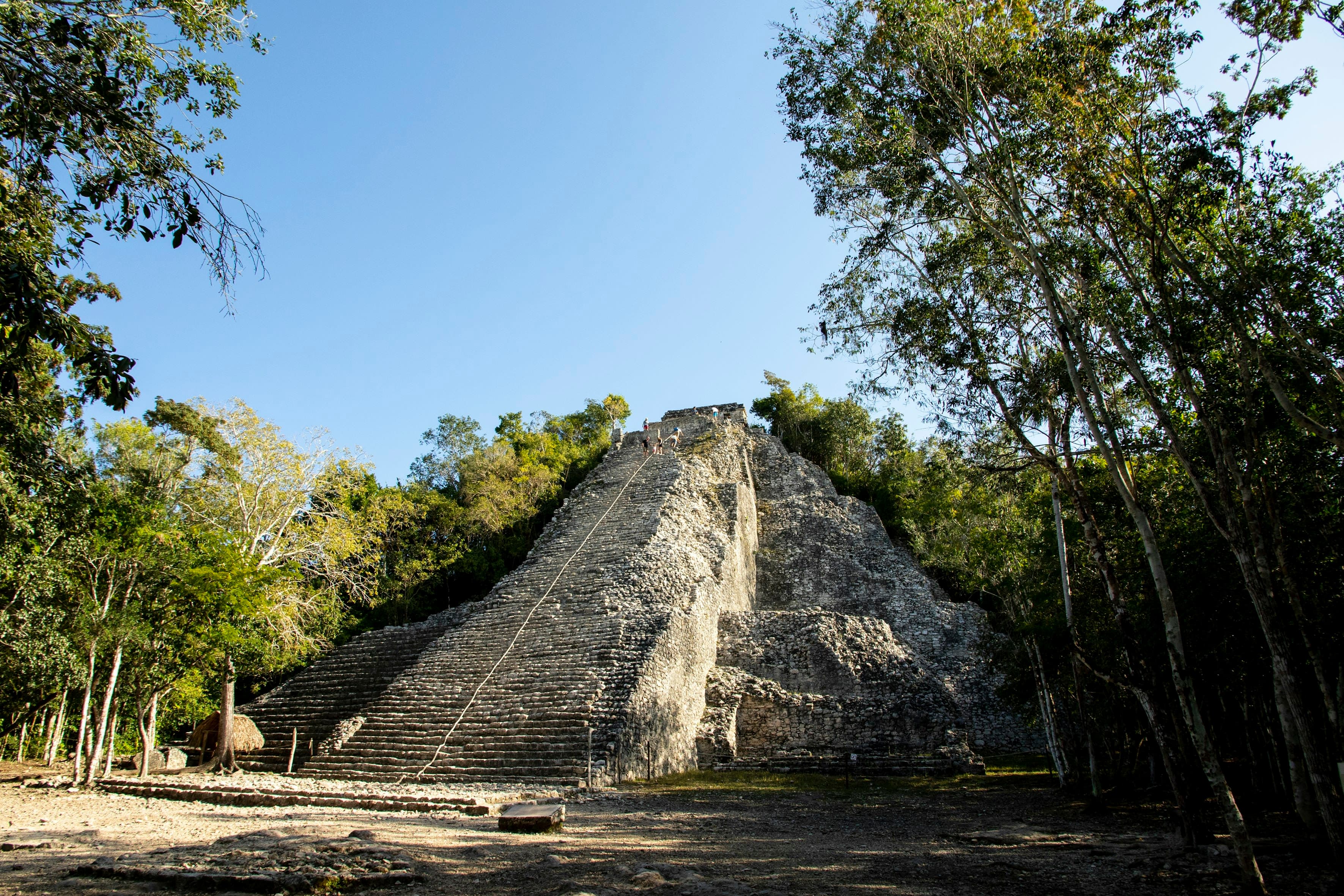
The city's most dramatic feature, Nohoch Mul, rises forty-two meters above the forest floor. After years of closure for preservation, a wooden stairway now allows visitors to ascend. At the summit, jungle extends to the horizon in every direction, broken only by the distant temples of La Iglesia and other structures. This view approaches what Maya lords surveyed when Coba governed vast territories.
Perhaps most significant for seekers, Coba is not merely archaeological. Contemporary Maya shamans perform blessing ceremonies and cacao rituals in the area. Offerings of flowers and copal incense are still left at La Iglesia pyramid. The ancient and contemporary exist here in relationship, the thread of practice never entirely broken.
Context And Lineage
Coba was one of the largest Maya cities of the Classic period, controlling vast territory through an unparalleled network of white roads. The city's unique lakeside setting and powerful female rulers distinguished it from other centers. After losing a power struggle with Chichen Itza, Coba declined but never lost its symbolic importance.
Maya oral tradition describes a road suspended in the sky, stretching from Tulum and Coba to Chichen Itza and Uxmal. This pathway, called kuxansum or sak-be, was understood as living, with blood flowing through its middle. The physical sacbeob, the white roads that radiate from Coba, were earthly expressions of this cosmic reality.
The cenotes throughout the region were understood as entrances to Xibalba, the underworld realm of the dead. The lakes around Coba, rare in the Yucatan, would have held similar significance: waters where the boundary between worlds was thin, where offerings could reach the powers below.
The founding of Coba is lost to time, but settlement began around 50 BCE. The city that emerged over the following centuries took its shape from the landscape: a center of power where water was abundant and roads could extend to distant allies. The longest known Maya road, stretching one hundred kilometers to Yaxuna, demonstrated both engineering capability and political ambition.
Recent discoveries have revealed the prominence of women in Coba's leadership. Ix Ch'ak Ch'een established the kaloomte' institution in 569 CE, formalizing female military and political authority. Lady K'awiil Ajaw II ruled during the city's golden age. These rulers performed sacred rituals connecting their governance to cosmic order, their authority derived from relationship with powers greater than themselves.
Coba's power stretched across the northern Yucatan during the Classic period. The sacbe network connected the city to dozens of sites, creating a web of political and ceremonial relationship. Alliances with distant Tikal, evidenced in inscriptions, suggest Coba's influence extended far beyond its immediate territory.
The rise of Chichen Itza challenged this dominance. By 900 CE, after decades of conflict, Coba had lost control of Yaxuna and significant territory. The power had shifted, though Coba retained symbolic importance. New construction continued through the Post-Classic period, maintaining the city as a living center even as political authority passed elsewhere.
The Spanish conquest brought final abandonment around 1550 CE. For three hundred years, the jungle reclaimed what the Maya had built. Stephens's mention in 1842 brought the first Western attention, but systematic excavation waited until 1974.
Today, the village of Coba has become a center for Maya cultural experience. Shamans continue traditional practices, offering ceremonies to visitors seeking authentic engagement. The thread connecting contemporary practice to ancient tradition has not broken.
Ix Ch'ak Ch'een
historical
Female ruler who established the kaloomte' (Supreme Warrior Queen) institution at Coba on May 12, 569 CE, formalizing women's military and political authority at the site.
Lady K'awiil Ajaw II
historical
Female ruler during Coba's golden age, governing from 640 to 682 CE when the city reached its peak power and population.
The Ancestors
deity
The spirits of the dead, accessible through cenotes and sacred waters, recipients of offerings and consultations. The stelae at Coba document rituals honoring ancestors and maintaining relationship across death.
Why This Place Is Sacred
Coba's thinness derives from its position at the nexus of over fifty sacred white roads, its rare lakeside setting understood as spiritually significant, its sixteen hundred years of ceremonial activity, and the continuing practices of contemporary Maya shamans who still honor the site. The vast majority of its structures remain unexcavated, adding mystery to power.
The sacbeob made Coba a node in sacred geography spanning hundreds of kilometers. These were not merely roads but representations of cosmic structure. Maya oral tradition speaks of a road suspended in the sky where blood flowed, connecting Coba to Chichen Itza and Uxmal. The white limestone surfaces reflected moonlight, making the roads visible at night as the Milky Way is visible above. To walk these paths was to participate in cosmic movement.
The lakes surrounding Coba add another dimension. Water was scarce and precious on the Yucatan, most of it hidden in underground rivers and cenotes. A city with five lakes possessed unusual abundance and, in Maya understanding, unusual power. The cenotes near Coba were portals to Xibalba, the underworld realm. Water connected the visible world to what lay beneath.
The ball courts at Coba were themselves thin places, understood as portals where the cosmic drama of life and death was ritually enacted. The game represented the journey of the hero twins through the underworld, the struggle between light and darkness that structured Maya cosmology. To watch or play was to participate in that ongoing battle.
The stelae throughout the site document ceremonial events and divine kingship. Coba's rulers included powerful women, notably the recently identified Ix Ch'ak Ch'een, who established the kaloomte' institution in 569 CE. These monuments were not mere records but declarations of sacred authority, connecting human governance to cosmic order.
Contemporary Maya shamans, called X'men, continue to perform ceremonies at and near Coba. The thread of practice has not broken. What the ancient Maya invested in this place persists not only in stone but in living tradition.
Archaeological evidence indicates Coba functioned as a major political, economic, and ceremonial center during the Classic period, from approximately 600 to 900 CE. The city controlled vast territory through its network of sacbeob, maintained alliances with distant cities like Tikal, and supported a population of possibly fifty thousand. The temples, stelae, and ball courts suggest sustained ceremonial activity over centuries. The lakes provided both practical resources and spiritual significance in a landscape where water was understood as sacred.
Coba's history spans sixteen hundred years, from initial settlement around 50 BCE to abandonment during the Spanish conquest around 1550 CE. The city reached its peak during the Classic period, when it likely rivaled Tikal and Calakmul in power. The construction of the hundred-kilometer sacbe to Yaxuna around 700 CE suggests political or military effort to maintain influence against rising Chichen Itza.
By 900 CE, power had shifted. Coba lost the struggle with Chichen Itza, its territory diminished though its symbolic importance continued. A modest revival in the Post-Classic period brought new construction in eastern coastal style, but the city never regained its former dominance.
John Lloyd Stephens first brought Coba to Western attention in 1842, based on reports from local sources. Systematic excavation began in 1974 and continues today, revealing new structures and inscriptions. The 2025 reopening of Nohoch Mul for climbing, after years of closure, allows visitors once again to survey the landscape as Maya lords once did.
The contemporary Maya community around Coba has become a center for ceremonial engagement, offering authentic experiences of traditional practice.
Traditions And Practice
Contemporary Maya shamans perform blessing ceremonies, cacao rituals, and temazcal purification at and near Coba. These are living practices, not reconstructions, maintaining relationship with the powers the ancient Maya recognized. Within the archaeological zone, visitors leave offerings at La Iglesia pyramid, continuing traditions documented in the stelae.
The ancient Maya at Coba performed stela dedication ceremonies marking accession, victories, and calendrical milestones. The over thirty carved stelae document this ceremonial life. Ball game rituals enacted cosmic drama at the two courts, representing the hero twins' journey through the underworld. Bloodletting and sacrifice maintained reciprocity with powers greater than human.
The kaloomte' institution, established by Ix Ch'ak Ch'een in 569 CE, formalized female sacred authority. The stelae document women rulers performing the same rituals as men, connecting governance to cosmic order. Offerings at the cenotes and aguadas reached Chaak and the ancestors in the underworld.
Contemporary Maya shamans, called X'men, perform traditional ceremonies in the Coba region. These are not reconstructions for tourists but living practices maintained across generations.
Mayan Blessing ceremonies invoke protection and harmony through offerings of flowers, copal incense, corn, and honey. The shaman addresses the four directions, honoring the powers that structure the world. Participants receive blessing and cleansing, reconnecting to the forces the ancient Maya recognized.
Cacao ceremonies explore the sacred plant the Maya called 'food of the gods.' Participants learn traditional preparation methods and share the drink in ritual context, opening to the heart-expanding properties the Maya attributed to cacao.
Temazcal purification rituals, available at wellness centers near Coba, offer the ancient sweat lodge experience. Entry into the heated dome represents entry into the womb of Mother Earth; emergence represents rebirth. This is one of the oldest continuous spiritual practices in Mesoamerica.
Within the archaeological zone, offerings of flowers and copal incense are still left at La Iglesia pyramid. This informal practice maintains ancient custom, connecting contemporary Maya to the ceremonies their ancestors performed.
If ceremony draws you to Coba, engage through the local Maya community. The village has developed infrastructure for authentic ceremonial experience, offering blessing ceremonies, cacao rituals, and access to temazcal.
Within the archaeological zone, approach La Iglesia with awareness that offerings are still left here. If you wish to make an offering, flowers or incense are appropriate; do not leave synthetic materials or garbage.
The cenotes near Coba, including Choo-Ha, Tankach-Ha, and Multum-Ha, allow swimming in waters the Maya considered sacred portals. Approach them with more than recreational intention. These were entrances to Xibalba, places where worlds met.
Climbing Nohoch Mul is itself a practice: one hundred twenty steps of approach, ascent through levels, arrival at a summit that surveys the world as Maya lords surveyed it. Take time at the top rather than rushing to photograph and descend.
Ancient Maya Religion
HistoricalCoba was a major ceremonial center for over a millennium, documented in more than thirty carved stelae. The city featured both male and female rulers performing sacred rituals. Ball courts served as portals to the underworld where cosmic battles were enacted. The network of sacbeob connected Coba to distant sacred sites, placing the city at a node in cosmic geography.
Stela dedication ceremonies marked important calendrical events. Ball game rituals enacted the journey of the hero twins through the underworld. Bloodletting and sacrifice maintained reciprocity with powers greater than human. Offerings at cenotes and aguadas reached the ancestors in Xibalba.
Contemporary Maya Spirituality
ActiveModern Maya shamans, called X'men, continue traditional ceremonies in the Coba region. The site and surrounding cenotes retain sacred significance as places where the veil between worlds is thin. Offerings are still left at La Iglesia pyramid, maintaining unbroken connection to ancient practice.
Blessing ceremonies invoke protection through offerings of flowers, copal, corn, and honey. Cacao ceremonies honor the sacred plant. Temazcal purification rituals offer death and rebirth in the ancient sweat lodge tradition. Fire ceremonies invoke the four cardinal directions. Spring blessing ceremonies mark the planting seasons.
Experience And Perspectives
Visitors to Coba consistently describe awe at the jungle setting, exhilaration from climbing Nohoch Mul, and a sense of discovery in exploring ruins largely reclaimed by forest. The spread of the site and presence of unexcavated mounds creates atmosphere unlike more developed archaeological zones. Those who participate in Maya ceremonies report profound spiritual encounters.
The first impression is scale: not of architecture but of jungle, the dense green that surrounds and penetrates the site. Most of Coba remains unexcavated, and the sense of approaching something only partly revealed distinguishes it from more developed ruins. Mounds rise throughout the forest, their forms suggestive of structures yet to be uncovered. The mystery is not absent but present.
The climb up Nohoch Mul transforms visitors. One hundred twenty steps is not merely physical effort but approach, each level bringing new perspective. At the summit, forty-two meters above the forest floor, the view expands to the horizon in every direction. Jungle stretches unbroken except for the distant temples of La Iglesia and other structures. To stand here is to approximate what Maya lords surveyed when Coba governed territories reaching a hundred kilometers.
The spread of the site invites wandering. Bicycles and bici-taxis are available because the main structures are separated by kilometers of ancient sacbeob. Walking these white roads, even fragments of them, connects visitors to the network that once linked Coba to distant cities. The limestone surfaces, though worn, still reflect light in ways that suggest their original effect.
The Macanxoc Group, with its numerous stelae, offers a different quality of encounter. Here, carved monuments document the ceremonial life of the city, including the recently identified female ruler Ix Ch'ak Ch'een. Standing before these inscriptions, visitors touch something specific: named individuals, dated events, the particularity of history.
Those who participate in Maya ceremonies report the deepest transformations. The blessing ceremonies conducted by local shamans invoke protection and harmony through offerings of flowers, copal, corn, and honey. Cacao ceremonies explore the sacred plant the Maya called 'food of the gods.' Temazcal purification rituals, available at wellness centers near the site, offer death and rebirth in the ancient sweat lodge tradition. These practices are not performances but living tradition, connecting contemporary seekers to the same powers the ancient Maya addressed.
Coba rewards exploration on its own terms. Consider renting a bicycle to cover the distances between major structures, but also plan time to walk portions of the ancient sacbeob. The limestone surfaces of these white roads still carry something of what they meant as cosmic pathways.
Nohoch Mul merits priority. Climb early, before heat and crowds, and linger at the summit. The view is not merely scenic but orientating, showing the landscape as the Maya lords saw it: jungle to the horizon, temples rising at distant points, the sense of governing vast territory.
The Macanxoc stelae deserve slow attention. These are not generic monuments but records of specific rulers, specific ceremonies, specific dates. The recently identified Ix Ch'ak Ch'een established the kaloomte' institution in 569 CE. To read these inscriptions, even without understanding the glyphs, is to touch named individuals across fifteen centuries.
If ceremony draws you, engage with it through the local Maya community. Blessing ceremonies, cacao rituals, and temazcal experiences offer authentic encounter with living tradition. The cenotes near Coba allow swimming in waters the Maya considered sacred portals. Approach them with awareness of what they meant.
Coba invites interpretation from archaeological, indigenous, and contemporary spiritual perspectives. Each illuminates different aspects of a city whose power derived from convergence: of roads, of waters, of worlds.
Archaeologists recognize Coba as one of the largest and most important Maya cities of the Classic period. The network of over fifty sacbeob, the most extensive in the Maya world, demonstrates unprecedented reach. Recent epigraphic work has revealed the prominence of women rulers, including Ix Ch'ak Ch'een who established the kaloomte' institution in 569 CE.
The lakeside setting was unique for major Maya cities, providing resources unavailable elsewhere on the Yucatan. Scholars estimate that only a small fraction of the approximately six thousand structures have been excavated, suggesting significant discoveries remain.
The struggle with Chichen Itza and subsequent decline reflects the political dynamics of the Post-Classic period. The hundred-kilometer sacbe to Yaxuna may represent a failed attempt to maintain alliance against the rising rival.
For contemporary Maya communities, Coba remains a place of ancestral power. The site represents achievements their forebears built and maintains living connection through continuing ceremonial practice. The cenotes are still understood as sacred portals. Maya shamans conduct ceremonies that maintain relationship with the powers their ancestors honored.
The sacbeob carry significance beyond infrastructure: they were earthly expressions of cosmic roads, paths where blood flowed connecting sacred sites as the Milky Way connects stars. To walk these roads is to participate in movement older than the city itself.
Some visitors perceive Coba as a powerful energy vortex, enhanced by its network of sacbeob, which some interpret as ley lines conducting earth energy. The junction of multiple white roads is seen as amplifying spiritual power. The cenotes are viewed as energetic gateways for consciousness expansion. The site's relative obscurity compared to Chichen Itza is sometimes seen as preserving purer spiritual energy.
While these interpretations lack archaeological support, they represent genuine contemporary spiritual engagement with the site's power.
Significant mysteries remain. Why did the ancient Maya construct the hundred-kilometer sacbe to Yaxuna, the longest known Maya road? What is the full extent of Coba's territory and alliance network at its peak? Why did the site develop such prominent female rulership? What lies beneath the thousands of unexcavated mounds throughout the eighty-square-kilometer site? What ceremonies were conducted at the various structures, and how did they relate to each other?
Visit Planning
Coba is accessible from Tulum, approximately forty-seven kilometers northwest. The dry season offers the most comfortable conditions. Plan for two to four hours minimum, longer if including cenotes. Bicycle rental is highly recommended for the spread-out site.
Coba lies forty-seven kilometers northwest of Tulum via paved road. Free parking at the site. Colectivos run from Tulum to Coba village. ADO buses connect major cities but schedules are infrequent. Within the site, walking takes two-plus kilometers round trip to Nohoch Mul. Bicycle rental (approximately fifty Mexican pesos) is strongly recommended. Bici-taxi (approximately one hundred fifty pesos round trip) offers guided transport.
Limited lodging in Coba village, mostly eco-oriented. Tulum offers extensive options forty-seven kilometers away. For those seeking ceremonial experience, Coba village has developed infrastructure for Maya cultural engagement.
Coba requires practical preparation for jungle conditions and respectful behavior toward both archaeological preservation and living tradition. The site's spread demands planning for distances, while its ceremonial importance asks for more than tourist behavior.
The jungle climate is hot and humid; bring water and sun protection. Comfortable walking shoes are essential for uneven terrain. If renting a bicycle, expect unpaved paths. If using bici-taxis, agree on price before departing.
Nohoch Mul is the only structure visitors may climb. Do not ascend other pyramids or enter restricted areas. The privilege of climbing the tallest climbable pyramid in the Yucatan depends on visitors respecting preservation requirements.
If you encounter ceremonies in progress, maintain respectful distance. Do not photograph participants without clear permission. Offerings at La Iglesia are personal devotions, not tourist attractions.
The stelae deserve more than quick photographs. These are records of specific people, specific events. Spend time with them.
Lightweight, breathable clothing suitable for jungle heat and humidity. Comfortable walking shoes or sturdy sandals essential for uneven terrain. Hat and sunglasses recommended. Modest dress appropriate when encountering ceremonial activity.
Photography permitted throughout for personal use. Tripods may require permits. Drones require INAH permission. Be respectful of any ceremonies in progress; ask permission before photographing people.
Small offerings of flowers or incense can be left respectfully at designated areas like La Iglesia, following the tradition that continues today. Do not leave garbage or synthetic materials.
Do not climb structures other than Nohoch Mul. Stay on designated paths and sacbeob. Do not remove artifacts, stones, or vegetation. Do not enter areas marked as restricted or under excavation. Do not swim in the lakes due to crocodile presence. Do not feed wildlife. Respect ceremonies in progress. Follow instructions of site guards.
Sacred Cluster
Nearby sacred places create the location cluster described in the growth plan. This block is intentionally crawlable and links into the wider regional graph.