Tulum
The Maya City of Dawn, where clifftop temples still greet the Caribbean sunrise
Tulum, Quintana Roo, Mexico
At A Glance
- Coordinates
- 20.2148, -87.4306
- Suggested Duration
- One and a half to two hours for the main archaeological site. Add thirty to sixty minutes for swimming at the beach below. Add two to three hours if combining with nearby cenotes. Half-day minimum for unhurried exploration.
- Access
- Tulum lies in Quintana Roo, approximately 130 kilometers south of Cancun, 65 kilometers south of Playa del Carmen, and 2-3 kilometers east of Tulum town. ADO buses run from Cancun (2 hours), Playa del Carmen (45 minutes), or Tulum town (10 minutes). Colectivo shared vans from Playa del Carmen offer economical transport. Taxis and rental cars are available. Parking at the site costs extra. Entry fees total approximately 515 pesos for foreign visitors, combining charges from Parque del Jaguar, CONANP, and INAH. Mexican nationals receive reduced rates, with free admission on Sundays. Cash payment in Mexican pesos recommended.
Pilgrim Tips
- Tulum lies in Quintana Roo, approximately 130 kilometers south of Cancun, 65 kilometers south of Playa del Carmen, and 2-3 kilometers east of Tulum town. ADO buses run from Cancun (2 hours), Playa del Carmen (45 minutes), or Tulum town (10 minutes). Colectivo shared vans from Playa del Carmen offer economical transport. Taxis and rental cars are available. Parking at the site costs extra. Entry fees total approximately 515 pesos for foreign visitors, combining charges from Parque del Jaguar, CONANP, and INAH. Mexican nationals receive reduced rates, with free admission on Sundays. Cash payment in Mexican pesos recommended.
- No formal requirements, but dress practically for tropical heat. Comfortable walking shoes are essential for uneven terrain. Bring swimsuit if planning to visit the beach below the ruins. Sun protection: hat, sunscreen, sunglasses.
- Personal photography permitted throughout most of the site. Do not use flash inside structures with murals. Tripods, drones, and professional equipment require INAH permits. Be present before being productive; the site will outlast your phone battery.
- Do not attempt rituals involving physical offerings within the archaeological zone. The site is managed for preservation, and foreign objects are considered interference. Any incense, flowers, or other offerings would be removed by staff. Be discerning about operators offering ceremonies. Legitimate Maya practitioners do not perform ceremonies within the ruins for tourists. Temazcal and other traditional practices should take place in appropriate settings with practitioners of integrity. The cenotes near Tulum are powerful places. If you swim in them, approach with the awareness that these waters were sacred to the Maya, understood as portals to the underworld. They deserve more than recreational use.
Overview
Tulum rises above turquoise waters at the edge of the Maya world, a walled city that once welcomed both trading canoes and the first light of morning. Originally called Zama, meaning dawn, the site was dedicated to the mysterious Descending God and oriented toward the rising sun. For the Maya, this was where light triumphed over darkness each day.
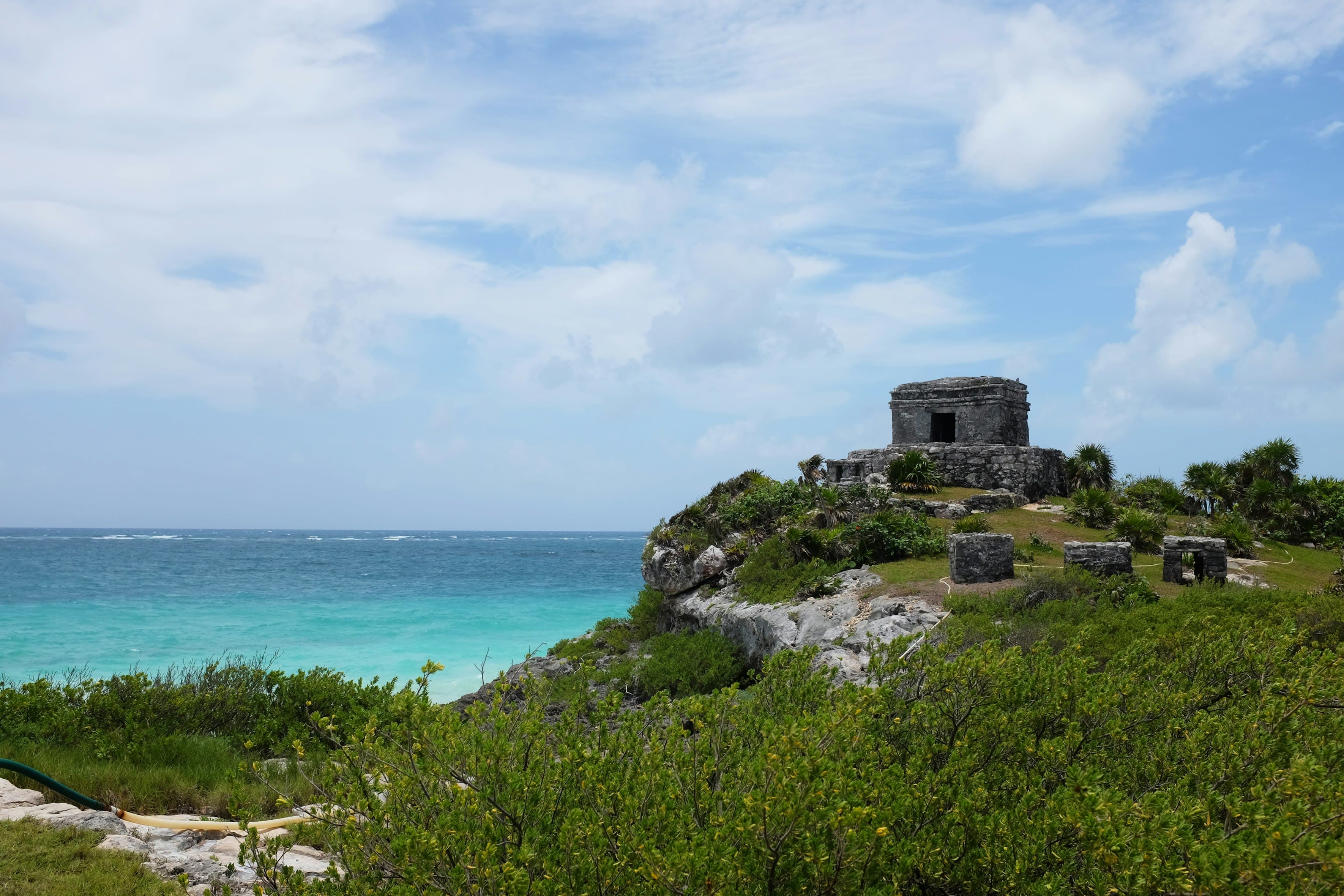
There is no preparation for the first glimpse of El Castillo rising from the cliffs above the Caribbean. The temple stands where the Maya intended it: at the threshold between land and sea, greeting the dawn that gave the city its original name.
Tulum was called Zama by its builders, a word meaning sunrise or dawn in Yucatec Maya. The name was not metaphor but observation, inscription of the city's fundamental orientation toward the light that conquered darkness each morning. For a civilization that read cosmic order in celestial movements, this east-facing position carried profound significance.
The city flourished from the thirteenth through sixteenth centuries, serving simultaneously as trading port and ceremonial center. Canoes laden with obsidian, jade, and cacao navigated through the reef, guided by fires burning atop El Castillo. The same structure that provided practical navigation also housed rituals we can only partially reconstruct, ceremonies honoring a deity found almost nowhere else: the Descending God, depicted diving headfirst toward earth.
That deity remains enigmatic. Scholars connect him to the Bee God Ah Muzen Cab, to the planet Venus, to the setting sun entering the underworld. Perhaps all of these. The four reliefs of the Descending God that mark Tulum's most important buildings suggest a theology centered on descent, on what comes down from above. In a culture that understood cenotes as portals to the underworld, this diving figure may represent the passage between realms.
Today, Tulum draws over two million visitors annually. The crowds can obscure what the Maya saw. But arrive at opening, when light slants across the temples as it has for eight centuries, and something of the original vision becomes accessible. This was a place where worlds met: sea and land, earth and underworld, darkness and light.
Context And Lineage
Tulum was built during the Post-Classic Maya period, flourishing from approximately 1200 to 1550 CE as a walled trading port and ceremonial center. Originally called Zama, the City of Dawn, it faced the rising sun and served as a center for worship of the Descending God. The city survived Spanish contact longer than most Maya sites, finally succumbing to European diseases.
The Maya named this city Zama: dawn, sunrise, the triumph of light over darkness. The name was declaration of purpose, encoding into language what the city's east-facing orientation proclaimed in architecture. Each morning, the sun rose over the Caribbean directly before these temples, and for the Maya this was not merely beautiful but cosmically significant.
The Descending God who presides over Tulum's most important structures remains partially mysterious. One founding narrative connects him to Ah Muzen Cab, the Bee God who gave the sacred stingless bees to the tropical forests. The Maya held these bees in deep reverence, their honey used in ceremonies and their hives tended with care. Another tradition links the Descending God to Venus, the planet whose movements determined timing for warfare and ritual. A third understanding sees the diving figure as the setting sun, entering Xibalba each evening to battle through darkness before emerging victorious at dawn.
Perhaps the Descending God was all of these. The Maya did not reduce their deities to single meanings. What seems clear is that this diving figure represented passage between realms, the movement from above to below that structured Maya cosmology. At Tulum, facing the sunrise, the Descending God marked the sacred geography of a threshold city.
The cenotes near Tulum complete this geography. The Maya word dzonot, from which cenote derives, means sacred well. These openings in the earth were understood as entrances to Xibalba, the underworld where gods and ancestors dwelled. The underground rivers connecting all cenotes were the mythological waters that souls must cross. To build a city here was to build at a gateway.
Tulum's occupation spans nearly a millennium, from the earliest inscription dated 564 CE through the final abandonment after Spanish contact. The visible structures date primarily from 1200 to 1550 CE, when the city served as a major trading hub connecting inland Maya centers with maritime routes along the Caribbean coast.
The city's defensive walls, unusual among Maya sites, suggest the political fragmentation of the Post-Classic period. What had been a unified Maya world was by this time divided into competing city-states. Tulum's fortifications protected trade that connected disparate regions.
After the Spanish arrived in 1518, Tulum survived longer than most Maya cities. Approximately seventy years passed before European diseases finally depopulated the site. Local Maya continued visiting the temples for centuries afterward, maintaining spiritual connection even as the city returned to forest.
Modern archaeological attention began with Stephens and Catherwood in 1843 and intensified through the twentieth century. INAH now manages the site, balancing preservation with the challenges of receiving over two million visitors annually. The infrastructure of contemporary tourism overlays but does not entirely obscure what the Maya built here.
The Descending God
deity
A unique Maya deity depicted diving headfirst, found primarily at Tulum and a few other east coast sites. Associated with bees, Venus, and the setting sun. Four reliefs of this god mark Tulum's most important buildings.
Kinich Ahau
deity
The Sun God, honored by the city's east-facing orientation. Dawn ceremonies at Tulum would have greeted his daily triumph over darkness.
Ixchel
deity
The Moon Goddess, associated with fertility and healing, venerated at Tulum alongside the Descending God. The nearby island of Cozumel was a major pilgrimage destination for her worship.
Chaak
deity
The Rain God, honored at the cenotes near Tulum. Offerings in these sacred waters sought rain and maintained relationship with underworld powers.
Why This Place Is Sacred
Tulum's quality as a thin place derives from its east-facing orientation toward the rising sun, its position on cliffs above the Caribbean where land meets sea, its role as a center for worship of the Descending God, and its proximity to cenotes understood as portals to Xibalba. The city was designed to stand at intersections: of sea and land, of light and darkness, of earthly and underworld realms.
The Maya who built Zama understood orientation as theology. Facing east meant facing the triumph of light over darkness, the daily renewal of Kinich Ahau the Sun God's victory. Each dawn, the first rays would strike the temples, energizing sacred spaces and marking the continuation of cosmic order. This was not symbolism but participation in fundamental reality.
The clifftop setting adds another dimension. Twelve meters above the turquoise Caribbean, Tulum occupies the threshold between land and sea, solid ground and boundless water. For the Maya, the sea was associated with the primordial waters of creation. The site exists at an edge, a meeting point of elemental forces.
The Descending God intensifies this liminal quality. Depicted upside-down, diving headfirst with legs splayed and arms extended, this deity embodies movement between realms. Some scholars connect him to Ah Muzen Cab, the Bee God, whose stingless bees linked the human world to spirit realms. Others see the setting sun descending into Xibalba, the underworld. The diving posture suggests passage, crossing, the act of going between.
Nearby cenotes complete the sacred geography. These natural sinkholes, opening into underground rivers, were understood as portals to Xibalba where gods and ancestors dwelled. Archaeological discoveries of ritual objects and human remains confirm what the Maya believed: these waters connected worlds.
The Temple of the Frescoes encoded cosmic structure in its murals, painted at three levels representing underworld, earthly realm, and heavens. To enter that temple was to enter a model of the universe. Though the murals are now protected from close viewing, their existence reminds visitors that the Maya built their understanding of reality into the walls themselves.
Centuries of pilgrimage and ceremony deposited something at Tulum that visitors still sense. Local Maya continued to visit the temples to burn incense and pray until the late twentieth century. The thread between ancient and contemporary practice never fully broke.
Archaeological evidence indicates Tulum functioned as both trading port and ceremonial center during the Post-Classic period, particularly from 1200 to 1550 CE. The defensive walls on three sides, the harbor accessible through a break in the barrier reef, and the beacon fire atop El Castillo suggest a city deeply engaged with maritime commerce. Simultaneously, the temples, astronomical alignments, and Descending God iconography indicate sustained religious activity. For the Maya, these functions were not separate but integrated dimensions of a city oriented toward cosmic order.
Occupation at Tulum dates to at least 564 CE, based on a carved stela found at the site. The visible structures, however, primarily date from 1200 to 1550 CE. The city remained inhabited for approximately seventy years after Spanish contact in 1518, finally abandoning due to diseases that arrived with the Europeans.
Local Maya maintained spiritual connection to the site even after abandonment, visiting to burn incense and pray through the late twentieth century. This continuity suggests that whatever sacred quality the Maya recognized in this location persisted beyond the political and demographic collapse of the conquest.
Modern rediscovery came through John Lloyd Stephens and Frederick Catherwood's 1843 publication, which brought Tulum to international attention. Archaeological work throughout the twentieth century, particularly by INAH, has preserved and interpreted the site. Today's visitor infrastructure, while necessary for managing over two million annual visitors, inevitably transforms the experience of a place originally designed for entirely different purposes.
Traditions And Practice
No formal ceremonies occur within the Tulum archaeological zone today. However, Maya spiritual practices continue in the broader region, including temazcal purification ceremonies and traditional crafts that preserve ancient knowledge. Visitors seeking ceremonial engagement should look to the surrounding area rather than the ruins themselves.
The Maya of Tulum would have performed dawn ceremonies honoring Kinich Ahau as sunlight first struck the temples. Rituals dedicated to the Descending God took place at his multiple shrines. Offerings to the Bee God reflected the sacred importance of stingless bee cultivation. Astronomical observations at the Temple of the Frescoes tracked the sun and Venus for ceremonial timing. Cenote rituals, at the sacred wells nearby, made offerings to Chaak and communicated with ancestors in Xibalba.
Venus tracking was particularly significant, as the planet's movements determined timing for warfare and important decisions. The Descending God's association with Venus suggests ceremonies timed to its appearances as morning or evening star. The specific nature of these rituals remains a matter of scholarly reconstruction, as no firsthand accounts survive.
While the archaeological zone hosts no formal ceremonies, traditional Maya practices continue in the Yucatan. Temazcal purification ceremonies, ancient sweat lodge rituals considered sacred acts of death and rebirth, are offered at various locations near Tulum. These are authentic traditional practices, not tourist performances, involving entry into a dome-shaped lodge symbolizing the womb of Mother Earth.
Contemporary Maya artisans maintain ceramic and textile traditions that echo ancient designs. Community-led cultural experiences in nearby Maya villages share knowledge of sacred plants, celestial patterns, and healing practices rooted in Maya cosmology. The craft of stingless bee keeping, though diminished, continues among some families.
Local Maya continued visiting Tulum's temples to burn incense and pray through the late twentieth century. Though this practice is not currently documented at the site, it demonstrates the persistence of spiritual connection across the centuries since abandonment.
If ceremony is important to your journey, arrange temazcal experience through reputable operators in the Tulum area. These purification rituals offer authentic engagement with Maya spiritual tradition in appropriate settings outside the archaeological zone.
Within the ruins, approach the site as the Maya intended: oriented toward dawn. Arrive at opening if possible, when the first light falls on temples as it has for eight centuries. Go first to El Castillo and face east, observing how sun and sea and stone relate.
The Descending God invites contemplation wherever you encounter his image. Rather than photographing, spend time with these figures. What might descent mean? What comes down from above? What passages between realms might the diving god represent?
The beach below the cliffs offers embodied connection with waters the Maya held sacred. Swimming there, looking up at the temples, provides a different quality of encounter than merely viewing from above.
Maya Religion (Post-Classic Period)
HistoricalTulum was a major sacred site dedicated to the Descending God, a unique Maya deity found primarily along the east coast. The city served dual functions as trading port and ceremonial center. Originally named Zama, the City of Dawn, its east-facing orientation connected it to the sunrise and the triumph of light over darkness. The Maya venerated the Bee God Ah Muzen Cab, the Moon Goddess Ixchel, and the Sun God Kinich Ahau alongside the Descending God.
Dawn ceremonies honoring Kinich Ahau as first light struck the temples. Rituals dedicated to the Descending God at his multiple shrines. Veneration of the Bee God reflecting the sacred importance of stingless bees. Astronomical observations at the Temple of the Frescoes tracking sun and Venus. Cenote rituals making offerings to Chaak and communicating with ancestors in Xibalba. Venus-tracking for ceremonial and warfare timing.
Contemporary Maya Spirituality
ActiveContemporary Maya communities maintain traditions rooted in the cosmology their ancestors practiced at sites like Tulum. Local Maya continued visiting the temples for prayer and incense burning through the late twentieth century. The broader region maintains living Maya traditions including temazcal ceremonies, traditional crafts, and knowledge of sacred plants and celestial patterns.
Temazcal purification ceremonies continue in the region, ancient sweat lodge rituals involving entry into a dome symbolizing the womb of Mother Earth. Traditional Maya artisans create pottery and textiles echoing ancient designs. Community-led experiences share spiritual significance of local plants and celestial patterns. The landscape of cenotes, jungle, and sea retains sacred meaning.
Experience And Perspectives
Visitors to Tulum consistently report being moved by the dramatic clifftop setting, the turquoise waters below, and the sense of encountering a civilization that integrated the sacred into every aspect of life. Those who arrive at opening, before cruise ship crowds, describe experiences of timelessness and connection that transcend typical tourism.
The visual impact is immediate and persistent: ancient stone against turquoise sea, temples perched on cliffs above a Caribbean beach that seems designed by the same sensibility that positioned the structures. Whatever the Maya intended, the aesthetic effect speaks across cultures and centuries.
Beyond the visual, visitors report subtler responses. A sense of timelessness, as though the usual markers of historical distance have collapsed. The feeling of encountering a civilization that saw no separation between commerce and ceremony, navigation and religion. An intuition that the Descending God, whatever he represented, addressed something still relevant.
The Temple of the Frescoes, with its astronomical alignments and three-level murals, invites contemplation of Maya cosmology. Though the interior is now protected from close viewing, the exterior niches still hold figurines of the Descending God. Looking at that diving figure, visitors often pause. What did the Maya understand about descent that we might have forgotten?
El Castillo draws the eye and the feet. Standing before this structure, positioned exactly where the Maya intended it, visitors look out over the same waters that trading canoes once navigated. The beacon fire that guided those canoes is long extinguished, but the sense of threshold remains. This is where land meets sea, where the known encounters the vast.
The small beach below the cliffs offers a different quality of encounter. Swimming in waters the Maya held sacred, looking up at temples eight centuries old, provides embodied connection that merely viewing cannot. The crowds that gather here on busy days diminish but do not eliminate this effect.
Those who report the deepest experiences almost always mention timing. Arriving at eight in the morning, when the site opens, allows an hour or more before tour buses arrive. The temples in that light, without crowds, permit something closer to what the Maya experienced. The sun that gave the city its name still rises in the east.
Approach Tulum as the Maya intended: oriented toward the east, toward the dawn. If possible, arrive at opening and go first to El Castillo. Stand where the temple faces the Caribbean and notice how light falls on the stone. This orientation was not accidental.
The Descending God appears throughout the site, particularly on the Temple of the Descending God and the Temple of the Frescoes. Rather than photographing these images, spend time with them. What might it mean for a deity to dive headfirst toward earth? What does descent signify that ascent does not?
The cenotes near Tulum, though not within the archaeological zone, complete the sacred geography the Maya recognized. If time permits, visiting Gran Cenote or Cenote Dos Ojos allows encounter with the waters the Maya understood as portals to the underworld. Swimming in those dark pools adds a dimension that the ruins alone cannot provide.
Tulum invites interpretation from archaeological, indigenous, and contemporary spiritual perspectives. Each illuminates different dimensions of what this threshold city meant and continues to mean.
Archaeologists recognize Tulum as a significant Late Post-Classic Maya trading port with remarkable coastal Maya architecture. The defensive walls, unusual among Maya sites, reflect the political fragmentation of the period. The prominence of the Descending God iconography makes Tulum crucial for understanding this particular deity, found primarily along the east coast. The Temple of the Frescoes contains some of the best-preserved Maya mural art.
The city's role as a port for Coba placed it in an extensive maritime trade network spanning the Caribbean coast and Central America. INAH continues archaeological research and conservation, balancing preservation with the challenge of mass tourism.
For contemporary Maya communities, Tulum represents ancestral heritage and continuing cultural connection. Local Maya visited the temples to burn incense and pray through the late twentieth century, demonstrating unbroken spiritual relationship. The cenotes of the region retain sacred significance as portals to the underworld.
Traditional Maya knowledge of celestial patterns, healing plants, and ceremonial practices persists in communities throughout the Yucatan. The site's original name Zama reflects Maya understanding of the sacred dimension of sunrise and the east. The Descending God, whatever his precise identity, addressed realities the Maya considered fundamental.
Contemporary spiritual seekers recognize Tulum's dramatic setting as conducive to contemplation and encounter. The Descending God has invited interpretations related to themes of descent, surrender, and transformation. The site's orientation toward sunrise resonates with those interested in solar symbolism and cycles of renewal.
Energy practitioners are drawn to the cenotes of the region as places of purification and connection to earth energies. These interpretations, while not endorsed by archaeological research, represent genuine contemporary engagement with the site's power.
Significant mysteries remain. What was the complete religious system surrounding the Descending God, and why is this deity found primarily at Tulum and a few other east coast sites? What activities took place outside the walls where most of the population presumably lived? What is the full content of the stela inscription from 564 CE indicating earlier occupation? What undiscovered structures or artifacts may remain in unexplored portions of the site or nearby cenote caves? What specific ceremonies were conducted at the temples, and how did they relate to astronomical observations?
Visit Planning
Tulum is accessible from the Riviera Maya, approximately 130 kilometers south of Cancun. The dry season offers best weather but also largest crowds. Entry fees include multiple charges from different authorities. Early morning arrival is strongly recommended.
Tulum lies in Quintana Roo, approximately 130 kilometers south of Cancun, 65 kilometers south of Playa del Carmen, and 2-3 kilometers east of Tulum town. ADO buses run from Cancun (2 hours), Playa del Carmen (45 minutes), or Tulum town (10 minutes). Colectivo shared vans from Playa del Carmen offer economical transport. Taxis and rental cars are available. Parking at the site costs extra. Entry fees total approximately 515 pesos for foreign visitors, combining charges from Parque del Jaguar, CONANP, and INAH. Mexican nationals receive reduced rates, with free admission on Sundays. Cash payment in Mexican pesos recommended.
Tulum town, 2-3 kilometers west, offers lodging at all price points. The beach zone between town and ruins features boutique hotels and eco-resorts at higher prices. Playa del Carmen and the Riviera Maya provide extensive options. Day trips from Cancun are common but rushed.
Tulum requires practical preparation for tropical conditions and respectful behavior toward archaeological preservation. The site's popularity demands patience with crowds, while its significance asks visitors to engage with more than cameras.
Over two million visitors annually creates an atmosphere quite different from what the Maya experienced. The most important preparation is accepting this reality while still seeking authentic engagement. Arriving at opening, before tour buses, allows an hour or more of relative quiet.
Do not climb on structures. The stones have stood for eight centuries; the pressure of millions of visitors threatens that survival. Stay on designated paths. Photograph mindfully, being conscious of others who also seek something more than snapshots.
The hot, humid climate demands practical preparation. Bring water in a reusable container, as plastic bottles are prohibited on site. Sun protection is essential. Comfortable walking shoes navigate uneven terrain.
Maintain an atmosphere appropriate to what the site meant. Loud conversation and performative behavior for social media diminish the experience for everyone. If you seek what Tulum offered the Maya, create conditions that allow it.
No formal requirements, but dress practically for tropical heat. Comfortable walking shoes are essential for uneven terrain. Bring swimsuit if planning to visit the beach below the ruins. Sun protection: hat, sunscreen, sunglasses.
Personal photography permitted throughout most of the site. Do not use flash inside structures with murals. Tripods, drones, and professional equipment require INAH permits. Be present before being productive; the site will outlast your phone battery.
Physical offerings are not appropriate within the archaeological zone. If you wish to offer something, make it internal: a moment of gratitude, an intention, a silent recognition of what the Maya built here.
Do not climb on any structures. Stay on designated paths. Do not touch murals or carved reliefs. Plastic water bottles prohibited; bring reusable container. No food in the archaeological zone. Respect the 3:30 PM last entry time. The site is not wheelchair accessible throughout.
Sacred Cluster
Nearby sacred places create the location cluster described in the growth plan. This block is intentionally crawlable and links into the wider regional graph.