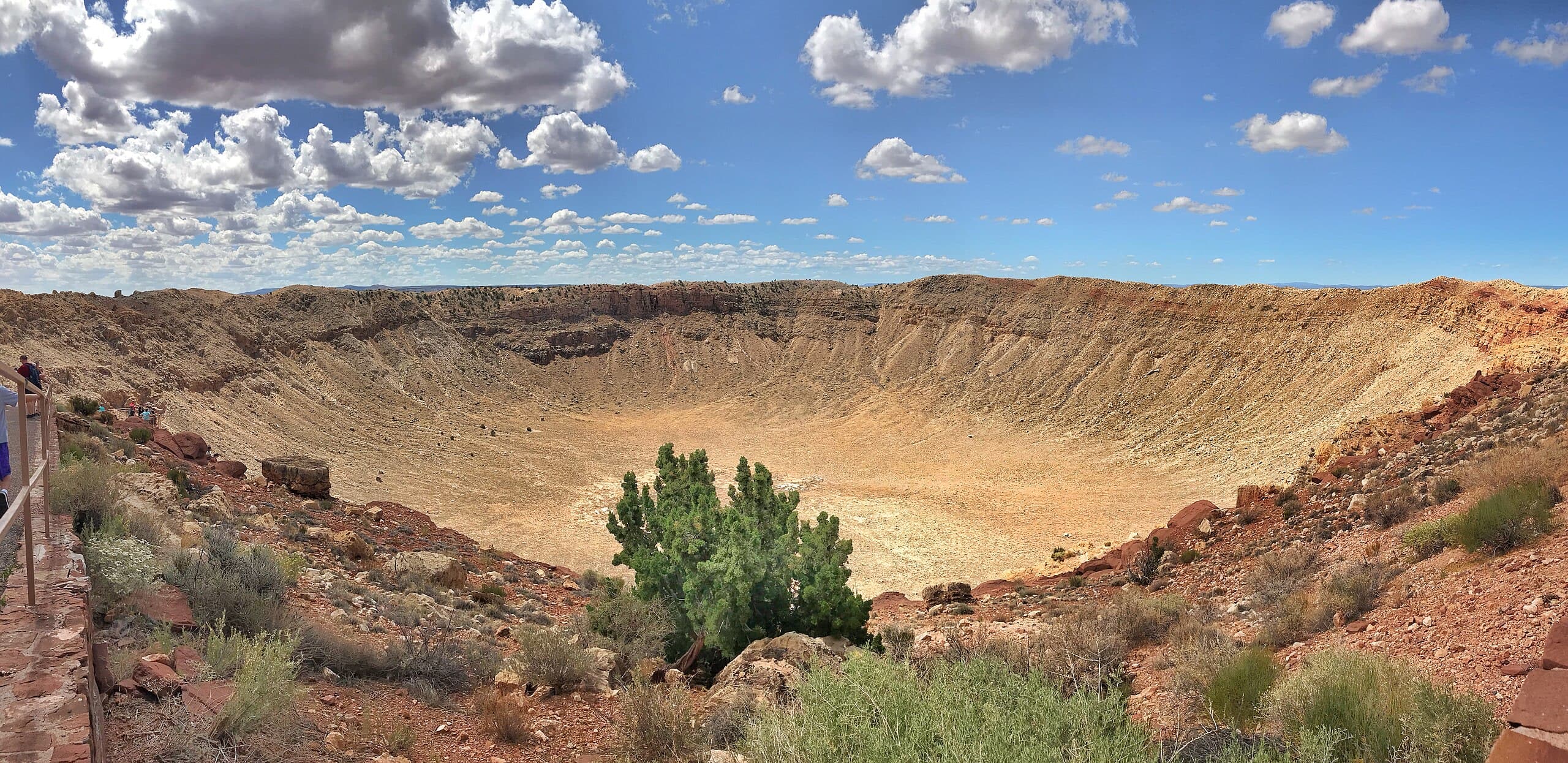
Meteor Crater, Arizona
Where a piece of the cosmos struck the earth and left a wound that still speaks
Coconino County, Arizona, United States
At A Glance
- Coordinates
- 35.0307, -111.0234
- Suggested Duration
- Most visitors spend 1.5 to 2 hours, which allows time for the museum, observation decks, film presentation, and optional guided rim tour. Visitors seeking a more contemplative experience should budget additional time for sitting at the rim.
- Access
- Located off Interstate 40, approximately 37 miles (60 km) east of Flagstaff and 18 miles (29 km) west of Winslow, Arizona, at Exit 233. The visitor center and some observation areas are wheelchair accessible. No public transportation serves the site — a personal vehicle is required. Admission fee applies. Mobile phone signal is generally available at the visitor center and rim areas.
Pilgrim Tips
- Located off Interstate 40, approximately 37 miles (60 km) east of Flagstaff and 18 miles (29 km) west of Winslow, Arizona, at Exit 233. The visitor center and some observation areas are wheelchair accessible. No public transportation serves the site — a personal vehicle is required. Admission fee applies. Mobile phone signal is generally available at the visitor center and rim areas.
- No special dress requirements. Comfortable walking shoes recommended for the rim trail. Sun protection is essential — hat, sunscreen, and water. The high desert is exposed and temperatures can be extreme, particularly in summer.
- Photography is permitted from the rim and observation decks. The crater photographs well in morning light when shadows define the walls. Binoculars enhance the experience of studying the far rim and crater floor details.
- Walking into the crater is strictly prohibited for both safety and preservation reasons. Do not remove any rocks or materials from the site. The crater is privately owned, and all access requires paid admission. No overnight visits or camping are permitted.
Overview
Fifty thousand years ago, a nickel-iron meteorite crossed the boundary between space and earth, excavating a crater nearly a mile wide in the Arizona high desert. Meteor Crater remains the best-preserved impact site on the planet, a place where the abstract violence of the cosmos becomes immediate, tangible, and strangely intimate. Standing at the rim, the scale forces a recalibration of perspective that photographs cannot prepare you for.
Nothing in the landscape warns you. The Colorado Plateau stretches flat and dry in every direction, scrubbed by wind, emptied of distraction. Then the ground falls away.
The crater is 1,200 meters wide and 170 meters deep, and every measurement fails to convey what the eye absorbs in the first seconds at the rim. This is not erosion, not volcanism, not the slow work of water. This happened in an instant. Approximately 50,000 years ago, a meteorite roughly 50 meters across struck here at 12.8 kilometers per second, releasing energy equivalent to ten megatons of TNT and displacing 175 million tons of rock. The air above the impact point reached temperatures hotter than the surface of the sun.
What remains is a scar. But scar is too passive a word for something this deliberate-looking, this geometric. The crater sits in the desert like a statement — a place where the boundary between planetary and interstellar was breached, briefly and catastrophically. Geologists come here to study impact dynamics. Apollo astronauts trained here before walking on the Moon. Indigenous peoples of the region recognized the site within their own cosmologies, though the specifics of that recognition remain debated by scholars.
The crater asks a simple question: what does it mean to live on a planet that exists within a cosmos capable of this? For a moment at the rim, the question is not theoretical. It lands in the body.
Context And Lineage
Meteor Crater was formed approximately 50,000 years ago by a nickel-iron meteorite impact. First scientifically described in 1891, it became the subject of decades of debate between volcanic and impact origin theories. Eugene Shoemaker's 1960 proof of impact origin established the field of impact cratering science. The site was designated a National Natural Landmark in 1967 and has been recognized as an IUGS Geoheritage Site.
The Canyon Diablo meteorite was a fragment of an asteroid, composed primarily of iron and nickel, roughly 50 meters in diameter. It had been orbiting the sun for perhaps four billion years. Approximately 50,000 years ago, its orbit intersected with Earth's. It entered the atmosphere at roughly 12.8 kilometers per second — about 28,600 miles per hour — and struck the Colorado Plateau with a force equivalent to ten megatons of TNT.
The impact vaporized much of the meteorite itself, excavated 175 million tons of rock, and created a crater 1,200 meters wide and 170 meters deep. The shockwave flattened everything within several miles. Temperatures at the impact point briefly exceeded those on the surface of the sun. In the silence that followed, dust settled over a landscape permanently altered.
Some Navajo oral tradition describes a star falling from the sky and creating a great hole in the earth, interpreted as a warning from the heavens. Some sources report a Hopi narrative of three gods descending in fiery chariots, one landing at this site, though the antiquity and authenticity of this specific tradition have been questioned by scholars. What is certain is that the peoples of this landscape lived with the crater's presence for thousands of years before Euro-American science arrived to explain it.
The crater has passed through successive frames of understanding. For indigenous peoples, it existed within cosmologies that recognized the significance of celestial events touching the earth. For Euro-American settlers, it was a geological curiosity attributed to volcanism. For Barringer, it was a potential mining bonanza. For Shoemaker, it was proof that the solar system is a dynamic and sometimes violent place. For Apollo astronauts, it was a rehearsal space for the Moon. Each frame adds a layer without erasing what came before.
Daniel M. Barringer
historical
Mining engineer who first proposed in 1903 that the crater was formed by meteorite impact rather than volcanic activity. He spent 26 years and much of his fortune attempting to locate the main body of the meteorite for mining. He was right about the origin but wrong about the meteorite surviving intact. His family still owns the crater.
Eugene Shoemaker
historical
Planetary scientist who confirmed the impact origin in 1960 by identifying coesite and stishovite, minerals formed only under extreme impact pressures. He later trained Apollo astronauts at the crater. After his death in 1997, a portion of his ashes was carried to the Moon aboard Lunar Prospector — the first human remains deposited on another world.
Grove Karl Gilbert
historical
Chief geologist of the U.S. Geological Survey who investigated the crater in 1891 and concluded, incorrectly, that it was volcanic in origin. His error set back recognition of the impact origin by decades and illustrates how scientific orthodoxy can resist evidence that challenges existing frameworks.
Albert E. Foote
historical
Mineralogist who presented the first scientific paper about meteorites from the site in 1891, noting the presence of diamonds in the Canyon Diablo meteorite fragments — the first discovery of diamonds in a meteorite.
Why This Place Is Sacred
Meteor Crater's thinness operates differently from most sacred sites. Rather than accumulated human intention or centuries of prayer, the quality here derives from direct contact between cosmic and terrestrial realms. A piece of the universe struck the earth, and the evidence is visible, walkable, undeniable. The abstraction of living on a planet in space collapses into physical fact.
Most thin places become thin through human activity — centuries of prayer, ritual, pilgrimage. Meteor Crater reverses the pattern. The thinness here precedes humanity entirely. It is geological, cosmological, written in displaced rock and shattered minerals.
The Canyon Diablo meteorite arrived from the asteroid belt, a fragment of iron and nickel that had orbited the sun for billions of years before its trajectory intersected with Earth's. The collision created pressures sufficient to transform quartz into coesite and stishovite — minerals that form only under conditions of extraordinary violence. These minerals, identified by Eugene Shoemaker in 1960, provided the first definitive proof that the crater was formed by extraterrestrial impact rather than volcanic activity.
Standing at the rim, you are looking at a place where the cosmos made itself visible. Not symbolically, not through revelation or meditation, but through brute physical contact. The iron fragments scattered across the surrounding desert — Canyon Diablo meteorites, collected for over a century — are pieces of another world that you can hold in your hand.
The Hopi and Navajo peoples of the region appear to have recognized something significant about this site, though scholarly analysis of specific oral traditions remains contested. Some sources report that Hopi people gathered finely ground white silica from the crater for ceremonial use, and that Navajo people regarded the meteorite iron as sacred sky metal. Whether or not specific origin stories about the crater predate European contact, the physical reality they respond to is the same reality visitors encounter today: a visible point of contact between earth and sky, between the human-scale world and forces that dwarf it.
For millennia, the crater existed within the landscape knowledge of the peoples who inhabited the Colorado Plateau. The Navajo name, Adah Hosh'ani, translates descriptively as 'many cacti descending from a height,' suggesting practical familiarity with the terrain. When Euro-American settlers encountered the site in the 1870s, they initially attributed it to volcanic activity. Daniel Barringer's 1903 proposal that a meteorite had formed the crater was controversial for decades, and the impact origin was not confirmed until Shoemaker's mineralogical proof in 1960.
The site's meaning shifted again in the 1960s when NASA selected it as a training ground for Apollo astronauts. The crater became a bridge between earthbound humanity and the lunar surface — astronauts who walked the rim later walked on the Moon. Today it operates as a privately owned visitor attraction, but for reflective visitors, the site continues to function as something more: a place where cosmic scale becomes personal.
Traditions And Practice
Meteor Crater operates as a commercial visitor attraction, not an active ceremonial site. No organized spiritual programs are offered. However, the site's capacity to shift perspective and provoke contemplation of cosmic scale offers its own form of practice for reflective visitors.
Some sources report that Hopi people historically gathered finely ground white silica from the crater for ceremonial use, and regularly visited golden eagle nests on the rim. Navajo people reportedly regarded the Canyon Diablo meteorite iron as sacred sky metal. Archaeological evidence from the nearby Camp Verde site includes a Canyon Diablo meteorite fragment wrapped in a feather blanket within a burial context, suggesting ceremonial significance of the meteorite material. However, academic analysis questions whether some traditions specifically linking the crater to Hopi emergence mythology were fabricated or misappropriated by early 20th century promoters.
No publicly documented indigenous ceremonies take place at the crater today. The site functions as a geological education center, with guided rim tours, museum exhibits, and a theater presenting the impact story. Scientific researchers continue to visit for field study, maintaining a tradition of inquiry that has been active since the 1890s.
Stand at the rim in the first minutes after arriving, before reading any plaques or entering the museum. Let the scale arrive on its own terms. The cognitive experience of absorbing the crater's dimensions without explanation is itself a form of encounter with the unknown.
If the guided rim trail is available, walk it slowly. Notice how the crater's appearance shifts from different vantage points — the floor looks closer from some angles, more remote from others. Pay attention to the exposed rock strata in the walls, each layer representing millions of years of accumulated earth history overturned in a single second.
Before leaving, spend a few minutes looking outward from the rim rather than into the crater. The flat desert extending to the horizon in every direction is the context in which this event occurred. The ordinariness of the surrounding landscape makes the crater's violence more, not less, profound.
Hopi
HistoricalSome sources report that Hopi people gathered finely ground white silica from the crater for ceremonial use and regularly searched for golden eagle nests on the rim. A tradition describes three gods descending from clouds in fiery chariots, one striking this location. However, peer-reviewed analysis by Hamacher (2020) questions whether these traditions are authentic or were fabricated by early 20th century promoters. The commonly cited Sipapu association conflicts with established Hopi tradition placing the primary Sipapu at the Grand Canyon.
Ceremonial silica gathering from the crater (historically reported but not well-documented by tribal authorities). Golden eagle nest visits on the crater rim (historically reported). No publicly documented active ceremonies at the site today.
Navajo (Dine)
HistoricalThe Navajo name for the crater, Adah Hosh'ani, translates as 'many cacti descending from a height' — a descriptive rather than explicitly sacred designation. However, Navajo oral tradition does describe a star falling from the sky and creating a great hole, interpreted as a warning from the heavens. The meteorite iron was reportedly considered sacred and concealed from outsiders. Archaeological evidence from the nearby Camp Verde site confirms ceremonial treatment of Canyon Diablo meteorite material.
Reverence for meteorite iron as sky metal, with reported concealment from outsiders. Oral storytelling tradition about the crater's formation. No publicly documented active ceremonies at the site today.
Scientific and Geological Heritage
ActiveMeteor Crater is the best-preserved and most studied simple meteorite impact crater on Earth. It was the first geological structure confirmed to have formed by extraterrestrial impact, making it foundational to the field of impact cratering science. Its use as an Apollo astronaut training ground connects terrestrial geology with space exploration. The site is recognized as a U.S. National Natural Landmark and an IUGS Geoheritage Site.
Ongoing geological and planetary science research. Educational programs through the Barringer Space Museum. Scientific field study access maintained by the Barringer Crater Company. The site continues to serve as a reference standard for impact cratering studies worldwide.
Experience And Perspectives
Visitors consistently report that the crater's scale exceeds expectation. Photographs flatten the depth and width into something manageable; standing at the rim undoes that. The most common response is a recalibration of perspective — a felt sense of the planet's vulnerability and the vastness of the forces that act upon it.
The first moment at the rim is the one that matters. You have driven across flat desert, perhaps for hours. The visitor center offers context — museum exhibits, a film, geological displays. None of it prepares you for the rim.
The drop is immediate and the scale is wrong. Your eye expects a canyon, a valley, something shaped by familiar forces. Instead, the walls fall away in a nearly circular bowl, the floor littered with boulders that look small from this height but stand taller than a person. The far rim, three-quarters of a mile away, appears close and impossibly distant at the same time.
Visitors describe awe, but not the pleasant awe of a sunset. Something more disorienting. The realization that this happened in a single second — that 50,000 years of wind and rain have barely softened the edges — forces the mind to reckon with timescales and energies that ordinary life holds at a comfortable distance. Some visitors report feeling very small, and then, paradoxically, feeling that smallness as a kind of relief.
The Apollo connection adds a layer for those who know it. Eugene Shoemaker trained astronauts here to recognize impact features they would later encounter on the Moon. His ashes, carried aboard the Lunar Prospector, were the first human remains deposited on another world. Standing where he worked, looking at the same walls he studied, the line between Earth and space thins in a different way — not through impact but through human reaching.
Walk the guided rim trail if it is offered during your visit. The shifting perspective — the crater's appearance changes significantly from different points along the rim — rewards the effort. If you are drawn to contemplation, find a spot where other visitors are not gathered and simply look. Let the scale settle into your body without narrating it. The crater does not need interpretation; it needs time.
If you have binoculars, use them to study the far wall. The layers of geological strata exposed by the impact tell 250 million years of Earth's history in a single cross-section. The overturned rim — layers flipped upside down by the explosion — is visible evidence that the ordinary rules were suspended here, violently and completely.
Meteor Crater sits at the intersection of geological science, contested indigenous tradition, and the human encounter with cosmic scale. Each perspective illuminates something the others miss, and honest engagement with the site requires holding them together without forcing resolution.
Scientific consensus is unambiguous about the crater's origin: it was formed approximately 50,000 years ago by the impact of a nickel-iron meteorite. The site's significance to planetary science is immense — it was the first geological structure confirmed to have formed by extraterrestrial impact, and its study established the field of impact cratering science.
The scholarly picture becomes more complex regarding indigenous traditions. Hamacher's 2020 peer-reviewed analysis in the Journal of Astronomical History and Heritage examines whether oral traditions attributed to the Hopi and Navajo about the crater's formation were authentic or were fabricated by early 20th century promoters seeking to bolster Barringer's impact hypothesis. The commonly cited association with the Hopi concept of Sipapu, in particular, conflicts with established Hopi tradition placing the Sipapu at the Grand Canyon. Archaeological evidence does confirm indigenous use of Canyon Diablo meteorite material in ceremonial contexts, but direct evidence of the crater itself being a major sacred site is limited.
Some sources report that Hopi people recognized the crater within their cosmology, gathering white silica for ceremonial purposes and visiting golden eagle nests on the rim. Navajo oral tradition describes a star falling from the sky and creating a great hole — a warning from the heavens. The Navajo word for the meteorite iron, pish le gin e gin, suggests recognition of its extraterrestrial origin, and its reported concealment from outsiders implies sacred status.
These accounts deserve respect without inflation. The indigenous peoples of the Colorado Plateau lived with this landscape feature for thousands of years and undoubtedly incorporated it into their understanding of the world. The precise nature and antiquity of specific traditions remain matters of legitimate scholarly debate.
Popular spiritual and travel literature sometimes describes Meteor Crater as a Sipapu — a Hopi portal between worlds — or attributes special energy properties to the site due to the cosmic impact. Some New Age sources frame the crater as an energy vortex, drawing on the broader Sedona-area metaphysical tourism culture.
These interpretations should be approached with significant caution. The Sipapu association conflicts with established Hopi tradition. Claims about the crater's energy properties lack empirical basis. However, the impulse behind such claims — the sense that a place where the cosmos physically touched the earth carries significance beyond the geological — is understandable and perhaps worth separating from the specific frameworks used to express it.
Several genuine mysteries persist. Whether pre-contact oral traditions about the crater's formation existed and have been accurately transmitted remains an open question. The full extent of ceremonial use of Canyon Diablo meteorite material by indigenous peoples is incompletely documented. Perhaps most intriguingly, whether the impact event itself was witnessed by Paleo-Indians — Clovis-era artifacts have been found nearby, but precise dating relative to the impact remains uncertain. If humans did witness the event, no confirmed tradition of that witnessing has survived the intervening millennia.
Visit Planning
Meteor Crater sits off Interstate 40 between Flagstaff and Winslow, Arizona. It is privately owned, requiring paid admission. Most visits take 1.5 to 2 hours. Spring and autumn offer the most comfortable temperatures. A personal vehicle is required as no public transportation serves the site.
Located off Interstate 40, approximately 37 miles (60 km) east of Flagstaff and 18 miles (29 km) west of Winslow, Arizona, at Exit 233. The visitor center and some observation areas are wheelchair accessible. No public transportation serves the site — a personal vehicle is required. Admission fee applies. Mobile phone signal is generally available at the visitor center and rim areas.
No accommodations at the site. Winslow (18 miles east) and Flagstaff (37 miles west) offer full lodging options. Flagstaff provides greater variety and serves as a base for exploring several nearby sacred and natural sites. No campground is associated with the crater.
Meteor Crater is a commercially operated geological attraction. Etiquette centers on preservation rather than religious protocol. Stay on designated trails, do not remove materials, and respect the site's scientific and cultural significance.
The site does not require the reverence appropriate to active worship. It does require the respect appropriate to a 50,000-year-old geological formation that has taught humanity fundamental truths about the cosmos. Stay on designated paths and observation areas. The rim trail offers changing perspectives that reward patience.
The site holds contested significance for indigenous peoples of the region. While the specific nature of that significance is debated among scholars, visitors should approach the site's indigenous associations with intellectual honesty rather than romanticizing or dismissing them. If you encounter references to the crater as a Hopi Sipapu or portal between worlds, know that this association is popular in travel literature but contested by scholars — the primary Hopi Sipapu is traditionally located at the Grand Canyon.
No special dress requirements. Comfortable walking shoes recommended for the rim trail. Sun protection is essential — hat, sunscreen, and water. The high desert is exposed and temperatures can be extreme, particularly in summer.
Photography is permitted from the rim and observation decks. The crater photographs well in morning light when shadows define the walls. Binoculars enhance the experience of studying the far rim and crater floor details.
Not applicable. The site operates as a commercial visitor attraction.
Walking into the crater is prohibited. Pets must remain on leash outdoors and are not permitted in the visitor center. Stay on designated trails and observation areas. No removal of rocks or materials. No camping or overnight access.
Sacred Cluster
Nearby sacred places create the location cluster described in the growth plan. This block is intentionally crawlable and links into the wider regional graph.