Winchester Cathedral
The longest medieval cathedral in the world, where Saxon kings rest and Jane Austen lies
Winchester, England, United Kingdom
At A Glance
- Coordinates
- 51.0607, -1.3132
- Suggested Duration
- 2-3 hours to include crypt, exhibition, and guided tour
Pilgrim Tips
- Respectful attire appropriate for a cathedral. No specific requirements.
- Permitted for personal use in most areas. Be discreet during services. Commercial photography requires permission.
- Entry fee charged. Check for closures due to special services. Photography restrictions may apply in specific areas.
Overview
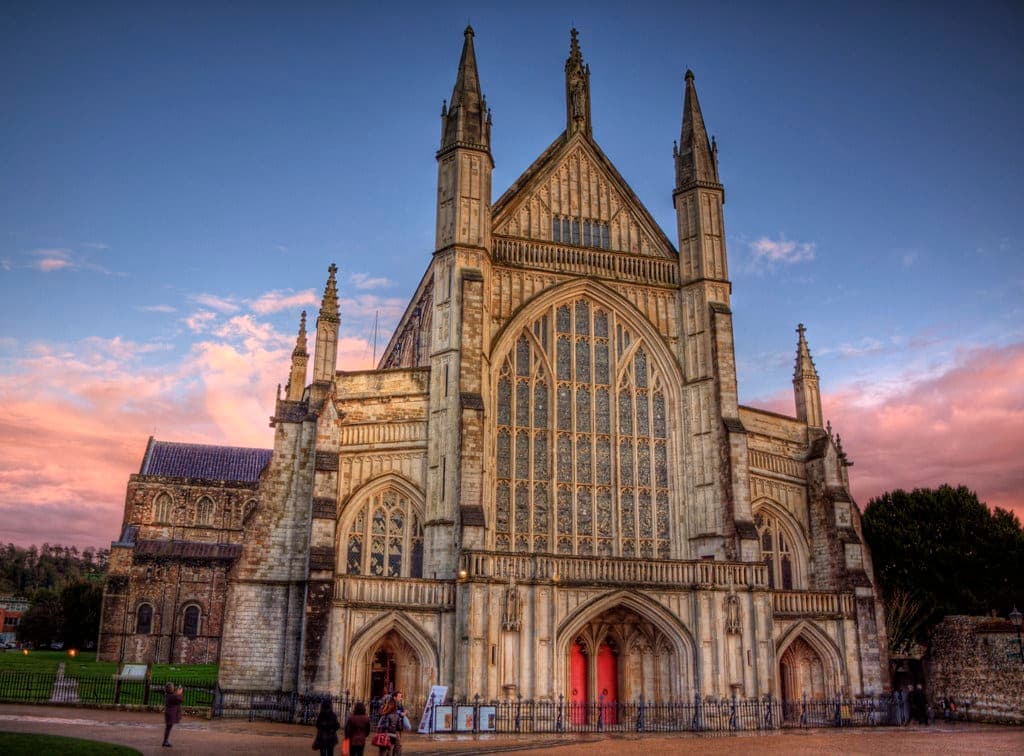
At 558 feet, Winchester Cathedral stretches further than any medieval church in the world. Within its walls, Saxon bishops established Christianity, medieval pilgrims sought St Swithun's shrine, and Jane Austen found her final rest. The Norman transepts have stood since 1093; the Perpendicular nave stretches through 12 bays of stone-ribbed vaulting. In the early 1900s, a deep-sea diver named William Walker worked underwater for six years to save the sinking building. Today, pilgrims still arrive—walking the ancient route to Canterbury or seeking a novelist's grave.
The first thing you notice is the length. Winchester Cathedral stretches 558 feet from west door to retrochoir, making it the longest medieval cathedral in the world. The nave alone runs through 12 bays of Perpendicular Gothic arches, its vaulted ceiling a stone sky that seems to recede into infinity. This is architecture as assertion: Norman conquest, medieval piety, and English endurance compressed into limestone. Bishop Walkelin began building in 1079, nine years after William the Conqueror installed him as the first Norman bishop. He built on a site already sacred—Winchester had been a bishop's see since 662, home to St Swithun whose cult would draw pilgrims for centuries. The Norman transepts and tower still stand, the crypt still holds water as it did when the building was new. But the cathedral has been transformed repeatedly. William of Wykeham encased the Norman nave in Perpendicular Gothic in the 14th century. Chantry chapels proliferated; bishops wanted to be buried near Swithun. Then the Reformation came, and in 1538 commissioners destroyed the shrine, scattering the saint's bones. The cathedral survived, adapted, accumulated. Mortuary chests hold the bones of Saxon kings. The Winchester Bible, illuminated in the 12th century, remains one of the finest surviving medieval manuscripts. Jane Austen was buried in the north aisle in 1817, her grave now a pilgrimage destination for literary visitors. And in the early 1900s, when the waterlogged foundations threatened collapse, diver William Walker worked underwater for six years to save what 900 years had built. His statue stands near the door, testament that buildings survive because people choose to save them.
Context And Lineage
Bishop's see since 662. Norman cathedral begun 1079 by Bishop Walkelin. St Swithun's shrine destroyed 1538. William Walker saved the sinking cathedral 1906-1911.
Winchester was one of Anglo-Saxon England's most important cities, its bishop one of the kingdom's most powerful churchmen. The see was established by 662, and St Swithun served as bishop from around 852 until his death in 862. He asked to be buried outside the church where rain could fall on him. In 971, his remains were translated inside. According to legend, it rained for 40 days, giving rise to the July 15 superstition. After the Norman Conquest, William the Conqueror installed his kinsman Walkelin as bishop. In 1079, Walkelin began a vast new cathedral just south of the Old Minster. By 1093, the building was ready for consecration; the Old Minster was immediately demolished. St Swithun's remains were transferred to the new building, and pilgrimage resumed. The shrine became one of medieval England's most visited. But the cathedral's most dramatic chapter came in the 20th century. The waterlogged chalk foundations were sinking. Pumping out water caused further instability. The building seemed doomed. Then diver William Walker began working underwater in the flooded trenches around the foundations. For six years, up to six hours a day, he placed bags of concrete—over 25,000 in total. He saved the cathedral, and his statue stands as testimony.
Winchester belongs to the tradition of English cathedral churches, but its exceptional length and the concentration of historical significance set it apart. The Perpendicular nave transformation by William of Wykeham influenced cathedral architecture across England.
St Swithun
Bishop Walkelin
William of Wykeham
Jane Austen
William Walker
Why This Place Is Sacred
The sheer scale of the cathedral creates its own atmosphere, while layered history—Saxon bishops, Norman builders, medieval pilgrims, literary visitors—accumulates into something that exceeds any single narrative.
What creates the particular quality of Winchester Cathedral? Perhaps scale itself. The nave's 12 bays draw the eye toward a distant choir screen, the vaulting lifting attention upward and forward simultaneously. You walk through space that was designed to humble, to make human concerns small against divine magnitude. The Norman builders understood this; their successors in the 14th century enhanced it. But scale alone cannot explain what visitors report. The accumulated layers matter too. In the crypt, Norman stonework holds water that seeps up from the chalk beneath—the same water that nearly destroyed the cathedral before William Walker's intervention. The mortuary chests ranged above the choir claim to hold the bones of Saxon kings: Egbert, Ethelwulf, Cnut. Their bones were scrambled by Parliamentarian soldiers in the Civil War, so no one knows precisely whose remains are whose. This confusion of royal bones becomes its own meditation. St Swithun's shrine is gone, destroyed in 1538, but the retrochoir where pilgrims approached still exists. You can walk the same path, even if the destination has been erased. Jane Austen's grave in the north aisle draws a different kind of pilgrim—literary rather than religious, though the distinction may be less clear than it seems. The devotion that brings visitors to a novelist's stone shares something with the devotion that brought medieval pilgrims to a saint's bones. Winchester holds all these visitors, all these purposes, within one impossibly long building.
Cathedral church and site of St Swithun's shrine, designed for both diocesan worship and pilgrimage.
Bishop's see from 662. Old Minster replaced by Norman cathedral 1079-1093. Perpendicular nave 14th century (William of Wykeham). Chantry chapels 15th-16th centuries. St Swithun's shrine destroyed 1538. Foundation crisis and William Walker's repair 1906-1911. Ongoing restoration and use as active cathedral.
Traditions And Practice
Active Anglican cathedral with daily services including Evensong. Starting point for Pilgrim's Way to Canterbury. Literary pilgrimage to Jane Austen's grave.
Medieval pilgrims approached St Swithun's shrine through the retrochoir, their journey through the building a ritual progression. The July 15 superstition about rain derives from the translation of his relics. The chantry chapels reflect medieval practice of praying for the dead.
Daily services including Evensong (typically 5:30pm weekdays). Sunday services. Special services for major feasts. Concerts and cultural events. The cathedral is the starting point for the Pilgrim's Way to Canterbury. Jane Austen's grave draws literary pilgrims, particularly around July 18 (anniversary of her death).
Attend Evensong to experience the cathedral in its intended liturgical use. The voices rising in the choir, the light fading through medieval glass, the congregation scattered through the vast nave—this is what the building was made for. Afterwards, explore the retrochoir where pilgrims approached Swithun's shrine. Visit the crypt if water levels allow. Pay respects at Jane Austen's grave. Find William Walker's statue and consider what it means that one man's effort saved 900 years of building.
St Swithun cult
HistoricalSt Swithun was Bishop of Winchester (died 862). His shrine made the cathedral a major medieval pilgrimage destination. The July 15 superstition about rain derives from the 971 translation of his relics.
Medieval pilgrims approached the shrine through the retrochoir. Miracles were reported. The shrine was destroyed in 1538, bones scattered.
Anglican cathedral worship
ActiveSince the Reformation, Winchester has been the cathedral of the Diocese of Winchester. Daily services continue the liturgical tradition.
Daily services including Evensong. Sunday worship. Special services for major feasts. Concerts and cultural events.
Literary pilgrimage
ActiveJane Austen's burial in the north aisle (1817) has made the cathedral a destination for literary visitors.
Visitors come to see her grave. The anniversary of her death (July 18) draws particular attention. The cathedral hosts related events.
Experience And Perspectives
Enter through the west door and the nave opens before you, 12 bays stretching toward the distant choir. The length itself creates the experience.
You enter through the west door and the cathedral opens before you. The nave stretches away, arcade and triforium and clerestory rising in three tiers, the Perpendicular vaulting drawing lines toward the choir screen distant at the east. The scale requires time to comprehend. You begin walking, and the space continues. Twelve bays pass before you reach the crossing where Norman transepts extend north and south, largely unchanged from the 11th century. The tower rises above, its proportions different from the Gothic nave—heavier, more solid, Norman weight against Perpendicular verticality. Continue east into the choir and retrochoir. Here medieval pilgrims approached St Swithun's shrine, their journey through the building a ritual progression. The shrine itself is gone, destroyed in 1538, but the space it occupied still exists. Above the choir stalls, mortuary chests ranged on screens claim to hold Saxon kings. The chantry chapels that line the retrochoir speak of individual ambition: bishops who wanted burial near the saint, their tombs elaborate declarations of status even in death. Jane Austen lies in the north aisle, her grave marked by a stone that originally did not mention her novels. A later brass was added; her fame required recognition. Visitors gather there, some in reverence, some in literary pilgrimage, some simply curious about the modest stone. Below everything lies the Norman crypt, one of the largest in England. It regularly floods—the water that nearly destroyed the cathedral still rises through the chalk. A sculpture by Antony Gormley stands in the water when levels allow. The duality captures Winchester's character: ancient solidity threatened by what lies beneath, saved only by human effort.
Enter through the west door. The nave stretches east to the choir screen. Beyond lies the choir and retrochoir with chantry chapels. Jane Austen's grave is in the north aisle. The crypt is accessible via stairs. The tower and north transept hold the Norman architecture most clearly.
Winchester Cathedral exists at the intersection of architectural ambition, royal history, medieval pilgrimage, literary significance, and engineering heroism.
The cathedral's architectural evolution from Norman to Perpendicular Gothic is well-documented. The crypt and transepts preserve the 11th-century building; the nave transformation under William of Wykeham (14th century) is a significant example of perpendicular style. The Winchester Bible ranks among the finest 12th-century illuminated manuscripts. St Swithun's cult and the medieval pilgrimage are extensively studied. William Walker's foundation work (1906-1911) is celebrated as engineering achievement.
For Anglican Christians, Winchester remains a living cathedral with daily worship. The Evensong tradition continues the liturgical life that has sustained the building since its Anglo-Saxon origins. The starting point of the Pilgrim's Way to Canterbury connects Winchester to England's most famous pilgrimage route.
Some note Winchester's pre-Christian significance as a Roman town (Venta Belgarum). The concentration of Saxon royal burials suggests the site's importance predated Christianity. Ley line theories place the cathedral at significant intersections. The flooding crypt invites interpretation about water, earth, and the sacred.
The full contents of the mortuary chests remain uncertain after Civil War disturbance. The location of St Swithun's scattered bones is unknown. Earlier structures beneath the cathedral have not been fully explored. Whether any artifacts from the medieval pilgrimage survive is unclear.
Visit Planning
City center cathedral with entry fee. Open daily except during special services. Guided tours included in admission. Starting point for Pilgrim's Way.
Winchester offers various hotels, B&Bs, and guesthouses. The cathedral city is a popular destination and accommodation should be booked in advance for peak periods.
Active cathedral welcoming visitors. Entry fee charged. Respectful behavior expected throughout.
Winchester Cathedral is a place of worship first, a heritage attraction second. Visitors are welcome, but the building continues to function as it has for nearly a millennium. Enter quietly. If a service is in progress, either join it or explore areas away from the congregation. Photography is generally permitted for personal use but be discreet during services. The silence that settles in the nave between services is part of the experience; preserve it for others.
Respectful attire appropriate for a cathedral. No specific requirements.
Permitted for personal use in most areas. Be discreet during services. Commercial photography requires permission.
Entry fee charged. Additional donations welcome. Gift shop available.
May close for special services or events. Quiet and respectful behavior expected throughout.
Sacred Cluster
Nearby sacred places create the location cluster described in the growth plan. This block is intentionally crawlable and links into the wider regional graph.