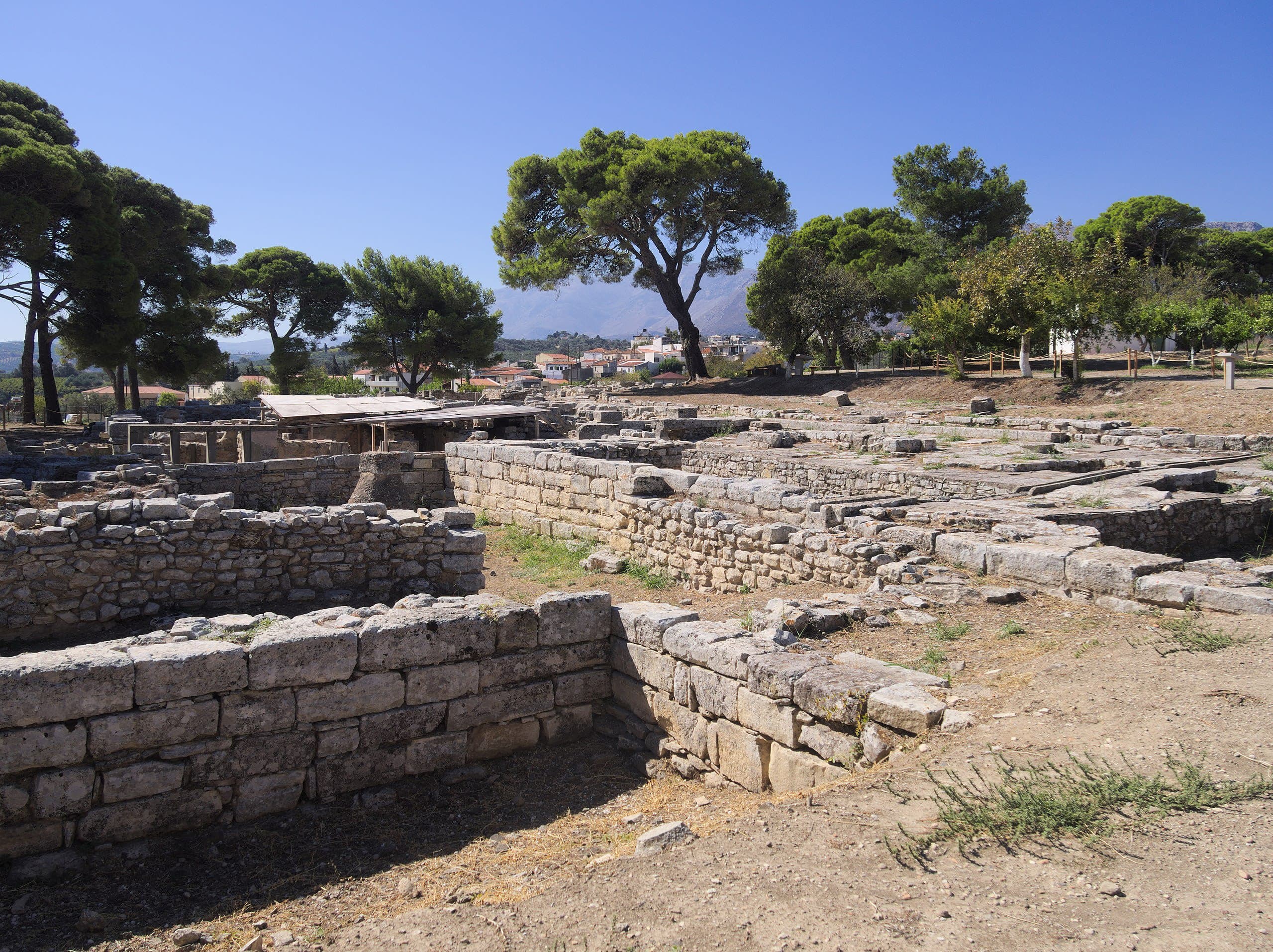
Tylissos Minoan Temple
Three Minoan villas where bronze hands still reach toward the gods in frozen prayer
Tylissos Municipal Unit, Region of Crete, Greece
At A Glance
- Coordinates
- 35.2983, 25.0202
- Suggested Duration
- Forty-five minutes to an hour for the villa complex itself. Allow additional time for wandering through the modern village, which directly overlays the ancient settlement and preserves the sense of temporal layering that makes Tylissos distinctive. A visit to the Heraklion Archaeological Museum to see the bronze cauldrons and adorant figurines should be considered an essential complement — allow at least an hour there for the Tylissos materials alone.
- Access
- Tylissos is located 13 to 16 kilometers southwest of Heraklion, accessible by car in approximately 20 minutes. Parking is available near the site entrance. KTEL buses run from Heraklion to Tylissos village. The site is compact and mostly level, though the terrain within is uneven with exposed stone foundations. Admission is approximately 2 euros (1 euro reduced). Contact: +30 2810 831498. Opening hours vary seasonally and by day of the week — some sources indicate closure on Mondays, others on Tuesdays. Verify with the local archaeological authority or your hotel before visiting. Mobile phone signal is generally reliable in the village. The nearest hospital and full services are in Heraklion. No food or drink facilities at the site itself, though the village has tavernas and small shops.
Pilgrim Tips
- Tylissos is located 13 to 16 kilometers southwest of Heraklion, accessible by car in approximately 20 minutes. Parking is available near the site entrance. KTEL buses run from Heraklion to Tylissos village. The site is compact and mostly level, though the terrain within is uneven with exposed stone foundations. Admission is approximately 2 euros (1 euro reduced). Contact: +30 2810 831498. Opening hours vary seasonally and by day of the week — some sources indicate closure on Mondays, others on Tuesdays. Verify with the local archaeological authority or your hotel before visiting. Mobile phone signal is generally reliable in the village. The nearest hospital and full services are in Heraklion. No food or drink facilities at the site itself, though the village has tavernas and small shops.
- No formal dress code. Comfortable walking shoes with good grip are important — the terrain within the site is uneven, with exposed stone, grass, and occasional loose rubble. In summer, sun protection is essential: hat, sunscreen, and lightweight clothing. In spring and autumn, a light layer for the breeze from the hills is sensible.
- Photography is permitted for personal use throughout the site. No special restrictions on equipment, though the site's modest scale and intimate character reward unhurried observation over extensive documentation.
- The site is an open archaeological ruin with uneven ground and exposed stonework. Stay on marked paths and do not climb on or touch the ancient structures. Do not remove any material — even loose stones may have archaeological significance. Summer temperatures can be extreme, and the site offers limited shade. Carry water. The Trapeza Cave and peak sanctuary are not formally maintained visitor sites and should be approached with appropriate caution and, ideally, local guidance.
Overview
In the foothills southwest of Heraklion, the ruins of three grand Minoan villas stand among olive groves at the edge of the modern village of Tylissos. This was no provincial outpost but a sophisticated center of worship and communal life connected to the Palace of Knossos, where pillar crypts held rituals older than Greek mythology and bronze figurines captured the gesture of prayer itself — a hand raised to the forehead in what scholars call the Minoan salute.
A villager digging in 1906 pulled massive bronze cauldrons from the earth near his home, accidentally opening a window into a civilization buried for three thousand years. What followed — systematic excavation by Iosif Hatzidakis beginning in 1909 — revealed one of the most complete Minoan villa complexes outside the great palaces, a place where domestic sophistication and sacred practice were not separate domains but dimensions of a single way of living.
Tylissos occupies a particular position in the Minoan sacred landscape. Three types of worship converged here: ritual spaces within the villas themselves, including pillar crypts and lustral basins for purification ceremonies; a peak sanctuary at Korfi tou Pirgou on the heights above; and the Trapeza Cave in the hills to the west, where figurines of worshippers were deposited in darkness. This vertical arrangement — from domestic shrine through sacred cave to mountain summit — mirrors the Minoan cosmological model that connected earth, underworld, and sky through a single sacred territory.
The three villas, designated Houses A, B, and C, were substantial structures with multiple stories, sophisticated drainage systems, and architectural refinement that scholars compare to the great palaces at Knossos and Phaistos. Yet what distinguishes Tylissos is not engineering but intimacy. This was a place where people lived among their rituals, where the cauldrons used for communal feasting served both social display and religious ceremony, and where the act of raising a bronze hand to the forehead — the gesture preserved in the remarkable adorant figurines now in the Heraklion Archaeological Museum — was part of the rhythm of daily life.
Context And Lineage
Tylissos was a prosperous Minoan center connected to the Palace of Knossos, controlling the route between central and western Crete. Its three grand villas combined domestic, administrative, and sacred functions in ways that reveal how Minoan religion permeated daily life.
The story of Tylissos's rediscovery begins with an ordinary act of rural labor. In 1906, a villager working his land near the modern village unearthed enormous bronze cauldrons — ceremonial vessels of a size and craftsmanship that could not belong to any recent century. The find attracted the attention of Iosif Hatzidakis, the pioneering Cretan archaeologist who had co-founded the Archaeological Service of Crete and the Heraklion Museum. Hatzidakis began preliminary investigations and, from 1912, conducted systematic excavations that revealed the three grand villas and confirmed that the modern village of Tylissos sat directly atop an ancient Minoan settlement of considerable importance.
The name itself reaches back to the Bronze Age. The syllables ti-ri-to appear on Linear B tablets found at Knossos, placing Tylissos among the named settlements in the administrative records of the Minoan palatial system. This is not a site discovered by archaeology and given a modern name; it is a place that has carried its identity, with minor phonetic variation, for nearly four thousand years.
The deeper origin — why this particular hillside, among all the foothills of central Crete, became a center of habitation and worship — likely relates to its position controlling the route between the northern coast, where Knossos dominated, and the fertile Mesara Plain and western Crete beyond. The convergence of peak sanctuary, sacred cave, and villa complex suggests that the landscape itself was read as sacred, its vertical geography offering access to the full range of Minoan cosmological zones.
Tylissos belongs to the tradition of Minoan religion, the spiritual system of Bronze Age Crete that predated Greek mythology by centuries and may have influenced it profoundly. Minoan worship centered on nature deities, peak sanctuaries, sacred caves, and domestic shrines, with evidence of bull veneration, goddess worship, and ritual feasting as core practices. The site's connection to Knossos places it within the palatial administrative system while the persistence of its cult center through the Mycenaean transition suggests local religious traditions that outlasted political change. The practices at Tylissos — pillar crypt rituals, lustral basin purification, votive offerings, communal feasting with ceremonial cauldrons — represent the common vocabulary of Minoan sacred life, expressed here with a clarity and intimacy that the great palaces, with their complexity and later reconstructions, sometimes obscure.
Iosif Hatzidakis
The father of Cretan archaeology who excavated Tylissos between 1909 and 1913. Co-founder of the Archaeological Service of Crete and the Heraklion Archaeological Museum, Hatzidakis was among the first Greek archaeologists to systematically investigate Minoan civilization on Cretan soil. His work at Tylissos revealed the villa complex and its extraordinary bronze finds, establishing the site as one of the most important non-palatial Minoan centers.
Nicholas Platon
Greek archaeologist who continued excavations at Tylissos in 1953-1955, expanding understanding of the site's extent and chronology. Platon later became famous for discovering the unplundered Minoan palace at Zakros in eastern Crete, but his earlier work at Tylissos contributed essential stratigraphic evidence for understanding the site's occupation phases.
Stylianos Alexiou
Excavator of the peak sanctuary at Korfi tou Pirgou in 1963. His work revealed the hilltop shrine that formed the upper element of Tylissos's three-part sacred landscape, connecting the villa-based rituals with the wider Minoan tradition of mountain-top worship.
Sir Arthur Evans
Though Evans never excavated at Tylissos, his monumental work at nearby Knossos beginning in 1900 created the interpretive framework — the concept of Minoan civilization itself — within which Tylissos's significance could be understood. The Linear B tablets he found at Knossos include references to Tylissos, confirming the administrative relationship between the two sites.
The Unknown Villager of 1906
The unnamed resident of Tylissos who, while working the land, unearthed the massive bronze cauldrons that triggered the archaeological investigation of the site. This accidental discovery — a farmer's tool striking ceremonial vessels buried for over three millennia — is the founding moment of modern Tylissos. The cauldrons he found are now among the treasures of the Heraklion Archaeological Museum.
Why This Place Is Sacred
Tylissos concentrates three dimensions of Minoan worship into a single landscape: the domestic ritual of villa shrine rooms, the subterranean devotion of the sacred cave, and the sky-oriented practice of the peak sanctuary. This convergence, sustained across centuries and survived even the catastrophe that ended Minoan civilization, marks a place where sacred intention was woven into the fabric of ordinary existence.
What makes a place thin is sometimes a single dramatic feature — a mountain peak, a natural spring, a point where land meets sea. At Tylissos, the thinness is structural. It lies in the way three distinct modes of sacred engagement converge within a few kilometers: the intimate rituals of the villa pillar crypts, where libations may have been poured to earth deities in small, enclosed, deliberately darkened rooms; the deposits of figurines in the Trapeza Cave, where worshippers entered the earth itself to leave offerings in perpetual darkness; and the open-air worship at the peak sanctuary of Korfi tou Pirgou, where the sky and the mountain met and votives were offered on exposed rock.
This vertical cosmology — underworld, earth, sky — is a pattern scholars recognize across the Minoan world, but Tylissos preserves it with unusual clarity. The three spaces are close enough to be experienced as a single sacred territory, and the evidence suggests they functioned together as a coherent system of worship spanning from at least 1650 BCE through the Mycenaean transition after 1450 BCE and into the early Iron Age.
The persistence is itself remarkable. Around 1450 BCE, a catastrophe — whether earthquake, invasion, or some combination — destroyed most Minoan centers across Crete. Knossos survived under new Mycenaean administration. Tylissos was rebuilt. And the cult center, with its paved courtyard and seven-columned stoa overlooking a ceremonial gathering space, continued to function. Whatever was worshipped here was deemed worth preserving by people whose world had just collapsed. That continuity speaks to a depth of sacred attachment that transcends any single tradition or political arrangement.
The bronze adorant figurines add another dimension. These small figures, arms raised in the characteristic Minoan salute — right hand touching the forehead — are not representations of gods but of worshippers. They capture the human side of the sacred encounter: the gesture of reaching toward something beyond the self. To see them in the Heraklion Museum is to witness devotion frozen in metal, a prayer that has been held in mid-utterance for thirty-five centuries.
Tylissos served as a regional administrative and religious center within the Minoan palatial system, subordinate to the Palace of Knossos some sixteen kilometers to the east. The villas functioned simultaneously as elite residences, administrative centers, and sacred precincts. Pillar crypts within the buildings hosted rituals that may have involved earth deity worship or ancestor veneration. Lustral basins provided spaces for ritual purification. The broader sacred landscape, encompassing the peak sanctuary and sacred cave, created a comprehensive system of worship that served both the elite inhabitants of the villas and the wider community.
The earliest settlement at Tylissos dates to the Pre-palatial period around 2000 BCE. The site reached its architectural peak during the Neopalatial period, roughly 1650 to 1450 BCE, when the three grand villas were constructed with their sophisticated drainage, multi-story design, and integrated ritual spaces. The destruction event of approximately 1450 BCE, which devastated Minoan civilization across Crete, damaged but did not end occupation at Tylissos. The site was rebuilt under apparent Mycenaean influence, and the cult center — with its courtyard, stoa, and ceremonial spaces — continued to function through the Late Bronze Age and into the early Iron Age transition around 1200 BCE. The modern chapter began in 1906 with the accidental discovery of bronze cauldrons, followed by Hatzidakis's excavations from 1909, Nicholas Platon's work in the 1950s, Alexiou's excavation of the peak sanctuary in 1963, and Kanta's further investigations in 1971. Today, the site is a protected archaeological monument managed by the Greek Ministry of Culture.
Traditions And Practice
Minoan religious practices at Tylissos encompassed communal ritual feasting, purification in lustral basins, pillar crypt ceremonies, and votive offerings at both the peak sanctuary and sacred cave. No active religious practice continues. The site invites contemplative engagement with the material evidence of Bronze Age devotion.
The religious life of Tylissos expressed itself through several interlocking practices, each leaving distinct material traces. The communal ritual feast was perhaps the most social of these. Massive bronze cauldrons — some large enough to serve dozens of people — were used to prepare food for gatherings that combined hospitality, political alliance-making, and religious ceremony. These were not casual meals but structured events, likely held in the paved courtyard of the cult center where the seven-columned stoa provided a viewing gallery for observers. The cauldrons themselves were objects of prestige and sacred significance, their production requiring metallurgical skill of the highest order.
Within the villas, the pillar crypts served a more restricted form of worship. These were small, partially subterranean rooms built around a central stone pillar, found across Minoan elite architecture. Scholars have proposed various interpretations: the pillars may have represented the axis connecting earth and underworld, the ceremonies may have involved libations poured at the pillar base, and the darkness of these enclosed spaces may have been integral to the ritual experience. What is clear is that these were not public spaces but private or semi-private rooms where a different quality of sacred encounter took place.
The lustral basins — sunken rooms with steps leading down into them — provided spaces for ritual purification. Whether these involved actual water immersion or symbolic descent-and-return, they indicate that the Minoans understood the transition between profane and sacred states as something requiring physical preparation of the body.
At the peak sanctuary on Korfi tou Pirgou, worship took a different form. Open to the sky on a mountain summit, the sanctuary received votive offerings — clay and bronze figurines, inscribed objects — deposited in rock crevices and built enclosures. The figurines found here include the characteristic adorant pose: a human figure with right hand raised to the forehead, the Minoan gesture of prayer or reverence. In the Trapeza Cave to the west, similar figurines were deposited in underground darkness, creating a mirror image of the peak sanctuary practice — devotion directed downward rather than upward.
No religious practice takes place at Tylissos today. The Minoan traditions that animated the site ceased around 1200 BCE, leaving no direct descendant tradition. The site functions as a protected archaeological monument.
Ongoing archaeological research represents the primary form of sustained engagement with the site. Conservation work by the Greek Ministry of Culture preserves the villa ruins and maintains access for visitors.
Stand in the pillar crypt of House A and consider its dimensions. The room is small, the ceiling was low, the pillar massive relative to the space. Imagine this room in lamplight, the world outside excluded, the stone pillar at the center — an axis connecting the room to whatever lay beneath. The Minoans built these rooms deliberately. Their purpose was not structural but spiritual. Let the proportions of the space communicate what the missing rituals cannot.
Walk the drainage channels and follow the path of water through the complex. In a Minoan context, water management was never merely engineering. The lustral basins integrated the technology of water with the technology of transformation. Where water moved through these buildings, the boundary between the practical and the sacred was fluid.
Before or after your visit, spend time with the bronze adorant figurines in the Heraklion Archaeological Museum. Study the gesture — the right hand raised to the forehead, the body slightly forward, the posture of someone in the presence of something greater. This gesture was repeated across centuries, in metal and in clay, at villa shrines and mountain sanctuaries and cave depths. It is the most direct evidence we have of what Minoan devotion looked like from the inside.
If you are drawn to walk further into the landscape, the Trapeza Cave and the peak sanctuary at Korfi tou Pirgou offer the possibility of experiencing the full vertical range of Tylissos's sacred territory — though both require additional effort and local guidance to reach.
Minoan Religion — Villa Shrine Cult
HistoricalThe villas at Tylissos contained pillar crypts and lustral basins that served as integrated religious spaces within elite residential architecture. This fusion of domestic and sacred space is a hallmark of Minoan religious practice, distinguishing it from later Greek and Roman temple-based worship. The rituals performed in these spaces — likely involving libations, purification, and offerings in darkness — represent some of the earliest evidence of structured indoor worship in the Aegean world.
Pillar crypt ceremonies, possibly involving libations and offerings to earth deities or ancestorsLustral basin rituals for purification or symbolic transition between profane and sacred statesDisplay and use of ceremonial bronze cauldrons for ritual feasting with religious dimensionsVotive offerings of bronze figurines in the characteristic Minoan salute posture
Minoan Religion — Peak Sanctuary Worship
HistoricalThe peak sanctuary at Korfi tou Pirgou served as the elevated component of Tylissos's sacred landscape. Minoan peak sanctuaries, found across Crete on prominent hilltops visible from settlements below, are understood as places where worship was directed upward — toward the sky, the weather, and the divine forces associated with mountains. The deposits of votive figurines and inscriptions found by Alexiou in 1963 confirm the sanctuary's function within the Tylissos religious system.
Votive offerings of clay and bronze figurines deposited in rock crevices and built enclosuresOpen-air worship on the mountain summitPossible fire rituals based on evidence from other Minoan peak sanctuariesPilgrimage from the settlement below to the mountaintop shrine
Minoan Religion — Sacred Cave Worship
HistoricalThe Trapeza Cave west of Tylissos received votive deposits including figurines of men in worship position, placing it within the Minoan tradition of cave worship that includes major sanctuaries like the Idaean Cave and the Dictaean Cave. Cave worship represented the chthonic dimension of Minoan religion — devotion directed into the earth, toward the underworld, into darkness. Together with the peak sanctuary above and the villa shrines between, the cave completed Tylissos's vertical sacred cosmology.
Deposition of figurines showing worshippers in prayer position within the caveEntrance into the earth as a ritual act — the physical descent into darkness as a sacred journeyPossible connection to fertility worship or communication with underworld deities
Experience And Perspectives
Tylissos offers what the great palaces cannot: an encounter with Minoan sacred life at human scale, in near-solitude, surrounded by the olive groves and mountain views that the original inhabitants knew. The ruins are compact and legible, the village continuous with the ancient settlement, the silence largely unbroken.
The road from Heraklion climbs gently southwest through the outskirts of the city and into the Cretan interior. After thirteen kilometers, the modern village of Tylissos appears — an ordinary Greek hillside settlement of whitewashed houses, kafeneia, and narrow lanes. The archaeological site sits at the village edge, announced by a modest sign and a low fence. There is no grand entrance. No ticket queue. On most days, you may be the only visitor.
This is the first gift of Tylissos: solitude. Where Knossos draws hundreds of thousands of visitors a year, Tylissos receives a fraction. The ruins are open to the air, set among grass and low vegetation, with olive trees marking the boundaries of the precinct. The three villas — designated Houses A, B, and C — spread across the site in a pattern that becomes legible as you walk among them. House A, the largest, reveals its plan most clearly: rooms arranged around a central court, corridors connecting wings, and the distinctive features of Minoan elite architecture visible even in ruin.
Look for the pillar crypts. These are small, stone-built rooms, partially below ground level, with square pillars at their center — characteristic features of Minoan religious architecture found in the great palaces as well. At Knossos, the pillar crypts are roped off and viewed from a distance. At Tylissos, you stand beside them. The intimacy changes the encounter. These were not public temples but enclosed spaces where rituals took place in restricted conditions, perhaps by lamplight, perhaps attended by only a few. The scale is domestic. The purpose was not.
The drainage systems reward attention. Channels cut into stone, catch basins, and conduits reveal an engineering sophistication that visitors consistently note with surprise. Water management in a Minoan context was never merely practical — lustral basins, the ritual purification pools found within elite buildings, connected the technology of water to the technology of the sacred.
From the site, the landscape opens in every direction. To the south, the foothills rise toward the massif of Mount Psiloritis, the highest point in Crete. The peak sanctuary at Korfi tou Pirgou sits on one of those heights, though it is not visible from the villas. To the west, the terrain folds into the valleys where the Trapeza Cave lies hidden. Standing among the villa ruins, you occupy the center of a sacred territory that extends both horizontally across the landscape and vertically from cave to summit.
The objects that brought this place to life — the bronze cauldrons large enough to hold a communal feast, the adorant figurines with their raised hands, the pottery and tools of daily existence — are now in the Heraklion Archaeological Museum. A visit to Tylissos without a visit to the museum is incomplete. The figurines, in particular, deserve sustained attention. They are small — hand-sized — but they carry the weight of a gesture repeated across centuries: a human being standing before something larger than itself, hand raised in acknowledgment.
Allow forty-five minutes to an hour for the villa complex, longer if you wish to sit among the ruins and let the silence work. Arrive in the morning when the light is low and the stone holds warmth from the previous day. Begin with House A and trace the room arrangements, looking for the pillar crypts and the drainage channels that reveal Minoan engineering. Then move through Houses B and C, noting how each villa combined residential, storage, and ritual functions in a single complex. Bring the Heraklion Archaeological Museum into your itinerary either before or after — seeing the bronze figurines in their glass cases and then standing where they were found, or the reverse, changes the meaning of both encounters.
Tylissos can be read as an archaeological site, as evidence of Minoan religious cosmology, as a case study in how sacred practice survived civilizational collapse, or as a quiet corrective to the reconstructed spectacle of Knossos. Each reading reveals something the others miss.
Archaeological consensus places Tylissos among the most important non-palatial Minoan sites on Crete. The three villas are understood as elite residences with integrated administrative and religious functions, subordinate to the Palace of Knossos and controlling the overland route between central and western Crete. The Linear B reference ti-ri-to from the Knossos tablets confirms this administrative relationship. Scholars emphasize the cult center's persistence through the catastrophic transition of approximately 1450 BCE — when most Minoan sites were destroyed or abandoned — as significant evidence for religious continuity during the Mycenaean takeover. The seven-columned stoa overlooking the paved courtyard is interpreted as a viewing platform for ceremonial activities, suggesting structured ritual gatherings with designated roles for observers and participants. The bronze adorant figurines from the site are considered among the finest examples of Neopalatial devotional art, and the massive bronze cauldrons represent both technological achievement and the material infrastructure of ritual feasting.
No living tradition claims direct continuity with Minoan religious practices at Tylissos. The Minoan civilization that built and worshipped here belongs to a stratum of Cretan history that predates the Greek traditions that followed it. Modern Cretans, however, maintain a strong sense of connection to the deep past of their island. The discovery of the bronze cauldrons in 1906 and the subsequent excavations became a source of local pride, and the continuity between the ancient and modern settlements — the village sitting directly atop the Bronze Age ruins — is often noted by residents as evidence of an unbroken relationship between the Cretan people and their land, even where specific cultural traditions have long since transformed beyond recognition.
Some writers and visitors interpret the Minoan sacred landscape — with its integration of domestic, cave, and mountain-top worship — as evidence of a spirituality more holistic than the later temple-based religions of Greece and Rome. The absence of monumental temple architecture at Tylissos, combined with the presence of ritual spaces within residential buildings, has been read as suggesting a culture in which the sacred was not separated from daily life but embedded within it. The adorant figurines, with their gesture of personal devotion rather than institutional worship, resonate with contemporary interest in embodied spirituality and contemplative practice. The three-part vertical cosmology — cave, earth, summit — has drawn comparisons with shamanic and animist traditions, though such comparisons should be made cautiously given the limited evidence for Minoan religious beliefs.
Fundamental questions about Minoan religion remain open. The exact nature of pillar crypt rituals is debated — whether they involved earth deity worship, ancestor veneration, libation ceremonies, or practices yet unimagined by modern scholars. The identity of the Minoan deities worshipped at Tylissos is uncertain; the commonly referenced Mother Goddess hypothesis, once dominant in Minoan studies, has been significantly revised and complicated by recent scholarship. How the three sacred spaces — villa shrines, peak sanctuary, and cave — functioned together as a system is understood only in outline. Why Tylissos's cult center survived the destruction of 1450 BCE when so many others were abandoned remains unexplained. And the meaning of the Minoan salute — the raised hand that the adorant figurines preserve — is inferred from context rather than any textual source, since Linear A, the script of the Minoans, remains undeciphered.
Visit Planning
Open daily except possibly Monday or Tuesday (verify locally). Located 13-16 km southwest of Heraklion by car or bus. Admission approximately 2 euros. Allow 45-60 minutes for the site alone, with additional time for the village and museum visit.
Tylissos is located 13 to 16 kilometers southwest of Heraklion, accessible by car in approximately 20 minutes. Parking is available near the site entrance. KTEL buses run from Heraklion to Tylissos village. The site is compact and mostly level, though the terrain within is uneven with exposed stone foundations. Admission is approximately 2 euros (1 euro reduced). Contact: +30 2810 831498. Opening hours vary seasonally and by day of the week — some sources indicate closure on Mondays, others on Tuesdays. Verify with the local archaeological authority or your hotel before visiting. Mobile phone signal is generally reliable in the village. The nearest hospital and full services are in Heraklion. No food or drink facilities at the site itself, though the village has tavernas and small shops.
Most visitors to Tylissos base themselves in Heraklion, which offers accommodation at all levels and is a short drive from the site. The village of Tylissos itself has limited tourist infrastructure but offers an authentic Cretan village experience for those who prefer to stay closer to the ruins. Agrotourism options in the surrounding countryside provide an alternative. For a comprehensive Minoan exploration combining Tylissos, Knossos, and the Heraklion Museum, two to three days based in Heraklion is ideal.
Standard archaeological site etiquette applies. Comfortable walking shoes, sun protection in summer, and respectful behavior toward the ruins. No formal dress code or religious observances required.
Tylissos is a protected archaeological site under the Greek Ministry of Culture, not an active place of worship. The expectations are those of any heritage site: treat the ruins with care, stay on designated paths, and refrain from touching, climbing on, or removing any part of the ancient structures. The stone walls and foundations are exposed to the elements and fragile after thirty-five centuries. What appears stable may be precisely balanced.
The site's intimacy — its small scale, its lack of crowds, its proximity to the village — can create a sense of informality that the ruins do not deserve. These structures survived the destruction of Minoan civilization, the transition to Mycenaean rule, centuries of abandonment, and millennia of burial. They warrant the same respect given to any survivor of extraordinary duration.
The village of Tylissos is a living community. Visitors walking between the site and the village should conduct themselves as guests in a residential area.
No formal dress code. Comfortable walking shoes with good grip are important — the terrain within the site is uneven, with exposed stone, grass, and occasional loose rubble. In summer, sun protection is essential: hat, sunscreen, and lightweight clothing. In spring and autumn, a light layer for the breeze from the hills is sensible.
Photography is permitted for personal use throughout the site. No special restrictions on equipment, though the site's modest scale and intimate character reward unhurried observation over extensive documentation.
Not applicable. Tylissos is an archaeological site with no active worship. Do not leave objects, flowers, or personal items among the ruins.
Stay on marked paths. Do not climb on walls, pillars, or foundations. Do not remove stones, pottery fragments, or any material from the site. The pillar crypts and drainage features are particularly fragile and should be observed from standing positions on the paths.
Sacred Cluster
Nearby sacred places create the location cluster described in the growth plan. This block is intentionally crawlable and links into the wider regional graph.
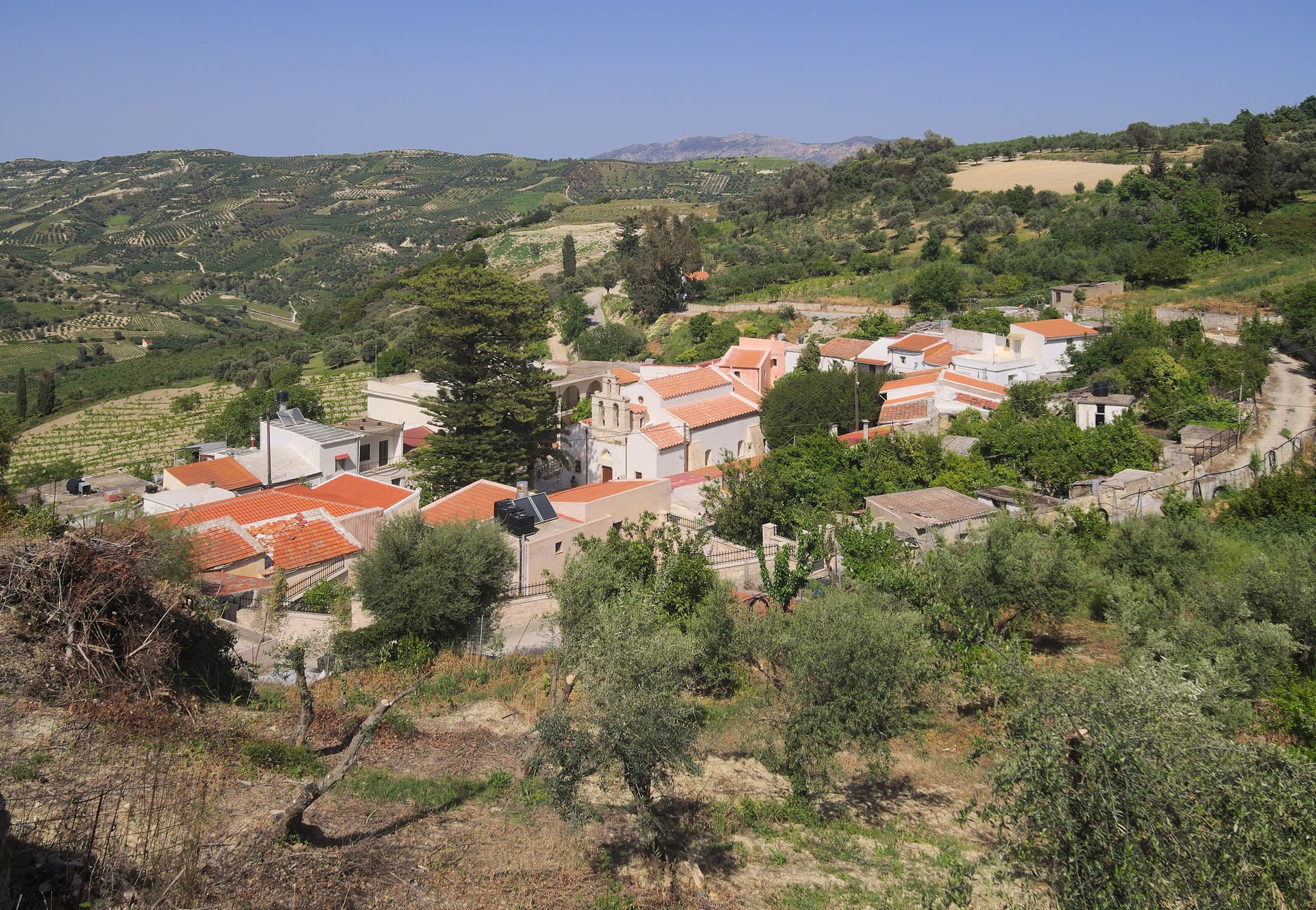
Paliani Monastery
Paliani Municipal Unit, Region of Crete, Greece
12.1 km away
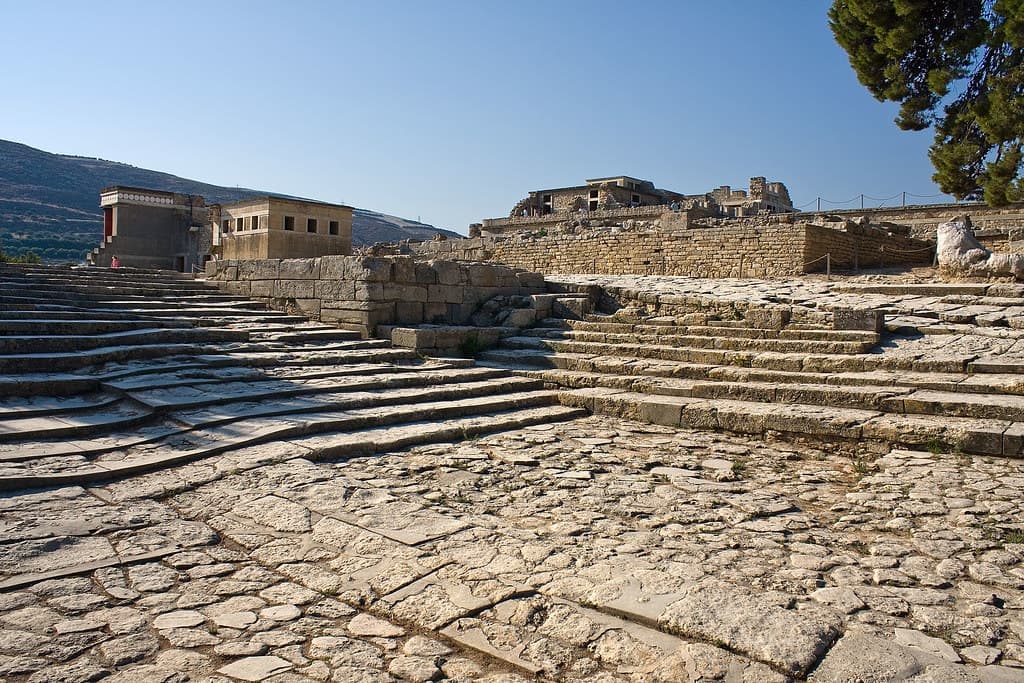
Knossos
Heraklion Municipal Unit, Region of Crete, Greece
13.0 km away
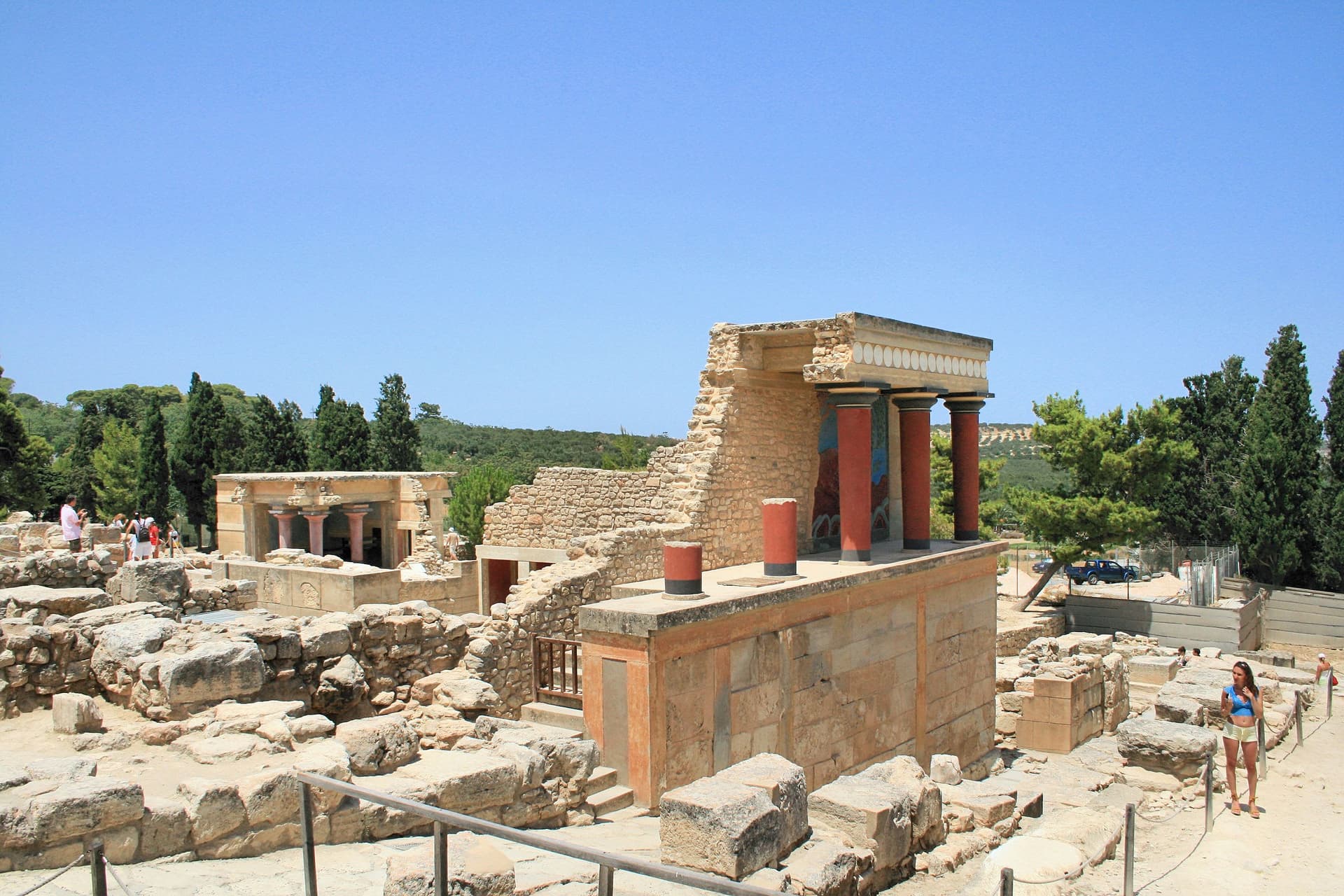
Palace of Knossos
Heraklion Municipal Unit, Region of Crete, Greece
13.0 km away
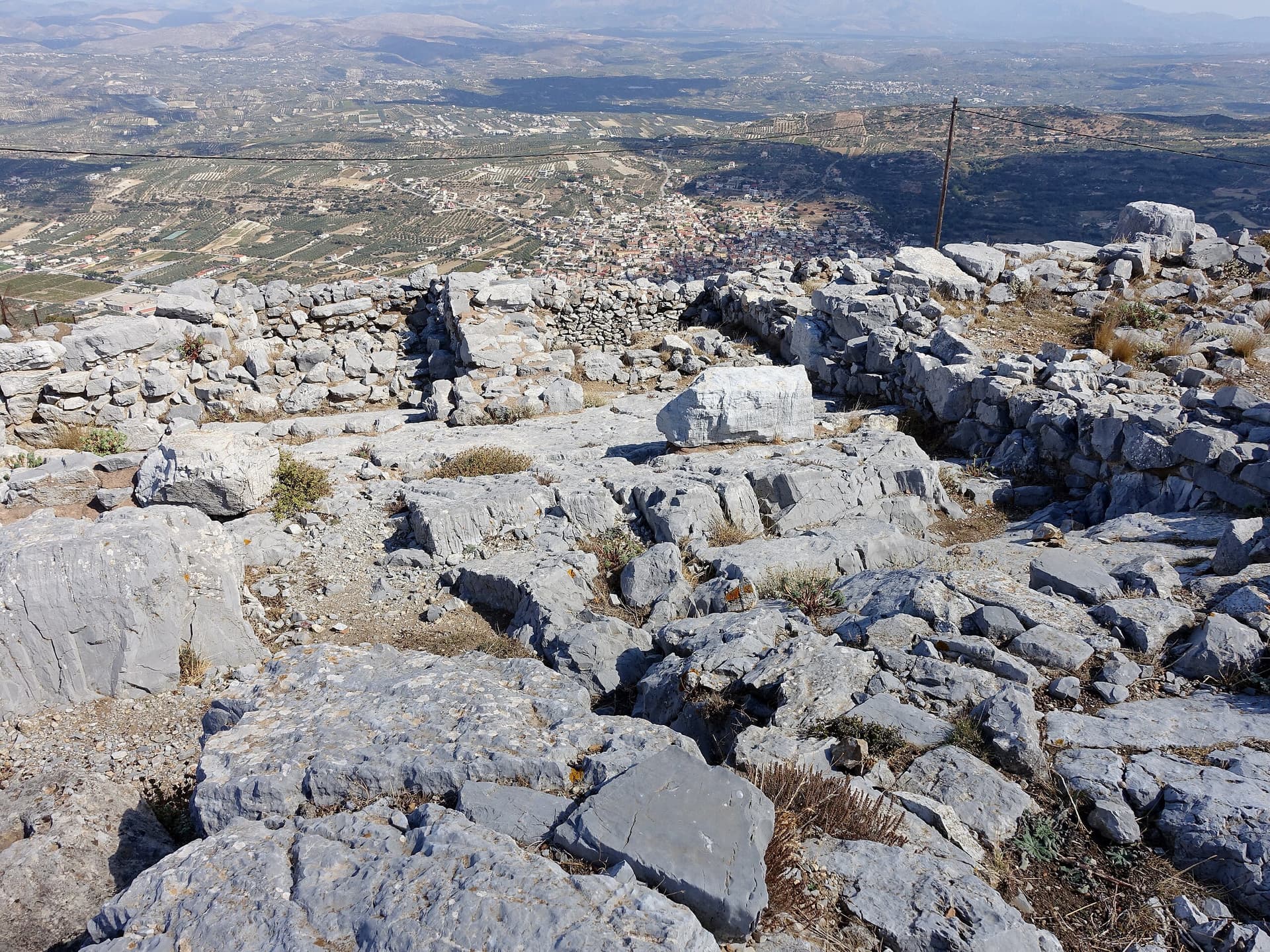
Mt. Juktas Minoan Peak Sanctuary, Crete
Archanes Municipal Unit, Region of Crete, Greece
13.0 km away