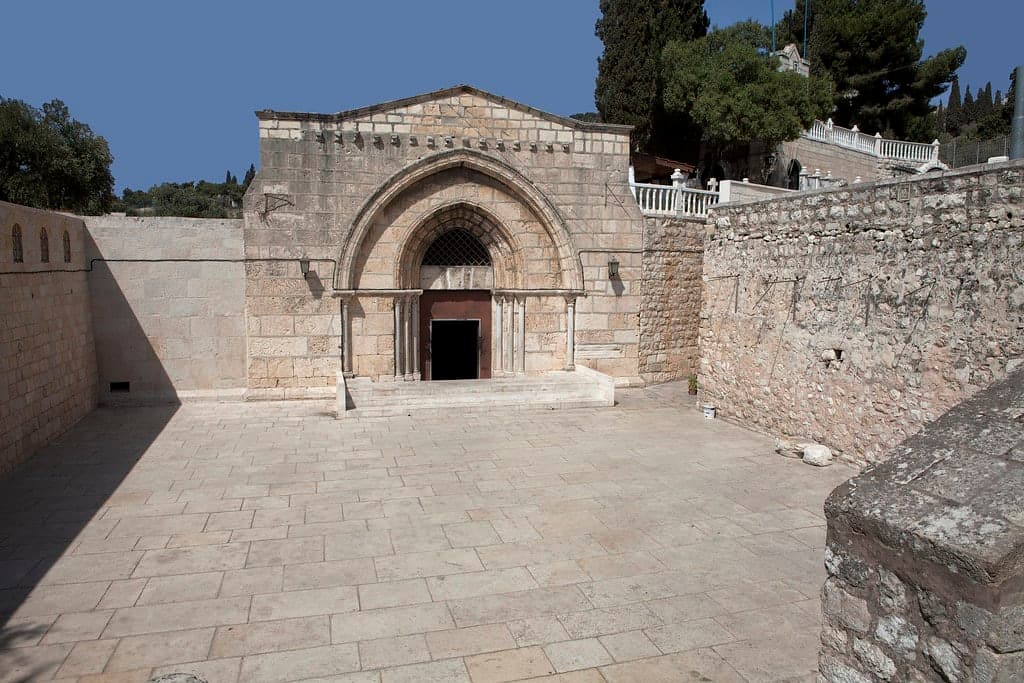
Tomb of Mary, Valley of Cedron, Jerusalem, Israel
Forty-seven steps into the earth, where five churches guard an empty tomb and pilgrims still seek Mary's blessing
Jerusalem, Jerusalem District, Israel
At A Glance
- Coordinates
- 31.7801, 35.2394
- Suggested Duration
- 30 minutes to 1 hour. Allow time to descend the staircase mindfully, visit the side chapels of Joachim, Anna, and Joseph, explore the underground church and its icons and lamps, and spend time at the tomb itself. During the Dormition Festival, plan for significantly longer due to crowds.
- Access
- Located in the Kidron Valley at the foot of the Mount of Olives, just east of the Lion's Gate (St. Stephen's Gate) in the Old City walls. Adjacent to the Garden of Gethsemane and the Church of All Nations (Basilica of the Agony). Accessible on foot from the Old City — 5-10 minutes from Lion's Gate. By bus or taxi to the Mount of Olives area. No dedicated parking; use Mount of Olives parking lots or park in the Old City vicinity. The 47-step descent may be challenging for those with mobility issues; there is no elevator. Opening hours approximately 8:00-18:00 (verify locally as hours may vary by season and denomination). Mobile phone signal is available in this part of Jerusalem.
Pilgrim Tips
- Located in the Kidron Valley at the foot of the Mount of Olives, just east of the Lion's Gate (St. Stephen's Gate) in the Old City walls. Adjacent to the Garden of Gethsemane and the Church of All Nations (Basilica of the Agony). Accessible on foot from the Old City — 5-10 minutes from Lion's Gate. By bus or taxi to the Mount of Olives area. No dedicated parking; use Mount of Olives parking lots or park in the Old City vicinity. The 47-step descent may be challenging for those with mobility issues; there is no elevator. Opening hours approximately 8:00-18:00 (verify locally as hours may vary by season and denomination). Mobile phone signal is available in this part of Jerusalem.
- Modest dress strictly required. Shoulders and knees must be covered. This is enforced at the entrance. Hats should be removed by men inside the church. Head covering for women is respectful but not mandatory.
- Generally permitted but should be restrained. No flash photography. Do not photograph worshippers in prayer without consent. During services and the Dormition Festival, photography may be restricted or impossible due to crowds. The dim interior makes handheld photography challenging in any case — accept this as the site's invitation to see with your eyes rather than your lens.
- The Dormition Festival period (late August) brings enormous crowds into a confined underground space. The heat, incense, and press of bodies can be physically overwhelming. If you are claustrophobic or sensitive to strong smells, plan your visit carefully. The Status Quo governs every aspect of the site. Do not move, rearrange, or touch any religious objects beyond the tomb stone and designated candle-stands. The arrangements are legally codified and their violation can provoke serious denominational conflict. Photography during services or when the space is crowded should be foregone entirely. Some moments are not meant to be captured.
Overview
Beneath the Kidron Valley floor, at the foot of the Mount of Olives, a rock-cut tomb from the 1st century is venerated as the burial place and site of the Assumption of the Virgin Mary. Jointly guarded by the Greek Orthodox and Armenian Apostolic Churches, with prayer rights held by five Christian denominations and a Muslim mihrab oriented toward Mecca, this underground sanctuary is one of the most densely layered sacred spaces in Jerusalem.
Descend. Forty-seven wide stone steps carry you from the bright heat of the Kidron Valley into cool, lamp-lit darkness. The transition is not gradual. By the tenth step, the world above has receded. By the twentieth, the air has changed — thicker, fragrant with incense and candle wax. By the time you reach the underground church, you have entered a different register of experience.
The tomb stands at the center of a subterranean chamber illuminated by hundreds of gold and silver hanging lamps. Their light is not steady but flickering, casting moving shadows on smoke-blackened walls covered in icons. The chapel housing the tomb itself is small — you bend to enter, an involuntary gesture of reverence that the architecture requires.
The tomb is believed to be where Mary, the mother of Jesus, was laid to rest by the Apostles. According to the tradition shared by both Eastern and Western Christianity, her body was placed here after her death — the Dormition, the 'falling asleep' — and when the tomb was opened three days later at the request of the Apostle Thomas, the body was gone. Only her burial cloths remained, along with a sweet fragrance. She had been assumed bodily into heaven.
The empty tomb resonates with the empty tomb of her son at the Church of the Holy Sepulchre less than a kilometer away. The parallelism is intentional and profound. Mother and son, both laid in rock-cut chambers, both absent from their graves, both understood as having passed through death into something beyond it.
Five Christian denominations hold rights here — Greek Orthodox, Armenian Apostolic, Syriac Orthodox, Coptic Orthodox, and Ethiopian Orthodox — with the Catholic Church maintaining prayer rights it rarely exercises. A mihrab in the southern wall testifies to Islam's reverence for Maryam, the only woman named in the Quran. The density of devotion compressed into this small underground space is almost physical — you can feel it in the heavy, lamp-warmed air.
Context And Lineage
The Tomb of Mary is one of the oldest documented Marian shrines in the world, with archaeological evidence confirming a 1st-century cemetery and literary tradition placing Mary's burial here from at least the 2nd-4th centuries. The subterranean church is governed by the Status Quo, the complex legal arrangement that regulates Christian holy sites in Jerusalem.
According to Sacred Tradition, when the time of Mary's death approached, the Apostles were miraculously transported from their missions around the world to be present at her bedside in Jerusalem. Mary died a natural death — the Dormition, the 'falling asleep' — and her soul was received by Christ. The Apostles carried her body in procession to this tomb in the Valley of Jehoshaphat.
Three days later, the Apostle Thomas — who had arrived too late for the burial — asked that the tomb be opened so he could see Mary one last time. When the stone was rolled away, the body was gone. Only her burial cloths remained, along with a sweet fragrance. The Apostles understood that she had been assumed bodily into heaven.
This narrative appears in apocryphal texts dating from the 2nd to the 7th century and was well established by the Council of Chalcedon in 451 CE, when Bishop Juvenal of Jerusalem testified to the tomb's authenticity. A competing tradition places Mary's death in Ephesus, but the Jerusalem tradition has stronger and older historical support.
The site's custodial history reflects the complex religious politics of Jerusalem. Byzantine Christians built the first church. Crusaders rebuilt it as a Benedictine abbey. Saladin destroyed the upper church but preserved the crypt. The Franciscans held custodianship for centuries until 1757, when it transferred to the Greek Orthodox and Armenian Apostolic Churches. The Status Quo of 1852 formalized these arrangements. Each transition has left its mark on the fabric of the building — the Crusader staircase, the Orthodox iconography, the Armenian chapel, the Muslim mihrab — creating a palimpsest of devotion in stone.
Mary (the Theotokos / Maryam)
sacred figure
The mother of Jesus Christ, venerated as the Theotokos (God-bearer) in Orthodox Christianity, the Blessed Virgin in Catholicism, and honored as the most revered woman in Islam — the only woman named in the Quran, with an entire chapter (Surah Maryam) dedicated to her.
Saints Joachim and Anna
sacred figure
Mary's parents, whose tombs are housed in a chapel along the descent staircase, maintained by the Armenian Apostolic Church. Their presence at the site creates a sense of encountering the entire Holy Family.
Patriarch Juvenal of Jerusalem
historical
The 5th-century patriarch who built the first upper church over the tomb and testified to the tradition of Mary's burial here at the Council of Chalcedon in 451 CE.
Caliph Umar ibn al-Khattab
historical
The second Rashidun caliph who prayed at the church after conquering Jerusalem in 638 CE, establishing the Islamic tradition of reverence for the site.
Bellarmino Bagatti
historical
Franciscan archaeologist whose 1972 excavation confirmed the presence of a 1st-century cemetery at the site, providing archaeological support for the tomb's antiquity.
Why This Place Is Sacred
The tomb's sacredness operates through descent — a literal movement underground into darkness, enclosure, and proximity to a grave that is empty. Nearly two thousand years of continuous prayer from multiple traditions have saturated this space with accumulated devotion, creating what many visitors experience as an almost tangible spiritual weight.
The architectural structure itself generates much of the site's spiritual power. The descent of forty-seven steps into the earth enacts a passage from the ordinary world into sacred space. The staircase, built during the Crusader period, is wide enough for pilgrims to pass in both directions, creating a continuous flow of those descending into darkness and those ascending back into light. The symbolism is inescapable — death and resurrection, descent and return, the movement between worlds.
At the bottom, the underground church opens into a cross-shaped space. Side chapels along the staircase hold the tombs of Joachim and Anna (Mary's parents) and Joseph (her husband), creating a sense of encountering the entire Holy Family on the way down. By the time you reach the tomb itself, you have been prepared — not by instruction but by architecture — for encounter.
The tomb chamber is what scholars have termed a 'womb tomb.' Enclosed, intimate, and dimly lit, it requires the visitor to bend forward to enter — a physical gesture that mimics both supplication and the act of being born. Ethnographic research has documented women pilgrims engaging in body-based rituals at the tomb, pressing their bodies against the stone, crawling through narrow spaces, and performing gestures that symbolically imitate passage through a birth canal. These practices, seeking fertility and healing, may be ancient or relatively modern — their origins are not fully documented.
The emptiness of the tomb is its theological core. Like the empty tomb of Christ, it testifies not to absence but to transformation — the claim that the material body can pass into another mode of existence. For pilgrims who enter this space, the emptiness is not disappointment but promise.
Archaeological excavation by Bellarmino Bagatti in 1972 confirmed the presence of a 1st-century cemetery at the site, consistent with the period in which Mary would have lived. The rock-cut tomb follows standard 1st-century Judean burial traditions. By the 5th century, Patriarch Juvenal of Jerusalem built the first upper church over the tomb, and by the Council of Chalcedon in 451 CE, the tradition placing Mary's burial here was established enough to serve as official testimony.
The site has been destroyed and rebuilt multiple times. The Persian Sassanid invasion of 614 demolished the original Byzantine church. Crusaders rebuilt it in 1130 as the Abbey of St. Mary of the Valley of Jehoshaphat, run by Benedictine monks. Saladin destroyed the upper church in 1187 but deliberately spared the crypt — an act of reverence reflecting Islam's own veneration of Maryam. The subterranean church that survives today is essentially the Crusader crypt, making it one of the oldest near-complete religious structures in Jerusalem.
In 1757, custodianship transferred from the Catholic Franciscans to the Greek Orthodox and Armenian Apostolic Churches, a change that remains politically sensitive. The Status Quo of 1852, codified by Ottoman Sultan Abdulmecid I, formalized the rights of each denomination — an arrangement that governs the site to this day.
Traditions And Practice
Greek Orthodox and Armenian daily liturgies anchor the site's spiritual life, with the annual Dormition Festival (August) drawing the largest crowds. Franciscan processions on August 15 mark the Catholic Assumption feast. Muslim prayer occurs at the mihrab. Year-round, pilgrims of all traditions light candles, touch the tomb, and seek Mary's intercession.
The Dormition procession is the site's most ancient and elaborate ceremony. On August 25 (Julian calendar), the icon of the Dormition of the Theotokos is carried in a grand procession from the Metochion of Gethsemane near the Church of the Holy Sepulchre to the tomb, where it remains through the feast and the Lamentations of the Eve of the Dormition until September 5. This procession reenacts the apostolic funeral procession described in the Dormition narratives.
Body-based rituals documented by ethnographic research include practices performed primarily by women: touching, pressing against, and crawling into the tomb chamber in gestures that researchers describe as symbolically imitating passage through a birth canal. These practices seek divine intercession for fertility, healing, and the resolution of personal afflictions. Oil is poured and collected from the tomb surface.
Greek Orthodox services are held daily. The Armenian Apostolic Church maintains its own liturgical schedule and celebrates the Assumption on the Sunday nearest August 15. The Franciscan Custody of the Holy Land leads a procession from the nearby Grotto of Gethsemane to the tomb on August 15, the Catholic Feast of the Assumption. The Syriac, Coptic, and Ethiopian Orthodox churches exercise minor liturgical rights at appointed times.
Year-round, pilgrims of all backgrounds descend to light candles and pray. The most common devotional acts are touching or kissing the tomb stone, lighting candles at the numerous candle-stands, and spending time in quiet prayer in the dim, lamp-lit space. Muslim visitors may pray at the mihrab.
Descend the staircase with deliberation. Pause at the chapels of Joachim, Anna, and Joseph — they are not obstacles on the way to the main event but integral parts of the experience.
At the tomb, light a candle if you wish. The gesture connects you to the simplest and most universal form of prayer practiced here across centuries and denominations. Touch the stone if you are moved to do so — generations of hands have worn it smooth, and yours adds to the accumulated devotion.
Spend time in the side spaces of the underground church, away from the tomb itself. The icons and hanging lamps create environments within the environment, pockets of particular beauty and intensity. The mihrab in the southern wall is worth finding — a small, powerful reminder that Mary belongs to more than one tradition.
Greek Orthodox Christianity
ActiveThe Greek Orthodox Church is the primary custodian and regards the tomb as the authentic burial place of the Theotokos. The Dormition is one of the Twelve Great Feasts — Mary's 'falling asleep,' followed by her bodily assumption into heaven, confirmed by the empty tomb.
Daily liturgical services. The annual Dormition Festival (August 25-September 5, Julian calendar) is the major celebration: the icon of the Dormition is carried in procession from the Old City, remains at the tomb through the feast, and returns after the Lamentations. Pilgrims light candles, kiss the tomb, and pray for intercession.
Armenian Apostolic Christianity
ActiveCo-custodian of the tomb, with a presence dating to at least the 5th century. The Chapel of Joachim and Anna on the descent staircase belongs to the Armenian Church, connecting the site to the broader narrative of the Holy Family.
Regular Armenian liturgical services at the tomb. Celebration of the Assumption on the Sunday nearest August 15. Maintenance of the Chapel of Joachim and Anna as a center of Armenian prayer and pilgrimage.
Roman Catholicism
ActiveThe Catholic Church celebrates the Assumption of Mary (August 15) as a major dogma defined in 1950. Though the Church lost custodianship of the Jerusalem tomb in 1757, it acknowledges the site's importance and maintains prayer rights.
The Franciscan Custody of the Holy Land leads a procession from the Grotto of Gethsemane to the tomb on August 15. A Mass is celebrated at the Dormition Abbey on Mount Zion. Catholic pilgrimage groups visit the tomb frequently throughout the year.
Islam
ActiveMaryam is the most honored woman in Islam — the only woman named in the Quran, with the 19th Surah dedicated to her. The Prophet Muhammad reported seeing a light over her tomb during his Night Journey to Jerusalem. A mihrab in the tomb chamber indicates the direction of Mecca.
Muslim visitors pray at the mihrab inside the church. The tomb is visited as a place of special blessing connected to one of Islam's most revered figures.
Syriac, Coptic, and Ethiopian Orthodox Christianity
ActiveThese three Oriental Orthodox churches hold minor liturgical rights at the tomb under the Status Quo arrangement, representing the continuity of ancient Eastern Christian devotion to Mary.
Limited liturgical rights exercised at appointed times. The Ethiopian Orthodox Church holds the Assumption as one of its most important feasts, reflecting Mary's central place in Ethiopian Christian devotion.
Experience And Perspectives
The descent into the underground church is consistently described as one of the most atmospheric spiritual experiences in Jerusalem. The contrast between the bright Kidron Valley and the candlelit, icon-covered crypt creates a powerful sensory transition. The small tomb chamber, with its requirement to bend upon entry, adds an intimacy that the grand churches of Jerusalem often lack.
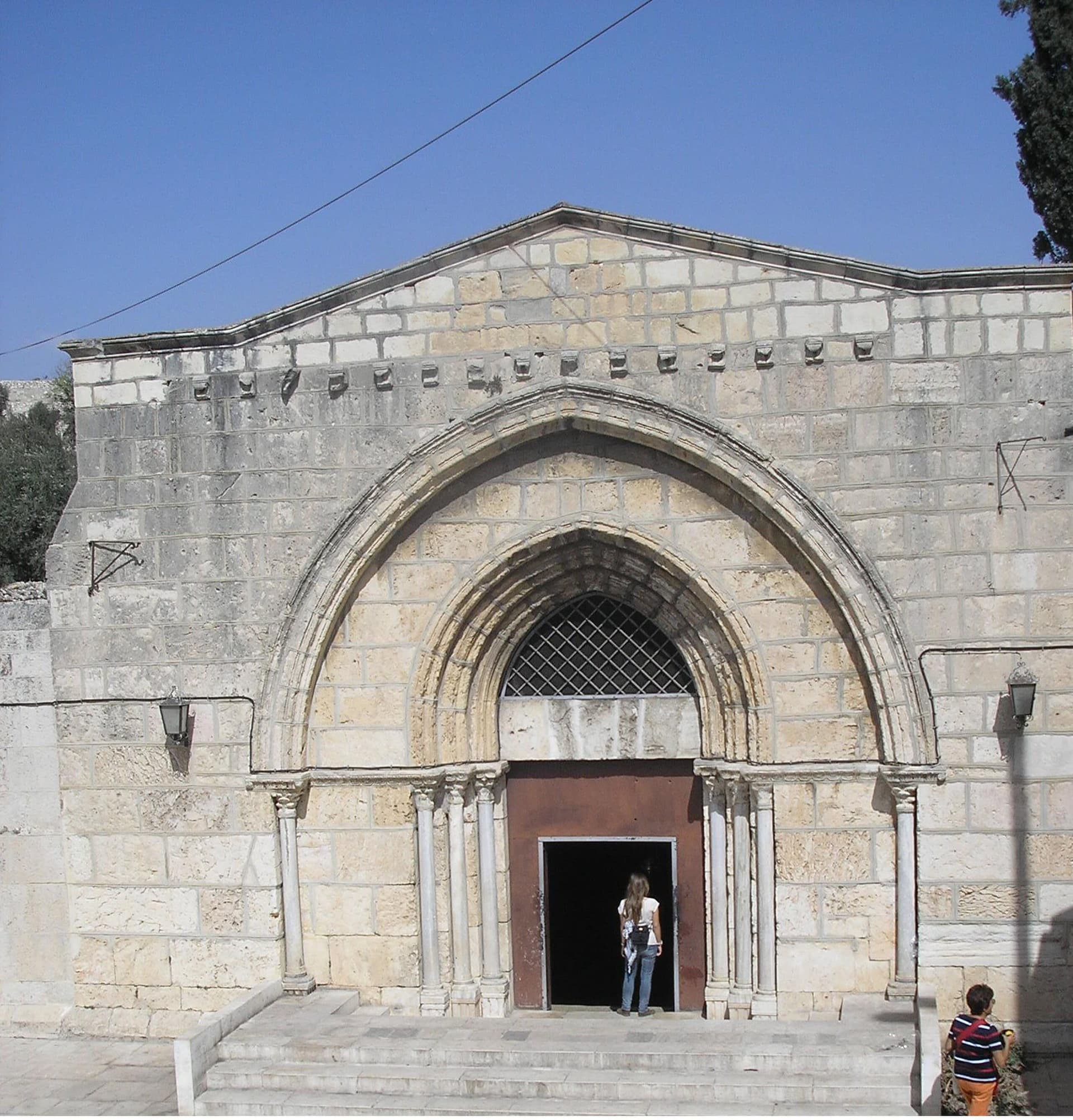
The entrance is modest — an arched doorway at the foot of the Mount of Olives, next to the Garden of Gethsemane. Nothing prepares you for what lies below. The staircase descends steeply, the ancient Crusader-era steps worn smooth by centuries of feet. The air cools as you go down. Light fades. Sound changes — the traffic and bustle of the Kidron Valley giving way to the muffled acoustics of stone.
Chapels appear on either side of the staircase as you descend. The Chapel of Saints Joachim and Anna, belonging to the Armenian Church, holds the tombs of Mary's parents. Further down, the Chapel of Saint Joseph. These intermediate stops create a sense of narrative — you are meeting the family before arriving at the matriarch.
The underground church opens at the bottom. Hundreds of hanging lamps — gold, silver, bronze — create a constellation of flickering light. The walls are blackened by centuries of candle smoke and covered with icons in elaborate frames. The smell is complex: beeswax, incense, old stone, the faint sweetness pilgrims associate with the Virgin's presence.
The tomb itself is housed in a small aedicule at the church's center. You must bend to enter. Inside, the space is barely large enough for two or three people. The rock-cut surface where the body is said to have rested is worn smooth by the touch of millions of hands and lips. Pilgrims light candles, kiss the stone, whisper prayers. The intimacy is almost overwhelming.
During the Dormition Festival in late August, the space fills to capacity. The Greek Orthodox procession carries the icon of the Dormition from the Old City to the tomb, accompanied by chanting that fills the underground chamber with sound that seems to come from the stone itself.
Come early in the morning for the most contemplative experience. The site can become crowded with tour groups by mid-morning, and the underground space does not absorb crowds gracefully.
On the staircase, resist the urge to rush. Each step deeper changes the atmosphere incrementally. The side chapels reward a pause. At the bottom, let your eyes adjust fully before approaching the tomb — the lamp-light reveals itself gradually.
At the tomb chamber, wait for a moment of relative quiet if possible. The act of bending to enter, touching the stone, and standing in the small space where Mary's body is said to have rested works differently when you are not shoulder-to-shoulder with a tour group.
The mihrab in the southern wall is worth finding. Its presence — a Muslim prayer niche inside a Christian church, indicating the direction of Mecca — speaks volumes about the multi-faith character of this site without any need for explanation.
The Tomb of Mary sits at the intersection of theology, archaeology, interfaith relations, and the politics of sacred space in Jerusalem. Each tradition that worships here brings its own understanding of who Mary was and what happened at this tomb — and each understanding illuminates a different dimension of a figure who bridges the Christian and Islamic worlds.
Scholars confirm that the rock-cut tomb dates to the 1st century CE, consistent with the period of Mary's life. The 1972 excavation by Bellarmino Bagatti confirmed an ancient cemetery at the site. The earliest literary references come from apocryphal Dormition accounts dating to the 2nd-4th centuries, making this one of the oldest documented Marian pilgrimage sites in the world.
The competing Ephesus tradition, which places Mary's death in Turkey, has weaker historical support but gained prominence after the 19th-century rediscovery of the 'House of the Virgin Mary' near Ephesus. The Catholic Church has not definitively ruled between the two locations.
The Status Quo arrangement governing the site is studied as a case study in religious diplomacy and inter-denominational power dynamics. Recent ethnographic work by Nurit Stadler has documented body-based fertility rituals at the tomb, opening new scholarly perspectives on how women interact with sacred space in ways that official religious frameworks do not always acknowledge.
Greek Orthodox tradition holds the Dormition as one of the Twelve Great Feasts, teaching that Mary died a natural death and was assumed bodily into heaven after three days. The empty tomb, like Christ's, testifies to the promise of resurrection. The annual Dormition procession reenacts the apostolic funeral described in Sacred Tradition.
Armenian tradition emphasizes the continuity of presence — the Armenian Apostolic Church has maintained a chapel here since at least the 5th century, and the tombs of Joachim and Anna connect the site to the broader narrative of salvation history.
Catholic dogma, defined ex cathedra by Pope Pius XII in 1950, affirms the Assumption but deliberately left open the question of whether Mary died before being assumed. The Franciscan procession on August 15 maintains the Catholic connection to a site the Church lost custodianship of in 1757.
Islamic tradition honors Maryam as the purest of women. The 19th Surah of the Quran bears her name. The Prophet Muhammad's report of seeing a light over her tomb during his Night Journey connects the site to the Islamic sacred geography of Jerusalem. The mihrab inside the church stands as permanent testimony to this reverence.
Some interpretive traditions regard the womb-like architecture of the underground tomb as symbolizing universal archetypes of death and rebirth — the descent into the earth mirroring the soul's passage through death to new life. The fertility rituals documented by ethnographers have been interpreted as survivals of pre-Christian goddess veneration adapted to a Marian framework, though this interpretation remains speculative.
The empty tomb motif — shared with the Church of the Holy Sepulchre — has prompted comparisons with other 'empty tomb' traditions worldwide, suggesting to some a cross-cultural spiritual principle of bodily transformation.
Whether Mary actually died before being assumed into heaven — the question of Dormition versus direct Assumption — remains theologically unresolved. The Catholic dogma of 1950 deliberately left this open.
The relationship between the Jerusalem and Ephesus traditions regarding Mary's final years has not been definitively settled by either scholarship or church authority.
The origins of the body-based fertility rituals at the tomb — whether ancient, medieval, or relatively modern — remain undocumented. Ethnographic research has described the practices but has not traced their history.
The identity and purpose of other 1st-century tombs in the cemetery around Mary's tomb remain archaeologically unexplored.
Visit Planning
Located in the Kidron Valley at the foot of the Mount of Olives, adjacent to the Garden of Gethsemane. A 5-10 minute walk from the Lion's Gate in the Old City walls. Open approximately 8:00-18:00 year-round, with the Dormition Festival in late August as the most significant visiting period.
Located in the Kidron Valley at the foot of the Mount of Olives, just east of the Lion's Gate (St. Stephen's Gate) in the Old City walls. Adjacent to the Garden of Gethsemane and the Church of All Nations (Basilica of the Agony). Accessible on foot from the Old City — 5-10 minutes from Lion's Gate. By bus or taxi to the Mount of Olives area. No dedicated parking; use Mount of Olives parking lots or park in the Old City vicinity. The 47-step descent may be challenging for those with mobility issues; there is no elevator. Opening hours approximately 8:00-18:00 (verify locally as hours may vary by season and denomination). Mobile phone signal is available in this part of Jerusalem.
Jerusalem offers extensive accommodation ranging from pilgrimage hostels in the Old City to luxury hotels in West and East Jerusalem. For proximity to the tomb, consider guesthouses near the Mount of Olives or the Old City's Christian Quarter. The Austrian Hospice and the Ecce Homo Sisters' convent offer pilgrimage-oriented accommodation within walking distance.
Modest dress is strictly required — shoulders and knees must be covered. Quiet, respectful behavior is essential in the underground church. The Status Quo governs all arrangements and must not be disturbed.
Jerusalem's holy sites enforce dress codes with particular seriousness, and the Tomb of Mary is no exception. Shoulders and knees must be covered. Men should remove hats inside the Christian worship areas. Women may cover their heads as a sign of respect — many Orthodox and Armenian women do so.
Inside the underground church, keep your voice to a whisper. Tour guides should explain outside and enter in silence. The acoustics of the underground space amplify sound in ways that can be intrusive.
Do not lean on, climb on, or attempt to sit atop the tomb structure. The stone is ancient and fragile. Touch it with your hands if you wish, but treat it as what it is — the most intimate contact you will have with a space venerated for nearly two millennia.
Be aware that different areas of the church are designated for different denominations, and a separate area exists for Muslim prayer at the mihrab. These boundaries are part of the Status Quo and should be respected even when they are not visibly marked.
During major feast days, the custodians may restrict access for private liturgies. Accept this gracefully — the site's primary function is worship, not tourism.
Modest dress strictly required. Shoulders and knees must be covered. This is enforced at the entrance. Hats should be removed by men inside the church. Head covering for women is respectful but not mandatory.
Generally permitted but should be restrained. No flash photography. Do not photograph worshippers in prayer without consent. During services and the Dormition Festival, photography may be restricted or impossible due to crowds. The dim interior makes handheld photography challenging in any case — accept this as the site's invitation to see with your eyes rather than your lens.
Candle lighting is the primary offering. Candles are available for purchase near the entrance. Oil lamps can also be lit. Small written prayers or offerings may be left at the tomb.
Modest dress strictly required. Quiet, respectful behavior at all times. Do not lean on or climb on the tomb structure. Do not move or rearrange religious objects. Be aware of denominationally designated areas. The 47-step descent has no elevator and may be challenging for those with mobility issues.
Sacred Cluster
Nearby sacred places create the location cluster described in the growth plan. This block is intentionally crawlable and links into the wider regional graph.