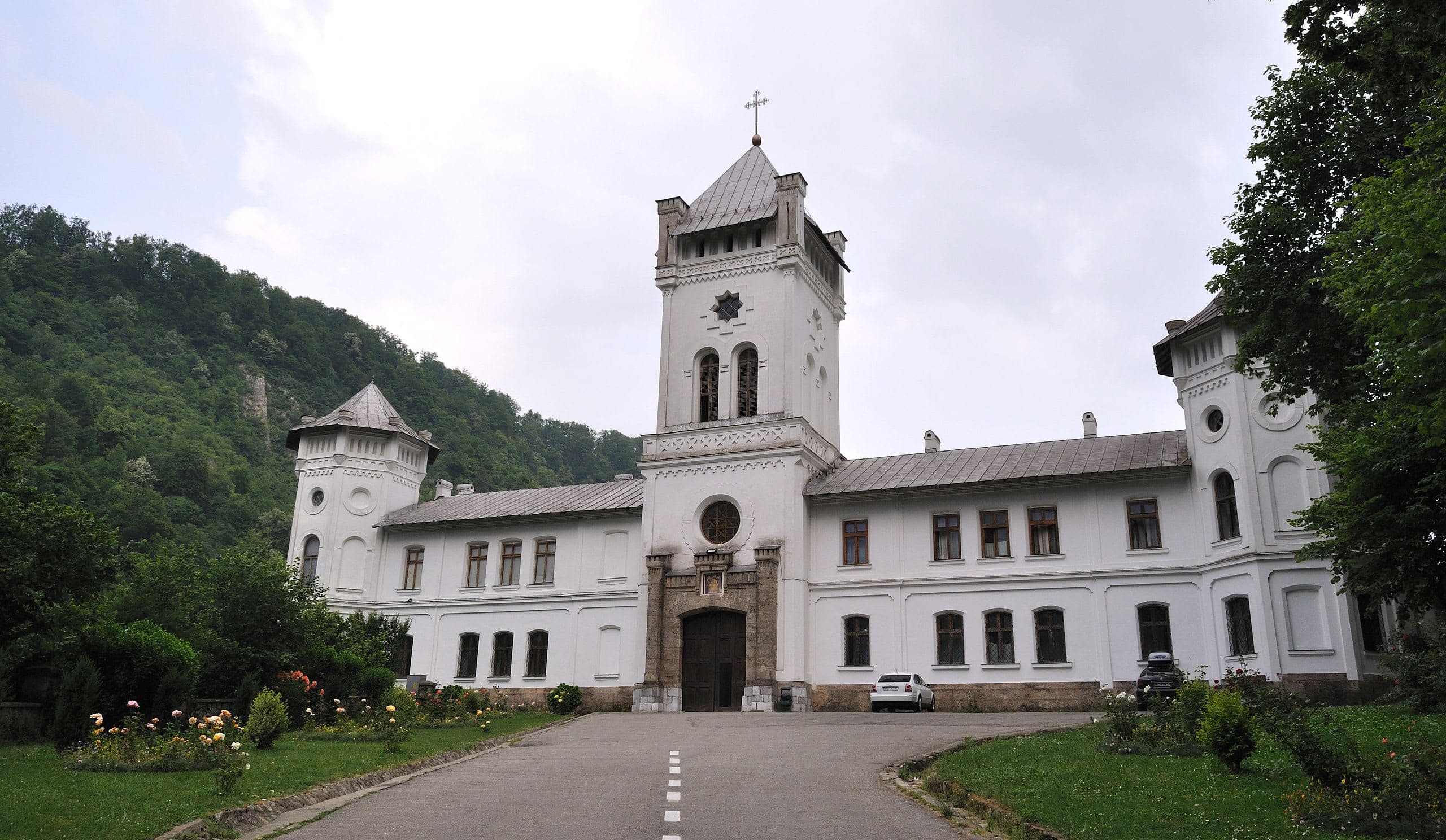
Tismana Monastery, Romania
The oldest monastery in Wallachia, where hesychast stillness first took root on Romanian soil
Tismana, Gorj, Romania
At A Glance
- Coordinates
- 45.0807, 22.9269
- Suggested Duration
- Allow 1-3 hours for the monastery itself, including the church, museum, and grounds. Additional time for visiting Saint Nicodim's cave and the trekking routes that begin from the monastery (up to 3 hours for longer trails). Overnight stays are possible and recommended for those seeking deeper contemplative engagement.
- Access
- Located in the town of Tismana, Gorj County, southwestern Romania, on Mount Starmina at approximately 300-400 meters altitude. Approximately 30 km from Targu Jiu, the county capital. Accessible by road from Targu Jiu. The nearest major city is Craiova, approximately 120 km east. Bucharest is approximately 320 km east. The monastery is reached by a road through forested mountain terrain. The Treasure Museum, managed by the National Bank of Romania, is adjacent to the monastery. Mobile phone signal may be limited in the mountain setting; check with your provider and note the nearest settlement with reliable signal.
Pilgrim Tips
- Located in the town of Tismana, Gorj County, southwestern Romania, on Mount Starmina at approximately 300-400 meters altitude. Approximately 30 km from Targu Jiu, the county capital. Accessible by road from Targu Jiu. The nearest major city is Craiova, approximately 120 km east. Bucharest is approximately 320 km east. The monastery is reached by a road through forested mountain terrain. The Treasure Museum, managed by the National Bank of Romania, is adjacent to the monastery. Mobile phone signal may be limited in the mountain setting; check with your provider and note the nearest settlement with reliable signal.
- Standard Romanian Orthodox monastery dress code. Women: shoulders covered, skirts or dresses below the knee. Men: long trousers, covered shoulders. Head coverings for women may be expected during services.
- Exterior photography is generally permitted. Interior photography of the church and frescoes may be restricted. No flash photography near frescoes or icons. Photography of the nuns requires explicit permission.
- Do not inquire intrusively about the location of Saint Nicodim's hidden relics. The information is a carefully guarded monastic secret, and pressing the question would be disrespectful to the community and the tradition. Tismana remains an active convent. The nuns are not guides or performers but women living under monastic vows. Do not photograph them without explicit permission. Maintain quiet and respectful behavior throughout the grounds, particularly near the churches and during prayer times. The cave of Saint Nicodim involves uneven terrain. Exercise appropriate caution.
Overview
Founded in the 1370s by Saint Nicodim, a monk from Mount Athos who carried the hesychast tradition of inner prayer across the Balkans, Tismana Monastery stands on a cliff top in the Gorj mountains as the birthplace of organized monasticism in Wallachia. Over 640 years of continuous prayer, hidden relics whose location is known to only two people, and a cave where the founder first sought God make this Romania's deepest monastic wellspring.
Before there were monasteries in Wallachia, there was a cave. Saint Nicodim, a Serbian-born monk shaped by the hesychast tradition on Mount Athos, arrived in the southwestern Carpathians sometime in the 1370s and found in a rock face the kind of space that seekers of inner stillness have always recognized: enclosed, removed, conducive to the silence that hesychasm calls the ground of prayer.
From that cave, everything followed. With the support of Voievode Radu I, Nicodim raised a stone monastery on Mount Starmina, consecrating its church on August 15, 1378, the Feast of the Dormition of the Theotokos. He designed it as the first cenobitic community in Wallachia, introducing the communal monastic rule he had learned on Mount Athos. The Patriarch of Jerusalem would later call Tismana the "head and Lavra among the monasteries in all over Wallachia."
Nicodim did not merely build a monastery. He planted a tradition. The hesychast practice of interior prayer, seeking divine stillness through the repetition of the Jesus Prayer, took root at Tismana and spread through his network of foundations, which spanned Wallachia, Serbia, and beyond. He served as confessor to rulers across national boundaries, introduced the triconch church plan that became standard in Romanian monastic architecture, and drew monks from Bulgarian, Serbian, Greek, Macedonian, and Wallachian backgrounds into a multinational community of contemplation.
Today, six and a half centuries later, the monastery endures as a convent. The nuns who live here maintain daily services, paint icons in a workshop called Tismanikon, and tend the grounds where Nicodim's presence lingers most forcefully. His relics remain within the monastery, but their exact location is a closely guarded secret, known at any time to only the Igoumen and one other person. This deliberate hiddenness mirrors something of the hesychast tradition itself: the deepest things are found not by seeking them outward but by going in.
Context And Lineage
Tismana Monastery was consecrated on August 15, 1378, making it the oldest monastic foundation in Wallachia. Built by Saint Nicodim the Sanctified, who carried the hesychast contemplative tradition from Mount Athos to Romania, the monastery introduced cenobitic monasticism and the triconch church plan to Wallachia, establishing the model for subsequent Romanian monastic architecture and spiritual life.
According to hagiographic tradition, Saint Nicodim received divine instruction to establish the monastery at this location. Born around 1320, possibly in the Serbian lands, he was shaped by the hesychast movement on Mount Athos, where he followed the teachings of Saint Gregory of Sinai. Hesychasm, the practice of seeking inner stillness and direct experience of divine light through the Jesus Prayer, was at its zenith in the 14th-century Orthodox world.
Nicodim arrived in the Carpathian region and first established a monastery at Vodita, near the Danube, around 1370. He then moved to the site of Tismana, where he initially used a cave in the rock face as his place of ascetic prayer. The cave became the seed from which the stone monastery grew.
With material support from Voievode Radu I of Wallachia, Nicodim raised the monastery between 1375 and 1378, consecrating the church on August 15, the Dormition of the Theotokos. He received the title of archimandrite from Constantinople, confirming Tismana's status as the first and chief monastery of Wallachia.
The name Tismana itself carries uncertainty. One tradition derives it from the Thraco-Dacian word for "place fortified with walls," suggesting pre-Christian associations. Another connects it to the yew trees that once covered the area. Both etymologies point toward a place already marked by distinctiveness before the monastery arrived.
Tismana's lineage runs from Mount Athos through the Balkans to Wallachia. Nicodim carried the hesychast tradition from its Athonite center to a new frontier, establishing a model that subsequent Romanian monasteries would follow. His network of foundations, which included Vodita, Tismana, and monasteries in Serbia, created a web of contemplative communities spanning national boundaries.
The monastery maintained its status as the chief archimandry of Wallachia for centuries. Successive rulers supported it, recognizing both its spiritual significance and its political usefulness. Nicodim himself served as confessor to Stefan Lazarevic of Serbia, Dan I and Mircea the Elder of Wallachia, and Sigismund, Holy Roman Emperor.
The transition from male monastery to convent in 1949 changed the community's composition but not its essential purpose. The nuns who now maintain Tismana continue the daily cycle of prayer that Nicodim established, adding their own contributions through the Tismanikon icon workshop and the ongoing care of the site's medieval heritage.
Saint Nicodim the Sanctified
founder
Monk from Mount Athos, follower of Saint Gregory of Sinai, and the primary transmitter of hesychast contemplative practice from the Athonite tradition to the Romanian lands. He founded Tismana as the first cenobitic monastery in Wallachia and served as confessor to rulers across national boundaries. Canonized in 1767, feast day December 26.
Voievode Radu I of Wallachia
patron
Ruler of Wallachia who provided material support for the monastery's construction. His patronage of Nicodim's monastic project established the pattern of princely support for Romanian monasticism that continued for centuries.
Saint Gregory of Sinai
spiritual_master
The great hesychast teacher whose revival of contemplative prayer on Mount Athos shaped Nicodim's spiritual formation. Through Nicodim, Gregory's tradition of the Jesus Prayer and interior stillness reached Romanian soil.
Mircea the Elder
patron
Voievode of Wallachia who continued the pattern of royal patronage of Tismana. One of several rulers who valued both Nicodim's spiritual authority and his diplomatic usefulness.
Why This Place Is Sacred
Tismana's sacredness derives from its identity as the origin point of Romanian cenobitic monasticism and the primary channel through which Athonite hesychasm reached the Romanian lands. The convergence of cliff-top geography, ancient forest, the founder's cave, hidden relics, and over 640 years of unbroken prayer creates conditions of unusual spiritual density.
Tismana occupies a landscape that seems to have been waiting for a monastery. Mount Starmina rises from forests that have never been fully cleared. The cliff-top setting provides natural elevation and separation, the kind of removed vantage point that monks from Sinai to Athos to the Carpathians have sought as the geographical counterpart to interior withdrawal.
But geography alone does not explain what visitors encounter here. Tismana's thinness has roots in a specific spiritual tradition. Hesychasm, the practice of inner stillness cultivated through the Jesus Prayer, is among the most intensive contemplative disciplines in the Christian world. When Nicodim brought this practice from Mount Athos to the Carpathian foothills, he introduced not merely a set of techniques but an orientation toward the sacred that understands prayer as the means by which the boundary between human and divine becomes permeable.
The cave where Nicodim first prayed retains a particular intensity. Stripped of all ornament, it offers what caves have always offered seekers: enclosure, darkness, the amplification of breathing, the sense of being held within the earth itself. Visitors who enter the cave often describe a quality of compression and presence that exceeds the physical dimensions of the space.
The hidden relics add another dimension. Saint Nicodim's body rests somewhere within the monastery, but no visitor and almost no resident knows where. This deliberate concealment, the fact that the most sacred object in the monastery is invisible, creates a condition of attention and receptivity. You cannot seek the relics with your eyes. You can only be present to whatever presence they generate.
Six hundred and forty years of prayer have saturated this site. The hesychast tradition holds that places can absorb the quality of the prayer directed through them, that walls and stones become, in a sense, repositories of accumulated silence. Whether or not this can be measured, visitors from many backgrounds describe something at Tismana that goes beyond the visual or historical: a stillness that feels inhabited.
Nicodim founded Tismana as the first cenobitic monastery in Wallachia, establishing communal monastic life following the Athonite model. The community combined rigorous contemplative practice with scholarly activity, including manuscript copying and theological scholarship. The monastery's designation as the first archimandry in Wallachia in 1375 reflected its intended role as the mother house and model for all subsequent Wallachian monasteries.
From its founding through the medieval period, Tismana functioned as a male monastery and spiritual center of enormous influence. Nicodim's role as confessor to multiple rulers gave the monastery political as well as spiritual significance. The multinational character of the early community reflected the trans-Balkan networks of Orthodox monasticism.
In 1949, during the Communist era, the government converted Tismana from a male monastery to a convent. The transition preserved the continuity of monastic prayer while changing the community's composition. The nuns who now inhabit the monastery have maintained and extended its traditions, establishing the Tismanikon icon painting workshop and continuing the daily liturgical cycle.
Pilgrimage to Tismana has intensified rather than diminished over the centuries. Thousands gather for the Dormition feast on August 15 and for Saint Nicodim's feast on December 26, drawn by the same qualities that drew Nicodim to this cliff top in the 14th century.
Traditions And Practice
Tismana Monastery maintains daily Orthodox worship through its community of nuns. Major pilgrimages occur on August 15 (Dormition of the Theotokos) and December 26 (Feast of Saint Nicodim). The Tismanikon icon workshop continues the Byzantine-Romanian painting tradition. The monastery offers overnight accommodation, allowing deeper engagement with the contemplative heritage of the site.
Nicodim established Tismana for the practice of hesychast contemplative prayer within a cenobitic framework. The daily cycle included the Hours, the Divine Liturgy, and sustained periods of the Jesus Prayer, the central practice of hesychasm. The community combined contemplative discipline with scholarly activity, including manuscript copying and theological scholarship.
Nicodim's role extended beyond the monastery walls. He served as confessor to rulers in Wallachia, Serbia, and the Holy Roman Empire, using his spiritual authority in the service of ecclesiastical diplomacy. His multinational community of Bulgarian, Serbian, Greek, Macedonian, and Wallachian monks embodied the trans-Balkan character of medieval Orthodox monasticism.
The veneration of Nicodim's relics has been a central practice since his death in 1406. His forefinger and lead pectoral cross are known to survive. His body remains within the monastery, hidden during a period of hostilities, its exact location passed down through an unbroken chain of monastic trust.
Daily Divine Liturgy and the canonical Hours structure the life of the convent. The monastic day follows the traditional rhythm of prayer, manual work, and rest. The nuns combine spiritual practice with icon painting in the Tismanikon workshop, farm labor, and the maintenance of the monastery's medieval fabric.
Two annual pilgrimages draw thousands. The Dormition of the Theotokos on August 15, the monastery's consecration feast, brings pilgrims from across Romania. The Feast of Saint Nicodim on December 26 honors the founder with special liturgical services and veneration of the accessible portions of his relics.
The monastery museum displays old wooden icons, manuscripts, and religious artifacts, providing historical context for the living tradition. The cave of Saint Nicodim is accessible to visitors and continues to draw those seeking connection with the site's contemplative origins.
Tismana offers rare depth for those willing to receive it. If the monastery offers accommodation during your visit, consider an overnight stay. Attending vespers in the evening and the morning Liturgy creates a frame of silence and prayer that a day visit cannot replicate.
Visit the cave of Saint Nicodim. Sit within it, even briefly. The hesychast tradition begins with physical stillness, and the cave provides the conditions for it: enclosure, reduced stimulation, the sound of your own breathing. You need not practice the Jesus Prayer to benefit from the quality of attention the space invites.
Attend a service if one is offered during your visit. The chanting of the nuns within the medieval church connects the present moment to the 14th century.
Consider what it means that the most sacred object in the monastery, the hidden relics of Saint Nicodim, is invisible. The hesychast tradition teaches that the deepest encounter with the divine occurs not through the senses but through an interior stillness that transcends perception. The hidden relics embody this teaching.
Romanian Orthodox Christianity
ActiveTismana is the oldest monastic settlement in Wallachia and the foundational monastery for Romanian Orthodox cenobitic life. Granted the title of first archimandry in Wallachia in 1375, it served as the spiritual model for all subsequent Wallachian monasteries. The Patriarch of Jerusalem described it as the head and Lavra among all Wallachian monasteries.
Daily Divine Liturgy, canonical Hours, icon veneration, Orthodox fasting calendar, feast day celebrations including the Dormition of the Theotokos (August 15) and the Feast of Saint Nicodim (December 26), veneration of Saint Nicodim's relics, icon painting in the Tismanikon workshop maintaining the Byzantine-Romanian tradition.
Hesychasm (Athonite Tradition)
HistoricalSaint Nicodim is recognized by scholars as the primary transmitter of hesychasm from Mount Athos to Wallachia. His practice of interior prayer seeking divine stillness, learned from followers of Saint Gregory of Sinai, represented a transformative moment in the spiritual life of the Romanian lands. Cambridge University Press has published an academic chapter specifically analyzing this transmission.
The hesychast discipline centered on the Jesus Prayer, the repetitive invocation seeking inner stillness and direct experience of divine light. Strict ascetic practice followed the Athonite monastic rule. The community combined contemplative prayer with scholarly activity and cenobitic communal life. While formal hesychast practice as Nicodim established it is no longer the monastery's primary mode, its spiritual influence permeates the tradition that continues here.
Experience And Perspectives
Visitors consistently describe a profound sense of peace upon arriving at Tismana, whose forested mountain setting creates natural conditions for contemplation. The cliff-top architecture, preserved medieval frescoes with their distinctive red pigment, the cave of Saint Nicodim, and the awareness of hidden relics combine to produce an encounter that operates on multiple levels simultaneously.
The approach to Tismana takes you through forested mountain terrain, each kilometer further from urban noise and closer to a quality of silence that feels positional rather than merely acoustic. By the time you reach the monastery, the Gorj landscape has already done its preparatory work.
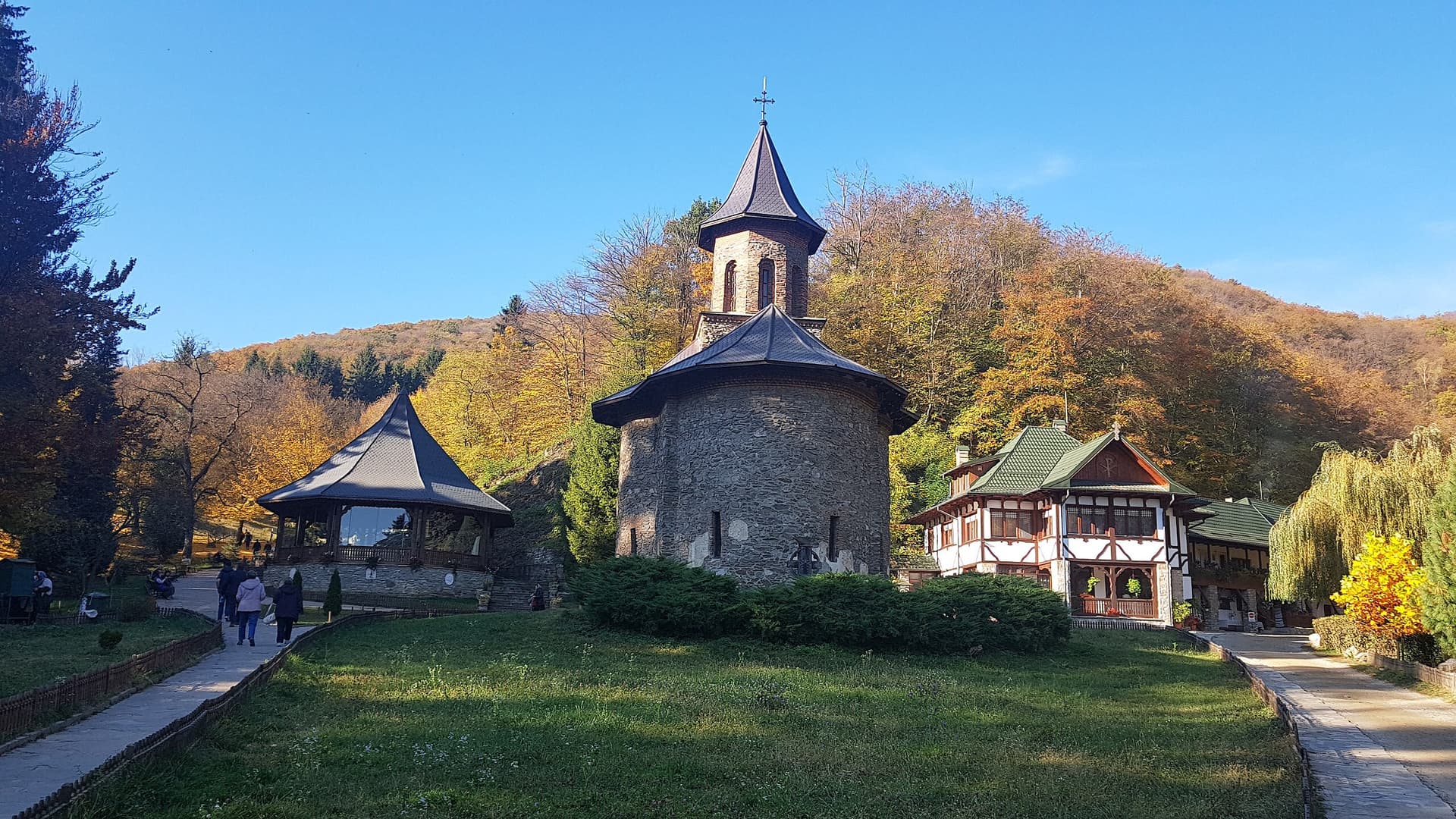
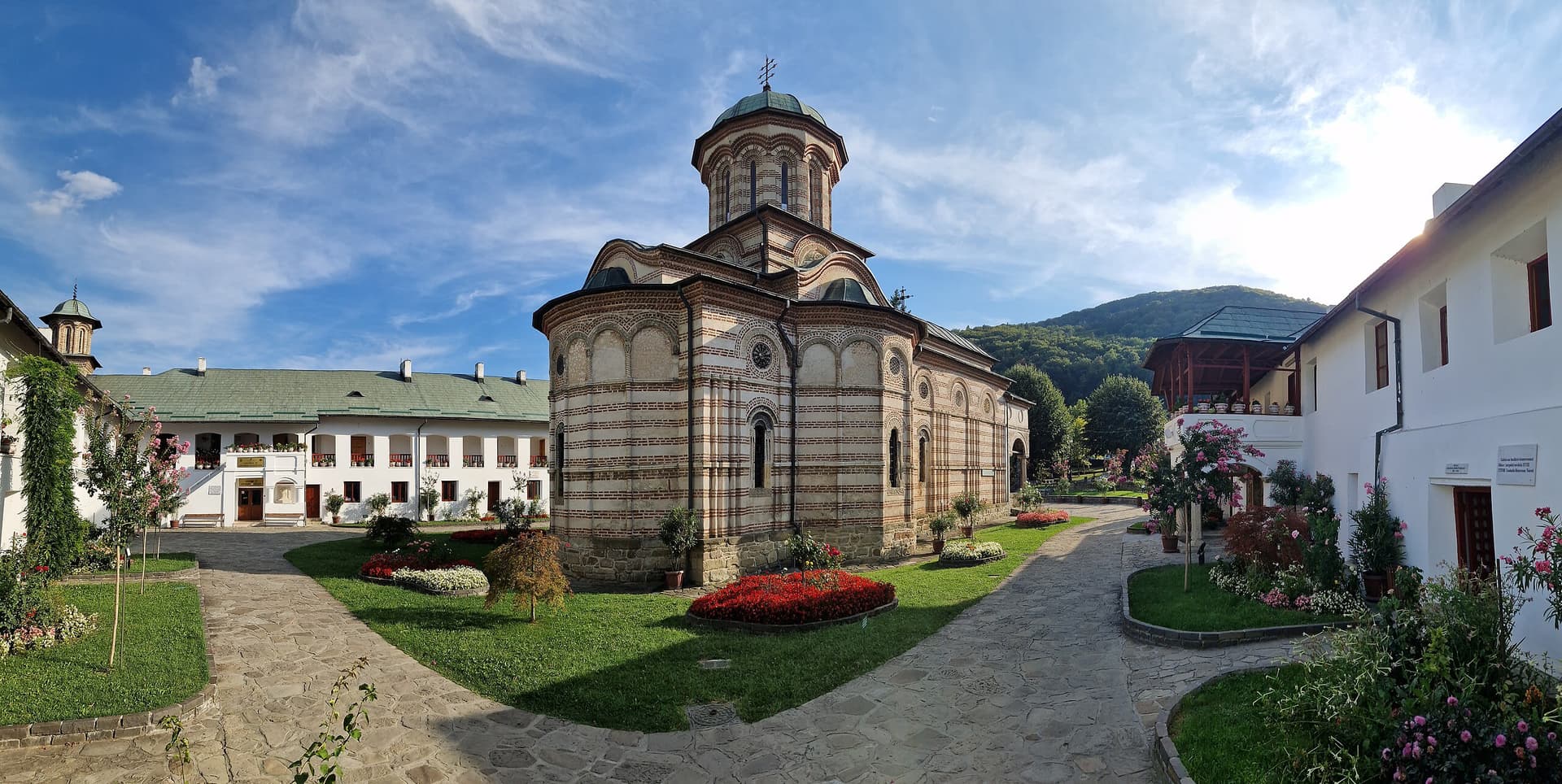
The monastery itself sits on its cliff top with an authority that comes from age rather than scale. The medieval architecture, with walls bearing the distinctive red pigment whose composition, like the Voronet Blue, remains unknown, speaks of a period when the things most worth building were built for God. The frescoes, restored but preserving their original character, create an interior environment dense with sacred narrative.
The cave of Saint Nicodim draws visitors who seek the monastery's deepest layer. This is the place before the monastery, the origin before the origin. The cave is small, rough, unadorned, exactly what a hesychast would choose: a space with nothing in it to distract from the practice of inner prayer. Visitors who sit in the cave, even briefly, describe a quality of enclosure that feels protective rather than confining.
The awareness of hidden relics creates a distinctive phenomenology. Knowing that Nicodim's body rests somewhere within the monastery, but not knowing where, produces a condition of heightened attentiveness. Every stone could be the one. Every wall could hold what you cannot see. The effect is to make the entire monastery a reliquary, saturated with potential sacred presence.
The Tismanikon workshop, where nuns paint icons in the Byzantine-Romanian tradition, offers a different mode of encounter. Watching sacred art being made, with the patience and precision the tradition demands, connects the present moment to the founding impulse: Nicodim, too, understood that prayer and making were aspects of a single discipline.
Tismana rewards those who come prepared for depth rather than breadth. Read about Saint Nicodim and hesychasm before arriving. Understanding what was planted here gives root to what you encounter.
Begin at the cave, if possible. The experience of the enclosed space, the darkness, the amplified sound of your own breathing, provides a physical analogue to the inner stillness the hesychast tradition cultivates.
Then enter the monastery church. Let the frescoes and the accumulated presence of centuries of prayer work at their own pace. Light a candle if you are moved to do so.
If you can arrange an overnight stay, the monastery offers accommodation. The experience of evening and morning services, the silence of the mountain night between them, transforms a visit into a retreat. The hesychast tradition Nicodim brought here was never intended for short encounters.
Tismana invites interpretation from scholarly, theological, and contemplative perspectives. As the origin point of organized Romanian monasticism and the channel through which Athonite hesychasm reached the Wallachian lands, it carries significance that extends well beyond its physical boundaries. Understanding these layers requires engaging with both the historical record and the spiritual tradition it documents.
Scholars broadly agree that Tismana represents the foundational institution of organized cenobitic monasticism in Wallachia and that Saint Nicodim was the primary agent through whom hesychast practice was transmitted from Mount Athos to the Romanian lands. Cambridge University Press published an academic chapter specifically on Nicodim as the "Transmitter of Hesychasm to Wallachia," confirming his pivotal role in the history of Eastern Orthodox spirituality.
Historians emphasize the multinational character of the early community, which included Bulgarian, Serbian, Greek, Macedonian, and Wallachian monks, reflecting the trans-Balkan networks that characterized medieval Orthodox monasticism. The monastery's architectural innovation, introducing the triconch church plan to Wallachia, is recognized as foundational for subsequent Romanian church design.
Nicodim's diplomatic activities, serving as confessor to rulers across national boundaries, are documented as evidence of the close relationship between monastic authority and political power in the medieval Balkans.
Within Romanian Orthodox tradition, Tismana is venerated as the mother monastery of Wallachian Orthodoxy. Saint Nicodim is honored as one of the great saints of the Romanian Church, canonized in 1767 with his feast day on December 26.
The tradition emphasizes his divine calling to establish the monastery, his transmission of the hesychast practice of the Jesus Prayer, and his role as spiritual father to an entire region. Healing miracles are attributed to his intercession, and pilgrims continue to report experiences of spiritual consolation at the site.
The hidden relics carry particular weight in traditional understanding. The fact that Nicodim's body rests within the monastery but cannot be located by ordinary means is interpreted as consistent with the hesychast teaching that the deepest spiritual realities are hidden from external perception. The relics generate presence without being present to sight.
Some alternative perspectives note the Thraco-Dacian etymology of the name Tismana, meaning "place fortified with walls," as possibly indicating pre-Christian sacred associations with the site. The cave of Saint Nicodim, used before the stone monastery was built, resonates with universal sacred cave symbolism found across traditions from paleolithic times onward.
The monastery's mountain-top location and connection to ancient forests have attracted interest from those studying sacred landscapes and the relationship between natural settings and spiritual practice. The Red of Tismana, a distinctive wall pigment whose composition remains unknown, has been noted by some as suggesting lost knowledge, though this interpretation remains speculative.
The exact location of Saint Nicodim's hidden relics is the monastery's most carefully guarded secret, known at any given time to only the Igoumen and one other person. The relics were hidden during a period of hostilities, and their precise resting place has been transmitted through an unbroken chain of monastic trust.
The composition of the Red of Tismana wall pigment, like the Voronet Blue, has not been scientifically reproduced. The full extent of Nicodim's diplomatic and ecclesiastical influence network across Serbia, Wallachia, Constantinople, and the Holy Roman Empire is still being researched. Whether the site held sacred significance before Nicodim's arrival, as the possible Thraco-Dacian etymology suggests, remains an open question.
Visit Planning
Tismana Monastery is located in Gorj County, southwestern Romania, approximately 30 km from Targu Jiu. The monastery offers overnight accommodation for visitors seeking deeper engagement. The cave of Saint Nicodim and local trekking routes extend visiting possibilities beyond the monastery itself. Mobile phone signal may be limited in the mountain setting; confirm coverage before relying on it.
Located in the town of Tismana, Gorj County, southwestern Romania, on Mount Starmina at approximately 300-400 meters altitude. Approximately 30 km from Targu Jiu, the county capital. Accessible by road from Targu Jiu. The nearest major city is Craiova, approximately 120 km east. Bucharest is approximately 320 km east. The monastery is reached by a road through forested mountain terrain. The Treasure Museum, managed by the National Bank of Romania, is adjacent to the monastery. Mobile phone signal may be limited in the mountain setting; check with your provider and note the nearest settlement with reliable signal.
The monastery offers accommodation for visitors, allowing for overnight stays that include attendance at evening and morning services. Request permission in advance when possible. The town of Tismana offers additional guesthouses. Targu Jiu, 30 km away, provides a full range of accommodation options.
Tismana requires the respectful behavior appropriate to one of Romania's most significant active monasteries. Modest dress is mandatory, quiet behavior is expected, and special sensitivity is needed regarding the monastery's hidden relics and the privacy of the resident nuns. The cave of Saint Nicodim should be approached with reverence.
Tismana carries a weight of spiritual significance that asks something of those who enter. As the birthplace of Romanian monasticism and the resting place of a saint's hidden relics, it operates in a register deeper than typical heritage tourism.
Approach with the awareness that the nuns who live here are continuing a tradition established in the 14th century. Their daily practice of prayer, work, and silence is not a performance but a vocation. Your presence is welcomed, but within a framework that places worship above all other activities.
Do not seek information about the hidden relics. The concealment of Nicodim's body is a deliberate act of monastic trust, and respecting it is part of respecting the tradition. The mystery is not an obstacle to your encounter with the site but an aspect of it.
When visiting the cave, approach with the awareness that you are entering the space where Romanian monasticism began. Even for visitors without specific religious commitment, the cave merits a posture of attention rather than curiosity.
Standard Romanian Orthodox monastery dress code. Women: shoulders covered, skirts or dresses below the knee. Men: long trousers, covered shoulders. Head coverings for women may be expected during services.
Exterior photography is generally permitted. Interior photography of the church and frescoes may be restricted. No flash photography near frescoes or icons. Photography of the nuns requires explicit permission.
Candles may be purchased and lit in the church. Donations are welcomed. Icons produced in the Tismanikon workshop are available for purchase, and buying them supports the community and its artistic tradition.
Monastic living quarters are off-limits. Do not touch frescoes, icons, or religious artifacts. Respect prayer and service times. Follow the guidance of the nuns regarding access to different areas. Do not bring food or drink into the churches.
Sacred Cluster
Nearby sacred places create the location cluster described in the growth plan. This block is intentionally crawlable and links into the wider regional graph.