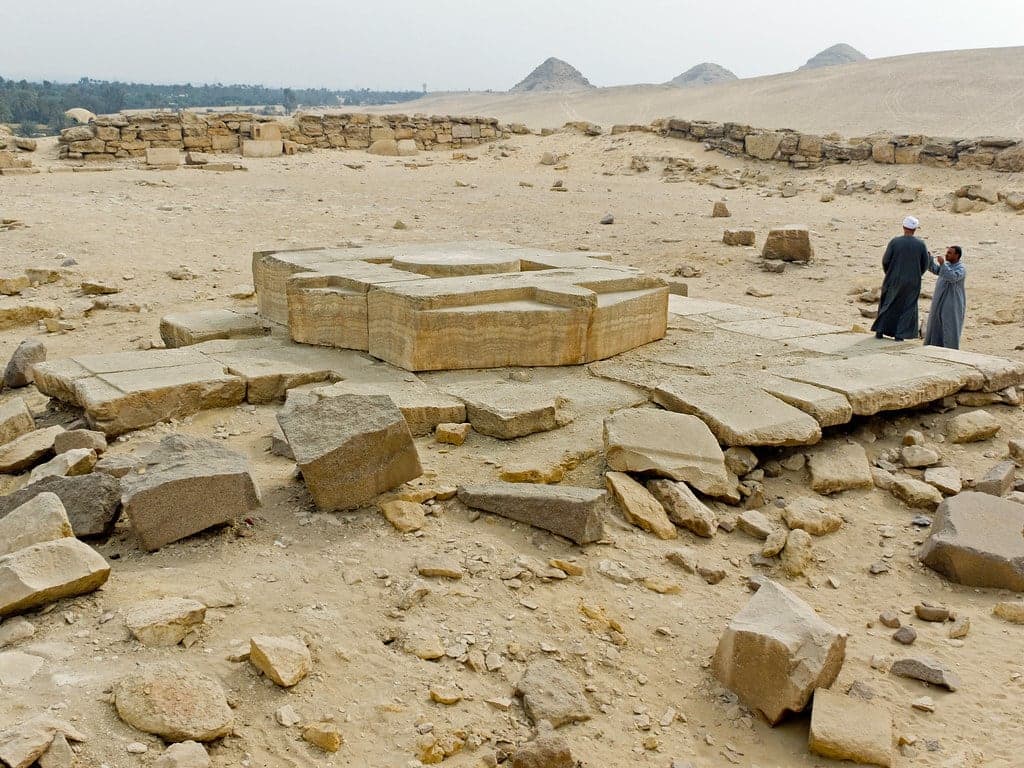
Sun Temple of Niuserre, Abu Girab
Where the sons of Ra built a monumental obelisk to honor the sun at creation's origin
Abu Sir, Giza, Egypt
At A Glance
- Coordinates
- 29.9167, 31.2333
- Suggested Duration
- 1-2 hours for the sun temple site. Can be combined with Abusir pyramids (adjacent) and Saqqara (nearby) for a full day exploring the Memphis necropolis.
- Access
- Located in the Abusir/Abu Ghurob archaeological zone, approximately 15 km south of Cairo. Part of the Saqqara/Abusir ticketing system; combined tickets available. No public transportation. Access by taxi, private car, or organized tour from Cairo or Giza. Often combined with visits to Saqqara and/or Abusir. Check current opening hours and ticket prices with Egyptian Ministry of Tourism and Antiquities.
Pilgrim Tips
- Located in the Abusir/Abu Ghurob archaeological zone, approximately 15 km south of Cairo. Part of the Saqqara/Abusir ticketing system; combined tickets available. No public transportation. Access by taxi, private car, or organized tour from Cairo or Giza. Often combined with visits to Saqqara and/or Abusir. Check current opening hours and ticket prices with Egyptian Ministry of Tourism and Antiquities.
- Practical desert clothing: sun protection including hat and lightweight long sleeves. Sturdy footwear for uneven terrain. Conservative dress appropriate for Egyptian cultural context.
- Generally permitted. Professional equipment may require permits. Flash not needed in open-air site. Respect any restrictions in active excavation areas.
- The site is fully exposed with no shade. Sun protection is essential. Bring water; there are no facilities. The remote location means less security presence than major sites. Active excavation areas may be restricted.
Overview
The Sun Temple of Niuserre at Abu Ghurob is one of only two surviving Fifth Dynasty sun temples, out of at least six that once existed. Its 56-meter obelisk, representing the primordial benben stone where the first rays of sunlight fell at creation, once stood taller than Niuserre's own pyramid. The alabaster altar at the center reads 'May Ra be satisfied' from all four cardinal directions.
The Fifth Dynasty kings understood themselves differently from their predecessors. According to Egyptian tradition preserved in the Westcar Papyrus, the first kings of this dynasty were triplets fathered by the sun god Ra himself, born to a priest's wife. This divine parentage demanded unique expression. Rather than merely building pyramids like their Fourth Dynasty predecessors, these pharaohs built sun temples, massive open-air sanctuaries dedicated to their divine father.
Six or seven sun temples were built during the Fifth Dynasty. Only two survive: the ruined temple of Userkaf and the better-preserved temple of Niuserre at Abu Ghurob. Niuserre's temple, named Shesepibre, 'Joy of the Heart of Ra,' was the largest and most elaborate of all. Its monumental obelisk, constructed of limestone blocks and standing approximately 56 meters tall including its pedestal, rose higher than Niuserre's own burial pyramid.
The obelisk represented the benben stone of Heliopolis, the primordial mound upon which the first rays of sunlight fell at creation. This was not merely symbolic architecture but cosmic machinery, connecting the temple to the moment when existence began. The hieroglyphic inscriptions read the temple's name as 'The Place Agreeable to Ra,' indicating that the structure was designed to please the sun god himself.
Context And Lineage
The Fifth Dynasty pharaohs, believing themselves sons of Ra, built sun temples to honor their divine father. Niuserre's temple was the largest and most elaborate, featuring a 56-meter obelisk representing the primordial benben stone and an alabaster altar calling for Ra's satisfaction.
According to the Tale of Djedi preserved in the Westcar Papyrus, the first kings of the Fifth Dynasty were triplets born to Rededjet, wife of a priest of Ra, and fathered by the sun god himself. This divine parentage explained why these pharaohs uniquely built sun temples alongside their pyramids. They were honoring their literal father.
Niuserre's sun temple was named Shesepibre, meaning 'Joy of the Heart of Ra' or 'Delight of Ra.' The name indicates the temple's purpose: to please the sun god, to be a place agreeable to him. The offerings, rituals, and architectural forms were all designed to satisfy Ra and ensure his continued creative activity.
The obelisk represented the benben stone of Heliopolis, the most sacred object in Egyptian solar theology. According to Heliopolitan creation myth, a mound emerged from the primordial waters at the beginning of time. Upon this mound, the first rays of sunlight fell, initiating creation. The benben was either this mound itself or a stone that sat upon it. By recreating the benben in monumental form, Niuserre created a physical connection to the moment when existence began.
The sun temples represent a unique architectural category within Egyptian sacred building. They borrowed elements from mortuary temples and Heliopolitan solar symbolism but combined them in new ways. The obelisk-centered design would influence later solar architecture, particularly the obelisks at Karnak and other New Kingdom temples. The temple's cosmic orientation and ritual function connected it to the broader Egyptian understanding of temples as machines for maintaining existence.
Nyuserre Ini (Niuserre)
Ra
Userkaf
Ludwig Borchardt
Massimiliano Nuzzolo
Why This Place Is Sacred
The thinness at Abu Ghurob operates through antiquity, cosmic significance, and rarity. The temple's function as a place of solar worship, its representation of the primordial moment of creation, and its status as one of only two surviving sun temples create multiple dimensions of significance.
The Fifth Dynasty sun temples represent a unique moment in Egyptian religious history. These pharaohs, understanding themselves as literal sons of Ra, created architectural forms that expressed this relationship. The sun temples were not tombs but places of active worship, where the divine father received honor from his royal children.
The obelisk at the temple's center represents the benben stone of Heliopolis, the most sacred object in Egyptian solar theology. This was the primordial mound that emerged from the waters of chaos at creation, the point where the first rays of sunlight touched solid matter. By recreating the benben in monumental form, Niuserre connected his temple to the origin of existence itself.
The architectural orientation reinforced cosmic significance. The temple faced the sunrise. The obelisk's shadow marked the passage of time throughout the day. The alabaster altar's cardinal alignment connected the offerings made there to the four corners of the world. This was not symbolism but function. The Egyptians understood the temple as actually participating in the cosmic processes it represented.
The Sed festival reliefs, depicting the royal jubilee that renewed the king's power, survive as the most complete ancient record of this crucial ceremony. The reliefs show the ritual run of the king, the gathering of gods, the washing of the king's feet. These images record practices that maintained cosmic order.
The temple's rarity intensifies its significance. Six or seven sun temples were built during the Fifth Dynasty; only two survive. Four are known only from ancient texts. The one Niuserre built, the largest and most elaborate, stands as the primary witness to an entire category of Egyptian sacred architecture.
Recent discoveries add mystery. The mud-brick structure found beneath Niuserre's stone temple in 2022 may be one of the 'lost' sun temples. If so, this site holds not one but two temples, layered like the Egyptian concept of time itself, where past and present coexist.
The sun temple served as a cultic installation for the worship of Ra during the Fifth Dynasty. It was not a mortuary temple but a place of daily worship where priests performed rituals to honor the sun god and ensure his continued creative activity. The temple also served as the site for the Sed festival, the royal jubilee that renewed the pharaoh's connection to divine power. The offerings presented at the alabaster altar were understood to sustain Ra's journey across the sky.
The sun temple was built late in Niuserre's reign, approximately 2420-2389 BCE. It was initially constructed in mud brick, then rebuilt entirely in stone. The temple remained in use throughout the Fifth Dynasty until approximately 2340 BCE, when sun temple construction ceased for reasons not fully understood. The site was then abandoned to the desert. Ludwig Borchardt and Friedrich Wilhelm von Bissing excavated the temple in 1898-1901 for the Berlin Museum, removing most of the decorated reliefs. Modern research began with the Polish Academy of Sciences' Sun Temples Project, which discovered evidence of an earlier temple beneath the stone structure in 2022. In 2025, Italian excavations revealed the massive valley temple.
Traditions And Practice
The daily solar rituals and Sed festival ceremonies that once animated this temple ceased over 4,000 years ago. What remains is encounter with architectural forms that embodied the Egyptian understanding of cosmic order.
Daily rituals honored Ra through the temple's priesthood. The offerings presented at the alabaster altar were understood to actually sustain Ra's journey across the sky. The temple was not merely commemorative but functional, participating in the cosmic processes it represented.
The Sed festival, the royal jubilee celebrating the pharaoh's continued fitness to rule, was performed here. The temple's reliefs, now in Berlin, provide the most complete surviving depiction of this crucial ceremony. The festival included the ritual run of the king demonstrating his vitality, processions of the gods gathering to venerate Ra, the washing of the king's feet, and a barque procession over water. These rituals renewed the pharaoh's connection to his divine father and ensured continued cosmic order.
Animal sacrifices were conducted at the alabaster altar. The nine alabaster basins may have collected sacrificial blood, though some scholars suggest they were purely symbolic. Offerings of food, drink, and incense accompanied the ceremonies.
No formal religious ceremonies take place at the sun temple today. The site is visited primarily by tourists, scholars, and spiritual seekers. Some alternative spiritual groups conduct meditation or ceremony at the alabaster altar, drawn by theories about the site's energetic properties. The ongoing archaeological excavations constitute another form of activity, revealing structures hidden for millennia.
Visit at sunrise or sunset when the light best reveals the temple's solar orientation. The play of light on the alabaster altar demonstrates the attention to cosmic alignment that informed the temple's design.
Spend time at the alabaster altar. This is the spiritual center of the complex, the point where offerings were made to satisfy Ra. The hetep hieroglyph, repeated four times, speaks across four millennia: 'May Ra be satisfied.'
Contemplate the obelisk pedestal and imagine the 56-meter monument that once rose from it. The scale of the original construction, taller than Niuserre's own pyramid, indicates the importance of solar worship to these pharaohs who believed themselves sons of the sun.
If possible, combine the visit with nearby Abusir and Saqqara. The sun temples make most sense within the broader context of the Memphis necropolis, the sacred landscape that stretches from Giza to Dahshur.
Ancient Egyptian Solar Religion
HistoricalThe sun temple represents the apex of Ra worship during the Fifth Dynasty, when the solar cult achieved unprecedented royal patronage. The pharaohs, claiming descent from Ra himself, built these massive structures to honor their divine father. The temple's architecture, centered on an obelisk representing the benben stone, embodied Egyptian understanding of creation and cosmic order.
Daily rituals honoring Ra conducted by priests. Offerings at the alabaster altar to sustain Ra's journey. Sed festival celebrations renewing the pharaoh's connection to divine power. Animal sacrifices and presentation of food, drink, and incense.
New Age/Energy Spirituality
ActiveSome contemporary spiritual seekers consider Abu Ghurob a site of unusual energetic properties. The teachings of Abd'El Hakim Awyan have influenced New Age interpretations of the site as a place of harmonic resonance and interdimensional contact. The precision of the stonework and the acoustic properties of alabaster are cited as evidence.
Meditation at the alabaster altar. Some practitioners report heightened states of consciousness, visions, or energy sensations at the site. Spiritual tours may include group meditation or ceremony.
Experience And Perspectives
Abu Ghurob offers encounter with one of the most complete expressions of Egyptian solar theology in relative solitude. The surviving obelisk pedestal, the unique alabaster altar, and the ongoing archaeological discoveries create a site where cosmic significance meets intimate scale.
The journey to Abu Ghurob passes through the broader Memphis necropolis, the pyramid fields stretching from Giza to Dahshur that constitute one of humanity's greatest burial grounds. The sun temples occupy the northern end of this sacred landscape, overlooking the Nile Valley and the path of the sun across the sky.
The site reveals itself gradually. The obelisk pedestal, a massive stone structure approximately 20 meters high, is what remains of the 56-meter monument that once rose here. The obelisk itself, constructed of limestone blocks rather than a single stone, has long since collapsed. But the pedestal remains, substantial enough to suggest the scale of what stood above it.
The alabaster altar sits in the courtyard, its white surface catching whatever light falls upon it. This is the temple's spiritual center, the point where offerings were made to satisfy Ra. The hetep hieroglyph, meaning 'be satisfied,' is carved four times, once facing each cardinal direction. The precision of the orientation demonstrates Egyptian surveying skill; the theological content demonstrates their understanding of cosmic order.
Nine circular alabaster basins line the courtyard's eastern wall. Their precise function remains debated: collection of sacrificial blood, symbolic representations of offering vessels, or something else entirely. Their presence testifies to ritual activity whose exact nature is no longer fully understood.
The 'Chamber of the Seasons,' whose reliefs now reside in Berlin, occupied the southern side of the complex. What remains are the empty spaces where those reliefs once depicted the sun's creative role in the agricultural cycle. The absence creates its own atmosphere, requiring imagination to complete what the eyes cannot see.
The view from the temple encompasses much of Egypt's sacred geography. The Giza pyramids are visible to the north. The Abusir pyramids lie immediately south. Memphis, the ancient capital, once stood to the east. The site occupied a position from which multiple sacred landmarks could be seen, suggesting deliberate placement within a larger cosmic design.
The relative obscurity of Abu Ghurob means visitors often have the site largely to themselves. Unlike crowded Giza, this is a place where contemplation is possible. The solar theology that drove the temple's construction remains accessible to those who take time to understand it.
The Sun Temple of Niuserre at Abu Ghurob lies approximately 15 km south of Cairo, 1 km north of Abusir, on the western bank of the Nile. The temple faces east toward the river and the rising sun. The main components include the obelisk pedestal, the alabaster altar, the nine alabaster basins, and the remains of cultic chambers. The valley temple, discovered in 2025, lies at the temple's eastern approach. The ruined Sun Temple of Userkaf sits 500 meters to the south.
The Sun Temple of Niuserre invites engagement as architectural achievement, as expression of solar theology, as evidence for royal ritual, and as witness to the unique self-understanding of the Fifth Dynasty pharaohs.
Egyptologists recognize the sun temples as a unique architectural category expressing the Fifth Dynasty's special relationship with Ra. The temple's Sed festival reliefs, though now in Berlin, provide the most complete ancient depiction of the royal jubilee. The 'Chamber of the Seasons' reliefs document Egyptian understanding of the sun's role in the agricultural cycle.
The 2022 discovery by the Polish Sun Temples Project of an earlier mud-brick structure beneath Niuserre's stone temple has opened new questions. This may be one of the four 'lost' sun temples known from ancient texts. The 2025 Italian discovery of the valley temple, covering over 1,000 square meters, reveals the temple's original grandeur.
The temple's astronomical alignments and mathematical precision are subjects of ongoing study. Its relationship to other Fifth Dynasty monuments and to Heliopolis, the center of solar theology, remains incompletely understood.
In ancient Egyptian understanding, the sun temple was where creation was perpetually renewed. The obelisk represented the benben, the primordial mound where the first sunlight fell. The rituals performed at the altar actually sustained Ra's journey across the sky. The temple was not symbolic but functional, a machine for maintaining cosmic order.
The Fifth Dynasty pharaohs understood themselves as sons of Ra, their divine parentage demanding appropriate architectural expression. The sun temples were not tombs but places of active worship, where the royal children honored their divine father and ensured the continuation of existence itself.
Some contemporary theorists, drawing on the work of the late Egyptian wisdom keeper Abd'El Hakim Awyan, propose that Abu Ghurob was designed as a 'stargate' or interdimensional portal. In this view, the alabaster structures were tuned to specific frequencies that could elevate human consciousness and enable contact with divine beings. The precision of the stonework and the acoustic properties of alabaster are cited as evidence. These interpretations, while not supported by archaeological evidence, reflect genuine wonder at the sophistication of the construction.
The exact function of the nine alabaster basins remains debated. What happened to the four missing sun temples known from ancient texts is unknown. The identity and purpose of the mud-brick temple discovered beneath Niuserre's stone structure in 2022 are not yet fully understood. Why sun temple construction ceased abruptly after the Fifth Dynasty remains unexplained. The astronomical alignments of the temple and their ritual significance are subjects of ongoing research.
Visit Planning
The Sun Temple of Niuserre lies 15 km south of Cairo in the Abusir/Abu Ghurob archaeological zone. It is less frequently visited than nearby Giza or Saqqara, offering a more contemplative experience.
Located in the Abusir/Abu Ghurob archaeological zone, approximately 15 km south of Cairo. Part of the Saqqara/Abusir ticketing system; combined tickets available. No public transportation. Access by taxi, private car, or organized tour from Cairo or Giza. Often combined with visits to Saqqara and/or Abusir. Check current opening hours and ticket prices with Egyptian Ministry of Tourism and Antiquities.
Full range of accommodations in Cairo and Giza. Day trips from Cairo hotels are the most common way to visit.
Standard archaeological site protocols apply. Respect the ancient structures, do not climb on or touch the alabaster altar and basins, and follow any instructions regarding restricted excavation areas.
Abu Ghurob is an archaeological site under government administration. No religious community maintains it; no services occur within its precincts. The protocols are those of heritage preservation.
Do not touch, climb on, or disturb the ancient structures. The alabaster altar and basins are particularly vulnerable. The oils from human hands can damage these ancient surfaces.
Respect any barriers or signage indicating restricted areas. Ongoing excavations may close portions of the site. Follow instructions from site guards.
The site's relative obscurity means less infrastructure than major monuments. Come prepared with water and sun protection. Do not leave trash.
If conducting meditation or spiritual practice, do so in a manner that does not disturb other visitors or conflict with site regulations.
Practical desert clothing: sun protection including hat and lightweight long sleeves. Sturdy footwear for uneven terrain. Conservative dress appropriate for Egyptian cultural context.
Generally permitted. Professional equipment may require permits. Flash not needed in open-air site. Respect any restrictions in active excavation areas.
Not applicable. This is an archaeological site with no offering tradition.
Do not climb on or touch ancient structures. Respect roped-off excavation areas. Follow site guard instructions. Bring water; no facilities available.
Sacred Cluster
Nearby sacred places create the location cluster described in the growth plan. This block is intentionally crawlable and links into the wider regional graph.