Church of Saint George, Cairo
A circular sanctuary rising from Roman ruins where two traditions honor the warrior saint
Mit Damsis wa Kafr Abu Girg, Ad Dakahliya, Egypt
At A Glance
- Coordinates
- 30.0059, 31.2306
- Suggested Duration
- 45 minutes to 1 hour for the church and immediate surroundings. Allow 2-3 hours to explore the broader Coptic Cairo complex including the Hanging Church, Coptic Museum, Ben Ezra Synagogue, and Church of Saints Sergius and Bacchus.
Pilgrim Tips
- Modest dress is required. Shoulders and knees must be covered. Long pants or skirts below the knee are appropriate. Sleeveless shirts and tank tops are not permitted. Comfortable walking shoes recommended for stone steps.
- Photography is generally permitted but should be done respectfully without flash. Avoid photographing during active services or ceremonies. Some areas of the convent may prohibit photography. Always ask permission before photographing clergy, nuns, or worshippers.
- The chains ritual in the convent is a sacred practice, not a performance for tourists. Approach with respect. Ask permission if you wish to observe. If you seek the ritual yourself, approach with genuine intention. The nuns take their role as mediators of the saint's blessing seriously.
Overview
The Church of Saint George in Old Cairo rises from the foundations of a Roman tower, its circular form rare in the Christian world. Here Greek Orthodox and Coptic Christians both honor the warrior saint they call 'Prince of Martyrs.' In the adjacent convent, chains believed to have bound George during his torture are still wrapped around pilgrims seeking healing. The site condenses nearly two millennia of continuous worship above ancient stone.
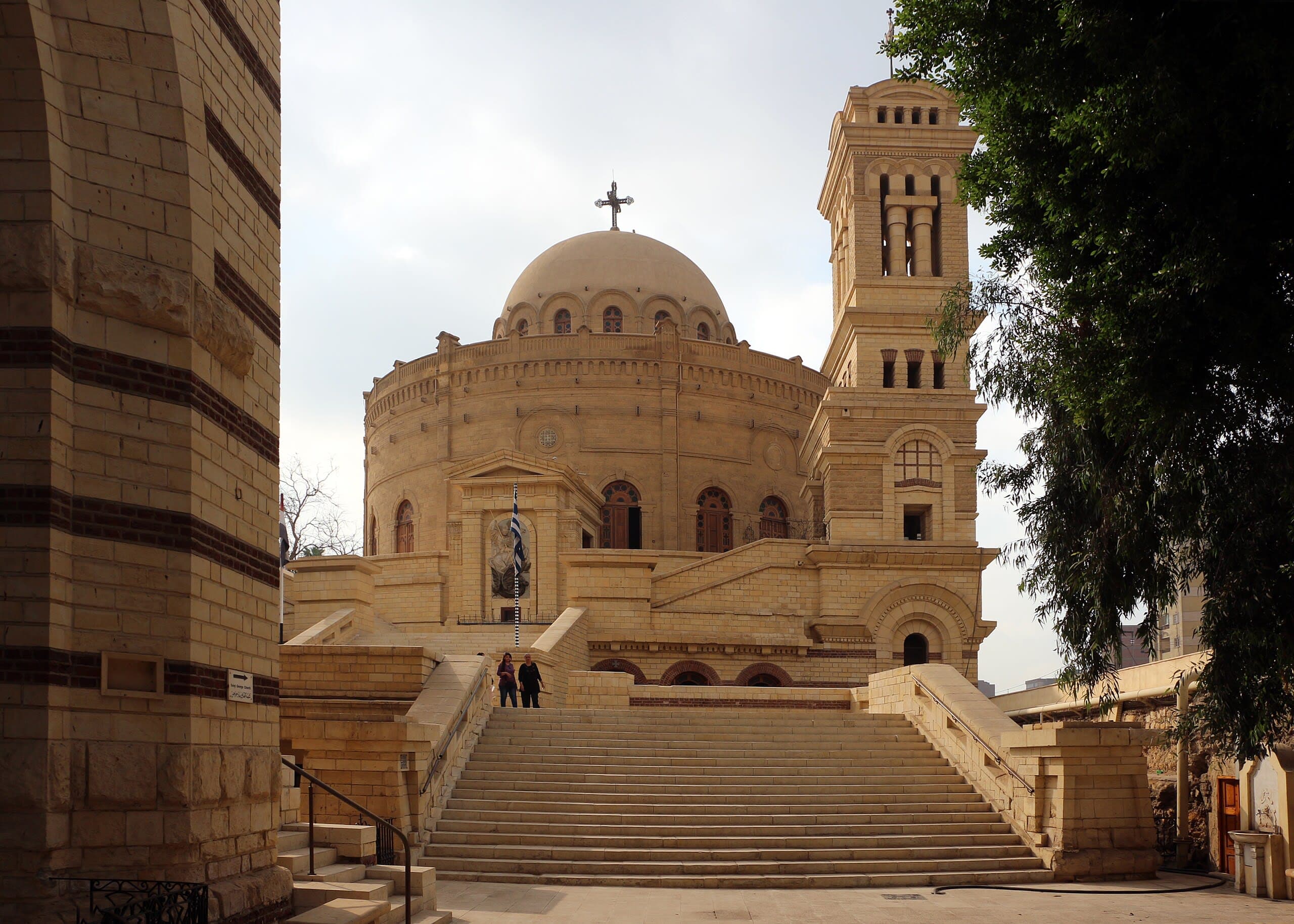
You climb the worn stone steps that ascend the exterior of a Roman tower, the same tower that flanked the entrance to Trajan's canal seventeen centuries ago. At the top, you enter a church unlike others, its sanctuary circular, its space intimate, its walls covered with icons and suffused with incense and candlelight. This is the Church of Saint George in Coptic Cairo, one of the most beloved shrines in Egypt.
Saint George was a Roman soldier who refused to renounce his Christian faith and died for it around 303 CE. The Copts call him Mari Girgis, the Prince of Martyrs, and they have built over two hundred churches in his honor across Egypt. This one, administered by the Greek Orthodox Patriarchate since the 15th century, sits at the heart of their shared devotion, a place where the Orthodox world's most venerated warrior saint meets the Egyptian Christianity that claims him with special intensity.
The church was rebuilt in 1909 after fire destroyed its predecessor, but its foundations are old. The Roman tower beneath your feet was built by Emperor Diocletian around 300 CE, the same emperor whose persecution created Saint George's martyrdom. The irony deepens the meaning: the persecutor's fortress now holds the martyr's shrine.
In the adjacent convent, nuns preserve the chains believed to have bound George during his torture. Pilgrims come, especially on Fridays and Sundays, to have these chains wrapped around them while prayers are offered for healing. The practice has continued since the 17th century. When you see it, you understand that this is not a museum. It is a place where medieval faith breathes in the present tense.
Each April 23rd, the molid of Mari Girgis draws thousands to Old Cairo. Despite the church being Greek Orthodox, Copts come in equal numbers, their shared devotion to the warrior saint transcending ecclesiastical boundaries. The narrow streets fill with celebration. The ancient walls absorb new prayers. The dragon-slayer, who in Egyptian understanding represents faith's triumph over imperial persecution, continues his victory.
Context And Lineage
The Church of Saint George is built upon a tower of the Roman Babylon Fortress constructed by Emperor Diocletian around 300 CE. The earliest church tradition dates to 684 CE. The current structure was rebuilt in 1909 after fire. The site serves as the principal Greek Orthodox church in Egypt while the adjacent Coptic convent preserves the chains tradition.
Saint George was a Roman soldier of Greek origin from Cappadocia who served in the Praetorian Guard under Emperor Diocletian. When Diocletian issued edicts persecuting Christians in 303 CE, George openly declared his faith before the Emperor. Refusing to renounce Christianity despite being offered wealth and positions, George was subjected to horrific tortures over seven years, including being bound with chains, placed on a wheel of swords, and thrown into boiling lime. Through divine intervention, according to tradition, he miraculously survived each torture. Finally, he was beheaded on April 23, 303 CE.
In Coptic tradition, the dragon that Saint George famously slays is understood as King Diocletian himself, called 'the dragon of the abyss.' The dragon-slaying legend symbolizes the victory of Christian faith over the persecuting Roman Empire. This interpretation connects to ancient Egyptian mythology where the hawk-headed god Horus defeats the crocodile-serpent Set, and the Copts see Saint George as the Christian fulfillment of this eternal battle between good and evil.
The church has been permanently under Greek Orthodox administration since the 15th century, serving as part of the Holy Patriarchal Monastery of St. George under the Greek Orthodox Patriarchate of Alexandria. Since 2009, the monastery's hegumen holds the rank of bishop with the title 'Bishop Babylonos' (Bishop of Babylon), connecting the ecclesiastical title to the ancient Roman fortress beneath. The adjacent Coptic convent preserves the chains tradition independently.
Saint George
martyr
Roman soldier and Christian martyr, known as 'Prince of Martyrs' in Coptic tradition. Died 303 CE under Diocletian's persecution. One of the most venerated saints in both Eastern and Western Christianity.
Emperor Diocletian
historical figure
Roman Emperor (284-305 CE) who built the Babylon Fortress and launched the persecution that created George's martyrdom. His fortress now supports the martyr's shrine.
Konstantinos Parthenis
artist
Greek artist who painted the church's interior during the 1907-1909 reconstruction using traditional fresco techniques.
Why This Place Is Sacred
The Church of Saint George draws its thinness from nearly two millennia of continuous worship above Roman foundations, the presence of relics believed to have touched the saint's body, the rare circular architecture creating a distinctive sacred space, and the ongoing healing rituals that demonstrate living faith in saintly intercession.
Something accumulates in a place that has been prayed in for seventeen centuries. The Roman tower was built around 300 CE, and Christians have worshiped above it since the religion became legal. The layers compress: Roman stone, Byzantine belief, Fatimid coexistence, Mamluk fire and survival, Ottoman continuation, modern revival. Each layer adds its weight.
The chains in the adjacent convent carry particular power. Tradition holds that they bound Saint George during his seven years of torture, that they touched the body of a martyr while he was being martyred. For those who accept this tradition, the chains are not merely symbolic but sacramental, conduits of the saint's presence and power. When the nuns wrap them around a pilgrim seeking healing, something is believed to transfer.
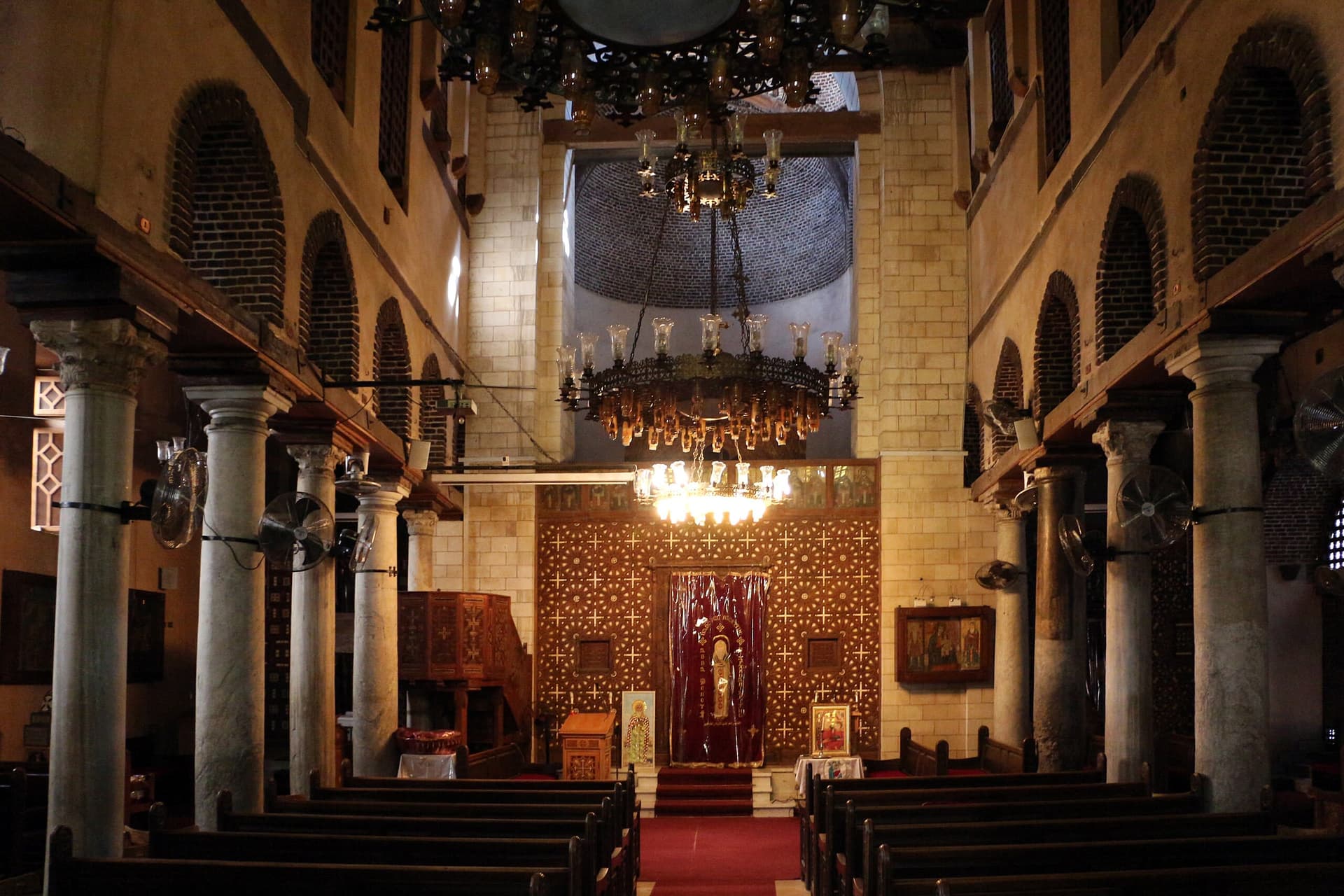
The circular architecture creates its own effect. Circular churches are rare in Christianity. The form encloses rather than directs, creating an intimate space where every part of the wall is equidistant from the center. Light enters through stained glass windows and refracts into the incense-thick air. The icons around the perimeter watch from all angles. You stand in the presence of witnesses.
The dual administration adds another dimension. Greek Orthodox and Coptic traditions, separated by centuries of Christological dispute, both claim Saint George with equal fervor. The church is Greek; the adjacent convent is Coptic; the pilgrims are both. This meeting point, where ecclesiastical boundaries dissolve in shared devotion, suggests something about the saint's power to unite.
The Roman tower beneath everything grounds the sacred in the historically tangible. You can descend into the lower levels and see the walls Diocletian built, the same emperor who created the persecution that made George a martyr. The persecutor's stones now support the martyr's shrine. The transformation could not be more complete.
The Roman tower was built as part of the Babylon Fortress, flanking the entrance to Trajan's canal. After Christianity became legal, the strategic location was transformed into sacred space. The earliest church on this site may date to the 7th century, though the tradition claims an older foundation.
The church has been rebuilt multiple times. The current structure dates to 1909, reconstructed after a devastating fire in 1904 that destroyed most of the previous building. The circular form was preserved or established in this reconstruction. The Greek artist Konstantinos Parthenis painted the interior. Despite the modern shell, the site's continuity with ancient worship remains unbroken.
Traditions And Practice
The church functions as an active Greek Orthodox place of worship with regular liturgical services. The adjacent Coptic convent conducts healing rituals with the chains of Saint George. The annual molid on April 23rd draws thousands of pilgrims from both traditions. Personal prayer and candle lighting are available daily.
Orthodox worship follows the Byzantine rite, with the Divine Liturgy celebrated regularly in the circular sanctuary. Icons of Saint George and other saints receive veneration. The healing ritual with the chains, conducted in the Coptic convent, has continued since at least the 17th century. Pilgrims with physical and mental ailments have the chain wrapped around them while prayers are offered for the saint's intercession.
The molid of Mari Girgis on April 23rd represents the most complete expression of devotion at this site. Despite the church being Greek Orthodox, thousands of Coptic pilgrims join the celebration, creating an ecumenical gathering that transcends ecclesiastical boundaries. Special liturgies, processions, and street celebrations mark the feast day.
The healing ritual with the chains remains available, primarily on Fridays and Sundays. Pilgrims seeking relief from physical ailments, mental disorders, anxiety, or spiritual affliction come to the convent. The nuns perform the ritual, wrapping the ancient chains around those who seek the saint's intercession.
For meaningful engagement with this site, consider these approaches:
Visit on a Friday or Sunday to witness or participate in the chains ritual at the convent. This living expression of pilgrimage faith offers something that ordinary tourism cannot.
Descend into the Roman tower foundations. Standing where Diocletian's soldiers stood, knowing what rises above, deepens the encounter.
Light a candle before the icon of Saint George. The gesture is simple, the effect connecting you to centuries of pilgrims who have done the same.
If possible, attend during the April molid. The transformation of the site during the feast reveals dimensions invisible at other times.
Greek Orthodox Christianity
ActiveThe Church of Saint George is the principal Greek Orthodox church in Egypt and serves as part of the Holy Patriarchal Monastery of St. George under the Greek Orthodox Patriarchate of Alexandria. Since 2009, the monastery's hegumen holds the rank of bishop. Saint George is one of the most venerated saints in Eastern Orthodoxy, celebrated as a Great Martyr and military saint.
Divine Liturgy and regular Orthodox services. Veneration of icons of Saint George. The annual Panegyris (feast day celebration) on April 23rd. Prayer services at the patriarchal seat.
Coptic Orthodox Christianity
ActiveAlthough the church itself is Greek Orthodox, Saint George (Mari Girgis) holds profound significance for Coptic Christians who call him 'The Prince of Martyrs.' The adjacent Convent of St. George (Deir Al-Banat) is Coptic and houses the famous chains of Saint George used in healing rituals since the 17th century. The annual molid draws thousands of Coptic pilgrims despite the church being under Greek Orthodox administration.
Veneration at the Shrine of the Chains of Saint George in the Convent. Healing rituals using the sacred chains for physical and mental ailments. The molid of Mari Girgis festival on April 23rd with processions and celebrations. Pilgrimage visits especially on Fridays and Sundays. Lighting candles and prayer for Saint George's intercession.
Experience And Perspectives
Visitors report awe at the unique circular architecture, a profound sense of historical continuity, moving experiences viewing the chains believed to have bound Saint George, and appreciation for the harmonious coexistence of Greek Orthodox and Coptic traditions at one sacred site.
The approach prepares you. The Mar Girgis metro station deposits you at the gates of Coptic Cairo, and you walk through narrow streets past ancient churches before climbing the stone steps that spiral up the Roman tower's exterior wall. The ascent itself is a transition, lifting you from the modern city into something older.
The church's circular interior surprises most visitors. The form is unusual, the space intimate, the atmosphere concentrated. Icons cover the walls. Incense hangs in the air, catching the colored light from stained glass windows. The dragon-slayer watches from multiple images: George on horseback, lance piercing the serpent that Copts understand as the persecuting emperor himself.
Descending to the Roman foundations creates another kind of encounter. The stones are rough, clearly ancient, unmistakably built by different hands for different purposes. Standing in Diocletian's tower, knowing that Diocletian's persecution created George's martyrdom, knowing that the martyr's shrine now rises above the persecutor's fortress, you feel history folding in on itself.
The chains, if you visit the convent and witness the healing ritual, bring everything to present tense. Here is medieval faith operating in the 21st century. Here are pilgrims seeking what pilgrims have sought for centuries. The 4.2-meter chain, wrapped around someone while prayers are offered, connects the present moment to a martyrdom seventeen centuries past.
The molid transforms the experience entirely. If you visit around April 23rd, you encounter not a quiet shrine but a celebration that fills the streets, that draws tens of thousands, that demonstrates the saint's ongoing power in Egyptian Christian life. The church becomes a center of gravity around which devotion swirls.
The Church of Saint George rewards multiple approaches. Visit first as a tourist, taking in the architecture and the Roman foundations. Then sit in the circular sanctuary, letting the icons become presences rather than objects. If you can witness the chains ritual at the convent, you will encounter living pilgrimage practice. If you time your visit for the April molid, you will see the site come fully alive.
The Church of Saint George invites multiple interpretations. Historical and archaeological perspectives illuminate its Roman foundations and medieval reconstruction. Greek Orthodox and Coptic traditions each claim the saint with distinctive emphases. The healing practice with the chains operates within a framework of faith that exceeds historical analysis.
Historical and archaeological scholars confirm that the church is built upon a Roman tower of the Babylon Fortress, constructed during the reign of Diocletian around 300 CE. The fortress was built at the site of an earlier Trajanic harbor. The church's establishment in its current form dates to the 10th century, with possible earlier origins. The 1904 fire and subsequent reconstruction resulted in the current structure. The church's alternating control between Coptic and Greek Orthodox communities reflects the complex ecclesiastical history of Christianity in Egypt.
In Coptic Orthodox tradition, Saint George (Mari Girgis) is one of the most beloved saints, known as 'The Prince of Martyrs.' The Copts have built over 200 churches in his honor throughout Egypt. The dragon-slaying imagery is understood as the triumph of Christian faith over the persecuting Roman Empire, with Diocletian himself being 'the dragon of the abyss.' The chains housed in the adjacent convent are venerated as authentic relics that touched the saint's body during his martyrdom, and through them, miraculous healings continue to occur by faith.
In Greek Orthodox tradition, Saint George is venerated as a Great Martyr and military saint. The church serves as the spiritual center for Greek Orthodox Christians in Egypt and part of the Patriarchal Monastery under Alexandria.
Some visitors and spiritual seekers interpret the unique circular architecture as having special energetic properties. The layered history of the site, from Roman fortress to Christian sanctuary, is sometimes understood as creating accumulated spiritual power. The chains healing tradition attracts interest from those studying alternative healing practices and the relationship between faith and physical or mental wellness.
Genuine mysteries remain. The exact date of the original church's establishment is uncertain, with traditions ranging from 684 CE to the 10th century. The precise origin and authentication of the chains as genuine relics of George's martyrdom cannot be scientifically verified. The nature of the reported healings, documented since the 17th century, has not been systematically studied. The extent of underground Roman structures that may remain undiscovered beneath modern ground level is unknown.
Visit Planning
The Church of Saint George is located in Coptic Cairo (Old Cairo), easily accessible via the Mar Girgis metro station. It is open daily from approximately 9:00 AM to 3:00 PM. The site can be combined with other Coptic Cairo attractions including the Hanging Church, Church of Saints Sergius and Bacchus, and Ben Ezra Synagogue.
Central Cairo offers accommodation at all price points. The site is easily accessible from anywhere in the city via metro or taxi.
As an active Greek Orthodox church and Coptic convent, modest dress is required. Photography is generally permitted but should be done respectfully, particularly avoiding services. Observe quietly if the chains ritual is being performed.
The Church of Saint George and adjacent convent are places of active worship, not museum displays. Your behavior should reflect this. The pilgrims you encounter are not extras in your tourism experience but people seeking something from the saint. The clergy and nuns have vocations, not jobs as heritage interpreters.
Modest dress is required. Shoulders and knees must be covered. This standard applies regardless of gender. Many visitors bring scarves or wraps to ensure compliance.
Photography presents nuances. The architecture invites documentation, and personal photography is generally permitted. But do not photograph during active services. Do not photograph pilgrims or clergy without permission. The chains ritual is particularly sensitive. If you witness it, do not treat it as a photo opportunity.
The site involves stairs and uneven surfaces. The climb up the Roman tower wall is manageable but requires reasonable mobility. The descent to the tower foundations involves steps that may be challenging for some visitors.
Modest dress is required. Shoulders and knees must be covered. Long pants or skirts below the knee are appropriate. Sleeveless shirts and tank tops are not permitted. Comfortable walking shoes recommended for stone steps.
Photography is generally permitted but should be done respectfully without flash. Avoid photographing during active services or ceremonies. Some areas of the convent may prohibit photography. Always ask permission before photographing clergy, nuns, or worshippers.
Candles can be purchased and lit as offerings at various shrines and icon stands. Donations to the church and monastery are appreciated and support preservation.
Maintain quiet and respectful behavior, especially during services. Modest dress required. No photography during active liturgical services. Be respectful when observing the chains healing ritual. Follow any instructions from clergy or staff. Some underground areas may be closed. Mobile phones should be silenced or turned off.
Sacred Cluster
Nearby sacred places create the location cluster described in the growth plan. This block is intentionally crawlable and links into the wider regional graph.