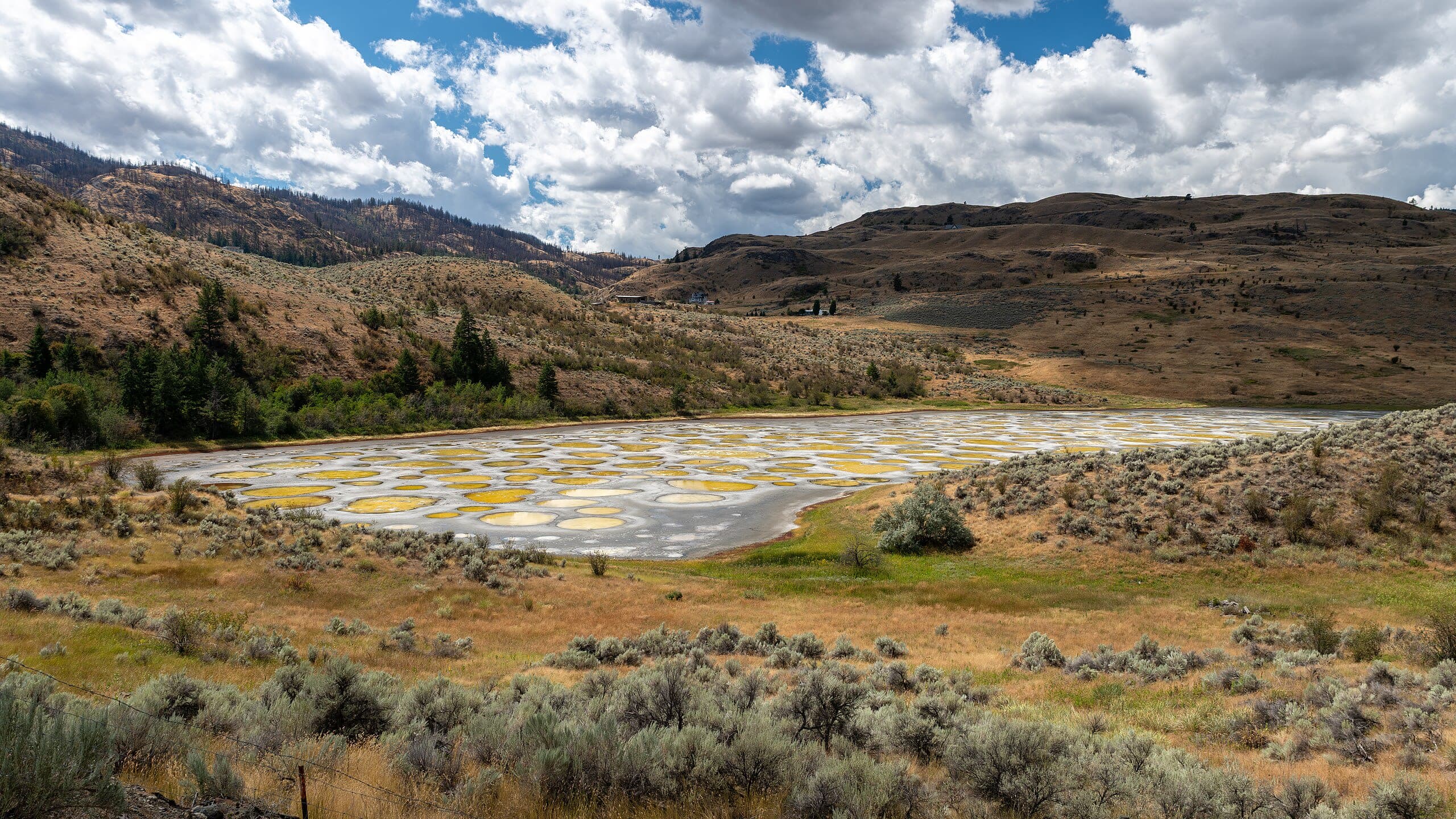
Spotted Lake, British Columbia, Canada
A medicine lake of 365 mineral pools, sacred to the Syilx Okanagan people since time immemorial
Area A (Osoyoos Lake), British Columbia, Canada
At A Glance
- Coordinates
- 49.0780, -119.5675
- Suggested Duration
- Fifteen to twenty minutes suffices for a brief stop at the Highway 3 viewpoint. Thirty to forty-five minutes allows time to absorb the spectacle, read the interpretive signage, and reflect. A half day is recommended if combining the Nk'Mip Desert Cultural Centre Spotted Lake Tour (approximately three hours for the complete experience including transport, lake visit, guided walk, and natural history program) with exploration of the Cultural Centre's exhibits and trails.
- Access
- The viewpoint is on Highway 3, approximately 10 km (6 miles) west of Osoyoos, British Columbia, on the north side of the road. A pull-off area provides parking. From Kelowna: approximately 2 hours south via Highway 97. From Vancouver: approximately 4.5 hours east via the Crowsnest Highway (Highway 3). No public transit runs directly to the viewpoint. For the guided tour, meet at the Nk'Mip Desert Cultural Centre at 1000 Rancher Creek Road, Osoyoos. Tour cost is approximately $99 per person with a minimum of 4 participants. The highway viewpoint is a flat roadside pull-off accessible to most visitors. The Nk'Mip Desert Cultural Centre is wheelchair accessible. Mobile phone signal is generally available along Highway 3; check with your carrier for coverage details in the surrounding area. No keyholder or booking is needed for the highway viewpoint. For the guided tour, book through the Nk'Mip Desert Cultural Centre website or by phone.
Pilgrim Tips
- The viewpoint is on Highway 3, approximately 10 km (6 miles) west of Osoyoos, British Columbia, on the north side of the road. A pull-off area provides parking. From Kelowna: approximately 2 hours south via Highway 97. From Vancouver: approximately 4.5 hours east via the Crowsnest Highway (Highway 3). No public transit runs directly to the viewpoint. For the guided tour, meet at the Nk'Mip Desert Cultural Centre at 1000 Rancher Creek Road, Osoyoos. Tour cost is approximately $99 per person with a minimum of 4 participants. The highway viewpoint is a flat roadside pull-off accessible to most visitors. The Nk'Mip Desert Cultural Centre is wheelchair accessible. Mobile phone signal is generally available along Highway 3; check with your carrier for coverage details in the surrounding area. No keyholder or booking is needed for the highway viewpoint. For the guided tour, book through the Nk'Mip Desert Cultural Centre website or by phone.
- No specific dress code. Sun protection is essential: hat, sunscreen, and sunglasses. The Osoyoos area regularly exceeds 35 degrees Celsius in summer. Comfortable shoes for the highway viewpoint. If taking the guided tour, ask the Nk'Mip Desert Cultural Centre for any specific guidance when booking.
- Photography is permitted from the Highway 3 viewing area, where the full mosaic pattern photographs well. If on a guided tour, follow the Syilx guide's instructions regarding photography and ask before photographing. Do not use drones over the lake without explicit permission from the Okanagan Nation Alliance. Do not photograph people engaged in ceremony or healing practices.
- Do not attempt to access the lake, touch the water, collect minerals, or cross the fence under any circumstances. The mineral crusts are extraordinarily fragile, and a single footprint can collapse a pool's structure and alter its chemistry for an entire season. Do not disturb the ceremonial cairns surrounding the lake. Do not fly drones over the site without explicit permission from the Okanagan Nation Alliance. Be aware that some tourism sources suggest the lake is open to visitors. It is not. Access beyond the highway viewpoint requires booking through the Nk'Mip Desert Cultural Centre. Be mindful that Syilx community members may be present for healing or ceremonial purposes. If you encounter anyone engaged in practice, give them complete privacy and silence.
Overview
In the semi-arid hills west of Osoyoos, British Columbia, a lake reveals its inner chemistry each summer. As water evaporates, hundreds of mineral pools emerge in shifting circles of green, blue, yellow, and white. The Syilx Okanagan people know this place as kłlilx'w, a sacred medicine lake whose healing waters have drawn First Nations peoples from across the region for thousands of years. Returned to Syilx ownership in 2001, the lake remains a living site of healing and ceremony.
Before the highway ran past it, before the minerals were extracted for wartime ammunition, before a non-indigenous landowner tried to build a spa on its shores, there was this lake and the people who understood what it held.
Spotted Lake sits in the eastern Similkameen Valley, surrounded by the dry golden hills of Canada's only true desert. For most of the year, it looks like an ordinary body of water. Then summer comes. As temperatures climb above 35 degrees Celsius, evaporation begins to draw down the water and something extraordinary surfaces: hundreds of circular mineral pools, each a distinct color, each containing a different concentration of magnesium sulfate, calcium, sodium sulphates, and trace minerals including silver and titanium. The effect is a mosaic of colored circles against the pale mineral crust between them.
The Syilx Okanagan people call this place kłlilx'w, a name that carries the meaning of sacred place in the Nsyilxcən language. They recognize 365 naturally formed pools, each understood to possess distinct healing properties. From time immemorial, Syilx Elders, healers, and community members have come here for physical and spiritual healing. The lake's reputation was so widely recognized that Indians from all tribes came to visit for its medicine, and warring peoples would declare truces so their wounded could access its waters.
The countless ceremonial cairns surrounding the lake, described as too numerous to count, testify to millennia of spiritual engagement. This is not a place that was once sacred. It is sacred now, actively stewarded by the Okanagan Nation Alliance and visited by Elders who continue to bring community members here to heal.
Visitors are welcome to view the lake from the highway. Understanding what they are looking at requires more than a glance.
Context And Lineage
Spotted Lake's significance to the Syilx Okanagan people predates all written records. The lake was a site of inter-tribal healing pilgrimage long before colonial contact. Its 20th-century history includes mineral extraction for World War I ammunition, decades of non-indigenous ownership, and a pivotal 2001 purchase that returned the land to Syilx stewardship. Today, the Okanagan Nation Alliance manages the site while the Nk'Mip Desert Cultural Centre offers guided tours on indigenous terms.
The specific origin stories and sacred narratives about kłlilx'w are held within the Syilx community and are not publicly documented in detail. This reflects appropriate cultural protocols around sacred indigenous knowledge. What is publicly shared is that the lake has been recognized as a sacred medicine place from time immemorial. The Syilx understanding of the lake's sacredness is rooted in direct, sustained relationship with the land rather than a single origin narrative accessible to outsiders.
The more widely shared account concerns the lake's inter-tribal reputation. The healing power of the waters was recognized so broadly that Indians from all tribes came to visit the lake for its medicine. According to tradition, warring tribes would declare truces so that wounded warriors from both sides could access the healing waters. This tradition speaks to the lake's status as a place that transcended political and territorial boundaries. Its sacred healing nature commanded universal respect, even amid conflict.
The geological story offers another layer. Spotted Lake is a saline endorheic alkali lake, meaning its closed drainage has concentrated minerals over geological time. The pools form through seasonal evaporation, each concentrating a different mineral signature. Scientists study it as a terrestrial analog for Martian evaporite terrains. The same chemistry that draws astrobiologists drew Syilx healers, though they would have framed the question differently.
The lineage of practice at Spotted Lake is unbroken, though it has weathered disruption. For millennia, the Syilx Okanagan people and neighbouring First Nations maintained the lake as a place of healing and ceremony. The ceremonial cairns that surround it accumulated across centuries of sustained engagement.
Colonial-era disruptions included the extraction of minerals during World War I and the acquisition of the surrounding land by non-indigenous owners. For approximately forty years in the 20th century, the lake's custodianship was severed from the people who understood it best.
The 2001 return to Syilx ownership was not merely a property transaction. It was a restoration of relationship. Since then, the Okanagan Nation Alliance has assumed active stewardship, and Syilx Elders have continued to bring community members to the lake for healing.
The Nk'Mip Desert Cultural Centre, opened by the Osoyoos Indian Band, now serves as a bridge between the Syilx community and the wider world. Its guided tours offer visitors the lake's significance as the Syilx choose to share it, an act of cultural generosity that preserves the community's authority over their own sacred knowledge.
Syilx Okanagan Elders and Knowledge Keepers
traditional custodians
Across generations, Syilx Elders and knowledge keepers have maintained the relationship between the people and the lake, bringing community members to kłlilx'w for physical and spiritual healing. They are the living carriers of the lake's traditional knowledge.
Chiefs of the Okanagan Nation Alliance
political leaders
Led the decades-long effort to reacquire Spotted Lake and return it to Syilx stewardship. In October 2001, they finalized the purchase of 22 hectares for $720,000, ending approximately forty years of non-indigenous ownership.
Ernest Smith
historical figure
Non-indigenous landowner who controlled the Spotted Lake area for approximately forty years in the 20th century. His 1979 attempt to develop a spa facility at the lake catalyzed First Nations efforts to reclaim the site.
Robert Nault
government official
Federal Minister of Indian Affairs and Northern Development who finalized the 2001 acquisition of the Spotted Lake lands for the use and benefit of the Okanagan First Nation.
Why This Place Is Sacred
Spotted Lake's sacredness emerges from the convergence of extraordinary geology and sustained indigenous recognition. Three hundred and sixty-five mineral pools, each with a unique chemical signature, are understood by the Syilx people as individual sources of healing. The lake's reputation transcended tribal boundaries, compelling even warring nations to lay down arms. Millennia of ceremonial cairns encircle the waters. The 2001 return to Syilx ownership restored a relationship that colonialism disrupted but could not sever.
What makes a place sacred? Geologists offer one answer for Spotted Lake: it is a saline endorheic alkali lake, meaning it has no outflow. Over geological time, minerals have concentrated in this closed basin to extraordinary density. The lake contains some of the highest known concentrations of magnesium sulfate, calcium, and sodium sulphates of any water body, along with at least eight additional minerals and trace amounts of silver and titanium. Each summer, evaporation reveals this hidden chemistry as a constellation of colored circles.
But mineral concentration does not explain why, for as long as anyone can remember, people have come here seeking healing.
The Syilx Okanagan understanding of kłlilx'w extends beyond what Western science can measure. Each of the 365 pools is recognized as possessing distinct therapeutic and spiritual qualities. The waters and mud have been gathered by healers and applied for wounds, skin diseases, aches, and illness, but also for something less easily named: spiritual healing, the mending of what is broken inside a person rather than on their surface. Syilx Elders and knowledge keepers have spent decades bringing community members to the lake to help them heal, whether the ailment is of body or spirit.
The lake's power was never a local secret. Its reputation drew First Nations peoples from across the region, making kłlilx'w a site of inter-tribal pilgrimage. The tradition holds that warring tribes would cease hostilities to allow their wounded access to the healing waters. A place that could halt warfare commands a respect that transcends the geological.
The ceremonial cairns surrounding the lake offer physical testimony. They are described as too numerous to count, accumulated through centuries of ritual engagement. No systematic archaeological study of these cairns has been published, which means their full story remains partially told. What they communicate without excavation is persistence: generation after generation returned here, each leaving a mark of their encounter.
The lake's seasonal transformation carries its own contemplative weight. In winter, the mineral secrets lie hidden beneath uniform water. In summer, the earth's inner chemistry surfaces in brilliant color, visible to anyone who looks. This annual cycle of concealment and revelation mirrors something found across spiritual traditions: the understanding that sacred knowledge is always present but visible only under the right conditions.
Spotted Lake has served as a sacred medicine site for the Syilx Okanagan people since time immemorial. There is no founding date and no founder. The lake is a natural geological formation that has been recognized as a place of physical and spiritual healing for as long as the Syilx people's relationship with this land has existed. The ceremonial cairns surrounding the lake attest to centuries of sustained use. Its purpose has never changed: it is a place where the earth offers healing to those who approach with the proper relationship.
The core of Spotted Lake's significance has remained constant across millennia, but the context around it has shifted dramatically.
During World War I, the lake's minerals were extracted for ammunition manufacturing. In 1915, records show 1,500 tons of material mined, producing over 707,000 kilograms of magnesium sulphate. The lake that healed was turned, briefly, into a source of material for killing.
In the mid-20th century, the Ernest Smith family acquired control of the land surrounding the lake for approximately forty years. In 1979, Smith attempted to develop a spa facility on the site. The proposal galvanized indigenous advocacy. What had been a quiet wound became an urgent cause.
The turning point came in October 2001, when the Chiefs of the Okanagan Nation Alliance and the federal Minister of Indian Affairs finalized the purchase of the 22-hectare site for $720,000. The Okanagan Nation contributed approximately twenty percent of the cost. The land was returned to Syilx stewardship.
Since 2001, the Okanagan Nation Alliance has actively managed the site: installing protective fencing, erecting interpretive signage along Highway 3, monitoring for climate change impacts and pollution, and managing access. The Nk'Mip Desert Cultural Centre, owned and operated by the Osoyoos Indian Band, now offers guided tours led by Syilx community members, ensuring that the lake's story is shared on indigenous terms.
Traditions And Practice
Spotted Lake is an active site of Syilx Okanagan traditional healing, where Elders continue to bring community members for physical and spiritual medicine. Specific ceremonial details are held within the Syilx community. General visitors do not participate in healing practices but may engage through guided tours led by Syilx community members at the Nk'Mip Desert Cultural Centre.
For as long as the Syilx Okanagan people have lived in the Okanagan Valley, they have gathered water and therapeutic mud from kłlilx'w for medicinal and spiritual purposes. Tribal healers applied the mineral-rich materials to treat wounds, skin diseases, aches, and illness. The healing was not understood as merely chemical but as the earth's own medicine, offered through a relationship that required respect and ceremony.
Access to the waters was traditionally governed by Elders and healers, reflecting a structured spiritual relationship with the lake rather than casual use. One did not simply walk to the lake and take what one wished. The proper approach involved guidance, intention, and ceremony.
The ceremonial cairns surrounding the lake, described as too numerous to count, are evidence of sustained ritual activity spanning centuries. Their precise age and ceremonial context have not been studied through systematic archaeology, but their presence speaks clearly: this was a place where people came, performed something meaningful, and marked their engagement.
The tradition of inter-tribal healing truces indicates that the lake's ceremonial significance was recognized across cultural boundaries. The act of setting aside warfare to access healing waters speaks to a shared understanding of the sacred that transcended political identity.
Syilx Elders and knowledge keepers continue to bring community members to the lake for physical and spiritual healing. The Okanagan Nation Alliance manages the site with attention to both ecological integrity and cultural significance. Monitoring includes tracking climate change impacts on the lake's evaporation patterns, pollution threats, and unauthorized access.
The Nk'Mip Desert Cultural Centre, owned and operated by the Osoyoos Indian Band, offers the Spotted Lake Tour as a way for the wider public to engage with the site on Syilx terms. The tour is led by a Syilx Nation community member and includes transport from the Cultural Centre, time at the lake, a guided walk, and a natural history program.
Specific ongoing ceremonial practices remain internal to the Syilx community. This is not secrecy but sovereignty: the right of a people to determine how their sacred knowledge is shared.
General visitors do not participate in Syilx healing practices at the lake. These are community practices, not public offerings.
What visitors can do is approach the experience with care. At the Highway 3 viewpoint, allow the visual spectacle to settle before reaching for your camera. Read the interpretive signage. Consider that each of those colored circles is understood by Syilx healers to hold distinct healing properties, and that people have traveled great distances, across tribal lines, across centuries, to access those waters.
If you have booked the Nk'Mip Desert Cultural Centre tour, listen more than you ask. The Syilx guide will share what they choose to share. What they do not share is equally meaningful: it speaks to the depth of what the lake holds.
The most meaningful thing a visitor can do at Spotted Lake is sit with the understanding that not everything sacred is meant to be accessed. Some things are meant to be witnessed with respect from the distance they require.
Syilx Okanagan Sacred Medicine Tradition
ActiveFor thousands of years, the Syilx Okanagan people have visited kłlilx'w as a sacred medicine lake. The name itself carries the meaning of sacred place in the Nsyilxcən language. The lake's 365 mineral pools are each understood to possess unique healing properties. The relationship between the Syilx people and the lake is not utilitarian but profoundly spiritual: the lake is a living medicine entity whose gifts require respect and ceremony. Syilx Elders and knowledge keepers continue to bring community members here for both physical and spiritual healing.
Traditional practices include the gathering of mineral-rich water and therapeutic mud by tribal healers for medicinal application, Elder-led healing ceremonies, and spiritual practices at the lake. Access to the waters was and is governed by Elders and healers, maintaining a structured ceremonial relationship with the land. The ceremonial cairns surrounding the lake evidence sustained ritual activity over centuries. Specific ceremonial details are held within the Syilx community and are not for public documentation.
Inter-tribal Healing Pilgrimage
HistoricalThe healing power of Spotted Lake was recognized far beyond the Syilx Nation. First Nations peoples from across the region traveled to the lake for its medicine, making kłlilx'w a site of inter-tribal significance. The lake's reputation was so profound that warring tribes would declare truces so wounded warriors from both sides could access the healing waters. This tradition speaks to the lake's status as a place that transcended political and territorial boundaries.
Warriors and community members from multiple First Nations traveled to the lake to treat wounds, aches, and illness using the mineral-rich waters and mud. During times of conflict, truces were established to ensure continued access to the healing waters for all parties. The tradition reflects an understanding that certain sacred places belong to no single people but serve all who approach with need.
Scientific and Astrobiological Research
ActiveSpotted Lake has been a subject of scientific inquiry since at least 1918, when the earliest documented saline lake study in British Columbia was conducted here. Contemporary research focuses on the lake as a terrestrial analog for Martian evaporite environments, studying extremophilic microorganisms that survive in its hypersaline pools.
Researchers study the lake's mineral composition, seasonal evaporation cycles, and microbial ecosystems. The lake's epsomite-dominant chemistry and seasonal patterns provide insights into conditions that may have existed on Mars. Any research on Syilx lands requires coordination with the Okanagan Nation Alliance.
Indigenous Cultural Tourism and Education
ActiveSince the lake's return to Syilx ownership, the Osoyoos Indian Band has developed culturally guided tourism through the Nk'Mip Desert Cultural Centre, offering the public access to the lake's significance on indigenous terms. This represents a model of indigenous self-determination in cultural heritage sharing.
The Nk'Mip Desert Cultural Centre offers guided Spotted Lake tours led by Syilx Nation community members. The tour includes transport, a guided visit at the lake, a walking tour of the Cultural Centre's desert trail, and a natural history program. The Cultural Centre also houses exhibits on Syilx history, a reconstructed traditional village, and the Inkameep Day School Art Collection.
Experience And Perspectives
Most visitors encounter Spotted Lake from the Highway 3 viewpoint, where the full mosaic pattern of colored mineral pools spreads across the valley below. The visual spectacle prompts an immediate response, but what deepens the experience is learning what the lake means to the Syilx people and understanding why access is restricted. Those who book a guided tour through the Nk'Mip Desert Cultural Centre come closer to grasping both the geology and the sacredness.
You come upon it suddenly. Driving west on Highway 3 from Osoyoos, the dry golden hills give nothing away. Then, on the north side of the road, the lake appears: a broad, shallow depression filled with circles of color against pale mineral crust. Green, blue, yellow, white, brown. Each circle distinct, hundreds of them spread across the lake bed like something designed rather than geological.
The first response is visual. The pattern is unlike anything most visitors have seen in a natural landscape. Photographs cannot quite capture it because the pools shift color throughout the summer as evaporation changes the mineral concentrations. What you see in July will differ from August, and neither will match September.
The second response, for those who read the interpretive signage or have done any preparation, is a shift in understanding. This is not a curiosity. It is a medicine lake, actively sacred, owned and stewarded by the Syilx Okanagan Nation. The fence that prevents access is not bureaucratic caution. It is protection of a living relationship between a people and a place.
From the highway viewpoint, the full scope of the lake is visible. Binoculars or a zoom lens reveal individual pools in sharper detail. Early morning light illuminates the pools well, as the viewpoint faces roughly east-northeast toward the lake. The surrounding landscape, arid hills in the rain shadow of the Cascade Mountains, provides a stark frame for the lake's concentrated color.
Visitors who book the Spotted Lake Tour through the Nk'Mip Desert Cultural Centre enter a different order of experience. The tour begins with pickup at the Cultural Centre at 8:30 AM, arriving at the lake at 9:00 AM. A Syilx Nation community member leads the tour, sharing what they choose to share about the lake's significance. The return to the Centre at 10:00 AM is followed by a guided walk and a natural history program. Hearing a Syilx community member speak about their relationship with the lake shifts the encounter from spectacle to meaning.
The restriction on access carries its own lesson. A single bootprint can collapse the fragile mineral crusts and alter a pool's chemistry for an entire season. The damage is real, not theoretical. Not everything sacred is meant to be touched or entered. Viewing the lake from a distance, knowing what it holds, knowing that Syilx Elders continue to bring their people here for healing, changes what distance means.
Before you arrive, consider what you are approaching. Spotted Lake is not a geological novelty. It is a living sacred site where healing practices continue under the guidance of Syilx Elders. Your visit begins with that recognition.
If you plan only to stop at the Highway 3 viewpoint, arrive in the morning when the light is best and the pull-off area is less crowded. Allow at least thirty minutes rather than a quick stop. Read the interpretive signage before looking at the lake. Let the context inform what you see.
If you want a deeper experience, book the Spotted Lake Tour through the Nk'Mip Desert Cultural Centre well in advance. The tour runs seasonally with a minimum of four participants. This is the only way to approach the lake more closely, and it supports Syilx cultural tourism directly.
Bring sun protection. The Osoyoos area is Canada's only true desert, and summer temperatures regularly exceed 35 degrees Celsius. Bring water. Binoculars or a zoom lens will reward you at the highway viewpoint.
Do not cross the fence. Do not attempt to access the lake. Do not fly a drone over it. The respect you bring is the most important thing you carry.
Spotted Lake holds meaning across multiple frameworks. For the Syilx Okanagan people, it is a living medicine lake where healing has been practiced since time immemorial. For geologists, it is one of the most minerally concentrated water bodies on earth. For astrobiologists, it is a terrestrial analog for conditions on Mars. Each perspective reveals something; none claims the whole.
Geologists classify Spotted Lake as a saline endorheic alkali lake containing dense deposits of magnesium sulfate (epsomite), calcium sulphate, and sodium sulphates, along with high concentrations of at least eight additional minerals and trace amounts of silver and titanium. The characteristic spotted pattern forms through seasonal evaporation: as temperatures rise, water loss leaves behind concentrated mineral deposits in circular pools. Different mineral concentrations create different colors.
The lake was the subject of the earliest documented scientific study of a saline lake in British Columbia, conducted around 1918. During World War I, its minerals were commercially extracted for ammunition production, with records showing 1,500 tons of material mined in 1915 yielding over 707,000 kilograms of magnesium sulphate.
Contemporary scientific interest centers on the lake as a terrestrial analog for Martian environments. Its seasonal hypersalinity, epsomite dominance, and visual similarities to evaporite terrains observed on the Martian surface make it valuable for astrobiological research. Studies of extremophilic microorganisms in the lake's hypersaline pools contribute to understanding whether microbial life could survive in similar extraterrestrial conditions.
What science can document is the chemistry. What it cannot explain is why, for thousands of years, people understood this chemistry as medicine before anyone had the word for magnesium sulfate.
The Syilx Okanagan understanding of kłlilx'w is rooted in a relationship with the lake that extends back to time immemorial. The lake is not a collection of useful minerals but a sacred medicine entity, a place where the earth offers healing through waters and mud that have been used by Elders, healers, and community members across countless generations.
Each of the 365 mineral pools is understood to possess distinct healing properties. The specific knowledge about individual pools and their applications is held within the Syilx community according to appropriate cultural protocols. What is shared publicly is the broader truth: this is a place where physical and spiritual healing converge, where the boundary between body and spirit is understood to be permeable.
The lake's sacredness is evidenced by the ceremonial cairns that surround it, too numerous to count, and by the tradition of inter-tribal truces that allowed even enemies access to its healing waters. The return of the lake to Syilx ownership in 2001 is understood not as a real estate transaction but as a restoration of the proper relationship between the people and their medicine lake.
To approach kłlilx'w only through Western scientific categories is to miss what the Syilx have always known: the lake is alive in a way that chemistry alone cannot describe.
Some visitors and spiritual seekers describe Spotted Lake as a site of concentrated earth energy, interpreting the mineral pools as visible manifestations of the earth's hidden energetic patterns. The circular formations have been compared to mandalas, cellular structures, and cosmic patterns. The lake's dramatic seasonal transformation, from uniform water to a constellation of colored circles, is sometimes read as a metaphor for spiritual awakening or the surfacing of hidden knowledge.
The convergence of extreme geological conditions with millennia of indigenous sacred recognition is cited by some as evidence of a genuine place where physical and spiritual realities intersect. The scientific interest in the lake as a Mars analog adds another dimension for those who find cosmic significance in terrestrial sacred sites.
These interpretations exist alongside, not within, the Syilx tradition. They are the observations of outsiders attempting to articulate what they sense. The Syilx understanding of the lake precedes and encompasses these perspectives without needing to name them.
Genuine mysteries remain at Spotted Lake. The full depth of Syilx traditional knowledge about individual pools and their specific healing properties exists within the community but is not publicly documented. The ceremonial cairns surrounding the lake have not been systematically studied, and their precise ages and purposes remain open questions. Whether the lake's mineral composition has changed significantly over geological time or remained relatively stable is not well understood.
The specific mechanisms by which the lake's minerals may produce therapeutic effects have not been subjected to rigorous modern clinical study, though the mineral compounds present are known to have therapeutic applications in other contexts. The full extent of extremophilic microbial life within the hypersaline pools remains an active area of research.
Perhaps the deepest mystery is one that resists scientific framing entirely: why this particular mineral lake, among all the lakes in the world, was recognized as sacred by multiple peoples across multiple millennia. Chemistry offers part of an answer. Lived experience, accumulated across thousands of years of healing, offers another part. The rest remains between the lake and those who know it best.
Visit Planning
Spotted Lake is visible from a pull-off along Highway 3, approximately 10 km west of Osoyoos, British Columbia. The mineral pools are best seen from late June through early September. For closer access, book the Spotted Lake Tour through the Nk'Mip Desert Cultural Centre. Mobile phone signal is generally available along Highway 3, though coverage may be patchy in the surrounding hills.
The viewpoint is on Highway 3, approximately 10 km (6 miles) west of Osoyoos, British Columbia, on the north side of the road. A pull-off area provides parking. From Kelowna: approximately 2 hours south via Highway 97. From Vancouver: approximately 4.5 hours east via the Crowsnest Highway (Highway 3). No public transit runs directly to the viewpoint. For the guided tour, meet at the Nk'Mip Desert Cultural Centre at 1000 Rancher Creek Road, Osoyoos. Tour cost is approximately $99 per person with a minimum of 4 participants. The highway viewpoint is a flat roadside pull-off accessible to most visitors. The Nk'Mip Desert Cultural Centre is wheelchair accessible. Mobile phone signal is generally available along Highway 3; check with your carrier for coverage details in the surrounding area. No keyholder or booking is needed for the highway viewpoint. For the guided tour, book through the Nk'Mip Desert Cultural Centre website or by phone.
Osoyoos, 10 km east, offers a full range of accommodation including hotels, motels, resorts, and vacation rentals. The Spirit Ridge Resort is located on Osoyoos Indian Band lands adjacent to the Nk'Mip Desert Cultural Centre and directly supports indigenous tourism. Camping is available at nearby provincial parks. No seasonal closures apply to the highway viewpoint, though the mineral pools are only visible in summer. Check the Nk'Mip Desert Cultural Centre website for current tour schedules and seasonal availability.
Spotted Lake is Syilx Okanagan Nation land. Do not cross the fence or attempt to access the lake. View from the designated Highway 3 lookout unless on an authorized guided tour. Do not photograph people in ceremony. Do not disturb cairns. Support Syilx cultural institutions by booking tours through the Nk'Mip Desert Cultural Centre.
The most important thing to understand at Spotted Lake is that you are on the boundary of someone else's sacred space. The fence is not a suggestion. It marks the edge of Syilx Okanagan Nation land where active healing practices continue.
From the Highway 3 viewpoint, you are a welcome observer. The Syilx people have erected interpretive signage and maintain the viewing area so that the lake's significance can be shared. This is a generous act of cultural bridge-building. Honor it by reading the signage, by taking time rather than treating the stop as a quick photo opportunity, and by speaking about what you have seen with accuracy and respect.
If you encounter Syilx community members at or near the lake, whether during a guided tour or from the highway, remember that you may be witnessing people engaged in something deeply personal. Do not press guides for information they choose not to share. The boundaries around sacred knowledge are themselves meaningful.
Use the Syilx name kłlilx'w alongside the English name Spotted Lake when speaking or writing about this place. Names carry meaning, and using the indigenous name acknowledges whose place this is.
The most respectful offering a visitor can make is not a physical object left at the site but financial support for Syilx cultural institutions. Book the guided tour. Visit the Nk'Mip Desert Cultural Centre. Purchase from the gift shop. These are concrete ways to ensure that the Syilx people benefit from interest in their sacred site.
No specific dress code. Sun protection is essential: hat, sunscreen, and sunglasses. The Osoyoos area regularly exceeds 35 degrees Celsius in summer. Comfortable shoes for the highway viewpoint. If taking the guided tour, ask the Nk'Mip Desert Cultural Centre for any specific guidance when booking.
Photography is permitted from the Highway 3 viewing area, where the full mosaic pattern photographs well. If on a guided tour, follow the Syilx guide's instructions regarding photography and ask before photographing. Do not use drones over the lake without explicit permission from the Okanagan Nation Alliance. Do not photograph people engaged in ceremony or healing practices.
Do not leave any objects, offerings, or materials at the lake or along the fence. The most respectful offering is supporting Syilx cultural institutions: book a guided tour through the Nk'Mip Desert Cultural Centre, visit the Cultural Centre, and share accurate information about the site's significance.
Do not cross the fence or attempt to access the lake. Do not swim in, touch, wade in, or collect water, mud, or minerals. Do not disturb or remove ceremonial cairns. Do not trespass on surrounding lands. Carry out all rubbish. Do not use drones without Okanagan Nation Alliance permission. Be mindful that Syilx community members may be present for healing or ceremonial purposes.
Sacred Cluster
Nearby sacred places create the location cluster described in the growth plan. This block is intentionally crawlable and links into the wider regional graph.