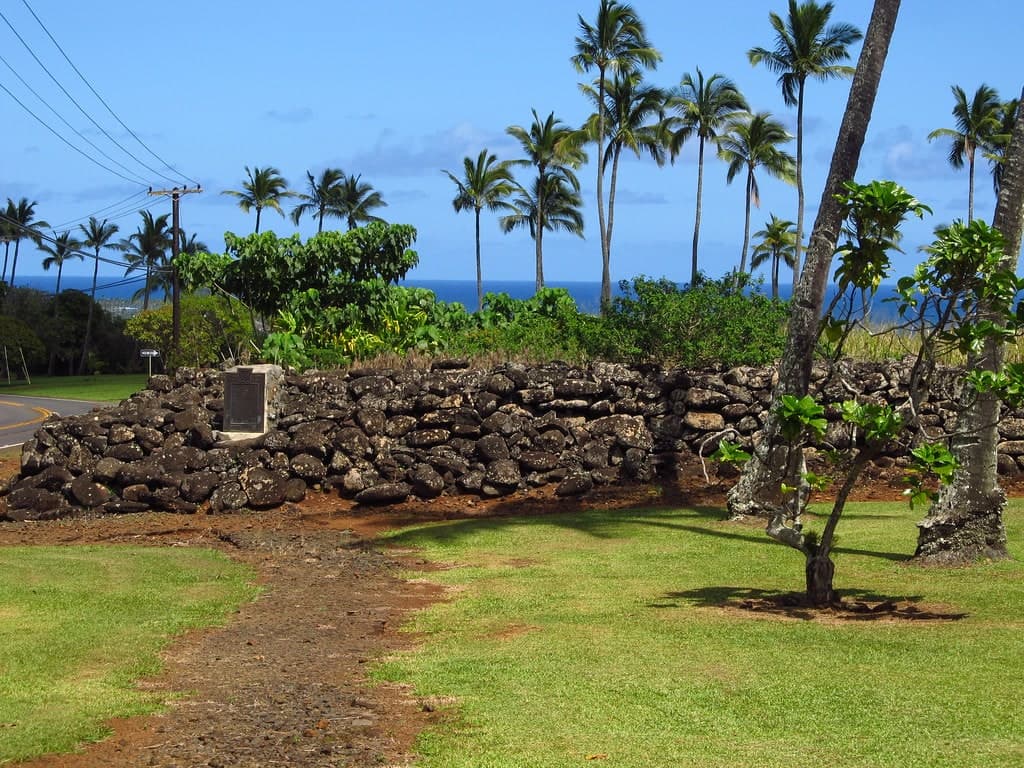
Poli'ahu Heiau, Kauai
A royal temple on a bluff above the sacred Wailua River, where Hawaiian chiefs once walked between worlds
Kapaa, Hawaii, United States
At A Glance
- Coordinates
- 22.0464, -159.3546
- Suggested Duration
- 15-30 minutes for the heiau visit. Combine with Opaeka'a Falls viewpoint directly across the road for a 30-45 minute stop. The site requires no hiking and can be visited efficiently.
Pilgrim Tips
- Casual outdoor clothing appropriate for tropical weather. Comfortable walking shoes recommended though no significant walking is required. No specific ceremonial attire is expected of visitors.
- Photography is permitted from viewing areas. Exercise respect when photographing this sacred site. Do not use the heiau as a casual backdrop for social media content.
- Do not enter areas marked as kapu. Do not climb on or sit upon the heiau walls. Do not remove any stones or artifacts. Do not leave offerings unless you are engaged in sanctioned Hawaiian cultural practice. The site's openness to visitors does not extend to participation in improvised spiritual activities. Respect the boundary between witness and intrusion.
Overview
On a bluff above Kauai's Wailua River, massive stone walls enclose a temple that once served the island's paramount chiefs. The Hawaiians called this region Wailuanui-hoano, great and sacred Wailua, and built seven heiau stretching from ocean to the rain-veiled summit of Wai'ale'ale. Poli'ahu Heiau stands where the divine and human realms intersected. Though the kapu system ended in 1819, central areas remain marked as forbidden. The sacred endures.
The Wailua River drains from Wai'ale'ale, one of the wettest places on Earth, winding through a valley that the Hawaiians recognized as among the most sacred on Kauai. On a bluff above this river, overlooking both the bay below and the mountains where the water originates, the ali'i built Poli'ahu Heiau. The temple walls rise five feet high and equally wide, enclosing more than an acre of ground. This was not a minor shrine but a seat of power.
The heiau's name connects it to Poli'ahu, goddess of snow who dwells atop Mauna Kea. Some sources suggest it was instead a luakini heiau, dedicated to Ku, the god of war. Whatever deities were honored here, the site functioned as a place where the paramount chief maintained the relationship between his people and the gods. The bellstone nearby, struck with ritual precision, announced royal births and the approach of sacred processions. The sound carried down the valley, marking moments when the ordinary gave way to the ceremonial.
Traditional Hawaiian religion ended when King Kamehameha II abolished the kapu system in 1819. The heiau fell silent. Yet something persists. The State of Hawaii marks the central areas as kapu, off-limits, acknowledging that sacredness does not expire with the ending of formal practice. Visitors who approach this place with reverence rather than mere curiosity may find that the threshold remains thin. The stones remember what was once prayed here.
Context And Lineage
Poli'ahu Heiau was part of the most sacred region on Kauai, seat of the paramount chief and location of seven temples connecting ocean to mountain summit. Built by unknown hands, possibly centuries before Western contact, the heiau served as a ceremonial center until 1819.
Hawaiian tradition credits the menehune with building Poli'ahu Heiau. These legendary small people were said to have inhabited the islands before the arrival of the Polynesians, capable of completing massive construction projects in a single night. According to one account, the menehune brought the stones from the Westside of Kauai, working with supernatural speed and coordination.
The heiau's name offers another origin thread. Poli'ahu is the Hawaiian goddess of snow, one of four sisters who dwell atop Mauna Kea on the Big Island. She is known for her beauty and her rivalry with Pele, goddess of fire and volcanoes. If the heiau was indeed dedicated to Poli'ahu, it creates a spiritual connection between Kauai and the distant sacred peak, honoring the elemental forces of cold and mountain against the island's tropical warmth.
Other sources identify the heiau as a luakini, dedicated to Ku, the war god, and reserved for the most significant ceremonies of the ruling chiefs. The truth may encompass multiple dedications across the centuries of use. What remains is the structure itself, the stones arranged by hands whose names are lost.
The Wailua Complex of Heiaus represents the concentrated religious infrastructure of pre-contact Kauai. Seven heiau stretched from the ocean at Wailua Bay to the summit of Wai'ale'ale, forming a sacred corridor through which ceremonies and processions moved. Poli'ahu Heiau occupied a central position in this arrangement, on the bluff above the river that connected sea and summit.
The complex was one of two primary religious centers on Kauai, together with Waimea on the island's west side. The paramount chief divided his time between these locations. At Wailua, the concentration of temples, birthing stones, bellstones, and burial sites made the region the island's spiritual heartland.
This lineage ended abruptly in 1819. Within years, missionaries arrived, and Hawaiian religious practice gave way to Christianity. The heiau remained, but the priests who had conducted ceremonies within them either converted, died, or carried their knowledge into silence. What remains is the architecture and the landscape, the stones and the view. The ceremonies themselves exist now only in fragments, passed through oral tradition and scholarly reconstruction.
The Menehune (Legendary Builders)
According to Hawaiian tradition, these small supernatural beings constructed the heiau, bringing stones from distant locations and completing the work with otherworldly speed. Whether understood literally or as cultural memory of earlier inhabitants, the menehune attribution signals the site's great antiquity.
Ali'i 'ai moku (Paramount Chiefs)
The paramount chiefs of Kauai resided at Wailua for much of the year, making the Wailua Complex their center of political and religious power. The heiau served their ceremonial needs and embodied their divine authority.
Kamehameha II (Liholiho)
In 1819, this Hawaiian king abolished the kapu system that governed religious and social life, effectively ending formal worship at all heiau throughout the islands.
Why This Place Is Sacred
Poli'ahu Heiau sits at a convergence of geography and cosmology. The bluff commands the meeting of river and ocean, mountain and sea. For centuries, ceremonies performed here connected the human community to the divine realm. Though formal practice ended in 1819, the site's designation of central areas as kapu suggests that what accumulated here has not dispersed.
The Hawaiians understood certain places as passages between realms. Poli'ahu Heiau occupies such a threshold. The bluff rises above the Wailua River at a point where you can see both the bay where the river meets the ocean and the inland mountains where it begins. This is not accidental siting. The river itself flows from Wai'ale'ale, a summit so perpetually wrapped in cloud and rain that it seems to belong as much to sky as to earth. Water descending from that peak carries something of its origin.
The heiau was one of seven temples stretching from the ocean to the mountain's summit, forming a sacred corridor through which mana flowed and ceremonies proceeded. Standing within the massive stone walls, the ali'i and kahuna conducted rituals that maintained the cosmic order. The bellstone's resonance announced when such moments occurred. For those within earshot, the ordinary day suspended; something greater had arrived.
Centuries of prayer leave their residue. The site may appear archaeological to the uninformed eye, but the State's continued marking of central areas as kapu acknowledges a different understanding. What was consecrated here remains consecrated. Native Hawaiians who visit are not encountering history but ancestry. For other visitors, the thinness may manifest differently: a quality of stillness, a sense of being watched, an awareness that the stones underfoot have held weight beyond their physical mass. The view across the Wailua valley has not changed since the heiau was built. What the chiefs saw, you see.
The heiau's original purpose remains a subject of scholarly and traditional interpretation. Some accounts identify it as a luakini heiau, the most significant class of Hawaiian temple, dedicated to the war god Ku and reserved for the ali'i. Such temples could involve elaborate ceremonies and offerings. Other traditions connect the name Poli'ahu to the snow goddess of Mauna Kea, suggesting dedication to her.
What is agreed is that the heiau served the paramount chief of Kauai, the ali'i 'ai moku, who resided at Wailua for much of the year. The temple's scale, over an acre enclosed by walls five feet high and wide, indicates its importance. It functioned as the religious center for a political center. Here the power of the gods and the power of the chiefs converged.
The legendary attribution to the menehune, small supernatural builders said to have inhabited the islands before the Polynesians arrived, reflects Hawaiian understanding of the heiau's antiquity. Whether or not one takes the menehune literally, the tradition signals that this place was already sacred before living memory began.
The heiau remained in active use until 1819, when King Kamehameha II, at the urging of Ka'ahumanu and Keopuolani, abolished the kapu system that structured Hawaiian religion and society. Temples across the islands were abandoned, and many were deliberately dismantled. Poli'ahu Heiau survived, though formal religious practice there ended.
In 1954, the State of Hawaii established Wailua River State Park. The heiau was added to the park in 1962, the same year the Wailua Complex of Heiaus received National Historic Landmark designation. This federal recognition placed the site among the most significant cultural resources in the United States.
The site today is managed for preservation and interpretation. Central areas remain marked as kapu, a designation that reflects both respect for Hawaiian cultural values and acknowledgment that the site's sacredness persists beyond the ending of formal ritual. Native Hawaiians continue to regard the Wailua region as deeply significant, and cultural connection to the heiau endures even in the absence of organized ceremony.
Traditions And Practice
Traditional Hawaiian religious practice at heiau included ceremonies to the gods, offerings, and rituals conducted by kahuna under the direction of the ali'i. These practices ended in 1819 with the abolition of the kapu system. Today, Native Hawaiians may visit for personal spiritual observance, but no formal ceremonies are conducted at the site.
The heiau functioned as a temple complex under the authority of the ali'i and the expertise of the kahuna, the priestly class. If Poli'ahu was indeed a luakini heiau, as some sources suggest, it would have been the site of the most significant ceremonies in Hawaiian religious practice. Luakini were dedicated to Ku, the god of war, and were restricted to the highest-ranking chiefs. Ceremonies could include elaborate offerings of fish, animals, and, at certain heiau, human sacrifice.
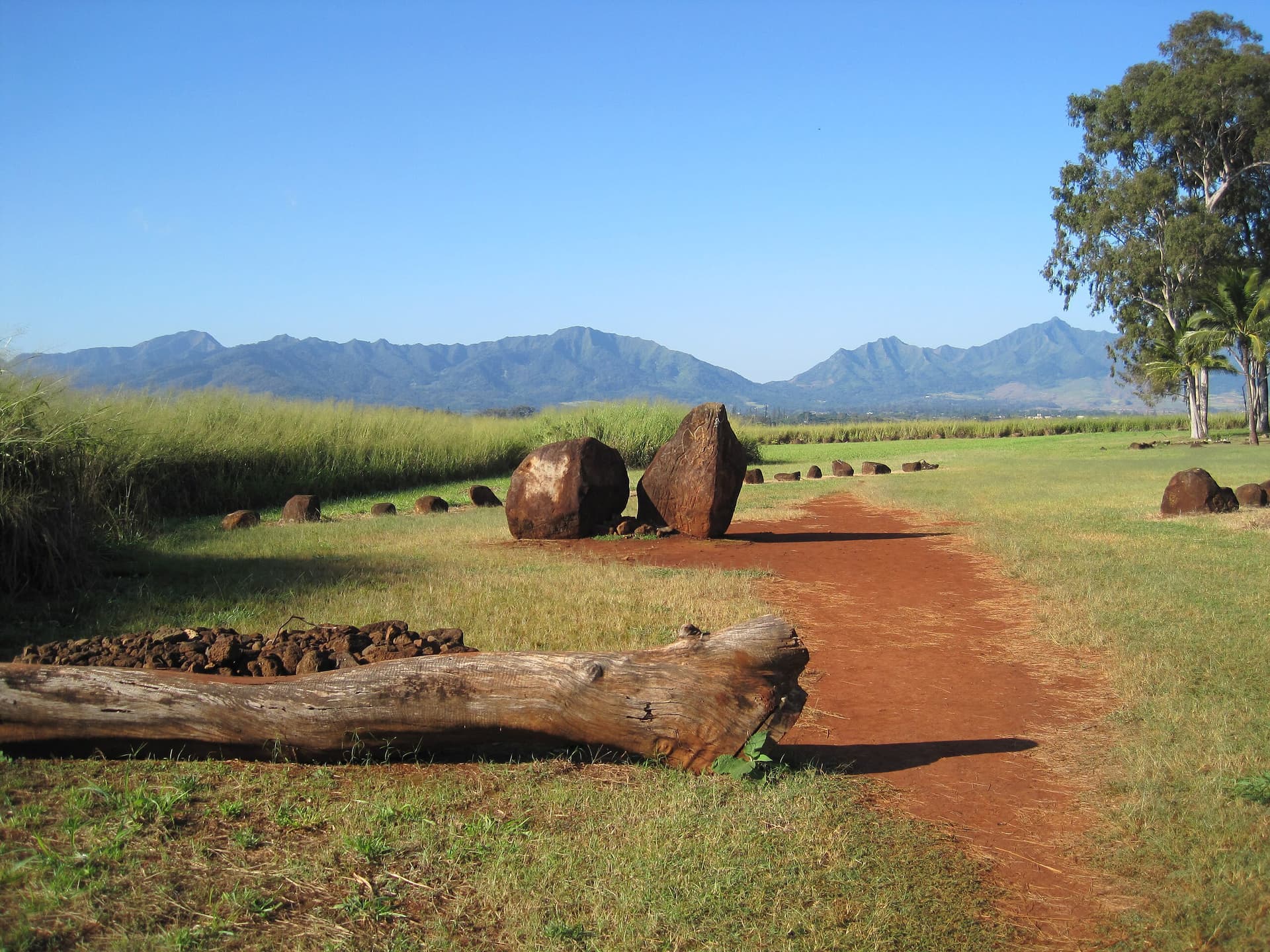
The nearby bellstone, pohaku kani, played a ceremonial role. When struck properly, it produced a deep resonant tone that carried through the valley, announcing royal births and the approach of chiefly or religious processions. The sound signaled transition from ordinary time to sacred time.
Within the heiau, the cobble-paved interior and prismatic stone uprights suggest the arrangement of a working temple. The uprights may have represented deities or marked significant ritual stations. The specific ceremonies performed here, the prayers spoken, the movements of priests and chiefs through the space, are not fully documented. Hawaiian religious knowledge was oral, guarded, and transmitted within lineages that fractured in 1819.
No formal religious ceremonies are conducted at Poli'ahu Heiau today. The site is managed as an archaeological and cultural resource by the State of Hawaii within Wailua River State Park. However, Native Hawaiians maintain cultural and spiritual connections to the site and to the broader Wailua region.
Contemporary Hawaiian cultural practitioners may visit heiau for personal spiritual observance, to honor ancestral connections, or to maintain awareness of traditional sacred geography. Such visits are private rather than organized. The site's continued designation of central areas as kapu reflects ongoing respect for its sacredness.
Educational programs and interpretive materials help visitors understand the heiau's significance. State park brochures provide historical context and etiquette guidance. The goal is preservation and respectful appreciation rather than revival of practices that ended two centuries ago.
Visitors are not invited to perform ceremonies at Poli'ahu Heiau. What is available is contemplation. Stand at the perimeter of the stone walls. Consider their scale. Look out over the Wailua valley and imagine this view as the ali'i saw it, as the frame for ceremonies that connected human society to divine order.
Respect the kapu markings. The central areas are closed not for archaeological reasons alone but because sacredness does not expire. You may feel an impulse to leave an offering, to mark your presence somehow. Resist it unless you are a Hawaiian cultural practitioner following traditional protocol. The most respectful offering a visitor can make is attention, silence, and the willingness to let the place speak.
If you have specific questions, state park signage provides context. What the signs cannot convey, the stones may suggest. Listen with your eyes.
Hawaiian Religion (Traditional)
HistoricalPoli'ahu Heiau was a major religious site within the Hawaiian spiritual system, likely a luakini heiau dedicated to the war god Ku or possibly to Poli'ahu, goddess of snow. The heiau was under the control of the ali'i and kahuna and served the paramount chief of Kauai, who resided at Wailua for much of the year.
Construction and maintenance of heiau under ali'i direction, ceremonies to the gods, offerings including fish and animals, rituals conducted by kahuna, use of the bellstone to announce royal births and ceremonial processions.
Menehune Legend
HistoricalHawaiian tradition credits the menehune, legendary small supernatural builders, with constructing Poli'ahu Heiau. The menehune were said to complete massive projects in a single night, working with supernatural coordination. This attribution signals the heiau's great antiquity and suggests origins beyond ordinary human capability.
According to legend, the menehune brought stones from the Westside of Kauai, arranging them with speed and precision impossible for human workers.
Hawaiian Cultural Practice (Contemporary)
ActiveWhile formal religious practice at Hawaiian heiau ended in 1819, contemporary Native Hawaiians maintain cultural and spiritual connections to these sacred sites. The Wailua River remains deeply sacred, and heiau are treated with reverence as places of ancestral significance.
Personal spiritual observance, cultural education, preservation advocacy, honoring ancestral connections. Contemporary practice is private and personal rather than organized and ceremonial.
Experience And Perspectives
Visiting Poli'ahu Heiau requires no hiking, only presence. You drive to a small turnout on Kuamoo Road, directly across from the Opaeka'a Falls viewpoint, and find yourself at the edge of a massive stone enclosure. The valley opens below. The central areas are marked kapu. What remains accessible is the perimeter view, the scale of construction, and the awareness that you stand where chiefs once prayed.
The approach to Poli'ahu Heiau lacks the drama of a pilgrimage ascent. You drive up Kuamoo Road from the coast, perhaps ten minutes from the highway, and pull into a small turnout. Across the road, tourists gather at the Opaeka'a Falls viewpoint, their cameras and chatter oriented toward the cascade. You turn in the opposite direction, and everything changes.
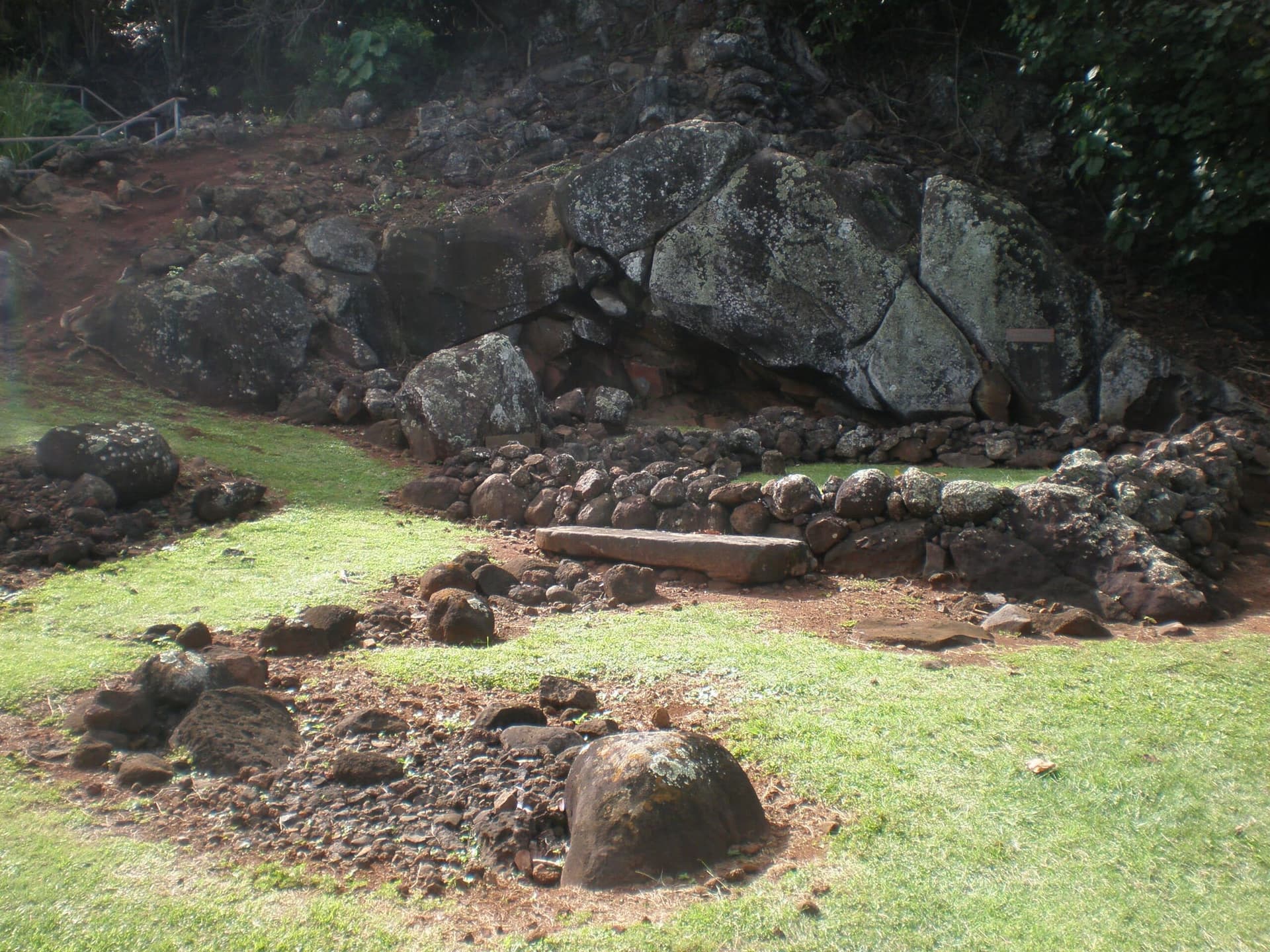
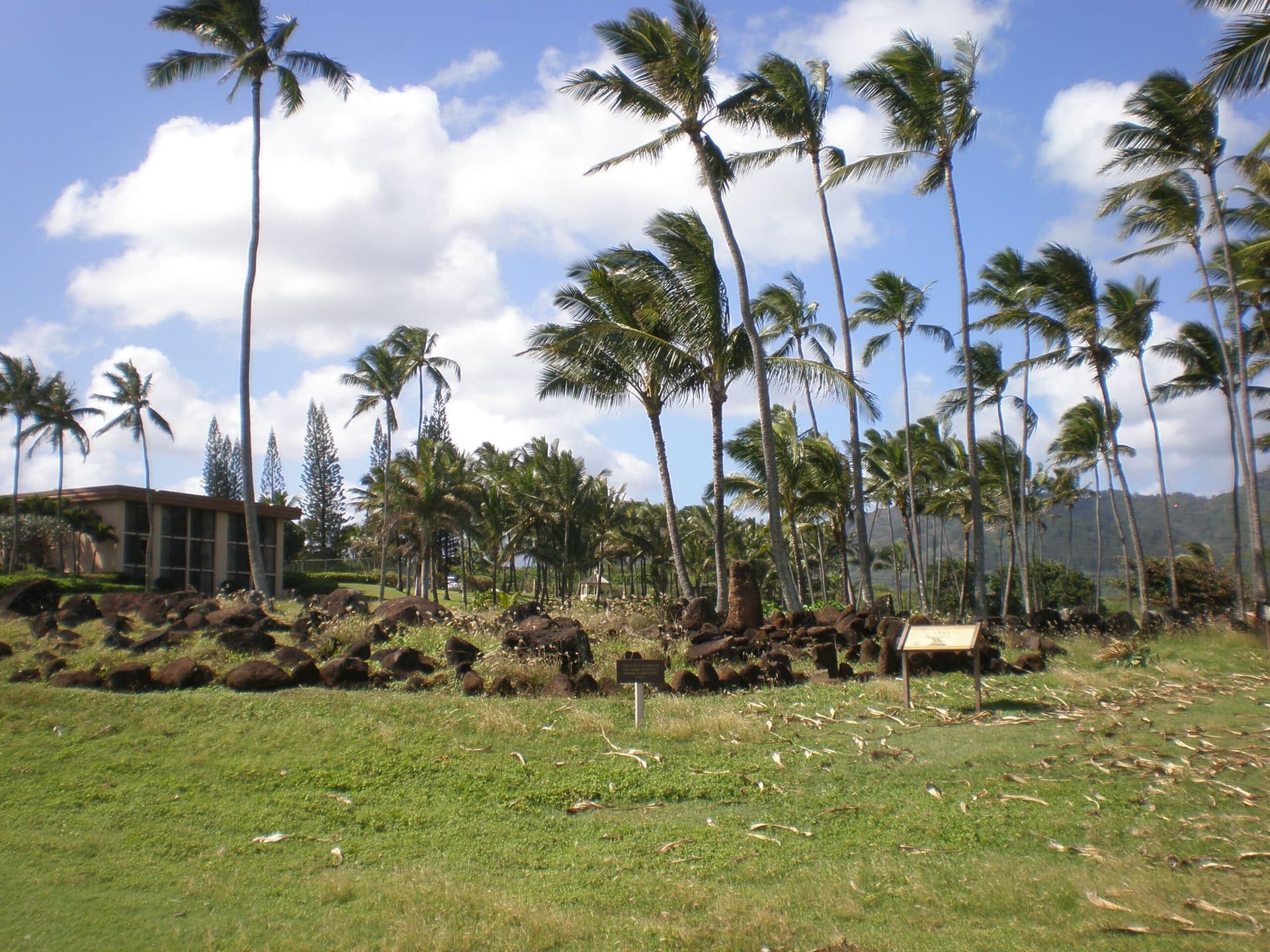
The heiau reveals itself immediately: stone walls stretching far wider than you expected, enclosing space that once held ceremonies whose content is no longer fully known. The scale impresses. These are not delicate arrangements but massive construction, walls five feet high and equally thick, extending over an acre. Someone, centuries ago, directed the hauling and placement of thousands of stones. The effort was not casual.
You can walk along the perimeter. The central areas are marked as kapu, and the signs are not merely regulatory; they acknowledge a sacredness that the State of Hawaii recognizes even as it cannot officially practice. Within the enclosure, cobble-paved areas and prismatic stone uprights suggest the arrangement of a temple interior, though their specific functions remain uncertain.
The view rewards attention. The Wailua River winds below, emerald against darker green, flowing toward the bay. Behind you, the land rises toward clouds that perpetually gather on Wai'ale'ale. The chiefs who came here saw this same configuration. The river carried the same water from the same source. What has changed is the presence of the one who observes.
Many visitors pause only briefly, take a photograph, and return to Opaeka'a Falls. Those who linger find something else. The silence beneath the wind. The weight of the stones. The awareness that this place was chosen, built, consecrated, used, and then, when the kapu system ended, left standing. Standing still.
Plan for 15 to 30 minutes at the heiau itself. Combine your visit with the Opaeka'a Falls viewpoint directly across the road, which adds little time but rewards the stop. The parking turnout accommodates roughly a dozen vehicles. Arrive in the morning for softer light and fewer visitors, though the site rarely feels crowded. No hiking is required. Visitors with mobility limitations can view the heiau from the parking area with minimal difficulty.
Poli'ahu Heiau invites interpretation through multiple lenses: archaeological, traditional Hawaiian, and personal. What unites these perspectives is recognition that the site represents something more than stone arrangement, that it was built to hold ceremony and continues to hold what ceremony left behind.
Archaeologists recognize Poli'ahu Heiau as a significant component of the Wailua Complex of Heiaus, designated a National Historic Landmark in 1962. The heiau's size, over an acre enclosed by walls five feet high and wide, suggests it was a major temple site. Archaeologist Wendell Bennett documented the heiau as a walled rectangular enclosure 242 feet long by 165 feet wide with a notch in the southeast corner.
The interior features include a cobble-paved courtyard and prismatic-shaped dike stone uprights that may have represented deities worshiped within. Some scholars identify the site as a luakini heiau, the most significant class of Hawaiian temple, typically dedicated to the war god Ku and restricted to the ali'i.
Dating the heiau precisely remains difficult. It was certainly in use during the 1600s and 1700s, but may be older. The attribution to menehune builders is legendary rather than historical, though it reflects Hawaiian understanding of the site's antiquity. Archaeological evidence points to Hawaiian construction rather than an earlier population.
The heiau's position reflects Hawaiian spatial organization. Sacred sites on Kauai connected ocean to mountain, with the Wailua River serving as a natural corridor. The seven heiau of the Wailua Complex formed a sacred geography that structured ceremonial life on the island.
For Native Hawaiians, Poli'ahu Heiau represents ancestral heritage and the spiritual power of the Wailua region. Wailua was Wailuanui-hoano, great and sacred Wailua, one of the most important centers of Hawaiian civilization on Kauai. The heiau was where the ali'i and kahuna maintained the relationship between the human community and the divine realm.
The site's connection to Poli'ahu, the snow goddess of Mauna Kea, links Kauai to the sacred geography of the entire Hawaiian island chain. If the dedication to Poli'ahu is accurate, the heiau represents worship of elemental forces, the cold and height of Mauna Kea honored even on tropical Kauai.
Though formal religious practice ended in 1819, the site retains its sacredness for Hawaiian people. The continued designation of central areas as kapu acknowledges this. The heiau is not a relic of the past but a place where ancestral presence endures. Native Hawaiians who visit are not encountering archaeology but relationship.
The menehune legends have attracted interest from those who seek evidence of mysterious pre-Polynesian builders throughout the Pacific. Some alternative theorists connect the menehune to worldwide traditions of small supernatural builders, speculating about lost civilizations or paranormal origins.
The heiau's position and alignment have prompted speculation about astronomical or energetic significance, though such theories lack scholarly verification. The Wailua corridor of seven heiau from ocean to summit has been interpreted by some as a Hawaiian ley line or energy pathway.
Visitors approaching the site with such frameworks should recognize the distinction between traditional Hawaiian knowledge, passed through generations within a specific cultural context, and external interpretations imposed from outside. The former has weight; the latter is speculation.
Who built Poli'ahu Heiau remains unknown. The menehune attribution is legendary. No specific historical figure is credited with the construction. The exact date of building and the period of active use are uncertain, though the site was clearly in use during the 1600s and 1700s.
Whether the heiau was primarily dedicated to Ku (war god) or Poli'ahu (snow goddess) is debated. The specific rituals performed here are not fully documented. Hawaiian religious knowledge was oral, guarded, and transmitted within priestly lineages that fractured when the kapu system was abolished.
Whether human sacrifice occurred at this specific heiau is uncertain. It was a practice at some luakini heiau, but the evidence for Poli'ahu is inconclusive. The original source of the stones, local or transported from the Westside, remains undetermined. The significance of the prismatic stone uprights in the interior is not fully understood.
These mysteries are not failures of scholarship but features of the site. Some questions cannot be answered. The heiau holds what it holds, and what it holds is not entirely accessible to inquiry.
Visit Planning
Poli'ahu Heiau is accessible year-round, located on Kuamoo Road within Wailua River State Park. Drive-up access requires no hiking. Free admission. Open during daylight hours. Combine with Opaeka'a Falls viewpoint directly across the road.
Full range of accommodations available on Kauai's east side in Kapaa and Wailua, ranging from resort hotels to vacation rentals. The site is easily accessible from anywhere on Kauai.
This is a sacred site that demands quiet respect. Stay out of kapu areas. Do not climb on walls or disturb stones. Photography is permitted from viewing areas. Approach as you would any consecrated ground: with awareness that you are a guest in a place that holds more than you can see.
Poli'ahu Heiau is accessible but not casual. The ease of reaching the site, directly from a roadside parking area, can mislead visitors into treating it as a minor attraction, a quick stop between Opaeka'a Falls and the next item on the itinerary. It deserves more than that.
The central areas are marked as kapu. These signs are not merely bureaucratic; they acknowledge the site's enduring sacredness in Hawaiian understanding. Do not enter these zones. The perimeter offers sufficient access for contemplation and photography.
The stone walls are archaeological resources. Do not climb on them, sit on them, or disturb them in any way. Do not remove any stones or artifacts. What looks like a loose rock may be exactly where it was placed centuries ago. Leave everything as you find it.
Photography is permitted from the designated viewing areas. Exercise discretion. This is not a backdrop for casual selfies but a temple site where chiefs once conducted ceremonies. Frame your images with the respect the place deserves.
Do not leave offerings. The impulse to mark sacred ground with personal tokens is understandable but inappropriate here unless you are a Hawaiian practitioner following traditional protocol. Accumulation of unauthorized offerings creates maintenance burdens and can constitute disrespect.
Quiet is appropriate. The site sits across from a busy viewpoint, and the murmur of tourists at Opaeka'a Falls can carry. Within the heiau precinct, lower your voice. Let the silence beneath the wind become audible. The ceremonies that once occurred here required focus and solemnity. A few minutes of the same honors what was.
Casual outdoor clothing appropriate for tropical weather. Comfortable walking shoes recommended though no significant walking is required. No specific ceremonial attire is expected of visitors.
Photography is permitted from viewing areas. Exercise respect when photographing this sacred site. Do not use the heiau as a casual backdrop for social media content.
Do not leave offerings unless you are participating in sanctioned Hawaiian cultural practice. Do not disturb any offerings that may be present.
{"Do not enter areas marked as kapu","Do not climb on or sit upon the heiau walls","Do not disturb, move, or remove any stones or artifacts","Stay on designated paths and viewing areas","Do not leave unauthorized offerings","Do not conduct improvised ceremonies or rituals","Treat the site with quiet respect"}
Sacred Cluster
Nearby sacred places create the location cluster described in the growth plan. This block is intentionally crawlable and links into the wider regional graph.