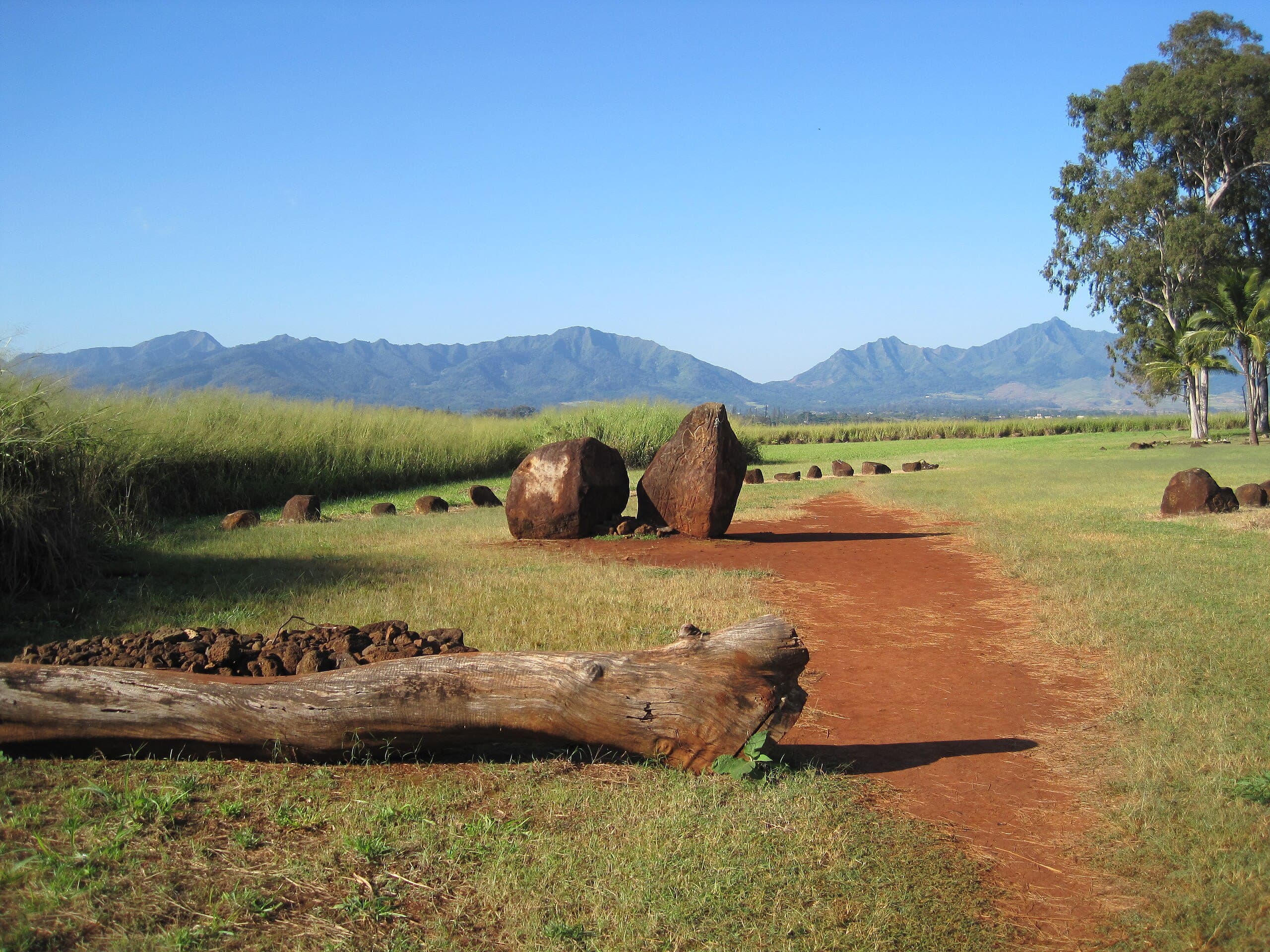
Kukaniloko Birthstones, Hawaii
The navel of Oahu, where Hawaiian chiefs entered the world for five centuries
Wahiawa, Hawaii, United States
At A Glance
- Coordinates
- 21.5055, -158.0250
- Suggested Duration
- Piko Listening Journeys typically last 1-2 hours. Contact the Hawaiian Civic Club of Wahiawa for specific arrangements.
Pilgrim Tips
- Modest, respectful attire appropriate for a sacred site. Comfortable shoes for walking on uneven ground. Sun protection for the central Oahu climate.
- Inquire with your Hawaiian guides about photography protocols. Approach with respect rather than assumptions. Do not photograph for commercial purposes without explicit permission.
- Do not attempt to access the site without arrangement through the Hawaiian Civic Club. Do not touch, sit on, or climb the stones. Do not remove anything from the site. Do not conduct personal ceremonies or rituals without Hawaiian guidance. Do not leave offerings without direction from stewards. The site's closure to general access is not an obstacle but a protection, ensuring that those who visit do so with intention and respect.
Overview
In the pineapple fields of central Oahu, stones rise from the earth that are not quite stones. They are the exposed tips of mountain ridges, emerging at the geographic center of the island. For five hundred years, royal Hawaiian women came here to give birth, surrounded by up to 48 witnessing chiefs, drums announcing each arrival to the sky. The name means 'to anchor the cry from within.' Today the Hawaiian Civic Club of Wahiawa tends this place as they have for over sixty years, offering guided journeys to those who approach with respect.
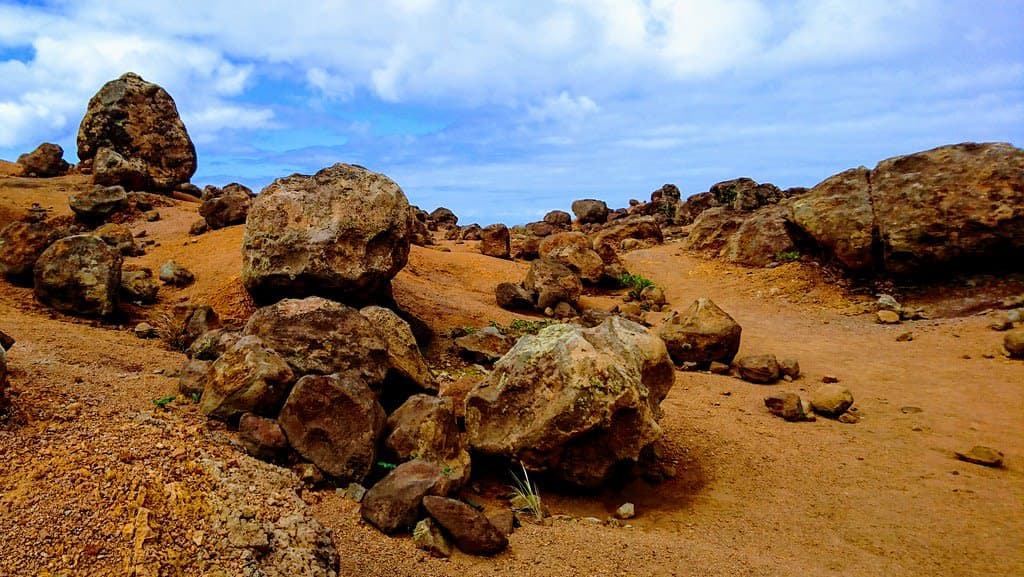
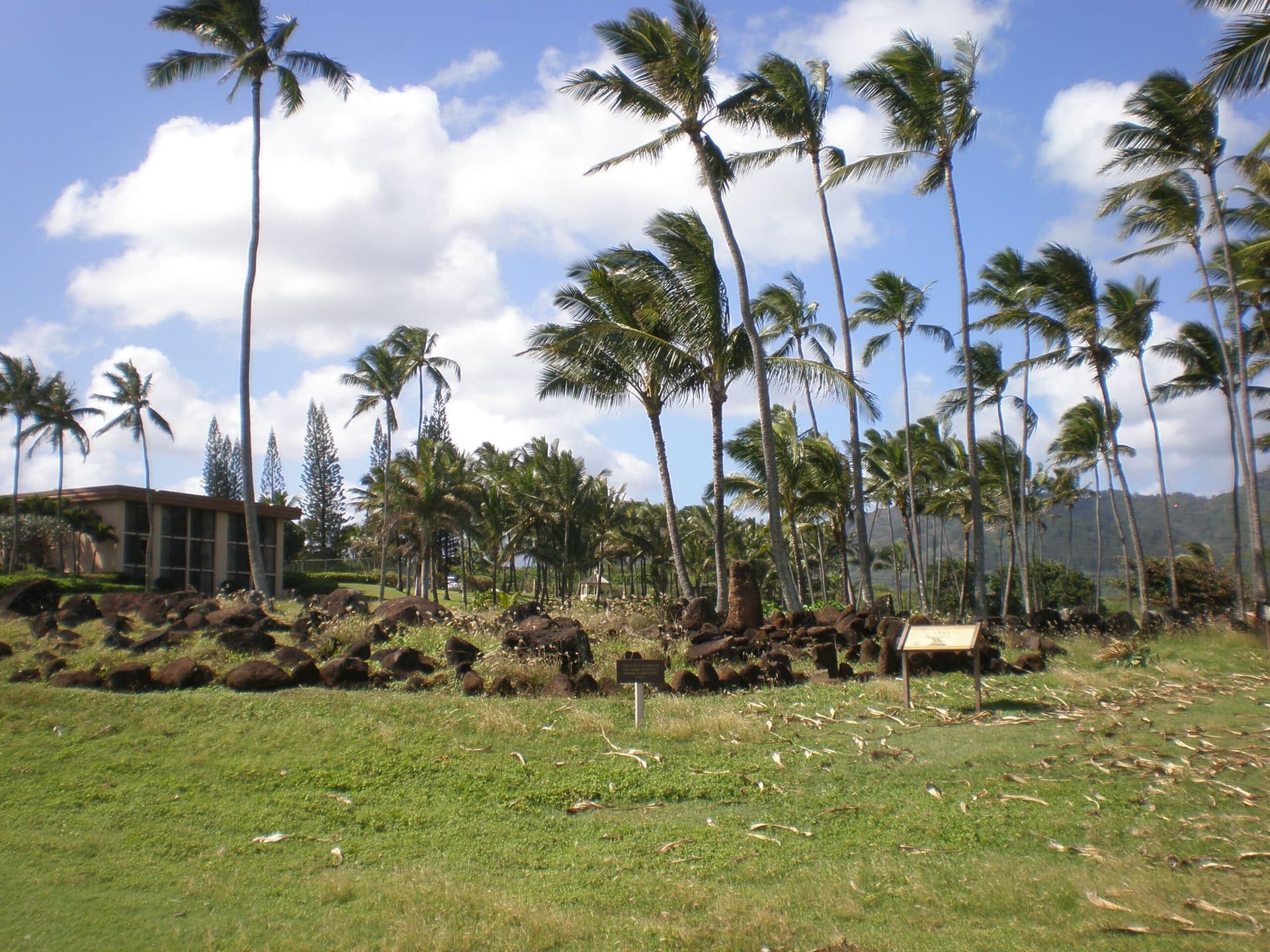
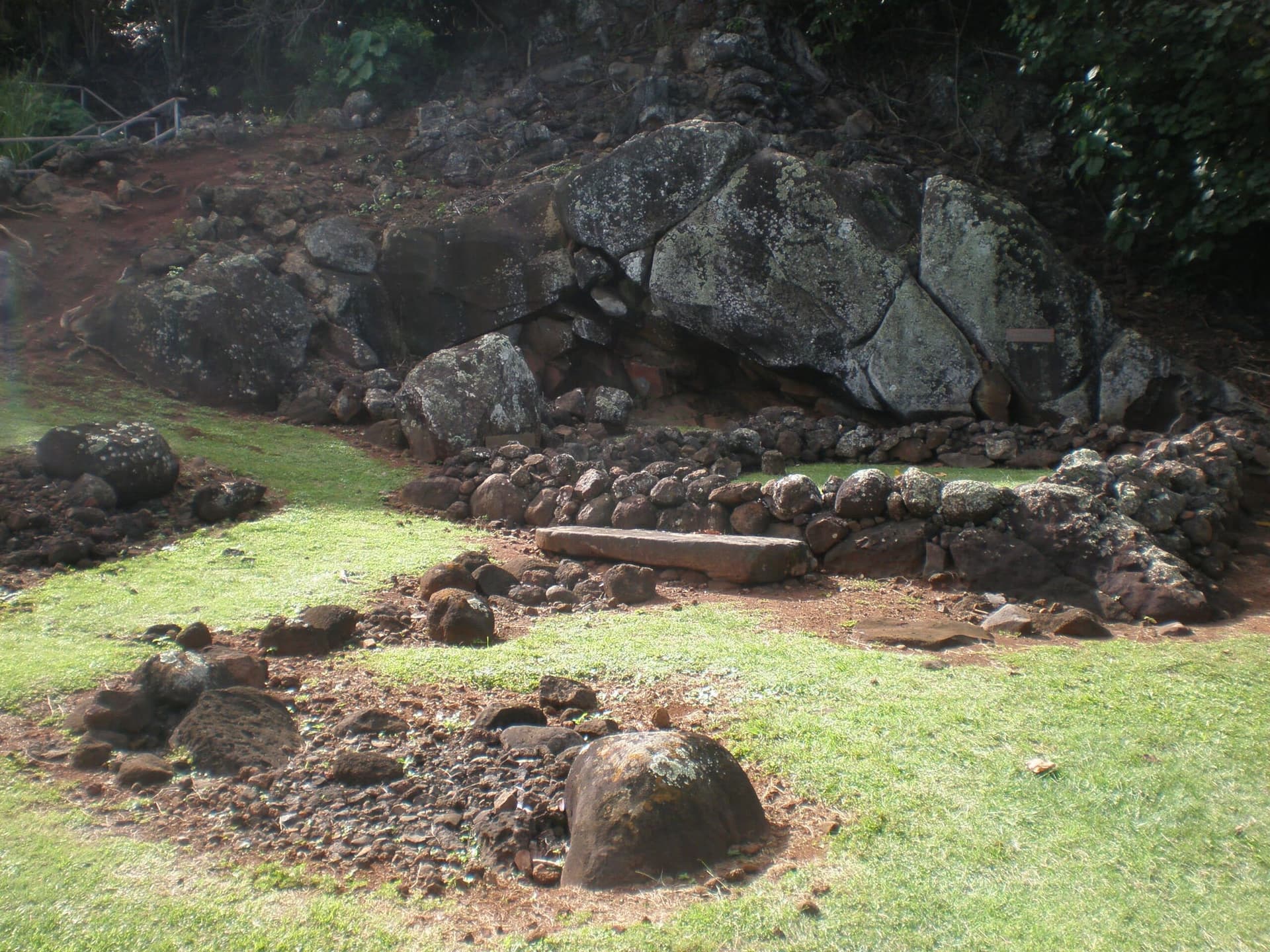
Kukaniloko sits where the Waianae and Koolau mountain ranges converge in the heart of Oahu, a place the Hawaiians recognized as the island's piko, its navel, the point where the life force of the land gathers most intensely. The stones here, approximately 180 of them, are not ordinary boulders. According to Hawaiian tradition, they are the tips of ridges rising through the central plain, which may account for the extraordinary spiritual power attributed to this place.
From approximately 1100 to 1650 CE, Kukaniloko served as one of only two designated royal birthing sites in all of the Hawaiian archipelago. When a chiefess was ready to give birth, she was brought here and positioned on a stone shaped as a poho, a basin seat. Up to 48 chiefs would gather to witness. Sacred drums announced the moment of arrival. A kahuna would split bamboo between his teeth to sever the umbilical cord. The newborn was then taken to a nearby heiau for purification and the recitation of genealogy stretching back generations.
To be born at Kukaniloko was to enter the world assured of divine status. The mana concentrated here would bless the child with a prosperous reign and ease the mother's labor pains. Chiefs Ma'ilikukahi, Kakuhihewa, and Kalanimanuia, the first female chief born here, all entered life on these stones.
Today, the site is closed to general public access. The Hawaiian Civic Club of Wahiawa, who have maintained stewardship since 1960, offer 'Piko Listening Journeys' to those who wish to learn the moolelo, the traditional stories, of this place. The surrounding 511 acres are being restored with native Hawaiian trees. What visitors encounter is not a museum piece but a living sacred site, its sanctity actively protected by the community who holds it sacred.
Context And Lineage
Kukaniloko was established around 1100 CE by Chief Nanakaoko and served as one of only two royal birthing sites in the Hawaiian archipelago for five centuries. The stones may be exposed ridge tips, channeling the island's geological power. The site's astronomical alignments suggest it also served calendrical and ceremonial functions beyond birthing.
The traditional account holds that Chief Nanakaoko and his chiefess Kahihiokalani established Kukaniloko in the 12th century for the birth of their son Kapawa. Nanakaoko was the son of Nanamaoa, one of the first ali'i to establish themselves in Hawaii after their arrival from Kahiki, the ancestral homeland. The name Kukaniloko itself encodes the site's purpose: 'ku' means to stand, anchor, or establish; 'ka' is the definite article; 'nilo' means to cry or wail; 'ko' indicates internality. Together, 'to anchor the cry from within' refers to the first cry of a newborn chief.
A second layer of meaning lies in the site's geography. Kukaniloko was chosen because it lies at the geographic center of Oahu, between the Waianae and Koolau mountain ranges, at a place where ancient Hawaiians believed the life force of the land was strongest. This central position made it the piko, the navel of the island, the point of maximum mana concentration.
A third tradition concerns the stones themselves. According to Professor Abraham Piianaia, the pohaku at Kukaniloko are not true stones but the exposed tips of mountain ridges rising through the plain. If so, the birthing stones are the island itself, pressing up through the surface, and to give birth upon them was to place a child directly on the living land.
Kukaniloko belongs to the Hawaiian tradition, specifically to the ali'i, the chiefly class, though its significance extends to all Hawaiian people as a site of cultural identity and ancestral connection. The founding genealogy traces to Nanamaoa and the first ali'i who arrived from Kahiki. Subsequent generations of chiefs, born at Kukaniloko, had their genealogies recited at nearby heiau as part of the birthing ceremony, establishing their legitimacy through unbroken lineage. Today, members of the Hawaiian Civic Club of Wahiawa include those who genealogically trace their genesis to the land of their ancestors. This living connection, maintained through generations, gives contemporary stewards authority to interpret and protect the site.
Chief Nanakaoko and Chiefess Kahihiokalani
Founders who established Kukaniloko as a royal birthing site for the birth of their son Kapawa. Nanakaoko was son of Nanamaoa, one of the first ali'i to arrive from Kahiki.
Ma'ilikukahi
High Chief of Oahu born at Kukaniloko circa 1520. He later moved the seat of power from Kukaniloko to Waikiki, marking a shift in the island's political geography.
Kalanimanuia
First female chiefess born at Kukaniloko, circa 1600. Her birth demonstrated that the site's sanctity extended to female rulers.
Kakuhihewa
Last known chief born at Kukaniloko, circa 1640. His reign marked the end of the site's five-century function as a royal birthing place.
Hawaiian Civic Club of Wahiawa
Organization of family members connected to Kukaniloko who have maintained stewardship since 1960, continuing the preservation begun by the Daughters of Hawaii in 1925.
Why This Place Is Sacred
Kukaniloko's thinness emerges from the convergence of earth and lineage. The stones themselves are ridge tips pushing through the surface, conduits between the deep island and the sky. Five centuries of royal births concentrated mana here, each new chief anchoring the cry from within to this precise location. The astronomical alignments to solstices and equinoxes further connect human ceremony to cosmic rhythm.
The Hawaiians chose this site with precision. Kukaniloko lies at the geographic center of Oahu, equidistant between the two mountain ranges that form the island's spine. In Hawaiian cosmology, the center is the piko, the navel, the point where energy gathers. The stones themselves reinforce this centrality. According to Professor Abraham Piianaia, they are not true stones but the exposed tips of mountain ridges rising through the plain. If so, what appears to be a scattering of boulders is actually the visible emergence of the island's deep structure.
This geology may explain why Hawaiians perceived such power here. The stones are not placed objects but emanations, the mountain making itself felt through the surface. To give birth on such a stone was to connect the newborn to the land itself, umbilical cord to piko, child to island.
But the thinness at Kukaniloko is also accumulated. For approximately five hundred years, royal women labored here. Drums announced each birth to the assembled chiefs and the sky. Prayers were offered. Genealogies recited. Piko, the severed umbilical cords, were tucked into crevices among the stones, their mana returning to the land. Each ceremony added to what the site holds.
The astronomical alignments deepen this convergence. The main birthstone aligns with the equinox sun setting over Mount Kaala. The northwest end of the site points to June solstice sunset; the southeast end to December solstice sunrise. University of Hawaii scientists in 2000 found designs that may have tracked stars and planets for calendrical purposes. The star Regulus, known across cultures as a 'king maker,' once cast a dagger-like shadow during a notable birth here.
The veil thins where heaven, earth, and human lineage meet. At Kukaniloko, they meet.
Chief Nanakaoko and his chiefess Kahihiokalani established Kukaniloko in the 12th century for the birth of their son Kapawa. Nanakaoko was the son of Nanamaoa, one of the first ali'i to establish themselves in Hawaii after their arrival from Kahiki, the ancestral homeland often identified with Tahiti. The name Kukaniloko means 'to anchor the cry from within,' referring to the first cry of a newborn chief.
The site was chosen because of the immense spiritual energy believed to concentrate at the geographic center of Oahu. Being born here assured a chief's divine status and the privileges that came with it. The main reason for choosing this location was the belief that the mana gathered here would bless royal children with prosperous reigns and ease the mother's labor pains. The 36 main stones represent the 36 chiefs of Oahu who witnessed births, though some accounts mention up to 48 witnessing chiefs.
Kukaniloko served as an active royal birthing site for approximately 500 years, from circa 1100 to the mid-1600s. The last chief known to have been born here was Kakuhihewa, around 1640. The reasons for the cessation of royal births at Kukaniloko are not fully documented, though the shift of the seat of power to Waikiki by Chief Ma'ilikukahi may have contributed to changing practices.
Preservation efforts began in 1925 when the Daughters of Hawaii took up formal protection of the site. In 1960, the Hawaiian Civic Club of Wahiawa assumed stewardship, a responsibility they continue to this day. The site was listed on the National Register of Historic Places in 1973, designated a State Monument in 1992, and listed on the Hawaii Register of Historic Places in 1994.
A significant evolution occurred in 2012 when the Office of Hawaiian Affairs acquired the 511 acres surrounding the birthstones, enabling comprehensive restoration. In 2022, public access was removed to protect the site's sanctity. A native reforestation project aims to plant 200,000 Hawaiian hardwoods, including koa, lonomea, wiliwili, and manele trees, returning the landscape to something closer to its original state.
Traditions And Practice
Historical practices at Kukaniloko centered on royal birthing ceremonies involving up to 48 witnessing chiefs, sacred drums, and piko ceremonies. Today, the Hawaiian Civic Club of Wahiawa offers Piko Listening Journeys that share traditional moolelo. The surrounding land is being restored through native reforestation.
When a royal chiefess was ready to give birth, she was brought to Kukaniloko and positioned on the main birthing stone, shaped as a poho, a basin seat. Up to 48 chiefs would gather to witness, arranged in a prescribed manner around the site. The 36 main stones represent the 36 chiefs of Oahu who witnessed births.
Sacred drums announced the moment of birth to the witnesses and the sky. A kahuna performed the 'splitting of the bamboo ceremony,' splitting bamboo between his teeth to create a sharp edge for severing the umbilical cord. The newborn was then taken to a nearby heiau for purification ceremonies and the recitation of genealogy, establishing the child's place in the lineage stretching back to the founding ancestors.
The piko, the severed umbilical cord, held profound significance. It was not discarded but tucked into crevices among the stones, connecting the child to the land. In Hawaiian tradition, piko is 'the connector' between mother and child and the residence of mana. The placement of piko at Kukaniloko anchored each new chief to the island's center.
The Hawaiian Civic Club of Wahiawa continues as the primary stewards of Kukaniloko, a responsibility they assumed in 1960 from the Daughters of Hawaii. They offer Piko Listening Journeys, educational visits that share the moolelo o kalana, the traditional stories of the district. These journeys are available by appointment to family reunions, halau hula, schools, nonprofits, and all interested individuals.
Ongoing restoration efforts, in partnership with the Office of Hawaiian Affairs and the University of Hawaii, aim to plant 200,000 native Hawaiian trees on the 511 surrounding acres. Species include koa, lonomea, wiliwili, and manele. This reforestation is not merely environmental but cultural, returning the landscape to something closer to what the ali'i would have known.
The Hawaiian Civic Club celebrated 65 years of stewardship on November 10, 2025. Their work embodies the Hawaiian value of malama, caring for both the physical and spiritual dimensions of the site.
The practice available to visitors is listening. The Piko Listening Journey is named precisely: you come to hear, not to perform. The Hawaiian guides share stories that have been passed through generations. Your role is to receive them with respect.
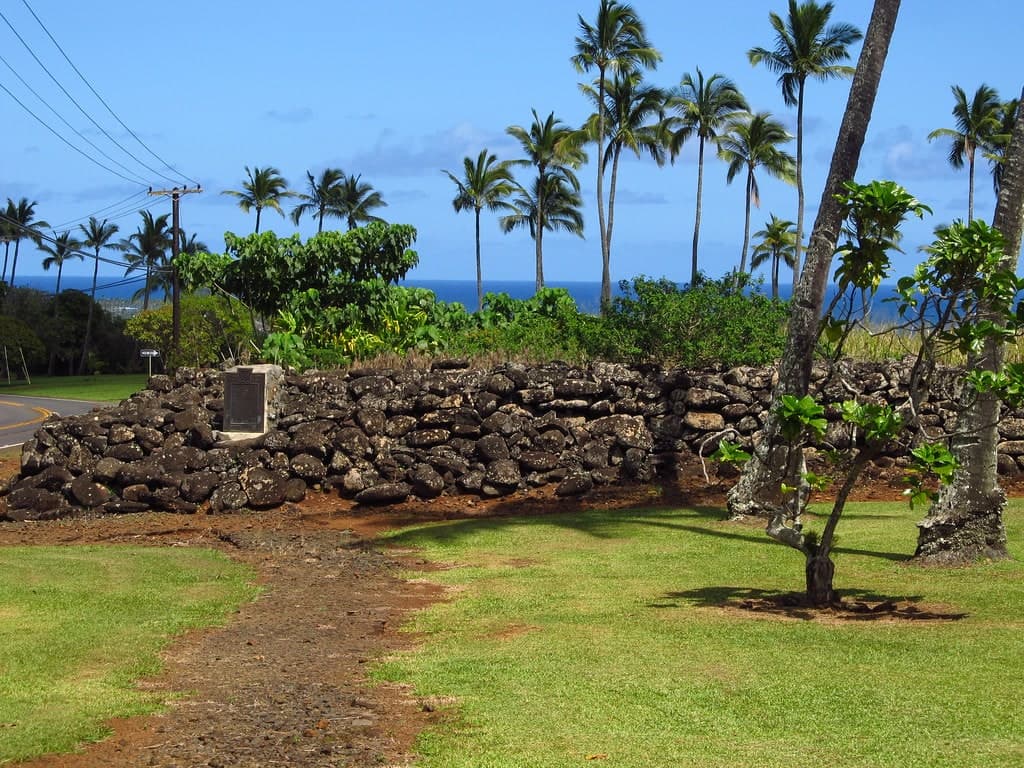
For those who cannot arrange a guided visit, the stones are visible from the road at the intersection of Whitmore Avenue and Highway 80. Standing at this threshold, one can observe the site's modest scale, the ongoing restoration, the planted trees. This too is a practice: acknowledgment from a distance, respect for boundaries.
Hawaiian Royal Birthing Tradition
HistoricalFrom approximately 1100 to the mid-1600s, Kukaniloko served as one of only two designated royal birthing sites in the Hawaiian archipelago. Being born here assured a chief's divine status and the right to rule. The mana concentrated at this location was believed to bless children with prosperous reigns and ease the mother's labor.
Royal mothers positioned on the main birthing stone (shaped as a poho/basin); up to 48 chiefs witnessing; sacred drums announcing the birth; the 'splitting of the bamboo ceremony' to sever the umbilical cord; purification at nearby heiau; recitation of genealogy; placement of piko in stone crevices.
Hawaiian Piko Tradition
ActiveThe piko (umbilical cord) holds profound significance in Hawaiian culture as the connector between mother and child, person and place, living and ancestors. Kukaniloko itself is called the piko of Oahu, the island's navel. The practice of specially caring for the umbilical cord connects a child to the land.
Traditionally, piko was never discarded carelessly. At Kukaniloko, umbilical cords were tucked into cracks among the stones. Broader Hawaiian practice includes placing piko in lava fields, the ocean, or petroglyph cupules to connect the child to land or sea. The mawaewae ceremony, traditionally within 24 hours of birth, clears a path for the child's life.
Hawaiian Civic Club Stewardship
ActiveThe Hawaiian Civic Club of Wahiawa was established November 10, 1960, specifically to maintain Kukaniloko, share its moolelo, and preserve all things Hawaiian. The organization comprises family members genealogically connected to this place, continuing the protection begun by the Daughters of Hawaii in 1925.
Piko Listening Journeys sharing traditional stories; site maintenance and protection; native reforestation in partnership with OHA and UH; community workdays; celebration of cultural continuity (65 years of stewardship marked in 2025).
Hawaiian Archaeoastronomy
ActiveKukaniloko served astronomical and calendrical functions alongside its birthing role. The site is oriented to solstices (northwest to June sunset, southeast to December sunrise) and equinox (main birthstone aligned with sunset over Mount Kaala). Landscape features around Oahu were named for celestial events as viewed from Kukaniloko.
Solar and stellar observation; tracking of stars and planets for calendar keeping; naming of mountains for sun stations and star positions. Lineal descendants maintain traditional knowledge of these alignments. The star Regulus, a 'king maker' across cultures, once cast a dagger-like shadow during a notable birth.
Experience And Perspectives
Visiting Kukaniloko requires advance arrangement with the Hawaiian Civic Club of Wahiawa. Their 'Piko Listening Journeys' offer more than a tour, they are an invitation to hear the moolelo, the traditional stories, of this place from those who have cared for it for generations. The stones are visible from the road, but the full encounter requires approaching with intention.
There is no casual access to Kukaniloko. The site closed to general public entry in 2022, a decision made to protect its sanctity from the kind of tourism that treats sacred places as curiosities to photograph and move on from. What remains is something better: the Piko Listening Journey, offered by the Hawaiian Civic Club of Wahiawa to those who arrange a visit in advance.
The journey begins before you arrive. Contacting the Hawaiian Civic Club, waiting for a response, scheduling a time, traveling to Wahiawa, the deliberateness required is itself a form of preparation. You cannot stumble upon Kukaniloko and check it off a list. You must seek it out.
The site lies at the intersection of Whitmore Avenue and Kamehameha Highway (Highway 80), in the central plateau of Oahu. The surrounding land, once pineapple fields, is being replanted with native trees. The stones themselves are modest in height, many no taller than a loaf of bread, but they spread across the ground in a pattern that speaks to ancient purpose.
During a Piko Listening Journey, Hawaiian guides share the moolelo, the traditional stories of the district. They speak of Nanakaoko and Kahihiokalani, who established this place for the birth of their son. They describe the ceremonies, the witnessing chiefs, the drums, the splitting of bamboo. They explain what piko means in Hawaiian culture, how the umbilical cord connects not just mother and child but person and place, lineage and land.
For those who cannot arrange a guided visit, the stones are visible from the road. Standing at that boundary, looking in, is its own kind of experience. The prayer cloths on the fence, if present, the planted trees, the quiet, all speak to a place that is cared for, protected, alive.
Contact the Hawaiian Civic Club of Wahiawa through kukaniloko.org to arrange a Piko Listening Journey. Allow 1-2 hours for the experience. The site is approximately 25 miles from Waikiki, about 40 minutes by car. Central Oahu can be warm; bring sun protection and water. Wear comfortable shoes and modest, respectful attire. Arrive with the same openness you would bring to any place of worship.
Kukaniloko invites interpretation from multiple angles: genealogical, geological, astronomical, and spiritual. What unifies them is the recognition that this place concentrates significance, a convergence point where lineage, land, and sky meet.
Archaeological and historical research confirms Kukaniloko's function as a royal birthing site from approximately 1100 to 1650 CE. Dating evidence is complicated by the site's continuous use; a wood fragment dated to around 1760 and charcoal fragments nearby to 4529 BCE suggest human activity spanning millennia.
In 2000, University of Hawaii scientists studied the stones and identified designs that may have tracked stars and planets for calendrical purposes. The astronomical alignments, with solstices at the northwest and southeast ends and the equinox sun setting over Mount Kaala in line with the main birthstone, suggest the site served functions beyond birthing. Mountains in the Koolau and Waianae ranges are named for sun stations and star positions as viewed from Kukaniloko, indicating the site's role as an observatory.
The site's designation on both State and National historic registers reflects scholarly consensus on its significance. Ongoing archaeological and ecological research continues through partnerships between OHA, UH, and Hawaiian cultural organizations.
For Hawaiian cultural practitioners, Kukaniloko is not primarily a historical site but a living spiritual reality. The stones hold mana that remains potent. The site is the piko of Oahu, its spiritual center, not merely in the past but now. Peter Apo has called it 'most sacred of Hawaiian places,' deserving the same reverence as any major place of worship worldwide.
Lineal descendants maintain traditional knowledge passed through generations, including astronomical observations and the meaning of various stones. The Hawaiian Civic Club of Wahiawa approaches stewardship as malama, caring for both the physical and spiritual dimensions of the site. Their Piko Listening Journeys share moolelo, traditional stories, with those who approach with respect.
The restriction of public access since 2022 reflects traditional Hawaiian values: some things are protected precisely because they are sacred. The alternative, unrestricted tourism, would erode what makes the site significant.
Some visitors may approach Kukaniloko through frameworks of 'energy vortexes' or generic spirituality. While the site does hold profound spiritual significance, the Hawaiian cultural practitioners who steward it emphasize that meaning comes through understanding Hawaiian cultural context. The comparison to Stonehenge, while apt regarding astronomical alignments, should not overshadow Kukaniloko's specific Hawaiian identity and protocols. What is offered here is not a blank screen for projection but an encounter with a particular tradition, living and specific.
Several aspects of Kukaniloko remain undocumented or uncertain. The precise meanings of individual stone carvings and petroglyphs have not been fully recorded. The specific ceremonial protocols practiced by ancient Hawaiians at royal births were sacred knowledge, not all of which was transmitted through the disruptions of Hawaiian history. The complete list of chiefs born at Kukaniloko between the 12th and 17th centuries is not available. The original extent of the heiau complex that accompanied the birthing stones is unknown. Dating varies between sources, with some citing 12th century establishment and others referencing 760 CE for earliest use. The number of stones varies in accounts: 36 main stones, 80+ rounded stones, or 180 large stones depending on the source. These uncertainties are part of the site's character. Not everything can be recovered. What matters is what continues.
Visit Planning
Kukaniloko is located in Wahiawa, central Oahu, approximately 25 miles from Waikiki. Access is by appointment only through the Hawaiian Civic Club of Wahiawa. The stones are visible from the road intersection for those unable to arrange a guided visit.
Wahiawa has limited accommodations. More options are available in Honolulu (approximately 20 miles south) or on the North Shore. Day trips from Waikiki are straightforward, approximately 40 minutes by car.
Kukaniloko requires the reverence appropriate to any major place of worship. Access is by arrangement only. Never touch the stones. Never remove anything. Approach as a guest at a site that is actively sacred, not as a tourist at a historical curiosity.
Peter Apo, Hawaiian cultural expert, has written that Kukaniloko deserves the same reverence as any major place of worship worldwide. This is the appropriate frame. You are not visiting a museum or a scenic overlook. You are approaching one of the most sacred places in Hawaiian culture, a site where chiefs entered the world for five centuries and where mana continues to reside.
The site is closed to general public access. Visits are available only through Piko Listening Journeys arranged with the Hawaiian Civic Club of Wahiawa. This restriction is not bureaucratic but protective. It ensures that those who enter do so with purpose and preparation, guided by those who hold the place sacred.
When you visit, dress modestly, as you would for any place of worship. Listen more than you speak. Follow the guidance of your hosts. If they indicate boundaries, physical or conversational, respect them. Some knowledge is shared; some is held close. Accept what is offered without pressing for more.
The prohibition against touching the stones is absolute. These are not artifacts to examine but sacred objects whose power persists. Do not sit on them, climb them, or use them as props for photographs. Do not remove anything from the site, not stones, not plants, not soil. Do not leave offerings unless directed by Hawaiian stewards.
Photography protocols should be discussed with your guides. Approach the question with humility. The default assumption should be restraint.
Modest, respectful attire appropriate for a sacred site. Comfortable shoes for walking on uneven ground. Sun protection for the central Oahu climate.
Inquire with your Hawaiian guides about photography protocols. Approach with respect rather than assumptions. Do not photograph for commercial purposes without explicit permission.
Do not leave offerings, items, or attempt personal ceremonies without guidance from Hawaiian stewards. What you bring should be yourself, attentive and receptive.
{"Site closed to general public, access only through arranged Piko Listening Journeys","Never touch, sit on, or climb the stones","Never remove anything from the site","Do not conduct personal ceremonies without Hawaiian guidance","Do not leave offerings without direction from stewards","Stay on designated paths and areas indicated by guides","Approach with the reverence appropriate to a major place of worship"}
Sacred Cluster
Nearby sacred places create the location cluster described in the growth plan. This block is intentionally crawlable and links into the wider regional graph.